

A lot of Southwest Florida business owners are in the same spot right now. The phone still rings from referrals, repeat customers, and word of mouth, but the website barely pulls its weight. You search your own service in Fort Myers, Cape Coral, or Naples, and some competitor with a weaker reputation shows up ahead of you.
I’ve seen this from both sides. I built and sold my own home services company before running a marketing agency, so I know what it feels like to watch jobs go to companies that show up better online. Most of the time, the problem isn’t that the business lacks skill. The problem is that the website, Google Business Profile, and ad strategy aren’t lined up to capture demand when local people are ready to buy.
If you’re trying to figure out how to get more website traffic, start by dropping the idea that you need every marketing tactic under the sun. You need a short list of moves that fit a small business budget and produce visible traction. Some of the broader proven small business marketing tips out there are useful, but local service businesses in SWFL need a tighter plan built around search visibility, trust, and lead quality.
Your SWFL Business Deserves More Traffic
A roofer in Cape Coral gets a call after a storm. A family in Naples needs a pediatrician. A property manager in Fort Myers is looking for a paving contractor who can respond quickly. In each case, the buying process usually starts the same way. They grab a phone, search, compare, and click the business that looks most credible and easiest to contact.
If your company isn’t visible in that moment, you’re not just missing website traffic. You’re missing qualified local traffic from people who already have intent.
That’s the frustrating part for a lot of solid businesses in Southwest Florida. They’ve invested in a website. They answer the phone. They do good work. But online, they’re buried under directories, national chains, and local competitors who took search more seriously.
Practical rule: If a customer can’t find you in a local search, your reputation can’t help you.
The good news is that traffic growth for a SWFL contractor, law firm, med spa, or healthcare practice usually doesn’t begin with some complicated growth hack. It starts with fixing the obvious gaps first. Local search visibility. Strong service pages. Better click-through from search results. Paid ads that defend your name before they chase broad, expensive keywords. Follow-up channels that bring people back.
That’s the approach that tends to work for smaller businesses with real budget constraints. It’s also the approach that avoids the common mistake of spending on scattered tactics that look busy but don’t move lead volume.
A practical traffic strategy should answer four questions:
- Can local customers find you when they search by service and city?
- Will they click you instead of the listing above or below you?
- Does the page match intent once they land on your site?
- Do you have a way to bring them back if they don’t convert right away?
If those four pieces are in place, traffic starts becoming a business asset instead of a vanity metric.
Dominate Local Search in Southwest Florida
For most SWFL businesses, the fastest place to win more visibility is Google Business Profile. Before you spend money on content production or ads, get this right. Your profile often appears before your website does, and for local buyers it can be the deciding factor between a call to you and a call to someone else.
Start with the complete profile, not the bare minimum
A half-finished profile won’t help much. A strong one gives Google clearer relevance signals and gives searchers fewer reasons to hesitate.
Here’s the baseline checklist I’d use for a Fort Myers paving contractor, HVAC company, dentist, or legal office:
- Use the exact business name you operate under. Don’t stuff extra keywords into it.
- Choose the best primary category first. Then add secondary categories that reflect services.
- Write a useful business description. Mention your services, service area, and what makes the business credible.
- Set accurate hours. Update holiday hours too.
- Add service areas carefully. Cover the places you serve, such as Fort Myers, Cape Coral, Estero, Bonita Springs, and Naples.
- List real services. Don’t leave this blank.
- Add your website and a direct contact path. If possible, send people to the most relevant page, not always the homepage.
If you want a deeper walkthrough on map visibility, this guide on how to rank in Google Maps is a useful companion to the checklist above.
Photos are not optional
Most business owners treat profile photos like decoration. They’re not. They’re part of the sales process.
According to Avalanche Creative’s local SEO analysis, businesses with more than 100 Google Business Profile images receive 520% more phone calls, 2,717% more direction requests, and 1,065% more website clicks. That’s one of the clearest local visibility opportunities available to a small business.
For a SWFL contractor, this is straightforward. Don’t upload a logo, two truck photos, and call it done. Build an actual library.
A Fort Myers paving contractor could upload:
- Crew photos showing branded shirts, trucks, and equipment
- Before-and-after project shots from driveways, parking lots, and sealcoating work
- Location-specific photos from jobs in Cape Coral, Estero, and Naples
- Process photos that show preparation, installation, cleanup, and finished work
- Office and yard photos so customers see a real local operation
The businesses that win local search often look more active, more credible, and more real. Photos do a lot of that work before a prospect ever clicks.
If you’re behind on this, set a recurring task. Upload new images every week. Use original photos, not stock. A stock image might fill space, but it doesn’t prove that you operate in Southwest Florida.
Reviews do more than build trust
Reviews influence both conversion and visibility. They also shape the quality of traffic you get. A profile with strong, recent reviews tends to attract better clicks because the buyer already feels some confidence before landing on the site.
The mistake I see most often is passive review collection. Owners ask once in a while and hope for the best. That approach usually produces stale review activity.
A better system looks like this:
- Ask at the right moment. Right after the job is finished and the customer is happy.
- Text and email the request. Make it easy.
- Train staff to mention it naturally. A technician, office manager, or account rep can prompt far more consistently than the owner alone.
- Respond to every review. Thank the customer and mention the service in a natural way.
A short response like “Thanks for trusting us with your roof repair in Fort Myers” is better than “Thanks so much!” It reinforces relevance without sounding robotic.
Use posts, questions, and services to look active
Most local profiles sit untouched for months. That’s a missed opportunity. Add updates when you complete a notable project, publish a service offer, or answer a common question.
A healthcare office might post about same-week appointment availability. A law firm might post about a common probate question. A cleaning company could highlight seasonal deep cleaning before snowbird arrivals. Keep it practical and local.
Use the Q&A area for real buyer concerns. Seed the profile with questions people ask on the phone:
- Do you serve North Fort Myers?
- Do you offer weekend appointments?
- Do you provide emergency service?
- What types of insurance do you work with?
Those details help remove friction.
What works and what doesn’t
Some local SEO advice sounds good but produces little. Here’s the short version.
| Approach | What usually happens |
|---|---|
| Real jobsite photos uploaded consistently | Builds trust and improves local engagement |
| Fast review requests after service | Creates fresh proof and better profile conversion |
| Accurate categories and service details | Gives Google better context for matching searches |
| Old profile with minimal activity | Blends into the pack |
| Stock images and generic descriptions | Looks fake or forgettable |
| Copy-paste service areas without proof | Weakens relevance and trust |
When a local profile is complete, active, and visually credible, it often becomes the front door to your traffic growth.
Build a Powerful SEO and Content Foundation
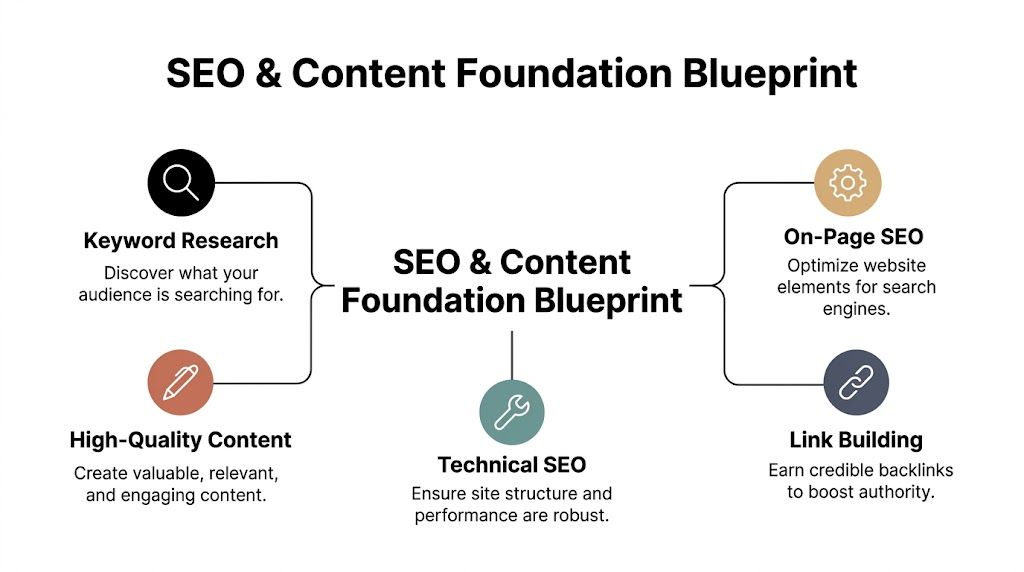
Once your local profile is in shape, the website has to do its job. That means two things. First, the site needs clean on-page and technical fundamentals. Second, it needs content architecture that matches how real people search in Southwest Florida.
Fix the basics that affect clicks
A lot of business owners obsess over rankings and ignore click-through rate. That’s a mistake. You can rank reasonably well and still lose traffic if your listing doesn’t earn the click.
According to Lucky Orange’s website metrics guide, the top position in Google search results captures a 28-39% click-through rate, but this drops sharply with each subsequent position. Improving your title and description to boost CTR can generate more traffic than moving up a rank.
That matters because your title tag and meta description are often the first sales pitch a prospect sees.
For example, compare these two title ideas for an HVAC page:
- HVAC Services | ABC Mechanical
- AC Repair in Cape Coral, FL | Fast Local HVAC Service
The second one gives Google and the searcher more context. It matches local intent better. It also earns more attention from someone who needs that exact service.
Use this checklist on every key service page:
- Write a clear title tag with service and location
- Use one focused H1 that matches the page topic
- Add a useful meta description that promises a specific benefit
- Keep pages mobile-friendly because local searches often happen on phones
- Make contact options obvious with click-to-call buttons and short forms
- Improve page speed so users don’t bounce before the page loads
Build topic clusters instead of random blogs
Random blogging usually creates busywork. A better model is a pillar-and-cluster structure where one core service topic links to several supporting pages.
Take a Naples estate planning law firm. Instead of publishing disconnected articles, the firm could build:
- A pillar page about Estate Planning
- A cluster page about Wills
- A cluster page about Trusts
- A cluster page about Probate
- A cluster page about Estate Planning for Business Owners
- A cluster page about What to Bring to an Estate Planning Consultation
This structure helps users explore and helps search engines understand the site’s depth on the topic.
Field note: One strong service hub usually outperforms five thin blog posts that don’t connect to each other.
The same model works for contractors. An HVAC company could create a main page for AC services, then support it with pages for AC repair, AC installation, maintenance, ductless systems, and emergency service.
Hyperlocal pages drive better intent
For SWFL businesses covering multiple cities, generic “service area” language leaves traffic on the table. People don’t always search by region. They search by need plus city or neighborhood.
A page targeting “HVAC Repair Cape Coral” serves a different intent than a broad “Southwest Florida HVAC Services” page. It gives you space to address local concerns, nearby landmarks, local service expectations, and city-specific trust signals.
The source material provided for this article notes that multi-location service businesses achieve 2x conversion rate improvement by implementing hyperlocal CTAs that reference visitor neighborhoods and area-specific service pain points, and that location-optimized organic pages can reduce customer acquisition cost compared to generic regional campaigns, based on the framework outlined in Hill Media Group’s local SEO guide.
That only works if the pages are unique. Duplicate content across location pages is one of the fastest ways to waste time.
Here’s a clean structure to follow:
| Page Type | URL Structure Example | H1 Tag Example |
|---|---|---|
| Core service page | /ac-repair/ | AC Repair |
| City service page | /ac-repair/cape-coral/ | AC Repair in Cape Coral |
| Second city service page | /ac-installation/estero/ | AC Installation in Estero |
| Specialized service page | /emergency-plumber/fort-myers/ | Emergency Plumber in Fort Myers |
| Location hub page | /locations/naples/ | Home Services in Naples |
What to put on each local page
A lot of local pages fail because they say the same bland thing with the city name swapped out.
A stronger page includes:
- A specific local headline tied to one service.
- A short intro that names the city naturally.
- Service details that answer buying questions.
- Local proof such as project photos, service area notes, or neighborhood references.
- A clear CTA that matches the page, such as scheduling an estimate or calling for emergency help.
For example, an Estero AC installation page might mention common concerns around system replacement timing, seasonal heat, and service availability in nearby communities. A Naples law page might reference local consultation convenience and the types of matters commonly handled for area families.
Don’t ignore internal links and page relationships
If you want to know how to get more website traffic without constantly paying for each visitor, internal structure matters. Each important page should link logically to related pages.
That means:
- service pages linking to location pages
- location pages linking back to core services
- blog articles linking into service hubs
- FAQs linking to the page that converts
This helps visitors keep moving and helps search engines understand which pages carry the most weight.
If you want a practical implementation list, this small business SEO checklist is one option for organizing the work into something your team can complete.
Accelerate Growth with Smart Paid Advertising
Paid traffic can work fast. It can also burn money fast. The difference usually comes down to whether you’re buying high-intent clicks or spraying budget across broad terms that look important but don’t convert.
For most SWFL businesses, paid ads work best when they support a strong local search foundation rather than replace it.

Start narrow and commercial
If you’re a plumber, roofer, med spa, or legal office, begin with searches that show clear buying intent. Someone searching “emergency plumber Fort Myers” or “roof repair Cape Coral” is much closer to action than someone searching a broad educational term.
That means your early paid campaigns should usually focus on:
- Branded searches for your business name
- High-intent service terms tied to a city
- Urgent problem searches when your category supports them
- Call-driven ads during business hours when your team can answer
The page matters as much as the keyword. Don’t send every click to the homepage. Match the ad to a service page that reflects the exact search.
Defensive branded PPC is underrated
This is one of the most overlooked traffic protections for local businesses. In crowded markets, competitors can bid on your business name and intercept people who were already looking for you.
According to AISDR’s visibility analysis, in competitive local markets like home services, competitors bidding on your brand name via PPC can cause a 20-30% traffic loss. A defensive branded campaign can reclaim this traffic at a low cost-per-click, often $0.50-$2, and significantly improve overall ROI.
That’s why I usually tell businesses to defend their own name before expanding into broad campaigns. If someone searches your company directly and a competitor appears above you, you’re paying a penalty for your own brand awareness.
A basic branded campaign is simple:
- bid on your business name and close variations
- send traffic to your homepage or strongest branded landing page
- use ad copy that reinforces trust, location, and contact options
- monitor search terms to make sure the campaign stays clean
If you skip brand defense in a competitive market, you can spend months building awareness only to hand the click to someone else.
For businesses that want outside help setting this up, PPC for small businesses is one example of a service category built around that kind of campaign structure.
Use Local Service Ads where they fit
If your business qualifies for Google Local Service Ads, they’re worth evaluating. They put your business in front of buyers who want a direct response, and they can work well for service categories where urgency matters.
Still, they aren’t a magic fix. You need strong review quality, good response habits, and a process for handling leads quickly. If your office misses calls or lets inquiries sit, paid visibility won’t solve the underlying issue.
This explainer covers the mindset behind efficient ad spend:
What to avoid
A lot of wasted ad spend comes from predictable mistakes.
| Bad move | Better move |
|---|---|
| Targeting broad statewide terms | Focus on city and service combinations |
| Sending all traffic to the homepage | Match ads to the exact service page |
| Ignoring branded traffic protection | Defend your own name first |
| Running ads without call handling | Make sure someone answers and follows up |
| Judging success by clicks alone | Track leads, booked calls, and quality |
Paid ads should bring speed and control. They shouldn’t become a substitute for clear positioning, relevant landing pages, and disciplined follow-up.
Drive Repeat Traffic with Email and Social Media
A lot of website traffic doesn’t convert the first time. That’s normal. The bigger mistake is letting that visitor disappear for good.
Email and social media give you a way to stay visible after the first click. For service businesses in Southwest Florida, these channels work best when they’re simple, local, and consistent. You don’t need a complicated funnel. You need a repeatable system.

Use social media to support trust, not chase vanity
For many SWFL businesses, Facebook and Instagram are the practical starting points. LinkedIn can work well for legal, healthcare, B2B, and professional services. The goal isn’t to post constantly. The goal is to give people enough current proof that they feel comfortable clicking through to your site.
The easiest content often performs best:
- Recent project photos from real local jobs
- Short client testimonials with service context
- Quick educational tips tied to seasonal concerns
- Team and behind-the-scenes posts that show a real business
- Links to new service pages or blog content on your website
A Cape Coral roofer could post storm prep tips and before-and-after project photos. A Naples pediatric practice could share common parent questions and office updates. A Fort Myers attorney could turn frequently asked consultation questions into short posts that lead back to the relevant page.
Social media should make your website stronger. If your posting never sends people back to a useful page, it’s mostly noise.
Build an email list from traffic you already have
Most small businesses ignore email until they think they’re “big enough” for it. That’s backward. If your site gets any traffic at all, you can start collecting email addresses now.
Keep the ask simple. Offer something relevant:
- a maintenance reminder signup
- a seasonal checklist
- a consultation prep guide
- a local homeowner tips newsletter
- updates on office news or service availability
Don’t overthink the form. Put it on your homepage, blog, and service pages where it fits naturally.
Then send one useful email on a regular schedule. Monthly is enough for many service businesses. The content can be plain and still work.
A simple monthly email that drives return visits
Here’s a format that takes less time than most owners expect:
- Open with one helpful local note. Example: a seasonal maintenance reminder or legal deadline awareness item.
- Feature one recent job, case type, or service insight. Keep it short.
- Link to one page on your site. A blog post, service page, or FAQ.
- Close with one clear action. Book, call, reply, or learn more.
For example, an HVAC company could send a short summer-readiness email linking to its AC maintenance page. A dentist could send a reminder about family scheduling with a link to a preventive care page. A law office could highlight one estate planning question and link to a relevant article.
Make sure your emails get delivered
Even good emails won’t help if they land in spam. That’s why deliverability matters more than flashy templates.
If your team is running into inbox problems, this guide on how to stop email from going to spam in Gmail is worth reviewing before you increase sending.
Keep the workload realistic
Most businesses either give up or hand off the wrong tasks. They try to post every day, write long newsletters, and build a complex automation sequence all at once.
A better operating rhythm is:
- One short email per month
- A few social posts each week
- One website link in most posts
- Reuse the same topic across channels
If you publish a new page about “roof repair in Naples,” turn it into a Facebook post, an email feature, and a short Instagram update. One useful piece of content can support multiple visits over time.
Your 90-Day Southwest Florida Traffic Plan
Most businesses don’t need more ideas. They need an order of operations. If you try to fix everything at once, traffic work turns into a pile of unfinished tasks.
The better approach is to stack improvements. Tighten local visibility first. Build the website pages that deserve to rank. Add paid traffic where speed matters. Then create a simple follow-up loop through email and social.
According to VWO’s website traffic statistics, 41.2% of B2B websites generate between 1,000 and 10,000 monthly visitors. For many SWFL professional service firms and local businesses, that’s the crowded middle. Breaking out of it usually comes from better local SEO and better content targeting, not from doing more random marketing.
Month 1 gets your foundation in order
The first month should focus on cleanup, visibility, and trust signals.
Your top priorities:
- Finish and refine your Google Business Profile
- Upload a steady stream of real business photos
- Set up a review request process
- Audit title tags, H1s, and core service pages
- Make sure mobile visitors can call or contact you easily
If you have multiple services but only one generic page, split them into separate service pages. If you serve multiple SWFL cities, identify which local pages need to be built first based on actual revenue opportunity.
Track basic signals during this month:
- Google Business Profile activity
- calls and form submissions
- top landing pages
- which cities generate the most inquiries
Month 2 builds pages that attract qualified searches
By the second month, your site should start expanding in a deliberate way.
Priority actions:
- Create your highest-value city pages
- Build one pillar page for a core service
- Add supporting cluster pages
- Improve internal linking across service and location content
- Publish and share at least one useful new piece of content
A contractor might build pages for Fort Myers, Cape Coral, and Naples before expanding further. A law firm might build around one profitable service line first instead of trying to cover the entire practice in one shot.
Start with the service and city combination that closes the best business. Traffic volume matters less than buyer intent.
During this month, pay attention to which pages begin earning impressions and which ones get clicks but no inquiries. That tells you whether the issue is visibility or conversion.
Month 3 adds acceleration and retention
The third month is where you layer in paid support and repeat-visit channels.
Tasks for this phase:
- Launch or tighten branded PPC
- Test a small high-intent search campaign
- Start a monthly email
- Repurpose your best website content onto social media
- Review which pages deserve more links, more proof, or better calls to action
This is also when you should make harder decisions. If a page gets traffic but weak lead quality, rewrite it. If a campaign gets clicks but poor calls, narrow the keyword set. If your profile gets views but too few actions, improve photos, reviews, and category alignment.
Sample 90-Day Traffic Growth Budget
You don’t need one universal budget. You need the right split for your capacity.
| Activity | Starter Plan (DIY) | Growth Plan (Agency) |
|---|---|---|
| Google Business Profile optimization | Owner or office manager updates profile, services, photos, and review process | Agency manages optimization, posting, review workflow guidance, and reporting |
| Core service page improvements | Revise top pages in-house with clear titles, headings, and CTAs | Agency rewrites and optimizes priority pages based on search intent |
| Location page creation | Build a few priority city pages internally over the quarter | Agency develops a broader local page rollout across target SWFL markets |
| Paid search | Small branded campaign only, monitored closely | Branded defense plus targeted high-intent local campaigns |
| Email marketing | One monthly newsletter sent from existing CRM or email platform | Agency-supported content calendar and email production |
| Social media | Repurpose project photos and site content manually | Agency-supported posting that aligns with traffic goals and service promotions |
What success should look like after 90 days
In the first quarter, I’d look for signs of momentum before I’d chase vanity numbers. Better profile engagement. More qualified calls from local searches. More pages showing up for service-and-city terms. More repeat visits from email and social.
That’s the right kind of progress because it compounds. A stronger local profile helps your site. Better service pages improve both organic traffic and paid conversion. Email and social keep your brand in front of people who weren’t ready the first time.
If you’re serious about learning how to get more website traffic, don’t measure success by raw visits alone. Measure whether the right people are finding you, clicking you, and contacting you.
If you want help turning this into a practical plan for your business, Polaris Marketing Solutions works with Southwest Florida businesses on local SEO, PPC, website improvements, and traffic strategies built around lead quality and clear ROI.