
You’re probably in one of two situations right now.
Either you’ve tried Google Ads for your law firm and felt like you lit money on fire. Or you’ve avoided it because every conversation about PPC turns into jargon, screenshots, and vague promises about “traffic.”
Both are reasonable reactions. Legal clicks are expensive, competition is brutal, and bad account structure will waste money fast. But small firms still win with google ads for attorneys when they stop chasing clicks and start building a system around signed cases, qualified calls, and local intent.
If someone in Fort Myers searches “car accident lawyer near me” from a phone, that person isn’t browsing for fun. They need help now. The firms that show up first get the first call, and often the only serious shot.
Why Google Ads Is Non-Negotiable for Law Firms in 2026
A law firm can still get referrals. It can still build a good reputation. It can still invest in SEO.
None of that changes one hard fact. When a prospective client needs a lawyer today, they search Google. If your firm isn’t visible at the top of the page, another attorney gets that lead first.
Google Ads matters because it captures high-intent demand. These aren’t random social media impressions. These are searches from people actively looking for legal help in a specific place for a specific problem.
According to StubGroup’s legal Google Ads benchmarks, Google Ads delivers an average conversion rate of 7% across legal services, compared with typical website benchmarks of 2-3%, and Google reports up to 8x returns for optimized campaigns. That gap is the whole game.
Why small firms can’t sit this out
Word-of-mouth is valuable, but it isn’t controllable. Google Ads is controllable.
You choose:
- Where ads show: Fort Myers, Cape Coral, Naples, Estero, or tightly defined service areas.
- What searches trigger them: “DUI lawyer Fort Myers” is very different from “what happens after DUI arrest.”
- What action counts: calls, form submissions, consultation requests, and signed cases.
That control is why good PPC is not a money pit. Bad PPC is.
Practical rule: If your campaign isn’t built around case value and intake quality, Google will happily spend your budget anyway.
What attorneys get wrong
A lot of firms judge ads by visibility alone. That’s backwards.
The right questions are simpler:
- Are the calls relevant?
- Are the leads in your service area?
- Are you getting consults from matters you want?
- Are those consults turning into cases?
If you can answer yes, Google Ads becomes a client acquisition channel. If you can’t, then the problem usually isn’t the platform. It’s the setup, the targeting, the landing page, or the intake process.
For a small or mid-sized firm, absence from paid search is a business risk. Competitors don’t need to be better lawyers to win. They just need to be easier to find at the moment a client is ready to hire.
Laying the Foundation for a Profitable Account
Before you launch a single ad, get the account infrastructure right. Here, most firms either protect their budget or lose it.
Law firm marketing costs have climbed hard. Attorney at Law Magazine reports that some Google Ads keywords have reached up to $1,000 per click, attorneys and legal services average $131.63 cost per lead, and 96% of clients initiate attorney searches online. In plain English, every mistake is expensive.
Start with business access and account control
Use a firm-owned Google account. Not your assistant’s personal Gmail. Not your nephew’s login. Not a former vendor’s email.
Set up:
- Google Ads
- Google Analytics
- Google Tag Manager
- Call tracking
- Google Business Profile access
Give role-based access to anyone who needs it. Keep admin ownership with the firm.
If you ever switch agencies, you need your data, your campaigns, and your history intact.
Define conversions before you buy traffic
Clicks aren’t the goal. Forms aren’t even the goal. Cases are the goal.
For a law firm, useful conversion actions usually include:
- Qualified phone calls: calls long enough to show real intent
- Case evaluation forms: submissions from prospects in your practice area
- Consultation requests: booked appointments, not just page visits
- Offline outcomes: signed cases imported back into Google Ads when possible
If you only track page views or button clicks, you’ll train Google to find cheap activity instead of valuable leads.
Track what matters to intake, not what makes the dashboard look busy.
Build a keyword list with intent, not ego
Most attorneys start by listing the biggest keywords they can think of. That’s how budgets get chewed up.
Start tighter. Use service-specific, location-specific phrases. Focus on terms that show hiring intent. If you need a practical framework for organizing and expanding those terms, this guide to AdWords keyword research is a useful reference.
A better early keyword set looks like this:
- “personal injury lawyer fort myers”
- “divorce attorney cape coral”
- “dui lawyer naples”
- “probate attorney estero”
A weaker set looks like this:
- “law”
- “attorney”
- “legal help”
- “how court works”
Don’t skip policy and compliance checks
Legal ads don’t get a free pass. Review your state bar advertising rules and Google’s legal advertising requirements before launch.
Pay attention to:
- Claims you can substantiate: avoid exaggerated promises
- Practice area accuracy: don’t imply services you don’t offer
- Geographic truthfulness: only advertise markets you can serve
- Intake disclosures: especially if forms or call tracking create privacy concerns
Use a pre-launch checklist
A small firm doesn’t need a fancy setup. It needs a disciplined one.
| Pre-launch item | What good looks like |
|---|---|
| Account ownership | Firm controls admin access |
| Conversion tracking | Calls, forms, and consult actions are configured |
| Keyword list | High-intent, local, practice-specific terms |
| Negative keywords | Basic exclusions added before launch |
| Landing pages | One focused page per service theme |
| Policy review | Ads and pages align with legal advertising rules |
If this foundation feels slow, good. Slow at setup is cheaper than fast and sloppy after launch.
Structuring Campaigns for High-Quality Leads
Treat your account like a filing cabinet.
Each campaign is a drawer. Each ad group is a folder. Each folder holds related keywords, ads, and a landing page built for that exact topic.
That structure gives you control. Without it, Google blends different services, locations, and search intent into one mess.
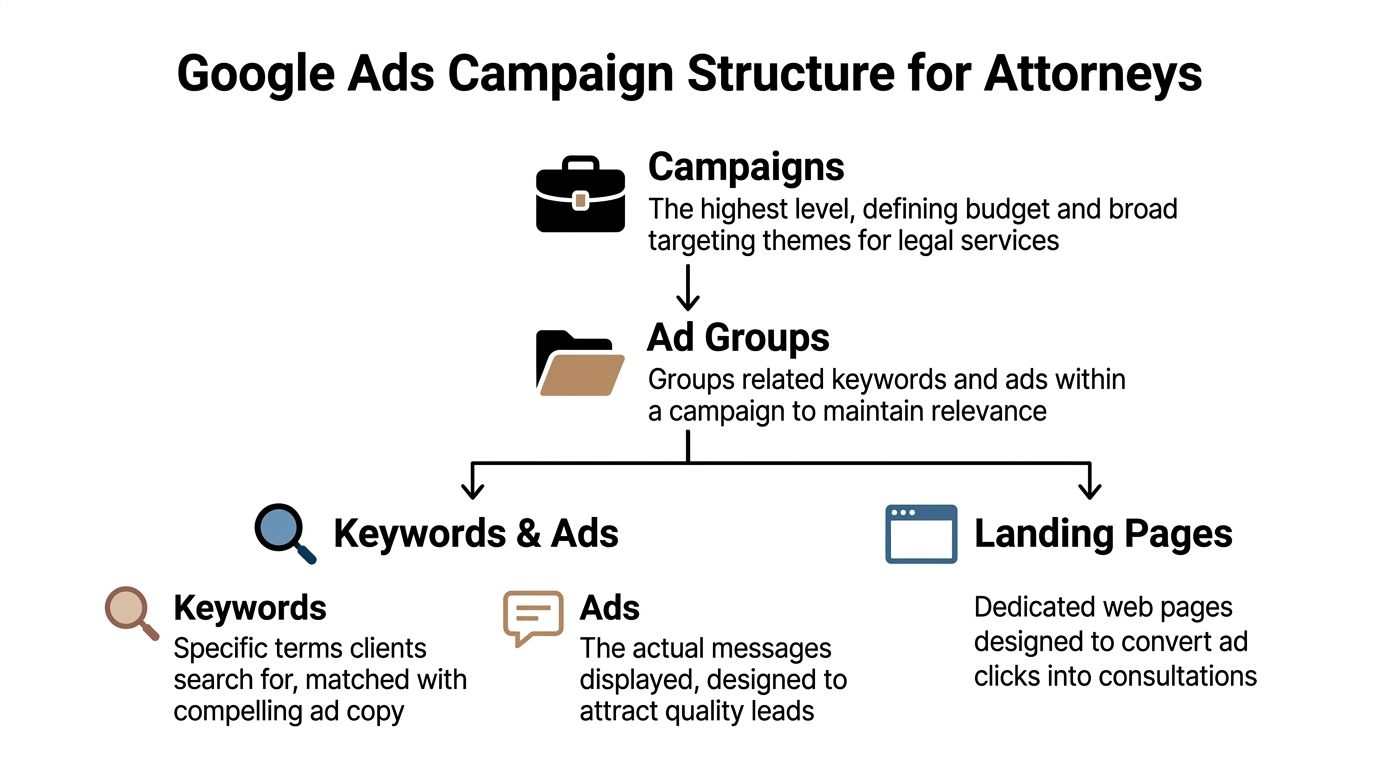
A profitable setup starts with high-intent keywords, tight geographic targeting, dedicated landing pages, and a target cost per signed case, as outlined by dNovo Group’s methodology for lawyer Google Ads.
Build campaigns by practice area first
Do not put personal injury, family law, criminal defense, and estate planning into one campaign.
Separate them.
Why? Because each practice area has different search behavior, different economics, different intake questions, and different ad copy. A person searching for a criminal defense lawyer at night behaves differently from someone researching divorce representation during the workday.
A clean account for a small firm might look like this:
- Campaign 1: Personal Injury
- Campaign 2: Family Law
- Campaign 3: Criminal Defense
- Campaign 4: Estate Planning
- Campaign 5: Brand Search
Inside each campaign, break ad groups down by service or location.
Examples:
Personal Injury campaign
- Car Accident Lawyer Fort Myers
- Truck Accident Lawyer Cape Coral
- Slip and Fall Lawyer Naples
Family Law campaign
- Divorce Lawyer Fort Myers
- Child Custody Attorney Cape Coral
- Alimony Lawyer Estero
Keep each ad group narrow
An ad group should hold closely related keywords only.
Bad example:
- divorce lawyer
- dui attorney
- probate lawyer
- injury attorney
Good example:
- divorce attorney fort myers
- fort myers divorce lawyer
- family law attorney fort myers
That narrow grouping improves relevance. Relevance improves click quality. Better click quality helps lead quality and cost control.
Match search intent, not curiosity
Many firms often burn money.
The keyword “how does child custody work in florida” may have informational value, but it’s weaker commercial intent than “child custody lawyer fort myers.” If your budget is limited, buy intent first.
A simple way to think about it:
| Search type | Keep or avoid | Why |
|---|---|---|
| “hire divorce attorney fort myers” | Keep | Strong hiring intent |
| “car accident lawyer near me” | Keep | Urgent local intent |
| “best dui lawyer naples” | Keep | Comparison-stage prospect |
| “what is personal injury law” | Avoid early | Research intent |
| “free legal forms divorce” | Avoid | Low buyer intent |
| “how to become a lawyer” | Block | Irrelevant entirely |
Use negative keywords aggressively
Negative keywords are not optional. They’re your first line of defense against junk traffic.
Start with obvious exclusions like:
- Free
- Pro bono
- Jobs
- Salary
- School
- Class
- Definition
- Template
- DIY
- Public defender
Then keep expanding the list based on actual search terms.
If you run family law ads and keep showing up for “divorce support group” or “free divorce papers,” those clicks will eat your budget while your intake team gets nowhere.
A strong search terms review also helps you qualify sales leads and boost conversion rates by aligning the front-end targeting with the same screening logic your intake staff uses after the call comes in.
The best negative keyword list usually comes from real searches that already wasted your money once. Don’t let them waste it twice.
Build one landing page per ad theme
Don’t send every click to your homepage.
If someone searches “truck accident lawyer fort myers,” they should land on a page about truck accidents in Fort Myers, with a clear CTA, a visible phone number, and intake language that matches the query.
That alignment matters because it reduces friction. The prospect shouldn’t have to figure out whether they’re in the right place.
Sample campaign structure by practice area
| Practice Area | Example Campaign | Example Ad Groups | High-Intent Keyword Examples | Example Negative Keywords |
|---|---|---|---|---|
| Personal Injury | Personal Injury SWFL | Car Accidents Fort Myers, Truck Accidents Cape Coral, Slip and Fall Naples | car accident lawyer fort myers, truck accident attorney cape coral, slip and fall lawyer naples | free, jobs, salary, definition, class |
| Family Law | Family Law Fort Myers | Divorce Lawyer Fort Myers, Child Custody Cape Coral, Alimony Estero | divorce attorney fort myers, child custody lawyer cape coral, alimony attorney estero | forms, template, DIY, free, mediation class |
| Criminal Defense | Criminal Defense Lee County | DUI Lawyer Fort Myers, Drug Crime Lawyer Cape Coral, Domestic Violence Attorney Naples | dui lawyer fort myers, criminal defense attorney cape coral, drug crime lawyer naples | public defender, salary, school, internship, meaning |
| Estate Planning | Estate Planning Collier and Lee | Wills Attorney Naples, Probate Lawyer Fort Myers, Trust Attorney Bonita Springs | probate attorney fort myers, wills lawyer naples, trust attorney bonita springs | forms, free template, sample, clerk, jobs |
Geo-target with discipline
For small firms, geography is strategy.
Don’t target all of Florida because it sounds bigger. Target the counties, cities, and service areas where you can serve clients and close cases efficiently.
If your office is in Fort Myers and most good cases come from Lee and Collier counties, focus there first. Earn profitable data before expanding.
A smaller, sharper account almost always beats a bloated one.
Crafting Ads and Landing Pages That Convert
A prospect searches. Your ad appears. They click. Then they decide, in seconds, whether your firm feels credible, relevant, and easy to contact.
That moment is where most campaigns win or lose.

Write ads that answer the search directly
Most legal ads are forgettable because they’re vague.
Bad ad:
“Experienced Attorneys. Call Today.”
Better ad:
“Fort Myers Car Accident Lawyer. Free Case Review. Speak With an Attorney Today.”
The better version works because it mirrors the search and gives the user a reason to act now.
A simple ad writing formula:
- Headline 1: service plus city
- Headline 2: trust signal or differentiator
- Headline 3: clear CTA
Example for family law:
- Divorce Lawyer Fort Myers
- Compassionate Family Law Counsel
- Schedule a Consultation Today
Example for criminal defense:
- DUI Lawyer in Cape Coral
- Fast Response for Urgent Charges
- Call Now for Immediate Help
Use extensions like part of the offer
Ad assets matter because they make your ad bigger, more specific, and easier to act on.
For law firms, the most useful ones are usually:
- Call assets: ideal for mobile users who want immediate contact
- Location assets: especially helpful for local trust and map visibility
- Sitelinks: direct users to practice pages like car accidents, divorce, or criminal defense
- Callouts: reinforce points like local service area, consultations, or attorney access
These assets shouldn’t repeat the same line over and over. Each should add something useful.
If your ad promises speed, your next click should not land on a slow, generic page with three menus and no phone number above the fold.
Message match is where conversion happens
If the ad says “Fort Myers Probate Attorney,” the landing page headline should say exactly that or something very close.
Not “Welcome to Our Firm.”
Not “Full-Service Legal Representation.”
Not a homepage slider.
The prospect clicked because they thought you solved a specific problem. Confirm that immediately.
A solid legal landing page usually includes:
- A specific headline tied to the search
- A short supporting statement that explains who you help
- A visible phone number at the top
- A simple form with only necessary fields
- Attorney photos that make the page feel real
- Client reviews or testimonials
- Practice-area details written in plain English
- A clear CTA repeated down the page
If you want inspiration, review examples of high-converting landing pages and pay attention to how clearly the page matches the visitor’s intent.
A practical before-and-after example
Say your ad targets “child custody lawyer cape coral.”
Weak path:
- Ad mentions family law generally
- Click goes to homepage
- User has to find family law in the menu
- Form asks for too much information
- No reassurance about local service
Strong path:
- Ad says “Child Custody Lawyer Cape Coral”
- Click goes to a custody-specific page
- Headline confirms custody representation in Cape Coral
- Phone number is prominent
- Form asks only for the essentials
- Page explains next steps clearly
That second path feels easier. Easier usually converts better.
Keep the form short and the CTA clear
Law firms often overbuild forms because they want to pre-qualify everything on the page. That’s a mistake.
Use the landing page to start the conversation. Use intake to qualify the case.
Ask for what you need to make contact and route the lead properly. Save the long screening for the phone call or follow-up process.
Good CTA examples:
- Speak With an Attorney
- Request a Case Evaluation
- Start Your Consultation
- Get Help Today
Weak CTA examples:
- Submit
- Learn More
- Continue
A legal landing page doesn’t need to be clever. It needs to be trustworthy, specific, and easy to use.
Bidding Budgeting and Ongoing Optimization
Google Ads isn’t hard because the interface is complicated. It’s hard because the platform will spend money even when your judgment is sloppy.
That’s why bidding strategy and optimization cadence matter. The firms that win aren’t always the firms with the biggest budgets. They’re the firms with tighter decision-making.
A major problem in legal PPC is dead-end lead flow. LawBrokr notes that 96% of legal clicks fail to convert, and they point to aggressive negative keyword use and stronger intake qualification as key fixes.
Pick a bidding strategy that matches your stage
For a new account or a messy account rebuild, start with control.
Manual CPC can make sense when you need to understand keyword behavior, test traffic quality, and avoid giving Google too much freedom too early.
Once tracking is reliable and you’ve collected enough meaningful conversion data, Smart Bidding options like Maximize Conversions can become useful. The mistake is switching to automation before the account has clean signals.
Use this rule of thumb:
- Early stage: prioritize visibility into search terms, lead quality, and spend control
- Middle stage: test automation selectively on proven campaigns
- Scaling stage: let automation help, but keep human oversight on search terms, geography, and intake outcomes
Don’t outsource judgment to the algorithm.
Budget around case economics, not fear
Small firms often ask, “What should my monthly budget be?”
The better question is, “What can I spend to acquire a signed case profitably?”
If one practice area produces stronger case value and faster intake decisions, it should get more budget. If another generates lots of weak consults, it needs tighter targeting before it deserves more spend.
For a practical overview of how smaller firms should think about campaign planning and budget discipline, this page on pay-per-click for small businesses is a helpful reference.
Your weekly optimization checklist
Run this every week. No exceptions.
- Review search terms: add negatives for irrelevant queries
- Check lead quality: ask intake which calls were usable
- Pause weak keywords: if they generate junk, stop paying for them
- Watch location performance: trim cities or zip codes producing poor fit
- Check mobile experience: many legal leads call from phones first
- Listen to call recordings when appropriate: look for pattern problems in lead quality and intake handling
Your monthly optimization checklist
Monthly work should be more strategic.
| Monthly review area | What to look for |
|---|---|
| Ad copy | Which messages produce stronger consultations |
| Landing pages | Which pages create drop-off or form abandonment |
| Device performance | Whether phone-first users need a simpler path |
| Intake quality | Which lead sources actually become cases |
| Practice area mix | Whether budget is sitting in weaker campaigns |
| Geographic targeting | Which local markets deserve expansion or tighter filters |
Cut dead-end consultations before they reach the lawyer
Many firms think optimization ends at the click. It doesn’t.
If your ads attract broad, low-intent traffic, your intake team wastes time. If your forms are vague, bad leads pile up. If your receptionist can’t screen effectively, expensive clicks turn into expensive distractions.
Fix that with three moves:
- Tighten negatives so junk searches stop triggering ads
- Use practice-specific landing pages so prospects self-select correctly
- Improve intake questions so weak matters get filtered before attorney time gets spent
Good PPC doesn’t just generate leads. It protects attorney time.
That’s the difference between activity and ROI.
Winning Locally The Fort Myers and SWFL Advantage
National PPC advice is usually too broad for small law firms in Southwest Florida.
Fort Myers, Cape Coral, Naples, Estero, and Bonita Springs aren’t just dots on a map. They have different demographics, different competition levels, different travel realities, and different search patterns. A local campaign should reflect that.

Local Service Ads deserve real attention
A lot of attorneys ignore Local Service Ads, and that’s a mistake for regional firms.
According to Webrageous on attorney LSAs, LSAs appear above traditional PPC results, use a Google Screened badge, and operate on a pay-per-lead model. That makes them especially attractive for small to mid-sized firms targeting searches like “personal injury lawyer near me” in places such as Fort Myers or Naples.
For local firms, LSAs can work well because they shorten the path from search to contact. The lead can call or message directly through Google without the same friction as a traditional landing page path.
Use LSAs and PPC together, not as substitutes
LSAs and standard search campaigns solve different problems.
LSAs are strong for trust, local visibility, and direct lead capture. Traditional Google Ads gives you more control over keywords, landing pages, ad messaging, and campaign structure.
A strong local setup often looks like this:
- LSAs for top-of-page local trust and direct calls
- Search ads for high-intent practice-area terms
- Google Business Profile support for local credibility
- Landing pages designed for city and service combinations
That mix gives a small firm more surface area on the results page.
Make your geography more specific than your competitors
Many firms target “Southwest Florida” and stop there. That’s lazy targeting.
Break markets apart where it makes sense.
Examples:
- A campaign for Fort Myers car accident lawyer
- A separate campaign or ad group for Cape Coral DUI lawyer
- Customized messaging for Naples estate planning attorney
- Radius targeting around your office for urgent practice areas where proximity matters
You can also adjust messaging by market. A family law prospect in Naples may respond to a different value proposition than a criminal defense prospect in North Fort Myers.
If you want a local benchmark for how this kind of regional campaign management should look, review Google Ads management in Fort Myers and compare that level of targeting to the generic statewide campaigns many firms still run.
Small firms win local PPC by being more specific than bigger firms are willing to be.
Support paid ads with your Google Business Profile
Your Google Business Profile supports both trust and conversion, especially for branded searches and local intent.
Keep it current:
- Accurate categories
- Practice area descriptions
- Office photos
- Recent reviews
- Correct hours
- Clear service areas
If your ad gets the click and your profile looks neglected, you’ve weakened your own close rate before the prospect even calls.
A practical SWFL playbook
For a small or mid-sized firm in Southwest Florida, the local playbook is simple:
| Local tactic | Best use |
|---|---|
| LSAs | Direct local lead capture with trust built in |
| City-specific campaigns | Better control over budget and messaging |
| Radius targeting | Useful around office-centered service areas |
| Practice-area landing pages | Stronger message match for local searches |
| Google Business Profile optimization | Reinforces trust before and after the click |
| Review management | Helps conversion when prospects compare firms |
Broad campaigns are easier to launch. Local campaigns are easier to make profitable.
Frequently Asked Questions about Google Ads for Attorneys
Is Google Ads better than SEO for law firms
They do different jobs.
Google Ads captures demand immediately. SEO builds long-term visibility and lowers your dependence on paid traffic over time. A small law firm shouldn’t treat this as an either-or decision. If you need leads now, start with paid search. If you want a stronger marketing position later, build SEO alongside it.
How long does it take to see results
You can see clicks and leads quickly. That doesn’t mean the campaign is dialed in.
A law firm usually needs enough time to gather search term data, improve negatives, refine landing pages, and connect ad performance to actual intake outcomes. Fast launch is easy. Profitable consistency takes active management.
Can a solo attorney compete with bigger firms
Yes, if the solo firm is more focused.
Big firms often run broad campaigns because they can afford waste. Small firms can beat them in specific local searches by narrowing geography, tightening keyword intent, matching ads to dedicated landing pages, and screening leads properly.
A solo attorney usually loses when trying to outspend a larger firm on broad terms. A solo attorney can absolutely win by being more precise.
What’s the biggest mistake law firms make
Tracking the wrong outcome.
If you optimize for clicks, you’ll get clicks. If you optimize for weak form fills, you’ll get weak form fills. The account needs to focus on qualified calls, relevant consultations, and signed cases.
Should I send ad traffic to my homepage
Almost never.
A homepage is too broad for most legal searches. Practice-specific and location-specific landing pages usually create a cleaner path to contact because they match what the prospect searched for.
How do I know if my intake process is hurting ROI
Ask three questions:
- Are good calls going unanswered?
- Are staff members screening consistently?
- Are unqualified matters eating up attorney time?
If the answer to any of those is yes, the ad account isn’t your only problem. Marketing and intake have to work together.
Should I run Local Service Ads too
If your practice area is eligible and your firm serves a defined local market, yes. LSAs can complement traditional search ads well, especially when local trust and direct contact matter.
What should I do first if my current campaign is underperforming
Don’t increase budget. Audit the basics first.
Use this order:
- Conversion tracking
- Search terms
- Negative keywords
- Landing page match
- Intake quality
- Bidding strategy
Most failing legal campaigns don’t need more spend. They need better control.
If your firm wants help building a Google Ads system that produces qualified consultations and signed cases in Fort Myers and across Southwest Florida, Polaris Marketing Solutions can help. The team works with small and mid-sized businesses on PPC, local SEO, landing pages, and lead generation strategy built around clear ROI, not vague marketing reports.