
It’s a Tuesday morning in Fort Myers. The crew is ready, the phones are too quiet, and you know people are searching for the service you sell right now.
That’s the moment when pay per click for small businesses stops being a marketing buzzword and becomes an operations tool. If you need calls this week, quote requests this month, or a way to keep your schedule full during a soft patch, PPC can put your business in front of buyers who are already looking.
For Southwest Florida companies, that matters more than most owners realize. Home service demand swings. Seasonal traffic changes behavior. Professional practices compete in crowded local searches. Waiting on SEO alone can be smart long term, but it doesn’t solve an immediate lead gap.
Why Your Business Needs Leads Now Not Later
A small business usually doesn’t fail because the owner lacks ambition. It struggles because lead flow becomes inconsistent.
If you run an HVAC company, cleaning service, law office, med spa, or local clinic in Southwest Florida, you’ve felt that pressure. One week is packed. The next week has gaps. Payroll, trucks, rent, and admin costs don’t wait for your organic rankings to improve.
PPC fills the gap between slow marketing and urgent demand
PPC is useful because it creates visibility fast. Your ad can appear when someone searches for the exact service you provide in the exact area you serve.
That matters when someone needs help now. A homeowner searching for “AC repair Fort Myers” isn’t browsing for fun. A parent searching for a pediatric clinic nearby usually has intent. A law firm prospect searching for a specific practice area often wants to talk to someone soon.
The appeal isn’t just speed. It’s accountability.
Businesses earn an average of $2 for every $1 spent on Google Ads, and 65% of SMBs actively run PPC campaigns, which is why it has become a practical growth channel for many smaller companies facing rising acquisition costs, according to these PPC statistics.
Waiting has a cost
A lot of owners compare PPC to SEO as if they must choose one forever. That’s the wrong frame.
SEO builds long-term equity. PPC buys immediate placement. If your schedule has open capacity now, the right question is simple: what will those empty appointment slots cost you if nothing changes this month?
Practical rule: If your business can close profitable jobs from inbound calls, PPC deserves a hard look because it can put you in the conversation while other channels are still ramping up.
A strong local strategy usually combines both. If you want a broader view of how paid channels fit into a growth plan, this guide on online advertising for small business is a useful companion read.
Why this matters in Southwest Florida
Fort Myers, Cape Coral, Estero, Bonita Springs, and Naples are competitive enough that “being online” isn’t enough. Buyers often click the businesses they see first, especially on mobile.
If your competitors are showing up above the map pack, above organic listings, and with a stronger offer, they’re getting the first shot at the lead. PPC helps you compete for that first click instead of waiting for leftovers.
For local service businesses, that first click often becomes the first call. And the first call often wins the job.
Understanding Pay Per Click Advertising
PPC is simple once you strip out the jargon. Imagine a digital billboard that only shows up when the right person asks for what you sell.
If someone types “roof repair Cape Coral” into Google, the platform decides which ads to show. You bid to appear there, but you don’t pay just because the ad showed up. You pay when someone clicks.

The three pieces that matter
Keywords
Keywords are the search terms that trigger your ad.
A plumber might target terms tied to urgent intent, while an estate planning attorney might target terms tied to research and consultation. The point is not to chase every possible phrase. The point is to show up for searches that are closely tied to revenue.
Examples of useful local-intent keywords include:
- Service plus city: “paver sealing Fort Myers”
- Problem plus location: “water damage cleanup Cape Coral”
- Category plus qualifier: “family lawyer Naples”
- High-intent near-me search: “urgent care near me”
Broad keywords create waste. Specific keywords usually create better leads.
Ads
Your ad is the message the searcher sees.
Good ads feel like a direct answer to the search. If the search is “same day garage door repair Bonita Springs,” the ad should sound like it belongs to that exact need. It should mention the service, the location, and a reason to act.
Weak ads tend to be vague. “Trusted local experts” by itself says almost nothing. Strong ads are concrete. “Garage Door Repair in Bonita Springs. Book Same-Day Service.”
Clicks
A click is the moment someone chooses your ad over the other options.
That click is not the win by itself. It’s a paid opportunity. You’ve bought attention from someone who has shown intent. What happens next depends on your landing page, your phone handling, and your follow-up process.
How the auction really works
You’re not just buying ad space. You’re entering an auction for relevant attention.
That auction isn’t only about who bids the most. Platforms also look at how well your keyword, ad, and landing page fit together. If the message matches the search and the landing page delivers what the ad promised, your campaign is in a better position to compete efficiently.
Relevance beats brute force more often than small businesses think.
Why owners like the model
Traditional advertising often charges for exposure. PPC charges for action.
That difference matters when you need tighter control over spend. You can turn campaigns on, pause weak keywords, test different offers, and shift budget toward what produces calls and form fills.
For a local business owner, that makes PPC easier to judge. You’re not left guessing whether a billboard or mailer helped. You can see which search terms, ads, and locations produce leads, then make changes quickly.
Choosing the Right PPC Platform for Your Business
Not every platform solves the same problem. If you choose the wrong one first, you can waste time and budget even with solid creative.
For local lead generation, the platform decision usually comes down to intent, cost, and how people discover you.
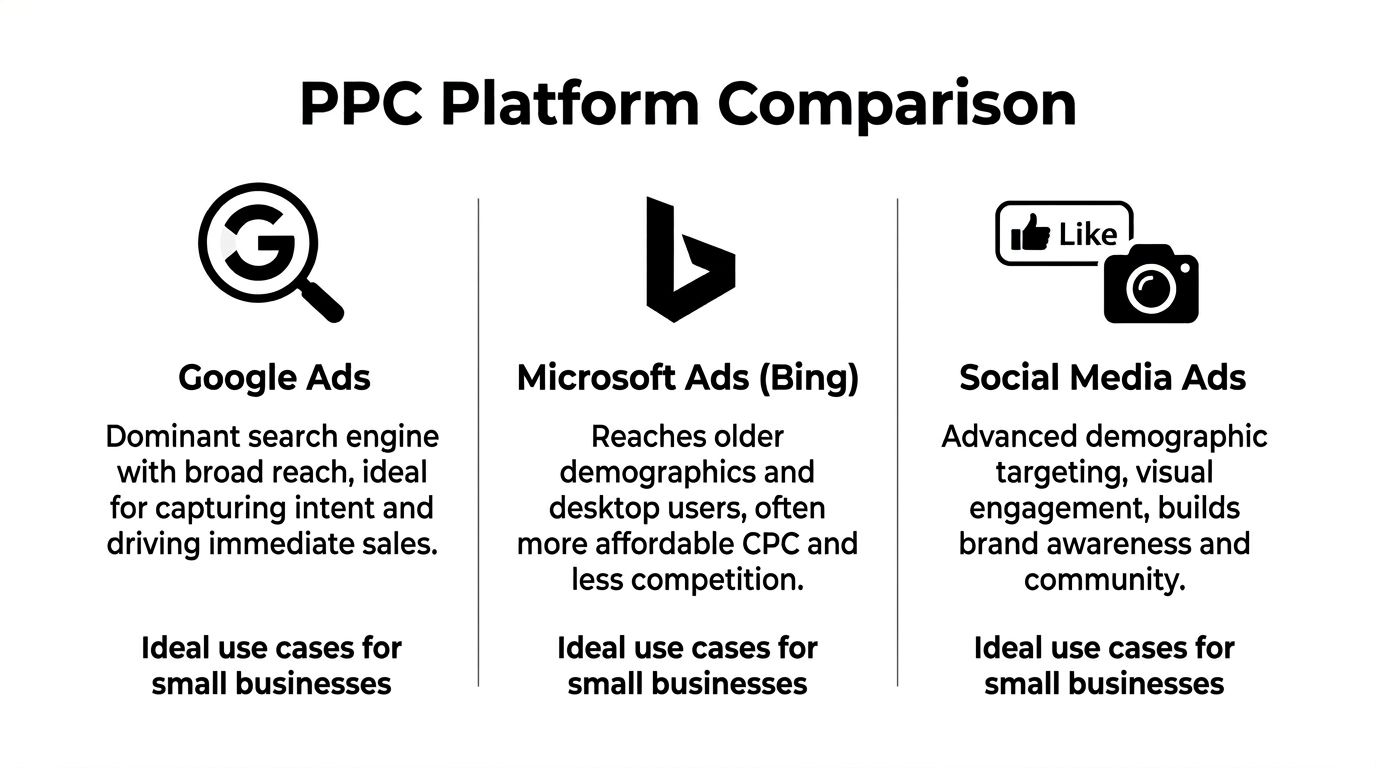
A simple comparison
| Platform | Best for | Buyer mindset | Main caution |
|---|---|---|---|
| Google Ads | Direct lead capture | Searching with immediate intent | Costs can rise quickly in competitive categories |
| Microsoft Ads | Cost-conscious search campaigns | Similar search intent, often overlooked by competitors | Lower volume than Google |
| Social media ads | Awareness, retargeting, offer-driven promotion | Browsing, not always actively searching | Leads can be less urgent |
Google Ads for high-intent searches
Google Ads is usually the first stop for service businesses because it captures people who are actively looking.
That’s very different from interrupting someone on social media. Search ads put your offer in front of a person who has already raised their hand. If you’re a roofer, dentist, med spa, accountant, or family lawyer, that intent is valuable.
Google also fits local campaigns well because owners can target service areas, write city-specific ad copy, and align landing pages with exact searches.
When Google is the right first move
Start with Google if most of your leads come from people searching for a service they already know they need.
Examples:
- Emergency and urgent services: AC repair, water extraction, locksmith work
- High-consideration local services: legal, healthcare, accounting, restoration
- Quote-driven home services: paving, roofing, cleaning, pool service
Microsoft Ads for lower-cost search coverage
Many small businesses ignore Microsoft Ads, which is often a mistake.
For local SMBs, Microsoft Ads can offer 32% lower CPCs on average while reaching 700 million users, according to Intuit’s 2025 small business advertising trends report. That’s useful when Google clicks are expensive in categories like business services and healthcare.
A practical approach is to use Microsoft as a complement, not necessarily a replacement. If your Google campaign is working but costs are tight, Microsoft can extend your reach with less pressure on the budget.
A lot of owners don’t need another channel. They need another profitable version of the same intent.
Social ads for demand generation and retargeting
Facebook and Instagram ads work differently. They’re not usually the best first choice for someone who needs a phone call tomorrow from search-ready buyers.
They’re strong when your service benefits from visual proof, repeat exposure, or community familiarity. Examples include med spas, fitness offers, cosmetic services, events, promotions, and remarketing.
Social also helps if your audience doesn’t always know to search for the service yet. A homeowner may not search for paver sealing until after seeing before-and-after visuals. A parent may not search for a specific youth program until a local ad puts it on their radar.
Social works best when you have one of these
- A visual offer: before-and-after transformations, product demos, facility tours
- A compelling promotion: consultation offers, seasonal campaigns, event signups
- A retargeting audience: people who visited your site but didn’t convert
How to choose your starting point
If I were advising a local owner to pick one platform first, I’d use this filter:
Need calls now
Start with Google Ads.Google is working but costs are climbing
Add Microsoft Ads for incremental search coverage.Need awareness, retargeting, or visually driven promotion
Layer in social media ads.
If you want to compare channel options in more depth, this overview of online advertising for small business services lays out how different paid channels fit different business goals.
Mastering Local PPC for Southwest Florida
Most local PPC waste comes from poor geography. The business says it serves Fort Myers, Cape Coral, Estero, Bonita Springs, and Naples, but the campaign is set too broadly, the ad copy is generic, and the landing page doesn’t reflect local intent.
That’s how you pay for clicks from people you can’t serve, don’t want, or can’t close.

Tighten the service area first
Start with the places that produce profitable jobs. Don’t default to a giant radius around your office.
A Fort Myers cleaning company might perform best in gated communities and higher-income neighborhoods where recurring service is easier to sell. A roofer might want county-wide coverage but separate campaigns by city because storm response, pricing, and competition differ. A legal practice may want to focus on one county and nearby affluent pockets instead of broad regional traffic.
A better local setup looks like this
- Separate by core market: Fort Myers, Cape Coral, Estero, Bonita Springs, Naples
- Tailor ad copy by location: mention the city in headlines and descriptions
- Match landing pages: send Naples searches to a Naples-focused page, not a generic homepage
- Exclude weak areas: remove locations outside your true service footprint
Use Google Business Profile with your ads
For local businesses, your Google Business Profile supports trust and visibility. When the profile is complete and aligned with the ad campaign, it helps reinforce that you’re a real local company, not a vague statewide operator.
That means your business name, categories, service areas, hours, and reviews need to be accurate. If the ad promises one thing and the profile shows something else, friction creeps in fast.
A local advertiser also needs landing pages that reflect the same market signal. If the search says “Fort Myers pest control,” the ad should mention Fort Myers, and the page should continue that experience.
If you’re evaluating campaign structure, local targeting, and account cleanup, this look at Google Ads management in Fort Myers shows the moving parts involved in a locally focused account.
Build campaigns around buying intent, not just locations
Local targeting works best when it intersects with intent. A search for “pediatrician Naples” behaves differently from “best pediatrician for newborn Naples,” and both behave differently from a display ad shown to a broad local audience.
That’s why local PPC should separate:
| Campaign type | Example search | Likely intent |
|---|---|---|
| Urgent need | “emergency plumber Cape Coral” | Ready to call |
| Quote request | “house cleaning estimate Fort Myers” | Shopping now |
| Research mode | “estate planning attorney Naples” | Comparing options |
The more clearly you sort these intent groups, the easier it is to write ad copy and build landing pages that fit.
Practical local tactics that reduce waste
Some of the simplest optimizations make the biggest difference.
- Use city-specific ad groups: Don’t lump Naples and North Fort Myers into one generic campaign.
- Write service plus location headlines: “Tile Cleaning in Estero” beats “Professional Cleaning Services.”
- Schedule ads around real availability: If nobody answers the phone late at night, don’t lean into those hours.
- Send traffic to service pages, not the homepage: The homepage tries to explain everything. A good landing page focuses on one service and one action.
Local PPC gets stronger when the search term, ad, landing page, and service area all say the same thing.
For Southwest Florida businesses, that alignment matters because local competition is tight and buyers often compare options fast. The business that feels nearest, clearest, and easiest to contact usually has the edge.
Setting a Smart Budget and Bidding for ROI
A Fort Myers plumbing owner can burn through a week’s ad budget by Tuesday and still have no clear answer about whether PPC is working. In most cases, the problem is not Google Ads itself. The problem is starting with a budget that has no relationship to job value, close rate, or local click costs.
PPC works when the numbers make sense before the campaign launches. A business owner should know what a qualified call is worth, what percentage of those calls turn into booked jobs, and how much margin is left after labor, materials, and overhead. That math sets the ceiling for what you can pay per lead and still protect profit.

Start with lead value, not an arbitrary monthly number
Many owners ask what their monthly PPC budget should be. The better starting point is cost per lead.
Here is the practical version. If an average job brings in strong margin and your team closes a healthy share of inbound calls, you can afford a higher cost per lead. If you sell lower-ticket services or your office misses calls, the budget has to stay tighter because wasted clicks get expensive fast.
For Southwest Florida service businesses, this matters because local CPCs can swing hard by category. Emergency plumbing, personal injury, and some legal terms can get expensive quickly. House cleaning, routine dental, or niche residential services may be more manageable. The budget should match the search market in Naples, Fort Myers, Cape Coral, or Sarasota, not a generic national benchmark.
A budget has to buy enough data to make decisions
Small budgets are not always efficient. Sometimes they only hide the truth.
If your campaign can only afford a trickle of clicks each month, you may never get enough searches, calls, or form fills to tell whether the targeting is right. That is one reason PPC is not the right fit for every small business. If the local cost per click is high and the customer value is low, paid search may be better used for a narrow set of high-intent services instead of your entire offering.
A simple rule helps here. Fund the campaign well enough to generate a real sample of clicks and leads, or keep the scope tight until you can.
Use a bidding path that matches the account stage
New accounts usually need control first and automation later.
A practical setup looks like this:
Start with Manual CPC or Max Clicks with tight guardrails
Early on, the goal is to see what people search, what terms trigger ads, and where wasted spend shows up.Review search terms and conversion actions weekly
Cut weak queries, pause low-intent keywords, and make sure calls and form submissions are tracking correctly.Move to Enhanced CPC or a conversion-focused strategy after you have enough real leads
Automation works better once the platform has reliable conversion history. Before that, it often makes bad assumptions with very little data.
I have seen small local accounts switch to automated bidding too early and let Google chase traffic that looked promising on paper but did not produce booked work. Manual control is slower, but it often saves money during the learning phase.
Lower costs usually come from relevance, not cheaper bidding tricks
Google rewards campaigns that make sense from keyword to ad to landing page. If those pieces are loosely connected, you often pay more for weaker traffic.
In practice, better performance usually comes from a few disciplined choices:
- Tighter keyword grouping: Keep one service theme per ad group instead of mixing unrelated searches.
- Ad copy that matches intent: A search for water heater repair should not trigger a vague plumbing ad.
- Landing pages built for the service: Send drain cleaning traffic to a drain cleaning page, not a general homepage.
- Fast, mobile-friendly pages: Local buyers often call from their phones. Slow pages waste paid clicks.
If your page is part of the problem, this guide on improving website conversion rates for local lead generation is a useful next read. If your form completion rate is weak, this high-converting lead capture form playbook is worth reviewing before you raise bids.
Budget ranges need honesty
Some campaigns can start lean and still produce useful insight. Others need a stronger testing budget from day one.
For example, a solo home service company targeting one town and one core service can sometimes learn a lot from a focused spend. A multi-location law firm trying to advertise several practice areas across Southwest Florida usually needs more budget to gather enough lead data to judge performance. The wider the geography, the more expensive the category, and the broader the keyword list, the more expensive the learning period becomes.
This is the trade-off owners need to hear clearly. Underfunded campaigns rarely fail in a dramatic way. They fail gradually. A few clicks come in. A few irrelevant searches slip through. One or two leads arrive, but there is not enough volume to know what to fix.
Budget reality check: If your spend cannot generate enough qualified traffic to judge search terms, ads, and lead quality within a reasonable time frame, PPC should not be your main lead source yet.
If PPC feels too expensive, diagnose the right problem
High costs do not always mean bidding is the issue.
| Issue | What it usually means | Better move |
|---|---|---|
| High CPC | The category is competitive, or ad relevance is weak | Narrow keyword targets, improve ad alignment, and focus on the most profitable services |
| Plenty of clicks, few leads | Search intent is too broad, or the offer/page is weak | Tighten targeting and fix the landing experience |
| Leads arrive, but few become customers | The problem is often qualification, follow-up, or call handling | Review search terms, lead screening, call answers, and sales process |
| Good lead cost, poor ROI | Lower-ticket jobs are filling the pipeline | Shift spend toward services with stronger margins or repeat value |
That last point gets missed a lot. A campaign can hit an acceptable cost per lead and still disappoint the owner if it brings in the wrong mix of jobs.
A quick primer on bid strategy can help if you want a visual walkthrough before changing settings:
What smart budgeting looks like in a local account
Strong PPC accounts in Southwest Florida usually start narrower than owners expect. One service line. One defined service area. One lead goal. Enough budget to test properly.
That approach protects cash and makes the results easier to read. Once the campaign proves it can produce profitable calls or form fills, then it makes sense to add nearby cities, related services, or more aggressive bidding.
Turning Clicks Into Phone Calls and Form Fills
A click is rented attention. The landing page decides whether that attention becomes a lead.
Many local campaigns encounter issues here. The ad is relevant, the keyword is good, and the targeting is tight, but the visitor lands on a generic homepage with too many choices and no clear next step.
The landing page should continue the conversation
If your ad says “Fort Myers House Cleaning Estimates,” the page should not open with a vague statement about being a full-service company serving many industries. It should confirm that the visitor is in the right place and make it easy to request an estimate.
For a local service business, the page needs to feel immediate. The buyer should know within seconds what you do, where you do it, and how to contact you.
A practical checklist for lead-focused pages
- Match the headline to the ad: If the ad mentions AC repair in Cape Coral, the page headline should reflect that same service and market.
- Make the phone number clickable: Many local buyers call before they read extensively, especially on mobile.
- Put the form high on the page: Don’t hide the form behind a long company story.
- Keep the form short: Name, contact info, service needed, and a short message field is often enough.
- Show trust signals: Reviews, certifications, badges, and clear local service-area references help reduce hesitation.
- Use one primary call to action: “Request a Quote” or “Book Service Today” works better than five competing buttons.
If you want practical ideas for reducing friction in the form itself, this high-converting lead capture form playbook is worth reviewing.
Homepage versus dedicated page
A homepage has too many jobs. It introduces the brand, explains multiple services, supports navigation, and tries to serve every visitor type at once.
A PPC landing page should do less. That’s why it usually performs better.
Take a Fort Myers cleaning company as an example:
| Destination | What the visitor sees | Likely result |
|---|---|---|
| Homepage | General messaging, many menu options, broad service list | More distraction, lower urgency |
| Dedicated cleaning quote page | Local headline, quote form, phone number, trust signals | Clearer path to contact |
That doesn’t mean every campaign needs a fully custom page for every keyword. It means the page should be specific enough to match the searcher’s intent.
Common fixes that improve conversion quality
Some changes are simple but high impact.
Put the offer above the fold
The visitor shouldn’t need to scroll to understand what action to take.
Remove extra exits
If the page is built for lead generation, trim down menu clutter and unnecessary links.
Use real local proof
Mention neighborhoods, cities served, and the type of customer you help. Generic claims are weak. Local specificity is stronger.
The ad wins the click. The page wins the lead.
If your traffic is decent but inquiries are thin, this guide on how to improve website conversion rates covers the website-side fixes that usually matter most.
Common PPC Pitfalls and Real-World Examples
A Fort Myers owner turns on Google Ads on Monday because the phone has been quiet. By Friday, the campaign has spent money, search terms look messy, and the only lead is someone outside the service area asking about the wrong job.
That pattern is common in small local accounts. PPC usually fails because the setup was loose, the offer was unclear, or the budget never had a real chance to produce enough data to improve.
The mistakes that drain budgets first
Broad keywords with weak intent
Broad targeting is one of the fastest ways to waste money.
A remodeling company bidding on "construction" or "home improvement" can show for job seekers, DIY research, commercial projects, and people who are months away from hiring. A tighter phrase tied to an actual service and city usually performs better because the searcher already knows what they need.
In Southwest Florida, that local filter matters. "Bathroom remodel Naples" and "roof repair Cape Coral" carry far more buying intent than a vague category term.
Generic ad copy
Small businesses often write ads that could belong to anyone. "Trusted professionals." "Quality service." "We care about our customers."
None of that helps a prospect decide.
Good local ads name the service, the area, and a reason to call now. If you serve Bonita Springs and offer same-day HVAC repair, say that. If your law firm offers consultations for a specific matter in Naples, say that. Specific copy gets fewer empty clicks and more qualified ones.
No conversion tracking
Without tracking, there is no way to know which keyword, ad, or landing page produced a phone call or form submission.
I have seen owners pause campaigns that were producing profitable calls because they judged performance by click volume alone. I have also seen them keep spending on campaigns that looked busy but generated nothing useful. Both mistakes come from the same problem. No clean tracking.
One campaign trying to cover every service
This shows up all the time in home services and professional practices. One campaign targets everything. Every city, every service, every customer type.
That usually creates weak ad relevance and muddy results. Emergency plumbing, drain cleaning, and water heater replacement do not behave the same way. Divorce consults, estate planning, and business law do not either. Separate campaigns or at least separate ad groups make the account easier to control and easier to judge.
When PPC is not the right fit
Some businesses should wait.
If the monthly budget is too thin for the click costs in your category, the campaign may never gather enough data to improve. In many Southwest Florida service niches, a business needs more than a token budget to get meaningful lead volume, especially in legal, medical, and high-competition home service categories.
A low budget does not automatically make PPC a bad idea. It does mean the math has to work. If you can only afford a handful of clicks each week, one bad search term theme can distort results and make the whole channel look broken.
PPC is also a poor choice when the business cannot support the leads it wants to buy.
Signs you should hold off on PPC for now
- You miss calls or respond to form leads hours later
- Your service area is unclear
- Your margins are too thin to absorb testing
- Your best services are still unknown
- Your online presence creates trust problems before a prospect even calls
For some Southwest Florida businesses, cleaning up operations, pricing, and local visibility produces a better return than rushing into paid traffic.
Two real-world examples that reflect how local campaigns improve
Estero home service contractor
A contractor serving Estero, Fort Myers, and Bonita Springs came in with a familiar problem. The campaign mixed broad service terms with location targeting that was too wide, so the account pulled in research traffic, price shoppers, and searches from people outside the most profitable areas.
The fix was not complicated, but it required discipline. Service lines were separated by intent. Priority ZIP codes got their own targeting and ad copy. Search term reviews became a weekly habit, not an afterthought. Calls got better because the campaign stopped chasing every possible click.
The biggest improvement was lead quality. The owner spent less time sorting through weak inquiries and more time estimating real jobs.
Naples professional service firm
A Naples practice had a different issue. Click volume looked acceptable, but consultations were inconsistent because the campaign was too broad and the ads sounded interchangeable with every other firm in the market.
The account improved once targeting narrowed around the exact matters the practice wanted, and the messaging spoke more directly to the local client. The goal was not more traffic. The goal was more of the right prospects, people ready to book a consult, not just browse.
That trade-off matters. Narrower targeting often reduces total clicks, but it can improve lead quality enough to raise return on ad spend.
Good PPC gets the right searcher to raise a hand. Everything else is noise.
Your Next Steps DIY or Professional Help
A lot of Southwest Florida owners reach this point with the same question. Should you run PPC yourself, or bring in help before the budget starts leaking?
The honest answer depends on margin, time, and how expensive your mistakes will be.
If you own a small service business with one core offer, a tight service area, and time to check search terms every week, a DIY launch can work. If you serve multiple cities, sell several services, or need the phone ringing consistently because crews, staff, or attorneys are sitting idle without leads, poor setup gets expensive fast.
A simple DIY PPC launch checklist
Keep the first version narrow enough to control.
- Start with one service: Pick the service that brings solid revenue and closes well from inbound calls.
- Choose one priority area: Fort Myers, Naples, Cape Coral, Bonita Springs, or one nearby cluster of ZIP codes is enough to start.
- Build one campaign around clear intent: Focus on searches from people looking to hire, not broad research terms.
- Write ads that match the search: Service, city, and a clear next step should all be obvious.
- Send traffic to one dedicated page: Put the phone number near the top, keep the form short, and remove distractions.
- Track calls and form fills from day one: Without tracking, you are guessing.
- Review search terms weekly: Cut junk traffic early before it becomes a habit in the account.
That approach will not give you perfect data in a week. It will give you a clean starting point and a much better shot at learning what the market will pay for.
When professional help makes sense
Professional management usually makes sense when complexity goes up or patience goes down.
That includes accounts with expensive clicks, overlapping service areas, multiple service lines, inconsistent follow-up, or landing pages that need work before traffic should touch them. It also applies when the owner will not have time to manage bids, negatives, call tracking, ad testing, and lead quality review. In those cases, PPC is less about launching ads and more about controlling waste.
Polaris Marketing Solutions is one option for Fort Myers area businesses that want PPC management as part of a broader local lead generation plan. The practical value is straightforward. Better account structure, cleaner attribution, and faster correction when a campaign starts attracting the wrong searches.
The decision is cost of time versus cost of error
I have seen owners do well with a small self-managed campaign because they stayed focused, answered the phone, and kept the account simple.
I have also seen businesses lose a month of budget on bad keyword matching, weak landing pages, and no conversion tracking. In a market like Southwest Florida, where some categories get competitive fast, that kind of trial-and-error costs more than many owners expect.
If you are unsure, use one filter. Ask whether you have the time and discipline to review the account every week and make changes based on lead quality, not just click volume. If the answer is no, professional help is usually the cheaper path.
If you want a practical second opinion before spending money on ads, Polaris Marketing Solutions can help you evaluate whether PPC is the right fit, where your local opportunities are, and what needs to be fixed before launch. Explore Polaris Marketing Solutions if you want a Fort Myers-based team that understands how small businesses in Southwest Florida need lead generation to translate into actual calls, booked jobs, and ROI.