
The slow season exposes weak pest control marketing fast. Calls drop, your technicians still need work, and the promotions you tried last month didn't build anything durable. A few boosted posts, a coupon mailer, maybe some search ads with broad targeting. Money went out. Results were uneven.
That frustration is common because most pest companies don't have a service problem. They have a visibility problem, a trust problem, or a follow-up problem. In a market like Fort Myers, where homeowners want quick answers and local relevance, generic marketing gets ignored.
Stop Guessing and Start Growing Your Pest Business
A local pest company can stay busy and still feel stuck. Spring hits, ant and roach calls come in, and the schedule fills. Then demand softens, branded searches flatten out, and the owner starts wondering whether the business needs more ad spend, a better website, or just better luck.
It isn't luck. It's usually a lack of system.
The opportunity is large, but so is the competition. The U.S. pest control market was valued at approximately $24.9 billion in 2023 and is projected to reach around $29.1 billion by 2026, with over 34,000 other businesses competing for that demand, according to PestPac's pest control industry statistics. That means a decent operator can still lose business every week because another company shows up first in search, answers faster, or looks more credible online.
Small operators feel this pressure more than the large regional brands because every missed lead matters. One slow month doesn't just hurt revenue. It disrupts technician scheduling, route density, and cash flow.
Practical rule: If your marketing only works when you're actively throwing money at random tactics, you don't have a marketing system. You have a series of short-term experiments.
Good pest control marketing ties operations and lead handling together. Your website has to convert. Your Google Business Profile has to show up when nearby homeowners search. Your review process has to create trust before a prospect ever calls. And your office has to respond fast once that lead comes in.
That's also why your tech stack matters. If you're still managing calls, scheduling, notes, and follow-up across disconnected tools, it's worth reviewing options for Pest Control Business Management Software that help connect operations with marketing execution.
The businesses that grow consistently aren't always the loudest. They're the easiest to find, the easiest to trust, and the easiest to contact.
Build Your Unbeatable Local Digital Foundation
Before ads, build the storefront. In local service businesses, that storefront is digital. If it looks incomplete, outdated, or inconsistent, homeowners click back and choose someone else.
In dense local markets, that's not a minor issue. With over 82% of the U.S. population living in urban areas, the need for hyper-local digital campaigns is paramount, according to Vantage Market Research's pest control market analysis. In Southwest Florida, that means your online presence has to match how people search. Fast, local, and problem-specific.
A simple way to think about it is this. Your Google Business Profile gets you seen. Your website service pages explain why you're the right company. Your reviews remove hesitation.
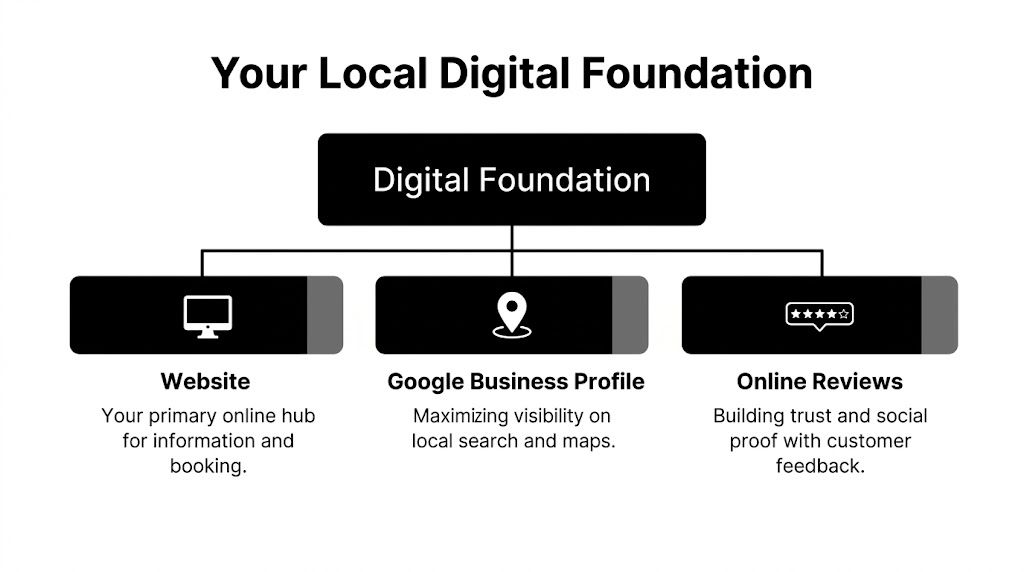
Get your Google Business Profile working
A neglected Google Business Profile wastes ready-to-buy demand. Many profiles have the basics filled out, but that's not enough in competitive areas.
Use this checklist:
- Choose precise service categories: Start with your primary pest control category, then add relevant supporting services if they match your actual offerings.
- Write a real business description: Mention service areas like Fort Myers, Cape Coral, or Naples naturally. Include core services such as termite treatment, rodent control, mosquito control, and recurring home protection if those apply.
- Upload current photos: Include trucks, technicians, equipment, before-and-after exclusion work, and clean exterior shots of your office if you have one.
- Use the Q&A section intentionally: Add common questions a homeowner would ask, then answer them clearly.
- Post updates regularly: Seasonal tips, service reminders, and limited-time offers all help keep the profile active.
One more point. If you offer emergency service, same-day service, or eco-conscious treatment options, say so where appropriate. Those details often decide who gets the call.
Build service pages that convert
A service page shouldn't read like a brochure. It should answer the exact question a homeowner has when they land on it.
For each core service, create a dedicated page. Rodent control needs its own page. Termite treatment needs its own page. Mosquito control, bed bugs, wildlife exclusion, roach control. Split them out.
A useful page structure looks like this:
- State the problem clearly: "Rodents in the attic" is stronger than vague copy about nuisance pests.
- Describe your process: Inspection, treatment, exclusion, monitoring, follow-up.
- Handle objections: Pets, kids, prep steps, timing, warranty questions.
- Show local relevance: Mention the communities you serve naturally.
- Finish with one action: Call, request an inspection, or book a quote.
Homeowners don't want a textbook. They want to know whether you handle their problem, whether you serve their area, and how soon you can help.
Create location pages that deserve to rank
If you want visibility in more than one city, don't rely on a single "service area" paragraph. Build actual location pages.
A Fort Myers page should not be a copy-paste version of a Naples page with the city name swapped out. Write around local conditions, common property types, nearby service neighborhoods, and the services people in that city commonly request.
Businesses that want stronger local visibility usually benefit from tightening these fundamentals before spending more on traffic. If you need a strong model for that work, this guide on local SEO for home services is a solid reference point.
Earn Customer Trust with Reviews and Citations
Visibility gets you considered. Trust gets you chosen.
Pest control is personal. You're not selling a t-shirt or a software subscription. You're asking someone to let your company onto their property, solve a stressful problem, and do it without creating a bigger mess. That's why trust deserves its own system.
Ask for reviews while the relief is fresh
Most companies ask for reviews inconsistently. The technician has a great appointment, the customer is happy, and nobody asks. That wastes the best moment.
Use a process your office can repeat every day:
- Ask right after the job: The ideal time is when the technician has solved the immediate issue and the customer is expressing relief.
- Use simple language: "I'm glad we could help today. If you don't mind, would you leave us a quick Google review? It really helps local homeowners feel confident choosing us."
- Follow up by text or email: Send the direct review link while the visit is still fresh.
- Tag the lead source and service type: This helps you see which jobs create the happiest customers and strongest social proof.
- Train the whole team: Review generation shouldn't depend on one technician who remembers.
Don't overcomplicate the script. Direct and polite works better than trying to sound clever.
Handle negative reviews like future customers are watching
Because they are.
A weak response sounds defensive or generic. A strong response does three things: acknowledges the concern, shows professionalism, and offers an offline path to resolve the issue. You don't need to win the argument in public. You need to show prospective customers that your company takes service seriously.
A basic structure works well:
| Situation | Better response approach |
|---|---|
| Customer says service was late | Acknowledge the inconvenience and invite direct follow-up |
| Customer says issue returned | State that retreatment or review of the service history is available |
| Reviewer sounds mistaken | Stay calm, ask them to contact the office, and verify whether they're an actual customer |
If your process for collecting reviews is weak, your competitors with fewer reviews but better consistency will often look safer to choose. For practical tactics, this resource on how to get more online reviews is worth studying.
Clean up your citations
Citations are mentions of your business name, address, and phone number across directories and local listings. When that information is inconsistent, you create friction for both search engines and customers.
Check the basics across Google, Yelp, Angi, Apple Maps, Bing, local chamber listings, and any industry directories where your company appears.
Focus on these details:
- Business name consistency: Don't use one version with "LLC" in one directory and a shorter version elsewhere unless that's part of a deliberate standard.
- Phone number consistency: Use the main public number consistently across listings.
- Address accuracy: Suite numbers, abbreviations, and formatting should match your chosen standard.
- Service area details: Keep them aligned with your actual operating footprint.
Citations aren't glamorous, but they support credibility. Clean data makes your brand look established. Messy data makes people hesitate.
Generate Leads Now with Smart Paid Advertising
SEO is compounding. Paid ads are immediate. If the phone needs to ring this week, paid search usually becomes part of the plan.
The mistake isn't running ads. The mistake is running them without control. In pest control, broad campaigns can burn cash quickly because high-intent searches are expensive. According to Netpeak's guide to digital marketing for pest control companies, cost per click for high-intent keywords can reach up to $35, but typical customer lifetime values of $300 to $1,500 can still make those clicks worthwhile when the campaign is structured correctly.
Choose the right paid channel
Google Local Services Ads and Google Ads solve different problems.
Local Services Ads are often the cleaner starting point for a small company because they align tightly with local intent and put trust front and center. The lead quality can be strong when your profile is complete and your response time is tight.
Google Ads give you more control. You can target termite treatment, emergency wasp removal, rodent exclusion, or mosquito service in a specific city or service area. That control matters when one service is more profitable, more seasonal, or more important to fill.
Use this decision guide:
- Start with LSAs if: you want a simpler entry point, your service area is defined, and your office can respond quickly.
- Use Google Ads if: you need tighter keyword control, dedicated landing pages, and service-specific messaging.
- Run both if: your intake process is disciplined and you can track outcomes back to revenue.
Tighten targeting before you increase budget
A common failure point is buying broad traffic for narrow services. "Pest control" is often too broad by itself. A homeowner searching "emergency rodent removal near me" is much closer to action than someone browsing generic options.
Good campaigns usually share a few traits:
- Service-specific ad groups: Keep termite, rodent, ant, and mosquito campaigns separate.
- Location control: Target only the cities and ZIP codes you serve.
- Strong landing page match: Send termite clicks to a termite page, not the homepage.
- Negative keywords: Filter out DIY, jobs, free, and unrelated searches that waste spend.
- Call-focused mobile experience: Most urgent pest leads don't want to hunt for a form.
Field note: The ad doesn't close the sale. It earns the click. The landing page and your call handling finish the job.
If you need a practical framework for setup, bidding, and account cleanup, this guide to PPC management for small business covers the essentials.
Use remarketing the right way
Most website visitors won't convert on the first visit, especially for non-emergency services. That's where remarketing helps. Someone visits your termite page, reads a bit, and leaves. A follow-up ad can bring that prospect back after they compare options.
For display and social remarketing, the creative should stay simple. Local credibility, problem solved, easy next step.
If you're extending that strategy onto social platforms, these Facebook advertising best practices are useful for tightening creative and audience setup without turning social into a money pit.
Create a Year-Round Pest Marketing Engine
Seasonality wrecks weak marketing plans. Busy months hide bad habits. Slow months expose them.
A better approach is to build pest control marketing around what homeowners worry about throughout the year, not only what they search during the obvious peak. That's especially important in Florida, where the service mix changes by season but demand never really disappears. It shifts.
According to Scorpion's pest control marketing insights, Google Trends shows a 35% year-over-year increase in searches for "winter pest prevention" in major US markets, which points to off-season demand that many local companies ignore.

Match content to seasonal demand
Your content calendar should mirror how people think.
In spring, homeowners tend to notice activity. In summer, they think about outdoor comfort. In fall, they start reacting to intrusions. In winter, preventive concerns and rodent issues often move higher on the list.
That translates into practical content like:
- Spring topics: ant trails, swarmers, early termite warning signs, prep for exterior treatments
- Summer topics: mosquito reduction, yard conditions that attract pests, outdoor entertaining without biting insects
- Fall topics: roaches, spiders, entry points around doors and garages
- Winter topics: rodent proofing, attic activity, crawlspace inspections, prevention plans
The key is to publish before the rush, not during it. If you wait until calls spike, you're late.
Make social media useful, not decorative
Most pest control social content fails because it looks like generic small-business filler. Stock photos, holiday graphics, vague captions. That content doesn't help a homeowner make a decision.
Use your real operation instead:
- Technician photos in the field: Clean uniforms, trucks, exclusion work, inspection snapshots with permission.
- Short educational videos: Show how to identify common problem signs around the home.
- Pest of the week posts: Keep these local and practical.
- Customer testimonials: Focus on peace of mind and professionalism, not hype.
- Behind-the-scenes clips: Explain what happens during an inspection or recurring service visit.
A useful social post answers a homeowner's question before they ask it.
This approach also helps your sales conversations. Prospects who have seen your team online arrive warmer. They recognize the truck, the technician style, and the tone of your brand.
Keep offers aligned with the season
Don't force the same message year-round. A general "call us for pest control" offer gets stale fast. Rotate the angle based on seasonal relevance.
A practical example for Southwest Florida:
| Season | Better offer angle |
|---|---|
| Spring | Inspection-first messaging for active infestations |
| Summer | Mosquito and exterior perimeter service bundles |
| Fall | Home sealing and prevention messaging |
| Winter | Rodent inspection and prevention plans |
The goal isn't to chase every trend. It's to keep your brand visible when competitors go quiet, so your slow season becomes more stable and less reactive.
Amplify Your Reach with Strategic Partnerships
Some of the best pest control leads never start with a Google search. They start with another trusted local professional saying, "Call this company."
A simple example. A pest company builds a relationship with a realtor who handles listings in Fort Myers and nearby communities. The realtor runs into termite concerns, WDO questions, last-minute inspection needs, and anxious buyers who want reassurance before closing. If the pest company is responsive, clear, and easy to work with, that realtor keeps sending business.
That's not theory. That's how many durable referral channels get built. Not through complicated networking tactics. Through repeat usefulness.
Start with the partners closest to the problem
Good targets usually fall into a few groups:
- Realtors: They need dependable inspection support and smooth communication.
- Property managers: They care about consistency, documentation, and tenant coordination.
- Home inspectors: They see issues early and value reliable follow-through.
- Contractors: Roofers, plumbers, exterior specialists, and restoration companies often hear about pest issues before the pest company does.
Not every local professional is worth chasing. Focus on the ones who already work with your ideal customer and have a real reason to mention your name.
Lead with value, not with a pitch
The fastest way to kill a partnership conversation is to make it about your company too soon. Start by making the other business look good to its own clients.
For a realtor, that might mean offering a straightforward inspection process and fast reporting. For a property manager, it might mean a dependable recurring service structure and clear communication with tenants. For a home inspector, it could mean being available when they need a second set of eyes on a concern.
A practical outreach approach looks like this:
- Choose one partner type first: Don't try to build five channels at once.
- Create one useful offer: Something simple and easy to understand.
- Make contact personally: In person, by phone, or with a concise email.
- Follow up consistently: Most referral relationships take time to warm up.
- Support the relationship: Send updates, respond quickly, and make referrals back when appropriate.
Protect the relationship with execution
Partnership leads close well because trust is preloaded. But they disappear fast if your process is sloppy.
If a realtor sends a lead and your office takes too long to reply, that relationship weakens. If a property manager sends recurring work and your communication is uneven, you'll lose the account. Referral channels are built on operational reliability more than charm.
A strong partner network becomes hard for competitors to copy because it isn't just ad spend. It's reputation compounded over time.
Your 90-Day Pest Control Marketing Blueprint
Most owners don't need more ideas. They need the right order of operations.
A useful pest control marketing plan for the next three months should create early wins without overwhelming the team. The sequence matters. Foundation first. Activation second. Expansion third.
Month 1 and fix the basics
In the first month, focus on assets you control. Don't launch five campaigns. Tighten the parts of your presence that affect every lead source.
Priority actions:
- Finish your Google Business Profile: Services, description, photos, service areas, business details, and messaging settings.
- Update core website pages: Homepage, contact page, and top service pages.
- Create location relevance: Add or improve pages for the main cities you serve.
- Check lead capture paths: Click-to-call buttons, forms, mobile experience, and thank-you pages.
- Standardize tracking: Make sure calls and form submissions are being captured somewhere reliable.
If your office team doesn't know how leads should be handled after they come in, write that process down now. Marketing without follow-up discipline creates fake optimism.
Month 2 and turn visibility into leads
Once the foundation is in better shape, add controlled lead generation.
This is the month to activate review collection and a modest paid channel. Keep the scope narrow enough that you can judge quality clearly.
Use this operating checklist:
- Launch a review request workflow: Technician asks, office follows up, direct link sent.
- Turn on one paid channel: Local Services Ads or a focused Google Ads campaign.
- Use one landing page per service focus: Don't send paid traffic to a generic homepage.
- Audit response time: Leads should reach a person quickly.
- Review search terms weekly: Cut obvious waste and refine intent.
Don't try to "scale" in month two. Prove that the channel can produce qualified leads first.
Month 3 and build stability
Now add the pieces that reduce dependence on one channel.
This is the month to create one referral relationship and publish seasonal content that keeps bringing in local traffic over time. Think durability, not novelty.
Good month-three actions include:
- Reach out to one partner category: Realtors, property managers, or home inspectors.
- Publish two local blog posts: Choose seasonal topics homeowners search for.
- Create one educational video or photo set: Use your own technicians and your own field experience.
- Refine service offers by season: Match current demand patterns in your area.
- Review results and reallocate time: Keep what is producing, pause what isn't.
Sample 90-day marketing budget
This is a sample planning table, not a fixed formula. The exact split depends on your service mix, local competition, and whether your website needs major cleanup first.
| Month | Activity | Focus | Sample Budget |
|---|---|---|---|
| Month 1 | Google Business Profile updates, website fixes, service page improvements, call tracking setup | Foundation and conversion readiness | Low to moderate, depending on website work needed |
| Month 2 | Review request workflow, LSA or Google Ads launch, landing page adjustments | Lead generation and trust building | Moderate, with tight control on paid spend |
| Month 3 | Seasonal content creation, partner outreach, remarketing or campaign refinement | Stability and channel diversification | Moderate, shifted toward proven channels |
A small company doesn't need a huge budget to improve results. It needs discipline. Many firms waste money by spreading too thin across SEO, social, search ads, print, and random sponsorships at the same time. Narrow focus usually wins.
The best 90-day plans are boring in the right way. They rely on repeatable actions, local relevance, fast response, and clean follow-up.
Track What Matters to Guarantee Growth
Many pest companies think they're tracking marketing when they're really just watching activity. Website visits go up. Social engagement looks decent. Impressions increase. None of that guarantees booked work.
The numbers that matter are the ones tied to revenue. Qualified calls. Quote requests. Booked inspections. Closed jobs. Repeat service agreements.
According to IronChess SEO's analysis of pest control KPIs, top-performing pest control websites achieve conversion rates of 5% or more on key service pages, while poorly optimized sites convert at under 1%. That's the difference between a page that produces leads and a page that just sits there.
Ignore vanity metrics and watch buying signals
Traffic matters only if the right visitors take action. A smaller volume of local, high-intent traffic is often more valuable than a larger audience that never calls.
Track these first:
- Qualified leads: Phone calls and form submissions from real prospects in your service area.
- Cost per lead: Total marketing spend divided by total qualified leads.
- Lead-to-customer rate: How many qualified leads book and buy.
- Service-line performance: Which services produce the best opportunities.
- Source quality: Google Business Profile, organic search, LSAs, Google Ads, referrals, and social.
If you don't separate lead sources, weak channels can hide behind overall volume.
Use simple tracking, not complicated dashboards
You don't need an enterprise analytics stack to run smarter pest control marketing. You need consistent attribution.
A practical setup includes:
- Google Analytics for site behavior: See which pages attract traffic and where visitors drop off.
- Call tracking software: Know which campaigns and pages generate calls.
- CRM or job management notes: Record whether a lead booked, what service they wanted, and what revenue followed.
- Monthly review cadence: Compare spend, leads, booked jobs, and close quality.
The goal of tracking isn't reporting. It's decision-making.
If a page gets visits but no calls, fix the page. If a campaign brings leads outside your service area, tighten targeting. If referrals close better than paid leads, invest more time in partnerships.
Let conversion rate guide your next move
A lot of owners assume they need more traffic when they actually need better conversion. That's an expensive misunderstanding.
If your termite page gets traffic but few inquiries, review the page itself. Is the offer clear? Is the phone number easy to tap on mobile? Does the copy answer real homeowner concerns? Is the location relevance obvious?
Likewise, if your office misses callbacks or responds slowly, marketing performance will always look worse than it should. Tracking exposes whether the issue is visibility, conversion, intake, or sales follow-through.
Good growth doesn't come from doing more of everything. It comes from measuring the few things that tell you what to fix next.
If your pest control company needs a practical plan instead of another generic marketing pitch, Polaris Marketing Solutions is worth a look. They work with small and mid-sized businesses in Southwest Florida and focus on the fundamentals that move the needle for local service companies, including visibility, lead generation, conversion, and clear ROI.