
A lot of plumbing owners in Fort Myers call after the same thing happens. They search their own services, see another company in the Map Pack, and realize the phone is probably ringing at a competitor’s office instead of theirs.
That frustration is valid. Plumbing local seo isn’t a branding exercise. It’s how you show up when someone in Cape Coral has a slab leak, someone in Estero has a dead water heater, or someone in Bonita Springs needs an emergency call before work.
The good news is that local visibility is fixable when you stop treating it like a generic SEO checklist and start building around the ways plumbing customers search in Southwest Florida. The playbook below is the one that works in the field: get the Google Business Profile tight, build pages for real service areas, earn reviews consistently, clean up citations, and push into the neighborhoods your competitors ignore.
Why Your Next Plumbing Job Depends on Local SEO
If your crew does solid work but your company keeps missing high-intent searches, the issue usually isn’t demand. It’s placement. The homeowner with a leak under the slab isn’t comparing twenty plumbing websites. They’re choosing from the businesses Google puts in front of them first.
That’s why local visibility has become operational, not optional. 88% of consumers are influenced by local search results when selecting plumbing services, and 70% of mobile searches result in a click on one of the top three Google Map Pack listings according to ALM Corp’s plumbing local SEO guide. If you’re outside those top spots, you’re often invisible at the moment the job is ready to book.
In practice, that changes how I look at marketing for plumbers. I don’t start with logos, taglines, or broad awareness campaigns. I start with whether the business appears for urgent local searches, whether the phone number is easy to tap, and whether the prospect sees enough trust signals to call right now.
Most plumbing searches happen under pressure. The business that looks closest, clearest, and most credible usually gets the first call.
There’s also a workflow angle here. If you’re already tightening operations on the back end with tools like Exayard plumbing estimating software, local SEO helps the front end match that efficiency by bringing in better-fit local leads instead of random inquiries.
The rest of this guide is the exact playbook. No fluff. Just what works, what wastes time, and where Fort Myers plumbers can gain ground fast.
Master Your Google Business Profile The Digital Foundation
Your Google Business Profile is the center of plumbing local seo. If it’s incomplete, sloppy, or inconsistent, your website has to work much harder than it should.
Data shows that the top 16% of fully optimized Google Business Profiles generate over 100 calls each month. Local searches make up 46% of all Google searches, and 78% of local mobile searches lead to an offline purchase or visit within 24 hours. For plumbers, that means one thing: your profile has to be treated like a revenue asset, not a directory listing.

Set the profile up like a real service business
Most plumbers should use Plumber as the primary category. Then add secondary categories only if you perform those jobs. Good examples include water heater installation service or drain cleaning service. Bad examples are categories that sound related but don’t reflect your work mix.
For service-area businesses, be careful with the address setup. If customers don’t visit your office, don’t force a storefront presentation just because it looks more official. It often creates confusion and can trigger verification headaches later.
Use a service area that reflects where you can realistically dispatch. For Southwest Florida, that usually means a practical cluster such as Fort Myers, Cape Coral, North Fort Myers, Estero, Bonita Springs, and nearby communities you already service profitably.
Fill in every field that affects trust
An underbuilt profile usually has three problems. Thin business info, weak visuals, and no active management.
Here’s the standard I use:
- Business description: Write a plain-English summary of what you do, who you serve, and what makes you reliable. Mention emergency service, residential and commercial work if applicable, and key local areas naturally.
- Hours: If you offer emergency service, reflect that accurately. Don’t list 24/7 if the phone rolls to voicemail overnight.
- Services menu: Add each core service as its own entry. Drain cleaning, leak detection, sewer repair, repiping, water heater repair, and installation should not be buried in one generic line.
- Attributes: Use only the ones that apply to your operation.
- Appointment and website links: Test them on mobile, not just desktop.
A lot of plumbers ignore the mechanics behind the power of 'Near Me' searches. That’s a mistake. Google is matching service relevance, location context, and mobile intent fast. Your profile has to help it, not slow it down.
Practical rule: If a homeowner can’t understand what you do, where you go, and how to contact you within a few seconds of landing on your profile, the setup isn’t finished.
Use photos that prove you’re real
Many GBP galleries are filled with stock graphics, logos, or low-quality truck shots. That doesn’t build trust. Real jobsite photos do.
Aim for a photo library that includes:
| Photo type | What to upload |
|---|---|
| Team photos | Uniformed techs, office staff, owner, dispatch team |
| At work | Technicians diagnosing leaks, replacing heaters, clearing drains |
| Before and after | Clean, honest proof of completed plumbing work |
| Vehicles | Wrapped vans or trucks in recognizable local settings |
| Office and equipment | Front desk, warehouse, tools, organized materials |
Good photos say, “These people will show up.” That matters more than polished branding.
Control the questions before prospects ask them
The Q&A section is underused. For plumbers, it’s a conversion tool.
Seed common questions yourself from the owner account, then answer them clearly. Keep the language direct and useful.
Examples:
- Do you offer emergency plumbing in Fort Myers after hours?
- Do you service tankless water heaters in Cape Coral?
- Can I get an estimate before work begins?
- Do you handle drain cleaning for older homes in Bonita Springs?
That keeps random users from defining your profile for you.
After the core profile is built, use a checklist so nothing slips through. This Google Business Profile optimization checklist is the kind of process document I recommend having in place for owners or office managers.
A quick visual walkthrough helps if you’re auditing your profile in-house:
What works and what doesn’t
What works
- A complete profile with accurate service categories
- Real local photos uploaded consistently
- Fast responses to reviews and Q&A
- Service descriptions that match actual customer searches
- Clear links and call paths on mobile
What doesn’t
- Stuffing city names into the business title
- Listing every surrounding town if you rarely dispatch there
- Using stock images in place of field photos
- Setting the profile up once and ignoring it
- Pretending to be a storefront when you operate as a service-area business
When a plumber tells me “we already have a Google profile,” I usually find an asset that exists but isn’t optimized. There’s a big difference.
Optimize Your Website for Local Calls and Clicks
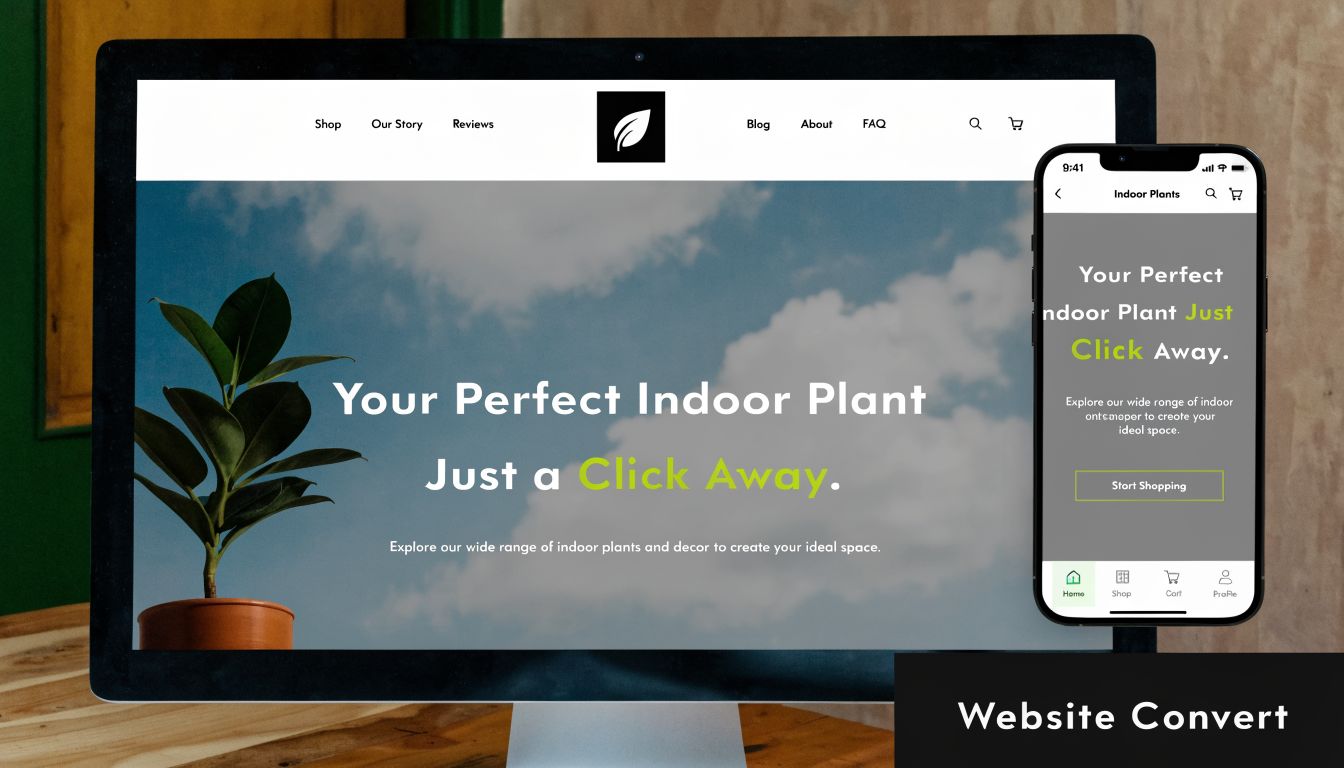
Your website should act like a digital service area map. The homepage is the main office. Every service page and location page is a branch that tells Google and prospects exactly what you do and where you do it.
That structure matters because generic plumbing sites don’t rank well for local intent. A homepage that says “we do it all” is weak. A site that breaks out drain cleaning, water heater repair, leak detection, sewer work, and emergency service across specific Southwest Florida locations is much easier for Google to understand.
Build the site around service intent
Start with core service pages. Each page should target one real buyer need.
A solid structure looks like this:
- Homepage for the brand and primary market
- Service pages for drain cleaning, leak repair, repiping, sewer repair, water heater services, emergency plumbing
- Location pages for Fort Myers, Cape Coral, Estero, Bonita Springs, Naples, and other real service areas
- Supporting articles that answer specific homeowner questions
The mistake I see most often is combining every service into one long page and then trying to force rankings with a few city mentions. That’s not enough. If you want to rank for emergency plumber in Cape Coral, you need a page that supports that intent.
What a strong location page includes
A location page shouldn’t be a spun template with the city swapped out. Google sees through that fast, and users do too.
For a page like “Emergency Plumber in Cape Coral, FL,” include:
- A clear title tag and H1 that match the service and city
- Unique local copy about the area’s housing stock, water issues, or common plumbing problems
- A short section about neighborhoods or service zones in that city
- Embedded map placement
- Testimonials from customers in that market, if you have them
- A visible phone number and form above the fold
- Internal links to relevant service pages
In Southwest Florida, local relevance often comes from specifics. Mention hard water issues, aging piping in older neighborhoods, storm-related plumbing risks, or local homeowner concerns when they apply.
A location page should read like it was written by someone who actually sends trucks there.
Keep technical SEO simple and useful
Plumbers don’t need a complicated technical stack. They need a site that loads fast, works on phones, and tells search engines what the business is.
Focus on these basics:
Mobile-first layout
The site has to be easy to use with one thumb. That means:
- tap-to-call buttons
- short forms
- large text
- no cluttered menu
- no giant image sliders slowing the page down
Schema markup
Add LocalBusiness and Plumber schema markup to the site. This helps search engines connect your business name, service area, hours, contact details, and service type.
At minimum, schema should support:
- business name
- phone number
- website
- service area
- hours
- service category
Internal linking
Don’t leave pages isolated. Your Fort Myers location page should link to emergency plumbing, water heater repair, and drain cleaning. Your drain cleaning page should link back to the cities where you offer it.
That creates a clean local relevance web inside the site.
What to write on pages that need to convert
Most plumbing pages fail because they sound like brochures. They talk about being trusted, experienced, and committed, but they don’t answer what the homeowner needs to know.
Use copy blocks that do this instead:
| Weak copy | Better copy |
|---|---|
| “We provide quality plumbing solutions” | “Need a plumber in Fort Myers for a leak, clog, or failed water heater? Call for same-day service when available.” |
| “Customer satisfaction is our priority” | “You’ll get a clear diagnosis, upfront recommendations, and a simple next step before work begins.” |
| “We serve many surrounding areas” | “We service Fort Myers, Cape Coral, Estero, Bonita Springs, and nearby communities in Southwest Florida.” |
The trade-off most owners miss
A tight local site takes more work up front. You have to write separate pages, add local proof, and maintain them. But that effort pays off because each page can rank for a narrower, more profitable search.
A thin site is easier to launch. It’s also easier to ignore. If your goal is more local calls, build depth where buyers search.
Build Unshakable Trust with Reviews and Citations
Plumbing local seo doesn’t hold up on optimization alone. You also need prominence, which is Google’s way of asking whether your business looks established and trusted across the web.
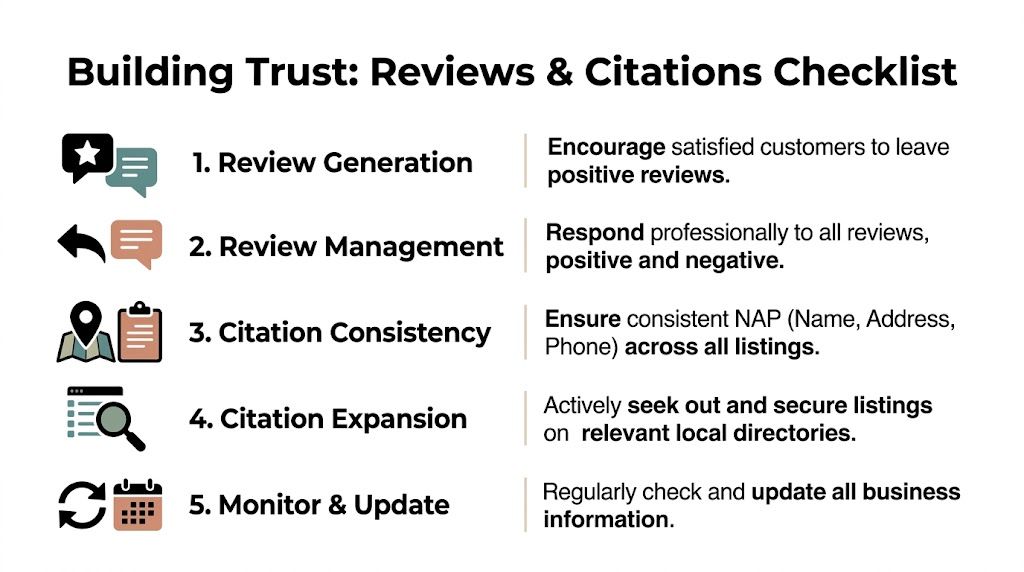
That’s where reviews and citations work together. Reviews shape buyer confidence and local ranking strength. Citations confirm your business details across directories, maps, and business listings.
Online reviews directly influence an estimated 19.2% of local search position, and aiming for a rating of 4.8 stars or higher with recent, consistent reviews is a key driver of visibility according to Husky Tail Digital’s plumbing local SEO methodology.
Build a review process your team will actually use
The best review strategy is the one your techs and office staff can repeat without thinking.
Here’s a simple version that works:
Ask right after a good job outcome
The best time is when the homeowner is relieved and the result is visible.Text the review link fast
Don’t say “we’ll send something later” and forget. Send it while the job is still fresh.Keep the ask short
“Thanks for trusting us today. If the service helped, would you mind leaving a quick Google review?”Train the office to follow up once
One reminder is fine. Repeated nagging is not.
A lot of companies overcomplicate this with long email templates. Plumbing customers don’t want a campaign. They want a fast prompt and a simple link.
Reply to every review like prospects are reading
Because they are.
For positive reviews, thank the customer and mention the service performed if appropriate. For negative reviews, don’t get defensive. A calm response often repairs more trust than the original complaint damaged.
Use this pattern for negative feedback:
- acknowledge the issue
- apologize for the experience
- invite the customer offline to resolve it
- keep the tone professional
“We’re sorry the experience missed the mark. Please contact our office so we can review what happened and work toward a resolution.”
That kind of response protects your brand better than trying to win an argument in public.
Clean up your citations before building more
A citation is any business listing that includes your name, address, and phone number. If those details vary across the web, Google gets mixed signals. So do customers.
Common citation problems for plumbers:
- old tracking numbers still floating around
- “Street” on one listing and a different format elsewhere
- old office addresses
- duplicate listings from a past rebrand
- one directory showing a hidden address while another shows a storefront
Start with the major platforms and key home service directories. Then expand outward.
A basic citation audit should check:
- Google Business Profile
- Apple Maps
- Bing Places
- Yelp
- Angi
- BBB
- industry and local business directories
If you need a reference point for a broader cleanup process, this overview of local citation building services gives a useful framework for what should be monitored and corrected.
Reviews and citations support each other
This is the part many guides miss. Reviews tell Google and the customer that people trust you. Citations tell Google the business details are stable and real. One without the other is weaker.
A plumbing company with great reviews but messy listing data often underperforms. A company with clean citations but almost no recent reviews looks inactive. You need both signals moving in the same direction.
What I’d do first if trust signals are weak
If a plumber in Fort Myers asked where to start, I’d prioritize it in this order:
- Fix the Google review request process
- Respond to every existing review
- Audit the core citations for NAP consistency
- Remove duplicate or outdated listings
- Then expand into additional quality directories
That order works because it improves both conversions and local authority quickly, without creating extra noise.
Create Authority with Content and Local Links
Most plumbing companies stop too early. They build one Fort Myers page, one services page, and maybe a few blog posts. That’s enough to be present. It’s usually not enough to dominate.
The bigger opportunity in plumbing local seo is going narrower, not broader. In Southwest Florida, that means targeting the actual communities and suburbs where buyers search, where proximity matters, and where many competitors haven’t built focused pages.
Competition for neighborhood-specific keywords is often 60% lower than for city-wide terms, and proximity drives over 55% of local ranking influence according to Uprankd’s guide on mastering local SEO for plumbers.

Stop thinking only in cities
If your entire local content strategy is “Plumber in Fort Myers,” you’re leaving room for smaller, smarter competitors.
In this market, I’d rather see plumbers build useful pages and content around:
- Cape Coral neighborhoods
- North Fort Myers communities
- Estero subdivisions
- Bonita Springs service pockets
- Naples-adjacent residential areas they actively serve
That approach matches how local ranking works in practice. Search visibility can shift within a short drive. One part of a service area may show you strongly. Another may barely show you at all.
Use geo-grid tracking to find weak spots
This is one of the most overlooked tactics in local SEO for plumbers.
A geo-grid tool like Local Falcon lets you see how your Google visibility changes across different points on the map. That matters because ranking “well in Fort Myers” is too vague to act on.
What geo-grid data can reveal:
- strong visibility near your office but weak visibility in Cape Coral
- poor performance in underserved neighborhoods
- pockets where a competitor owns the Map Pack
- places where a dedicated suburb page or more local links could help
If you don’t measure rankings across the map, you can’t tell whether your service area is truly covered or just looks covered from one zip code.
Create content locals would actually read
Authority content for plumbers should solve local homeowner problems. Not generic “top ten plumbing tips” filler.
Good Southwest Florida examples:
- Fort Myers homeowner guide to plumbing checks before storm season
- What salt air can do to exposed outdoor plumbing fixtures in Cape Coral
- Signs an older home may need repiping in established neighborhoods
- Tankless water heater questions local homeowners ask before installation
- Cast iron versus PEX considerations in renovation work
That content does two jobs. It builds topical depth for search engines, and it makes your business sound like a local operator instead of a templated brand.
Here’s a simple comparison:
| Weak content idea | Stronger local content idea |
|---|---|
| “How to fix plumbing issues” | “What Fort Myers homeowners should check after heavy rain or localized flooding” |
| “Water heater guide” | “Tankless water heater installation questions we hear in Cape Coral homes” |
| “Drain problems explained” | “Why kitchen sink backups happen in older Southwest Florida homes” |
Earn links that make local sense
Local links still matter, but the standard should be relevance, not volume.
The best plumbing link opportunities are often offline relationships turned into online mentions:
- local chambers of commerce
- builder associations
- supplier relationships
- home service partners such as electricians and HVAC companies
- sponsorships for schools, leagues, and community groups
- local news or neighborhood publications
If you’re doing active outreach, ask a simple question before pursuing any link: would this website make sense if a real homeowner found it? If the answer is no, it probably isn’t worth your time.
A focused approach to local link building service usually beats broad, low-quality outreach because it strengthens geographic relevance, not just domain metrics.
What works better than pumping out generic blogs
I’d rather publish fewer pieces with a clear purpose than churn out keyword-heavy posts no one reads.
A practical content and link mix for a plumbing company looks like this:
- one strong city page per real market served
- selective suburb or neighborhood pages where geo-grid data shows opportunity
- service pages tied to local intent
- educational articles tied to local weather, housing, or plumbing conditions
- local partnerships that can lead to trusted mentions and backlinks
That combination creates a harder-to-copy footprint. A big competitor can outspend you on broad terms. They can still miss the neighborhood-level demand if they don’t build for it.
Track Your ROI and Win in Southwest Florida
A plumbing SEO campaign only counts if it produces booked work. Rankings are useful. Traffic is useful. Neither pays the crew by itself.
The KPI set I care about for plumbers is simple:
- phone calls from organic search and Google Business Profile
- contact form submissions
- clicks for directions when relevant
- booked jobs tied back to local search pages or listings
That’s where the business case becomes clear. A well-executed local SEO campaign that integrates AI-driven signals and emergency intent can boost phone leads by over 300% and increase organic traffic by more than 180% as noted earlier in the ALM Corp research. The point isn’t the headline number by itself. The point is that visibility becomes measurable revenue when the right tracking is in place.
Measure the channels that create jobs
For plumbing local seo, I use a narrow dashboard mindset. Too many reports bury owners in metrics that don’t help them make decisions.
The essentials are:
- Google Search Console for search queries, page visibility, and indexing issues
- Google Analytics for lead actions and user behavior
- call tracking software to connect calls to SEO pages and campaigns
- GBP insights to monitor calls, clicks, and engagement trends
- geo-grid tracking to see where the map visibility is strong or weak
If the emergency plumber page in Cape Coral gets traffic but no calls, that page may have a trust problem. If the Fort Myers drain cleaning page gets calls but weak rankings, that suggests the offer converts and needs more visibility support.
Don’t report vanity metrics in isolation
Impressions can rise while leads stay flat. Rankings can improve while the wrong pages get the traffic. That’s why local SEO reporting for plumbers has to tie back to jobs, not just visibility.
I’d rather see a report that answers these questions:
- Which pages generated calls?
- Which towns or neighborhoods are improving?
- Which service terms are driving contact?
- Where are we visible but not converting?
- Which fixes should happen next month?
That’s a better operating document than a giant PDF full of charts.
Your Southwest Florida local SEO checklist
Use this as a working list, not a one-time setup.
- Google Business Profile complete with accurate categories, services, photos, Q&A, and service area settings
- Website structure built out with separate service pages and real location pages for Fort Myers, Cape Coral, Estero, Bonita Springs, and other active markets
- Mobile conversion paths clear with tap-to-call buttons, short forms, and visible trust signals
- Review system running through field requests and office follow-up
- Core citations cleaned up so NAP details stay consistent
- Neighborhood opportunities mapped using geo-grid tracking
- Local content publishing around real homeowner issues in Southwest Florida
- Local partnerships active for relevant links and mentions
- Tracking installed so calls and leads can be tied to pages and locations
The plumbers who win locally aren’t always the biggest companies. They’re often the ones with the cleanest profile, the strongest trust signals, and the best coverage in the neighborhoods competitors overlooked.
Southwest Florida is competitive, but it’s also fragmented in a way that creates openings. Fort Myers isn’t Cape Coral. Estero doesn’t behave exactly like Bonita Springs. The companies that build local SEO at that level usually outperform the ones running a generic county-wide strategy.
If your plumbing company needs a clearer local SEO game plan in Fort Myers, Cape Coral, Estero, Bonita Springs, or nearby Southwest Florida markets, Polaris Marketing Solutions can help you sort out what’s working, what’s holding rankings back, and where the best local opportunities are. The team focuses on practical lead generation, not vague marketing talk, with support for Google Business Profile optimization, local SEO, website improvements, and reporting that ties visibility to actual business growth.