

Some months your schedule feels packed. The phones are moving, hygiene is steady, and larger cases are showing up. Then a slow stretch hits, cancellations pile up, and suddenly you're wondering whether the problem is marketing, front-desk follow-up, your website, or just the market.
That uncertainty is what makes growth hard in a dental practice. You can't hire confidently, invest in equipment confidently, or plan expansion confidently when patient flow swings week to week.
If you're serious about how to get more dental patients, stop thinking in isolated tactics. More reviews alone won't fix a weak website. More ad spend won't save a front desk that doesn't answer fast. Better SEO won't matter if your Google Business Profile is incomplete or your treatment presentations fall flat. What works is a connected system that turns local attention into booked appointments, booked appointments into accepted treatment, and happy patients into referrals.
Your Goal is More Than Just Patients
A practice in Fort Myers can look busy on the schedule and still have a growth problem.
I see this often. The phone rings, new patients come in, and the month feels active. Then the owner looks at production, case acceptance, hygiene reappointment, and provider utilization and realizes the volume was not the win. Too many low-value emergencies. Too many price shoppers. Too few families, implant cases, or long-term patients who fit the practice model.
The target is a steady flow of patients your team can serve profitably and retain. That means setting a monthly patient goal based on provider capacity, preferred procedures, collection targets, and how quickly the front desk can convert inquiries into kept appointments. This number provides an operational benchmark, not just an emotional one.
Without that benchmark, practices make expensive decisions. They increase ad spend when missed calls are the problem. They push for more new patients when hygiene is already strained. They celebrate lead volume that never turns into treatment.
In a competitive market like Southwest Florida, disconnected marketing creates waste fast. Local SEO may generate map views. Ads may drive calls. Reviews may improve response rates. If those pieces are not tied to one budget and one tracking system, it becomes hard to tell what is producing booked appointments and accepted treatment.
That is why growth has to be managed as a system:
- Patient target: Set a monthly goal tied to dentist capacity, hygiene availability, and production goals.
- Channel mix: Assign each source a job, such as Google Business Profile visibility, paid search for immediate demand, and reactivation for past patients.
- Conversion process: Track calls answered, forms submitted, appointments booked, show rates, and treatment acceptance.
- ROI tracking: Review cost per booked patient and cost per accepted case, not just clicks or impressions.
A lot of practices skip the setup work because it feels less urgent than running campaigns. It is the part that protects your budget.
If your local visibility is weak, start by tightening the basics in your Google profile and local listings with a Google Business Profile optimization checklist for local practices. Then build the rest of the system around what your numbers say you can support.
Master Your Digital Front Door with Local SEO
A Fort Myers parent searches "emergency dentist near me" at 7:10 a.m. before work. They do not review ten practices. They check the map pack, scan a few profiles, compare reviews, hours, photos, and how easy it looks to call or book. If your local presence is incomplete or inconsistent, that patient goes to the office that made the decision easier.
That is why local SEO deserves a defined role inside your growth system. Its job is to capture existing demand from nearby patients and send it into a trackable booking path. In a competitive market like Southwest Florida, local visibility without measurement is only partial progress. You need to know which searches lead to calls, which pages support booked appointments, and whether the cases coming in fit your production goals.
Start with your Google Business Profile
Your Google Business Profile often creates the first impression before a patient ever reaches your site. I have seen practices spend heavily on ads while leaving this profile half-finished. That is a budget leak.
A strong profile includes:
- Accurate core details: Practice name, address, phone number, hours, website, and appointment link should match your other listings.
- Correct categories: Choose a primary category that reflects your main service focus. Add supporting categories only when they match real services.
- Service listings: Include treatments patients search for, such as emergency dentistry, implants, cosmetic dentistry, cleanings, pediatric care, or dentures.
- Current photos: Use real images of the exterior, operatories, team, and front desk. Outdated or stock-style photos reduce trust.
- Questions and answers: Address common concerns like insurance, financing, same-day emergencies, sedation, parking, and new patient paperwork.
- Direct next step: Give patients a clear way to call or request an appointment.
For a step-by-step reference, use this Google Business Profile optimization checklist for local practices.
Build service pages around local intent
Generic service pages rarely pull their weight in local search. A page titled "Restorative Dentistry" is too broad to compete for the searches that drive appointments.
Create pages based on how patients search in your area. For a Southwest Florida office, that usually means focused pages such as:
- Emergency dentist in Fort Myers
- Dental implants in Fort Myers
- Cosmetic dentist in Fort Myers
- Clear aligners in Fort Myers
- Family dentist in Fort Myers
Each page should answer practical questions. What problem does the treatment solve? Who is a good candidate? What happens at the first visit? How long does treatment usually take? What financing or payment options are available?
The page also needs to convert. If you want a useful reference on page structure, review how to create a landing page that converts. The best local SEO pages do two jobs at once. They rank for specific intent and make booking simple.
A good test is simple. If the copy could belong to any dentist in any city, it is too generic.
Clean up your local signals
Google compares your website, profile, and third-party listings to judge whether your practice looks established and relevant in your area. Inconsistent business information creates friction.
Your name, address, and phone number should stay aligned across directories, social profiles, insurance listings, chamber pages, and healthcare platforms. Minor differences are not always catastrophic, but enough inconsistency weakens trust and makes local visibility harder to maintain.
Use this audit framework:
| Area | What to check | What good looks like |
|---|---|---|
| Google profile | Hours, categories, services, booking link | Complete and current |
| Website | Location terms on service pages | City-specific and patient-focused |
| Directories | Name, address, phone consistency | Same format everywhere |
| Reviews | Freshness and response activity | Active management |
| Mobile experience | Tap-to-call and fast load | Easy from the first screen |
What tends to produce results
Local SEO improves when the setup matches patient behavior and your intake process.
What usually works:
- Focused service pages tied to real search intent
- An active Google Business Profile with recent updates
- Fresh office and team photos
- Consistent local citations
- Review generation tied to actual patient experience
What usually wastes time:
- Repeating city names unnaturally across pages
- Publishing thin suburb pages with copied text
- Letting the profile sit untouched for months
- Sending every local visitor to a generic homepage
- Ignoring mobile call and booking behavior
The trade-off is straightforward. Local SEO is slower than paid search, but it compounds when your profile, pages, reviews, and booking path work together. For many dental practices, that makes it one of the most efficient channels in the mix, especially when you track calls, form fills, booked appointments, and case value by source instead of treating search visibility as its own goal.
Turn Website Visitors Into Booked Appointments
A dental website shouldn't function like an online brochure. It should function like a receptionist who never misses a call, never forgets to ask for the appointment, and never makes a patient work to find the next step.
That's where most practices lose momentum. They spend money getting traffic from Google, then send that traffic to a site that looks fine but doesn't convert.
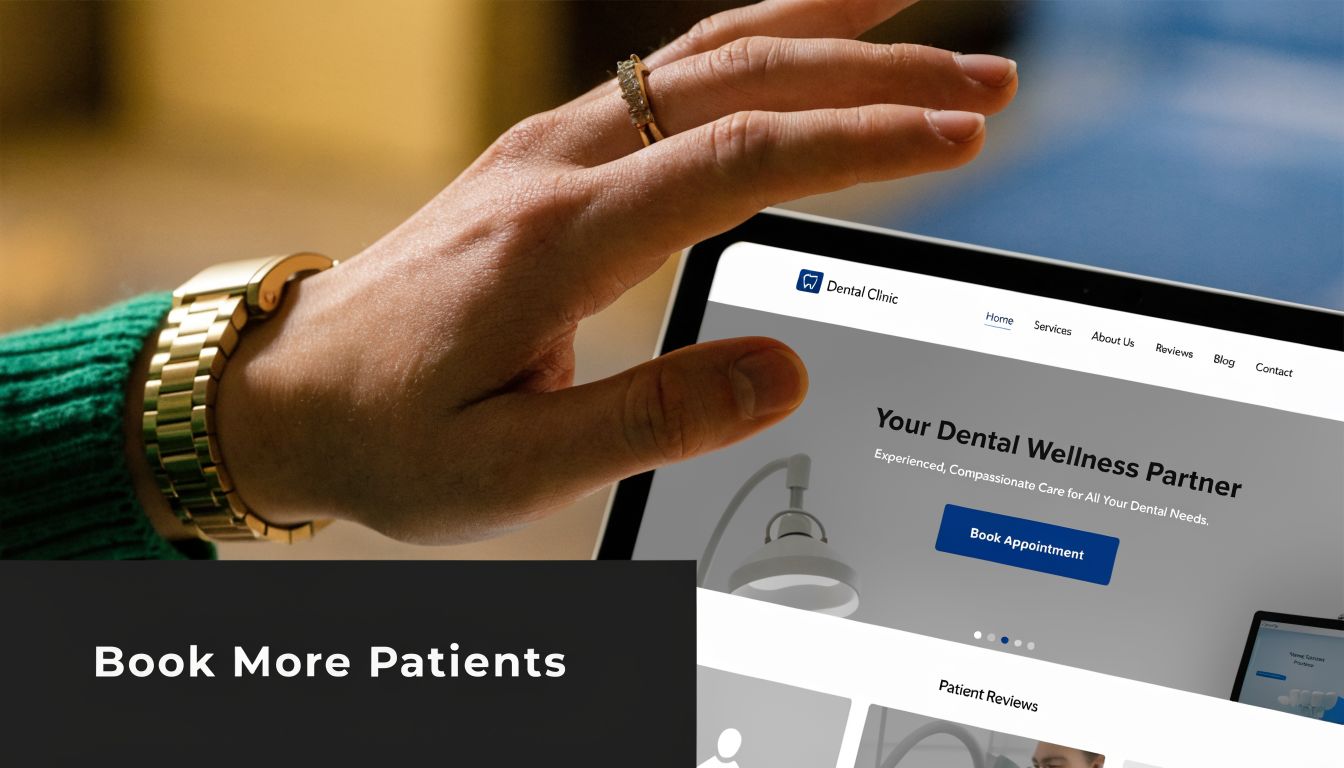
Your homepage has one job
When a new visitor lands on your site, they make a fast decision. Are you close enough, credible enough, and easy enough to contact?
If the first screen doesn't answer that, your bounce problem isn't a traffic problem. It's a website problem.
A strong homepage usually includes these elements above the fold:
- A clear headline: Say what you do and where you do it.
- Primary call button: “Call Now” should be obvious on mobile.
- Appointment option: Give patients a second path if they don't want to call.
- Trust signals: Reviews, insurance info, doctor credentials, or office photos.
- New patient message: Make it easy for first-time visitors to know they're in the right place.
Compare the two versions.
| Weak site | Strong site |
|---|---|
| Generic welcome message | Clear location and service promise |
| Tiny phone number in header | Large tap-to-call button |
| Long intro paragraph | Immediate booking options |
| Stock imagery | Real office and team photos |
| Buried forms | Fast scheduling path |
Mobile first isn't optional
Dental searches often happen on phones. That's obvious in practice even without digging into analytics. Someone has a toothache, a broken crown, or a child who needs to be seen. They're not looking for a beautifully worded mission statement. They want speed and certainty.
That means your mobile site should make these actions frictionless:
- Tap to call
- Request an appointment
- Get directions
- View hours
- See accepted insurance or financing information
If a patient has to pinch, zoom, hunt through your menu, or wait for a bloated page to load, you've already made the wrong first impression.
For a solid framework on page structure, this guide on how to create a landing page that converts is worth reviewing. The same core principles apply to service pages for emergency dental, implants, cosmetic work, and new patient campaigns.
Every service page needs a conversion path
A lot of dental sites put effort into design but ignore intent.
Someone searching for “emergency dentist” shouldn't land on a broad general dentistry page. Someone interested in implants shouldn't have to dig through a menu, then find a vague paragraph, then guess whether you're a fit.
Each service page should answer five questions quickly:
- What is this treatment?
- Who is it for?
- Why would someone choose your office for it?
- What happens next?
- How do they book?
A useful layout looks like this:
- Headline with service and location
- Short patient-focused explanation
- Benefits and candidacy
- Office trust signals
- Clear call and booking buttons
- FAQ section
- Financing or payment options if relevant
A lot of practices also need a sharper landing-page mindset. Not every page needs every detail. Some pages need one focused action.
Here’s a practical example of how stronger conversion thinking changes outcomes in real campaigns.
Trust has to be visible, not implied
A clean website isn't enough. Patients need reasons to believe.
Good trust signals include:
- Doctor bios with real photos: Credentials matter, but so does approachability.
- Review excerpts: Pull in specific comments about service, comfort, staff, and outcomes.
- Before and after galleries: Especially important for cosmetic and restorative pages.
- Office process details: Explain what happens during a first visit or consultation.
- Insurance and financing clarity: Uncertainty around cost creates hesitation fast.
A site that looks polished but hides the next step usually underperforms a simpler site that makes booking obvious.
If you're auditing your own site, start with one question. Could a new patient on their phone book or call within a few seconds of landing on your page?
If the answer is no, fix that before you spend another dollar on traffic.
For a deeper conversion checklist, this resource on improving website conversion rates can help you identify where your site is leaking appointments.
Build Unshakeable Trust with Reviews and Reputation
A dental office can have a strong website, a solid location, and good clinical outcomes, then still lose patients to a competitor with a better reputation footprint.
People read reviews before they call. In many cases, the review profile is the deciding factor.
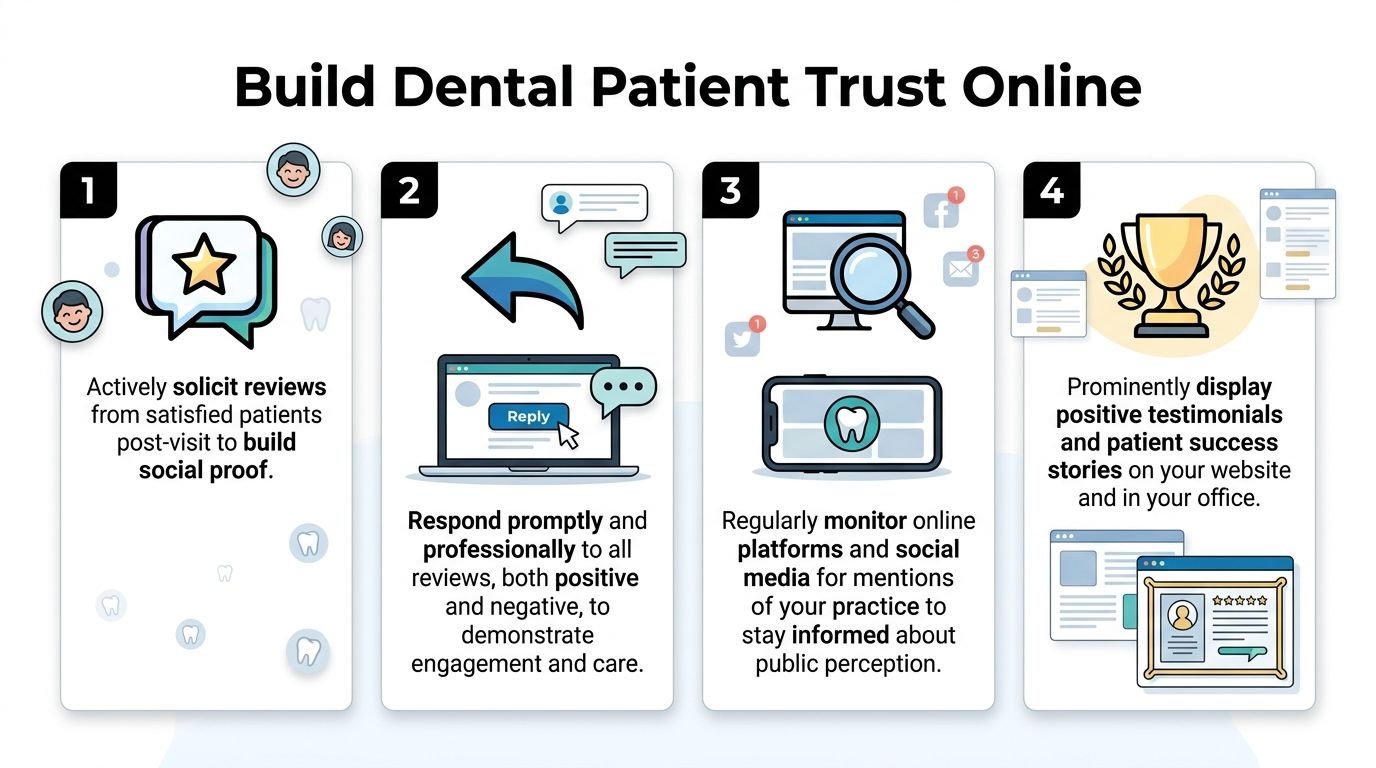
According to NexHealth, practices with 4.5+ star ratings on Google and Yelp see up to 30% more inquiries from organic search compared to those below 4 stars. That's not a branding metric. That's a lead-generation metric.
Ask at the right moment
Most practices don't have a review problem. They have a process problem.
If your team only asks when they remember, you'll get inconsistent volume. If they ask too early, the patient hasn't felt the outcome yet. If they ask too late, the moment is gone.
The best review requests usually happen after a positive appointment moment. That might be after a pain-relief visit, after a smooth hygiene appointment, or after a patient verbally says they had a great experience.
Use simple language. Don't over-script it.
Try lines like:
“I'm glad that visit went smoothly. If you'd be open to it, we'd really appreciate a quick Google review.”
Or:
“A lot of new patients find us through reviews. I'll text you the link so it's easy if you'd like to leave one.”
Use automation without sounding robotic
Manual asking matters. Automation makes it consistent.
A practical setup often includes a text message or email review request sent after the visit. The best systems are short, direct, and link to the exact profile where you want the review.
Keep the message clean:
- Thank the patient
- Mention the office name
- Ask for feedback
- Provide one direct link
Don't overload the message with multiple links, a long survey, or too much branding language.
This is also where internal accountability matters. Assign someone on your team to monitor requests, responses, and review quality each week. If nobody owns it, it slides.
Respond to every review
Responses do two jobs.
First, they show the patient that you noticed. Second, they show future patients that the office is active, attentive, and professional.
Use this framework:
- For positive reviews: Thank them by name if appropriate, keep it brief, and reinforce the patient experience.
- For negative reviews: Stay calm, protect privacy, avoid debating details publicly, and invite an offline conversation.
- For vague complaints: Acknowledge the concern and offer a direct path to resolution.
A simple response to a negative review might look like this:
“Thank you for sharing your feedback. We're sorry to hear your experience didn't meet expectations. Because patient privacy matters, we can't address specifics here, but we'd welcome the chance to speak with you directly and make this right.”
That kind of response builds more trust than a defensive one.
Make reputation visible across the patient journey
Reviews shouldn't live only on Google.
Use them in places that influence decisions:
- Your homepage
- Service pages
- New patient pages
- Printed materials at checkout
- Follow-up emails
- In-office screens if appropriate
That doesn't mean copying dozens of testimonials onto every page. It means placing the right proof where hesitation tends to show up.
Here’s a simple reputation workflow.
| Stage | Action | Purpose |
|---|---|---|
| After visit | Ask for review | Capture positive momentum |
| Same day | Send direct link by text or email | Reduce friction |
| Weekly | Monitor and respond | Keep profile active |
| Monthly | Identify patterns in feedback | Improve service and messaging |
If your office needs a better system, this guide on how to get more online reviews is a good operational starting point.
Reputation management isn't separate from patient acquisition. For local practices, it is patient acquisition.
Accelerate Growth with Paid Advertising
A Fort Myers practice can spend $3,000 on ads in a month and feel busy without adding enough profitable dentistry to justify the spend. I see that happen when every service gets pushed through the same campaign structure, the same landing page, and the same follow-up process.
Effective ad campaigns require treating different types of patient demand differently.
Someone searching for an emergency dentist is making a fast decision. Someone considering veneers or clear aligners may compare offices for weeks. If those two searches hit the same ads, the same page, and the same front-desk process, return usually suffers.

Use Google Ads for high-intent demand
Google Ads works best when the patient already wants help and is actively looking for a provider nearby. In competitive local markets, clicks can get expensive fast, so campaign structure has to protect margin.
For dental practices, the strongest paid search categories usually include:
- Emergency dentistry
- Dental implants
- Cosmetic dentistry
- Clear aligners
- Same-day appointments
Those services do not belong in one catch-all campaign. Separate them by intent, geography, and conversion goal so you can see which service line is producing booked appointments, completed treatment, and actual revenue.
Weak setup often includes:
- One campaign covering every service
- Traffic sent to the homepage
- Broad match keywords with little control
- No call tracking
- Ads running when no one can answer the phone
A stronger setup looks like this:
- Separate campaigns by service type
- Tight keyword grouping
- Landing pages matched to the search term
- Mobile pages built around click-to-call
- Office staff ready to answer and book quickly
Ad copy should also match urgency and value. An emergency ad should sound immediate. An implant ad should speak to consultation quality and trust. A cosmetic ad should focus on the outcome the patient wants.
Examples:
- Emergency care: “Need an Emergency Dentist in Fort Myers? Call Now for Fast Help.”
- Implants: “Considering Dental Implants? Book a Consultation With a Local Implant Dentist.”
- Cosmetic: “Want a Straighter Smile? Ask About Clear Aligner Options.”
Use social ads to create demand
Google captures existing demand. Facebook and Instagram are better for generating interest around services people are not searching for today.
Visual treatments often fit better on these platforms. Whitening, smile makeovers, veneers, and aligners usually need stronger creative, better before-and-after positioning, and a clear offer that gives the patient a reason to raise their hand now instead of later.
There is a trade-off. Social leads are often colder than search leads. Cost per lead can look acceptable while booking rate stays weak. That is why social campaigns need tighter follow-up, better scripting, and a clear next step such as a consult request, limited-time offer, or financing message.
A workable paid social campaign usually includes:
- A tight service focus
- A narrow local radius
- Creative built for one audience segment
- A simple lead form or landing page
- Retargeting for people who visited but did not book
If your team needs faster creative testing, the ShortGenius AI ad generator can help produce ad variations for social campaigns. It does not replace strategy, but it can reduce production time while you test different hooks and formats.
Set budget by service line, not by guesswork
Practice owners often ask how much to spend before they ask what they are trying to buy.
A better question is: which services can your practice deliver profitably, and what is an acceptable cost to acquire that patient?
That shifts paid advertising out of the “marketing expense” bucket and into a measurable production model. If an implant case, emergency visit, or clear aligner consult has a known value range, you can set a budget ceiling, track booked appointments by source, and decide whether to increase, hold, or cut spend based on return.
Paid ads also expose operational problems quickly.
If calls go unanswered, forms sit untouched, or consults are booked two weeks out, more ad spend will usually increase waste, not growth. In that situation, fix intake first. Then scale.
A practical way to compare channels:
| Channel | Best for | Main risk |
|---|---|---|
| Google Ads | Immediate, high-intent searches | Expensive clicks if targeting is loose |
| Facebook and Instagram | Demand generation for elective services | Weak lead quality without a strong offer and fast follow-up |
| Branded search ads | Protecting your name in competitive markets | Limited impact if the practice has weak conversion systems |
Paid advertising works best as part of a connected patient acquisition system. Campaigns bring in demand. Landing pages sort it. Call tracking and form tracking show which dollars produced appointments. Budget decisions get easier once each service line has its own targets and each channel is measured against real production.
Activate Your Community and Patient Base
A Fort Myers practice can spend months chasing new clicks while leaving easier growth untouched inside the office and inside its local network.
Current patients, referral partners, treatment conversations, and community relationships often produce better-fit patients at a lower acquisition cost than cold traffic. They also tend to hold up better when ad costs rise. The trade-off is simple. These channels only produce predictable results when they are run as a system, tracked by source, and reviewed against production.
Build a referral system you can measure
A lot of practices say they grow by word of mouth. That is encouraging, but it is not a plan.
According to Pearl, structured dental referral programs perform 3 to 4 times better than casual word-of-mouth alone, referral programs can represent 20% to 30% of new patient acquisition once optimized, and professional referrals can generate 5 to 10 qualified patients monthly per partnership.
The practical takeaway is not “ask for referrals more often.” It is to build a process the team can repeat and the owner can evaluate.
A referral program usually needs four parts:
- A clear prompt: Ask at the right moment, after a positive visit or completed treatment.
- A simple thank-you structure: Keep it easy to explain and easy to redeem.
- Source tracking: Separate patient referrals, physician referrals, specialist referrals, and local partnerships.
- Monthly review: Check which sources lead to booked appointments, completed visits, and retained patients.
In smaller Southwest Florida markets, one good physician relationship or one active family referral base can outperform a generic sponsorship. I have seen practices waste money on community visibility that felt good but produced no measurable patient flow. Referral tracking fixes that problem fast.
Improve case acceptance before chasing more demand
A practice does not always need more leads. Sometimes it needs more patients saying yes to treatment already being diagnosed.
According to Pearly, effective practices achieve 60% to 75% treatment plan acceptance rates on complete cases through structured presentations, acceptance rates increase by 15% to 25% when visual aids accompany verbal explanations, and the 95-5 Rule suggests treatment coordinator attention should focus mostly on the patient’s condition and consequences, with only a small portion on logistics.
That has direct budget implications. If the practice raises acceptance on restorative, implant, or aligner cases, the return on SEO, reviews, and paid ads improves without adding more media spend.
A stronger treatment presentation usually includes:
- A plain-language explanation of the condition.
- Photos or visuals that show the patient what the doctor sees.
- A clear explanation of what happens if treatment is delayed.
- Options presented in a logical order.
- Transparent discussion of fees and financing.
- A printed or digital summary the patient can review at home.
Small changes matter here. Intraoral photos help. Consistent scripting helps. A rushed handoff to the front desk usually hurts. The goal is not to sound polished. The goal is to make decisions easier for the patient and easier to track for the practice.
Use community outreach selectively
Community marketing still works, but random outreach usually does not.
The right community activity should match the type of patient the practice wants more of and feed back into the same measurement system as every other channel. A pediatric or family office might focus on schools and parent groups. An implant-focused office might get better returns from physician relationships, senior-focused organizations, and educational events.
Useful options include:
- School partnerships tied to family dentistry
- Event sponsorships where staff can meet local households
- Relationships with physicians, orthodontists, and other providers
- Educational talks on oral health, implants, or aligners
- Participation in neighborhood and parent groups
CareCredit notes opportunities in teledentistry and school-based dental services, including a North Carolina mobile clinic that served 1,200 students in one year, and cites 2,802 additional dental visits per practitioner annually in connection with NHSC participation in community-based programs.
This point is relevant even for practices not planning large outreach programs.
The lesson is that underserved pockets of demand exist in many local markets. If competitors are all buying the same clicks and sending the same mailers, a focused school relationship, provider partnership, or access-based program can open a less crowded growth path. In the right situation, that lowers acquisition cost and diversifies patient flow.
Make these channels support each other
Referral growth, case acceptance, and community outreach work best when they are connected.
A patient who understands the diagnosis is more likely to accept care. A patient who had a well-run visit is more likely to refer a friend. A school contact or physician partner can introduce households that later feed hygiene, restorative care, and long-term retention.
That is the operating mindset I recommend. Stop treating these activities as side projects. Give each one an owner, a tracking method, and a target. Once they are tied into the same budget and ROI framework as your digital channels, they become a reliable part of patient acquisition instead of background noise.
Measure What Matters and Plan Your Budget
A Fort Myers practice can feel busy all month and still end up disappointed at the end of it. The schedule had holes. Ads generated calls, but too many never booked. Hygiene stayed full while high-value treatment slowed down. That usually happens when marketing channels are running, but nobody is measuring them as one system.
The budgeting mistake is simple. Practices treat marketing as overhead instead of an investment that has to earn its keep.
Track a short list of numbers every month, and tie each one to a decision.
- New patients per month: Compare patient flow against provider capacity, chair availability, and production goals.
- Patient acquisition cost: Track this by channel so you know whether Google Ads, SEO, referrals, or mailers are producing efficiently.
- Patient lifetime value: Use this to judge how much you can afford to spend to acquire the right patient.
- Lead-to-appointment rate: This shows whether your website, forms, and front desk are converting interest into scheduled visits.
- Appointment-to-patient rate: This shows whether booked visits are showing up and entering care.
As noted earlier, benchmarks can help frame expectations. They should not run the practice for you. A PPO-heavy office in a competitive Southwest Florida zip code will not budget the same way as a fee-for-service cosmetic practice with a long waitlist. The point is to compare performance against your own economics, capacity, and growth target.
A simple monthly dashboard
| KPI | What it tells you | Action if weak |
|---|---|---|
| New patients | Whether demand is meeting capacity needs | Review channels and conversion points |
| Acquisition cost | Whether spend is efficient | Cut waste and tighten targeting |
| Lifetime value | Whether a channel is worth scaling | Reassess service mix and retention |
| Lead-to-appointment | Whether inquiries are handled well | Improve scripts and response speed |
| Case acceptance | Whether diagnosed treatment is converting | Improve presentation process |
Many practices lose margin because they know total ad spend but do not track cost per booked appointment, cost per kept appointment, or cost per patient who starts treatment. Those are very different numbers. If you only track clicks and calls, weak follow-up can make a decent campaign look bad, and strong demand can hide a front-desk problem for months.
Budgeting gets easier once every dollar has a job.
A practical budget usually covers three roles. First, long-term demand capture through local SEO, content, and website improvements. Second, immediate demand capture through paid ads for services you want to grow now. Third, conversion and retention support through reviews, call handling, follow-up, and reporting. That mix gives a practice a clearer way to balance short-term bookings with long-term acquisition cost.
I usually advise owners to scale in steps, not jumps. If paid search is producing booked appointments at an acceptable cost, increase spend carefully and confirm the front desk can keep up. If SEO is generating qualified traffic but the site is not converting, fix the conversion issue before adding more traffic. The right answer is rarely "spend more everywhere." It is to strengthen the weak point in the system, then increase budget where return is already proven.
If your practice in Fort Myers or Southwest Florida wants a clearer path to steady patient growth, Polaris Marketing Solutions can help you build the full system, from local SEO and website conversion work to PPC, review strategy, and reporting that ties spend to real appointments. Start with a conversation at Polaris Marketing Solutions.