
A homeowner searches for an emergency plumber nearby. Your Google listing appears, but the hours say you close at 5 PM, even though your crew takes calls around the clock. The homeowner doesn't investigate. They call the competitor whose profile looks current.
That missed call is the practical reason to run a Google Business Profile audit. Your listing is not merely a directory entry. It carries the business details customers use to decide whether to call, visit, request directions, or move on. In 2026, Google has also phased out the old Q&A system and is using AI-driven answers across Maps and Business surfaces, which makes accurate, complete wording more important than legacy checklist tactics.
Why Your Google Business Profile Needs a Fresh Audit
Most owners update a profile when they open, move, change phone numbers, or notice a bad review. That approach misses the slower problems. A former service category remains active, holiday hours go stale, the website points to an old page, and a service-area boundary no longer matches where the company works.
Google's local listing product has changed significantly over time. It launched as Google Local in March 2004, became Google My Business in June 2014 after earlier tools were consolidated, and was renamed Google Business Profile in November 2021. That history matters because information can persist across Search, Maps, and older management systems, so an audit should confirm that current details are synchronized across every visible surface. The product timeline documented by Candid Creative helps explain why older settings and naming conventions can still create cleanup work.
The cost of treating setup as permanent
A profile can look acceptable to an owner and still answer customer questions incorrectly. A contractor may serve several nearby communities but show an incomplete service area. A clinic may have the right address but outdated appointment information. A law office in a shared building may omit its suite number, making it harder for visitors and Google to identify the exact location.
The business case for completeness is substantial. A local SEO analysis of 2 million Google Business Profile pages found that businesses with more than 200 reviews were more likely to appear in the top three local results, while top performers averaged nearly 250 reviews. The same local SEO roundup cites Google-linked findings that complete profiles are 2.7 times more likely to be considered reputable, and that 94% of consumers are more likely to use a business with a complete profile. The underlying local SEO statistics are summarized by SHNO.
Practical rule: Audit the information customers need before you chase advanced ranking tactics. A wrong phone number can waste demand that a sophisticated strategy can't recover.
Why quarterly reviews make sense
A full audit should happen at least quarterly, with quick checks after changes to hours, location, services, ownership, or staffing. The timing is especially important for contractors and other service businesses because service areas, emergency availability, seasonal schedules, and offerings change quickly.
A 2026 survey cited by Neil Patel found that only 11% of businesses describe their profile as fully optimized, while 60% fall into basic-setup-only, inconsistent, or unmanaged states. The survey context appears in Neil Patel's Google Business Profile optimization analysis. For most small businesses, the first audit doesn't need a clever hack. It needs a disciplined review of missing, stale, or contradictory information.
Verifying Core Business Information and Categories
Start with the fields that establish what the business is, where it operates, and how a customer reaches it. Open the profile as a customer would, then compare it with the company website, signage, social profiles, major directories, and actual operating procedures.
Confirm identity before optimizing relevance
The business name should match the name used on the storefront, vehicle signage, website, and customer communications. Don't add “best roofer” or a city name to gain relevance when those words aren't part of the actual business name. Keyword stuffing can create compliance problems and make the listing look less trustworthy.
For the address, use the complete official address. Google says businesses should keep the address and service area accurate and precise, and its address guidance calls for building, suite, and floor information where applicable. A law office in a shared building should list its full suite number. It shouldn't replace the official address with a nearby landmark or cross-street. Google's address guidance is the standard to use when formatting this field.
Service-area businesses need a different check. Confirm that the listed areas reflect where the company serves customers, not every city a sales team hopes to reach. A paving contractor shouldn't create the impression of a staffed office in a market where it only travels for jobs.
Check categories against real services
The primary category should describe the core business as specifically as Google's available options allow. Secondary categories should support genuine services, not unrelated search terms.
A roofing company listed only as “General Contractor” may be sending Google a weaker relevance signal than a profile using the most accurate roofing category available. A medical practice that offers a distinct specialty should review whether its category choices represent that specialty. Compare the categories used by prominent competitors, then check whether each candidate category matches an actual service, department, or customer need.
Don't choose categories just because a competitor has them. A category that doesn't describe your operation creates a mismatch between the profile and the customer experience.
Audit the operational details
Check the phone number by calling it. Test the website link on a mobile device. Review regular hours, appointment links, service descriptions, attributes, and holiday or special hours. If the business takes emergency calls after normal office hours, say so accurately through the appropriate profile fields and website content rather than leaving customers to guess.
Use this table to record the correction rather than relying on memory:
| Field | Common Error | Correct Approach |
|---|---|---|
| Business name | Adding services or locations that aren't part of the real name | Use the name customers see on signage and business materials |
| Address | Missing suite, floor, or building details | Enter the complete official address |
| Phone | Old tracking number or disconnected line | Use a working number that reaches the business |
| Categories | Broad or irrelevant primary category | Select the most accurate primary category and relevant secondary categories |
| Hours | Regular hours don't match actual availability | Confirm daily hours and add special hours when needed |
| Website | Homepage or old location page is linked | Link to the page that accurately supports the profile's services and location |
Inconsistent directory data can prolong cleanup. If citation records are scattered across sites, follow a local citation building playbook before deciding which listing is authoritative. For businesses with duplicate or outdated records, a dedicated citation cleanup service can help organize ownership and correction work.
Evaluating Review Health and Response Patterns
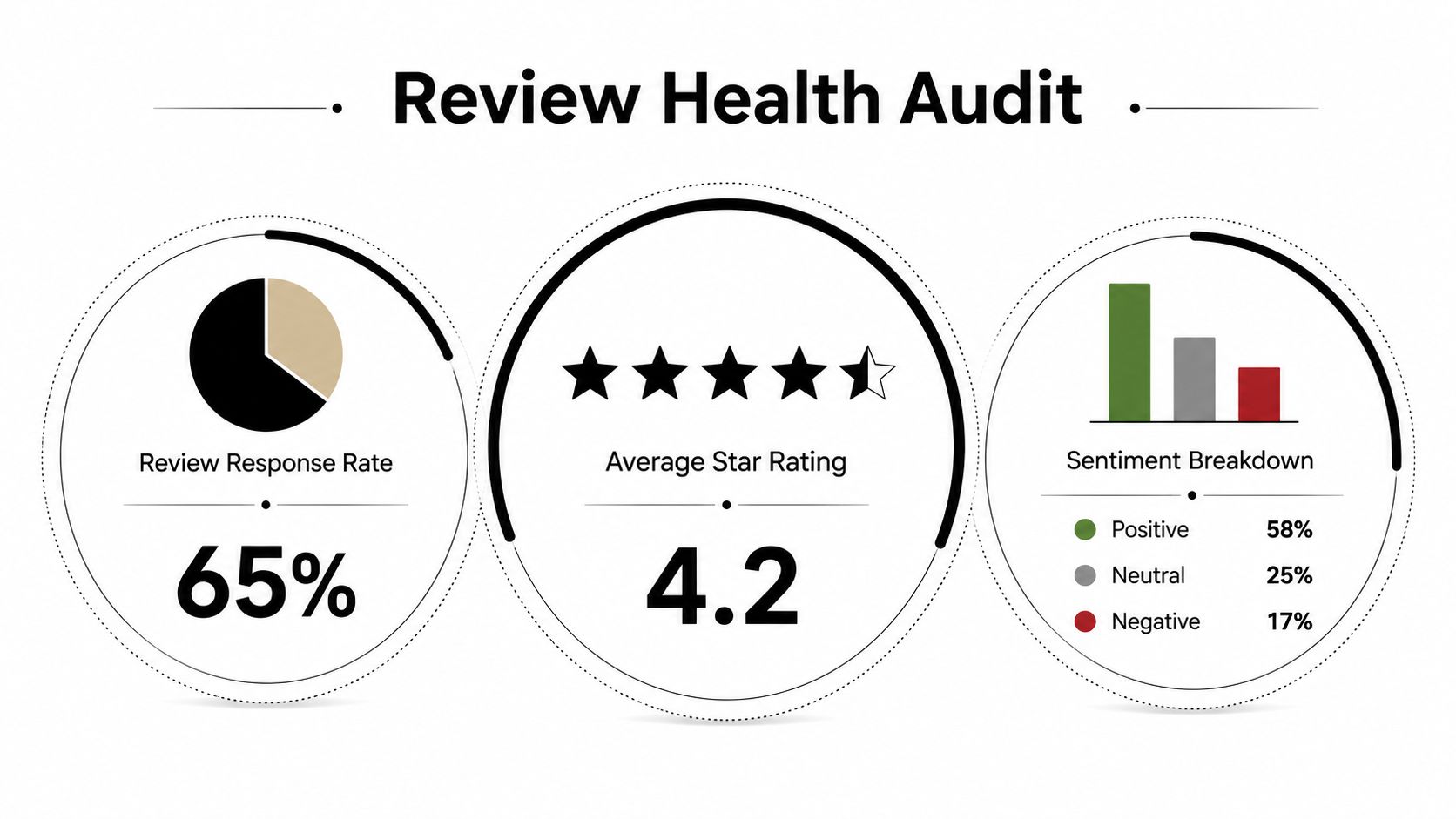
Review health requires more than counting stars. Compare your rating and review count with the local top five, then examine recency, response behavior, and the language customers use to describe the work.
A practical framework compares the star rating with the local top-five average, the review count with the local median, review velocity over the last 90 days, and the owner response rate. Warning thresholds include fewer than 50% of the local median review count and an owner response rate under 10%. No new reviews in 90 days is treated as a critical recency issue in the audit framework published by Prospect Audits.
Read the pattern, not just the average
A high rating with no recent activity can create a different impression from a slightly lower rating supported by steady, authentic customer feedback. Review velocity should be evaluated against comparable local businesses, not an arbitrary target. Look at when competitors received their latest reviews and whether their customers mention services that your profile doesn't clearly list.
Response quality matters, too. “Thanks for the review” is polite but limited. A stronger response acknowledges the actual job, addresses a concern where appropriate, and naturally reinforces the service without turning the reply into keyword-stuffed advertising.
For example, a cleaning company could thank a customer for mentioning a move-out cleaning appointment and confirm that the team appreciated the feedback. A contractor responding to a complaint should address the issue directly, move sensitive details offline, and avoid arguing in public.
Monitor reputation risks early
During the audit, flag reviews that appear unrelated, duplicate, abusive, or inconsistent with the business's records. Don't accuse competitors of manipulation without evidence. Instead, document the review URL, date, content, and policy concern, then use Google's reporting process when appropriate.
Build a simple monitoring sheet with the review date, rating, service mentioned, response status, and escalation need. If negative feedback reveals repeated complaints about missed arrival windows or unclear pricing, the profile audit has uncovered an operational problem, not just a copywriting task. Use the guidance in this negative review response resource to keep replies factual, calm, and useful.
Adapting Your Audit for AI-Driven Search Answers
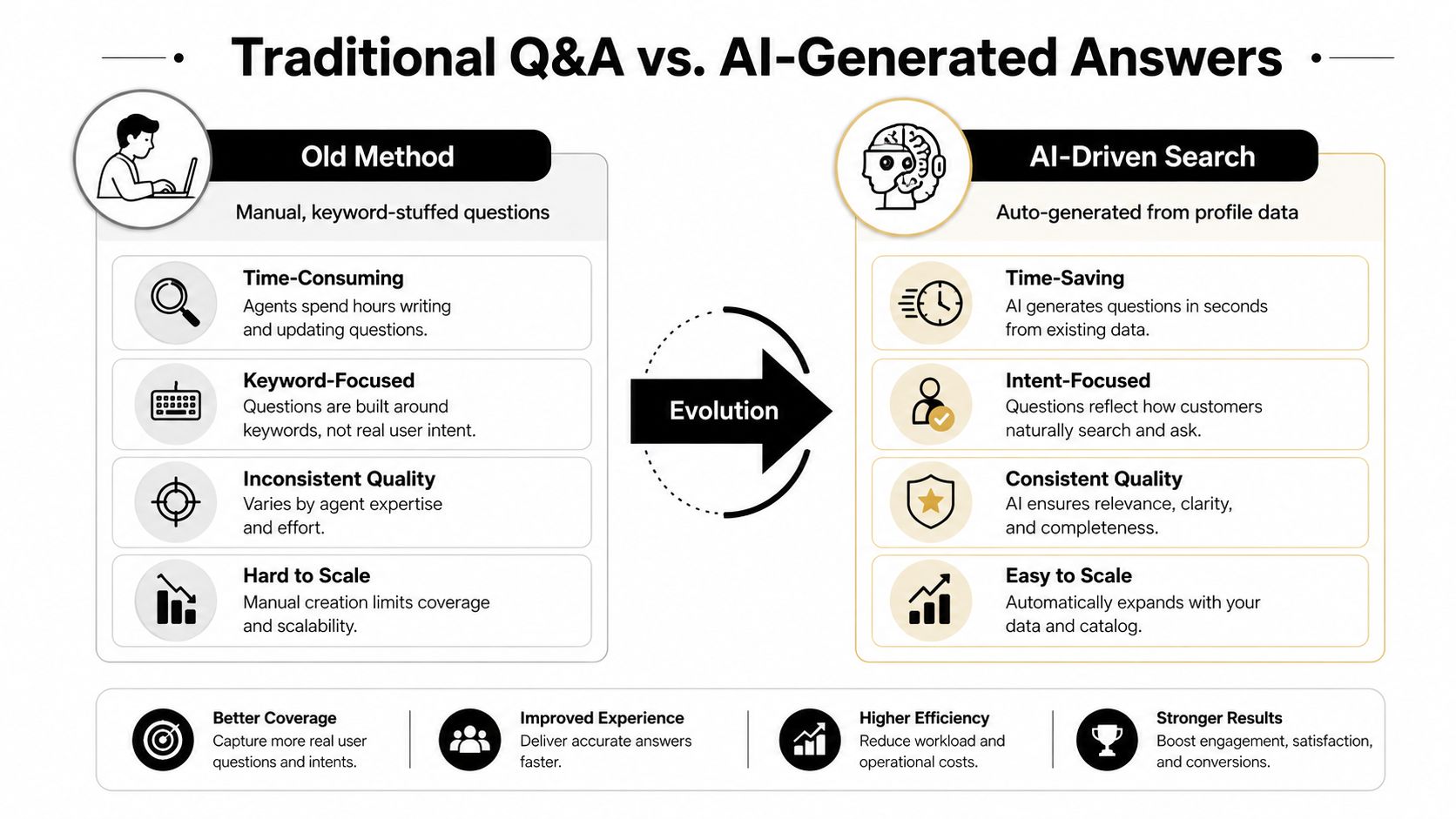
The old Q&A playbook is no longer the priority. Google phased out the Q&A API and public Q&A in late 2025, new profiles no longer receive the feature, and Gemini or Ask Maps can answer visitor questions using information from profile data. SlashPost's 2026 coverage of Google Business Profile updates describes the shift and its practical implication: the profile itself must contain clear answers.
Replace seeded questions with answer-ready data
Don't spend audit time manufacturing keyword-heavy questions. Review the business description, services, attributes, products, photos, service areas, and linked landing page as a connected information set.
A natural service description should answer questions such as:
- What do you provide? “Residential HVAC repair and maintenance.”
- Where do you work? Name the legitimate service area or explain the address accurately.
- When are you available? State normal and emergency availability without overstating it.
- What should customers expect? Describe the appointment, estimate, consultation, or intake process.
Attributes deserve careful attention because they can support direct yes-or-no answers. If a business offers accessibility features, accepts certain payment methods, or provides appointments, the profile should reflect those facts accurately. Don't select an attribute because it sounds useful.
Run an AI-readability test
Search Google and Maps using the questions customers ask. Try queries such as “Does this plumber handle water heater repair?”, “Is this clinic accepting new patients?”, or “Does this law office offer consultations?” Review the answer and compare it with the business's current operations.
If the answer is incomplete, identify which profile field could supply the missing fact. If it is wrong, correct the source field and check the website page connected to the profile. AI systems may combine profile and website information, so conflicting wording creates avoidable ambiguity.
Audit the answer a customer receives, not just the field you edited.
Businesses working on this broader question can also review answer engine optimization as a related discipline. The focus is not gaming an answer system. It is making the business's real services, boundaries, and policies easy for both people and search systems to understand.
This short video provides useful visual context for the change:
Setting Activity Thresholds That Prevent Visibility Drops
Freshness should be measured, not treated as a vague promise to “stay active.” Review the profile's post history, photo upload dates, review responses, and customer interactions. Then separate activity that helps a customer decide from activity created only to fill a calendar.
Recent 2026 reporting says profiles may experience visibility declines after about 30 days without new activity, and guidance increasingly emphasizes weekly photos and posts plus review replies within 48 hours. Alev Digital's reporting on Google Business Profile in the AI era provides that context. These thresholds should guide your workflow, not encourage meaningless updates.
Use a sustainable activity schedule
A small contractor doesn't need to publish elaborate campaigns. A practical weekly rhythm might include one post about a real service, a recent project photo, and responses to reviews that arrived during the week. A clinic might rotate appointment information, service education, and staff or facility updates. A retailer can highlight current inventory or seasonal availability.
The benchmark table gives you a working audit standard:
| Activity Type | Minimum Threshold | Optimal Target | Impact if Below Threshold |
|---|---|---|---|
| Posts | Avoid going about 30 days without activity | Maintain a consistent weekly rhythm | The profile can appear dormant and provide fewer current customer signals |
| Photos | Review upload dates before the profile goes quiet | Add relevant real-world photos regularly | Customers see less evidence of current operations |
| Review responses | Aim to respond within 48 hours | Respond consistently to positive and negative feedback | Questions and concerns remain visible without an owner response |
| Profile updates | Correct information whenever operations change | Review core fields during monthly checks | AI and customers may rely on stale details |
Prioritize conversion-oriented updates
A post about “We exist” is weaker than a post that answers a current customer need. For an HVAC company, explain which repair appointments are available. For a roofer, show completed work and describe the type of repair. For a professional service firm, explain how a prospective client starts the consultation process.
Photos should show the actual team, workplace, equipment, completed work, or products. Avoid treating stock imagery as a substitute for evidence. Before setting a schedule, check who can create content, who approves claims, and who responds to reviews. A simple calendar that someone follows is more useful than an ambitious plan nobody maintains.
Building Your Prioritized Fix List
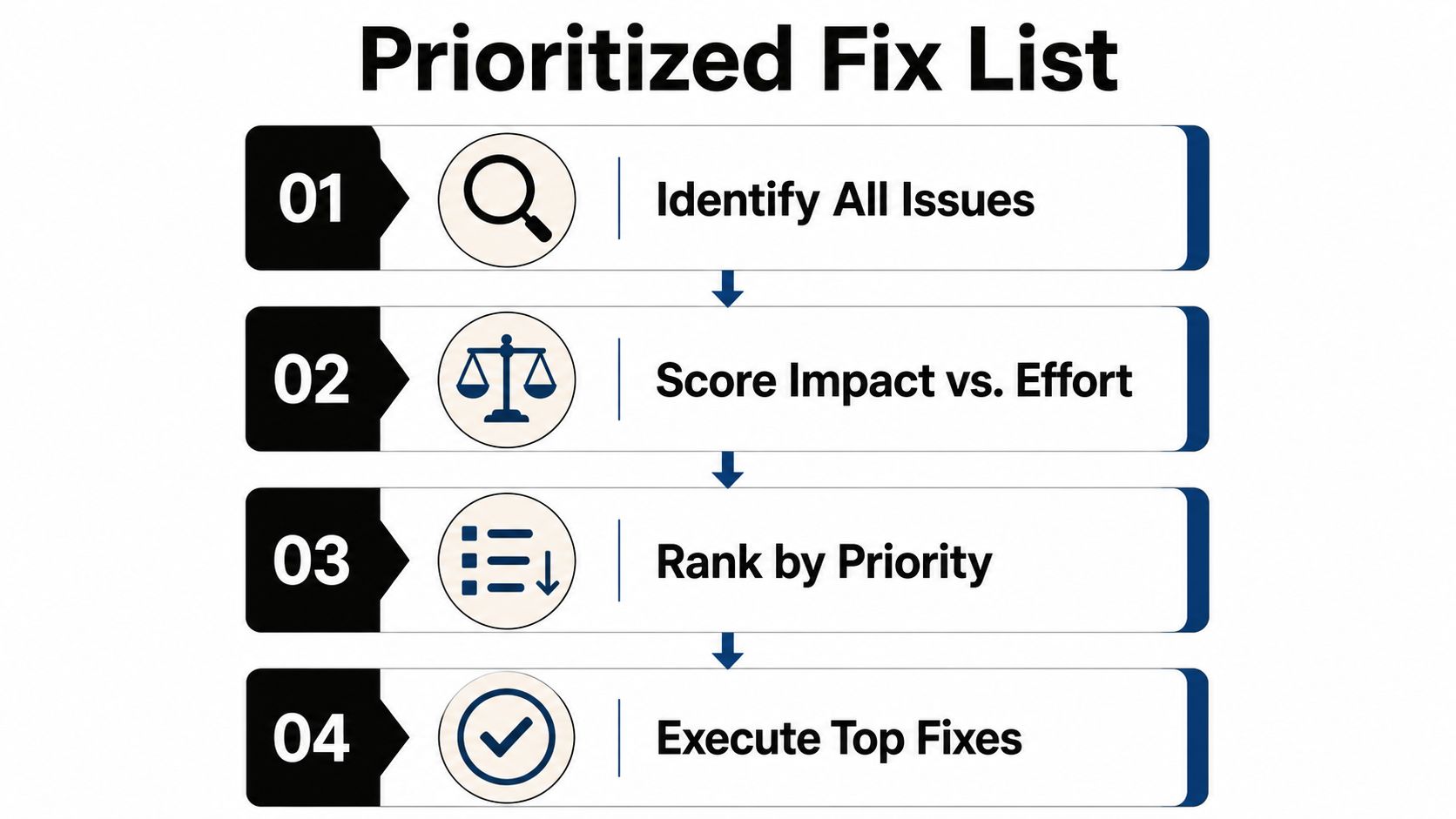
An audit report becomes useful only when someone knows what to fix first. Rank each issue by customer risk, local relevance, potential visibility impact, and effort, then assign an owner and a deadline.
A wrong phone number, inaccurate address, or misleading category belongs at the top because each can interfere with contact, trust, or eligibility. Missing attributes and minor wording improvements can wait when foundational information is broken.
Sort work by impact and effort
Use four practical buckets:
- Quick wins: Correct the phone number, hours, website link, or obvious category error when you have access to the profile.
- Strategic projects: Resolve duplicates, repair citation inconsistencies, rebuild service descriptions, or align a location landing page with the profile.
- Maintenance tasks: Respond to reviews, add authentic photos, check special hours, and publish useful updates.
- Deprioritized items: Delay cosmetic changes or speculative tactics that require substantial effort but don't solve a customer-facing problem.
A benchmark from Prospect Audits reports an average SMB receives about 1,009 Google Business Profile searches per month, and that fully completed profiles earn about 7 times more clicks and 70% more in-store visits than incomplete profiles. The benchmark data is presented in its GBP audit guide. Treat those figures as a reason to fix completeness first, not as a promise of identical results for every market.
Turn findings into a working schedule
In the first 30 minutes, correct verified errors in hours, contact details, categories, and links. Over the following week, complete service descriptions, attributes, special hours, duplicate research, and website alignment. Then create an ongoing routine for reviews, photos, posts, and monthly checks.
Record each issue in a simple sheet with these columns:
- Finding: What is wrong or missing?
- Evidence: Which profile field, directory, review, or customer question confirms it?
- Impact: Could it mislead customers, weaken relevance, or reduce trust?
- Effort: Can the owner fix it quickly, or does it require technical or citation work?
- Owner and date: Who will complete it, and when will you verify the change?
For verification, Google says its review process can take up to 5 business days, so don't interpret an unconfirmed status as an immediate failure. Google's verification guidance supports planning verification early enough to allow follow-up.
If Google requests video verification, prepare a continuous mobile walkthrough showing the location, signage, workspace, and proof of operations. Google's community guidance says video verification requires a real-time mobile video and can't be completed on a desktop. The video verification guidance gives the operational requirements to prepare for before submitting.
Polaris Marketing Solutions helps small and mid-sized businesses audit and improve Google Business Profiles, citations, location content, and review processes. Visit Polaris Marketing Solutions to request a practical online analysis and competitor report, then turn the findings into a prioritized local visibility plan.