
That sinking feeling when a 1-star review notification hits your phone—every business owner knows it. Your first instinct might be to get defensive or just ignore it. But to properly respond to negative reviews, you have to see them for what they really are: a critical opportunity.
A quick, professional, and genuinely empathetic response can do more than just damage control. It can show potential customers you’re the real deal and even win back the person who left the bad review in the first place.
Why a Bad Review Isn't Just a Bad Review
For a local business owner, a negative review can feel like a personal jab. It’s a public critique of the blood, sweat, and tears you pour into your company every single day. The first, most important step is to shift your mindset. Don't see it as an attack. See it as free, high-stakes consulting that’s telling you exactly where your business has a chance to get better.
When you post a reply, you’re not just talking to one unhappy customer. You’re speaking directly to the 9 out of 10 prospects who read reviews before they ever pick up the phone. They aren’t just looking at the star rating; they’re watching you to see how you handle the heat.
The True Cost of Radio Silence
Letting a negative review sit there unanswered is one of the worst things you can do for your business. It's not just about one person's bad experience; it's about the silent message you send to everyone else who sees it.
To really understand the impact, let's look at the numbers. The decision to respond—or not—has a direct effect on how potential customers see you and, ultimately, on your bottom line.
The Impact of Responding vs. Ignoring Negative Reviews
| Action | Potential Customer Perception | Business Impact |
|---|---|---|
| Respond Quickly & Professionally | "This business cares and stands behind their work. They're trustworthy." | Builds trust, recovers unhappy customers, and attracts new leads. |
| Ignore the Review | "They don't care about their customers. If I have a problem, they'll ignore me too." | Loses trust, drives potential customers to competitors, and damages brand reputation. |
| Respond Defensively or Angrily | "This owner is unprofessional and can't handle criticism. I'll avoid them." | Creates a public relations nightmare and makes the situation far worse. |
Ignoring a problem doesn’t make it go away; it just makes it bigger. A thoughtful, public response is your chance to show everyone that you’re a business that genuinely cares, even when things don’t go perfectly. That kind of public accountability often speaks louder than a dozen 5-star reviews.
This is where your online reputation becomes a powerful sales tool. Every single reply is a mini-advertisement for your company’s professionalism and commitment to getting it right.
From Unhappy Customer to Vocal Supporter
It might sound crazy, but a customer who took the time to write a negative review is often more invested than a silent, happy one. They cared enough to voice their frustration, which means they also have the potential to become a huge advocate if you fix the problem.
When you handle their issue well, many will go back and update their review—sometimes even changing it to five stars. That's a powerful story for any potential customer to see.
Responding well delivers real business benefits:
- Builds Trust and Transparency: Addressing issues head-on shows you have nothing to hide and that you value what your customers have to say. Actionable Example: A public reply that says, "Thank you for this feedback; you're right, our communication should have been better," shows prospective customers you don't make excuses.
- Improves Customer Retention: Making it right can save a customer relationship you would have otherwise lost for good. Actionable Example: After a service mishap, calling the customer and offering a future discount can turn a one-time critic into a repeat client.
- Provides Actionable Feedback: These reviews are a goldmine. They pinpoint specific weaknesses in your operation, whether it's slow service, a product issue, or a gap in staff training. Actionable Example: Multiple reviews mentioning "messy job sites" tells a contractor they need to retrain their crews on cleanup protocols.
- Boosts Your Local SEO: Google actually rewards businesses on their Business Profile for actively engaging with customers, and that includes responding to every single review.
Learning to handle negative feedback isn’t just about putting out fires; it's a fundamental part of building a resilient brand. Our guide on online reputation management tips offers even more strategies to protect and grow your digital footprint.
Your 24-Hour Playbook for Negative Reviews
That sinking feeling when a negative review hits your page? We’ve all been there. Your first instinct might be to fire back a defensive reply or just ignore it and hope it goes away. Resist both urges.
What you do in the first 24 hours is critical. A hot-headed, emotional response will only pour fuel on the fire. But a calm, strategic reply can completely defuse the situation, turning a public complaint into a showcase of your great customer service.
The secret isn’t to win the argument. It's to control the public narrative and prove you’re a business that listens and cares. The strategy is simple: Acknowledge, Empathize, and Redirect. Your goal is to post one professional, thoughtful reply that takes the real problem-solving offline.
This simple process shows how you can turn a bad review into an opportunity to build trust.
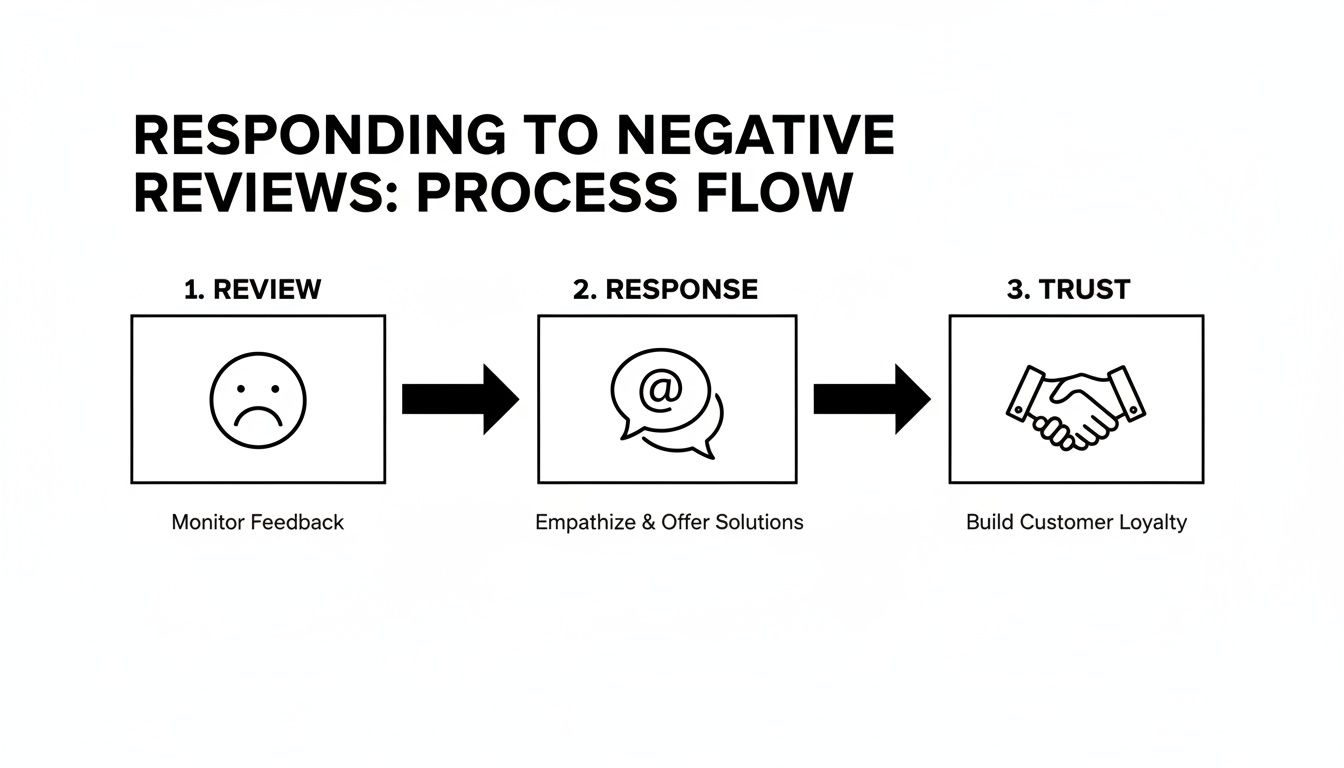
It’s a powerful reminder that what happens after the review is posted is completely in your hands.
Acknowledge and Thank the Reviewer
First things first: thank them for the feedback. I know, it feels backward, but you aren’t just writing for them. You’re writing for the hundreds of potential customers reading that review.
Using the reviewer's name makes the interaction feel personal and proves you’ve actually read their complaint instead of just copy-pasting a response. It instantly shifts the tone from a confrontation to a conversation.
Actionable Example:
- Instead of silence: (No response)
- Try this: "Hi [Customer Name], thank you for taking the time to share your feedback with us."
This simple opener sets a respectful tone and shows you’re ready to listen. It’s a small move with a huge impact.
Express Empathy and Validate Their Feelings
Next, show them you get it. Apologizing doesn't mean you're admitting fault. You're simply sorry their experience didn't live up to their expectations—which, from their point of view, is a fact.
Whatever you do, avoid getting defensive.
"Your response should validate their frustration, not dispute their reality. Phrases like 'I'm sorry to hear your experience fell short of expectations' or 'I can understand your disappointment' go a long way in de-escalating tension."
Actionable Example:
- Instead of: "We are never late."
- Try this: "I'm very sorry to hear we arrived later than you expected. I can understand how frustrating that must have been for your schedule."
This is the most important step. According to a study, 91% of travelers believe businesses should reply to negative reviews, and a polite response improves their impression. Empathy is the quickest way to show you’re one of the good ones.
For a deeper dive into managing all your customer feedback, it's worth building out a complete modern review and response playbook.
Redirect the Conversation Offline
The public review page is no place for a back-and-forth argument or a detailed investigation. The final step in your public reply is to offer a clear, direct path to resolve the issue privately. This proves you’re serious about fixing it while protecting everyone’s privacy.
Give them a direct contact person, phone number, or email address. It shows you’re taking ownership and gives you a chance to get the full story without an audience.
Actionable Example (for a local paving company):
- Review complains about a messy job site: "Hi Sarah, thank you for bringing this to our attention. We're very sorry to hear that our crew didn't leave your property as tidy as it should have been. That is not the standard we hold ourselves to, and I can understand your frustration. My name is David, and I'm the owner. I'd like to connect with you directly to make this right. Please call me at (239) 555-1234 when you have a moment."
This response nails the framework: it acknowledges, empathizes, and redirects offline. It’s the perfect way to handle a tough review, protect your reputation, and turn a bad experience into proof of your commitment to great service.
Crafting the Perfect Public Response With Examples
Once you’ve done your initial triage, it’s time to post your public reply. Remember, this response isn't just for the unhappy customer—it's for every single prospect who reads your reviews from now on. Getting this right can defuse the situation and actually showcase your commitment to great service.
The real goal here is to show you’re listening and taking action, while pulling the nitty-gritty details of the dispute offline. This is how you respond to negative reviews in a way that builds trust with everyone watching.
Let's walk through a few common scenarios I see all the time and break down exactly how to handle them.
Scenario 1: The Service Mishap
This is probably the most frequent complaint you'll see. Something just went wrong on the job. A technician showed up late, the cleanup wasn't perfect, or the result simply didn’t hit the mark for the customer.
The secret is to validate their feelings without getting dragged into an online argument about who was right or wrong.
Real-World Example: A Landscaping Company
- Review: "They left my yard a complete mess! Dirt and clippings all over the patio, and they trampled my prize-winning petunias. For the price I paid, I expected much better. 1-star."
- Response:
"Hi Rebecca, thank you for bringing this to our attention. I am very sorry to hear that our cleanup did not meet your expectations and about the damage to your petunias. That's certainly not the standard of care we aim to provide, and I completely understand your disappointment. My name is Mark, and as the owner, I'd like to make this right. Please call me directly at [Your Phone Number] at your convenience so I can learn more and resolve this for you."
Why This Works
- It's personal. Using their name and giving yours (especially as the owner) shows you're not hiding behind a corporate script.
- It apologizes for their experience. You're not admitting legal fault; you're sorry they had a bad experience. It’s a subtle but important distinction.
- It takes the conversation offline. Giving a direct contact number proves you're serious about fixing it, not just performing for an audience.
Scenario 2: The Miscommunication
These complaints happen when expectations don't line up. Maybe the customer thought the price included something it didn’t, or they had a different timeline in mind. Your job is to show empathy while gently setting the record straight for future readers.
Real-World Example: A Roofing Contractor
- Review: "The project took two weeks longer than they said it would! I had to reschedule other contractors because of the delay. They never called to update me. Not happy."
- Response:
"Hi Tom, I appreciate you sharing your experience. It's completely understandable that you were frustrated with the project's timeline, especially when it affected your other plans. While we always aim to hit our initial estimates, unforeseen weather delays did push our schedule back, and I apologize if our communication about these changes wasn't as clear as it should have been. We're reviewing our process to ensure we provide more proactive updates going forward. I’d be happy to discuss this further with you. Please feel free to reach out to me, Maria, at [Your Email]."
Why This Works
- It leads with empathy. "It's completely understandable that you were frustrated" is a fantastic phrase. You're validating their feelings without necessarily agreeing with their interpretation of events.
- It adds context, not excuses. Mentioning "unforeseen weather delays" explains the situation to onlookers without sounding defensive.
- It signals you're improving. Saying you're reviewing your process shows that you actually use feedback to get better.
Scenario 3: The Unjustified or Vague Complaint
Every so often, you’ll get a 1-star review with almost no context or one that you know is just plain false. This is the toughest one to handle. Fighting back online is a guaranteed loss—you’ll just look defensive and unprofessional.
Your only move is to be the calm, professional adult in the room and invite them to talk privately. It shows potential customers that you’re reasonable, even when faced with someone who isn't.
Real-World Example: A Local Restaurant
- Review: "Terrible service. Never coming back."
- Response:
"Hi there, thank you for the feedback. We're very sorry to see that your experience with us was anything less than great. We are committed to providing excellent service and would genuinely appreciate the opportunity to learn more about what happened during your visit. If you are willing, please contact our manager, Dave, at [Your Phone Number] so we can better understand and address your concerns."
Why This Works
- It's short and professional. There’s simply no fuel here for an online flame war.
- It shows you still care. Even with a vague drive-by complaint, you're making an effort.
- It puts the ball in their court. You've made a reasonable offer. If they ignore it, other readers will see you did your part.
Winning Customers Back with Private Follow-Up
You've posted your public reply. That was for every potential customer watching from the sidelines. This next step? This is for the one unhappy customer you're about to lose for good.
Taking the conversation offline is where the real work begins. It’s your chance to move beyond damage control and actually fix what went wrong. This private follow-up—whether by phone or email—shows you’re serious about your apology, not just putting on a show for the public.
When you promptly reach out after asking them to in your public reply, it proves you meant it. You're showing that you're ready and willing to listen.
How to Structure the Follow-Up Conversation
The single most important goal here is to listen. Forget defending your actions or explaining your side of the story. The customer is already upset, and the second they sense you're getting defensive, the conversation is over. You're here to make them feel heard.
Start simply by restating your apology and thanking them for giving you a few minutes of their time. This immediately sets a more collaborative, less confrontational tone.
From there, your job is to become an investigator. You need to understand their experience from their point of view, and you do that by asking open-ended questions—the kind they can't just answer with a "yes" or "no."
Effective Open-Ended Questions to Ask:
- "Could you please walk me through what happened from your perspective?"
- "What was the most frustrating part of the experience for you?"
- "In your eyes, what would a fair and complete resolution look like?"
Remember, the customer's perception is their reality. It doesn't matter if you think they're wrong. Your job isn't to argue the facts; it's to understand their feelings and find a solution.
Once you have the full story, you can work toward a fix. Asking them what a fair resolution looks like is a brilliant move—it puts the ball in their court and gives you a clear, customer-approved path to making things right.
Offering Real, Concrete Solutions
The solution you offer has to match the scale of the problem. A generic "sorry" or a flimsy discount won't cut it. Your offer needs to be thoughtful and directly address the specific issue they raised.
Practical Examples That Work:
- For a plumber whose crew left a mess: Don’t just apologize. Offer to pay for a professional cleaning service to handle the exact area they dirtied.
- For a restaurant with a complaint about slow service: Have the manager send a personal email with a meaningful gift card for their next visit, promising a much better experience.
- For a roofer who had a project delay: Acknowledge the inconvenience by offering a discount on the final invoice to compensate them for their time.
This is also where you need to read the room. If the customer is still seeing red, keep listening and validating their anger before you even think about proposing a fix. If they seem more open to a solution, you can move forward more quickly.
The Delicate Art of Asking for an Update
This is by far the most sensitive part of the entire process, and you have to tread very, very carefully. You can never directly ask a customer to change their review to 5 stars. You also can't offer a refund or discount in exchange for an updated review. That’s a fast track to getting your business flagged on platforms like Google and Yelp, and it can blow up in your face.
The only time to even think about this is after the problem is 100% resolved to their satisfaction. If the customer seems genuinely happy with the outcome and thanks you for making it right, then—and only then—can you gently open the door.
A Compliant and Effective Script:
"I'm so glad we were able to find a resolution that works for you. Your initial feedback was really helpful for us, and we appreciate you giving us the chance to make it right. If you feel that our recent actions have changed your perspective, you're always welcome to update your original review. We'd be grateful for any revision that reflects your complete experience with us."
This approach is respectful, and it's compliant with review platform policies. It subtly reminds them of the review without being pushy and empowers them to make a change if they feel it's deserved. The decision is left completely in their hands, which protects your integrity while creating a genuine opportunity to turn that negative rating around.
Navigating Review Policies on Google, Yelp, and Facebook
While the core principles of responding to negative feedback are universal, the ground rules change depending on where you're standing. Each major review platform—Google, Yelp, and Facebook—has its own personality and set of policies.
Knowing the lay of the land for each one is essential for protecting your reputation. A savvy response on Google might actually get you in trouble on Yelp, so a one-size-fits-all approach just won't cut it. Let's break down the playbook for each platform.
Google Business Profile: Your SEO Powerhouse
Think of your Google Business Profile as more than just a review page; it's the digital front door for most of your local customers. How you act here sends direct signals to Google's algorithm, impacting your rank in local search results.
- Public Responses Boost SEO: Every reply you post is indexed by Google and is highly visible to potential customers. Weaving in keywords naturally (like "our paver sealing in Naples") helps reinforce who you are and where you operate. This is a huge, often-missed opportunity.
- Engagement is Key: Promptly replying to reviews—both good and bad—tells Google you're an active, attentive business. This can directly improve your visibility in the coveted local map pack.
- Flagging Fake Reviews: Google has clear content policies. You can and should flag reviews that contain hate speech, spam, private information, or represent a conflict of interest (like a review from a disgruntled ex-employee).
When you're hit with a review that's clearly out of line, knowing how to dispute a Google review is a must. It can be a slow process, but getting a fake review taken down is a major win. This all ties into your bigger picture, which you can learn more about in our guide on how to optimize your Google Business Profile.
Yelp: The Strict Enforcer
Yelp is known for having a notoriously strict set of rules. The platform is built to amplify the "voice of the consumer," which can sometimes feel like it's working against the business owner. The key to success on Yelp is to tread carefully.
Yelp gives you two tools for responding:
- Public Comment: This is your public-facing reply. Keep it professional, stick to the Acknowledge-Empathize-Redirect framework, and never, ever get drawn into a public argument.
- Direct Message: This is your best friend on Yelp. Use it to take the conversation private, get the customer's side of the story, and work toward a real resolution away from prying eyes.
Yelp is incredibly aggressive about what it calls "review solicitation." You are strictly forbidden from asking customers to leave you a review. This makes your public responses one of the only compliant ways to show future customers that you stand behind your work.
Facebook Recommendations: The Social Proof Hub
Facebook has moved from a star-based "Review" system to "Recommendations," which feels much more like a community conversation. Managing your reputation here is all about participating in that conversation.
- Make Sure Recommendations Are On: First things first, check your page settings and ensure this feature is active. Actionable Example: On your business page, go to Settings > Templates and Tabs > and make sure the "Reviews" or "Recommendations" tab is toggled to ON.
- Respond to Everything: Because Facebook is a social network, people expect quick, conversational replies. A friendly, human tone works best here—ditch the corporate-speak.
- Report Violations: You can report recommendations that violate Facebook's Community Standards, which cover things like spam, hate speech, and nudity.
When and How to Report a Malicious Review
Let's be honest—not every bad review comes from a real customer. You will eventually encounter reviews that are completely fake, posted by a competitor, or just plain malicious. Knowing when to escalate is a critical skill.
Run through this quick checklist to see if a review is worth reporting:
- Spam or Fake Content: Does it read like a bot wrote it? Is it just an ad for another business?
- Off-Topic: Is the review a political rant or clearly about a different company?
- Conflict of Interest: Can you identify the reviewer as a competitor, a bitter ex-employee, or someone else with a clear axe to grind?
- Hate Speech or Offensive Content: Does it contain threats, harassment, or discriminatory language?
- Personal Information: Does it expose anyone's full name, address, or other private data?
If a review ticks any of these boxes, flag it immediately using the platform's built-in reporting tool. Be prepared to wait, and don't be surprised if your first request is denied. But persistent, accurate flagging can and does work.
Turning Negative Feedback into Your Greatest Business Asset
You’ve got the playbook for responding to reviews, but here’s where we shift from defense to offense. It's time to stop viewing negative reviews as a threat and start treating them like free consulting—invaluable feedback from the very people who keep your doors open.
This isn't just about damage control. Every complaint is a data point, showing you exactly where your business can get stronger. When you handle a negative review perfectly, it doesn't just disappear; it transforms into a public testament to your company's integrity and commitment to doing things right.

Creating a Simple Feedback Tracking System
You don't need fancy software to find the gold in this feedback. A simple spreadsheet is all it takes to start turning raw complaints into business intelligence. The goal is to move beyond reacting to reviews one by one and start looking at the bigger picture.
Set up a sheet to log every piece of constructive or negative feedback you get, whether it’s from Google, Yelp, Facebook, or even a direct email.
Your tracker should include columns for:
- Date: When the review was posted.
- Source: Which platform it came from (e.g., Google Business Profile).
- Customer Name: To help track your conversations.
- Core Complaint: A quick summary of the main issue.
- Complaint Category: Tag the issue into a specific bucket.
This last one is where the magic happens. By categorizing complaints, you can quickly spot recurring problems that need your attention.
Identifying Actionable Insights from Review Data
Once you start logging your reviews, the patterns will jump out at you. Are several people complaining about the same thing? That’s not a coincidence. It’s a clear signal that a process in your operation is broken and needs to be fixed.
Common categories we see with our clients include:
- Service Quality: The actual work performed (e.g., "the new paver patio has an uneven spot").
- Communication: Issues around scheduling, project updates, or surprise costs.
- Staff Professionalism: Feedback about a specific team member’s attitude or behavior.
- Timeliness: Complaints about showing up late or projects running over schedule.
- Cleanliness: For service businesses, this is huge—leaving the job site a mess.
Let's imagine you run a local HVAC company. After tracking reviews for a quarter, you notice that 25% of your negative feedback mentions technicians arriving outside the promised service window. That’s more than a few annoyed customers; that’s a direct hit to your reputation and a sign your dispatching system is failing. Now you have the hard data you need to justify an operational change.
By looking at your reviews as a whole, you can identify the root causes of customer dissatisfaction. Fixing these underlying issues is far more effective than just apologizing for them one review at a time.
This approach transforms your effort to respond to negative reviews from a reactive chore into a proactive strategy for business improvement. You’re no longer just putting out fires; you’re fireproofing your entire company.
Turning Feedback into Marketing Gold
The insights you gather aren't just for internal meetings—they're powerful marketing messages waiting to be shared. When you fix a problem because your customers pointed it out, you have a fantastic story to tell.
Here’s how it works:
Imagine a restaurant gets repeat feedback about long wait times on weekends. They use this data to finally implement a new reservation system and add another host on busy nights.
Now, their response to any new (or even old) review about wait times can be completely different:
"Hi [Customer Name], thank you for this feedback. You were right—our weekend wait times were getting too long. Based on feedback from you and other valued guests, we've recently implemented a new online reservation system and added more front-of-house staff to get everyone seated faster. We appreciate you helping us get better."
A response like that is incredibly powerful. It proves you listen, you take action, and you genuinely care. It builds massive trust and can even convince a prospect who was on the fence to give you a shot.
This cycle of listening, improving, and communicating is the ultimate strategy for building a bulletproof reputation. Over time, as you fix the core issues, you'll find it much easier to how to get more online reviews that are positive.
At Polaris Marketing Solutions, we help local businesses turn feedback into fuel for growth. Our expertise in review management and local SEO can transform your online reputation into your most powerful marketing asset. To see how your business measures up, get your free online analysis and competitor report today. Learn more at https://polarismarketingsolutions.com.