
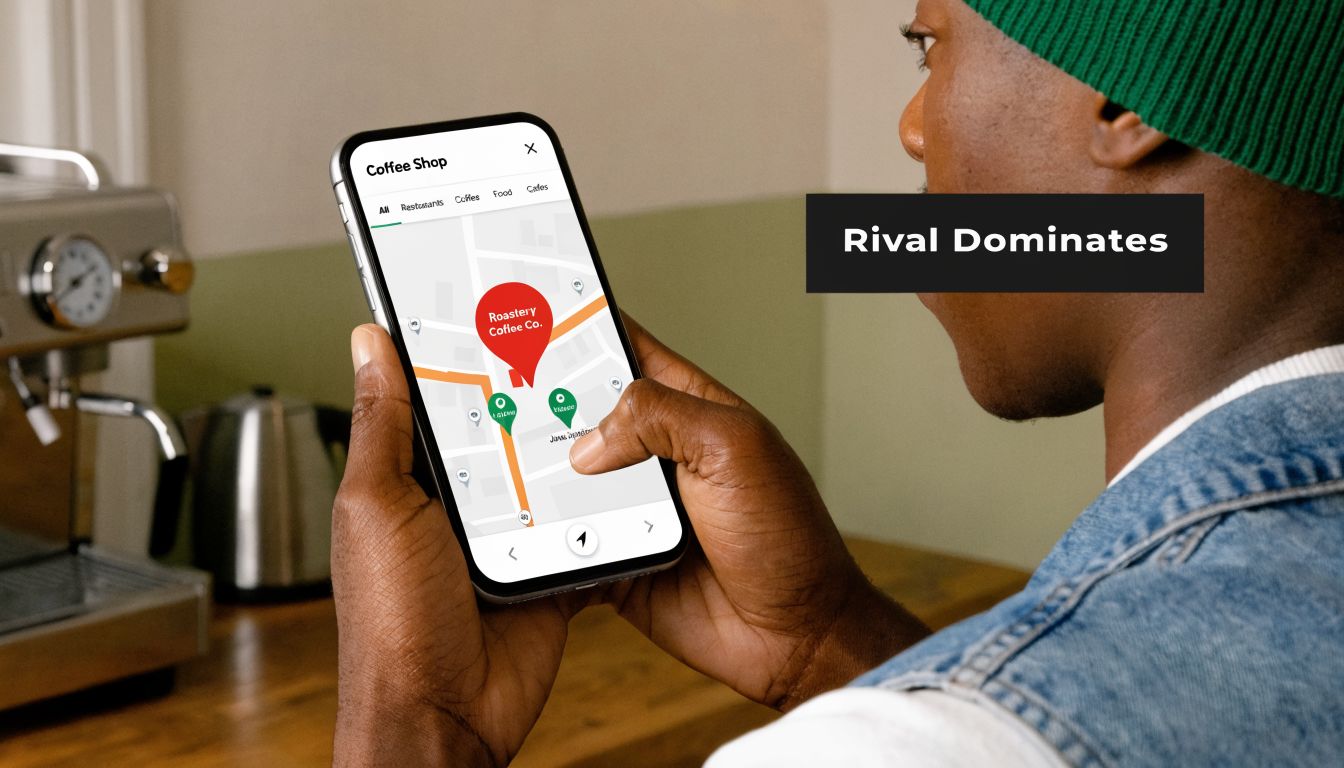
You search your service on Google Maps. A competitor in Cape Coral or Fort Myers shows up in the Map Pack. You don’t. Your reviews might be solid. Your website might be better. Your crew might answer the phone faster. But Google is still giving the visibility to someone else.
A lot of owners assume the problem is content, ads, or reviews. Sometimes it is. But a quieter issue causes a lot of lost local visibility: your business information is scattered across the web with inconsistencies, old entries, duplicates, and half-finished listings.
For home services in Southwest Florida, this happens all the time. A contractor changes phone systems. A cleaning company switches from showing an address to a service-area setup. An HVAC business rebrands. A roofing company has old directory listings from a previous office. Then that bad data keeps spreading.
That’s where a citations cleanup service matters. Think of it as jobsite cleanup for your local SEO. If the foundation is crooked, the finish work won’t sit right. Clean citations help Google trust that your business is real, current, and consistent enough to rank.
Your Competitor Ranks Higher on Google Maps This Might Be Why
A Fort Myers contractor can do everything right offline and still lose online because Google sees conflicting business details.
Maybe your Google Business Profile says one phone number, Yelp has another, Apple Maps still shows an old address, and a niche directory lists the wrong category. None of those errors feel dramatic on their own. Together, they create doubt. Google doesn’t like doubt when it chooses who to surface in the Map Pack.
The digital breadcrumbs Google follows
Your citations are the mentions of your business details across the web. They act like digital breadcrumbs. Google follows them to confirm your Name, Address, and Phone number, often shortened to NAP.
When those breadcrumbs point in different directions, rankings get weaker. A manual audit often uncovers 50 to 200+ inconsistent listings, and because Google treats NAP consistency as a top-3 local ranking factor, businesses with errors can see up to 25% lower Map Pack visibility according to Marketers Center’s citation cleanup overview.
That’s why a cleanup service isn’t busywork. It fixes the trust signals under your rankings.
Practical rule: If Google has to choose between two similar contractors, it will usually trust the one with cleaner, more consistent business data.
What this looks like in real life
A home services owner usually notices the problem backwards. They don’t start by saying, “My citations are broken.” They say:
- “We used to show in Maps more often.” Old business data may still be circulating.
- “Customers say they found the wrong number.” Legacy listings are still live.
- “A competitor with fewer reviews is ahead of us.” Their local trust signals may be cleaner.
- “We moved, and rankings dropped after.” The old address may still exist across directories.
If you’re trying to improve Google Maps ranking, citations are one of the first places to inspect because they affect both visibility and lead quality. A customer who gets the wrong address or dead phone number is gone.
For a business owner in Fort Myers, this is the useful takeaway: bad citations don’t just hurt SEO. They waste calls, direction requests, and buying intent. If you want a broader view of the local map factors around your listing, this guide on ranking in Google Maps gives helpful context.
What Are Local Citations and Why Do They Break
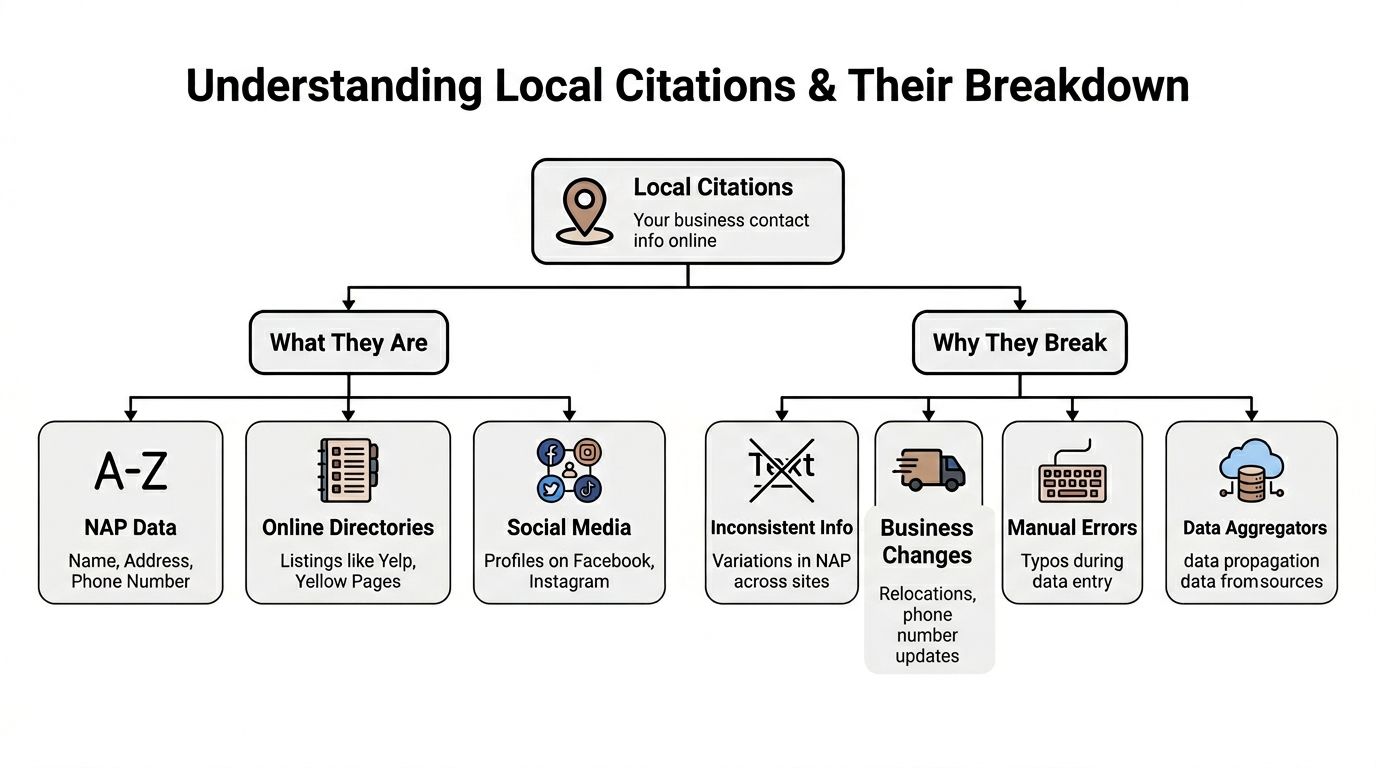
A local citation is any online mention of your business details. In plain terms, it’s your company listed in the internet’s version of a phone book.
That includes well-known platforms like Google Business Profile, Yelp, Bing Places, and Apple Maps. It also includes local directories, industry sites, and profile pages on social platforms. For a Fort Myers roofer or cleaning company, these citations help search engines verify that the business is legitimate and active in the market.
The basic parts that have to match
The core citation data is NAP:
- Name of the business
- Address if you show one publicly
- Phone number
Other details matter too. Website URL, business category, office hours, service area, and descriptions all help shape how platforms understand your company. But NAP is the baseline. If that baseline shifts from site to site, trust goes down.
There are two broad types of citations:
| Citation type | What it is | Example |
|---|---|---|
| Structured citations | Listings in directories with fixed business fields | Google Business Profile, Yelp, Apple Maps |
| Unstructured citations | Mentions of your business details in articles, blogs, or local pages | A neighborhood blog mentioning your company |
For most small businesses, the biggest ranking impact comes from getting the structured citations cleaned up first.
Why citations break so often
Citation problems usually start with a normal business change.
A contractor moves offices. A service-area business decides not to display its address. A law firm changes suite numbers. A medical office updates its main phone line. A business owner launches under one name, then later shortens it. Every change creates a chance for drift.
Then directories and data aggregators spread the old information further. One stale listing can turn into several because platforms pull from each other, scrape public data, or keep old records indexed long after the business has moved on.
A listing error isn’t always a one-site problem. It often becomes a network problem.
Southwest Florida businesses have extra friction
Home services companies in Southwest Florida deal with citation issues that generic guides usually miss.
A pressure washing company may operate as a service-area business and not want its home address exposed. An HVAC company may cover Fort Myers, Cape Coral, Estero, Bonita Springs, and Naples, but older listings may pin the business to one outdated office. Seasonal schedule changes and mobile crews can also create confusion in categories, hours, and service footprints.
Here’s where owners get tripped up most often:
- Address transitions: A business moves or hides its address, but old sites keep the previous location live.
- Phone tracking confusion: Marketing numbers get used inconsistently across platforms.
- Name drift: “ABC Roofing LLC” appears elsewhere as “ABC Roofing” or “ABC Roofing and Repair.”
- Category mismatch: A paving contractor gets listed as a general contractor on one site and a concrete contractor on another.
What a citations cleanup service really does
A citations cleanup service tracks those listings down, compares them against one approved version of your business information, and fixes the bad entries manually.
That’s important because cleanup isn’t only about deleting obvious mistakes. It’s about building a single, trusted version of your business across the sites that influence local search. For a contractor, that’s the online equivalent of making sure every truck, invoice, yard sign, and business card carries the same brand and phone number. If they don’t match, people get confused. Search engines do too.
The Most Common Citation Errors We Find in Audits
Most business owners don’t have one giant citation problem. They have a pile of small ones.
A cleanup audit is basically a punch list. You look across major directories, niche platforms, map apps, and old records, then identify every place where your business data drifted. For home services companies, that drift is usually worse than expected because the business has changed over time and old listings were never fully closed out.
The errors that show up again and again
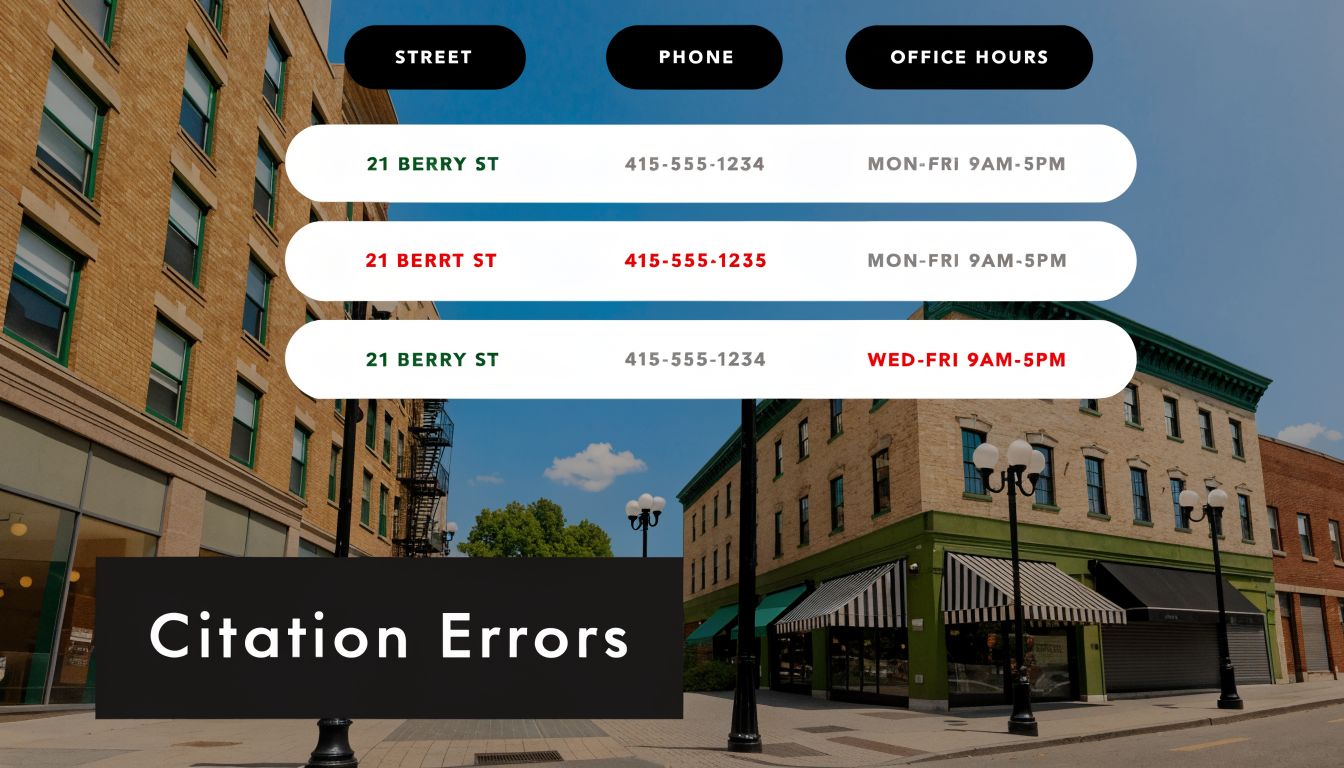
Here are the issues that most often turn up in real audits.
Mismatched business name
One listing says “Gulf Coast AC Repair LLC,” another says “Gulf Coast Air Conditioning,” and another adds service keywords into the business name.Old phone numbers
A plumbing company changed numbers two years ago, but an old directory still sends calls to the previous line.Outdated address data
A Fort Myers office moved, yet Apple Maps or a smaller directory still points customers to the old suite.Duplicate listings
An HVAC company ends up with two profiles on the same platform, which splits authority and confuses customers.Wrong categories
A cleaning company is listed as janitorial on one site and house cleaning on another, which weakens relevance.Bad website URLs
Some listings still link to an old domain, a broken page, or a social profile instead of the main site.Incorrect hours
A service business shows weekend hours on one platform and weekday-only hours on another.Unclaimed listings
The profile exists, but no one controls it, so edits are limited and changes take longer.Address shown when it shouldn’t be
A service-area business exposes a private address on directories where it should rely on service-area settings instead.Thin or incomplete listings
Missing descriptions, photos, service details, and categories leave the listing weaker than it should be.
A lot of these are fixable. The harder part is finding all of them and deciding which version becomes the source of truth.
Why duplicates cause so much trouble
Duplicates are one of the most expensive citation errors because they create two kinds of waste.
First, they split ranking signals. Second, they split customer actions. One duplicate may collect reviews while the other receives direction requests or clicks. That means your authority gets diluted instead of concentrated.
For businesses trying to identify where they’re listed, a reference list of common local listing sites helps show how wide the cleanup job can get.
If your business has changed names, locations, or ownership details, assume duplicate listings exist until you verify otherwise.
The errors contractors miss on their own
Contractors usually notice obvious issues, like an old number. They often miss the more subtle ones.
A listing might have the right number but the wrong business category. Another might use the correct name but the wrong URL. A directory may show the right company but keep an old city association that no longer matches your target service area. Those are easy to overlook and hard to catch without a systematic audit.
This walkthrough gives a useful visual on how cleanup work is handled in practice.
What matters most in Fort Myers
For Southwest Florida home services, the most damaging citation errors usually involve service-area setup, outdated location data, and wrong categories.
A roofer serving Fort Myers and Cape Coral doesn’t need random directories pinning the business to an old residential address. A paving contractor doesn’t benefit from being categorized too broadly. A cleaning company doesn’t want leads calling a dead number from an old franchise or tracking setup.
The practical test is simple: if a customer found this listing today, would they get the right impression and the right contact path on the first try? If the answer is no, the listing needs cleanup.
The Manual Citation Cleanup Process Step by Step
A proper citations cleanup service is detailed, repetitive, and slower than most business owners expect. That’s exactly why it works.
Automated tools can surface issues, but they rarely finish the job on stubborn platforms. A full cleanup can take over 50 hours of manual work because someone has to reconcile the correct business information, contact directories, suppress duplicates, and verify what changed across aggregators and local platforms, as described in OptiLocal’s cleanup process.
Step 1 starts with a source of truth
Before anyone edits a listing, the business needs one approved version of its core information.
That means one exact business name, one primary phone number, one website URL, one address format if the address is public, and one set of category and hours decisions. If this step is sloppy, the cleanup just spreads a new set of inconsistencies.
For a service-area contractor, this also means deciding where the address should stay hidden and where service areas should be emphasized instead.
Step 2 is the full audit
The essential work then begins. The cleanup team checks major platforms first, then expands into secondary directories, niche sites, map apps, and older records.
The goal isn’t just to “find listings.” It’s to identify every variation that can weaken local trust.
A useful audit record usually includes:
- Listing URL: The exact page where the business appears
- Issue type: Wrong phone, duplicate, old address, bad category, unclaimed profile
- Current status: Live, pending, inaccessible, needs claim, needs suppression
- Required action: Edit, merge, remove, claim, or build
- Proof notes: Screenshots, login status, confirmation emails, ticket references
Step 3 is manual correction and outreach
This is the part owners underestimate.
Some directories let you fix information directly after verification. Others require forms, emails, ownership claims, phone verification, or support tickets. Some update quickly. Others drag out changes or ignore the first request.
That’s why manual work outperforms one-click software in real cleanup jobs. People have to push the changes through, follow up, and confirm that edits went live.
Field insight: The directory isn’t fixed when you submit the request. It’s fixed when the live listing reflects the approved business data.
Step 4 handles duplicates and suppression
Duplicate listings need their own workflow.
Sometimes the fix is a merge. Sometimes it’s suppression. Sometimes it requires proving ownership of the right listing first, then asking the platform to remove or combine the wrong one. If a duplicate carries old reviews or old location data, the cleanup has to be handled carefully so authority isn’t scattered further.
For contractors with prior addresses, rebrands, or acquisitions, this step is often the difference between a surface-level cleanup and a real one.
Step 5 fills the missing gaps
Cleanup isn’t only subtractive. Good service also adds missing foundational citations where the business should already exist.
That may include major platforms, respected directories, and industry-relevant listings with complete categories, descriptions, and media. The point isn’t to spray the business across every directory online. The point is to strengthen the trusted signals and close obvious coverage gaps.
Step 6 finishes with proof and monitoring
The final deliverable should show what was corrected, what’s pending, what was removed, and which listings still need follow-up.
That matters because citation work drifts over time. A business changes hours. A platform republishes old data. An unclaimed profile gets recreated. Without ongoing checks, the same issues can return.
A serious cleanup service should leave the owner with documentation, login clarity, and a clean record of what was fixed. If the vendor can’t show that, the cleanup likely wasn’t thorough.
The ROI of Citation Cleanup Pricing and Expected Results
Most owners ask the right question first. “What does this cost, and what do I get back?”
That’s the right way to look at a citations cleanup service. Not as a technical task, but as a customer acquisition fix. If your listings are wrong, people can’t reliably call you, find you, or trust what they see. If they are accurate, your visibility and lead flow have a better chance to improve.

What business owners are really paying for
You’re not paying for a spreadsheet. You’re paying for someone to find errors, verify the correct information, make edits manually, chase confirmations, suppress duplicates, and document the work.
That labor is why pricing varies. In the verified market examples, WEB20 Ranker lists a Complete Citation Cleanup for $199, with audits starting at $20, and WordLead lists an audit/cleanup at $369 that scans the top 70 sites, as summarized in CitationBuilderPro’s write-up on citation cleanup value.
Cheap cleanup offers often skip the painful part, which is follow-up. They may generate a report or push automated suggestions, but they don’t always get the hard listings corrected.
What results actually matter
The useful outcomes are not vanity metrics. They’re business actions.
Accurate citations can lead to measurable gains in:
- Phone calls
- Direction requests
- Website visits
- Map interactions
- Lead flow
Those improvements happen because consistent business data helps Google trust the listing more and helps customers act without hesitation. The same source above notes that cleanup supports stronger visibility in Google Maps and local rankings, which is where the lead impact starts.
Clean citations don’t create demand. They remove friction so existing demand can reach your business.
A contractor-friendly way to think about ROI
If you run a home services company, think of citation cleanup like fixing the signage on every truck, yard sign, invoice, and phone line at once.
If the old number is still out there, some leads go nowhere. If the wrong address is listed, some people end up confused. If your categories are off, Google may not connect your business to the jobs you seek.
A single missed call from a high-intent customer can matter more than a lot of small marketing tweaks. That’s why cleanup tends to pay off best for businesses in competitive local markets where ranking and response quality both matter.
What works and what doesn’t
Here’s the short version.
| Approach | What works | What usually falls short |
|---|---|---|
| Manual cleanup | Fixes stubborn listings, handles duplicates, verifies changes | Takes time and requires process |
| Automated-only tools | Useful for discovery and monitoring | Often weak on actual correction |
| One-time cleanup | Good when data is messy from moves, rebrands, or old vendors | Needs occasional review later |
| Ongoing monitoring | Helps catch drift before it spreads | Can be overkill if the business is very stable |
For Fort Myers contractors, the highest ROI usually comes when cleanup is treated as foundational work. Not glamorous. Not fast. But necessary. Once citations are stable, everything else in local SEO has a cleaner base to build on.
How to Choose a Citations Cleanup Service A Vendor Checklist
Most citation vendors sound similar until you ask specific questions.
Everyone says they do audits. Everyone says they fix inconsistencies. The gap shows up in how they do the work, how much they correct by hand, and whether they understand the reality of service-area businesses in Southwest Florida.
One of the more overlooked points for local contractors is that generic cleanup doesn’t always address the platforms and edge cases that matter in this market. The Southwest Florida angle matters because industry-specific cleanup that includes sites like HomeAdvisor and geo-targeted Fort Myers needs can improve contractor visibility, with the cited example noting 25% higher Google Maps visibility for customized audits in this context, according to Loganix’s discussion of citation cleanup and repair.
Vendor evaluation checklist for citation cleanup
| Question to Ask | Why It Matters | Ideal Answer |
|---|---|---|
| Do you fix listings manually or mostly through software? | Manual work is usually needed for stubborn directories and duplicate handling. | “We use tools for discovery, but corrections and follow-ups are handled manually.” |
| Which directories and map platforms do you include? | Coverage should go beyond just Google. | “We cover major platforms, relevant directories, and industry-specific sites.” |
| Do you handle duplicate suppression or removal? | Duplicates often do the most damage. | “Yes, we identify, document, and work to merge or remove duplicates.” |
| How do you establish the correct business data? | Cleanup fails if the source of truth is unclear. | “We confirm the exact business name, phone, address policy, URL, categories, and hours before editing.” |
| Do you work with service-area businesses? | Contractors often shouldn’t expose a private address. | “Yes, we align listings with service-area rules and avoid unnecessary address exposure.” |
| Will I own the claimed listings and credentials? | You should keep control of your assets. | “Yes, ownership and credentials remain with you whenever possible.” |
| What proof do you provide? | Reporting separates real work from vague promises. | “We deliver live URLs, status updates, and documentation of completed changes.” |
| Do you add missing quality listings too? | Cleanup is stronger when it also closes obvious gaps. | “Yes, we build or optimize missing foundational and niche citations where appropriate.” |
| How do you handle follow-up on pending edits? | Many edits don’t stick on the first try. | “We track submissions, pending statuses, and recheck unresolved listings.” |
| Can you tailor cleanup for my trade and city coverage? | A roofer in Fort Myers has different needs than a storefront retailer. | “Yes, we adjust for your industry, service area, and local market targets.” |
What to look for if you’re in home services
For contractors, the checklist needs to go one level deeper.
A generic vendor may understand directory cleanup in theory but still mishandle the details that affect a cleaning company, paving company, or HVAC business. The biggest issue is often address policy. Many home services businesses operate from a home office or private location and should not have that address pushed all over the web.
Ask directly about these points:
- Service-area handling: Can they clean listings without forcing a public address everywhere?
- Trade-specific directories: Do they understand niche platforms relevant to contractors?
- Category accuracy: Can they align categories to the actual services you sell most?
- Geo-targeting: Will they account for Fort Myers, Cape Coral, Estero, Bonita Springs, and nearby service areas appropriately?
If you’re comparing providers, a specialized local citation building service page can also help you understand what a fuller offering should include beyond basic cleanup.
The best vendor for a contractor is rarely the cheapest one. It’s the one that understands how your business actually operates in the field.
Red flags that should make you pause
Some offers look attractive because they promise speed or massive directory volume. Be careful.
A weak provider often shows one or more of these signs:
- They focus on quantity over accuracy. Hundreds of listings don’t help if the core data is still wrong.
- They won’t explain the process. If the workflow is vague, the results usually are too.
- They keep ownership in their own accounts. That creates long-term dependency.
- They don’t mention duplicates. That usually means they’re ignoring the hardest part.
- They treat all businesses the same. A lawyer, dentist, and roofer do not need the exact same citation strategy.
For a Fort Myers business owner, the goal is simple. Hire a vendor who can clean the mess without creating a new one.
Take Control of Your Local SEO Get Your Free Analysis
Messy citations are one of the most common reasons good local businesses underperform on Google Maps.
If your name, phone number, address policy, categories, or duplicate listings are inconsistent across the web, Google gets weaker trust signals and customers get a rougher path to contact you. That hurts twice. You lose visibility, and you lose leads that were ready to act.
For Southwest Florida contractors, this problem tends to be more complicated than generic SEO advice suggests. Service-area settings, hidden addresses, old office locations, niche directories, and shifting market coverage all create citation issues that need careful handling. A proper citations cleanup service solves that by standardizing the data, fixing the listings that matter, and documenting what changed.
The practical upside is straightforward. Cleaner citations support stronger local trust, better Google Maps performance, and fewer wasted opportunities from bad business information online.
If you suspect this is holding your business back, don’t guess. Get the listings reviewed, compare them against the competitors showing up above you, and find out where your local visibility is leaking.
Polaris Marketing Solutions offers a complimentary online analysis and competitor report for businesses in Fort Myers and Southwest Florida. If you want a clear view of where your citations, Google Maps presence, and local SEO stand right now, request your free review through Polaris Marketing Solutions.