
Your phone still rings, but your website reports don't look the way they used to. You may be seeing fewer form fills, fewer obvious organic clicks, and more leads that start with, “I found you on Google,” even when the visitor never touched a traditional blue link.
That shift confuses a lot of Fort Myers business owners at first. A roofing company in Cape Coral, an HVAC contractor in Estero, or a law office in Naples can all feel it. People ask a question in Google, ChatGPT, Perplexity, or voice search, get a direct answer, and call the business that got mentioned.
That's where Answer Engine Optimization, or AEO, comes in. It's the process of shaping your website, business data, and local authority so AI systems can pull your business into direct answers instead of leaving you buried in a list of links.
The New Way Customers Find You in Fort Myers
A Fort Myers service business can do solid work on SEO and still feel like something changed. Rankings may hold. The site may be live and healthy. But customers behave differently. They ask, “Who's the best AC repair company near me?” and Google gives them a summary. Or they ask a chatbot, “Who handles emergency roof repair in Fort Myers?” and the assistant names a few companies without sending many clicks.
That behavior isn't a fringe trend. Answer Engine Optimization addresses a structural shift where 30% of online searches are now conducted via answer engines or AI-powered assistants, thereby changing how businesses capture visibility and bypassing traditional search listings, according to recent AEO search behavior data.
For a local business, that means the lead path is shorter and less visible. A homeowner in Bonita Springs may never browse five contractor websites. They may trust the answer they see, compare a couple names, and call.
What this looks like on the ground
A few common signs show up when this shift starts affecting a business:
- Calls stay steady while site clicks soften because users get enough confidence from search features, business listings, and AI summaries.
- Questions get more specific such as “best pediatric dentist in Fort Myers for same-week appointments” instead of a broad phrase like “dentist Fort Myers.”
- Google Business Profile becomes more important because customers often make a decision before they ever reach your homepage.
Practical rule: If customers can make a decision from the answer screen alone, your business has to be visible on the answer screen.
That's why old SEO thinking on its own isn't enough anymore. You still need strong local rankings. But you also need content and business signals that answer engines can trust, summarize, and cite.
If you're also looking at how AI changes customer interactions after the search, these practical strategies for AI CX are useful because they connect visibility with what happens once a lead reaches your business.
AEO vs Traditional SEO What Businesses Must Know
Traditional SEO and AEO work together, but they're not the same job.
A simple way to think about it is this. Traditional SEO tries to get your page onto the top shelf of the library. AEO tries to get your paragraph quoted by the librarian when someone asks a question.
In classic search, the goal is usually a click. In answer engines, the goal is often a citation, a mention, or inclusion in a generated response. That changes how you write, structure, and measure content.
The key difference in practice
AEO targets the zero-click result. The user asks a question, and the AI generates the answer directly. To improve the odds of being pulled into that answer, the core answer should appear within the first 40–60 words of a section, because AI models prioritize that lead text for extraction, as explained in Similarweb's AEO overview.
That one rule creates a real trade-off. A lot of business websites still open service pages with generic marketing copy. That style may sound polished, but it often hides the useful answer too deep in the page. AI systems don't reward that.
Traditional SEO vs. Answer Engine Optimization AEO
| Aspect | Traditional SEO | Answer Engine Optimization (AEO) |
|---|---|---|
| Primary goal | Earn clicks from search results | Get included or cited in direct answers |
| Main target | Rankings on search result pages | Retrieval, trust, and citation in AI responses |
| Content style | Broad service pages, keyword targeting | Direct question-and-answer formatting |
| Best page opening | Intro copy can be flexible | The answer should appear immediately |
| Success signal | Organic traffic, rankings, conversions | Citation frequency, answer visibility, AI-referred traffic |
| User behavior | Search, scan, click, compare | Ask, read answer, choose fast |
What still works and what doesn't
Some SEO fundamentals still matter a lot. Clear site structure, strong local pages, and service-specific relevance still help. But some habits don't transfer well into AEO.
What works:
- Direct answers early so the machine doesn't have to interpret vague copy.
- Question-based headings that match how real customers ask things.
- Service pages with local detail like Fort Myers, Cape Coral, Naples, and Estero context.
What doesn't work:
- Long introductions that delay the answer.
- Keyword stuffing that reads awkwardly to humans and machines.
- Thin city pages with swapped place names and no useful information.
Businesses that win in AI search usually don't write prettier copy. They write clearer copy.
Paid search still matters too, especially when you need immediate lead flow while organic visibility builds. If you're reviewing that side of the mix, Keywordme's optimisation insights are worth a look because they help frame when to rely on ads and when to strengthen your search foundation.
The Core Components of Answer Engine Optimization
AEO isn't one tactic. It's a stack of signals that help an answer engine find your content, understand it, trust it, and use it.
For a Southwest Florida business, the easiest way to think about it is as a set of building blocks. Miss one and your visibility gets weaker. Stack them properly and your chances improve.
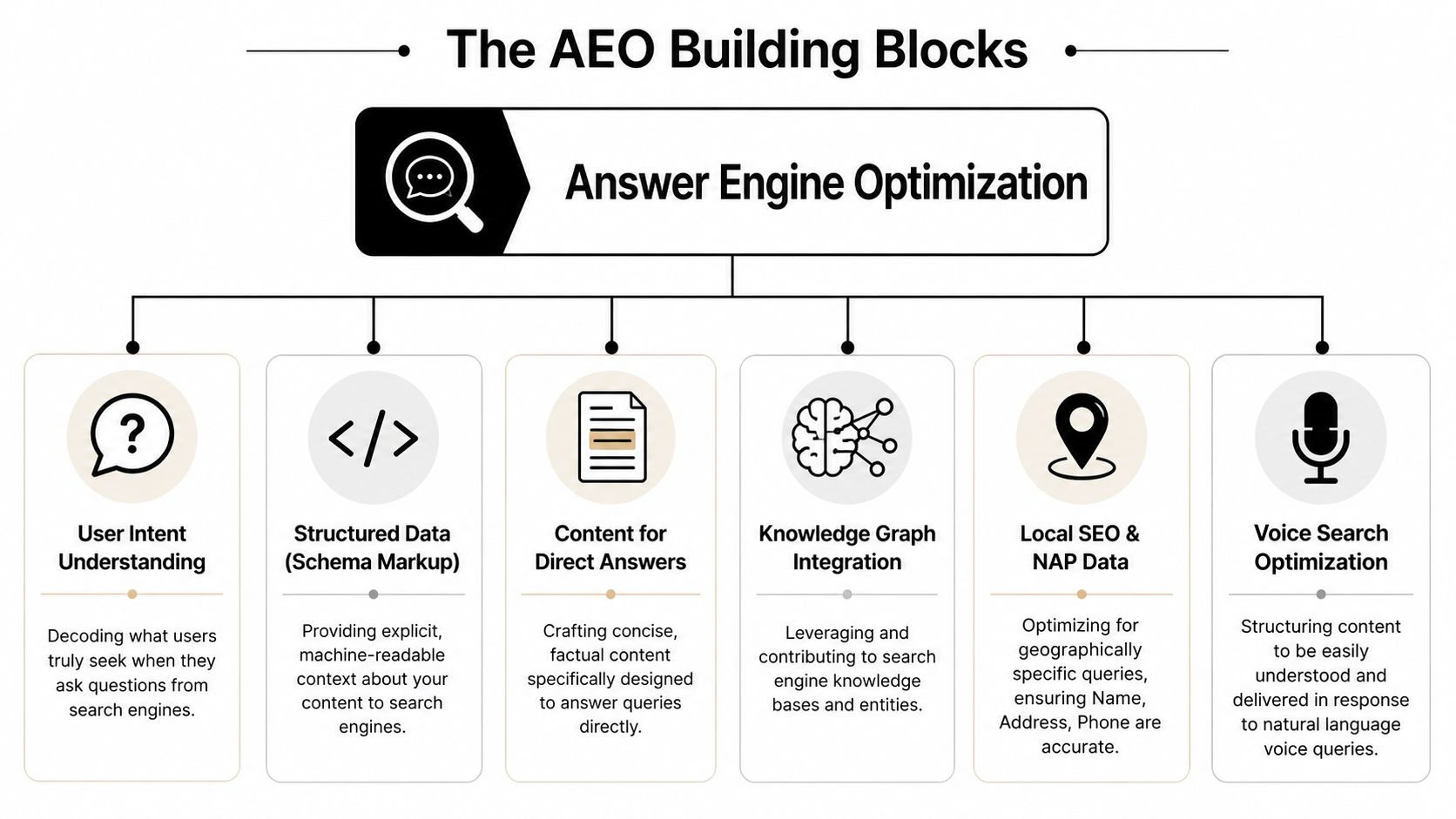
Conversational queries and direct answers
People don't search the way they used to. They ask full questions. A homeowner might ask, “Why is my AC blowing warm air in Fort Myers?” not just “AC repair Fort Myers.”
Your content should mirror that behavior. Strong AEO pages include headings that sound like customer questions and answers that get to the point fast.
A practical example for an HVAC site:
- Heading: Why is my AC blowing warm air in Fort Myers?
- First sentence: Warm air usually points to low refrigerant, airflow problems, thermostat issues, or an outdoor unit problem, and in Southwest Florida heat it should be checked quickly.
That format is far more usable for AI extraction than a paragraph that starts with company history.
Structured data acts like a translator
Schema markup tells search systems what a page contains. It removes guesswork.
For AEO, structured data like FAQPage and HowTo matters because it gives clear semantic relationships that AI systems can parse. It also helps when you publish service FAQs, troubleshooting steps, and local business details.
Think of schema as the label on a storage bin. Without the label, the system has to guess what's inside. With the label, retrieval gets easier and cleaner.
A practical local example:
- FAQPage for “Do you offer same-day drain cleaning in Fort Myers?”
- HowTo for an educational guide like “How to shut off water before a plumbing emergency”
- Organization or Local business details to reinforce who you are and where you operate
If you want a closely related search feature that often overlaps with answer-first formatting, this guide to featured snippet optimization is helpful because snippets and AEO often reward similar page structure.
AI Overviews are crowded by design
Google's AI-generated summaries don't usually rely on one source. AI Overviews now pull from 8–15 cited sources to synthesize one answer, according to Reporter Outreach's AEO analysis.
That creates a very different competitive environment from old-school SEO. You don't always need to “win” one top ranking to get noticed. But you do need content that earns trust as part of that source pool.
Many local businesses frequently miss the mark. They publish one short service page and expect it to cover everything. Answer engines respond better when your site has:
- Service depth for each core offering
- Location relevance for where you operate
- Clear authorship and credibility
- Supporting content that answers follow-up questions
Entity clarity and local identity
For a local business, AI also needs to understand that your company is a real entity, not just a webpage. That means your business name, services, location, contact details, and reputation should line up across your site and the wider web.
If your homepage says one thing, your Google profile says another, and directories show old contact information, trust weakens. For a Fort Myers contractor, that can be the difference between appearing in an answer and disappearing from consideration.
How to Implement AEO for Your Southwest Florida Business
If you run an HVAC company, roofing company, plumbing business, med spa, dental office, or law firm in Southwest Florida, AEO implementation should be practical. Start with what customers ask, then make your digital presence easy to retrieve and trust.
Here's a workable local process.
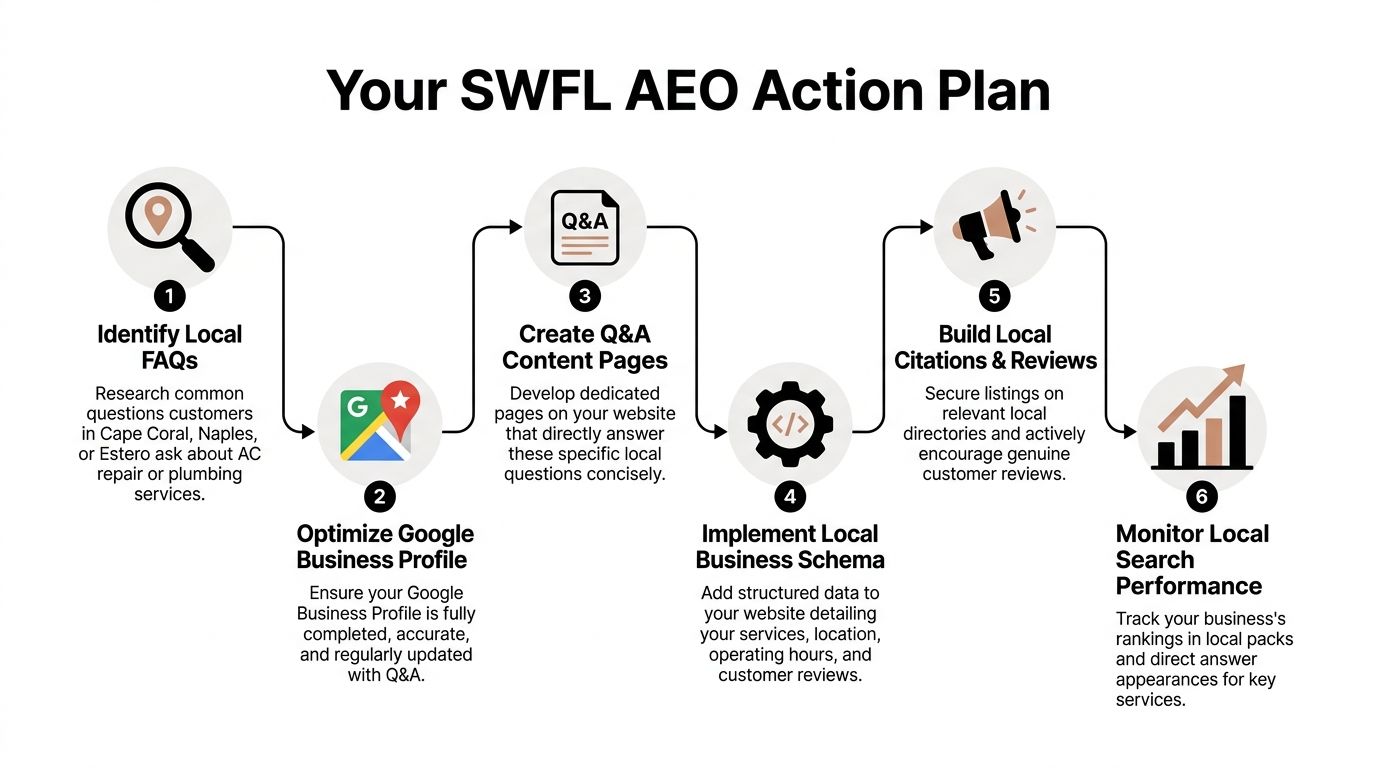
Start with real customer questions
Use your phone logs, service emails, estimate requests, Google Business Profile questions, and sales conversations. A Fort Myers roofer probably hears versions of the same questions every week:
- How much storm damage can wait
- Do you serve my neighborhood
- Can you tarp a roof same day
- What's the difference between repair and replacement
Those questions should become content assets, not just things your team answers one at a time.
A useful pattern is to create one page for each service category, then add support content around the exact questions that block a lead from calling.
Build pages that answer fast
Once you know the questions, structure your pages so the answer appears immediately. Don't lead with broad claims like “we are committed to quality.” Put the practical answer first, then explain.
For example, a Naples plumbing page could open a section like this:
- Question heading about emergency leak repair
- Direct answer in the first paragraph
- Short bullet list of causes, urgency, and next steps
- Service area confirmation
- Clear call option
That format helps humans and machines at the same time.
If a homeowner is stressed, clarity beats cleverness every time.
Clean up your Google Business Profile and local signals
Your Google Business Profile is one of the most important assets in local answer visibility. Fill out services, service areas, categories, hours, photos, questions and answers, and business description carefully.
If you need a solid local checklist, this guide on how to optimize Google Business Profile covers the basics that often get skipped.
For local businesses, entity credibility matters a lot. A 2025 study found that businesses with consistent entity data across 12+ platforms saw 3.2x more citations in Google AI Overviews than businesses with fragmented data, according to Position Digital's AEO best practices.
That means your Name, Address, and Phone data can't be sloppy. If your business appears as “SWFL AC Repair,” “Southwest Florida AC Repair LLC,” and “SWFL Air and Plumbing” across directories, answer engines get mixed signals.
Add schema and make the site easy to crawl
This is the technical part, but it's not optional.
AEO implementation gets stronger when you use:
- FAQPage schema on service FAQs
- HowTo schema on instructional content
- Server-side rendering so AI crawlers can access important text without JavaScript barriers
- A trust block near the top with author credentials, update dates, and cited sources when relevant
Keep sections self-contained. Short blocks, clear headings, bullets, and tables work better than long walls of copy.
Here's a video that gives added context on how these changes fit into modern search behavior.
Use a Fort Myers contractor example
Take a hypothetical AC company serving Fort Myers, Cape Coral, and Estero.
A practical AEO setup would include:
- A core AC repair page with direct answers to common issues.
- Location-support pages only for real service areas with local specifics.
- FAQ content like “Why is my AC freezing up in humid weather?”
- Consistent citations across major directories and local platforms.
- Ongoing review generation because reputation supports trust.
- Routine updates so old service details don't sit untouched.
What usually fails is trying to shortcut the process with spun city pages, vague blog posts, or a site that hides key content behind design effects and scripts.
Measuring AEO Success and Choosing the Right Tools
AEO gets messy if you measure it the old way. If you only watch website sessions, you'll miss what's happening in answer-driven search.
That's because people can discover your business, trust your business, and contact your business without generating a clean organic click path. In other words, visibility and traffic no longer move in lockstep.
The new metrics that matter
Research shows that 68% of AI-generated answers change within 24 hours for high-traffic queries, which makes static optimization and old traffic-only reporting unreliable for judging visibility, according to Content Marketing Institute's AEO analysis.
That volatility changes how a local business should track results.
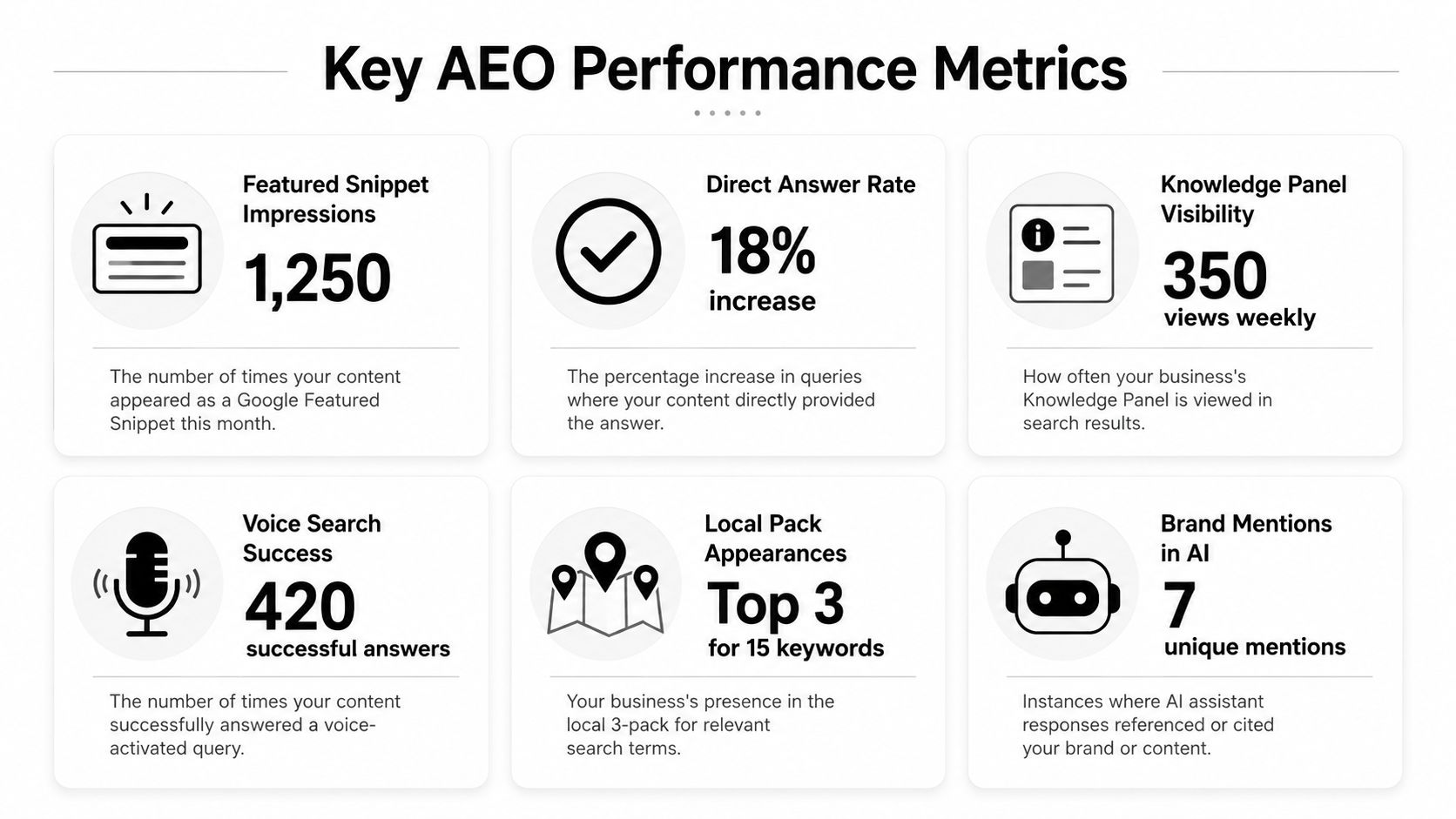
Watch these indicators instead:
- AI citation frequency which means how often your business or content appears in generated answers
- Prompt citation rate for the questions that matter to your services
- AI-referred traffic from sources such as chat-based platforms
- Google Business Profile actions including calls, direction requests, and website taps
- Lead quality from local search because better answers often bring in more informed prospects
A simple way to monitor it
A Bonita Springs service business doesn't need an enterprise stack to start. Keep it practical.
Use a mix of:
- Google Analytics 4 to review referral sources and lead paths
- Google Search Console to spot query patterns and page visibility
- Google's Rich Results Test to validate schema
- Manual prompt testing in major answer engines using your top service questions
- A rank tracker or local SEO platform to monitor map pack and local search movement
Keep a recurring list of your highest-value prompts. For example:
| Prompt type | What to look for |
|---|---|
| Emergency service question | Does your brand appear in the answer or local map context? |
| Comparison question | Are your strengths explained clearly on your site? |
| Local “best” query | Is your business profile complete enough to compete? |
| Process question | Does your FAQ or HowTo content get surfaced? |
Operational advice: Track the same prompt set regularly. Random spot checks won't tell you whether visibility is improving or drifting.
Judge success by lead quality, not just volume
AEO success often shows up in better conversations. The caller already knows your service area. They understand the issue. They're closer to booking.
That's why lead tracking still matters. Tie answer visibility back to calls, booked jobs, consult requests, and qualified inquiries. If your team needs a cleaner way to connect marketing effort to revenue, this resource on how to measure marketing ROI is a useful framework.
The Future of Local Search Is Answers
For local businesses, the question isn't whether answer-driven search matters. It already affects how customers discover and choose providers. The key question is whether your business will become one of the answers people hear first.
That's the shift behind what is answer engine optimization. It's no longer enough to publish a service page and hope it ranks. You need content that answers questions clearly, technical structure that machines can parse, and business data that stays consistent everywhere your brand appears.
The businesses that adapt fastest will have an edge
The local companies that stand out in AI search usually do a few things well. They clean up their entity data. They write pages around real customer questions. They publish direct answers instead of padded copy. They make their site technically accessible.
At the advanced level, AEO also requires structured data such as FAQPage and HowTo, server-side rendering for critical content, and a trust block with author credentials so content is easier for AI crawlers to retrieve and trust, as covered in CXL's guide to answer engine optimization.
That doesn't mean every small business needs a massive publishing machine. It means you need sharper execution than most competitors. A clean, well-structured local site can outperform a bigger site that says a lot but answers very little.
Don't wait for the old search model to come back
The old model rewarded ranking. The new model rewards usefulness, clarity, and credibility. Fort Myers businesses that adapt now have a real chance to lock in local visibility before competitors catch up.
If you're sorting through platforms, reporting, and implementation choices, a practical resource like how to pick SEO tools fast can help narrow the stack without wasting time.
The direction is clear. Local search is becoming more conversational, more summarized, and more selective. Businesses that become easy to cite will be easier to choose.
If you want help figuring out where your business stands in AI-driven search, Polaris Marketing Solutions offers a complimentary online analysis and competitor review for businesses in Fort Myers and across Southwest Florida. It's a practical way to see how your website, local listings, and search presence stack up, and where AEO opportunities may already be costing you leads.