

A homeowner in Fort Myers, a family in Cape Coral, or a patient in Naples may compare several local providers before making one call. They'll look at star ratings, recent comments, business information, photos, and how professionally each company responds when something goes wrong. The provider with the clearest information and strongest pattern of customer care often earns the inquiry before a salesperson ever speaks with the prospect.
That's why online reputation management is more than replying to criticism. It's an operating workflow that supports trust, local visibility, lead quality, retention, hiring, and marketing cost control. The eight benefits below connect reputation activity to practical outcomes for Southwest Florida home services, healthcare practices, legal firms, and other local businesses. Each section includes a local scenario, an impact measure drawn from the supplied examples, and an action you can apply.
Every review is both a customer-service signal and a local-search asset.
1. Increased Customer Trust and Credibility
Trust is the first business outcome of a strong online reputation. Pew Research data summarized by New Media's reputation management statistics found that 82% of U.S. adults at least sometimes read online ratings or reviews before buying something new, including 40% who always or almost always do so. A later survey reported that 77% considered reviews important, while about one in three said they wouldn't buy without reading them first.
That behavior matters even more for businesses where customers are inviting workers into their homes, sharing private health information, or choosing legal representation. A Fort Myers HVAC contractor with complete business details, current reviews, and thoughtful responses gives prospects more reasons to believe the company will communicate clearly and finish the job responsibly.
Reviews also need to look credible, not manufactured. The same research found that 51% of review readers believe reviews generally provide an accurate picture of product quality, while 48% say it's often difficult to tell whether reviews are truthful. That tension makes response quality, review recency, and consistent business information important parts of credibility.
Build trust through a repeatable request process
A review program should follow the customer journey, not rely on occasional reminders. After a completed service call, send a short email or text asking for honest feedback. Home-service teams can hand customers a card with a QR code linking directly to the Google Business Profile review page, while healthcare practices can send a post-visit message that respects privacy and platform rules.
Use a simple operating rhythm:
- Ask at the right moment: Request feedback after the technician completes the work, the patient finishes an appointment, or the attorney closes a meaningful milestone.
- Respond consistently: Thank customers for positive feedback and acknowledge concerns with a professional next step.
- Review progress monthly: Track new reviews, recurring complaints, and rating movement with the team.
Don't pressure customers to leave only positive feedback or write reviews for them. Authenticity protects the trust you're trying to build.

2. Higher Search Engine Rankings and Local Visibility
A strong reputation helps a local business become easier to find and easier to choose. Google Business Profile completeness, accurate listings, relevant categories, service descriptions, customer reviews, and response activity all contribute to the information customers use when comparing nearby providers. Reputation management doesn't replace technical SEO or a well-built website, but it strengthens the local signals surrounding both.
Rating quality and freshness matter alongside review volume. Research summarized by Reputation X's local business statistics reported that 97% of consumers read reviews for local businesses, 31% will only use a business rated 4.5 stars or higher, and purchase likelihood tends to peak between 4.0 and 4.7 stars, rather than at a perfect 5.0. The same source reported that 73% of consumers only trust reviews written within the last month, while 40 reviews is the minimum many shoppers want before viewing a star rating as reliable.
Those figures point to a practical local-search strategy. A Cape Coral roofing company shouldn't collect reviews in one burst and then stop. It should maintain an accurate profile, publish useful local updates, request feedback after completed projects, and build service pages for nearby markets such as Bonita Springs.
Turn visibility into trackable local actions
Claim and complete every available Google Business Profile field. Add accurate hours, service areas, categories, photos, appointment or quote links, and project information. Publish local updates regularly, but don't post empty filler. A completed roof, storm-preparation advice, or an explanation of maintenance services gives customers a reason to engage.
For businesses competing in map results, this guide to ranking in Google Maps provides a useful companion to review and listing work. Measure visibility through calls, direction requests, profile visits, website clicks, and tracked leads, not rankings alone.
- Keep citations consistent: Use the same business name, address, phone number, and website across relevant directories.
- Create location-specific pages: A roofing provider can develop pages for Cape Coral, Bonita Springs, and Estero when those areas are served.
- Request specific feedback: Ask customers to describe the service they received, without scripting or incentivizing the review.
3. Competitive Lead Generation and Market Share Growth
A homeowner in Naples may compare roofing companies before calling. A patient in Cape Coral may review dental practices before booking. A legal client may check recent feedback before submitting a consultation form. Reviews, owner responses, current photos, and clear service details shape that shortlist before a sales conversation begins.
Analysts cited in Moz's local consumer review survey found that 88% of consumers said they'd use a business that replies to all reviews, compared with 47% who'd use a business that doesn't respond. The survey also found that 91% said local branch reviews influence their perception of big brands. That matters for multi-location healthcare, home-service, and professional-service businesses serving Southwest Florida.
A Naples dental practice can turn reputation work into a measurable acquisition channel by combining review requests, Google Business Profile updates, and accurate website content. Track which inquiries came from Google, which callers mentioned reviews, and which forms became appointments. The same process helps a Fort Myers contractor compare reputation-driven leads with referrals, paid search, and social campaigns.
Move reputation data into the sales pipeline
Set up call tracking for the website and Google Business Profile where appropriate. Configure form conversions in analytics, then record each inquiry's source, requested service, response time, and outcome in a basic CRM. This reveals whether reputation activity produces qualified opportunities or merely increases low-value contacts.
A practical workflow includes:
- Set a response standard: Assign new inquiries to someone who can answer the service question promptly.
- Test useful actions: Compare “Call,” “Request a Quote,” and “Book Now” according to the customer's buying process.
- Separate lead quality from lead quantity: A smaller group of well-matched inquiries can produce more revenue than a larger volume of poor-fit calls.
Contractors can also use accurate, current customer feedback during sales conversations. For broader acquisition ideas, review these Phone Staffer contractor lead strategies alongside a reputation-focused process. Never quote a rating or review count without checking that it remains current.
The trade-off is measurement discipline. Reviews rarely operate alone, so use source tracking and customer conversations before attributing every new lead to online reputation management. This approach shows which reputation investments generate calls, appointments, signed work, and stronger market share.
4. Protection Against Negative Reviews and Crisis Management
A Bonita Springs cleaning company sees a Google complaint about incomplete work shortly after the job. The manager confirms what was missed, schedules a re-cleaning, and posts a professional response. The customer may remain dissatisfied, but prospective clients can see that the company acknowledges problems and follows through.
That response protects more than the review score. In Southwest Florida, a missed appointment, billing confusion, delayed repair, or difficult communication can affect local searchers, referral decisions, and future bookings within a short time. Reputation management gives the business a process for identifying these incidents, assigning ownership, and tracking whether service recovery prevents repeat complaints.
A business should not promise that every unhappy customer will revise a review. Offering compensation for deletion or generating artificial positive reviews can create a larger credibility problem. Keep the public reply factual, avoid private details, and move the customer's case into an internal service workflow.

Create an escalation path before a crisis
Monitor the business name, common misspellings, important service terms, and review notifications. Alerts should reach someone who can make decisions rather than remain in an unattended inbox. A response template can cover acknowledgment, an apology when appropriate, a factual explanation, and a private route for resolving account details.
Use this guidance on responding to negative reviews with how to handle bad customer feedback. Public professionalism matters, but internal action determines whether the same issue returns.
- Identify patterns: Group complaints by service, employee, location, and issue.
- Enable staff: Let front-line employees flag dissatisfaction before it becomes a public review.
- Fix root causes: Adjust scheduling, training, quality checks, or communication when complaints repeat.
A healthcare office can use this process to protect patient privacy, while a legal practice can route sensitive matters away from public replies. Home-service companies can track rework, missed arrival windows, and unresolved calls. Measure the result through repeat complaints, recovered customers, response time, and retained bookings. A response has value when operations improve, not merely when the wording sounds polished.
5. Enhanced Website Traffic and Qualified Customer Sessions
A homeowner in Cape Coral may find an HVAC company through Google Maps, read reviews about arrival times, and visit the site ready to request service. That visitor has already formed an initial opinion, so the website must continue the experience rather than restart it.
Send each profile visitor to the page that matches the search intent. A North Fort Myers legal practice can link its Google Business Profile to a practice-area page instead of a generic homepage. That page should explain the service location, consultation process, next steps, and appropriate proof of experience. Reviews can reinforce relevance, but they should not promise legal outcomes or reveal confidential information.
The click is only one measurable step. A broken form, outdated phone number, unclear service description, or slow mobile page can turn reputation work into wasted demand. Coordinate review activity with page content, conversion design, analytics, and technical maintenance.
Match the destination to the customer's question
A home-services company can connect a water-heater listing to a repair or quote form. A healthcare office can send prospective patients to appointment information. A law firm can direct visitors to the relevant practice page and a clear consultation request. These choices reduce friction and make lead quality easier to evaluate.
Use this guide to increase website traffic organically, then audit the path from profile visit to completed action:
- Separate traffic sources: Distinguish Google Business Profile sessions from other organic and paid visits.
- Track qualified outcomes: Record calls, form submissions, booking requests, and consultation starts.
- Review service intent: Compare which profile links and pages produce inquiries for the services the business wants.
- Maintain proof: Add recent, permission-based testimonials and remove outdated claims.
A healthcare practice may prioritize appointment starts, while a home-service company may measure booked jobs and a legal practice may track consultation requests. Judge traffic by qualified sessions and completed actions, not visits alone. A smaller audience asking for the right service can produce more value than a larger audience that leaves immediately.
6. Long-Term Cost Reduction and Improved Marketing ROI
Reputation management can improve marketing efficiency because a useful review remains available after the initial request. A review may support a map listing, influence a comparison, reinforce a landing page, and help a salesperson answer a concern. That doesn't make ORM free or passive. Staff still need to request feedback, monitor platforms, respond to customers, update listings, and improve service quality.
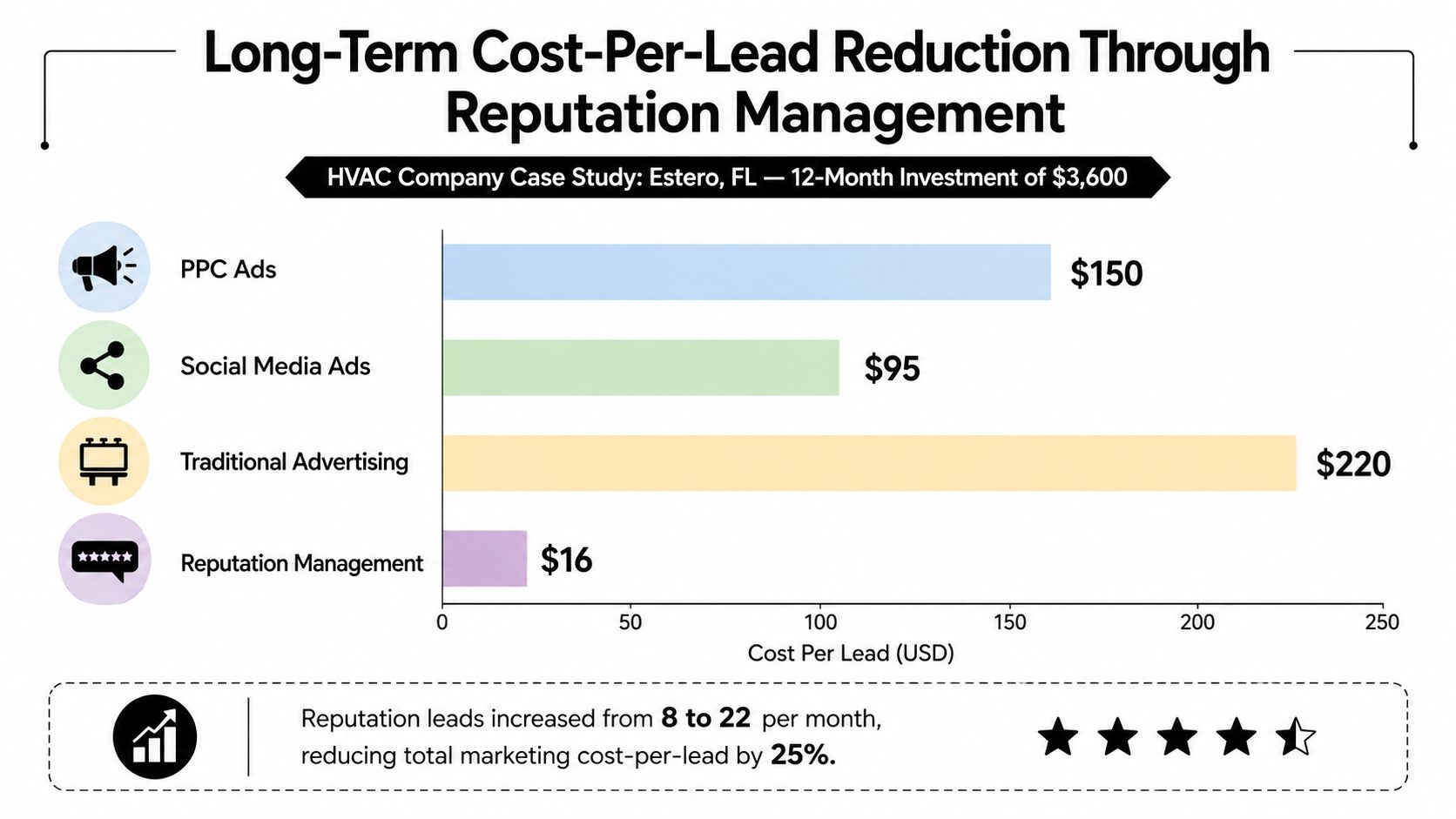
An Estero HVAC company can compare reputation-related opportunities with paid advertising on a monthly basis. The supplied scenario describes a five-person company investing $300 per month, or $3,600 across 12 months, in reputation management and Google Business Profile optimization. It generated 180 new reviews, moved from position 7 to position 2 in local search, and increased monthly qualified leads from 8 to 22. In the following month, the company reduced the spend to $100 for maintenance, while the scenario reports a comparison of $150 per paid-ad lead versus $16 per reputation-related lead, producing approximately $2,800 in savings for that month.
Those are scenario figures, not a promise for every business. Results depend on service quality, competition, tracking accuracy, market demand, and execution.
Calculate the economics before shifting budget
Track cost per qualified lead, not only cost per inquiry. Include software, agency fees, staff time, review-request administration, website work, and listing maintenance. Compare those costs with paid media spend and the revenue produced by each channel.
- Start with a baseline: Record current review volume, profile actions, calls, forms, booked jobs, and acquisition costs.
- Protect working channels: Don't shut off profitable paid campaigns before organic and reputation-driven demand is dependable.
- Automate carefully: Automate reminders and alerts, but keep human approval for sensitive responses and service recovery.
- Invest by value: Prioritize high-margin services and locations where a qualified lead has meaningful financial value.
7. Improved Customer Retention and Lifetime Value
A Fort Myers healthcare practice can learn from reviews whether patients value appointment availability and clear communication, or struggle with long waits, confusing instructions, and difficult scheduling. A Naples law firm can identify complaints about unclear billing or slow updates before those issues push prospective clients toward another practice. Contractors can spot repeated concerns about arrival windows, cleanup, or workmanship.
Recent business-decision-maker data summarized by Trustpilot's growth research reported that 94% believe investing in review and rating platforms helps build brand trust, 90% say it improves customer retention, and 91% say online review feedback helps improve products and services. The operational value comes from acting on repeated themes. A manager who assigns those themes to scheduling, billing, clinical, or service leaders can improve the experience that drives repeat business.
Use a respectful post-visit request, thank customers who share feedback, and review patterns during regular service meetings. Fix unclear instructions, long waits, or difficult booking processes, then check whether complaints decline and returning customers increase. The review may support local discovery, while the follow-through helps existing patients, clients, or homeowners stay.
Turn feedback into retention work
A personal response to a positive review can reinforce the behavior the customer appreciated. A negative review that identifies a real gap should trigger private outreach through an appropriate channel, service recovery, and a documented operational fix when possible. Public replies must never disclose protected health information or confidential legal details.
Track customer outcomes beside reputation activity:
- Repeat booking rate: Compare customers who return for another service or appointment.
- Referral activity: Ask new customers how they heard about the business and record referrals.
- Recurring themes: Share patterns with operations, training, and leadership teams.
- Recovery outcomes: Monitor whether customers contacted after a service problem remain active.
Review requests can reveal problems that staff or managers have stopped noticing. That exposure carries a cost: collecting feedback creates little retention value if scheduling, communication, billing, or service quality remains unchanged. Assign an owner to each recurring issue, record the fix, and compare retention and referral trends after implementation.
For Southwest Florida home services, healthcare practices, and legal firms, the strongest retention gains come from connecting review themes to the customer journey. That link shows which operational changes protect repeat revenue and lifetime value.
8. Attracting Higher-Quality Employees and Building Organizational Culture
A prospective employee may check Google reviews before applying to a cleaning company, HVAC contractor, medical office, or legal practice. Accurate business information and specific customer praise show how the organization treats people, especially in Southwest Florida markets where dependable local staff can be difficult to recruit.
For example, a Cape Coral cleaning company can share selected feedback in team meetings, connect praise to the employee behavior behind it, and use recurring complaints to improve training. In the supplied scenario, the company had a 4.8-star Google rating and more than 120 reviews. New hires said the reputation influenced their decision to apply. Average employee tenure rose from 14 months to 22 months, while training costs fell by 35%.
Treat that result as a specific scenario, not a standard hiring forecast. Reviews may strengthen an employer's appeal, but they cannot offset poor scheduling, weak management, low pay, or unsafe working conditions.
Turn customer feedback into a workplace tool
Share positive reviews with the people recognized, whether they are technicians, receptionists, assistants, or case coordinators. Ask front-line employees which service issues create repeat complaints and give managers a clear process for acting on their suggestions. That approach makes reputation work part of daily operations instead of a system used only to identify mistakes.
Practical uses include:
- Connect praise to values: Identify the behavior that earned customer appreciation and explain why it matters.
- Use reviews in recruiting: Link to legitimate review profiles in job postings when the context is appropriate.
- Recognize contributions: Feature employees with customer feedback when permission and privacy allow.
- Track workforce outcomes: Compare applicant quality, acceptance rates, tenure, and training demands over time.
Review themes can also guide hiring criteria. If customers consistently praise clear communication, punctuality, or careful explanations, use those behaviors in interviews and onboarding for service, healthcare, and legal roles.
Do not ask employees to create customer reviews or manipulate ratings. A credible culture comes from consistent service, fair management, and visible follow-through.
Online Reputation Management: 8-Benefit Comparison
| Benefit / Outcome | Implementation Complexity 🔄 | Resource Requirements ⚡ | Expected Outcomes ⭐📊 | Ideal Use Cases 💡 | Key Advantages ⭐ |
|---|---|---|---|---|---|
| Increased Customer Trust and Credibility | Moderate, ongoing monitoring & response workflows | Low–Moderate: staff time for review requests and responses; basic tools | Higher first‑time conversion rates; stronger local reputation | Service businesses (home contractors, healthcare) relying on trust | Builds credibility, reduces acquisition friction, supports premium pricing |
| Higher Search Engine Rankings and Local Visibility | Moderate, GBP optimization, citations, local content | Moderate: content work, directory listings, review generation over weeks | Improved local rankings; increased organic local traffic and CTR | Local SMBs aiming for Google "3‑pack" and neighborhood searches | Sustainable organic visibility; lower CAC than paid ads |
| Competitive Lead Generation and Market Share Growth | Moderate–High, trackable funnels & listing optimization | Moderate: CRM/call tracking, review campaigns, analytics | More qualified inbound leads; measurable ROI and pipeline growth | Businesses converting research‑stage buyers into inquiries | Captures ready‑to‑buy customers; reduces cost‑per‑lead |
| Protection Against Negative Reviews and Crisis Management | High, continuous monitoring and rapid response protocols | Moderate–High: monitoring tools, trained staff, daily alerts | Faster issue resolution; fewer PR incidents; preserved ratings | High‑risk public sectors or firms exposed to frequent feedback | Prevents small issues from becoming crises; enables recovery |
| Enhanced Website Traffic and Qualified Customer Sessions | Moderate, GBP CTAs, landing pages, analytics setup | Low–Moderate: web optimization, analytics, regular content updates | Increased qualified traffic, longer sessions, higher conversion rates | Businesses wanting improved organic site conversions from local searches | Higher‑intent visitors; reduced bounce rates; better engagement |
| Long‑Term Cost Reduction and Improved Marketing ROI | Moderate, initial setup then steady maintenance | Low–Moderate ongoing: automation/tools plus periodic effort | Lower long‑term CPL; compounding ROI; less reliance on ads | Small/mid businesses with constrained marketing budgets | Sustainable leads; scalable without proportional spend increases |
| Improved Customer Retention and Lifetime Value | Moderate, feedback loops and follow‑up systems | Moderate: CRM, communications, incentives for reviews | Higher repeat purchase rates; increased LTV and referrals | Repeat‑service businesses (healthcare, legal, home services) | Boosts LTV, reduces acquisition pressure, uncovers service improvements |
| Attracting Higher‑Quality Employees & Culture | Low–Moderate, internal sharing and employer branding | Low: internal comms, career pages, review highlights | Better applicant quality; improved morale and retention | Businesses hiring regularly or prioritizing service excellence | Stronger employer brand; reduced recruitment time and costs |
Turn Reviews Into a Repeatable Growth Workflow
The eight benefits work together when reputation management becomes part of normal operations. A completed HVAC repair should trigger a feedback request. A new review should reach the right person for a response. A recurring complaint should reach the manager responsible for scheduling, training, or quality control. A strong review should support a relevant service page, sales conversation, recruiting message, or customer-retention initiative.
Start with a simple workflow. Request feedback after completed work, appointments, or meaningful legal-service milestones. Monitor Google Business Profile and other important platforms daily or on a schedule your team can maintain. Respond to reviews within 24 hours as an internal service standard, with escalation rules for safety, privacy, legal, billing, or discrimination concerns. Keep business information current across directories, and connect profile links to landing pages that match customer intent.
Measure business outcomes, not vanity signals. Track calls, forms, appointment requests, booked jobs, consultation starts, repeat bookings, referrals, cost per qualified lead, and hiring outcomes. Use review themes to identify service improvements, then look for changes in retention, complaint volume, and customer satisfaction. These small business review tactics can help strengthen the request process without turning it into an awkward sales script.
A practical 30-day starting sequence looks like this:
- Days 1 through 7: Audit your Google Business Profile, major directory listings, review history, response coverage, business hours, service areas, photos, and website links.
- Days 8 through 14: Create response templates for positive, neutral, and negative reviews. Define who approves sensitive replies and who owns service recovery.
- Days 15 through 21: Set up call tracking, form goals, CRM source fields, review-request follow-ups, and notifications for new reviews.
- Days 22 through 30: Review early data, identify recurring customer themes, update priority pages and listings, and set a monthly performance meeting.
Businesses in Fort Myers, Cape Coral, North Fort Myers, Estero, Bonita Springs, and Naples can use Polaris Marketing Solutions for an integrated approach that combines local SEO, review management, website improvements, and transparent reporting. Polaris also offers a complimentary online analysis and competitor report, which can help establish a realistic starting point before you invest in a longer program.
Online reputation management pays off when it connects customer experience with discoverability and measurement. The objective isn't a perfect-looking profile. It's a current, credible, responsive presence that helps the right customers find you, trust you, contact you, return to you, and recommend you.
Polaris Marketing Solutions helps Southwest Florida businesses strengthen online reviews through reputation management, local SEO, website improvements, and transparent reporting. Visit Polaris Marketing Solutions to request a complimentary online analysis and competitor report, then use the findings to build a practical reputation workflow tied to calls, leads, retention, and growth.