

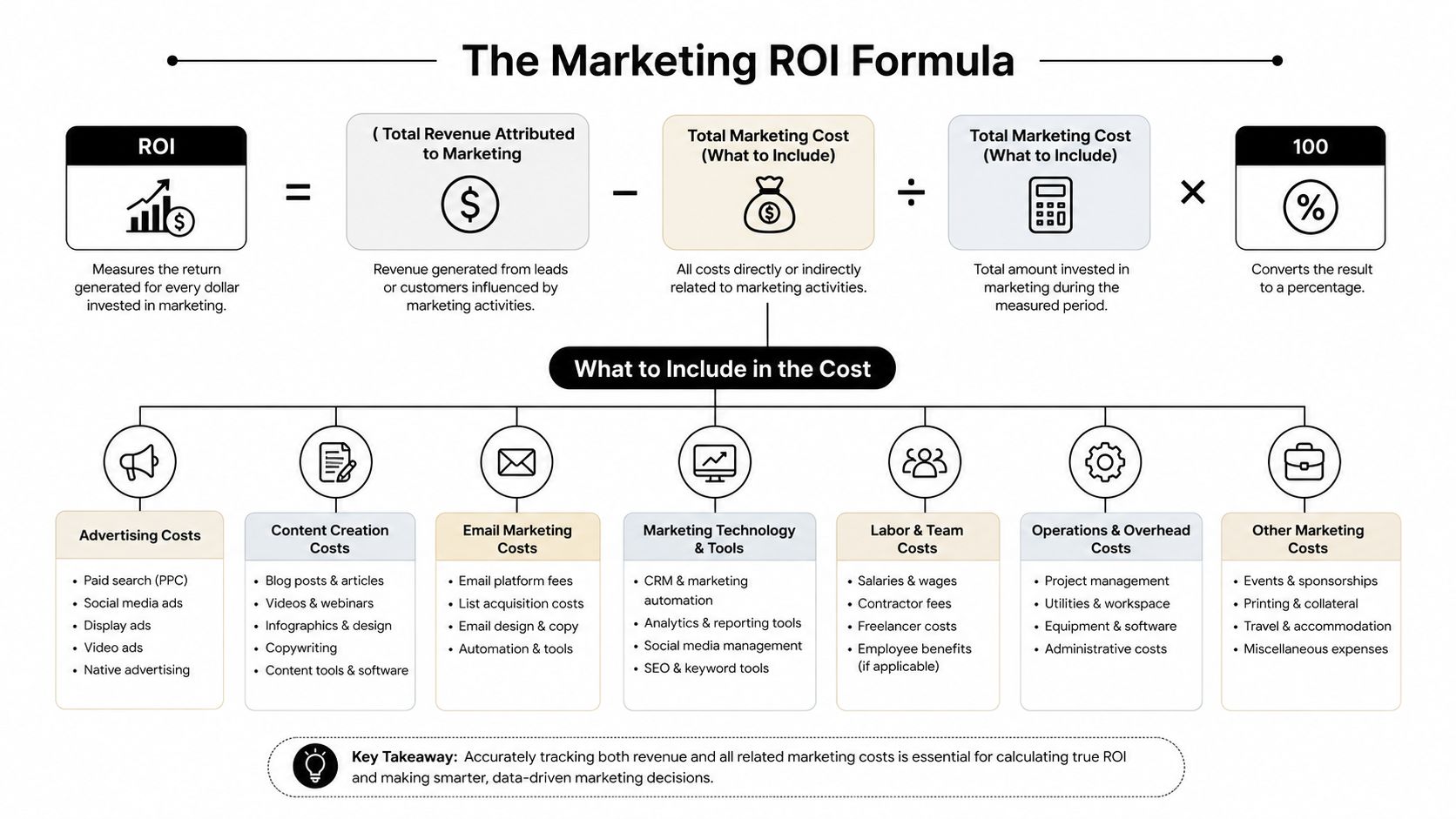
Marketing ROI is the percentage return generated by the dollars spent on marketing. The working formula is ROI = ((revenue attributed to marketing – marketing cost) ÷ marketing cost) × 100.
A local business owner can spend a month watching leads arrive, phone calls ring, and website traffic climb, then still hesitate when someone asks, “Did marketing make money?” The answer isn't hidden in a bigger dashboard. It comes from connecting marketing activity to qualified inquiries, booked appointments, completed jobs, and profitable customers.
That connection is where return on investment, or ROI, becomes useful. It turns a vague question about whether marketing “worked” into a practical decision about where the next dollar should go. This guide explains the formula, the costs people leave out, the supporting metrics that prevent misleading conclusions, and a workable tracking system for local businesses.
Why Marketing ROI Matters More Than Lead Counts
A cleaning company owner checks the numbers on Monday morning. The advertising account reports clicks, the website form has produced inquiries, and the phone has been busy. It looks like a successful month, but several leads were outside the service area, some never answered follow-up calls, and only a portion became paying customers.
Lead volume describes activity. ROI describes financial return.
Traffic, impressions, clicks, engagement, and leads can help diagnose a marketing system, but they don't answer the business question by themselves. A campaign can generate inexpensive leads that rarely close, while another campaign produces fewer inquiries from customers who need a high-value service. Counting both campaigns as equal would hide the difference that matters.
Marketing ROI is a profitability metric comparing what the company gains from marketing with what it spends. Major vendors describe it as the return generated by marketing activities as a whole, not merely advertising spend, as summarized in this marketing ROI benchmark reference.
Practical rule: A lead is an opportunity. Revenue, gross profit, and recovered acquisition cost tell you whether the opportunity was worth buying.
For a small business, that distinction affects every budget decision. The rest of this guide shows how to calculate ROI, compare channels, include repeat business, choose an attribution method, and build a lean reporting rhythm around tools a small team can maintain.
The Marketing ROI Formula and What to Include in the Cost
Start with the simple calculation:
ROI = (revenue attributed to marketing – marketing cost) ÷ marketing cost
To express the result as a percentage, multiply by 100. If a campaign generates $50,000 in attributed revenue from $10,000 in marketing cost, the calculation is (($50,000 – $10,000) ÷ $10,000) × 100 = 400%, or 5:1. This example and the percentage form are also set out in Oracle's marketing ROI explanation.
For a more useful profitability view, replace revenue with gross profit when the cost of goods, fulfillment, or delivery materially affects what the business keeps. Salesforce describes this distinction in its ROI measurement guide. Revenue-based ROI can look attractive even when the margin left after fulfilling the sale is thin.
Consider a campaign with $50,000 in attributed revenue and $10,000 in media spend. The media-only calculation produces 400% ROI. Now add $2,000 for creative production, $1,000 for tools, and $2,000 for campaign management. The fully loaded cost is $15,000, so fully loaded ROI becomes (($50,000 – $15,000) ÷ $15,000) × 100 = 233.3%.
| Calculation | Inputs | ROI Result |
|---|---|---|
| Simple ROI | $50,000 revenue, $10,000 media spend | 400%, or 5:1 |
| Fully Loaded ROI | $50,000 revenue, $15,000 total campaign cost | 233.3% |
Build the cost line honestly
The cost line can include media budgets, agency fees, technology, headcount, creative production, and labor, not just the amount paid to an ad platform. This cost-basis discussion explains why comparing media-only ROI with fully loaded ROI can change budget decisions.
If you use PPC advertising management services, include the management fee in the overall view. For owner-operated businesses, estimate the time spent writing ads, answering leads, updating landing pages, and reviewing results. You can keep a simple media-only figure for fast channel comparisons, but label it clearly so it isn't mistaken for profitability.
Beyond ROI The Supporting Metrics Small Businesses Actually Need
ROI answers whether a marketing investment produced a return, but it can mislead when the timing or customer value is incomplete. A new customer may make an initial purchase, return for future services, refer a neighbor, or become a recurring account. A short reporting window can make that acquisition look weaker than it really is.
Four supporting metrics add the missing context:
- ROMI: Return on marketing investment, usually applied to a particular campaign or channel. It helps decide whether one marketing activity deserves more or less budget.
- CAC: Customer acquisition cost, the average marketing and sales cost required to acquire a paying customer. It tells you what each new customer costs.
- LTV: Customer lifetime value, the value a customer can generate across the relationship. It shows why repeat business matters.
- Payback period: The time required for the gross profit from a customer to recover the acquisition cost. It protects cash flow when revenue arrives gradually.
The practical framework is to ask a different question for each metric.
| Business decision | Metric to examine | What it reveals |
|---|---|---|
| Reallocate channel budget | ROMI and ROI | Which activity returns more value for its cost |
| Kill or revise a campaign | ROI and qualified conversion data | Whether poor results come from the channel or weak execution |
| Raise prices or improve margins | Gross profit, CAC, and payback | Whether acquired customers are financially sustainable |
| Invest in retention | LTV and repeat purchase behavior | Whether existing customers create more value over time |
A campaign can show weak first-purchase ROI and still be the strongest long-term investment if it attracts customers who stay longer or buy additional services. That's why recent small-business guidance recommends looking at gross profit per customer, CAC, and payback period, rather than relying on revenue attribution alone, as explained in this small-business marketing ROI guide.
The useful question isn't “Which channel has the highest ratio?” It's “Which channel buys profitable customers quickly enough for the business to keep funding growth?”
For a local service company, track the first invoice, later jobs, referrals, and the time between acquisition and recovered cost. A simple spreadsheet with customer ID, source, first sale, repeat revenue, gross profit, and acquisition cost can reveal more than a detailed dashboard that never reaches closed revenue.
Three Worked Examples for Local SEO PPC and Social
The same formula works across channels, but the inputs differ. SEO may create value over a longer period, paid search can connect directly to calls, and social campaigns often need booked appointments as the conversion event.
Local SEO for a home services company
A home services company invests $10,000 in a six-month local SEO project. The business attributes $50,000 in collected revenue to organic search during the measurement window.
Calculation:
(($50,000 – $10,000) ÷ $10,000) × 100 = 400% ROI, or 5:1.
For a project like this, use a realistic attribution window rather than judging the work immediately after an invoice. Track qualified calls, service-area relevance, booked jobs, completed jobs, and revenue in the CRM. A practical starting point is local SEO for home services, paired with consistent source capture.
The takeaway is simple: don't value SEO by rankings alone. Value it by the profitable jobs those rankings help create.
Google Ads with tracked calls
A contractor spends $10,000 on a Google Ads campaign for one service area. Call tracking identifies calls from the campaign, and the CRM records $30,000 in revenue from completed jobs.
Calculation:
(($30,000 – $10,000) ÷ $10,000) × 100 = 200% ROI, or 3:1.
The campaign report should exclude missed calls, irrelevant callers, duplicate inquiries, and jobs that never closed. If management, landing-page work, or creative costs are included, use those expenses in a second fully loaded calculation.
The takeaway is that a platform conversion isn't the final result. A qualified call that becomes a completed job is much closer to the true return.
Social media for a local practice
A healthcare or legal practice spends $10,000 on a local social campaign. The campaign produces booked appointments that later generate $15,000 in attributed revenue.
Calculation:
(($15,000 – $10,000) ÷ $10,000) × 100 = 50% ROI.
Likes and comments can help explain reach, but they shouldn't replace booked appointments and collected revenue as the main outcome. Track the campaign with UTM tags, appointment-source fields, and a status for attended, canceled, and converted appointments.
The takeaway is that social may need better audience targeting, a clearer appointment offer, or stronger follow-up before the channel deserves more money.
A $10,000 budget can therefore produce 400% ROI through SEO, 200% through Google Ads, or 50% through social in these examples. That gap is why businesses should calculate ROI by channel and campaign instead of blending every result into one attractive average.
Attribution and Tracking How to Actually Tie Revenue to Marketing
Most small businesses don't struggle with the arithmetic. They struggle to answer the question, “Which marketing activity produced this customer?” A form submission may enter one system, a phone call another, and the final invoice may never retain the original source.
Attribution is the method used to assign credit for a conversion. The main models each tell a different story:
- First-touch attribution gives credit to the first recorded interaction. It helps assess which activity introduced the customer.
- Last-touch attribution credits the final interaction before conversion. It's easy to use, but can over-credit a direct visit, branded search, or final email.
- Multi-touch attribution distributes credit across several interactions. It better reflects a journey that includes search, social, email, and follow-up.
- Time-decay attribution gives more weight to interactions closer to the conversion. It can suit journeys where recent touches influence the decision most strongly.
For a small business, start with one consistent model rather than creating false precision. Last-touch is a practical baseline for short, direct-response journeys, while first-touch can be added as a second view. If customers take longer to decide, compare those views with a simple multi-touch model and document the rule in every report.
A minimalist closed-loop stack
A one-person marketing operation can maintain a focused system:
- GA4 records site behavior and key conversion events.
- Search Console shows organic search queries and landing-page activity.
- Call tracking connects phone inquiries to campaign sources.
- CRM source capture preserves the original source through qualification, booking, and close.
- UTM tags identify every campaign link with a consistent naming convention.
The measurement gap is substantial. A 2026 SMB dataset reports that 27% of firms use no formal marketing measurement, 18% track only spend, and 17% track leads or inquiries instead of revenue. Those figures come from this 2026 SMB marketing measurement dataset.
Use one source naming system everywhere. For example, record the channel, campaign, service, and location in the UTM fields, then require staff to select a source when entering a lead. Guidance on configuring analytics access is available through this Google Analytics access walkthrough.
Benchmarks and Practical Levers to Improve ROI
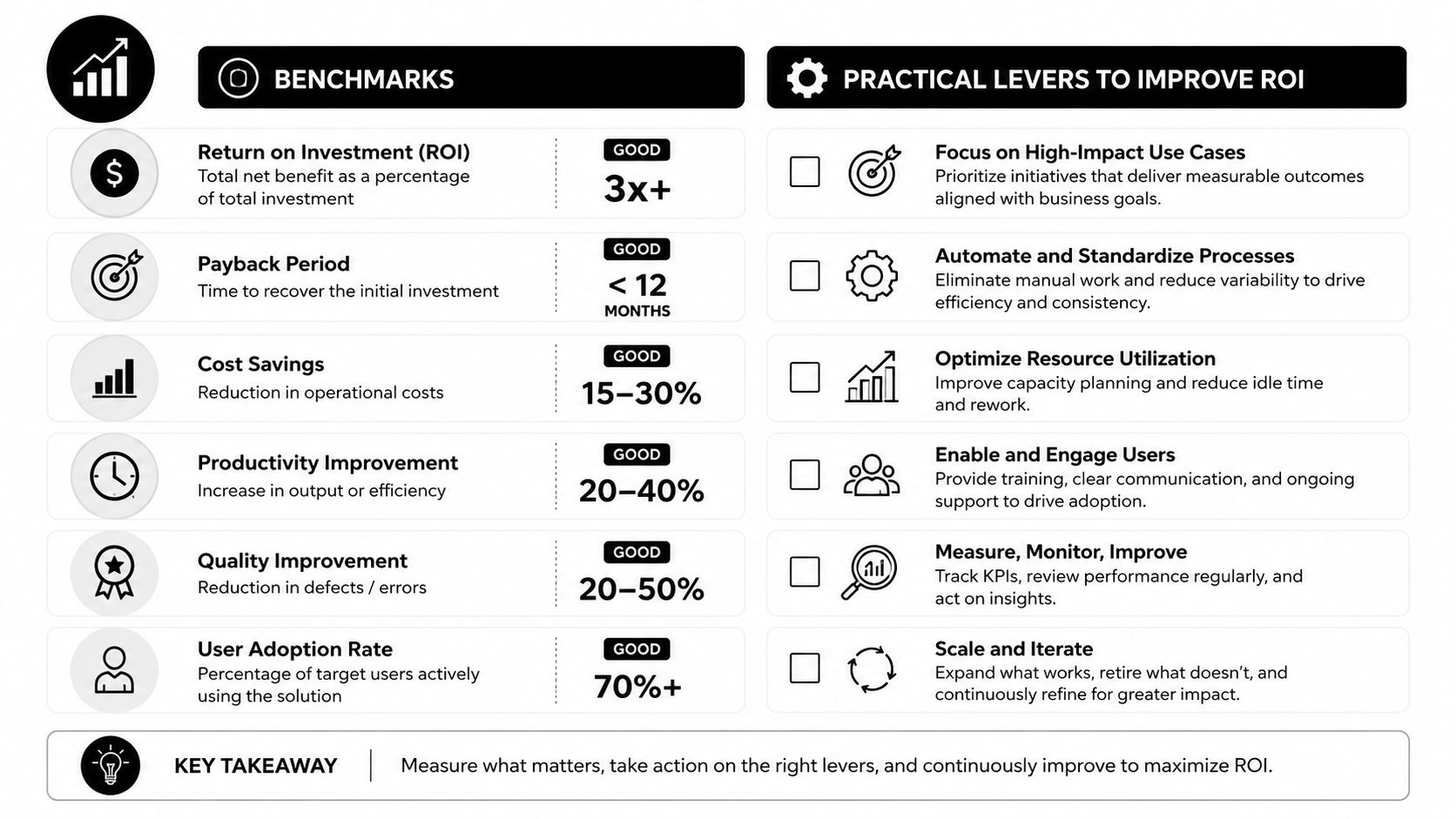
Benchmarks are guardrails, not promises. They help compare channel behavior, but your margin, customer value, sales process, and attribution rules determine whether a campaign pays back.
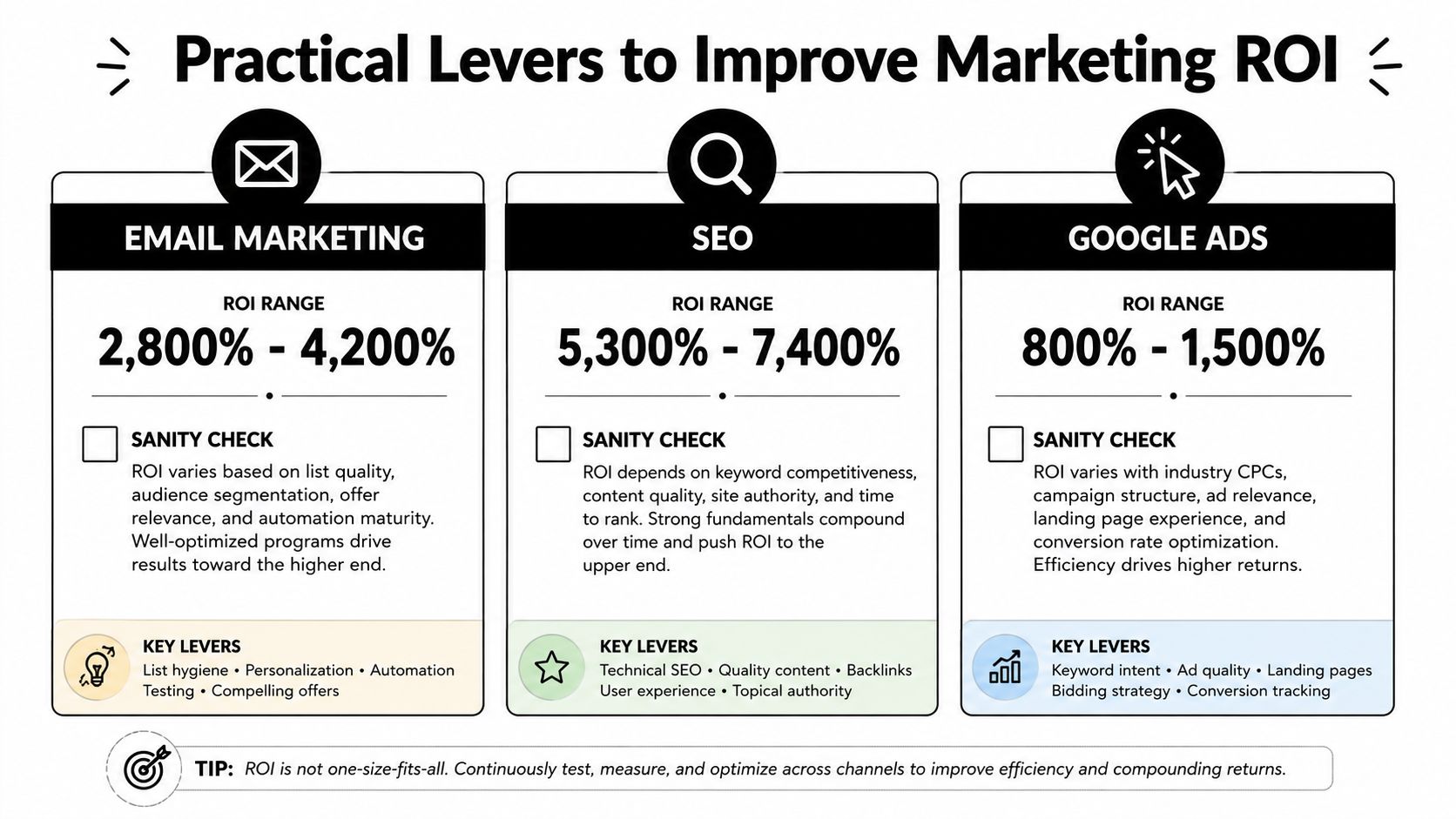
Published references commonly place email marketing at $36 to $42 returned per $1 spent, or 3,600% to 4,200% ROI, in this email and channel benchmark reference. Another benchmark places SEO at about $22.24 returned per $1 spent and Google Ads at about $2 returned per $1 spent, showing why organic work and paid acquisition should not share the same payback expectation, according to this ROI overview.
Use these figures to form questions before changing a budget. Does the source measure revenue or profit? Are labor and software included? Does the result count only the first purchase, or later customer value too? Does its attribution window match yours? A benchmark is like a map scale. It helps you compare routes, but it does not tell you whether your vehicle, fuel cost, or destination matches the example.
Pull the levers closest to revenue
- Tighten targeting: Remove irrelevant search terms, narrow service areas, and focus on customers your team can serve profitably.
- Improve landing pages: Present the service, location, proof, phone number, and next action in a clear sequence.
- Respond faster: Send calls and forms to someone who can qualify the inquiry and follow up while interest is active.
- Strengthen local SEO: Keep the Google Business Profile accurate, publish location-specific service content, request legitimate reviews, and maintain consistent citations.
- Import offline conversions: Where supported, send qualified calls, booked appointments, and closed jobs into paid-search reporting.
- Raise LTV: Use reminders, maintenance plans, referral prompts, and follow-up campaigns to encourage profitable repeat business.
Before increasing spend, run this check:
- Source: Can each lead be tied to a channel and campaign?
- Quality: Can you separate qualified inquiries from noise?
- Revenue: Does the CRM record booked work and closed revenue?
- Cost: Does the calculation include the costs you intend to manage?
- Timing: Is the reporting window long enough for the sales cycle?
- Action: What budget, targeting, offer, or follow-up change will you test next?
A 30 Day ROI Reporting Plan and How Polaris Marketing Solutions Helps
A useful ROI system doesn't need daily spreadsheet surgery. It needs consistent ownership, clean inputs, and a monthly decision tied to the numbers.
Days 1 through 7
List every active channel and write down its cost. Choose the conversion that matters for the business, such as a qualified call, booked appointment, completed job, or collected invoice. Create one source field in the CRM and agree on naming rules for campaign links.
Days 8 through 14
Check that GA4 records important website actions, Search Console is connected, call tracking identifies campaign sources, and forms pass source information into the CRM. Test the journey yourself. Submit a form, place a call, and confirm that the record reaches the right person with the right source attached.
Days 15 through 21
Match marketing records to sales outcomes. Remove duplicates, mark unqualified inquiries, and add revenue or gross profit to closed customers. Keep first-touch and last-touch views separate if both are useful, but don't mix their results in one total.
Days 22 through 30
Create a monthly report with spend, qualified leads, booked work, closed revenue, ROI, CAC, LTV signals, and payback observations. End with decisions, not just commentary: increase, reduce, revise, or hold each channel while more data arrives.

Polaris Marketing Solutions is a Fort Myers digital marketing agency that serves small and mid-sized businesses across Southwest Florida. Its services include website design and hosting, local and national SEO, pay-per-click advertising, social media management, and e-commerce web design, with monthly reporting that presents traffic, leads, and ROI in plain English. The agency can handle tracking setup, reporting, channel selection, and ongoing campaign adjustments for businesses in markets including North Fort Myers, Cape Coral, Estero, Bonita Springs, and Naples.
A practical starting point is a complimentary online analysis and competitor report. It gives a business owner a clearer view of current visibility, lead capture, and the measurement gaps that need attention before the next budget decision.
If you need help connecting marketing spend to qualified calls, booked appointments, closed revenue, and repeat business, request a complimentary online analysis and competitor report from Polaris Marketing Solutions. Ask the team to review your current tracking and monthly reporting, then use the findings to build a channel-by-channel ROI plan for your business.