
The average website converts only 2.35% of visitors, while the top 25% convert at 5.31% or higher. That gap is where conversion rate optimization, or CRO, earns its keep, because the goal isn't more traffic, it's turning the traffic you already have into calls, forms, and sales.
For Southwest Florida contractors, attorneys, and other local service businesses, that matters more than most owners realize. A site can look good and still leak leads at every step.
Understanding the Core Concept of CRO
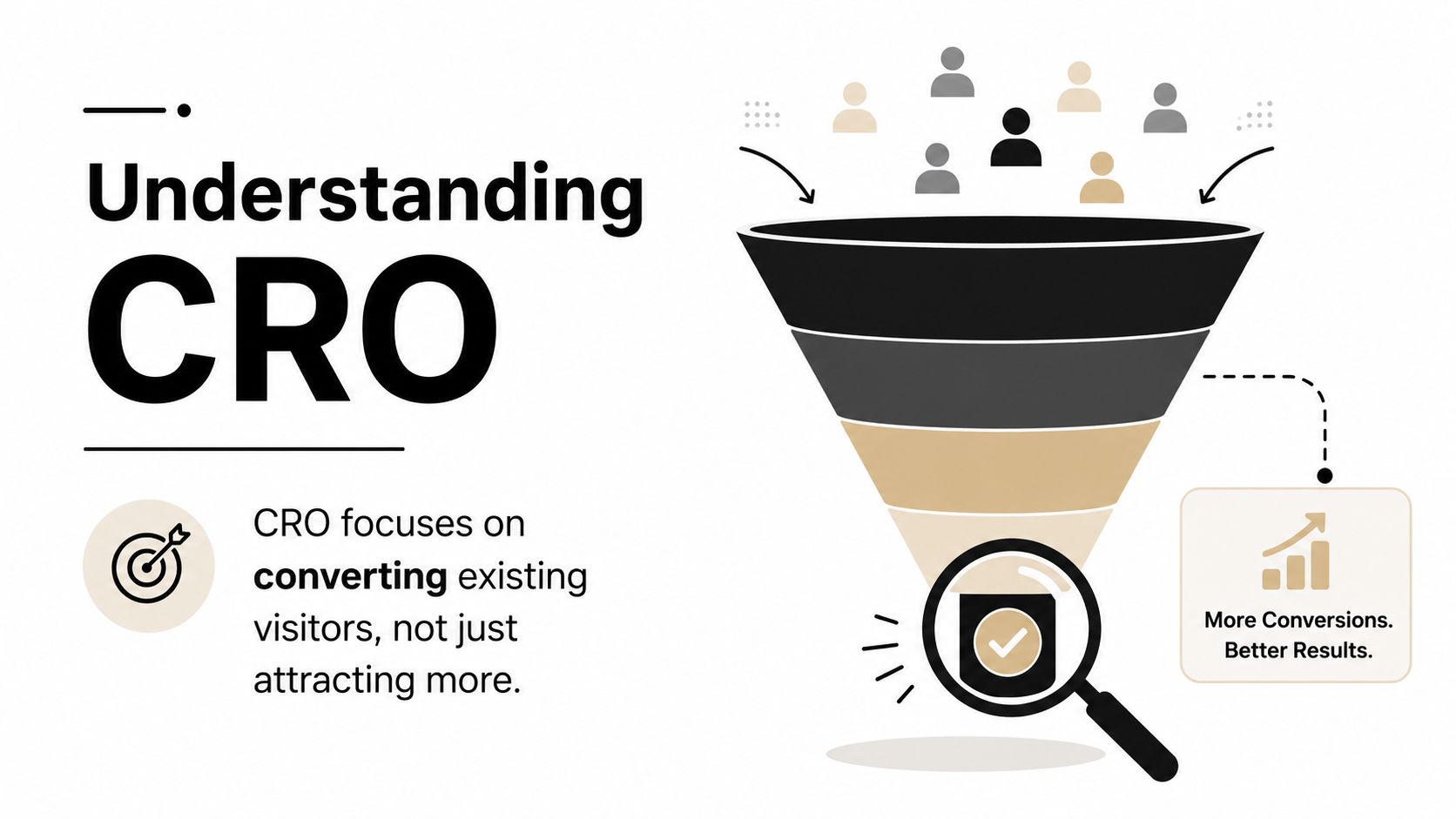
Conversion rate optimization is the work of getting more visitors to complete the action you want, without depending on more ad spend or more traffic. That action could be a call, a form fill, a checkout, or a demo request. The math behind it is simple, but the business impact is not.
Across all industries, the average website conversion rate is 2.35%, while the top 25% of websites convert at 5.31% or higher (Matomo's conversion rate optimisation statistics). That spread shows why CRO is more than a design polish exercise. It's a structured way to close the distance between an average site and a site that turns visitors into revenue.
For a local business, the point is straightforward. If your Fort Myers roofing page gets traffic but only a few people call, the problem may not be awareness, it may be friction. Weak headlines, long forms, slow pages, and vague calls to action all make a visitor hesitate.
Why this matters for local service businesses
CRO is useful because it improves the value of traffic you've already paid for or earned. That matters in competitive markets like Cape Coral, Naples, and Fort Myers, where every click has a cost, whether it came from SEO, PPC, or referrals. A stronger conversion path means fewer wasted visits and better lead quality.
Practical rule: if a page gets attention but not action, treat it like a broken sales process, not a branding problem.
A simple way to think about CRO is this. SEO gets people in the door, CRO gets them to sign the estimate request, book the appointment, or make the purchase. That's why a resource like Tagada's conversion rate playbook is useful, because it reinforces the same principle, better structure beats guesswork.
The Step-by-Step CRO Process Explained
CRO works because it follows a repeatable cycle, not a hunch. You look at what visitors do, decide why they might be dropping off, test a change, and keep what performs better. That rhythm keeps teams from changing pages just because they feel stale.
Start with the behavior, not the opinion
The first move is to find the exact point where people stop moving forward. Maybe they land on your HVAC page and never reach the form. Maybe they start the form and quit halfway through. Either way, the data tells you where to look first.
A/B testing is the cleanest way to validate a change. In a technical explanation of CRO, conversion rate is defined as conversions divided by unique visitors, and A/B tests are commonly run for at least a week, with results interpreted only after confidence gets above about 90% to reduce false positives (academic explanation of CRO and A/B testing).
Don't trust a “winner” that only looked better for a day. Random noise can make a weak change look useful.
Turn the insight into a test
A real hypothesis sounds specific. For example, “If we shorten the form and move the trust badge next to the button, more people will submit the lead request.” That's testable. “The page feels better” is not.
The next step is to isolate one change whenever possible. If you change the headline, button, form length, and layout at the same time, you won't know which element mattered. That's how teams waste months without learning anything useful.
Implement, then repeat
When the winning version is clear, roll it out and watch the page again. CRO isn't a one-time cleanup project. It's a habit of removing friction, measuring the result, and moving to the next bottleneck.
A useful shortcut for owners who don't want to manage every test themselves is to use Square CRO playbook as a reference point, especially if your site depends on direct-response pages and lead capture.
How CRO Works With Your Local Marketing Strategy
Local marketing gets people to your site, but CRO determines whether that visit becomes a lead. That's the part many Southwest Florida businesses miss. They invest in local SEO, pay-per-click, directory listings, and reviews, then send all that traffic to a page that asks too much, says too little, or loads too slowly.
If your search visibility is bringing in high-intent visitors from Fort Myers or Naples, CRO makes sure those people don't bounce before they contact you. That's why SEO and CRO work best as partners. SEO creates the opportunity, CRO captures it.
Why page experience changes lead quality
A well-built page does more than convert. It signals clarity, trust, and fit. A contractor page that speaks directly to roof leaks, storm damage, or emergency repairs will usually attract more qualified inquiries than a generic home page that tries to cover every service at once.
That's where the handoff matters. If the traffic source is local and intent is strong, the landing page should stay focused on one outcome. Clear calls to action, fast load times, and a short path to contact all support that outcome.
The same logic applies to content strategy. A good local article can bring in readers, but a relevant landing page turns that attention into appointments. If you want the content side of that equation, this local business content guide is a practical companion piece.
The page should do less, not more
For service businesses, every extra click creates another chance to lose the lead. That's why CRO often starts with removing distractions. Too many menu items, too many form fields, and too many competing offers make the visitor work harder than they should.
Clarity closes more leads than clever copy does.
Polaris Marketing Solutions also applies this logic in PPC landing page work, where service-specific pages, conversion tracking, and post-click optimization matter more than broad traffic alone. When the page matches the search intent, the lead pipeline gets cleaner.
Real-World Examples of High-Converting Pages
A local landing page can look busy and still miss the point. The headline stays broad, the copy stays generic, and the contact form feels tacked on instead of built for action.

Roofing company example
Take a roofing company in Cape Coral. A weak page opens with a vague welcome message and hides the form at the bottom. A better page speaks to the job the visitor already has in mind, such as storm damage or leak repair, then makes contact easy.
The form should feel like a short checkout line, not a paper stack. Keep only the fields you need, place reassurance close to the button, and remove anything that distracts from the call to action. Small edits like those often make the page easier to trust and faster to use.
For case studies showing these principles in action, see our examples of high-converting landing pages.
What the benchmark data tells you
Landing pages do not perform the same way across industries. Analysts at Unbounce report a median landing-page conversion rate of 6.6%, which gives you a practical reference point for pages that are underperforming (Unbounce benchmark report). Another benchmark summary shows lead-generation pages averaging 4.6%, while product pages average 2.3%, which reflects how page type and intent shape results (2026 benchmark summary).
That gap matters for local businesses. A service lead page should reduce anxiety and make contact feel straightforward. A product page has a different set of objections, so the layout and copy need to answer different questions.
The lesson is simple. Pages that match visitor intent usually beat pages built to impress everyone. Urgent offers should feel urgent. Cautious leads need proof, clear next steps, and a page that earns confidence fast.
Essential Tools and Metrics for Measuring Success
A lead page that feels busy or vague can lose a contractor before the phone ever rings. CRO fixes that by showing where visitors stop, what they ignore, and which changes help. You do not need a heavy enterprise stack. You need clean tracking, a way to spot friction, and a short list of numbers you review every time you make a change.
What to track first
Start with conversion rate, then look at the steps that shape it. Form completion, page load time, and funnel drop-off show where the leak sits. If visitors reach the form and leave, that is a different problem from a page that never earns a click.
Form performance has a useful benchmark too. One source reports a cross-industry median form conversion rate of 17.3%, measured as completed submissions divided by users who interacted with the form (AB Tasty sample-size and form benchmark page). That gives you a cleaner comparison point, because a form should be judged against the people who opened or used it, not every visitor who landed on the page.
| Key CRO Metrics and Targets | ||
|---|---|---|
| Metric | Target Value | Why It Matters |
| Conversion rate | Improve from your current baseline | Shows whether more visitors are completing the action you want |
| Form conversion rate | 17.3% median for interacted forms | Helps identify friction inside the form itself |
| Largest Contentful Paint | Under 2.5 seconds | Faster pages keep visitors around long enough to act (Core Web Vitals thresholds) |
| Interaction to Next Paint | Under 200 milliseconds | Measures responsiveness when users try to interact |
| Cumulative Layout Shift | Under 0.1 | Limits visual instability that can break trust |
Tools that fit a small business workflow
Google Analytics shows where traffic comes from and where people fall out of the funnel. Form analytics and session recordings show what happened inside the experience. That combination is usually enough to find obvious leaks before you spend money on a redesign.
The technical side matters too. Core Web Vitals give you a practical baseline for speed and stability. The commonly used thresholds are Largest Contentful Paint under 2.5 seconds, Interaction to Next Paint under 200 milliseconds, and Cumulative Layout Shift under 0.1. These thresholds match Google's page experience standards.
If you need help connecting ads to leads, this conversion tracking guide is a good companion to the broader CRO work. Without tracking, it is hard to know which page changes are producing sales conversations.
A practical way to use the numbers
Start with one page. Measure what happens before and after a change. If the page loads faster, the form is cleaner, and the call to action is clearer, the data should show it before the business feels it.
Practical rule: if you cannot measure the change, you cannot prove the improvement.
Taking Your Business to the Next Level
CRO is a long-term operating habit, not a one-time website refresh. The businesses that win with it keep testing, keep measuring, and keep trimming friction from the path to contact. That matters in Fort Myers, where contractors, healthcare practices, law firms, and other service businesses compete for the same local attention.

For owners who don't have time to manage testing, tracking, and landing page changes themselves, a local partner can handle the moving parts. Polaris Marketing Solutions works with Southwest Florida businesses on website design, local SEO, PPC, and conversion-focused landing pages, and it offers a free online analysis and competitor report to show where traffic is leaking before you spend more to replace it.
If your website is getting visits but not enough calls, estimates, or form submissions, Polaris Marketing Solutions can help you find the friction and fix it. Visit Polaris Marketing Solutions to request a free analysis and see how your pages can work harder for your business.