
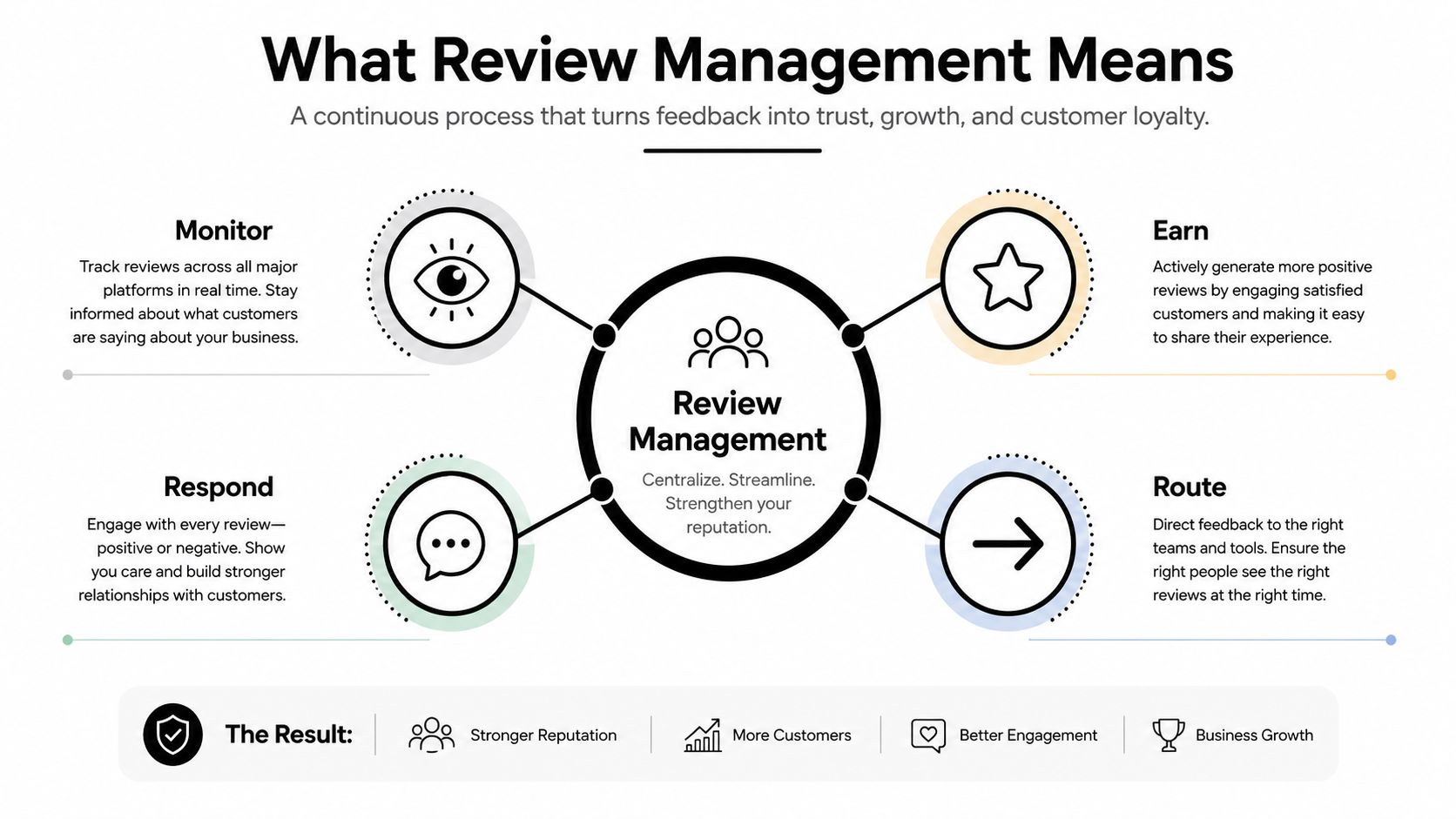
Review management is the ongoing process of monitoring, earning, responding to, and acting on customer reviews across platforms to protect reputation and local visibility. 97% of consumers use reviews to guide purchase decisions, 49% trust them as much as personal recommendations, and 31% will only use a business rated 4.5 stars or higher (WiserReview).
That pressure shows up in ordinary Southwest Florida businesses. A homeowner in Cape Coral compares two roofers, a patient in Fort Myers checks a clinic before booking, and a family in Estero scans a law firm's latest feedback before calling. The business with the better service might still lose if its profile looks neglected, its newest review is old, or nobody from the company responds.
The Moment a Job Walked Out the Door
On a Tuesday morning, a Cape Coral roofing contractor sat in his office with blueprints across the desk. He had measured a roof, asked careful questions, and prepared a detailed proposal at a competitive price. The inspection was thorough, and the customer appeared ready to hire him.
Then the customer called with a different decision.
“I searched both companies again before signing,” the customer explained. “They had three reviews from the last month. Yours had six reviews, but the newest one was from six months ago. I wanted to know who was working with customers right now.”
The contractor's work was not the problem. The competing profile showed recent activity and visible engagement. His profile looked quiet, even though he had more reviews overall. For a homeowner choosing between roofers, that difference created doubt at the exact point when trust needed to be clear.

The same pattern appears across Fort Myers, Cape Coral, North Fort Myers, Bonita Springs, and Naples. A business owner may treat reputation management as asking for a five-star review after a customer says, “Great job.” That request matters, but it does not maintain the whole profile. Customers also see whether feedback is recent, whether the owner responds with substance, whether business details are accurate, and whether complaints lead to visible improvement.
Practical rule: A review profile should look like an active business, not an old scrapbook of past victories.
A working process assigns responsibility for monitoring reviews, requesting feedback at appropriate moments, answering thoughtfully, escalating sensitive issues, and identifying repeated complaints. For a Southwest Florida contractor, clinic, or law firm, those operating habits can determine whether a prospective customer books, calls another business, or walks away before the first conversation.
What Review Management Means
Review management is a repeatable operating system for customer feedback. It covers monitoring Google, Facebook, Yelp, Nextdoor, Apple Maps, industry directories, and niche platforms such as Avvo for law firms or Healthgrades for clinics. It also involves earning new reviews, responding publicly, resolving issues privately, and routing useful feedback to the people who can correct the underlying problem.
That work goes beyond collecting star ratings. A Fort Myers roofing company may receive praise for clean job sites, repeated complaints about late arrival windows, and questions about warranty language. A clinic may see appreciation for a caring nurse alongside concerns about scheduling. Each comment carries marketing value, service information, and a possible operational warning.
The storefront window test
An online profile works like a storefront window. The business name and star rating are the sign above the door, while the rest of the profile shows how the business operates. Fresh reviews are the lighting. Owner responses show that someone is inside. Detailed customer experiences create the display. Inaccurate listings and unanswered complaints look like smudges.
The sign gets attention first. The condition of the window often shapes whether someone steps inside.
Three practical outcomes matter:
- Local visibility: Reviews contribute to the local search ecosystem, where service businesses compete for attention before a customer visits a website or makes a call.
- Conversion trust: Recent, specific feedback helps a prospect decide whether a contractor, clinic, or law firm serves customers like them.
- Operational learning: Repeated review themes can reveal scheduling, communication, billing, or service problems that internal meetings miss.
A credible profile does not require perfect praise. Consumers often trust believable feedback more than a wall of uniformly positive comments. Reviews are more likely to earn trust when they are mixed rather than uniformly perfect, according to WiserReview's review and reputation statistics. The practical goal is a credible record, honest customer feedback, and visible follow-through on legitimate concerns.
For a healthcare-specific framework, this reputation playbook for dental practices is useful because dental teams need tighter privacy and response controls than a general service company.
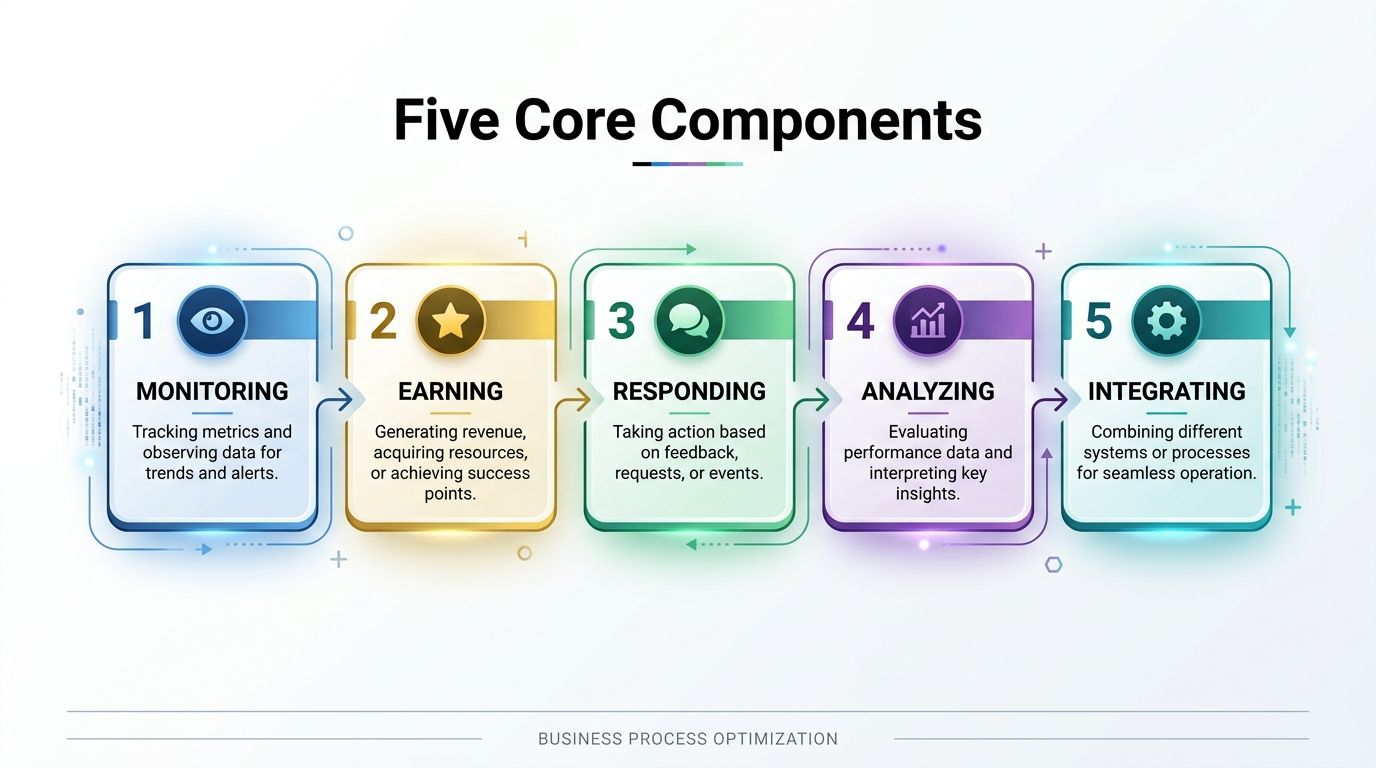
The Five Core Components of a Working System
A working review program gives every task an owner, a tool, and an expected output. Without those assignments, the owner checks platforms only after a complaint appears, requests reviews inconsistently, and learns about recurring service problems too late. The system should also reflect how a Southwest Florida business operates, from the first customer contact through the internal fix.
1. Monitoring
Assign someone to check every platform where customers may discuss the company. A Fort Myers contractor may need Google Business Profile, Facebook, Yelp, Nextdoor, Apple Maps, and a trade directory. A law firm may add Avvo, while a clinic may monitor Healthgrades and other healthcare listings.
The output is one reliable inbox or notification path. If a review remains unseen inside a platform dashboard, the business has disconnected accounts rather than a monitoring process. Platform mix should follow customer behavior and industry expectations, not the owner's personal preference.
2. Earning
Send a review request after the service is complete and the customer has had a chance to assess the result. A cleaning company can ask after the customer confirms the home looks right. An HVAC company can request feedback after the technician completes the repair, explains the invoice, and leaves the customer with a clear understanding of the work.
The request should make the next action obvious, direct customers to the platform that matters most, and leave room for honest feedback. Do not offer incentives or script praise. A steady, credible flow of feedback is more useful than a short burst that looks manufactured.
3. Responding
Every response has two audiences, the reviewer and future customers reading the exchange. Thank positive reviewers for a specific detail. Acknowledge the concern in a negative review without arguing, then explain the next step without exposing private information.
Response quality matters more than filling a template with generic appreciation. “Thanks for your review” says little. “Thank you for mentioning how our crew protected the landscaping during the roof replacement” shows that someone read the comment and understood the work.
4. Escalation
Route reviews involving safety, legal threats, refund demands, protected health information, fraud accusations, or named employees to the owner or a designated manager. Frontline staff should not make sensitive decisions in a public thread.
The output is a documented decision. A reviewer may receive a brief public acknowledgment while the substantive discussion moves offline. Preserve the facts, identify the responsible team member, and determine whether the complaint points to a process failure or an isolated event.
5. Reporting
A monthly report should connect review activity to operations. Track new-review flow, rating movement, response time, response rate, recurring themes, and activity alongside calls, website visits, direction requests, or other local actions.
A Fort Myers paving company might find that positive reviews mention crew professionalism while negative reviews repeatedly mention unclear arrival windows. The first theme supports marketing. The second belongs in scheduling and customer communication.
Reviews are public commentary and a customer-language report. They show where the operation keeps its promises, where it breaks them, and which platforms carry that evidence.
Why Recency and Response Now Beat Star Rating
A high average rating helps, but it is a hygiene metric, not a complete growth strategy. A Cape Coral dental office can keep an excellent rating and still lose attention when its latest feedback is old, its platform coverage is thin, or the owner never responds.
Fresh feedback gives buyers evidence that the business is still active and serving customers. 74% of buyers prioritize reviews from the last three months, while 32% want reviews from the last two weeks, according to BrightLocal's local consumer review survey. A separate summary reports that 73% pay attention only to reviews written in the past month, and many consumers want 40 reviews before a rating feels reliable (SearchLab's review statistics summary).
The operating priorities look different now:
| Signal | Old Priority | Current Priority |
|---|---|---|
| Average rating | Chase the highest possible number | Maintain a credible, healthy rating |
| Total review count | Accumulate reviews without a cadence | Build a steady stream of recent feedback |
| Review responses | Reply only to severe complaints | Respond consistently with specific, human language |
| Platform presence | Focus on one familiar site | Match the platforms customers use for the industry |
| Negative feedback | Hide or dispute everything | Verify facts, acknowledge concerns, and resolve appropriately |
A contractor with five recent reviews may look more active than a company with hundreds of older reviews. That does not prove better workmanship, but it changes how buyers judge current demand, reliability, and responsiveness. For a Fort Myers roofing company, a steady flow of recent project feedback can support trust more effectively than an untouched archive of older praise.
Responses create another visible operating signal. Research cited by Moz found that more than 90% of consumers are influenced by owner responses, while 50% lose trust when it appears owners or employees reviewed their own business (Moz's local business review survey). A rushed or defensive reply can weaken confidence even when the rating remains strong. A specific response shows that the business monitors service quality and accepts responsibility for addressing concerns.
The practical priority is a regular request cadence, accurate review monitoring, and owner-led replies that address the actual experience. Platform mix matters too. A clinic may need Google and Healthgrades, while a contractor may gain more from Google and an industry site customers already consult.
For difficult feedback, use this guide on responding to negative reviews to structure the response. Rating gets a buyer's attention, but recency, response quality, and platform coverage help earn the next step.
A Practical Workflow for Small Businesses
A dependable review program starts with ownership, not software. For a Fort Myers contractor, clinic, or law firm, the process should make clear who requests feedback, who monitors each platform, and what happens when a review signals a service problem.
Start with a one-page policy
Write the rules before the next complaint arrives:
- Choose priority platforms. Start with Google, then add the industry site customers already use, such as Healthgrades, Avvo, or Houzz.
- Assign response ownership. Name a primary responder and a backup. “The office” is not an owner.
- Set the voice. Decide whether replies should sound warm, concise, formal, or conversational. Keep the tone consistent with the brand.
- Define prohibited content. Never include protected health details, private contact information, fee negotiations, or defensive accusations in a public reply.
- Document escalation. Reviews mentioning safety, legal threats, refund demands, or serious allegations should reach the owner within one business hour.
Use templates as guardrails
Templates reduce delays, but the responder must customize the middle. A five-star reply can thank the customer and mention the specific detail they praised. A three-star response should acknowledge what went well, name the shortcoming, and provide a direct contact path. A one-star review involving an employee should confirm that the matter is being reviewed without discussing private personnel details.
The best response does not promise an outcome the business cannot deliver. It shows ownership, protects privacy, and gives the reviewer a reasonable next step. For a clinic, that may mean moving the conversation away from public comments. For a roofing company, it may mean assigning a manager to inspect the job.
Build the request cadence into service delivery
For a Southwest Florida trade business, request feedback soon after the work is complete. A text within two hours, an email follow-up at 48 hours, and a printed card with a short URL can work together. Technicians may have dirty phones, and customers may need time before they can describe the experience accurately.
Use the channel customers are most likely to notice, while managing consent and opt-outs carefully. Email and SMS can serve different customers, so track which channel produces completed reviews rather than sending every request everywhere.
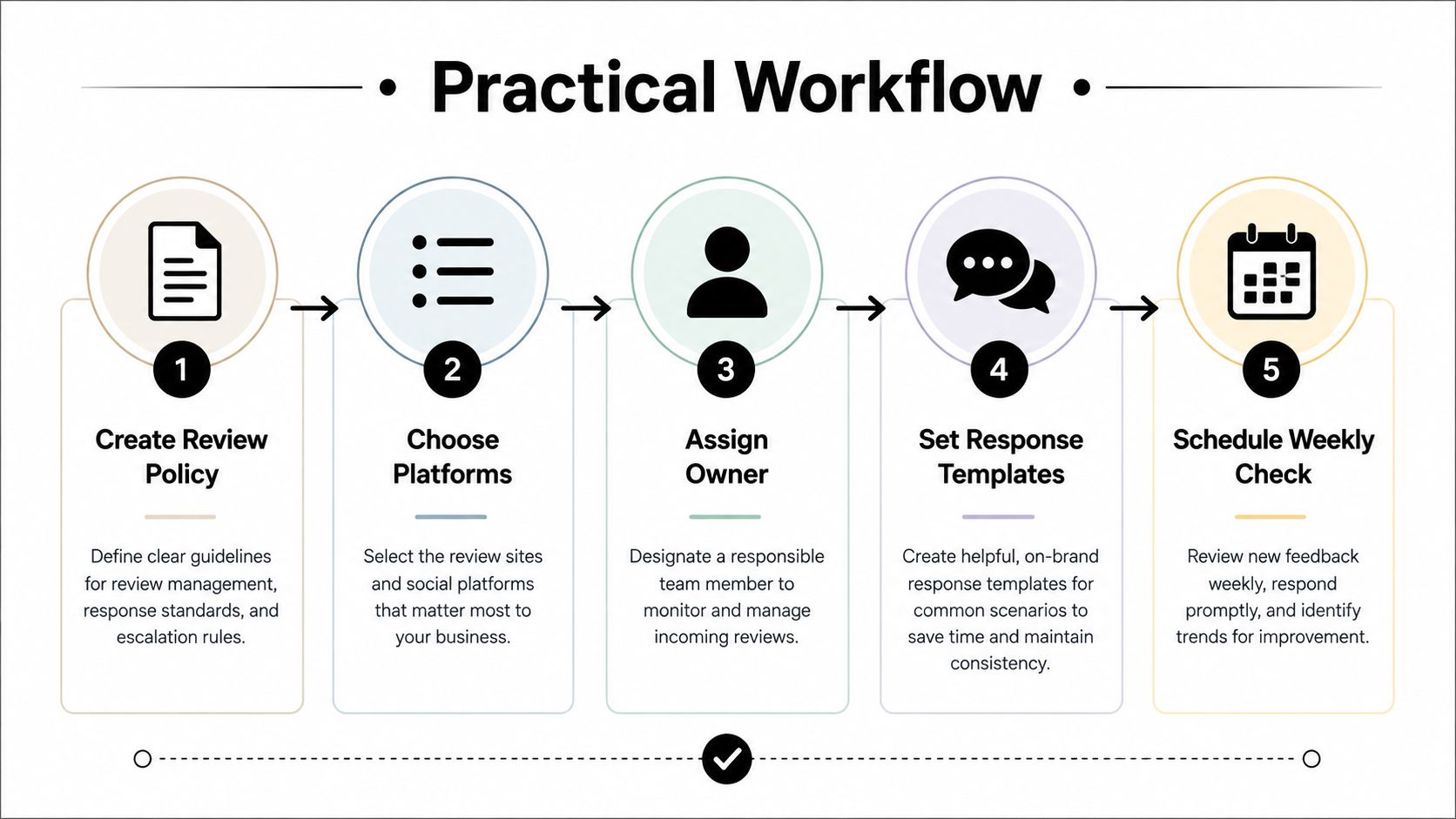
End each week with a 20-minute review meeting. Read new feedback aloud, assign operational fixes, and confirm that escalated issues have an owner. A Fort Myers clinic might discover repeated scheduling complaints, while a contractor might identify missed cleanup steps. Record those patterns instead of treating each review as an isolated comment.
Once a month, update a simple dashboard with review flow, response performance, recurring topics, and local profile actions. Use this guide to getting more online reviews to refine the request process without pressuring customers or steering only happy clients toward public feedback.
Tools Worth Considering and What to Look For
Choose tools around the work your team can maintain. A single-location cleaning company may need Google Business Profile, an SMS platform, and a shared spreadsheet. A multi-location clinic may need centralized permissions, automated routing, and reporting across several directories. Extra features add cost and training time without improving results if no one uses them consistently.
Listings management
Confirm that the system supports the platforms customers use and reports citation accuracy. It should flag inconsistent business names, addresses, phone numbers, hours, and service details. Compare outsourced providers by reviewing the scope and controls included in their listing management services.
Review generation
Check SMS and email deliverability, opt-out handling, QR code creation, and suppression rules for customers who already submitted feedback. The request tool should prevent duplicate messages and keep the path to a review short. For a Fort Myers contractor, a complicated form can lose a customer before the request is completed.
Response and workflow
Prioritize role-based permissions, response history, assignment rules, and approval controls. AI-drafted replies can improve speed, but a person should approve sensitive responses, especially complaints involving a clinic visit, property damage, or legal service. Set tone controls and require edits where a template would sound detached or mass-produced.
Analytics
Choose reporting that shows rating trends, review velocity, recurring sentiment themes, response performance, and source attribution. A dashboard displaying only total reviews cannot show whether Google, Facebook, or an industry directory is producing useful feedback.
A system that hides recent activity or places basic responses behind a costly tier may create more work than it removes. Review customer feedback management software by checking how it combines collection, routing, response management, and analysis. The right tool supports the existing workflow. It should not force a small business to rebuild daily operations around a dashboard.
Measuring Whether Your Review Program Is Working
A review program is working when it changes customer behavior and operating decisions, not when the review count increases. Use data from Google Business Profile, platform insights, call tracking, website analytics, and a spreadsheet your team will maintain.
Review velocity shows whether fresh feedback arrives at a dependable pace for each location. A sudden drop can point to a broken request trigger, inconsistent technician follow-up, or a message that takes too many steps to complete. For a Southwest Florida contractor, this metric can expose a process failure before the owner notices it in monthly revenue.
Rating trend deserves more attention than the lifetime average. Compare recent periods to see whether service quality is improving or slipping. An unchanged overall score can hide a current problem, while an older complaint may no longer reflect how the business operates.
Response time and response rate show whether public feedback has a clear owner. Track Google and Facebook separately when they reach different customer groups. A serious complaint that waits days for an answer requires a coverage or escalation fix, not another reminder.
| Metric | Source | Action Trigger |
|---|---|---|
| Review velocity | Google Business Profile and platform dashboards | Investigate when request follow-up becomes inconsistent |
| Recent rating trend | Native platform history or spreadsheet | Review training and service issues when recent sentiment declines |
| Response time | Review inbox or manual time log | Reassign coverage when replies regularly wait too long |
| Response rate | Platform dashboard or monthly audit | Add a backup responder when coverage falls |
| Sentiment themes | Review text and tagging | Route repeated complaints to operations |
| Assisted local actions | Google Business Profile insights and analytics | Compare review activity with calls, direction requests, and website visits |
Compare review activity with Google Business Profile actions, then check whether the same pattern appears on platforms relevant to the business. 83% of consumers primarily read reviews on Google, and 89% are willing to leave a review after a positive experience if asked, according to Starfish Reviews' review statistics. Google is a sensible starting point, but a clinic, law firm, and home-service company may depend on different platform mixes.
A monthly scorecard can stay practical: current review count, new reviews, recent rating trend, average response time, unresolved escalations, leading positive theme, leading negative theme, and local actions. Review these numbers against calls, direction requests, and website visits rather than treating stars as the final outcome. For owners measuring how reputation affects customer access, SkipCalls' reputation insight offers another perspective on how prompt, responsive handling supports business results.
Local Examples and Your Next Steps
A Cape Coral HVAC company tightened its review-request timing and reply workflow, then increased Google Business Profile actions by 38% within four months. A Fort Myers dental practice addressed a widely shared two-star complaint publicly, protected private health information, and moved the patient discussion offline. In both cases, the gain came from consistent operations, not a short campaign.
A roofing, cleaning, or paving company can start with five tasks:
- Audit every listing. Review Google, Facebook, Yelp, Nextdoor, Apple Maps, and industry directories customers use.
- Write the policy. Assign the primary and backup responders, tone, prohibited content, and escalation route.
- Draft three replies. Prepare responses for praise, mixed feedback, and serious criticism.
- Set the request cadence. Ask after completed service, using a channel that fits the customer and platform.
- Assign one owner. Give one person responsibility for monitoring, routing issues, and reviewing results each week.
Put these tasks on the calendar and use the process consistently. A steady flow of recent, well-handled feedback builds more credibility than occasional praise or efforts to polish an old star average.
Polaris Marketing Solutions helps Fort Myers and Southwest Florida businesses connect review management with local SEO, listings, and lead generation. Visit Polaris Marketing Solutions to request a complimentary online analysis and competitor report, then turn customer feedback into stronger visibility and trust.