

If you're a business owner in Fort Myers, Cape Coral, Estero, or Naples, this probably sounds familiar. Leads still come in, but growth feels flat. You search your service and see the same competitors everywhere. Their trucks are on the road, their Google Business Profiles show up first, and their offers seem to be following yours within weeks.
That's usually the point where owners make an expensive mistake. They add a new service nobody asked for, chase a new area they can't serve well, or spend more on ads without fixing the underlying problem. A better move is often simpler. Sell more of what already works to the market you already know.
That's what market penetration strategy is for. It's not theory for a boardroom. For a Southwest Florida home service company, law office, med spa, or clinic, it's a practical way to win more customers in the same local market without taking on the risk of reinventing the business.
Growing Your Business in a Crowded Market
A lot of local businesses don't have a demand problem. They have a share problem.
You may already have a solid service, decent reviews, and a service area full of potential customers. But if competitors are more visible, easier to book, more aggressive with pricing, or better at follow-up, they'll keep taking jobs that you should be winning. That's why growth can stall even when the market itself is still active.
Market penetration strategy gives you a cleaner path forward. Instead of asking, “What new thing should we launch?” it asks, “How do we get more of this market to choose us for what we already do well?”
For a Fort Myers roofer, that might mean improving visibility in specific ZIP codes where competitors dominate map results. For a Cape Coral dentist, it could mean tightening new-patient offers and fixing missed calls. For an HVAC company, it may be less about adding duct cleaning and more about getting more maintenance agreements from neighborhoods already inside the service radius.
Practical rule: If your current service works, your team can deliver it consistently, and your market still has room, penetration is usually the first growth lever to pull.
That's why this approach fits local service businesses so well. It builds on what's already proven. You're not betting on a new city, a new product line, or a major operational shift. You're competing harder and smarter in the market right in front of you.
What Market Penetration Really Means for Your Business
The cleanest way to understand what is market penetration strategy is through the Ansoff Matrix. In that framework, market penetration sits in the bottom-left quadrant, which focuses on increasing revenue by selling existing products to an existing market. It's the lower-risk growth option because it uses the strengths you already have and the customer behavior you already understand, rather than pushing into new products or new markets, as explained by Lighter Capital's overview of market penetration strategy.
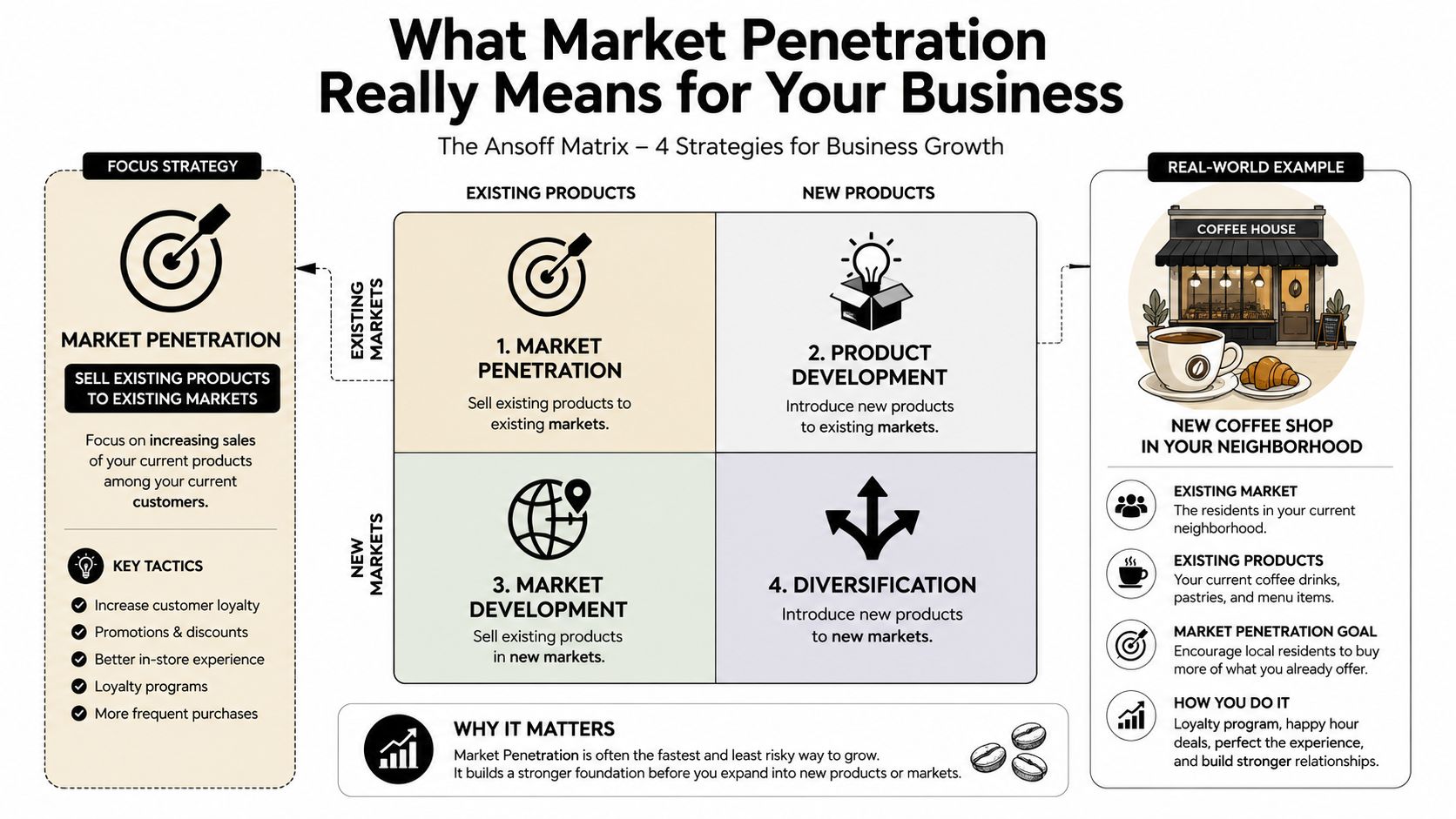
A simple local example
Think about a neighborhood coffee shop in Fort Myers. It already sells coffee and pastries. Market penetration does not mean opening a second location in Naples. It does not mean launching a catering division. It means getting more of the current neighborhood to buy the same coffee and pastries more often.
Now swap that example for a lawn care company in Cape Coral.
- Market penetration means getting more lawn maintenance customers in Cape Coral for the same lawn service you already provide.
- Market development means taking that same service into a new city.
- Product development means adding irrigation repair or pest control.
- Diversification means doing both something new and serving a new market.
For most small and mid-sized businesses, the first option is the smartest place to start. You already know what a lead looks like. You know your service costs. You know how long jobs take. You know what customers ask before they buy.
Why this matters in Southwest Florida
In local service businesses, execution usually beats novelty. Owners often assume growth means expansion. In practice, tighter positioning, sharper offers, and better customer retention can do more than adding a service line that strains the team.
A penetration strategy also works well with retention. If you want more repeat bookings, stronger referral volume, and higher customer lifetime value, a loyalty system matters just as much as lead generation. If that's a weak spot, this lifelong repeat customers playbook is a useful companion because it focuses on turning one-time buyers into repeat revenue.
The safest growth move is often not “do more things.” It's “get chosen more often for the thing you already do well.”
That's the heart of it. Market penetration is about taking share in the market you already serve, not distracting yourself with expansion before the foundation is strong.
Setting Goals and KPIs You Can Actually Measure
Most businesses say they want more customers. That's not a strategy. It's a wish.
If you want market penetration to produce ROI, you need a baseline, a target, and a timeline. The core metric is the market penetration rate, calculated as (Current Customers / Total Target Market) × 100, according to SurveyMonkey's guide to measuring market penetration.
Start with a usable baseline
Take a Fort Myers law office that focuses on estate planning in Estero. If the firm identifies its current customer count for that service segment and compares it against the total target market, it can measure current penetration instead of guessing. That changes the conversation.
“Get more estate planning clients” is vague. “Increase market penetration from 8% to 12% in a defined segment by Q4” is measurable. That kind of target forces better decisions around offer, geography, channel, and follow-up process.
The same source notes that effective market penetration strategies can improve market share by up to 25%, and that sustainable gains from tactics like distribution and loyalty programs typically play out over a 12 to 18-month horizon. That matters because a lot of owners quit early when they don't see immediate traction.
Track the numbers that protect profit
Penetration without profitability is just busy work. Watch these KPIs alongside penetration rate:
| KPI | Why it matters for local SMBs |
|---|---|
| Customer acquisition cost | Tells you whether your promotions and media spend are still efficient |
| Churn | Shows whether new customers stay or disappear after the first job or visit |
| Competitive response | Helps you spot when rivals are matching prices, offers, or ad messaging |
| Repeat purchase behavior | Reveals whether your strategy is building actual customer value |
If you run a restaurant or any service business with slim margins, KPI discipline matters even more than creative campaigns. For operators who want another lens on profit-focused metrics, OrderOut's insights on restaurant profit are worth reviewing because the thinking applies well beyond hospitality.
Use one source of truth for ROI
A practical reporting setup should be simple enough to maintain every month. One dashboard. One owner or manager accountable. Clear definitions for every metric.
If you need a framework for tying leads and revenue back to channels, this guide on how to measure marketing ROI is a strong reference point.
Don't judge a penetration campaign by lead volume alone. Judge it by whether the business can acquire, keep, and monetize customers better than before.
That's what separates strategy from noise.
Proven Tactics for Gaining Local Market Share
Most local businesses don't need more tactics. They need fewer tactics executed with discipline.
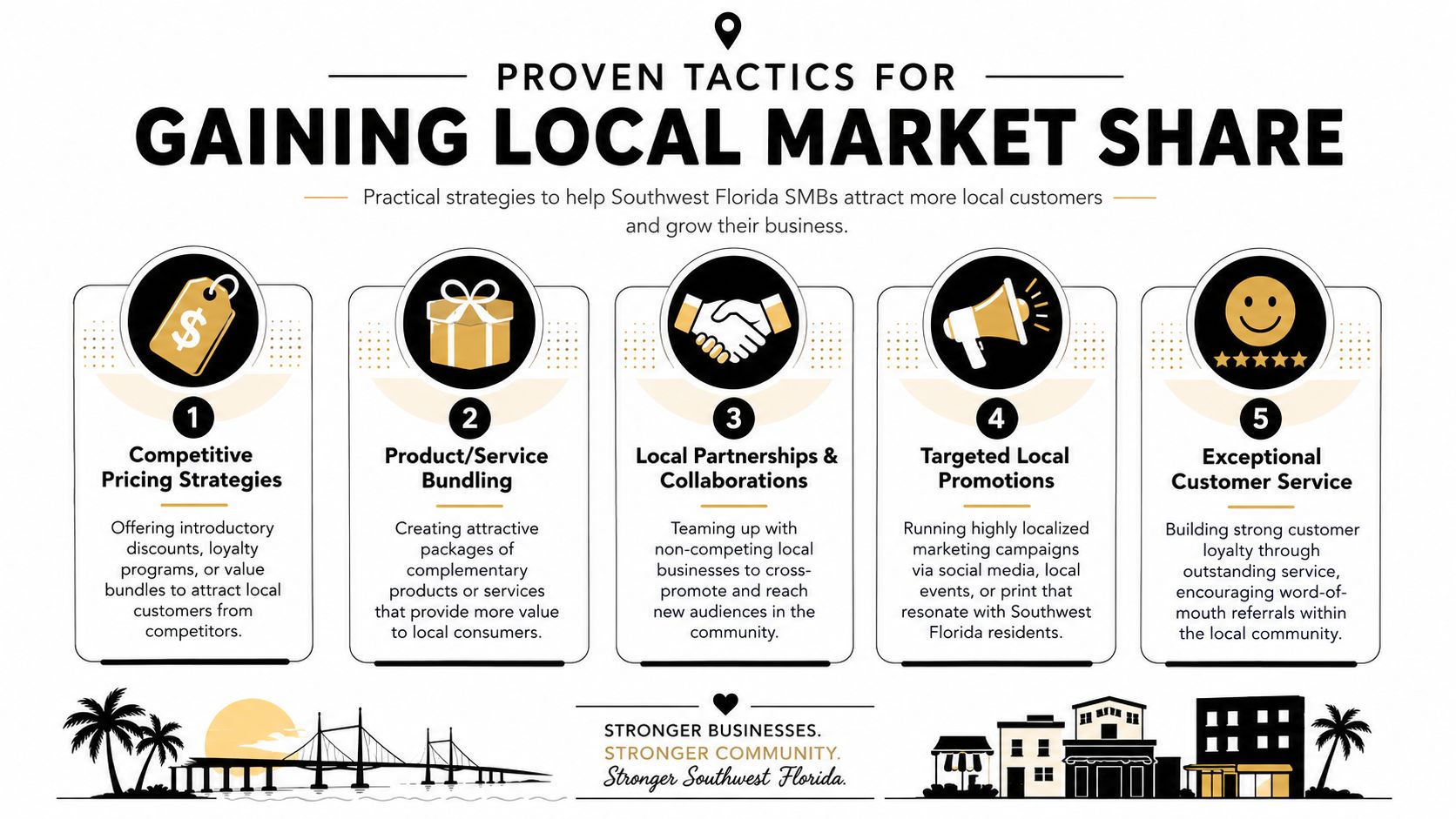
Market penetration works by increasing visibility and getting more buyers to choose your current offer. Common levers include lowering prices, launching ad campaigns, acquiring rivals, and offering loyalty programs. These tactics can be combined, such as pairing a lower entry price with a loyalty offer to increase both acquisition and repeat purchases, as outlined in Coursera's explanation of market penetration strategy.
Pricing that gets attention without damaging the business
Discounting can work, but random discounts usually train customers to wait for the next deal.
A better approach is targeted pricing. An HVAC company in Bonita Springs might offer a new-resident maintenance agreement incentive through realtor referrals. A cleaning company might run a first-service offer only in a neighborhood where competitor presence is heavy and route density is still attractive. A med spa might package a first visit around a high-interest introductory service while protecting margins on follow-up care.
The point isn't to be the cheapest. It's to lower friction for a specific segment long enough to earn the first transaction.
Promotions and bundles that fit local buying behavior
Bundling works especially well when buyers already think in seasonal or household terms.
Examples a Southwest Florida business can use quickly:
- Home services bundle: A roofing or exterior company can package inspection, minor preventative maintenance, and storm-season readiness messaging into one local campaign.
- Professional services bundle: A legal or financial office can package related consultations under a simple local offer that removes confusion for first-time clients.
- Healthcare follow-up offer: A clinic can build a reactivation campaign for inactive patients with a clear next-step service instead of a generic “book now” message.
Good bundles clarify value. Bad bundles create clutter. If customers need a long explanation, the offer probably isn't ready.
Distribution and partnerships that open doors
A lot of local growth comes from access, not just advertising.
Partnerships often outperform broad ad spend for service businesses. Property managers, HOAs, realtors, moving companies, pediatric practices, senior communities, and insurance professionals all influence who gets called first. A pest control company that becomes the preferred vendor for a few property managers can take share faster than one running broad awareness ads with no referral channel behind them.
Local SEO that targets service areas, not vanity traffic
For many Fort Myers businesses, the most profitable penetration move is local search visibility. That means tightening Google Business Profile categories, building location-specific service pages, strengthening citation consistency, and collecting reviews tied to the right services and towns.
If you want a practical starting point, this guide to local marketing for small business covers the core local visibility pieces that support penetration efforts.
Better local penetration usually comes from tighter offers in tighter areas, not broader messaging across a whole county.
That's where local market share gets won.
Your 5-Step Framework for Local Market Domination
A penetration plan doesn't need to be complicated. It needs to be repeatable. If you're running a business without a full marketing department, use a simple operating rhythm and protect your attention.
Start with the visual framework below, then apply each step to one service line and one local segment first.
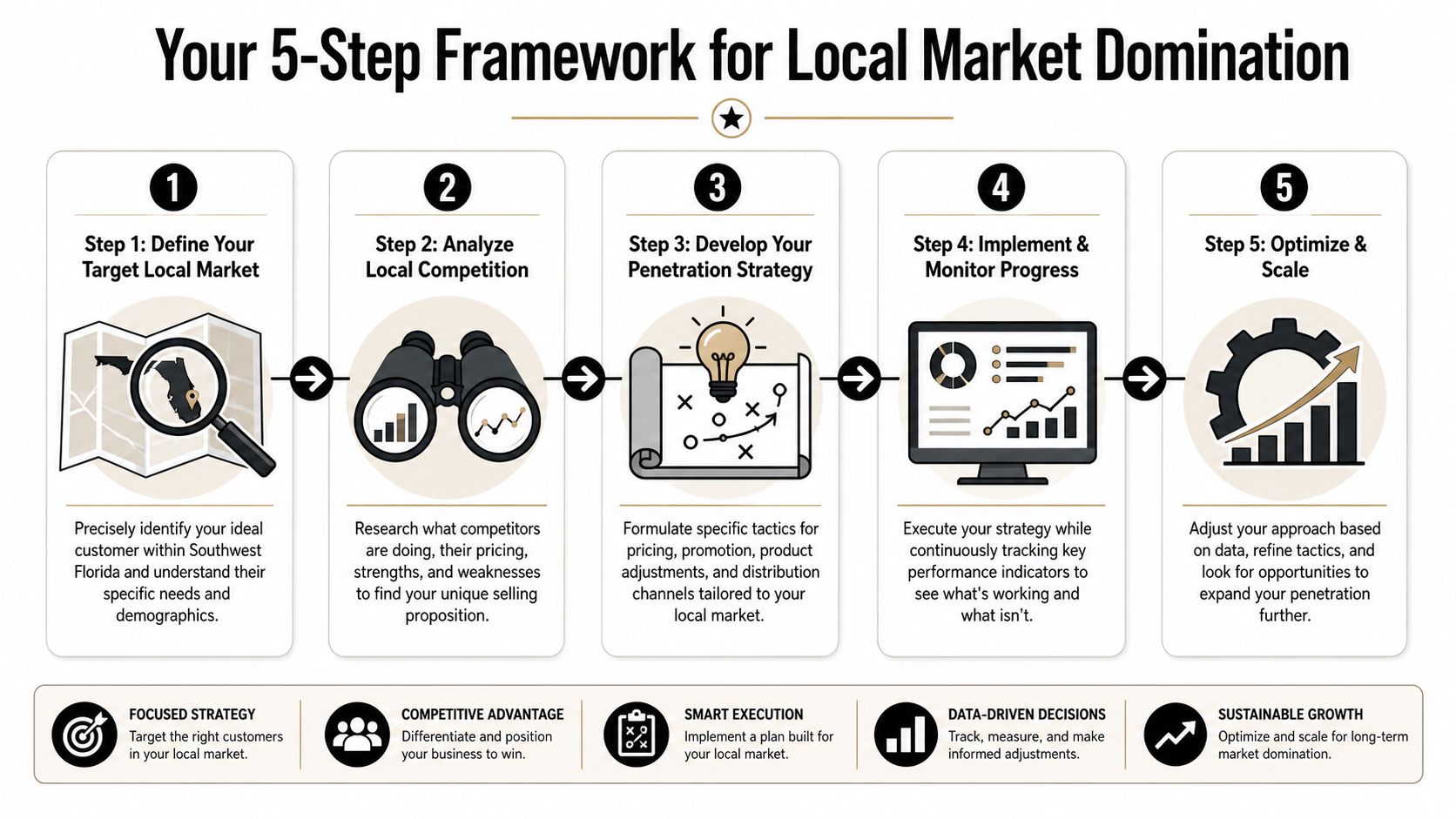
Step 1 Define your target local market
Don't target “everyone in Southwest Florida.” Define the market in operational terms.
For a home service company, that might be owner-occupied single-family homes in a few ZIP codes where route efficiency is strong. For a family law firm, it may be a specific service area plus a specific case type. For a clinic, it could be a defined patient category within a realistic travel radius.
The narrower the segment, the easier it is to build a useful offer and a believable message.
Step 2 Analyze local competition
Most owners think they know their competitors. They usually know their names, not their strategy.
Study their Google Business Profile categories, review themes, headline offers, service pages, ad copy, and referral relationships. Look at where they're weak. Slow response time, generic messaging, poor review consistency, weak location pages, no financing language, no Spanish-language support, weak maintenance plan positioning. Those are openings.
If you need a place to begin, these best tools for competitor analysis can help structure the process.
Step 3 Segment the market before you spend
A critical part of execution is segmenting by geography, customer type, or channel so you can find where penetration is lowest relative to performance elsewhere. That's how you direct budget to the places where share is being lost and where incremental investment has the best return, as described in Rework's market penetration strategy guide.
Here's a simple explanation:
| Segment type | Example for a local business | What to look for |
|---|---|---|
| Geography | Cape Coral vs. Estero | Which area gives weaker close rates or lower visibility |
| Customer type | Homeowners vs. landlords | Which buyer group responds better and stays longer |
| Channel | Google Maps vs. referrals | Which source brings lower acquisition cost or better retention |
Many campaigns improve at this stage. Owners stop spreading budget evenly and start funding the pockets of real opportunity.
A short video can help if you want another explanation of how this plays out in practice.
Step 4 Launch one primary penetration lever
Don't launch six ideas at once. Pick a primary lever.
That might be pricing-led, distribution-led, or visibility-led. For example, a Fort Myers paving company might choose neighborhood-specific direct response offers. A dental office might focus on reactivation plus referral incentives. An HVAC business may choose review generation and Google Business Profile improvement over broad paid traffic.
The best first lever is the one your operation can support. If your phones aren't answered well, don't pour gas on lead volume. Fix intake first.
Step 5 Measure, adjust, and scale slowly
Quarterly review is where the strategy becomes real. Look at customer acquisition cost, churn, close rate, review volume, response time, and lead-to-job quality. Then ask one hard question: should this tactic be scaled, refined, or cut?
A workable local strategy is rarely flashy. It's usually a series of small corrections made consistently over time.
That discipline is what turns penetration from a concept into market share.
Market Penetration in Action A Fort Myers Mini-Study
Coastal Breeze HVAC is fictional, but the situation is common. The company serves Fort Myers and wanted more residential maintenance agreement customers in Cape Coral. Leads existed, but the area felt crowded. Competitors were visible in Google Maps, running paid ads, and showing up often in neighborhood Facebook discussions.
The company started by narrowing the target. Instead of trying to dominate the whole region, it focused on a defined Cape Coral service area, one core offer, and one operational goal: win more first-time service calls and convert more of them into maintenance relationships.
What they changed first
They didn't begin with a huge media push. They tightened the offer, sharpened booking language, and improved how the team asked for reviews after completed jobs. They also cleaned up business citations and made sure location pages matched the service area language customers were using.
Paid search still played a role, but the team treated it as support, not the whole strategy. That mattered because saturated local markets can punish lazy spending. A Q2 2026 BrightLocal report found that in saturated HVAC markets, businesses that increased PPC spend by 40% saw a 22% drop in organic click-through rates, which points to the risk of keyword cannibalization and the need to prioritize factors like review velocity and citation consistency, as noted in this analysis of local market saturation and digital visibility.
Where the adjustment happened
At first, the company leaned too hard on paid visibility. The phones rang, but organic performance softened. That's the local SEO saturation paradox in action. More spend doesn't always mean more total share if every serious competitor is fighting over the same geo-modified search terms.
So the company shifted attention. It made review requests faster and more systematic after service calls. It tightened NAP consistency across listings. It improved service-area page quality and stopped chasing every keyword variation under the sun.
In crowded local markets, the winner often isn't the one spending the most. It's the one sending Google and customers the clearest trust signals.
What this shows a local owner
The lesson isn't “avoid paid ads.” It's “don't treat ad spend as a substitute for local authority.”
For a Fort Myers contractor, clinic, or law office, that same principle applies. If your market is tight, penetration comes from stackable execution. Better offer. Better follow-up. Better reviews. Better service-area relevance. Better referral pathways. Those pieces work together. When one of them is weak, spending more on traffic usually exposes the weakness faster.
Common Pitfalls and Your Implementation Checklist
A lot of market penetration campaigns fail for predictable reasons. The most common one is bad math.
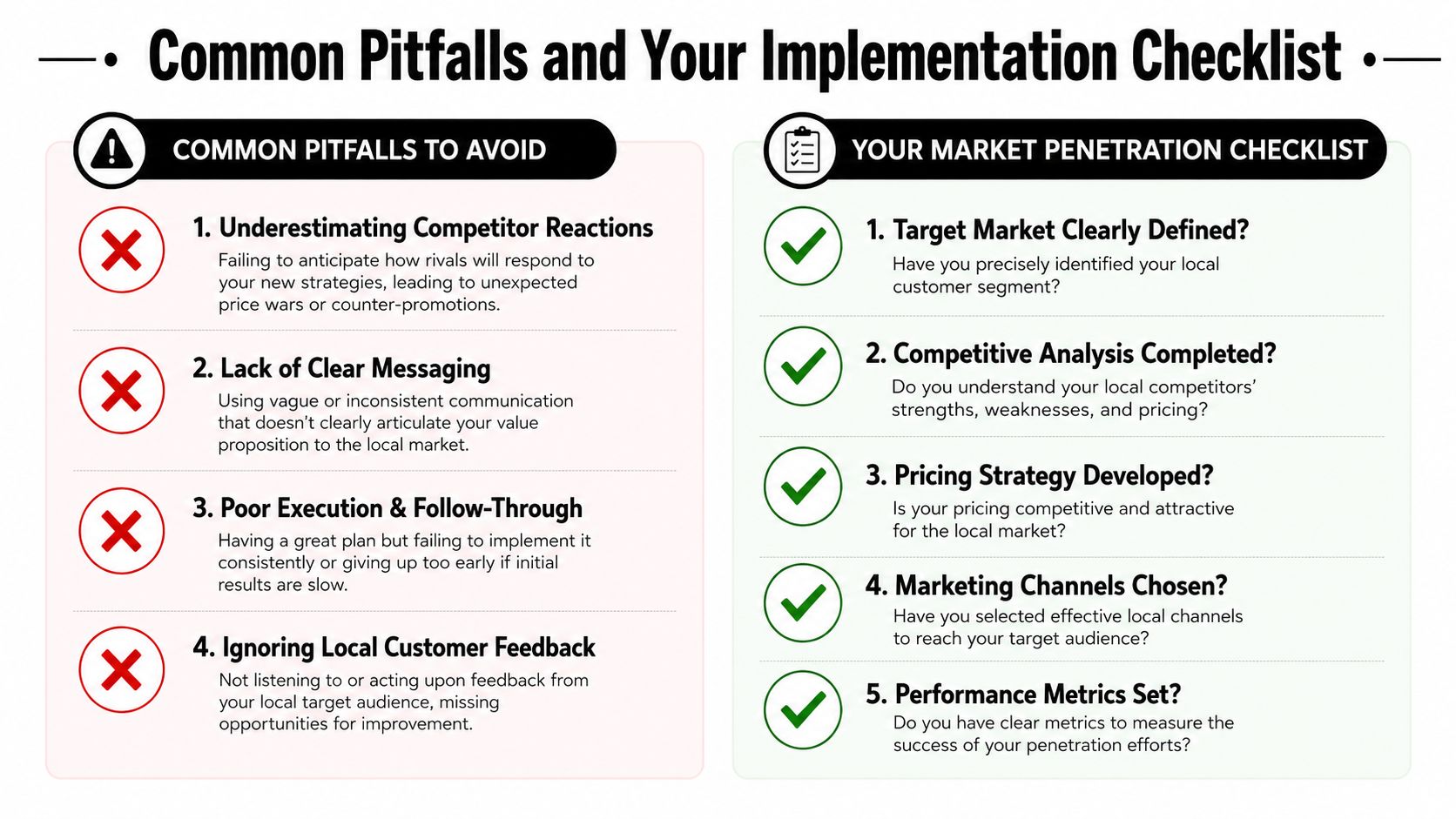
Owners cut prices, launch promotions, and assume volume will make up the margin loss. Often it doesn't. A 2025 National Federation of Independent Business study found that 68% of SMBs that launched penetration pricing campaigns failed to recoup initial discounts within one year because they underestimated competitor retaliation and customer churn, according to Simon-Kucher's discussion of penetration strategy risk.
Mistakes that hurt local businesses fastest
- Discounting without a retention plan means you buy first-time customers who never come back.
- Chasing every area at once spreads your team thin and hides where opportunity lies.
- Ignoring competitor response leaves you exposed when rivals match price or increase promotions.
- Weak messaging makes your offer look interchangeable with every other provider in town.
- Poor follow-through kills good strategy. If calls go unanswered or reviews go unrequested, penetration stalls.
A practical checklist to use this week
- Define one target segment by service, geography, and customer type.
- Calculate your current penetration baseline before changing anything.
- Choose one primary lever such as pricing, partnerships, loyalty, or local SEO.
- Set KPIs that protect profit including acquisition cost, churn, and repeat behavior.
- Review results on a fixed cadence and adjust before you expand the campaign.
Market penetration works when the business is disciplined enough to stay focused. That's the difference between “more marketing” and a real share-grab plan.
If your business is trying to grow in Fort Myers, Cape Coral, Estero, Bonita Springs, or Naples, Polaris Marketing Solutions can help you turn market penetration strategy into a local plan that produces leads, visibility, and measurable ROI. Start with a clear view of where you stand, where competitors are beating you, and which moves are most likely to win market share without wasting budget.