
As a small business, local marketing isn't just another strategy—it’s your secret weapon for turning proximity into real profitability. It's about becoming the undeniable first choice for customers right in your neighborhood, using a smart mix of tools to build a fortress around your local market.
Why Local Marketing Is Your Greatest Advantage
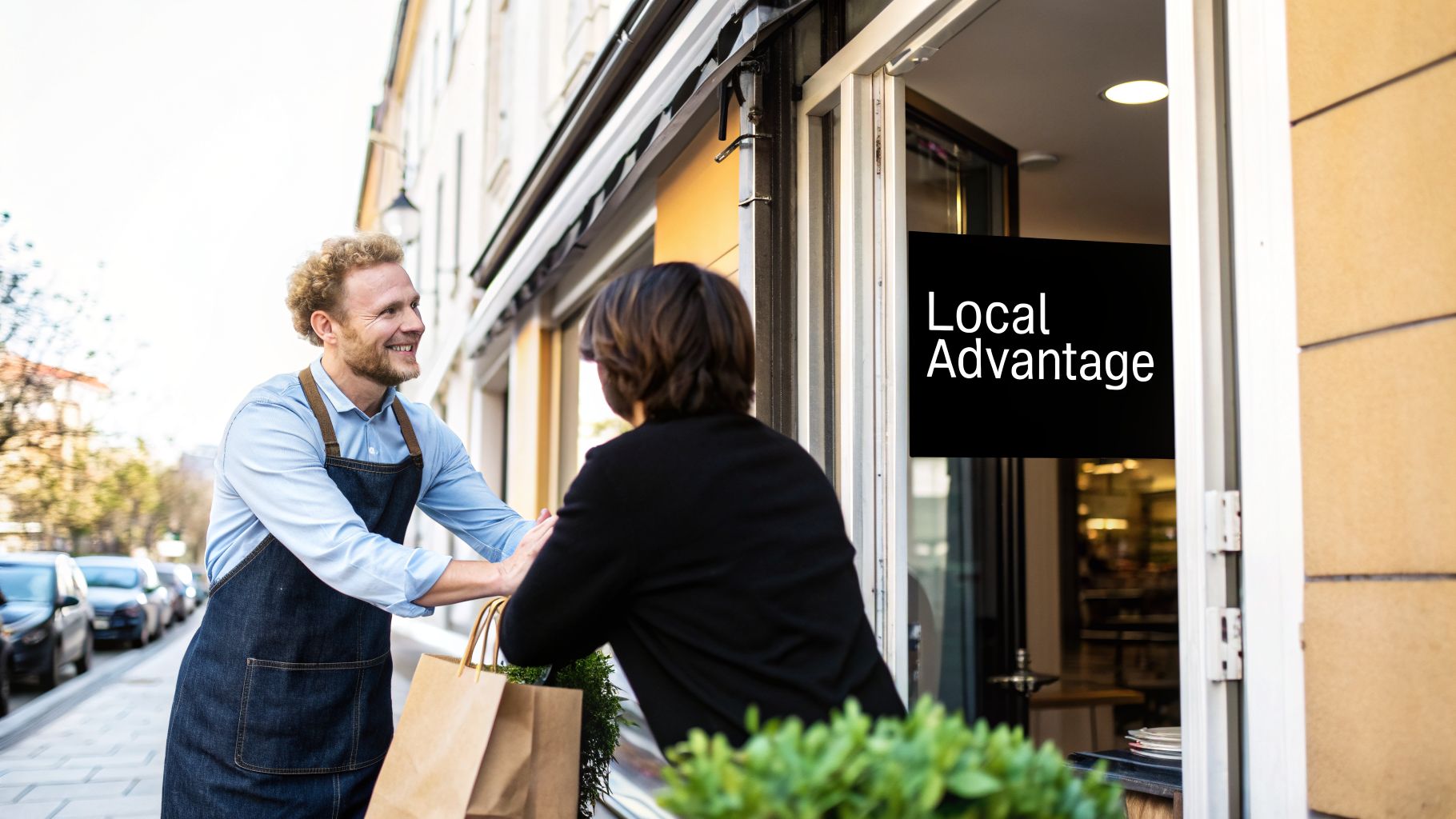
Forget trying to go toe-to-toe with national chains and their massive advertising budgets. Your most powerful asset isn’t a blank check; it's your genuine connection to the local community. When you master local marketing, you become the digital version of the most trusted name on Main Street.
Think about how customers actually find businesses now. The old-fashioned word-of-mouth referral still matters, but it has evolved into a quick "near me" search on a smartphone. When a homeowner's AC gives out on a sweltering July afternoon in Cape Coral, they aren't digging through a phonebook. They’re grabbing their phone, searching "AC repair near me," and trusting Google to point them to the best local pros.
This shift in customer behavior is everything. You're no longer just competing with the other company down the street; you're competing for attention and trust on a 6-inch screen.
Becoming the Go-To Local Choice
The ultimate goal here is to make your business the automatic, default answer for local needs. Whether you’re a roofer in Fort Myers, a dental practice in Naples, or a cafe in Bonita Springs, a strong local marketing plan makes sure you're the first name people see, the first one they trust, and the first one they call.
This is more important than ever as search habits become faster and more frequent. In fact, recent data shows that a staggering 32% of Americans look up local business information online at least once a day, very often using those critical 'near me' phrases. As you can see from these small business marketing trends, this makes hyperlocal visibility non-negotiable if you want to bring in nearby customers.
This digital-first approach works by building that fortress around your service area, anchored by a few key pillars:
- A strong Google Business Profile: Think of this as your digital storefront. For example, a bakery in Naples would use their profile to showcase daily specials with photos, answer questions about gluten-free options, and highlight their five-star reviews for custom cakes.
- Community-focused content: This means creating blog posts or service pages that speak directly to local pain points and geography. For instance, a landscaping company in Fort Myers could write a blog post titled "5 Plants That Survive SWFL's Rainy Season."
- Targeted local ads: This allows you to reach potential customers in specific zip codes, neighborhoods, or even gated communities. A pressure washing company could run a Facebook ad targeting homeowners only in the 33913 zip code who have shown an interest in "home improvement."
When these elements work together, they build serious trust and authority with both search engines and the people you want to serve. By consistently showing up where and when local people are looking for help, you turn your physical location into your biggest competitive advantage.
Building Your Digital Foundation with Local SEO
If you think of your local marketing strategy as a house, then local search engine optimization (SEO) is the concrete foundation. It’s the non-negotiable groundwork that makes sure everything else you build—your website, your social media, your paid ads—actually stands strong and gets seen by the right people.
Put simply, local SEO is the art and science of getting your business to show up prominently when local customers search on Google, especially in the coveted Map Pack.
When a homeowner in Fort Myers types in “paving company near me,” you don’t just want to be an option; you want to be the option. A solid local SEO strategy is what gets you there. It’s all about making it ridiculously easy for both search engines and human customers to find, understand, and trust your business.
Your Digital Storefront: Google Business Profile
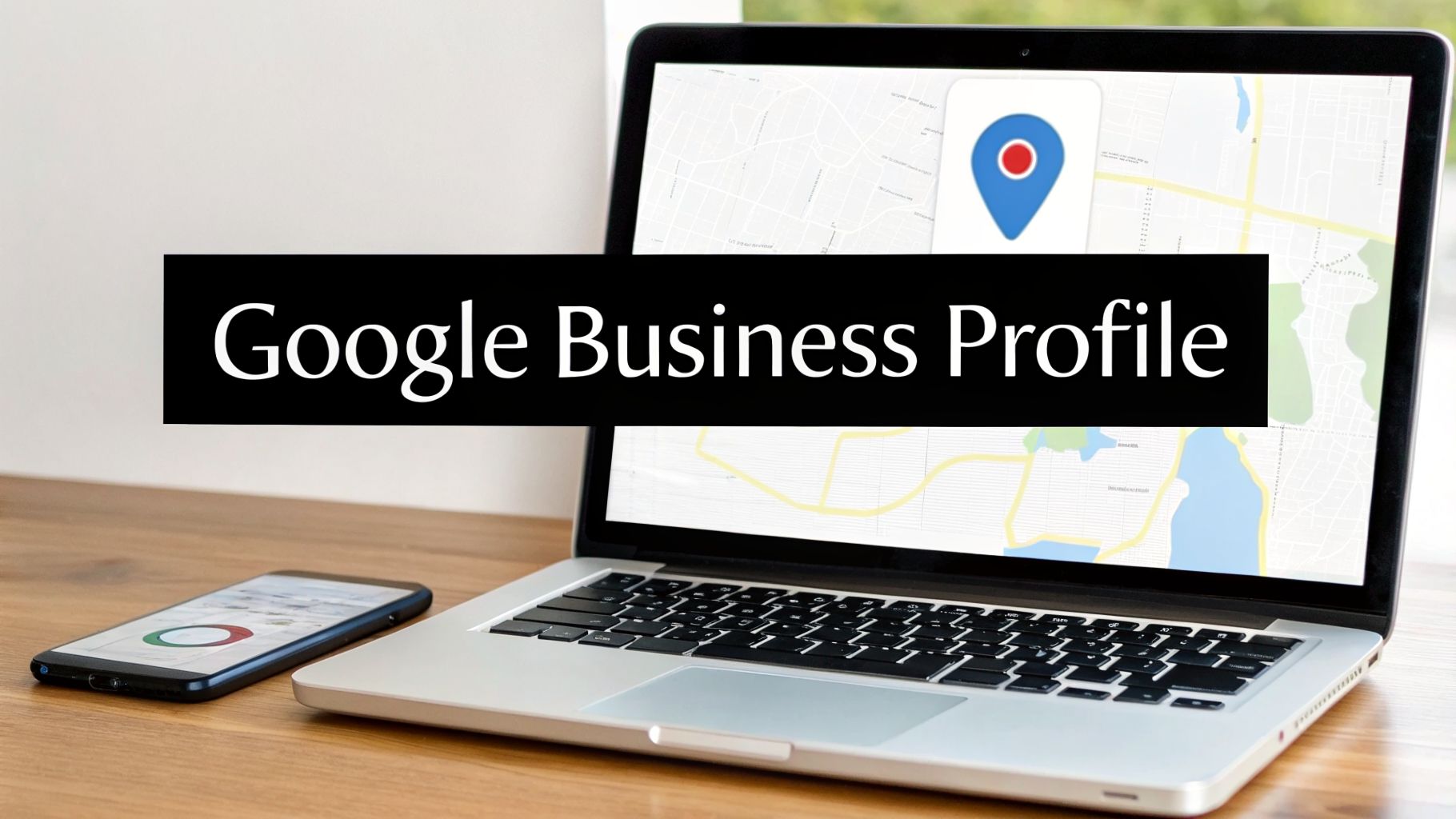
Your Google Business Profile (GBP) is, without a doubt, the most powerful tool in your local marketing toolkit. This isn't just another online listing. It’s your digital storefront, and for many customers, it’s the very first impression they’ll ever have of your business.
This free profile is what Google uses to populate the Map Pack and local search results, showcasing your hours, phone number, photos, and those all-important customer reviews.
It’s a fact: businesses with a complete, optimized GBP are seen as more credible. They get more clicks, more phone calls, and more requests for directions than businesses with a neglected profile. You have to treat your GBP with the same care and attention you give your physical office or showroom.
For a Fort Myers paving company, this means loading it up with high-quality photos of finished driveways, adding specific services like "asphalt repair" and "sealcoating," and using the Q&A feature to answer common questions before they’re even asked.
Ready to build a five-star profile? Here’s your checklist:
- Claim and Verify Your Profile: This is step one. You need to take official ownership of your listing through Google’s verification process. Example: Google will mail a postcard with a verification code to your business address.
- Complete Every Single Section: Don’t leave anything blank. Fill out your business name, address, phone number (NAP), website, and hours. The more complete it is, the more Google trusts the information.
- Choose Accurate Categories: Be specific. If you’re a law firm, your primary category should be "Law Firm," not a generic "Professional Service." Then, add secondary categories that apply, like "Estate Planning Attorney" or "Real Estate Attorney."
- Upload High-Quality Photos and Videos: Show, don’t just tell. Regularly add photos of your team in action, your completed work, and your location. A Bonita Springs law firm could add professional headshots and a shot of their welcoming lobby.
- Utilize Google Posts: Think of this as a mini-blog right on your profile. Share updates, announce special offers, or highlight a recent project. Example: A plumber could create a post saying, "Leaky faucet? We're offering 10% off all repairs in Cape Coral this week!"
- Enable Messaging: Let customers message you directly from your profile. Just be ready to respond quickly—speed matters.
The Power of Consistent Citations
Once your GBP is dialed in, it's time to build consistency across the web. This is where NAP (Name, Address, Phone Number) and local citations come in. A local citation is simply any online mention of your business’s core information.
These citations pop up in all sorts of places, from major directories like Yelp and Bing Places to smaller, industry-specific sites. Google’s algorithm uses these listings to cross-reference and verify that your business is legitimate and that its information is correct.
If your business name is listed as "SWFL Coastal Law, P.A." on one site but "SWFL Coastal Law" on another, it creates signals of confusion for Google. That inconsistency can erode the search engine's trust and harm your local rankings.
Your goal is to have your NAP information be absolutely identical everywhere it appears online. Every matching citation acts as a vote of confidence, telling Google that you are an established, trustworthy local business. A great place to start is by auditing your existing listings and methodically cleaning up any errors. If you need a more detailed guide, check out our small business SEO checklist.
Mastering Online Reviews
Finally, let’s talk about the lifeblood of local business credibility: online reviews. Your reviews are a massive ranking factor for local SEO, and they have a direct, immediate impact on whether a customer chooses you or a competitor.
A steady stream of recent, positive reviews signals to Google that you’re an active, reputable business that deserves to be recommended. But managing reviews isn’t just about collecting five-star ratings. It’s about how you engage with all feedback.
- Actively Request Reviews: Don't be afraid to ask. The perfect time to request a review is right after a job well done. For example, a pest control technician could hand a happy customer a small card with a QR code that links directly to the Google review page.
- Respond to Every Review: Thank customers for positive feedback—it shows you’re listening. More importantly, address negative comments professionally and quickly. For a negative review, you could respond: "We're sorry to hear about your experience. Please call our manager, [Name], at [Phone Number] so we can make this right."
Creating Content That Connects with Your Community
While technical SEO puts your business on the digital map, it’s your content that truly opens the door and welcomes customers inside. This is the real core of local marketing for any small business. It’s how you turn your website from a flat, static brochure into a living, breathing resource for your community.
This is your chance to prove you get it. You understand the lives, the problems, and the unique culture of your neighbors. A generic "Services" page simply won't resonate anymore. Your customers are out there searching with incredibly specific, location-based questions. To win their business, you have to meet them right there with content that speaks their language and solves their hyperlocal problems.
Think of it this way: a generic website is a national chain’s brochure. A locally focused website is the friendly advice you'd get from a trusted neighbor over the fence. That neighborly trust is what wins business in Southwest Florida.
Crafting Location-Specific Pages That Rank
Your first move is to stop just listing what you do and start showing how and where you do it. This means creating dedicated pages for your key services that are explicitly tied to the towns and neighborhoods you serve. These pages become powerful assets that Google loves to show for local searches.
For instance, a standard "Window Installation" page is a start. But a page titled "Hurricane-Proof Windows for Fort Myers Homes" is infinitely more powerful. It taps directly into a real, local fear and uses the exact words a homeowner would be frantically typing into Google as storm season approaches.
Here are a few more actionable examples:
- For a Fort Myers paving company: Instead of a single "Services" page, think bigger. Create pages like "Asphalt Driveway Paving in Cape Coral" and "Brick Paver Patio Installation for Naples Homes." You can even feature photos of completed projects right in those specific areas.
- For a Bonita Springs law firm: Don't just settle for "Estate Planning." Build out dedicated pages for "Florida Snowbird Residency and Estate Planning" or "Setting Up a Trust in Lee County." You'll be addressing the precise needs of the people who live here.
Brainstorming Blog Content That Solves Local Problems
Your blog is where you cement your status as the go-to expert. It’s time to stop writing generic, cookie-cutter posts and start answering the questions that only a local would think to ask. This strategy builds incredible authority and attracts highly qualified traffic to your site.
Think about the unique rhythm of life here in Southwest Florida. What are the seasonal shifts, the common frustrations, and the local passions that your business can speak to?
A Framework for Local Blog Ideas:
- Seasonal Needs: What do people in your area need at different times of the year?
- Pool Service: "Preparing Your Pool for Snowbird Season in Naples"
- HVAC Contractor: "When Is the Best Time to Service Your AC in Fort Myers?"
- Local Activities: How does your business connect with what people love to do around here?
- Boat Dealer: "The Top 5 Backwater Fishing Spots Near Cape Coral"
- Outdoor Retailer: "Beginner's Guide to Kayaking the Estero River"
- Community Events & News: How can you tie your services into what's happening locally?
- Event Planner: "How to Host the Perfect Graduation Party in Estero"
- Security Company: "Keeping Your Home Safe During the Edison Festival of Light Parade"
If you're hunting for more inspiration, digging into different content marketing strategies for small business can give you a much broader playbook to work from.
Using Storytelling to Build an Authentic Local Brand
At the end of the day, fantastic local content isn’t just about services and keywords—it’s about people. Your connection to the community is your single biggest competitive advantage, and storytelling is how you bring that connection to life. People want to do business with companies that feel like a genuine part of their town, not some faceless corporation.
Use your blog and social media channels to tell the stories that anchor your brand right here in the community. This is how you build an emotional bond that online-only giants can never hope to replicate.
Showcase your community involvement by:
- Spotlighting a local sponsorship: Did you sponsor a Little League team? Write a post celebrating the kids, tag the league, and share pictures from a recent game.
- Featuring employee stories: Interview a long-time employee who lives down the street. Share their story and what they love about serving their neighbors. For example, a local coffee shop could feature a barista and their favorite local spots to visit on their day off.
- Celebrating local partnerships: Do you refer business to another local company? Feature them on your blog! It strengthens your community network and gives your audience another great local resource. A wedding photographer could write a post titled "Our 5 Favorite Wedding Venues in Naples," linking to each venue's website.
Running Local Ads That Actually Generate Leads
While organic strategies like SEO and content build your brand over the long haul, sometimes you just need the phone to ring right now. This is where paid local advertising really shines. It's not about burning through your budget; it's about surgically precise targeting that puts your business directly in front of customers who are ready to make a call.
Think of paid ads as a powerful magnet, pulling in qualified leads today while your slower-burn SEO efforts build momentum for tomorrow. For most small businesses, two platforms stand out for their incredible accuracy and cost-effectiveness: Google’s ad ecosystem and hyper-targeted social media campaigns.
This focused approach is quickly becoming the standard. With 68% of small businesses planning to increase their marketing budgets, they’re putting their money into channels like social media that are proven to deliver real value. As inflation remains a concern, the adoption of digital tools—with 54% of owners already using them—is making these cost-effective local strategies possible. You can discover more insights about small business marketing investments on MarketingProfs.com to see where the trends are heading.
Google Ads for Local Services
For any home service business, Google Local Service Ads (LSAs) are a true game-changer. These ads show up at the very top of the search results—even above the traditional pay-per-click (PPC) ads—and come with a "Google Guaranteed" badge that builds immediate trust with homeowners.
The best part? You only pay when a customer actually calls you through the ad. You aren't paying for a simple click; you're paying for a direct lead.
Imagine a cleaning service based in Fort Myers. Instead of running a generic ad that gets seen by renters and commercial properties all over Lee County, they can use Google's location targeting to show ads only to homeowners within a specific 10-mile radius. This completely eliminates wasted ad spend and makes sure every dollar is focused on their ideal customer. For a closer look at this kind of paid strategy, check out our guide on PPC management for small business.
Local Service Ads are not just ads; they are lead-generation machines. They cut through the noise by connecting you with customers who have a specific need at the exact moment they are searching for a solution.
Hyper-Targeted Social Media Ads
Platforms like Facebook and Instagram offer incredibly detailed targeting options, letting you reach very specific demographics and behaviors right within your service area. This is where you can get creative and find customers before they even think to search on Google.
Let’s walk through a real-world example:
Goal: A home renovation contractor wants to find new clients in the affluent, fast-growing community of Estero, Florida.
Actionable Facebook Ad Campaign:
- Define the Audience: Instead of blasting an ad to everyone in Estero, they create a custom audience. They can target users living in a specific zip code (like 33928) who Facebook's data has recently flagged as "new movers."
- Add Interest Layers: They get even more specific by adding interests like "home renovation," "HGTV," or "interior design." Now the ad is only shown to new homeowners who are already thinking about improving their new space.
- Craft a Compelling Offer: The ad itself could feature a stunning before-and-after photo of a kitchen they remodeled locally, with a clear call-to-action: "Welcome to Estero! Let's build your dream kitchen. Get a free design consultation."
This hyper-targeted approach is far more powerful than a generic billboard because it speaks directly to a person's immediate needs and interests.
Local PPC vs. Local SEO: Deciding Your Strategy
It's critical to understand that paid ads and organic SEO aren't opponents; they're teammates. One delivers quick wins and immediate data, while the other builds sustainable, long-term value for your brand. Deciding how to allocate your budget really depends on your business goals and how quickly you need results.
This table breaks down the core differences to help you decide where to focus your efforts.
| Factor | Local PPC (e.g., Google Ads) | Local SEO (e.g., GBP Optimization) |
|---|---|---|
| Speed to Results | Immediate. Ads can go live within hours, generating clicks and calls right away. | Slower. It typically takes 3-6 months or more to see significant ranking improvements. |
| Cost Structure | Pay-per-click or pay-per-lead. You pay for each interaction, and costs stop when you pause the campaign. | Ongoing investment of time and resources. The cost is front-loaded, but results are "free" once you rank. |
| Longevity | Short-term. Your visibility disappears the moment you stop paying for ads. | Long-term. Once you achieve high rankings, you can maintain them with consistent effort, creating a lasting asset. |
| Best For | Quickly testing new markets, promoting special offers, generating immediate leads, and filling gaps while SEO builds. | Building brand trust and authority, establishing a sustainable source of leads, and becoming the go-to local expert. |
Ultimately, a smart strategy uses both. PPC can get the phone ringing this week, giving your business the breathing room it needs while your SEO efforts build a foundation for reliable, long-term growth.
Building Real-World Trust with Offline Marketing
Being a local powerhouse means more than just showing up online. While a solid digital game with SEO and social media gets you seen, it’s the real-world, face-to-face connections that build the kind of trust that digital-only competitors can't replicate.
This is where you cement your place in the community. When people see your business out and about—at a high school football game or on a truck in their neighbor’s driveway—you stop being just another name on a screen. You become a familiar, trusted part of their world.
Become a Visible Part of the Community
Getting your name out there isn't about blanketing neighborhoods with flyers. It's about smart, strategic visibility that puts your brand in front of people in a positive way, over and over again. This is how you go from being a business in town to being the go-to business for what you do.
Here are a few ideas that work wonders:
- Sponsor a local sports team: Putting your logo on a Little League team’s jerseys in Estero is about more than just a donation. It puts your name in front of dozens of local families all season long. You can then share pictures of the team on your social media, blending that offline goodwill with your online marketing.
- Host a free workshop: A law firm in Bonita Springs could host a free seminar on "Estate Planning Basics for Florida Residents." You're not selling anything; you're offering genuine help. This positions you as the go-to expert and brings in high-quality leads from people who now trust you.
- Use branded vehicles and yard signs: For any home service contractor, a clean, branded truck is a rolling billboard. When your crew is on a job in a Fort Myers neighborhood, pop a professional-looking yard sign out front. Suddenly, your truck and sign become a silent testimonial for every neighbor who passes by.
Forge Strategic Local Alliances
Some of the best marketing you'll ever get will come from other local businesses who serve the same customers you do, just in different ways. Building a referral network is one of the most powerful and cost-effective moves you can make. The goal is simple: create a small group where everyone helps each other win.
A warm referral from another trusted local business is pure gold. It cuts through all the noise and skepticism because the trust is already built-in.
Think about the possibilities right here in Southwest Florida:
- A real estate agent in Cape Coral could team up with a reliable local moving company, a home inspector, and a paving contractor. Together, they could offer a "Welcome to Cape Coral" packet to new homeowners, with each business recommending the others.
- A high-end interior designer in Naples might form a partnership with a custom home builder and a landscape architect. They can confidently refer clients back and forth, knowing the quality of work will always be top-notch.
These partnerships work because they provide real value. This community-first approach is exactly what local customers want. In fact, 72% of customers make a point to return to local businesses they know, and 88% become repeat buyers after having a good experience. In a place like SWFL, being a neighborhood staple beats a generic ad every time. You can get the full story on these small business marketing trends and see how they are impacting our area.
Your 90-Day Local Marketing Action Plan
Okay, we've covered a lot of ground. It’s easy to feel overwhelmed by all the strategies, so let's turn theory into a clear, manageable roadmap. This 90-day action plan breaks everything down into a practical schedule that any small business owner can use to start seeing real, measurable progress right away.
Think of this as your launch sequence. Each month builds on the last, creating the kind of momentum that will carry your business forward. To really dig in, we recommend exploring these powerful local business marketing strategies that have a proven track record of driving growth.
Month 1: The Foundation
The first 30 days are all about building a rock-solid foundation. This is the essential groundwork that makes every other marketing effort more effective. Your goal here is to get your digital house in order and start collecting the social proof that wins over new customers.
Here are your action items for this month:
- Google Business Profile Audit: Perform a top-to-bottom audit and optimization of your GBP. Don't skip anything. Fill out every single section, upload at least 10 high-quality photos, and write detailed service descriptions that answer your customers' biggest questions.
- Citation Cleanup: Zero in on your top 10-15 most important local citations (think Yelp, Bing Places, and key industry directories). Manually check each one to ensure your business Name, Address, and Phone number (NAP) are 100% consistent across the board.
- Automate Review Requests: Set up a simple, automated system using email or SMS. The best time to ask for a review is right after a customer has had a great experience. This simple step creates a steady stream of fresh, positive feedback.
Month 2: Gaining Visibility
With your foundation secure, month two is focused on expanding your reach and actively attracting new customers. Now is the time to start creating the local content and running the targeted ads that get you noticed.
The goal here isn't to be everywhere at once. It's to be highly visible in the specific places your ideal customers are looking.
Here’s your checklist for the next 30 days:
- Publish Your First Local Blog Post: Write and publish one hyper-local blog post that solves a specific problem for your community. Think "Preparing Your Pool for Snowbird Season in Naples" or "The Best Hurricane-Resistant Windows for Fort Myers Homes."
- Create Two Service Area Pages: Build out two new pages on your website dedicated to a specific service in a specific location, such as "Paver Driveway Installation in Estero" or "Estate Planning Services in Cape Coral."
- Launch a Hyper-Targeted Ad Campaign: Run a small, controlled ad campaign on Google or Facebook. Start by targeting a single zip code with a compelling offer to test what resonates with your audience before scaling up.
Month 3: Growth and Analysis
The final 30 days of this initial push are all about building real-world connections and analyzing your data. This is where you translate your new visibility into tangible community trust and start making data-driven decisions for the future.
This visual timeline breaks down how offline efforts like sponsorships, workshops, and alliances build trust over time.
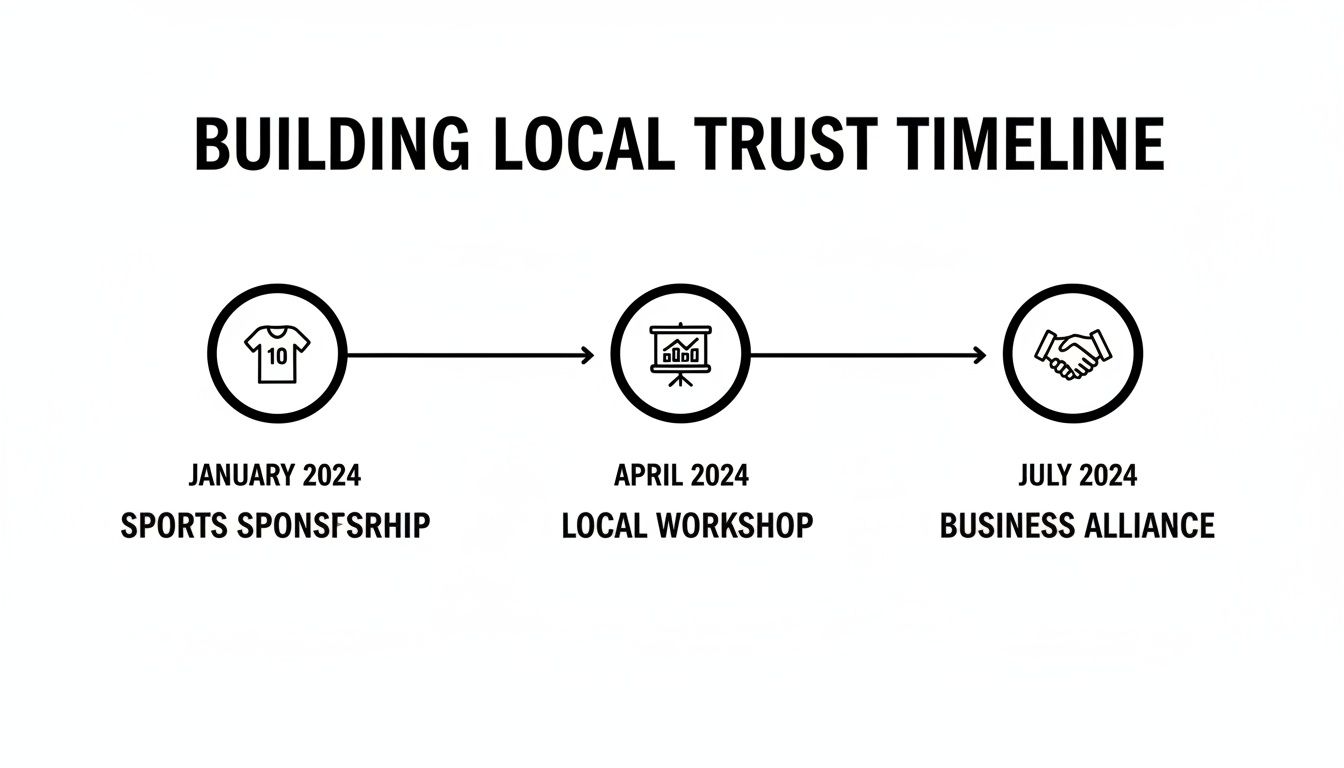
These offline activities create authentic touchpoints that digital-only marketing can't replicate, turning brand awareness into genuine loyalty. This month, your focus is on making one of these connections and reviewing what you’ve accomplished.
Your mission is to secure one local partnership or sponsorship. Then, dive into your key metrics from the past 90 days. Figure out what’s driving calls and clicks, and use that insight to plan your next quarter.
Frequently Asked Questions About Local Marketing
Diving into local marketing can feel like opening a can of worms—plenty of questions pop up. We get it. Here are some straightforward answers to the questions we hear most often from business owners, designed to give you the confidence to move forward.
How Much Should a Small Business Budget for Local Marketing?
A solid benchmark to start with is dedicating 5-10% of your total revenue to marketing. If you're in a competitive area like Fort Myers or just getting your business off the ground, you’ll want to lean toward the higher end of that range.
But it’s not just about spending money; it’s about spending it smart. Before you spend a dime, max out the free tools at your disposal.
- Get your Google Business Profile to 100% completion. Don’t leave any section blank.
- Make it a habit to ask every single happy customer for an online review.
Once you have that foundation, you can start small and test the waters. Earmark a controllable budget, say $300-$500 per month, for a single, focused local ad campaign. Use the data from that test to see what works, then scale your investment where you’ll get the best return.
Does Local Marketing Work If I Don't Have a Physical Storefront?
Absolutely. In fact, for a service-area business (SAB), it's not just an option—it’s essential. Google doesn't see your "location" as just one address. It sees it as the entire territory you serve, and your goal is to be the most visible and trusted choice in that entire zone.
For a service-area business, your marketing isn’t about drawing people to your shop; it’s about proving you are the best choice within their neighborhood.
If you're a mobile business, here’s how you make that happen:
- Define Your Turf: In your Google Business Profile, make sure you hide your physical address. Then, clearly list the specific cities and zip codes you serve, like "Cape Coral, Bonita Springs, and Naples."
- Create "Digital Storefronts": Build out dedicated pages on your website for your core service areas. Think "AC Repair in Lehigh Acres" or "Plumbing Services in Estero."
- Get Hyperlocal Reviews: When you ask for reviews, encourage customers to mention their city or even their neighborhood. For example, a customer review might say, "John fixed our plumbing issue in our Estero home fast! Highly recommend."
How Long Does It Take to See Results from Local SEO?
Think of local SEO as a marathon, not a 100-yard dash. When you do the foundational work right—like fully optimizing your Google Business Profile and website—you can often see positive movement in your visibility within 1-3 months.
However, consistently landing at the top of the map pack for your most valuable keywords is a longer game. That typically takes 6-12 months of dedicated effort, including creating local content, building business citations, and steadily earning reviews. That's why we always recommend a balanced approach: use local pay-per-click (PPC) ads for immediate leads while your long-term SEO strategy builds momentum and authority.
Ready to stop guessing and start growing? The team at Polaris Marketing Solutions builds practical, effective local marketing strategies that get real results for businesses right here in Southwest Florida. Get your complimentary online analysis and competitor report today.