
A lot of Fort Myers business owners are in the same spot right now. You know people are searching for your service on Google, you’re paying for some kind of marketing, and yet the calls that matter either don’t come in or come in from the wrong people.
That’s usually the moment when the question changes from “how do I get more traffic?” to “what is LSA in marketing, and will it get my phone ringing?” For many local businesses, especially service businesses that need direct inquiries instead of casual website visits, the answer is yes.
LSA stands for Local Services Ads. It’s Google’s pay-per-lead ad product for local service businesses and eligible professional categories. These ads sit at the very top of the search page, above standard Google Ads and above organic rankings, and they’re built to drive calls and messages from people who are ready to hire.
Your Phone Isn't Ringing But Your Competitor's Is
A Fort Myers business owner sees this all the time. The website is live, reviews are decent, some money is going into marketing, and the phone still stays quiet while a competitor keeps picking up the calls. In Southwest Florida, that usually means the competitor is winning the search result that gets seen first at the exact moment someone needs help.
A homeowner in Cape Coral with a broken AC is not comparing ten providers. A car accident victim in Naples looking for a lawyer is not reading five practice area pages before making a call. A family trying to book urgent care or a specialist visit often chooses the business that looks trusted, nearby, and easy to contact right away.
That top placement is often an LSA.

For local service businesses and eligible professional categories, Google built Local Services Ads to generate direct inquiries instead of passive traffic. That distinction is critical because many Fort Myers, Cape Coral, and Naples businesses do not have a traffic problem. They have a lead intake problem. They need qualified calls, not another report showing impressions went up.
I see this most often with professional services that get left out of LSA guides. Attorneys, medical practices, and other regulated local providers have a more delicate intake process than a typical home service company. They need visibility, but they also need the right kind of inquiry, clear service-area targeting, and a budget they can defend month after month. LSAs can fit that need well, but only if the account is set up around real cases, real appointments, and real capacity.
A few reasons LSAs get attention from local owners:
- They show in a premium spot on Google: You get visibility before many standard paid and organic results.
- They are built for contact, not browsing: Searchers can call or message directly from the ad.
- They match urgent local intent: This works especially well for searches tied to immediate need.
- They can be easier to judge on ROI: Lead volume, lead quality, and close rate are easier to track than general website traffic.
The trade-off is simple. LSAs are strong for demand capture, but they are not a full marketing plan. They do not replace reputation management, your website, intake training, or follow-up speed. If nobody answers the phone, if reviews are weak, or if your staff cannot separate a good lead from a bad one, the platform will not fix that for you.
For owners trying to get more local leads for your business, LSAs are often one of the fastest channels to test because they tie spend more closely to actual inquiries. If you want a broader view of that model, understanding pay per lead strategies helps explain why many local businesses prefer paying for contacts instead of paying for clicks and hoping some of them turn into revenue.
How Local Services Ads Actually Work
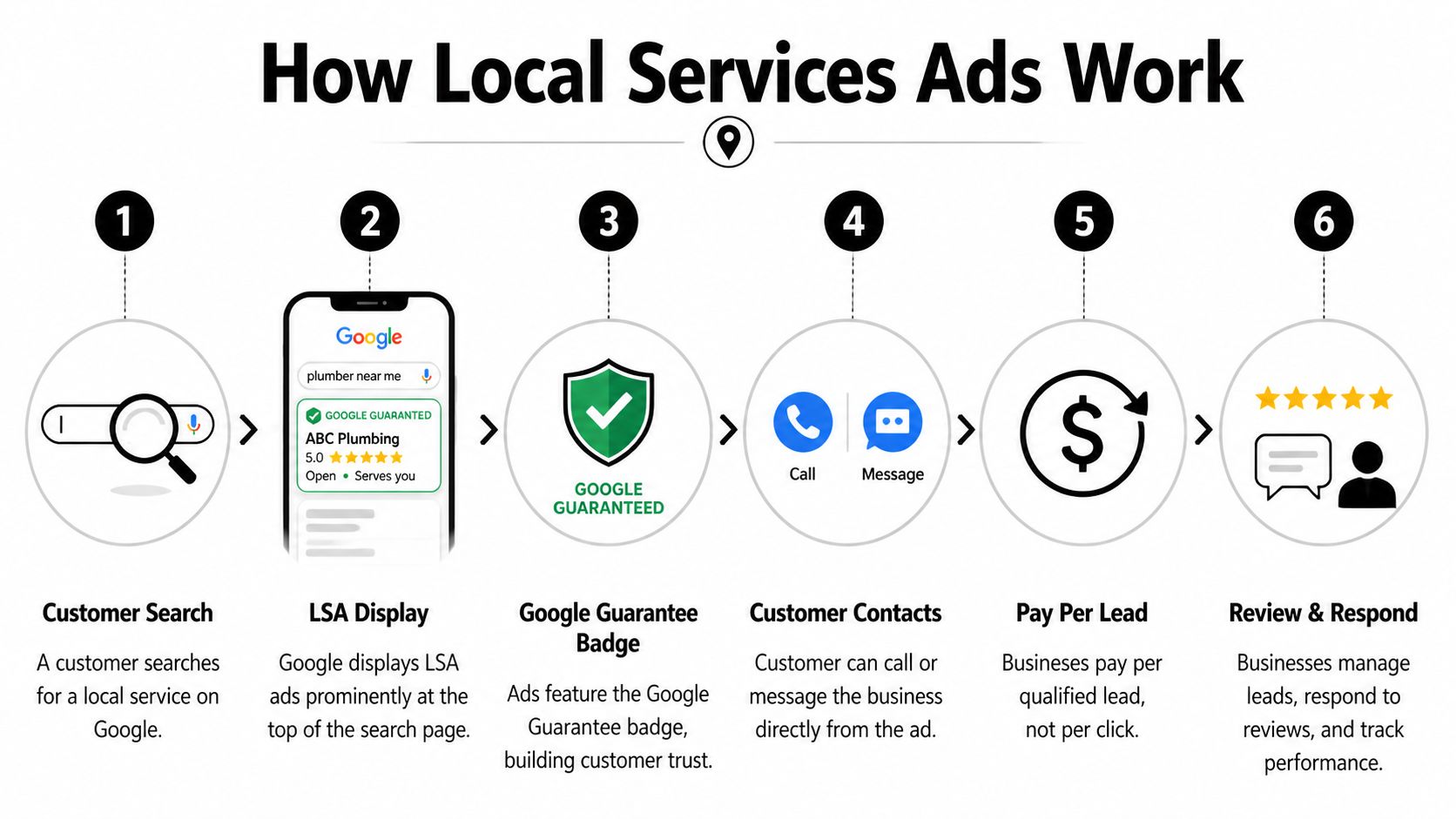
LSAs are easiest to understand if you think of them as a digital referral system run inside Google. Google checks that your business is eligible, verifies key business details, and then places your profile in front of nearby searchers who need that service. When the person contacts you through the ad, that becomes the billable event.
That’s different from traditional click-based advertising. You’re not paying because someone was curious. You’re paying because someone took action.
What a customer sees
When someone searches for a service, Google may show an LSA unit at the top of the page. The business listing can include the company name, reviews, service area, hours, and a trust badge. The user can then call or send a message directly from that ad.
The model matters because Local Services Ads don’t work like open-ended media buying. They work more like controlled lead intake.
If you want a broader grounding in understanding pay per lead strategies, that model helps explain why many service businesses prefer leads over raw click volume. The closer the billing point is to a real inquiry, the easier it is to judge whether the channel belongs in your budget.
What the business has to do
To run LSAs, a business has to complete Google’s setup and verification process. Depending on the category, that can involve license checks, insurance information, and background screening. For local owners in Florida, paperwork and category accuracy are particularly important.
The trust component is a big reason LSAs work. As described in this explanation of Google Local Service Ads, Google connects ad visibility with business legitimacy, review strength, and profile completeness. That means setup isn’t just admin work. It directly affects performance.
Here’s the basic workflow:
- Confirm category and location eligibility so Google can determine whether your service can run LSAs in your market.
- Build your business profile with the right services, hours, and operating area.
- Submit verification documents such as licensing and insurance where required.
- Launch the ad profile once Google approves the account.
- Receive leads by phone or message and manage them from the LSA dashboard.
- Review lead quality and disputes so you’re not treating every charge as final.
The owners who struggle with LSAs usually don’t fail on ad copy. They fail on setup accuracy, review quality, and lead handling.
Why owners like the model
The appeal is simple. You don’t need to obsess over keyword match types, write multiple ad variations, and babysit search term reports the same way you would in PPC. Google handles much of the presentation. Your job is to keep the business credible, responsive, and well-reviewed.
That also means LSAs are not a “set it and forget it” lead faucet. They’re simpler than PPC in some ways, but they demand strong operational follow-through once inquiries start arriving.
LSA vs Google Ads A Clear Comparison
A lot of owners mix these up because both appear on Google search pages. They are not the same tool, and treating them like they are usually leads to budget waste.
Traditional Google Ads, often called PPC, are built around clicks, keywords, ad copy, bidding, and landing pages. LSAs are built around local service intent, trust signals, and direct contact. In practice, that changes how you budget, how you manage leads, and what success looks like.
Side by side comparison
| Feature | Local Services Ads (LSA) | Traditional Google Ads (PPC) |
|---|---|---|
| Primary cost model | Pay per lead | Pay per click |
| Placement | Top of the results page above PPC and organic listings | Below the LSA unit and above or around organic results |
| Main conversion action | Direct phone call or message from the ad | Click to website, form fill, call, or other landing page action |
| Trust element | Verification badge, reviews, business details | Ad copy and landing page do most of the persuasion |
| Control level | Less control over creative and query handling | More control over keywords, copy, extensions, and landing pages |
| Best use case | Immediate local demand and lead generation | Broader targeting, service promotion, and funnel building |
| Ranking driver | Reputation, responsiveness, relevance, proximity | Bid strategy and ad quality factors |
What this means for a local budget
For a home services contractor, LSAs can outperform PPC for urgent, bottom-funnel searches because they’re designed to capture buyers who want to act now. Lawyerist’s explanation of Local Services Ads notes that a home services contractor with superior Google reviews and faster customer response times can achieve top LSA placement despite spending less than competitors with larger budgets.
That’s one of the biggest practical differences.
With PPC, more spend often creates more visibility if the account is managed well. With LSAs, money still matters, but it doesn’t override reputation and response behavior in the same way. A smaller Cape Coral HVAC company can beat a larger competitor if it answers calls fast and maintains stronger review quality.
When to use one, and when to use both
A simple way to think about it:
- Use LSAs for “I need someone now” searches.
- Use PPC for broader services, special offers, branded messaging, and searches that need a stronger landing page.
- Use both when you want immediate lead flow and broader market coverage.
A Fort Myers law office or medical practice may also need this distinction more than a roofer does. Some professional services can’t rely on a single ad format because the buyer journey is more cautious. They may search, compare reviews, visit the site, and only then call.
For businesses weighing their options, this guide to pay per click for small businesses is useful because it shows where PPC still plays an important role even when LSAs are available.
If you need control, education, and broader targeting, PPC usually carries more of the load. If you need inbound calls from nearby prospects, LSAs often carry it better.
The Key Benefits and Limitations of LSAs
A lot of Fort Myers business owners hear "pay per lead" and assume LSAs are an easy win. Sometimes they are. Sometimes they create a steady stream of expensive interruptions that your front desk is not prepared to sort.

The difference usually comes down to fit. LSAs work best when the searcher has clear intent, your category is fully supported by Google, and your team can answer and qualify leads fast. In Cape Coral and Fort Myers, that often makes LSAs a strong channel for firms that depend on inbound calls and quick response times.
Where LSAs tend to work well
The biggest upside is placement. If your profile shows above the traditional ads and map results, you have a real chance to get the first call, especially from people searching with immediate need.
Trust matters just as much. Reviews, verification, and proximity all show up before someone ever reaches your website. For a smaller local firm in Southwest Florida, that can narrow the gap with a larger regional competitor.
In practice, the businesses that like LSAs usually like them for four reasons:
- You pay for leads, not clicks: That can make budgeting easier for owners who are tired of paying for traffic that never contacts the office.
- Intent is usually stronger: A person using LSAs is often closer to booking, calling, or requesting an appointment than someone casually browsing search results.
- Setup is simpler than a full PPC campaign: You do not need multiple landing pages, ad variants, and a large keyword structure just to get started.
- They fit phone-based sales well: If your team is good at answering calls, screening cases, and booking quickly, LSAs can match how revenue already comes in.
That said, "pay per lead" does not automatically mean "lower cost per client." A Naples attorney may get fewer but higher-value matters, while a clinic or contractor may need tighter intake standards to keep lead quality from slipping.
Where businesses get frustrated
The limitations are real, and they show up fast.
Some businesses never get far because their category has limited availability or stricter verification. That issue comes up more often in legal, healthcare, and specialty professional services than in the contractor-focused examples you see in many LSA guides.
Other problems come from operations, not advertising:
- Category and market limits: Google does not support every service the same way in every area.
- Verification delays: Licensing, insurance, and background checks can slow down launch or stall updates.
- Less control than PPC: You cannot shape keyword targeting, messaging, and landing page flow with the same precision.
- Missed calls hurt performance: If the office lets leads roll to voicemail, results usually decline.
- Review quality affects visibility: A weak review profile can hold you back even if your budget is healthy.
I see this often with smaller professional practices in Fort Myers and Naples. The owner approves the ad spend, but nobody fixes intake. Calls get missed during lunch, staff members are unsure how to screen leads, and good prospects move on to the next listing.
The professional services wrinkle
Consequently, local professional services need a more careful plan than home service companies.
A personal injury firm, family law office, med spa, dental practice, or specialty clinic does not always win the lead with one quick phone call. People may compare reviews, check credentials, visit the site, ask about insurance, or want reassurance before they book. LSAs can start that process, but they rarely carry the full weight on their own.
Compliance is part of the equation too. Healthcare advertisers and legal advertisers often have tighter guardrails around claims, intake language, and follow-up. That makes LSAs useful, but also narrower. They can produce demand at the top of the funnel, while your website, Google Business Profile, and local SEO do more of the trust-building and education.
For Southwest Florida businesses, that is the practical takeaway. LSAs are strong for capturing nearby demand that is ready to call. They are weaker when the buyer needs education, careful screening, or a longer decision cycle.
Your 5-Step LSA Setup Checklist
If you’re trying to move from theory to action, keep the setup process simple. Most delays happen because the owner skips a requirement, uses inconsistent business information, or launches before the team is ready to handle leads.
Step 1 Check whether your business is eligible
Start with the basics. Make sure Google offers LSAs for your business category in your service area. That’s especially important for legal, healthcare, and specialty service providers in Fort Myers, Cape Coral, and Naples because category availability can vary.
Look at your exact service model, not just your broad industry label. A business may assume it qualifies because a competitor runs LSAs, but that competitor may be in a different category or market setup.
Step 2 Build the profile with real service detail
Your LSA profile needs accurate services, service areas, hours, and contact information. Don’t treat this like filler text. If your business only serves parts of Lee and Collier counties, define that carefully.
A practical example: a Fort Myers contractor might include only the zones the team can service quickly, instead of claiming the whole region and then struggling to answer inquiries in time.
Step 3 Gather documents before you start the application
Many owners lose momentum here. Pull together the documents Google is likely to request for your category. That may include business license details, liability insurance, and background or verification information.
Keep names, addresses, and business details consistent across every document. Small mismatches create avoidable delays.
Don’t start the application until your paperwork is organized. Half-finished verification creates more frustration than a one-day delay to prepare properly.
Step 4 Set a realistic budget and service area
Don’t start too wide. A focused service area usually gives better early signal quality than trying to cover every nearby market at once.
Use the budget as a throttle, not a vanity setting. Your goal isn’t to say you’re “running LSAs.” Your goal is to generate leads you can answer, qualify, and close without disrupting the rest of the business.
A practical starting framework:
- Choose your strongest geography: Start where your team already wins jobs.
- Match hours to reality: Don’t advertise availability your office can’t support.
- Prepare the phone workflow: Make sure calls route to someone who can respond properly.
Step 5 Launch only when lead handling is ready
Before going live, decide who answers calls, who checks messages, and how missed inquiries get followed up. This matters more than most owners expect.
If your office manager is already overloaded, LSA volume can expose that immediately. Even a strong profile underperforms when the first response is slow, inconsistent, or unclear.
The best launch day question isn’t “are the ads active?” It’s “if five qualified people contact us today, do we have a clean intake process for every one of them?”
Advanced LSA Strategy for Southwest Florida Businesses
A Fort Myers firm can turn LSAs on Monday and still watch calls go to a competitor by Friday. The difference usually shows up after launch. Better review momentum, tighter category alignment, stronger intake, and cleaner geographic choices tend to win the placements that matter.

Review momentum matters more in smaller local markets
In Southwest Florida, a stale profile stands out fast. Businesses in Fort Myers, Cape Coral, and Naples often compete in tighter pools than large metro areas, so recent reviews can influence both visibility and conversion quality.
For professional services, this gets more complicated than it does for roofers or plumbers. A personal injury firm, med spa, dentist, or private practice is not just selling availability. The buyer is screening for trust, discretion, professionalism, and proof that the office can handle their specific problem. That means your review strategy should aim for detail and consistency, not just volume.
Ask for reviews from the right clients. Encourage language that reflects real service experience, such as responsiveness, bedside manner, case communication, billing clarity, or how easy it was to get scheduled.
Set geography based on lead quality, not map size
A wider service area can look ambitious and still produce weaker leads.
Naples, Fort Myers, and Cape Coral do not behave the same way. Naples often supports higher-value cases and appointments, but searchers may compare more carefully before contacting anyone. Cape Coral can generate volume, but speed and coverage usually affect outcomes more. Fort Myers often sits in the middle, where the best setup is usually selective coverage tied to real staff capacity.
For legal and healthcare offices, distance also changes conversion odds. Someone searching for a family lawyer or specialist may travel for the right fit. Someone looking for urgent dental help or same-week care usually will not. Set your service area around where profitable clients come from, then expand only after you see consistent close rates.
Category strategy matters more for legal and healthcare
A lot of LSA advice is written for home service contractors. That leaves out an important reality in Southwest Florida. Professional service buyers often check your office, credentials, and reputation before they ever call back.
That means the ad itself is only part of the sale. Your Google Business Profile, office photos, attorney or provider information, and recent reviews all help validate the click. If those trust signals look thin, LSAs can still generate leads, but too many of them turn into price shoppers, mismatched inquiries, or people who never respond after first contact.
Google’s own Local Services Ads help documentation explains that ad ranking can depend on factors like review score and the number of reviews, responsiveness to customer inquiries, and your proximity to the searcher. Use that as an operating guide, not a one-time checklist.
Build LSAs into the rest of your marketing budget
LSAs work best as one channel in a local acquisition mix. Relying on them alone puts too much pressure on one platform, especially in categories where trust takes more than one touchpoint.
A better budget approach for Southwest Florida professional services looks like this:
- Use LSAs for high-intent demand: Capture prospects who are ready to contact someone now.
- Support them with local SEO: Make sure branded searches and map checks confirm credibility.
- Protect intake quality: Train the front desk or intake team to qualify quickly and book correctly.
- Reduce missed opportunities: Automate small business scheduling if your office misses calls during lunch, after hours, or while staff is with clients.
That last point has real financial impact. In legal and healthcare, one missed qualified lead can be worth far more than a week of ad spend.
What better LSA management looks like here
For Southwest Florida businesses, advanced LSA strategy usually comes down to operating discipline:
- Keep reviews coming in steadily, with specifics that build trust
- Watch lead quality by ZIP code, not just total volume
- Dispute invalid leads consistently when the charge does not fit
- Align ad hours with real phone coverage and appointment availability
- Check whether intake scripts fit the category, especially for legal and healthcare
Owners who do this well usually stop asking whether LSAs “work.” They start asking which locations, categories, and intake changes produce the best return. That is the right question.
Maximize Your LSA ROI with Polaris Marketing Solutions
A Fort Myers firm can spend good money on LSAs and still feel like nothing is working. The ad may be live, but calls go unanswered during lunch, reviews have stalled, or the wrong service types keep coming through. In Southwest Florida, that usually means the problem is not the platform itself. It is the gap between ad spend and day-to-day operations.
Polaris Marketing Solutions helps close that gap.
For legal, healthcare, and other professional service businesses in Fort Myers, Cape Coral, and Naples, LSA performance depends on more than turning campaigns on. You need the category set correctly, the service area aligned with where you want cases or appointments, a review process that keeps trust signals fresh, and an intake team that knows how to respond fast and qualify properly. Home service advice only gets you so far here. A law office has to screen urgency and case fit. A medical practice has to protect staff time, confirm insurance or service type, and avoid wasting paid leads on calls that were never a match.
That is where management earns its keep.
A disciplined LSA process usually includes:
- Category and profile review: Make sure Google is matching you to the right searches.
- Lead quality checks: Review charged leads and dispute invalid ones consistently.
- Review generation: Keep recent Google reviews coming in with detail that supports trust.
- Intake follow-through: Respond quickly, route calls correctly, and track whether leads become booked consults or appointments.
- Coverage and budget control: Adjust hours, locations, and spend based on where qualified leads come from.
Missed calls are expensive in this market. A single qualified lead in legal or healthcare can be worth far more than several days of LSA spend. Businesses that want to automate small business scheduling often improve LSA return because they reduce the number of leads that disappear after the first call or voicemail.
The practical value of working with a local agency is simple. Someone needs to look at Fort Myers ZIP codes differently than Naples ZIP codes. Someone needs to spot when Cape Coral leads are plentiful but weak, or when intake breaks down after 4 p.m. That work is part ad management, part local market judgment, and part operational cleanup.
If you want help building an LSA strategy that fits your service area, budget, and lead-handling capacity, Polaris Marketing Solutions can help you evaluate the right mix of LSAs, SEO, Google Business Profile optimization, and PPC so your marketing produces qualified local opportunities instead of wasted spend.