

You know the feeling. A competitor with a worse website, weaker reviews, and a sloppy brand still shows up when someone searches for a roofer in Kendall, a personal injury lawyer in Brickell, or a walk-in clinic near Aventura. Meanwhile, your business has real customers, real referrals, and real results, but online you barely exist.
That gap is where miami local search engine optimization matters. In a market as crowded and neighborhood-driven as Miami, visibility isn’t just about having a website. It’s about sending the right local signals to Google, to map users, and increasingly to AI search tools that summarize local options before a customer ever clicks.
Miami adds pressure that generic SEO advice doesn't handle well. Search behavior changes by neighborhood. Language changes by audience. A med spa in Coral Gables, a contractor serving Doral and Hialeah, and a law firm targeting Downtown and South Miami all need different local pages, different review handling, and different ways to present service areas.
Small business owners also need advice grounded in ROI, not theory. That’s why broad startup SEO frameworks can still be useful when adapted locally. If you want a simple outside reference on prioritization, Feather’s guide to effective SEO tactics for startups is a solid reminder that the basics still matter when resources are tight.
Winning the Digital Battle for Miami Customers
Miami punishes generic marketing fast. If your site says “serving South Florida” and your Google Business Profile is half-filled out, you're asking Google to guess where you belong. Google usually rewards the business that makes the answer easier.
A lot of owners think local SEO means adding “Miami” to a few page titles and waiting. That doesn't work for service-area businesses. A plumber covering Coral Gables, Doral, Pinecrest, and Aventura needs stronger location signals than a single office address can provide.
Why weaker competitors still outrank you
Most of the time, they’re not actually better. They’re just clearer.
They usually have some mix of:
- A complete Google Business Profile with the right categories, services, and recent activity
- Neighborhood relevance on their website instead of one broad city page
- Consistent business data across directories
- Recent reviews that reinforce trust and local intent
- Pages built around actual search behavior such as “emergency AC repair Coral Gables” instead of “HVAC services”
Practical rule: Local SEO rewards specificity. The business that clearly says what it does and where it does it usually beats the business that stays vague.
What good local SEO looks like in Miami
For a roofer, it means showing up when someone searches by problem and neighborhood.
For a lawyer, it means ranking for service plus city and also building enough authority that branded searches convert.
For a clinic, it means your profile, website, and reviews all confirm the same story. Who you serve, where you serve them, and why a patient should trust you.
The businesses that win local search in Miami don't treat SEO like a side task. They treat it like route planning. Every page, profile field, citation, and review points customers toward the same destination.
Your Local SEO Starting Point Audit and Keywords
Every strong campaign starts with a baseline. If you don’t know where your business is visible now, you can't tell whether your work is moving the needle.
Research cited in 2025 market analysis says 64% of customers search for local businesses online, and AI-powered search platforms now handle over 40% of local service queries according to this Miami SEO market analysis. That changes the audit process. You're not only checking your Google rankings. You're checking whether your business information is clear enough to be understood across search surfaces.

Run the fast audit first
Start with your own phone, not a fancy tool. Search the way a customer searches.
Try variations like:
- Service plus neighborhood such as “roofer Brickell”
- Near me intent such as “urgent care near me”
- Spanish local intent such as “abogado de inmigracion Hialeah”
- Problem-based local intent such as “water damage repair Miami Beach”
Write down what appears in the map pack, what appears organically, and whether your own business appears at all.
Then check these basics:
Google Business Profile completeness
Is every field filled out? Categories, hours, phone, services, service areas, photos, and business description all matter.Homepage clarity
Can a first-time visitor tell within seconds what you do and where you work?Location coverage
If you serve multiple Miami-Dade neighborhoods, do you have pages that reflect that, or are you relying on one generic city page?Review profile
Are recent reviews coming in? Are you replying to them?Technical basics
Is the site mobile-friendly, secure, and easy to load on a phone?
If you want a real-world benchmark for what agencies usually inspect, these SEO audit sample reports show the kind of issues that often surface before ranking work even starts.
Look at the search results by geography
Miami isn't one SERP. Search results can shift by neighborhood, language, and searcher location.
A criminal defense lawyer in Downtown won't always see the same top results as someone searching from Kendall. A pest control company may show differently in Aventura than in Westchester. That’s why it helps to spend time analyzing regional SERPs before choosing targets. It keeps you from optimizing for a version of search that your customers never see.
Search your target terms from the neighborhoods you want to win. If the local pack changes, your content and profile strategy probably should too.
Build a keyword list based on intent, not vanity
Most business owners start too broad. “Plumber Miami” sounds attractive, but it's often less useful than a set of tighter, high-intent phrases.
A better keyword set looks like this:
| Search intent | Example keyword | Why it matters |
|---|---|---|
| Emergency service | emergency plumber Coral Gables | High urgency, strong lead potential |
| Professional service | family lawyer Brickell | Clear practice area plus place |
| Medical need | pediatric clinic Aventura | Good fit for local map and organic visibility |
| Spanish search | plomero en Doral | Matches real bilingual search behavior |
| Service-area search | roof repair Kendall | Strong for neighborhood page targeting |
Good local keyword research should answer three questions:
- What problem is the person trying to solve right now
- What place name are they using
- What language are they using when they search
If the keyword doesn't reflect those three things, it's usually too broad to drive qualified leads.
Mastering Your Google Business Profile for Miami
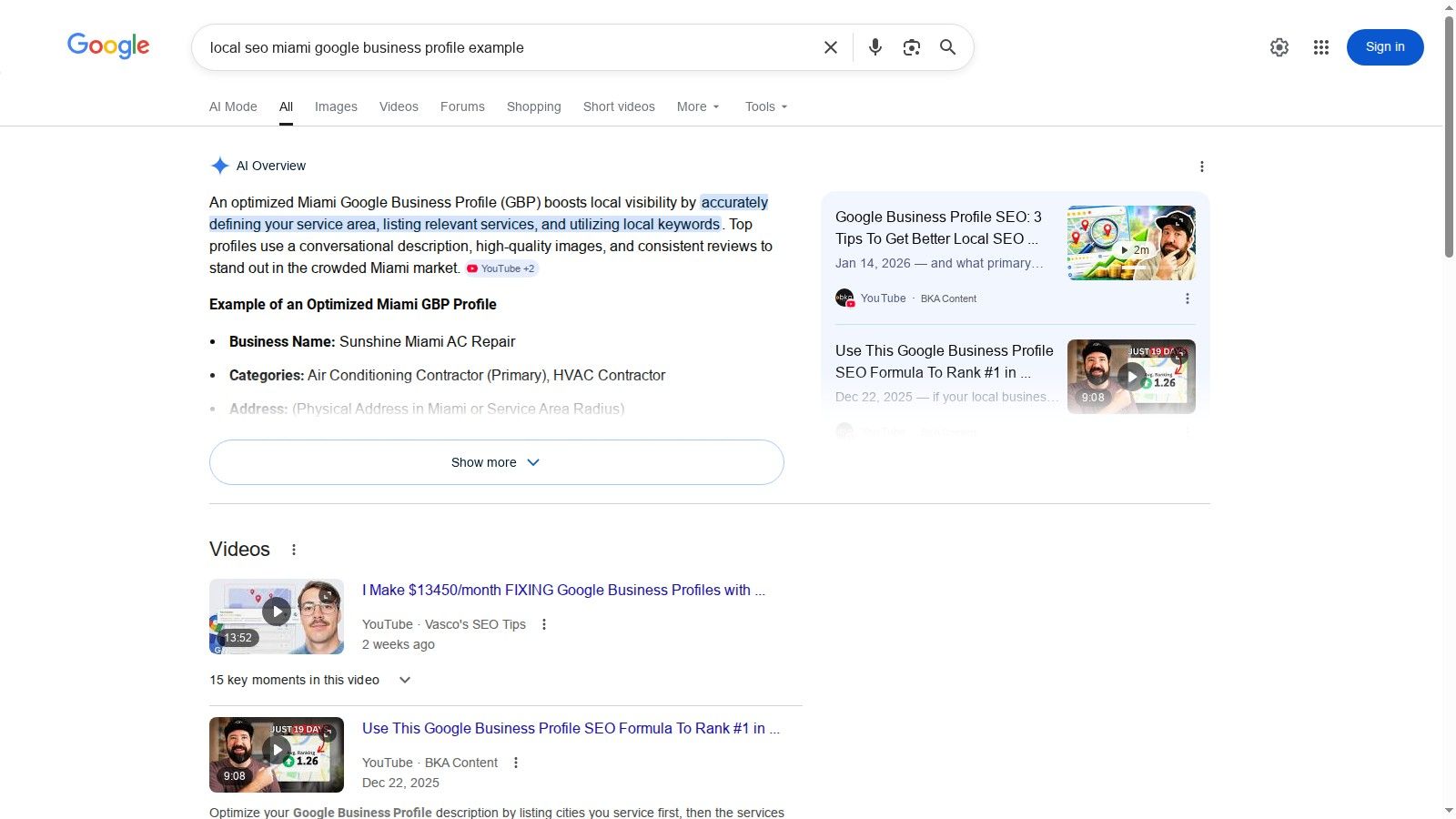
Your Google Business Profile is usually the first thing a Miami customer sees. For many service businesses, it drives more calls than the website itself. If that profile is weak, incomplete, or confusing, everything else gets harder.
A documented case study found that full Google Business Profile optimization increased views by 234% within 90 days, with broader SEO impact typically taking longer according to this local SEO case study.
Fill the profile like a buyer will read it
Most profiles fail in small ways. Wrong primary category. Thin service list. No recent photos. No posts. A generic description that could fit any business in any city.
If you run an Aventura med spa, don't stop at “Medical Spa.” Build out service entries for the treatments people search for. If you're a roofer, don't just list “roofing contractor.” Add the specific residential and repair services you want to rank for.
Focus on:
- Primary and secondary categories that match your core services
- Business description that mentions your core service areas naturally
- Services section with plain-English descriptions
- Hours and special hours kept current
- Service areas that reflect where you work
- Appointment or contact options that reduce friction
Use photos to prove local relevance
Photos do more than decorate the listing. They help customers trust you, and they give Google more context.
A contractor should upload job photos from recognizable areas like Coral Gables, Pinecrest, or Doral when appropriate. A clinic should add interior photos, provider photos, reception, treatment rooms, and exterior signage. A law office should show the building entrance, office interior, team, and branded conference space.
Avoid stock-looking uploads. Real business photos outperform polished but vague visuals because they confirm that the business exists and serves real clients locally.
A strong profile doesn't just say you're in Miami. It shows where and how you work.
Add activity that supports trust
Many profiles go stale after setup. That’s a mistake.
Use Google Posts to highlight:
- Seasonal service reminders like roof inspections before storm season
- Promotions if your industry allows them
- Educational updates such as “What to do after a slab leak”
- Neighborhood-relevant messages tied to areas you serve
Preload Q&A with common buyer questions. A clinic can answer insurance and appointment questions. A contractor can answer permit, cleanup, or emergency-response questions. A law firm can clarify consultation topics.
Later in the buying cycle, a short walkthrough helps. This video gives useful context on how profile optimization fits into local visibility:
Fix the website signals connected to the profile
A Google Business Profile doesn't work in isolation. The landing page it points to has to reinforce the same story.
Common fixes include:
- Page speed improvements
- Mobile-first design
- Local schema markup
- Secure browsing
- Consistent name, address, and phone details
One practical issue shows up constantly. Businesses let small NAP differences pile up between the profile, website footer, contact page, and directories. Those inconsistencies weaken local trust.
If you want your profile to perform, make the profile and the website read like they belong to the same business. Same services. Same geography. Same contact data. Same brand language.
Building Local Trust with Citations and Reviews
Trust is a ranking factor in practice, even when business owners don't label it that way. Google wants confirmation. Customers want reassurance. Citations and reviews do both jobs when they're handled properly.
The problem is that most advice stops at “get listed” and “get more reviews.” That’s not enough. Guidance often ignores how to recover from negative feedback or how to build momentum when a profile starts from zero, even though review sentiment and review velocity influence local pack rankings, as noted in this discussion of local review strategy gaps.
Clean up your citations before chasing more links
A citation is any place your business name, address, phone number, and core details appear online. If your office suite number is missing on one listing, your old phone number appears on another, and a third directory shows outdated hours, you're creating doubt.
For Miami businesses, the first pass should be boring and thorough:
- Check your exact business name everywhere
- Match your phone number across every major listing
- Use one address format consistently
- Remove duplicates when possible
- Update old categories if your business has changed
For service-area businesses, be careful with address presentation. If you don't receive customers at the location, don't force storefront-style details where they don't belong.
If you need structured help with the foundational listing work, local citation building services are one way businesses handle cleanup at scale.
Review strategy has to be operational
Reviews don't happen because you “care about reputation.” They happen because your team asks at the right moment.
Good moments include:
- Right after a successful job completion for contractors
- After a resolved case milestone for law firms, where ethical rules allow it
- After a positive visit outcome for clinics and practices
Bad moments include asking too early, asking everyone with the same script, or making the process hard on mobile.
Use a simple workflow:
- Finish the job or visit.
- Confirm the client is satisfied.
- Send one direct review request with a clean link.
- Follow up once if needed.
- Reply to every review.
Use response templates that sound human
A five-star review response doesn't need to be clever. It needs to reinforce trust.
Thanks for choosing us, [Name]. We appreciate your feedback and are glad we could help with your roof repair in Coral Gables. If you ever need anything else, our team is here.
A negative review needs a different goal. You're not trying to win the argument. You're showing future customers that you respond like a professional.
Try this:
Thank you for the feedback. We're sorry your experience didn't meet expectations. We take concerns about communication and wait times seriously, and we'd like the chance to review what happened. Please contact our office directly so we can address it properly.
For industry-specific complaints, be direct. A clinic can address scheduling and wait times. A contractor can address cleanup, delays, or job-site communication. A law firm can address responsiveness without discussing confidential details.
The businesses that recover fastest from bad reviews are usually the ones that already have a response process. They don't improvise after damage happens.
Winning Beyond Your Address Neighborhood and Multilingual SEO
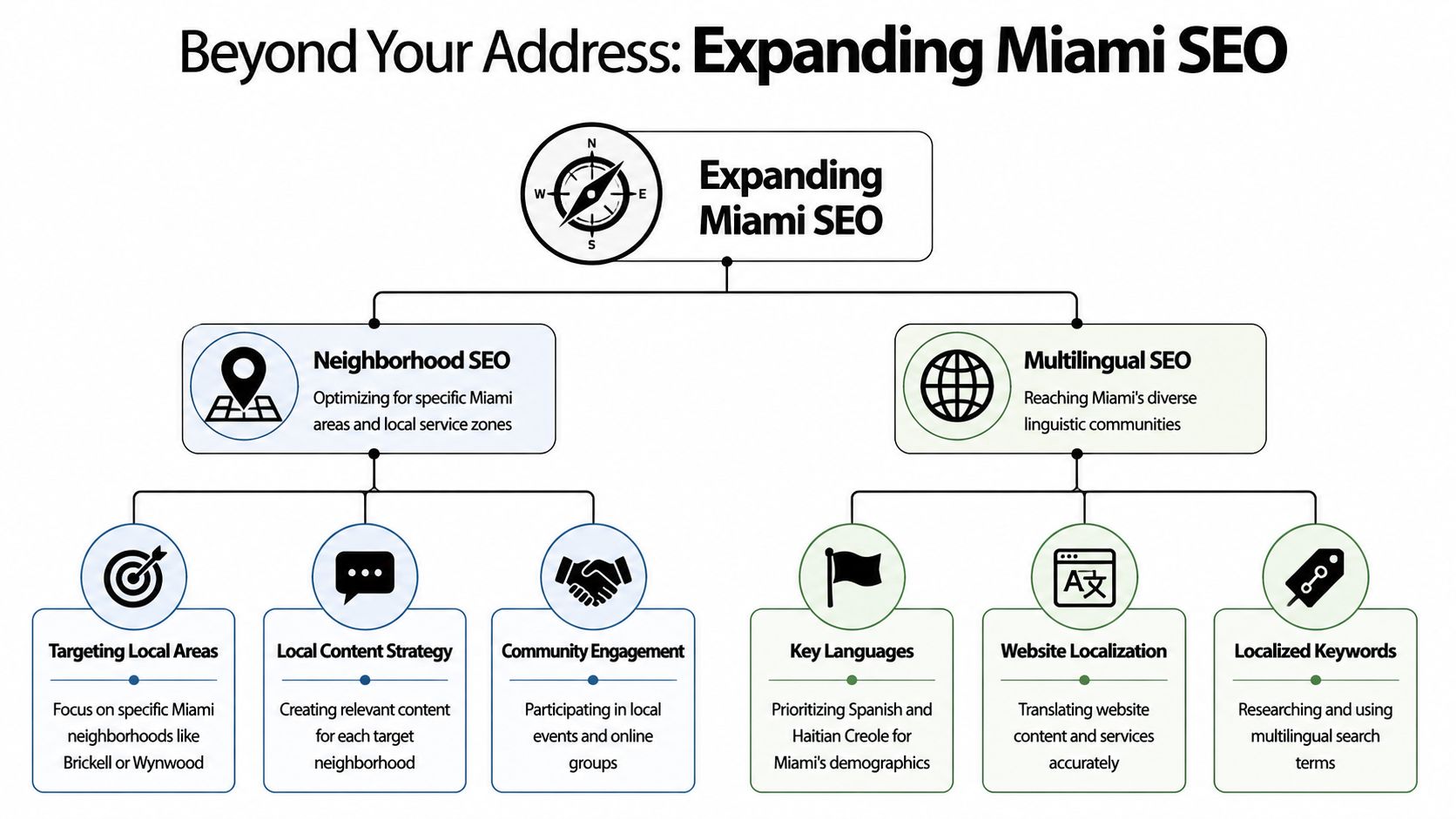
Most local SEO advice assumes one office, one city, and one simple radius around that address. That isn't how many Miami businesses operate. Contractors, clinics, and professional service firms often work across multiple neighborhoods and city pockets that search very differently.
That gap is common in existing guidance. Much of the local SEO content aimed at Florida businesses treats the problem as single-city optimization, even though service businesses need distinct signals across places they serve, as discussed in this analysis of the multi-location strategy gap.
Build neighborhood pages that deserve to exist
A page for “AC repair in Miami” isn't enough if your real market includes Doral, Kendall, Pinecrest, Brickell, and Aventura.
Each location page should have:
- A unique service angle tied to that area
- Copy that reflects the neighborhood, not just the city name swapped out
- Examples of jobs, case types, or service patterns common in that area
- Internal links to related services and nearby areas
- A strong call to action that matches the visitor's likely intent
A weak location page says:
“Need a plumber in Kendall? We are the best plumber in Kendall. Call for plumbing in Kendall.”
A useful location page says:
“Homeowners in Kendall often call about water heater failures, slab leaks, and kitchen drain backups. Our team handles residential plumbing across the Kendall area, with service suited for older homes and newer remodels.”
Don't create doorway pages
If every page says the same thing with a different neighborhood inserted, Google can treat those pages as low-value. Customers will too.
Good service-area pages answer:
- What do you do in this area specifically?
- Why do people in this area call you?
- What proof can you show?
- What nearby landmarks, neighborhoods, or service conditions make the page feel real?
The page should help a human from that neighborhood feel understood. If it only exists for a keyword, it usually reads like it.
Multilingual SEO matters in Miami
Many businesses in Miami lose qualified leads because they only publish English pages while their audience searches in Spanish. In some cases, bilingual review responses and bilingual FAQ content also help reduce friction before the first call.
That doesn't mean machine-translating the whole site and calling it done.
Use multilingual content when:
- Your staff can serve that audience
- Customers regularly ask questions in another language
- Search behavior in your market supports it
- You can maintain the translated pages properly
Strong examples include:
- An immigration attorney with English and Spanish service pages
- A clinic with Spanish FAQs about appointments, insurance, and forms
- A home service company with Spanish pages for high-demand services in Hialeah or Doral
Keep the translations natural. “Plomero en Doral” may reflect real search behavior, but the page still needs native-sounding copy, not awkward literal translation. If the language feels off, trust drops fast.
Earning Local Links and Digital PR
Citations tell search engines that your business exists. Local links and mentions tell them your business matters.
A lot of businesses waste time buying low-grade links from irrelevant sites. Those rarely help much in local markets. A single good mention from a respected Miami publication, neighborhood blog, chamber site, or relevant partner can be more valuable than a pile of junk listings.
What this looks like in real business terms
A roofing company in Miami doesn't need a random backlink from an unrelated blog. It needs local relevance.
That can come from:
- A partnership with a real estate agency on a home maintenance article
- A storm-preparedness checklist contributed to a neighborhood publication
- A sponsorship or community involvement page on a local organization website
- A quote in a business or community article about permits, repairs, or insurance issues
A law firm might contribute commentary to a local publication covering business, real estate, or community issues. A clinic might partner with a local wellness group or event. A contractor might collaborate with a property manager, HOA vendor, or home inspector.
Press releases can help if there's actual news
Most press releases are ignored because there’s no story. “We launched a website” isn't a story. “We opened a new service area, hired a specialist, launched a community program, or partnered with a local organization” can be.
If you're evaluating whether release-driven visibility fits your plan, this guide on boost SEO with press releases gives a practical breakdown of when they support search and when they don't.
Start with relationships you already have
The easiest local links often come from businesses you already know.
Make a short list:
- Referral partners
- Suppliers
- Community groups
- Industry associations
- Local event organizers
- Non-competing businesses serving the same audience
Then ask a better question than “Can you link to me?”
Ask:
- Can we create a neighborhood resource together?
- Can we publish a Q&A for homeowners, patients, or local business owners?
- Can we co-host a guide or checklist worth sharing?
For businesses that want a more structured outreach process, local link building service options can support prospecting, placement, and relevance review. The main point is strategy. Local links work best when they come from actual participation in the market you serve.
Tracking ROI and Planning Your Investment
If local SEO isn't tied to leads, calls, booked consultations, or closed jobs, it turns into a reporting exercise. Business owners don't need more charts. They need to know whether visibility is producing revenue opportunities.
Miami pricing gives a useful benchmark. Monthly SEO costs typically range from $1,000 to $5,000+, with basic local packages clustering around $1,000 to $2,500, according to this breakdown of Miami SEO pricing and outcomes. That same source cites case studies showing +664% increases in organic traffic and up to +800% in conversion rates for some campaigns. Those outcomes don't mean every business should expect identical results. They do show why serious local SEO is treated as an ongoing investment, not a one-time setup.
Metrics that matter more than vanity traffic
A local campaign should be judged by signals tied to buying intent.
Track these first:
- Map pack visibility for your priority service and neighborhood terms
- Google Business Profile calls and direction requests
- Contact form submissions from service and location pages
- Phone calls from organic search
- Qualified leads by area so you know which neighborhoods are producing work
Traffic can be useful, but raw sessions don't pay payroll. A clinic cares about appointment requests. A lawyer cares about consultations. A contractor cares about calls from the service areas that generate profitable jobs.
If reporting doesn't show where leads came from and what they were looking for, it isn't useful enough.
What timeline is realistic
The fastest gains usually come from cleanup and profile optimization. Website authority and location page performance usually take longer.
A practical timeline looks like this:
| Timeline | What usually happens |
|---|---|
| First phase | Audit, Google Business Profile fixes, citation cleanup, service-page updates |
| Early traction | Better local relevance, cleaner brand signals, more consistent presence |
| Meaningful momentum | Location pages, reviews, internal linking, and link acquisition begin compounding |
| Mature performance | Stronger rankings across multiple neighborhoods and steadier lead flow |
The pace depends on competition, site quality, and how aggressively the business invests in content, reviews, and local authority.
Sample Miami Local SEO Investment Tiers Monthly
| Tier | Typical Budget | Core Activities | Best For |
|---|---|---|---|
| Foundational local SEO | $1,000 to $2,500 | Google Business Profile optimization, citation cleanup, on-page improvements, one to two content pieces monthly | Single-location businesses and smaller firms that need core visibility |
| Growth-focused local SEO | $3,500 to $5,000+ | Ongoing content creation, technical remediation, internal linking, broader local targeting, stronger review workflows | Competitive local businesses expanding reach across multiple neighborhoods |
| Advanced local SEO | $3,500 to $7,000+ | Structured content hubs, programmatic internal linking, sustained link building, deeper technical work | Service-area businesses and firms competing in tougher search environments |
How to budget without wasting money
A roofer serving several Miami-Dade neighborhoods usually shouldn't spend like a small storefront with one narrow service category. The service-area business needs more page coverage, more review support, and better geographic targeting.
At the same time, spending more doesn't fix a weak plan. If an agency can't explain:
- what pages it's building,
- what neighborhoods it's targeting,
- how it will improve your Google Business Profile,
- how it will handle reviews and citations,
- and how it will report leads,
then the budget number doesn't matter much.
The best investment level is the one your team can sustain long enough to build local trust, not the one that looks impressive for a month.
If your business needs a practical local SEO plan that fits how service-area companies operate, Polaris Marketing Solutions offers support with Google Business Profile optimization, location-specific content, citation building, and broader local search strategy for small and mid-sized businesses. The useful next step is simple. Get clear on your baseline, your target neighborhoods, and the lead actions that matter most. Then build from there.