
You’re probably in one of these spots right now.
You run a roofing company in Cape Coral, a dental practice in Naples, a med spa in Fort Myers, or a law office serving Lee and Collier County. You do solid work. Your customers refer people. Your phone rings. But online, the bigger competitor with the cleaner feed, faster responses, and steadier review flow keeps showing up first in people’s minds.
That gap is where local social marketing matters.
Not the fluffy version. Not “post three times a week and hope.” The version that helps a Southwest Florida business become the name people recognize when they need help, ask neighbors for a recommendation, or check a business before calling. In SWFL, that often means showing up for someone in Gateway, Pelican Preserve, Cape Harbour, downtown Naples, or near HealthPark with content that feels relevant to where they live and what they need right now.
What Is Local Social Marketing Anyway
A lot of business owners hear local social marketing and think it sounds like agency jargon. It isn’t. It’s the online version of being the business people around here already know, trust, and mention to friends.
If word-of-mouth used to happen at church, little league, HOA meetings, and backyard cookouts, now it also happens on Facebook, Instagram, Google Business Profile, Nextdoor, and neighborhood group chats. People still ask, “Who do you use for AC?” They just ask it online now, and they check your page before they call.
What it looks like in practice
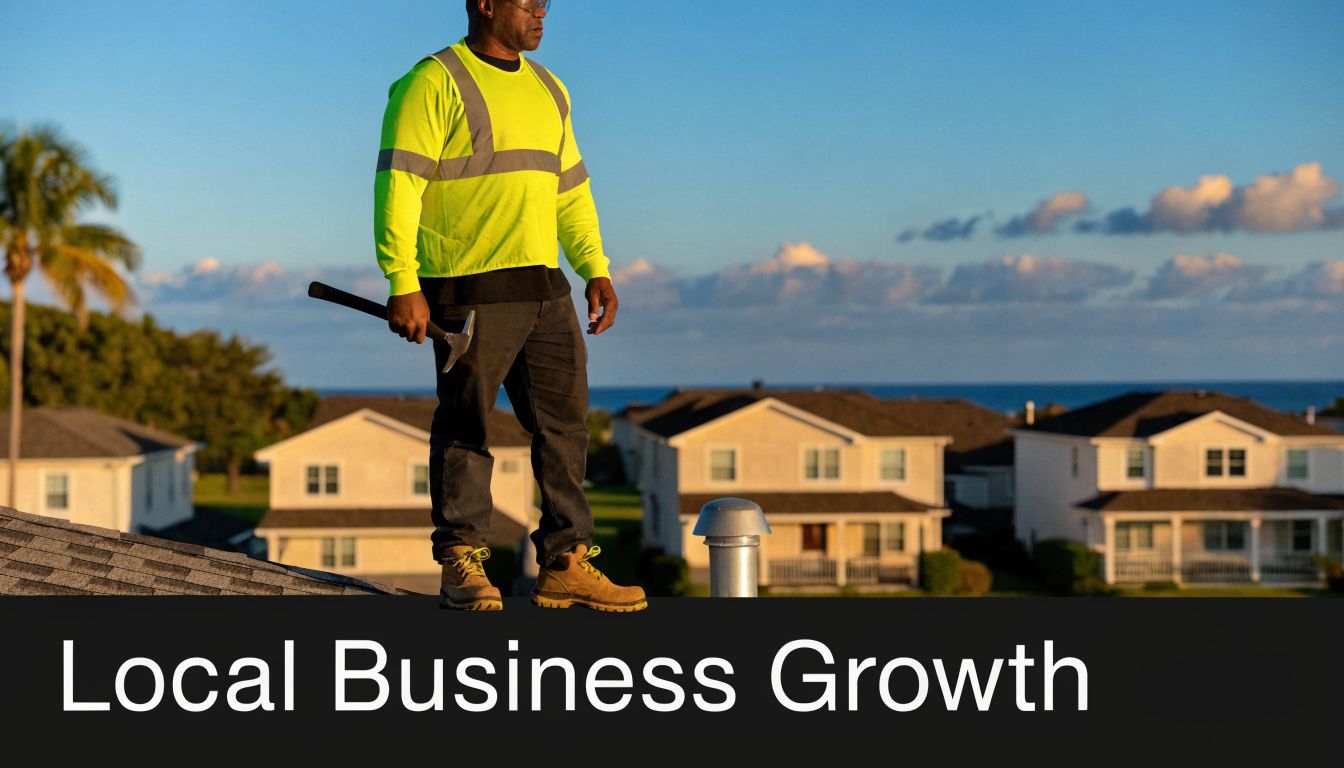
For a Cape Coral roofer, local social marketing means posting storm repair updates tied to actual neighborhoods served, responding to comments quickly, and making it easy for homeowners to click for directions, call, or message.
For a Naples dentist, it means showing the office team, answering common patient questions, highlighting community involvement, and making your social profiles feel like a real local practice instead of a stock-photo brand.
For a Fort Myers attorney, it means publishing short, useful videos about the issues people are already worried about, then distributing them where local residents spend time.
Practical rule: If your posts could be copied, pasted, and used by a business in any other city without changing a word, they’re not local enough.
What it is not
It’s not chasing random likes.
It’s not posting a generic “Happy Monday” graphic and calling that strategy.
It’s not trying to talk to all of Florida when you really serve a tighter footprint.
A good local business digital marketing guide can help frame the broader picture, but on social, the central job is simple. You want nearby customers to recognize your name, trust your reputation, and take one clear next step.
That next step might be a call, a message, a direction click, a form fill, or a visit. That’s the standard. Everything else is support.
Why Your Business Needs a Local Focus
Trying to market a local business with broad, generic social content is like putting a billboard in the middle of the Gulf and hoping someone sees it. Reach isn’t the problem for most SWFL businesses. Relevance is.
The strongest business case for local social marketing is that it tracks directly to growth. The LSM Benchmark Report found that businesses that excel in localized social marketing saw revenue growth at three times the rate of their peers, with 72% of all brand engagement on Facebook happening on local business pages and geotargeted content receiving six times more engagement than non-targeted content, according to SOCi’s report on localized social marketing.
Broad messaging wastes attention
A home service company in Fort Myers doesn’t need attention from people in Tampa. A healthcare clinic in Naples doesn’t need engagement from someone three counties away. A CPA in Cape Coral needs visibility among local residents and business owners who can book, visit, or refer.
That’s why local focus works. It lines your message up with your service area.
Think about how people buy locally:
- They check proximity: Can this company serve my address?
- They check trust: Do these people seem active, responsive, and established here?
- They check relevance: Have they worked with someone like me in my area?
If your social presence answers those questions fast, you make the short list.
Local pages do the heavy lifting
Most SWFL businesses don’t need a polished national brand voice. They need active local pages with signs of life. Fresh photos. Real comments. Timely replies. Posts tied to neighborhoods, weather, local events, and common local concerns.
That’s one reason location-based tactics keep outperforming broad awareness campaigns. If you want a useful reference on that side of the strategy, these Splash Access visitor engagement strategies show how proximity-based marketing supports local action.
A stronger local presence also improves how your whole marketing system works. Social supports reviews. Reviews support search. Search supports calls. Calls support revenue. If you want the broader local framework behind that, this guide on local marketing for small business is worth bookmarking.
Local social marketing isn’t just content distribution. It’s reputation building inside the exact geography where you need customers.
What that means in Southwest Florida
In SWFL, people respond to businesses that feel present. A post about a project near McGregor Boulevard lands differently than a generic “we serve Southwest Florida” graphic. A physician update tied to seasonal resident questions in Naples feels more useful than recycled health tips. A law firm video about storm-related claim issues in Lee County feels grounded in reality.
That local specificity is the advantage. Bigger competitors often struggle to sound human at the neighborhood level. Smaller businesses can win there.
Choosing the Right Channels for SWFL
Most businesses don’t need more platforms. They need the right ones.
Research shows 90% of local businesses use social media, 58% of consumers discover new businesses there first, and 63% plan to visit a business after a positive social interaction, according to Synup’s social media marketing statistics. That doesn’t mean you should be everywhere. It means you should be deliberate about where you show up.
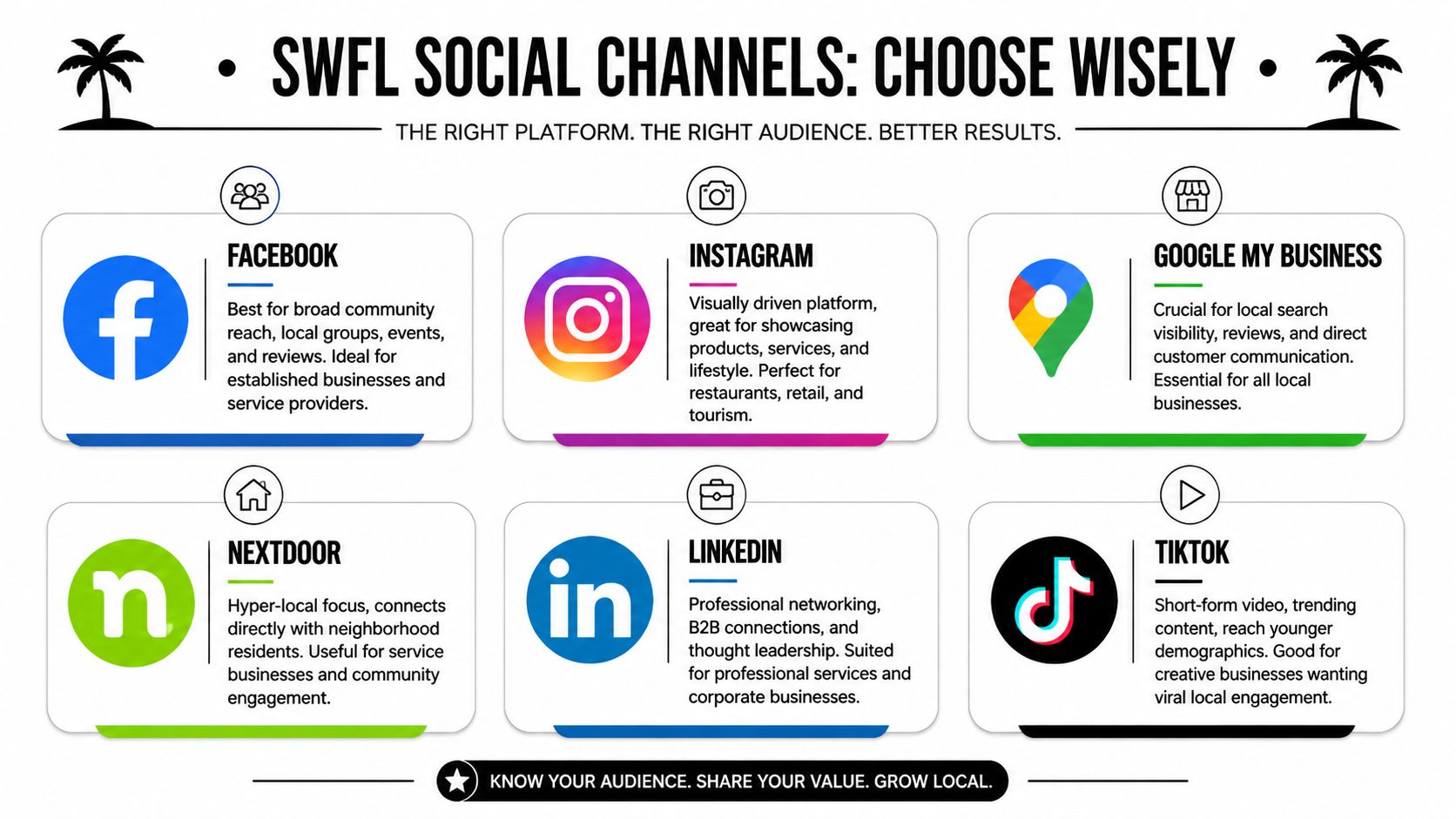
Facebook and Google Business Profile
For many SWFL service businesses, these are the foundation.
Facebook still matters because local communities use it for recommendations, events, neighborhood groups, and business page checks. If someone in Fort Myers asks for a plumber or pediatric dentist, Facebook is often one of the first places the conversation happens.
Google Business Profile isn’t a social platform in the traditional sense, but it behaves like one for local buying decisions. People see your photos, reviews, updates, questions, and calls-to-action in a moment when they’re ready to act.
Best fit:
- Home services: HVAC, roofing, plumbing, cleaning, paving
- Healthcare: dental, urgent care, med spa, chiropractic
- Professional services: legal, accounting, insurance
What works:
- Before-and-after photos
- Local service updates
- Review responses
- Questions answered in plain language
- Staff and office visibility
What doesn’t:
- Infrequent posting
- Stock graphics with no location tie
- Ignoring comments and messages
Instagram and Nextdoor
These are different tools for different trust signals.
Instagram works when visual proof matters. Think pavers, landscaping, med spas, restaurants, boutiques, cosmetic dentistry, waterfront real estate, and hospitality-heavy businesses in Naples and Bonita Springs. If the work looks good, Instagram helps.
Nextdoor is better for hyper-local trust. It’s not glamorous, but it’s practical. People use it to ask neighbors who they trust for pressure washing, appliance repair, lawn care, elder care, and legal referrals.
If your business grows from neighborhood recommendations, Nextdoor deserves more attention than many owners give it.
Use Instagram when:
- Your service has a visible transformation
- Your audience cares about aesthetics
- You can post Stories, Reels, and project updates consistently
Use Nextdoor when:
- Your service depends on trust and proximity
- You serve specific neighborhoods or gated communities
- Referrals from nearby residents drive calls
LinkedIn and TikTok
These two get misused a lot.
LinkedIn is strong for professional credibility. It’s a smart fit for attorneys, CPAs, consultants, wealth advisors, commercial contractors, and healthcare leaders who want referral relationships or B2B visibility. It’s less about neighborhood chatter and more about authority.
TikTok can work for local businesses, but only if you can produce short, natural video content without looking stiff. It’s useful for businesses with personality, visible work, or educational demonstrations. A Naples boutique, a cosmetic practice, or a home improvement company with clean before-and-after transformations can use it well. A firm that won’t commit to video usually shouldn’t force it.
A simple channel decision guide
| Business type | Best starting channels | Why |
|---|---|---|
| HVAC in Fort Myers | Google Business Profile, Facebook, Nextdoor | Urgent need, local trust, quick calls |
| Dentist in Naples | Google Business Profile, Facebook, Instagram | Reviews, office familiarity, visual trust |
| Law firm in Cape Coral | Google Business Profile, Facebook, LinkedIn | Credibility, education, local visibility |
| Boutique in Naples | Instagram, Facebook, TikTok | Visual product discovery |
| Med spa in Estero | Instagram, Facebook, Google Business Profile | Social proof, visual results, local research |
If your team needs help staying organized once you choose your channels, these social media management tools for small businesses can make scheduling, approvals, and response time more manageable.
Crafting Content That Connects with Your Community
Generic content is easy to spot. A local audience can tell when a business is posting because “we should probably put something up today.” They can also tell when a business is part of the community.
That difference shows in the details.
Start with places, people, and problems
A paving company in Estero shouldn’t post “Another happy customer.” It should post a short driveway time-lapse, mention the community or nearby area, and explain what the homeowner wanted fixed.
A Naples attorney shouldn’t post legal trivia. A better post is a short video answering a timely question local residents are asking, especially when weather, insurance, property, or seasonal residency issues are top of mind.
A healthcare clinic in Fort Myers can make a routine team post feel local by tying it to real life. Highlight a staff anniversary, mention their favorite downtown lunch spot, or show the team supporting a community event.
Content ideas you can use tomorrow
Here are formats that work well because they feel grounded:
- Neighborhood job spotlight: “Completed this tile roof repair near Whiskey Creek. Homeowner called after spotting a leak near the lanai.”
- Seasonal advisory: “Hurricane prep checklist for homeowners in Cape Coral before the next storm watch.”
- Staff feature: “Meet the hygienist patients always ask for by name.”
- Community tie-in: “We’re set up this weekend around the Edison Festival of Light route. Stop by and say hello.”
- Quick explainer video: “What to do in the first hour after water damage.”
- Client-generated proof: Repost a customer Story showing the finished project or their visit.
A good local post answers one of three things. Where you work, who you help, or what local problem you solve.
Make the content feel lived-in
Use geotags. Mention neighborhoods naturally. Show trucks, uniforms, office spaces, job sites, waiting rooms, or storefronts people will recognize. If your office is near Coconut Point or downtown Fort Myers, say it when it matters.
That doesn’t mean stuffing every caption with place names. It means giving enough local texture that the post feels real.
Short-form video usually helps here. So do customer photos, team clips, and simple talking-head updates filmed on a phone. If you want fresh ideas for formats and repurposing, these social content strategies can help without pushing you into generic content calendars.
Keep your voice practical
For SWFL businesses, the best content often sounds like a competent local pro talking to a customer. Not a brand manager. Not a trend chaser.
That means:
- Use plain English
- Skip hype words
- Explain what happened and what people should do next
- Respond in a tone you’d use in the office or on a job site
If a post wouldn’t sound normal coming out of your service manager’s mouth or your front desk coordinator’s mouth, rewrite it.
Turning Reviews and Ads into Local Revenue
Reviews and local ads work best when they support each other. Reviews build trust before the click. Ads create the opportunity for the click.
Start with reviews, because they influence nearly every local buying decision that follows.
Turn review requests into a routine
Most businesses ask for reviews too randomly. The right time is right after a clear win. The AC is working again. The case was handled well. The patient had a good experience. The project is complete and the client is relieved.
Keep the ask simple:
- In person: “If you don’t mind, would you leave us a quick review and mention the service we completed?”
- By text: “Thanks again for choosing us. If you have a minute, we’d appreciate a review about your experience.”
- By email: “We’re glad we could help. Your feedback helps other local customers feel confident reaching out.”
The best review requests are specific. Ask customers to mention the service, location, or staff member if appropriate. That gives future prospects more useful context.
Respond in public like future customers are watching
Because they are.
A good response to a positive review reinforces what the business is known for. A good response to a negative review shows calm, accountability, and professionalism. Don’t argue in public. Don’t sound copied and pasted.
For example:
- Positive review response: Thank them, mention the service, and express appreciation for the local trust.
- Negative review response: Acknowledge the issue, invite an offline conversation, and keep the tone measured.
The response isn’t only for the reviewer. It’s for the next person comparing you with two other businesses.
Use local ads with tighter geography
The paid side gets more efficient when you stop targeting too broadly. Location-specific social content with geotags and local hashtags can boost check-ins and user-generated content by up to 50%, and when paired with geofenced ads targeting a 1 to 5 mile radius, optimized campaigns can achieve a 15% to 25% conversion rate from digital interaction to offline visit or lead, according to Rio SEO’s local marketing metrics guide.
That matters in SWFL because service areas are often tighter than owners admit. A roofer may technically serve all of Lee County, but a campaign focused on a specific part of Cape Coral after a storm often produces stronger lead quality than a county-wide message. A clinic near south Fort Myers may get better results speaking directly to nearby residents than trying to cover the entire region.
A simple local ad setup looks like this:
- Audience area: Tight radius around the office, store, or active project zone
- Creative: Real photo or short video, not a generic stock image
- Message: One local problem, one offer, one action
- CTA: Call now, get directions, send message, request quote
This is a useful refresher before you launch:
What good local ads actually say
A Fort Myers HVAC ad might say:
“AC struggling in South Fort Myers? Book a tune-up before the next heat wave.”
A Cape Coral roofing ad might say:
“Roof leak after recent storms? Serving homeowners in Cape Coral with fast inspections.”
A Naples dental ad might say:
“Looking for a family dentist near downtown Naples? Meet the team and schedule your first visit.”
Those aren’t clever. They’re useful. Useful usually wins.
Local Social Marketing in Action
The easiest way to build momentum is to run a simple campaign that uses the same local message across several channels. Not identical copy everywhere. One core idea adapted to each platform.
A Fort Myers HVAC tune-up campaign
Say an HVAC company wants more spring tune-up appointments in Fort Myers.
On Facebook, the business runs a short local video with a technician speaking plainly about systems struggling before summer heat ramps up. The copy mentions the service area and offers a simple next step.
On Google Business Profile, the company posts an update with the same seasonal angle, a clean image, and a booking prompt.
On Nextdoor, the post sounds more neighborly. Less ad copy, more practical reminder: local homeowners are getting systems checked now to avoid breakdowns later.
On Instagram, the content shifts visual. Technician on-site. Short Reel. Thermostat close-up. Before-and-after maintenance clip. Same offer, different presentation.
That’s how a local campaign starts to feel consistent without becoming repetitive.
A healthcare and legal example
A Fort Myers clinic could run a back-to-school wellness campaign with team photos, FAQ videos, patient-friendly reminders, and local office updates timed to when families are getting organized.
A Cape Coral law office could build a short campaign around storm-related insurance questions. One video answers a common concern. One post highlights a checklist. One Facebook update invites people to message the office with a specific issue. One LinkedIn post leans more professional for referral partners.
Strong local social marketing campaigns don’t rely on one hero post. They repeat the same useful point across the channels where trust gets built.
Sample local social campaign ideas for SWFL businesses
| Industry (SWFL Focus) | Campaign Idea | Key Platforms | Primary Goal |
|---|---|---|---|
| Home services in Fort Myers and Cape Coral | Seasonal service reminder tied to weather, neighborhood service areas, and recent project photos | Facebook, Google Business Profile, Nextdoor, Instagram | Lead generation |
| Legal services in Cape Coral and Naples | Short educational video series answering one urgent local legal question at a time | Facebook, LinkedIn, Google Business Profile | Trust and consultation requests |
| Healthcare practices in Fort Myers and Naples | Team-centered campaign with patient FAQs, office familiarity posts, and local community visibility | Facebook, Instagram, Google Business Profile | New patient inquiries |
| Retail and boutique businesses in Naples | Event-driven product showcase tied to local shopping periods and in-store visits | Instagram, Facebook, TikTok | Foot traffic |
| Professional services across SWFL | Authority campaign using local business insights, client education, and referral-friendly updates | LinkedIn, Facebook, Google Business Profile | Brand credibility and lead nurturing |
The point isn’t to copy these exactly. It’s to build campaigns around one local need, one audience, and one next step.
Measuring Success and Budgeting for Growth
If you can’t tell whether your local social marketing is producing calls, visits, or leads, you’re not running a strategy. You’re posting.
For small businesses, tracking ROI can stay simple. Focus on shares, direct messages, and clicks on “directions” or “call now” buttons, then connect those actions with website analytics to see how social engagement turns into leads, as explained in this guide on how to measure marketing ROI and supported by Lightspeed’s local marketing article.
What to track first
Don’t obsess over vanity metrics before you measure buyer signals.
Watch for:
- Calls: Which posts or ads triggered them
- Messages: Especially quote requests and appointment questions
- Direction clicks: Strong signal for clinics, retail, and office-based services
- Form fills: Use simple tracking links where possible
- Review volume and response activity: Helps explain trust shifts over time
A practical budget mindset
If you’re just starting, spend time before you spend heavily on ads. Clean up your profiles. Fix your branding. Add current photos. Reply to reviews. Build a small library of local content. Then put paid support behind the messages that already get a response.
If you’re ready to grow, don’t spread budget evenly across every platform. Put more behind the channel that produces action. For one business, that’s Facebook messages. For another, it’s Google direction clicks. For another, it’s Instagram DMs.
Keep the decision process simple
Ask these questions every month:
- Which channel produced the most real customer conversations?
- Which posts led to calls, messages, or visits?
- Which local themes got a response?
- Which platform took time but gave nothing back?
That review is what keeps local social marketing from turning into busywork. The businesses that do this well don’t just post more. They learn faster.
If your business in Fort Myers, Cape Coral, Estero, Bonita Springs, or Naples needs a clearer local social marketing plan, Polaris Marketing Solutions can help you connect social media, local SEO, paid ads, and conversion tracking into one practical system that produces measurable growth.