
A lot of Southwest Florida business owners are in the same spot right now. You do solid work, your customers are happy, and referrals still come in, but when someone in Fort Myers, Cape Coral, Estero, or Naples searches for your service, your company is hard to find. Meanwhile, a competitor with a weaker reputation shows up in Google Maps, Yelp, Apple Maps, and every other place customers look before they call.
That gap usually isn’t caused by one big problem. It’s caused by dozens of small visibility issues. Wrong phone numbers. Duplicate listings. Old addresses. Missing profiles. A half-finished Google Business Profile. No presence in trusted business directories that help search engines verify who you are and where you serve.
A good directory submission service fixes that foundation. It doesn’t replace your website, reviews, or Google Business Profile. It supports all of them. If you’re trying to get more qualified local leads in Southwest Florida, this is one of the first things that has to be right.
Your Business Needs to Be Found in Southwest Florida
A Fort Myers roofer gets this fast. During storm season, people aren’t doing deep research. They search on their phones, tap a few listings, compare reviews, and call the company that looks legitimate and local. If your business information is missing or inconsistent across the web, you lose that call before your estimator ever gets a chance.
The same thing happens for plumbers in Cape Coral, med spas in Naples, lawyers in Bonita Springs, and HVAC companies serving North Fort Myers. Searchers often discover businesses through maps, local directories, and third-party listings before they ever visit the company’s website. That’s why directory visibility isn’t a side task. It’s part of the sales path.
Why this matters in local search
Local SEO has a lot of moving parts, but directory presence still carries real weight. Local directories contribute to 31% of Google’s local ranking factors, according to directory submission statistics compiled by SEO Sandwitch. For a Southwest Florida business, that means your listings aren’t just citations sitting around the internet. They help confirm your location, category, and legitimacy.
If you’ve already been working through broader effective local SEO strategies, directory cleanup and submission belongs near the top of the checklist. It’s one of the few tasks that improves both search visibility and customer trust at the same time.
What it looks like in the real world
Here’s a common local scenario:
- A cleaning company shows one phone number on its website, another on Yelp, and an old tracking number on a chamber listing.
- A law firm moved suites last year, but an outdated listing still sends prospects to the wrong office.
- An HVAC contractor has a strong Google profile, but no presence on major supporting directories, so competitors look more established across the web.
Practical rule: If a customer can find three different versions of your business details in three minutes, Google can too.
For Southwest Florida businesses, visibility is regional and fragmented. A customer in Naples may use different platforms than one in Cape Coral. Seasonal residents may rely on Apple Maps. Longtime locals might trust chamber directories or BBB. Homeowners comparing contractors may check Angi, Yelp, and Google in the same session.
That’s why the goal isn’t to get listed everywhere. The goal is to be listed correctly in the places your market uses.
What Are Citations and Why Do They Matter for Local SEO
A citation is any online mention of your business’s name, address, and phone number, often called NAP. A directory submission service places or fixes those details on business listing platforms so search engines and customers keep seeing the same information everywhere.
Consider it the modern version of making sure your business is listed the same way in every phone book, map, and local business guide in town. If one listing says “ABC Plumbing LLC,” another says “ABC Plumbing of SWFL,” and a third has an old Cape Coral address, that inconsistency creates friction.

NAP consistency is the core issue
Search engines want to trust the data they show. If they keep finding mismatched business details, they have less confidence in which version is correct. That can affect how often your business appears in local search results.
According to Yext’s overview of directory submission and listing accuracy, inconsistent listings can reduce a business's appearance in the local search pack by up to 30-50%. That’s a serious problem for any business that relies on local intent searches.
Here’s where contractors get hurt most:
- Old addresses send customers to the wrong office or service area hub.
- Tracking numbers left on old listings split your citation signals.
- Different business names across directories weaken brand consistency.
- Duplicate profiles compete with each other instead of strengthening one clear identity.
A Cape Coral electrician can feel this directly. A homeowner finds an old listing, calls a dead number, gets no answer, and moves on to the next company. That lost lead never shows up in your CRM because the call never reached you.
What a citation includes beyond NAP
Good directory submissions usually go beyond basic contact data. They also include:
- Business category so platforms know whether you’re a roofer, dentist, law office, or med spa
- Service details such as emergency service, financing, or specialties
- Hours and holiday updates so customers don’t show up or call at the wrong time
- Photos and branding to make the listing look real and current
Those details matter because customers use them to decide whether to click or call.
A quick explainer helps if your team needs to understand the basics before cleanup starts:
A citation doesn’t need to send huge traffic on its own to be useful. Sometimes its main job is to confirm that your business information is accurate wherever people and search engines look.
If you remember one thing, remember this: a directory submission service is really a trust-building service. It creates a cleaner, more consistent business footprint online.
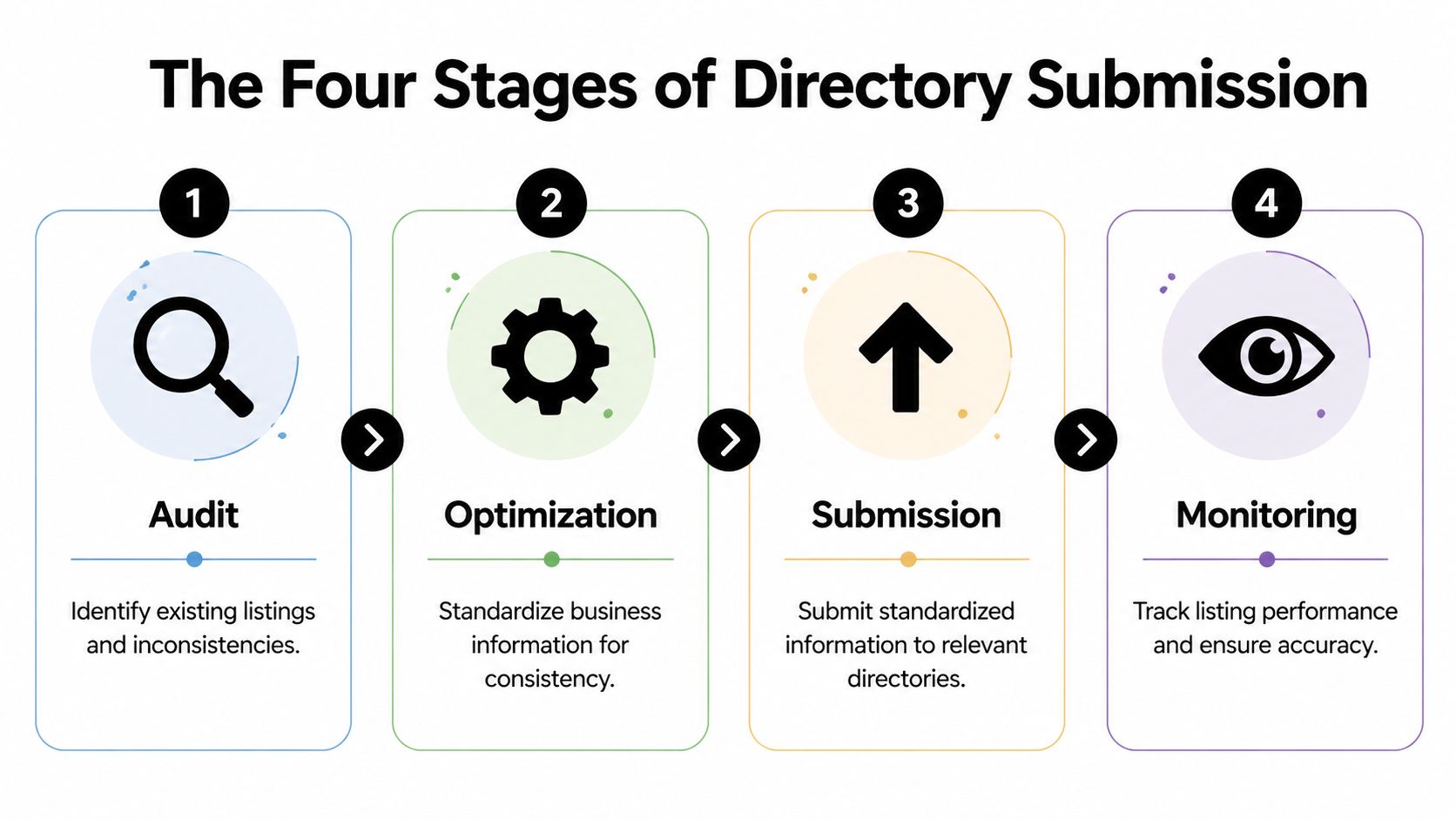
The Four Stages of a Professional Directory Submission Campaign
A proper campaign isn’t “submit your website to a bunch of directories and hope for the best.” That approach caused problems years ago, and it still does when low-quality vendors use it today. A professional process is controlled, selective, and built around accuracy.
Stage one and two
1. Audit
Start by finding what already exists. That includes correct listings, outdated profiles, duplicate entries, and business mentions you may not even know about.
For a Naples law office, the audit might reveal:
- an old suite number on Yelp
- a duplicate Apple Maps result
- a chamber listing with an abbreviated firm name
- a stale phone number on an industry directory
Without the audit, you’re building on top of bad data.
2. Cleanup and optimization
Once the bad listings are found, they need to be corrected, claimed, merged, or removed. Many DIY efforts frequently stall out because each platform has its own process, login requirements, and verification steps.
Cleanup also means setting a single source of truth for your business details. One exact business name. One primary phone number. One official address format. One website URL. A defined list of categories and services.
Field advice: Write your official NAP exactly once in a shared document before you touch any listing. That prevents your own team from creating new inconsistencies during cleanup.
Stage three and four
3. Submission to quality directories
After cleanup, the campaign adds missing listings on relevant platforms. For a Fort Myers contractor, that may include major mapping platforms, trusted business directories, local chambers, and industry-specific sites where homeowners compare providers.
This stage is not about volume for the sake of volume. It’s about choosing directories that make sense for your location and industry.
4. Monitoring and maintenance
Listings drift over time. Data aggregators update records. Platforms create duplicates. Staff members change hours. Businesses move offices or add tracking lines. Monitoring catches those changes before they hurt visibility.
A good maintenance routine includes:
- Checking core listings regularly for edits or duplicates
- Updating hours quickly after seasonal or holiday changes
- Reviewing customer-facing details like services, photos, and business descriptions
- Watching for reappearing errors from old data sources
The work doesn’t end after the first round of submissions. It shifts into maintenance.
What good campaign management looks like
A contractor shouldn’t need to guess whether the job was done right. A real directory submission service should be able to show what was found, what was fixed, where the business was submitted, and what still needs follow-up.
That transparency matters because local SEO problems are often cumulative. One wrong listing rarely kills performance. Fifty weak or conflicting ones can.
DIY Submissions vs Hiring an Agency
Some businesses should handle listings themselves. Others shouldn’t. The right choice depends on how much time you have, how many existing errors are out there, and whether someone on your team can manage the details without creating more inconsistencies.
For a brand-new one-location business with a simple setup, DIY can work. For an established contractor with old addresses, call tracking leftovers, duplicate map listings, and multiple service areas, the project gets complicated fast.
The real trade-off
DIY is like handling your own business taxes. You can do it. But if you miss something important, the cost shows up later.
A professional usually works faster because they already know the platforms, categories, verification patterns, and cleanup order. That matters when listings are spread across local directories, mapping apps, industry platforms, and old data sources.
According to SubmitShop’s data on manual directory submission, manual directory submission services show approval rates of 80-90% compared to 50% for bots, and expert-handled submissions can potentially boost domain authority by 5-15 points in 3-6 months. The useful takeaway isn’t just the numbers. It’s that manual, selective work outperforms bulk automation.
DIY vs Professional Directory Submission
| Factor | DIY Approach | Professional Service |
|---|---|---|
| Time | Takes owner or staff time away from sales, scheduling, and operations | Frees your team to focus on running the business |
| Learning curve | You have to learn each platform’s rules and verification process | Process is already established and repeatable |
| Accuracy | Easy to create variations in business name, phone, or category | Better control over consistency across listings |
| Cleanup ability | Harder when duplicates and old listings already exist | Better suited for audits, suppression, and correction work |
| Submission quality | Often limited to the directories you already know | Usually broader and more strategic across local and niche sites |
| Reporting | Can be informal or scattered | Should include tracked work and visible status updates |
When DIY makes sense
DIY is reasonable if:
- You only need the basics like Google Business Profile, Yelp, Apple Maps, and a few local listings
- Your business information has never changed and you don’t have duplicate issues
- You or a staff member can stay organized with logins, screenshots, and follow-ups
When hiring makes more sense
An agency is usually the better path when:
- You’ve rebranded, moved, or changed phone numbers
- You serve multiple Southwest Florida cities
- You already suspect duplicate listings
- You want cleanup plus ongoing maintenance
If that’s the situation, a specialized citations cleanup service is more useful than a cheap “submit to hundreds of directories” package. The expensive mistake isn’t paying for help. It’s paying for the wrong kind of help.
Essential Local Directories for a Southwest Florida Business
Most businesses don’t need every directory on the internet. They need the right mix of core platforms, local authority sites, and industry-specific listings that match how people in Southwest Florida search.
That mix looks a little different for a Naples attorney than it does for a Cape Coral pool company. Still, there’s a practical shortlist every local business should evaluate.

Start with the core platforms
These are the listings I’d treat as essential for most Southwest Florida businesses:
- Google Business Profile because it anchors Maps visibility and branded local discovery
- Apple Maps because many mobile users rely on it without thinking about it
- Yelp because customers still use it heavily for local comparison, especially in service and hospitality-adjacent searches
- BBB because it adds credibility for professional and home service businesses
- Angi for contractors and home service categories where comparison shopping is common
For Yelp in particular, presentation matters. If you want a cleaner view of how businesses showcase social proof there, Testimonial.to's Yelp features are worth reviewing for ideas on how reputation content can support listing performance.
Add chambers and local business directories
Southwest Florida has strong local business ecosystems. Chamber listings can reinforce location relevance and help customers verify that you’re active in the area.
Good places to check include:
- Greater Fort Myers Chamber of Commerce
- Cape Coral Chamber of Commerce
- Greater Naples Chamber
- Bonita Springs Area Chamber
- Estero and regional business associations
These aren’t flashy listings. They’re useful because they support local trust and geographic relevance.
Local rule of thumb: If a directory helps a real Fort Myers or Naples resident confirm your business is legitimate, it’s worth evaluating.
Match the directory to the business type
A one-size-fits-all directory list is where many campaigns go off track. Better examples:
- Roofers and HVAC companies should prioritize home service platforms, mapping apps, local chambers, and contractor-relevant directories.
- Law firms should focus on legal directories, local business listings, chambers, and review platforms.
- Medical practices should prioritize healthcare directories, map listings, and major trust platforms where patients verify hours and locations.
If you need a better starting point than a random spreadsheet, a curated list of local listing sites for citation building is more useful than chasing generic “top 500 directories” lists.
The right list is always smaller and more relevant than people expect. That’s a good thing. It keeps your effort focused on listings that can help you win local business in Fort Myers, Cape Coral, Naples, and the surrounding service areas.
How to Choose the Right Directory Submission Service
The wrong service can make your local SEO worse. That’s the part many business owners don’t hear until after they’ve paid for a cheap package and their listings are scattered across weak directories with mismatched details.
The core risk isn’t just wasted budget. According to SERP Maestro’s discussion of directory submission risks, low-quality directory submission services can create spammy links that raise Google penalty concerns and spread inconsistent NAP data that erodes local rankings. That’s why vendor screening matters.
Questions to ask before you hire anyone
Use this checklist before signing up for any directory submission service:
Do you focus on quality or quantity
If the pitch centers on submitting your site to hundreds or thousands of directories, that’s a warning sign.Will you provide a full report of what was submitted or corrected
You should be able to see where your business was listed, updated, claimed, or flagged.Do I keep ownership of my listings
Your business should control the important profiles, not get locked out because a vendor used their own email everywhere.How do you handle duplicates and old data
Submission without cleanup is incomplete work.Do you customize categories and business descriptions by platform
Copy-paste submissions across every site usually mean low care and low relevance.
What a weak service sounds like
Bad vendors usually sell speed and volume. They talk about “instant backlinks,” “mass submission,” or “hundreds of directories” without naming the specific platforms that matter to your market.
They also tend to skip the messy work:
- cleaning old citations
- suppressing duplicates
- standardizing your NAP
- checking whether a listing is worth having in the first place
That’s how a Fort Myers contractor ends up listed on irrelevant directories while still missing or misconfigured on the few platforms customers use.
What a better service looks like
A stronger provider usually does the opposite:
- Starts with an audit
- Explains which listings matter for your industry
- Uses manual review for sensitive cleanup work
- Builds around one approved business identity
- Shows proof of work
Cheap citation packages often fail for the same reason cheap bookkeeping fails. The vendor enters data without understanding what the data controls.
If a service can’t explain its process clearly, can’t name the directories it targets, or avoids questions about ownership and cleanup, move on.
Measuring the Return on Your Citation Building Investment
Citation work matters because it supports business outcomes, not because a spreadsheet says fifty listings were created. If the listings are accurate and visible where customers search, you should start seeing stronger engagement signals from the channels tied to local discovery.
The easiest place to look is your Google Business Profile. Watch for movement in calls, website clicks, and direction requests after cleanup and submission work has been completed. Then compare that with what’s happening in your website analytics and call tracking.
Metrics that actually matter
For most Southwest Florida businesses, the useful indicators are:
- Calls from business listings because that’s often the first conversion for contractors and professional services
- Website visits from directory profiles which show whether listings are sending qualified traffic
- Direction requests or map interactions especially for office-based businesses
- Lead quality based on whether callers are in your service area and asking for the work you want
This gets even more important on phones. According to Active Marketing’s analysis of directory SEO performance, businesses with optimized and consistent mobile-friendly directory listings see 29% more customer actions, and mobile-optimized listings can drive up to 45% direct website visits from users. For local service businesses, that’s where a lot of buyer intent lives.
Build a simple reporting habit
You don’t need a giant dashboard to judge ROI. A practical monthly review works fine:
- Check Google Business Profile insights for calls, clicks, and map activity.
- Review Google Analytics referral traffic from directories and map platforms.
- Listen to call patterns and ask staff where new leads found you.
- Compare lead quality before and after citation cleanup.
If reporting is the weak point in your process, these actionable insights for local SEO reporting can help you structure what to watch without drowning in vanity metrics.
You should also connect citation work to your broader marketing measurement. A listing campaign rarely works in isolation. It supports your Google Business Profile, your reviews, your website trust signals, and the ability of prospects to verify your business quickly. That’s why a practical guide to measuring marketing ROI for local campaigns helps put citation performance in context.
The best sign your directory work is paying off isn’t a prettier spreadsheet. It’s more calls from the right neighborhoods, more map actions, and fewer dead ends caused by wrong business information.
For a Fort Myers contractor, that’s the ultimate goal. Better listings should lead to more qualified local leads. If they don’t, either the wrong directories were chosen, the data still isn’t clean, or the rest of the local SEO foundation needs attention too.
If you want a clear picture of where your listings stand today, Polaris Marketing Solutions offers a complimentary online analysis that can uncover inconsistent citations, missing directory opportunities, and local visibility gaps across Fort Myers, Cape Coral, Naples, and nearby Southwest Florida markets.