
You've probably had this thought while checking Google after a long day on the job.
A roofer in Cape Coral keeps showing up. An HVAC company in Naples seems to own every service search. A law firm in Fort Myers gets the calls you know could have gone to you. Meanwhile, you do solid work, your customers like you, and your team shows up. But online, a competitor looks bigger than they really are.
That gap usually isn't luck. It's visibility.
Keyword gap analysis is one of the fastest ways to understand why another business is getting found more often in search, and what you need to do to close that distance. It gives you a practical way to see which search terms send traffic to competing websites, where your own pages are missing, and which opportunities matter most in a local market like Southwest Florida.
For service businesses in Fort Myers, Naples, Cape Coral, Estero, and Bonita Springs, this matters because local SEO isn't just about broad terms like “plumber” or “paving contractor.” It's about service-plus-location searches, neighborhood demand, and the exact wording real customers use when they need help now.
Find Your Edge in the Fort Myers Market
A lot of Southwest Florida business owners are in the same spot. They know their company does strong work, but when they search for the services that pay the bills, another company keeps showing up first.
Think about a Fort Myers plumber who notices a competitor ranking across nearby markets. Not just for “plumber Fort Myers,” but for searches tied to specific services and nearby locations. Or a Naples remodeling company that sees another contractor show up whenever someone searches for kitchen remodels, outdoor living upgrades, or seasonal home improvement questions tied to the area.
That's frustrating, but it's also useful.
Those rankings leave clues. They show where Google already sees demand, where your competitors have built relevant pages, and where your own site may have blind spots. Keyword gap analysis is the process of finding those blind spots before another season goes by with the same businesses owning the search results.
In plain terms, it's like walking a roofing job before you quote it. You don't guess from the driveway. You inspect the weak spots, note what's missing, and build a plan around what's present. SEO works the same way. If you want more local calls, you need to know which search terms competitors cover that your site doesn't.
A local keyword gap isn't an abstract SEO issue. It's often a service page you never built, a city page you never finished, or a customer question you never answered.
What Keyword Gap Analysis Really Means
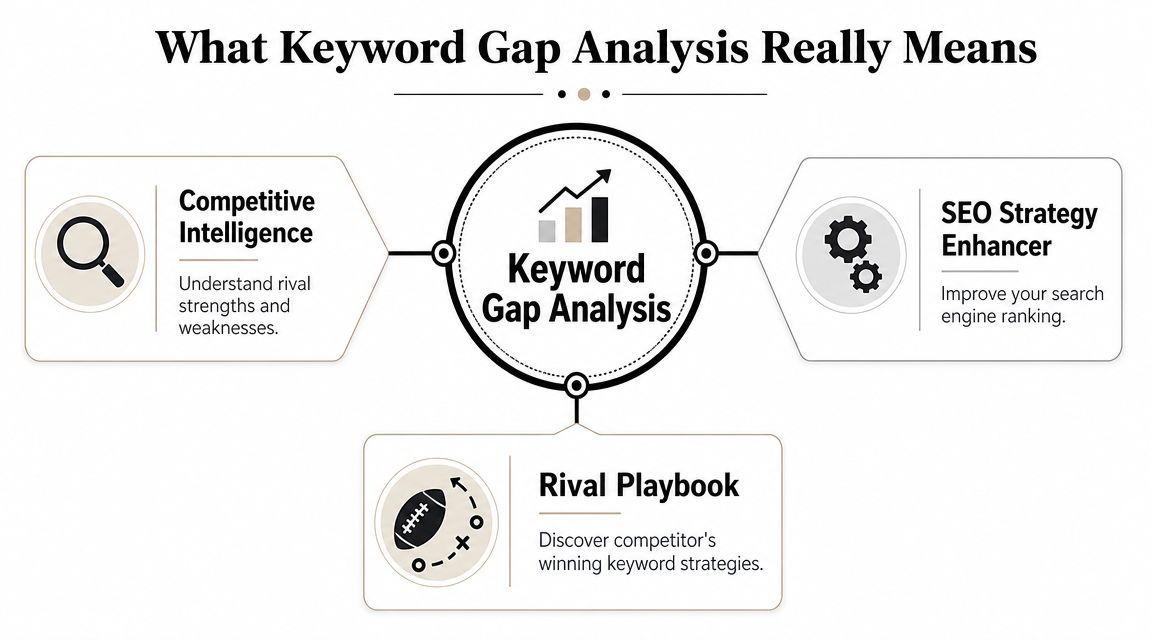
Keyword gap analysis compares your website's keyword profile against competing domains so you can find terms they rank for and you don't, or terms where you rank weakly. Major SEO tools typically let marketers compare their domain against up to 4 competitors and sort results into buckets like shared, missing, and weak keywords, which helps uncover content clusters and thin sections that hold rankings back, as described in Altudo's overview of keyword gap analysis.
The three buckets that matter
The easiest way to understand it is to think like a football coach reviewing film.
You aren't studying a rival just to admire their offense. You're looking for the plays they run well, the formations you haven't prepared for, and the spots where your team keeps giving up yardage. In SEO, those “plays” are keywords and the pages attached to them.
Here's what the main categories mean:
| Category | What it means | What you usually do next |
|---|---|---|
| Missing keywords | Competitors rank, but your site doesn't | Create a new page, service page, city page, or article |
| Weak keywords | You rank, but competitors rank much better | Improve the existing page |
| Shared keywords | Both sites rank | Study who has the stronger page and why |
Missing keywords are usually the clearest opportunities. If an HVAC company in Fort Myers doesn't have a page for ductless mini-split work in nearby service areas, but competitors do, that's not just a ranking issue. It's a service-market mismatch.
Weak keywords are different. You already have a page, but it isn't pulling its weight. That's common with generic service pages that mention a topic once but don't cover pricing questions, local examples, FAQs, or related service details.
Shared keywords show where the main competition is happening. These are terms both companies care about, and they often reveal whether your page depth, structure, or local relevance is falling short.
Why the report matters more than the definition
The phrase “what is keyword gap analysis” sounds technical, but the output is practical. It tells you where your site is thin.
That's why I treat it less like an SEO report and more like a scope-of-work document. If you want a sense of platforms commonly used for this kind of research, Polaris has a helpful breakdown of tools for competitor analysis.
Practical rule: Don't stare at the keyword list as if it's the strategy. The strategy is what you build, fix, combine, and prioritize after you see the gaps.
Why This Matters for Your Southwest Florida Business
For a local business, a keyword gap is often a market gap.
In Southwest Florida, customers don't always search the way business owners expect. They search by service, by urgency, by city, by neighborhood, and by problem. An AC company may think it needs to rank for one broad phrase across the whole region. In reality, demand often splits into narrow searches tied to cooling issues, installation types, or city-specific service intent.
Local intent changes everything
A roofing contractor in Cape Coral may compete with one set of companies for roof repair searches and a different set for storm-related inspections. A med spa in Naples may face one group of competitors for branded services and another group for educational searches about treatments. A law office in Fort Myers may discover that search competitors aren't the same firms it usually sees in referrals or networking circles.
That's where keyword gap analysis becomes useful. It shows the language local customers are already using and which nearby companies have built pages around that demand.
Consider how this plays out across service categories:
- HVAC companies often find gaps around emergency service, mini-splits, maintenance plans, and city-specific installs.
- Paving contractors may uncover searches around driveway repair, paver sealing, pool decks, lanais, and nearby affluent service areas.
- Plumbers often spot opportunities in drain cleaning, water heater replacement, leak detection, and after-hours terms.
- Legal and healthcare practices may find that FAQ-style searches lead into appointment or consultation intent when handled well.
Geography creates hidden opportunity
Southwest Florida is not one uniform search market. Fort Myers, Cape Coral, Naples, Bonita Springs, and Estero can produce different search results even for similar services.
That matters because one competitor may be strong in one city and nearly absent in another. If your business serves multiple areas, keyword gaps often reveal where you're underrepresented. Sometimes the issue isn't your service offering. It's the fact that you've never built a page that clearly ties that offering to a local area Google associates with demand.
A lot of owners keep adding general content to the homepage and wonder why visibility doesn't move. That usually doesn't work. A homepage can't carry every service in every city.
What works better is using keyword gaps to identify specific combinations like:
- service plus city
- service plus problem
- service plus urgency
- service plus home type or project type
When a competitor ranks for a local service phrase and you don't, Google is often telling you that your market wants a page you haven't built yet.
It helps you stop guessing
Here, the method proves its worth. Instead of brainstorming random blog topics or creating broad pages no one searches for, you can focus on terms already connected to local demand.
For trades businesses, that's a lot like checking where your jobs come from before hiring another crew. You don't grow by guessing which neighborhoods might call. You look at the patterns and invest where demand already exists.
How to Perform a Keyword Gap Analysis
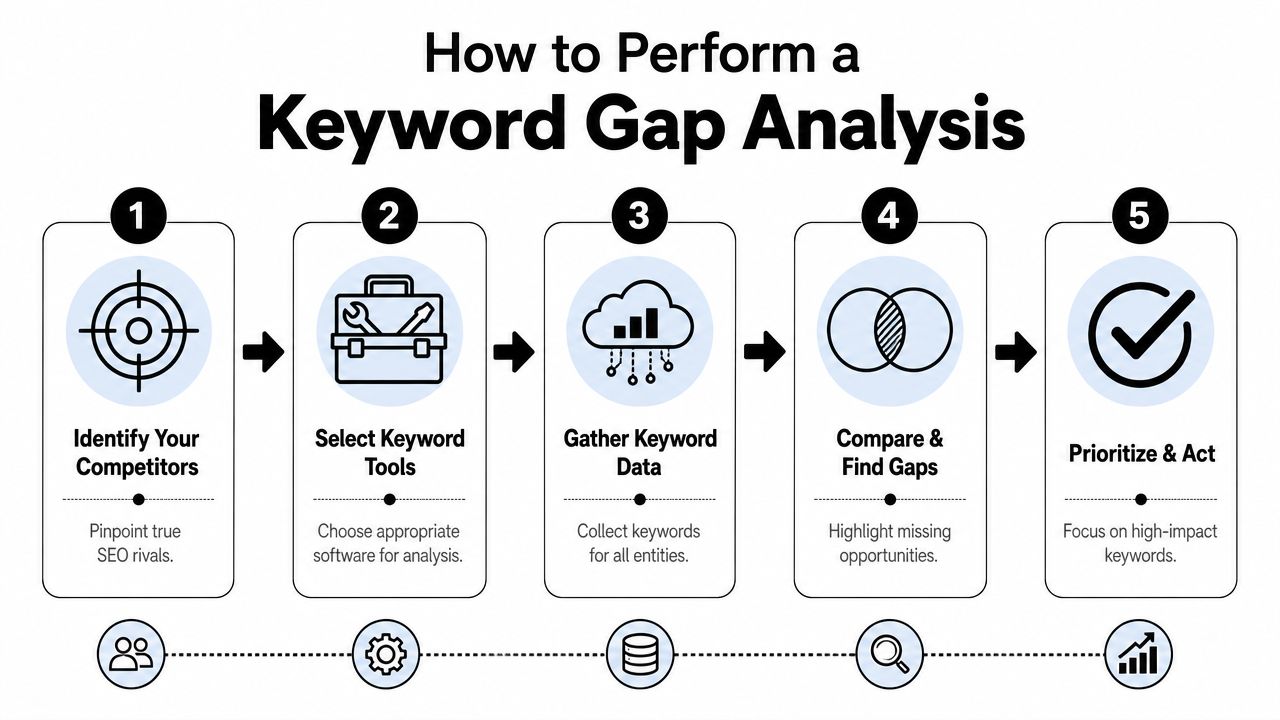
The workflow is straightforward. The hard part is choosing the right competitors and filtering the results with discipline.
Start with your real SEO competitors
Many businesses often go astray here.
Your direct business rival is not always your search rival. Search-focused guidance stresses that you need to identify both known competitors and the sites appearing in search results before running a gap tool, especially for local service businesses where top organic competitors can vary by city, service line, and intent, as noted in this YouTube discussion on choosing the right competitors.
If you run a roofing company, search terms like your customers would:
- roof repair Cape Coral
- tile roof replacement Fort Myers
- metal roofing Naples
- emergency roof leak Bonita Springs
Write down the domains that appear repeatedly. Those are your SEO competitors.
Then separate them into simple groups:
| Type | Example in SWFL | Why it matters |
|---|---|---|
| Direct competitor | Another local contractor offering the same service | They compete for the same lead |
| Search competitor | A business you don't usually bid against but that ranks well | They still take clicks and calls |
| Content competitor | A site publishing useful local or service education | They may own informational searches |
Use a tool and compare domains
Once you have a list, plug your domain and competitor domains into a tool such as Semrush, Ahrefs, or Moz. The modern workflow is operational: choose roughly 5 to 10 top competitors overall, compare ranking keywords, export results into spreadsheets, remove duplicates, and prioritize opportunities by search volume and difficulty, according to Publisher Desk's explanation of how keyword gap analysis evolved.
Most businesses should compare in two ways:
- Group mode to see broad patterns across several competitors.
- One-to-one mode to catch gaps hidden by the group view.
That second pass matters more than most guides admit. One Naples competitor may dominate paver-related terms while another owns service-area pages in Estero. If you only run one big comparison, those patterns can blur together.
Here's a useful walk-through if you want to see the concept in action:
Filter the output before you act
A raw report can get messy fast. You'll see branded terms, irrelevant phrases, and keywords that don't match your services.
Use filters that make business sense:
Intent filter
Prioritize keywords by intent. Search Engine Land notes that advanced workflows often filter findings by informational, commercial, and transactional intent, along with difficulty, so teams can focus on relevant and realistically winnable gaps in a guide to gap analysis.Difficulty filter
Don't chase every hard keyword in the report. Choose opportunities your current site can realistically support.Location filter
Focus on Fort Myers, Naples, Cape Coral, Bonita Springs, Estero, or the cities you serve.Service relevance filter
If you don't offer the service, ignore the keyword. Ranking for the wrong lead wastes time.
Turn the findings into a work list
After filtering, export the results and sort them into action buckets:
- Build new pages for missing services or city-service combinations
- Rewrite thin pages for weak terms
- Add support content for recurring questions
- Strengthen internal links between service and location pages
If you want a benchmark for how these findings usually get organized after the report stage, examples in SEO audit sample reports show the kind of issues teams often turn into action items.
An Example Keyword Gap Analysis for a Local Pro
Let's make this concrete with a fictional company called Coastal Paving in Fort Myers.
They install pavers, repair driveways, and handle outdoor hardscape work across nearby cities. They've got a decent website, a gallery, and a few service pages. But they keep seeing competitors show up first for the jobs they want more of.
What the report reveals
Coastal Paving compares its site against two local competitors. The report turns up patterns right away.
One competitor ranks well for lanai and pool deck searches in Bonita Springs. Another has much stronger visibility around driveway repair terms in Fort Myers. Coastal Paving has some overlapping rankings, but their pages are thin and overly broad.
A simplified snapshot might look like this:
| Keyword type | Example finding | Likely action |
|---|---|---|
| Missing | A competitor ranks for a Bonita Springs lanai paver term and Coastal Paving does not | Build a dedicated service-area page |
| Weak | Coastal Paving ranks for driveway repair in Fort Myers, but well behind a competitor | Rework the existing page |
| Shared | Both sites rank for paver installation Fort Myers | Improve trust, depth, and internal linking |
The report then stops being abstract. It becomes a to-do list.
How a contractor should read the gaps
The missing gap tells Coastal Paving that it doesn't have enough focused content for a service-location combination that appears to matter in a nearby market. If the company already serves Bonita Springs, the opportunity is obvious. Build a page specifically for that service in that city, show local project photos if available, and answer the questions buyers in that area ask.
The weak gap is different. Coastal Paving already has a driveway repair page, but it's too generic. It needs better copy, stronger headings, clearer service details, local proof, and probably a better FAQ section. That's like having a service truck with the right tools but no organization. The capability exists, but the presentation slows you down.
A weak keyword usually doesn't mean “start over.” It means the page exists, but it hasn't been finished properly for search or for buyers.
The hidden lesson in the example
Most local businesses assume they need “more SEO.” What they usually need is more precision.
Coastal Paving doesn't need fifty random blog posts. It needs a tighter map between what it offers, where it offers it, and how searchers describe those needs. The gap analysis exposes that map.
This also helps with prioritization. A broad page about pavers may stay important, but nearby city-specific intent can often produce cleaner local opportunities. When a company sees those patterns, content planning gets easier because every page has a reason to exist.
Turn Your Analysis into More Customers and Calls
A keyword gap report has no value by itself. The return comes from what you build after you read it.
That's why I tell business owners to treat the report like a punch list on a job site. If you walk a property and identify drainage problems, cracked concrete, and weak grading, you haven't fixed anything yet. You've only found the work. SEO is the same.

Match each gap to a specific action
The simplest way to act on the analysis is to assign one action to each type of gap.
For missing keywords
Create a dedicated page. If you offer the service and serve the area, don't bury it inside a paragraph on another page. Give it its own URL, title, headings, and content.For weak keywords
Improve the existing page. Add stronger service detail, local examples, FAQs, trust signals, and clearer calls to action.For informational gaps
Publish helpful support content. These are often blog posts, guides, or FAQ pages that answer pre-purchase questions and feed internal links into service pages.For recurring local themes
Build clusters instead of isolated pages. If several terms revolve around one service family, create a stronger hub around that topic.
What this looks like in practice
If your landscaping company discovers a gap around outdoor kitchen pavers in Naples, create that page. If your plumbing company finds weak rankings around emergency water heater replacement in Fort Myers, strengthen that existing service page instead of writing another generic article. If your law firm sees question-based searches tied to a practice area, build a FAQ page that supports the core service page.
A few tactical fixes often make a page more competitive:
| Gap type | Content move | Business purpose |
|---|---|---|
| Missing service term | Add a new service page | Capture searches you currently miss |
| Missing city term | Add or expand location pages | Improve local relevance |
| Weak ranking | Refresh headings, copy, FAQs, media | Lift an existing asset |
| Question-based gap | Write educational support content | Build trust earlier in the buying process |
Don't ignore supporting channels
Some keyword gaps turn into content that can work beyond your website. If you publish company updates, new service launches, location expansions, or community involvement, keyword-aware announcements can support visibility when written correctly. This guide on SEO strategies for press releases is a useful reference for handling keywords and metadata without turning a release into spam.
You should also connect this work to lead tracking. A page isn't helpful because it exists. It's helpful when it brings the right visitor, answers the right question, and helps turn that visit into a call or form submission. Polaris Marketing Solutions offers lead generation support for local businesses alongside SEO and website work, which is relevant when gap findings need to feed into a broader local marketing system.
The businesses that benefit most from keyword gap analysis aren't the ones with the biggest reports. They're the ones that turn the findings into pages, updates, and local proof fast.
If your site already has authority in your market, gap analysis helps you direct that authority better. If your site is still developing, it helps you stop wasting effort on vague content and focus on pages that align with real local demand.
If you want a practical second set of eyes on your local SEO opportunities, Polaris Marketing Solutions can help review your current visibility, compare your site against local competitors, and identify which service and location gaps are worth acting on first for the Southwest Florida market.