
You’re probably looking at a competitor’s website right now and thinking the same thing a lot of small business owners think. Their homepage feels more credible. Their customers are on camera. Their videos look real enough to trust, polished enough to feel established, and simple enough that you know this wasn’t made by a movie studio.
That gap matters more than most owners want to admit.
For a roofing company in Fort Myers, a law office in Naples, a med spa in Cape Coral, or a cleaning company in Bonita Springs, buyers don’t just compare prices. They compare confidence. A strong testimonial video often becomes the fastest way to answer the questions they won’t ask out loud: Can I trust these people? Have they solved my problem before? Will I regret calling them?
The good news is you don’t need Hollywood production to make that happen. You need the right customer, the right story, clear audio, a believable setting, and an edit that respects the viewer’s time.
Why Customer Stories Are Your Best Sales Tool
Small business owners usually don’t need to be convinced that reviews matter. What’s changed is the format buyers expect before they reach out. Video isn’t a bonus anymore. It’s become part of how people screen businesses before they call, book, or request a quote.
One 2026 industry roundup says 87% of businesses now include video testimonials in their marketing strategy, up 21% over the prior two years, and 78% of buyers have watched a video testimonial to learn more about a company before purchasing, according to Vidlo’s video testimonial statistics roundup. That should reframe testimonial video production for any local company. This is not optional content for “bigger brands.” It’s standard trust content.
Why local buyers respond to faces faster than claims
A service page can say “family-owned,” “trusted,” and “high quality” all day long. Buyers skim those words because every competitor uses them.
A customer on camera saying, “They showed up when they said they would, explained the repair in plain English, and the leak stopped after the first visit,” lands differently. It feels specific. Specificity is what makes trust believable.
That’s especially true in local service markets where buyers often don’t know the owner personally. They’re judging from a phone screen. A good testimonial closes the distance between stranger and trusted provider in a way written copy rarely can.
Practical rule: If your competitor has believable customer stories on video and you don’t, you’re asking buyers to take a bigger leap of faith.
Testimonials work best when they support the rest of your reputation
Video isn’t a replacement for reviews, your Google Business Profile, or a solid website. It’s the layer that makes all of those assets feel human. When buyers see the same themes repeated across reviews, photos, and customer stories, your marketing starts to feel consistent instead of assembled.
If you’re still building the foundation, this guide on how to get more online reviews pairs well with testimonial video production because the best video candidates usually come from your happiest recent reviewers.
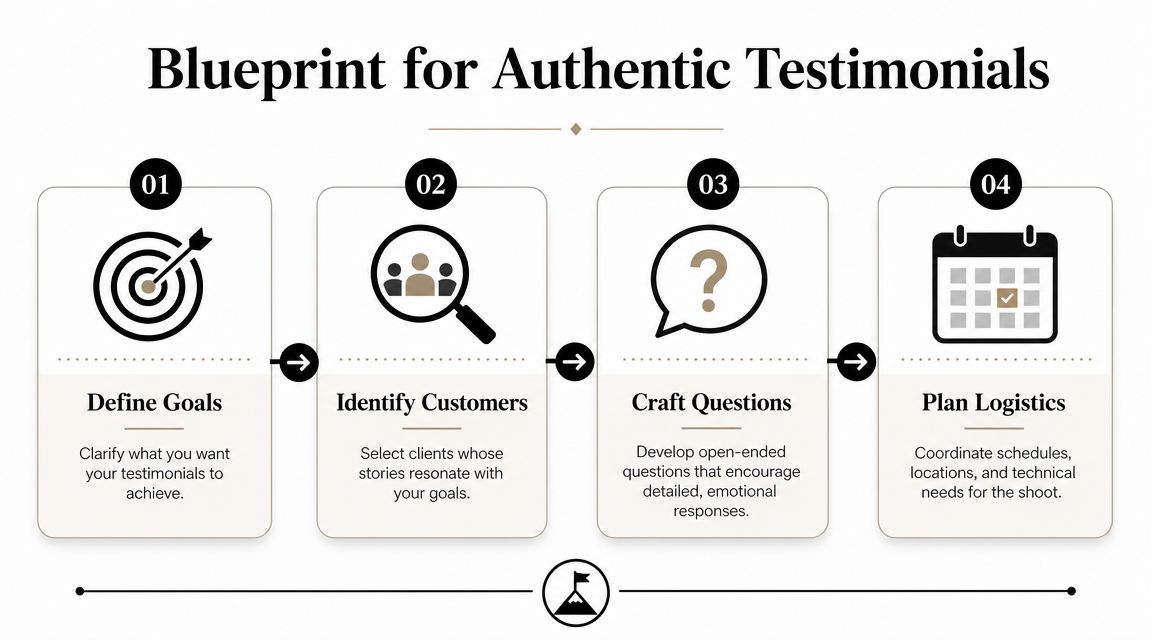
Blueprint for Authentic Testimonials Planning and Questions
Most bad testimonial videos fail before anyone presses record. The wrong customer gets picked, the questions are weak, and the result sounds like a commercial no one believes.
The better approach is simple. Start with the customer who can tell a before-and-after story clearly. The ideal person isn’t always your most enthusiastic fan. It’s often the client who had a recognizable problem, hesitated before buying, and can now explain what changed.
Pick the customer with the clearest transformation
A practical workflow for testimonial video production is to identify a satisfied customer, prepare open-ended questions around the pre-purchase pain point and the measurable outcome, record in a quiet well-lit environment with clear audio, then edit to a concise narrative with captions and branded overlays. Guidance from TechSmith’s testimonial video recommendations also suggests keeping the final cut around 90–150 seconds.
That workflow sounds basic, but small businesses skip the most important part all the time: choosing the right story.
Look for customers who fit one of these patterns:
- The skeptical buyer: They delayed hiring you, compared options, or worried about cost.
- The urgent case: They had a leak, legal issue, scheduling headache, or service failure that needed a fix fast.
- The high-trust scenario: They let your team into their home, medical practice, office, or property.
- The clear outcome: They can explain what improved after working with you.
A roofing contractor, for example, should prioritize the homeowner who can explain what happened before the repair, how the crew handled the job, and how things changed after the work was completed.
Here’s a useful visual walkthrough before you draft your interview list:
Ask questions that create a story, not praise
Weak questions produce weak footage.
Bad question:
- “Were you happy with our service?”
That invites a short answer and usually gets: “Yes, absolutely.”
Better questions for a local roofing company:
- “What was happening with your roof before you called us?”
- “What had you already tried before you found our company?”
- “What made you choose us over the other estimates?”
- “What did the crew do that stood out once the work started?”
- “What’s different now that the job is done?”
Those questions pull out context, tension, and resolution. That’s what viewers remember.
Don’t chase compliments. Chase details.
A simple planning checklist that saves the shoot
Before the interview day, lock down the basics:
- Choose one goal per video. Homepage trust, retargeting ad, service-page proof, or recruiting content.
- Pre-interview the customer by phone. Listen for specifics worth capturing on camera.
- Draft prompts, not a script. You want natural phrasing.
- Plan proof visuals. Jobsite footage, office scenes, finished work, screenshots, or product-in-use clips.
- Set expectations. Tell the customer this is a conversation, not a performance.
If you do this prep well, the interview becomes easy. If you skip it, editing turns into rescue work.
Choosing Your Production Path DIY vs Hiring a Pro
This is the question most owners care about first. Do you film it yourself, build a small in-house setup, or hire a production team?
The honest answer is that each option can work. The right one depends on how visible the video will be, how much trust your market requires, and how much time you can realistically spend organizing, filming, and editing.
Time is part of the budget
Practitioners recommend reserving about 45 minutes for the interview itself, with setup ranging from roughly 30–45 minutes for low-budget kits to at least 1.5 hours for high-end multi-camera and advanced-lighting shoots, based on Small Films’ production planning guide. That same guidance warns against common mistakes like weak release form prep, scripted delivery, and poor audio or lighting.
A lot of owners underestimate the hidden cost of DIY. The phone is cheap. The coordination isn’t.
Production Path Comparison
| Approach | Estimated Cost | Time Investment | Best For |
|---|---|---|---|
| Smartphone DIY | Low, using gear you already have or basic add-ons | Owner or staff handles planning, filming, retakes, and editing. Interview still needs about 45 minutes, plus prep and cleanup | Quick social clips, early-stage testing, casual follow-up content |
| Hybrid kit | Modest investment in a tripod, lav mic, ring light, and editing software | Setup usually takes more effort than pure phone recording, but less than a full production shoot | Home services, local professional services, recurring monthly content |
| Professional crew | Higher investment with more planning and coordination | Interview time remains similar, but setup can run much longer for multi-camera and advanced lighting | Homepage hero videos, legal, healthcare, brand campaigns, paid ads |
What’s good enough for different businesses
A phone-recorded testimonial can work if the story is specific, the room is quiet, and the speaker feels credible. For an HVAC company posting to social media, that may be enough.
A law firm asking a higher-value lead to trust them with a serious matter usually needs tighter framing, stronger lighting, cleaner audio, and more careful editing. Not because buyers demand cinematic visuals, but because sloppiness can signal risk.
Here’s a practical way to decide:
- Use DIY if the video is short-lived, informal, or mainly for social proof in feeds.
- Use a hybrid setup if you want a repeatable in-house process without agency pricing.
- Use a pro when one video needs to anchor a homepage, campaign, or high-trust service line.
The hybrid path is often the sweet spot
For many small businesses, the hybrid route wins. A modern smartphone, a DJI Mic or Rode wireless mic, a simple tripod, and a ring light can get you far if the room is decent and the interviewer knows how to guide a conversation.
The trick is not to imitate a national commercial. It’s to remove the obvious distractions. Echo, dim lighting, shaky framing, and cluttered backgrounds hurt trust faster than “non-cinematic” footage does.
If viewers have to work to hear the customer, they stop listening to the story.
On-Camera Confidence Interviewing for Genuine Responses
The customer sits down, smiles, and suddenly forgets how to speak in complete sentences. That happens all the time. Good testimonial interviews don’t come from forcing confidence. They come from reducing pressure.
The easiest way to get genuine responses is to treat the first few minutes like a warm-up conversation, not the official interview. Ask about their day, how business has been, or how the project has held up since completion. Keep the camera rolling if they’re comfortable, because people often say their most natural lines before they think they’ve started.
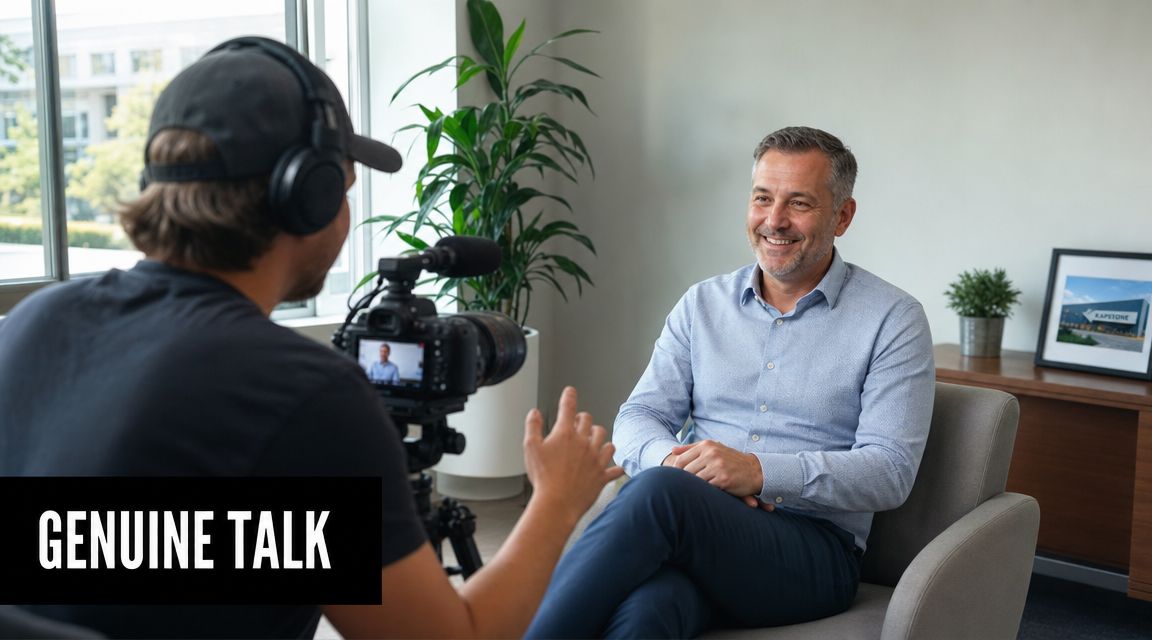
A mock interview that actually works
Say you’re interviewing a satisfied paving client.
You start with a bad question: “Would you recommend us?”
They answer: “Yes, definitely.”
That clip is usable, but weak.
You follow up differently: “What was the driveway like before the job?” Now they say, “It had cracks everywhere, water would pool near the garage, and it looked rough enough that we kept putting off guests.” That’s the moment the story starts.
Then ask: “What made you finally call?” They explain the trigger. Maybe they were tired of the mess. Maybe they were listing the house. Maybe another company no-showed them. Each detail makes the testimonial more believable because it sounds like real life.
Trust comes from proof cues, not polish
To build trust, testimonials need verification cues viewers now expect, such as specific job context, measurable outcomes, and customer stories paired with on-screen evidence, according to Teraleap’s analysis of stronger testimonial structure. That same guidance notes that a slightly rougher but more concrete testimonial may outperform a more cinematic one if it includes before-and-after details and named roles.
That changes how you interview.
Don’t stop at “They were great.” Ask:
- “What exactly were you dealing with before?”
- “Who on your team or in your family was affected?”
- “What changed after the project was done?”
- “What would you tell someone in the same situation?”
If the customer says, “Our office manager had to keep calling different vendors before we found them,” you’ve got a useful verification cue. If they say, “The doctor needed the waiting room painted before reopening,” that’s even stronger. Named roles and context make claims feel grounded.
The most convincing line in a testimonial is often the most ordinary, because ordinary details are hard to fake.
How to calm nervous speakers
Borrow a few habits from media coaching. These PR agency insights for founders are aimed at interviews more broadly, but the same principle applies here: people sound better when they know the topic, the audience, and the point they’re trying to make.
Use a few simple tactics on set:
- Lower the stakes: Tell them they can pause, restart, and ignore the camera.
- Ask for full-sentence answers: It saves the edit.
- Use follow-ups instead of moving on: “Can you say that again, but start with what the problem was?”
- Affirm specifics: When they mention a useful detail, lean into it.
That’s how you get responses that feel lived-in instead of rehearsed.
Post-Production Magic Editing for Engagement and Reach
Raw footage almost always feels longer, slower, and less persuasive than it should. Editing is where a decent interview becomes a clear sales asset.
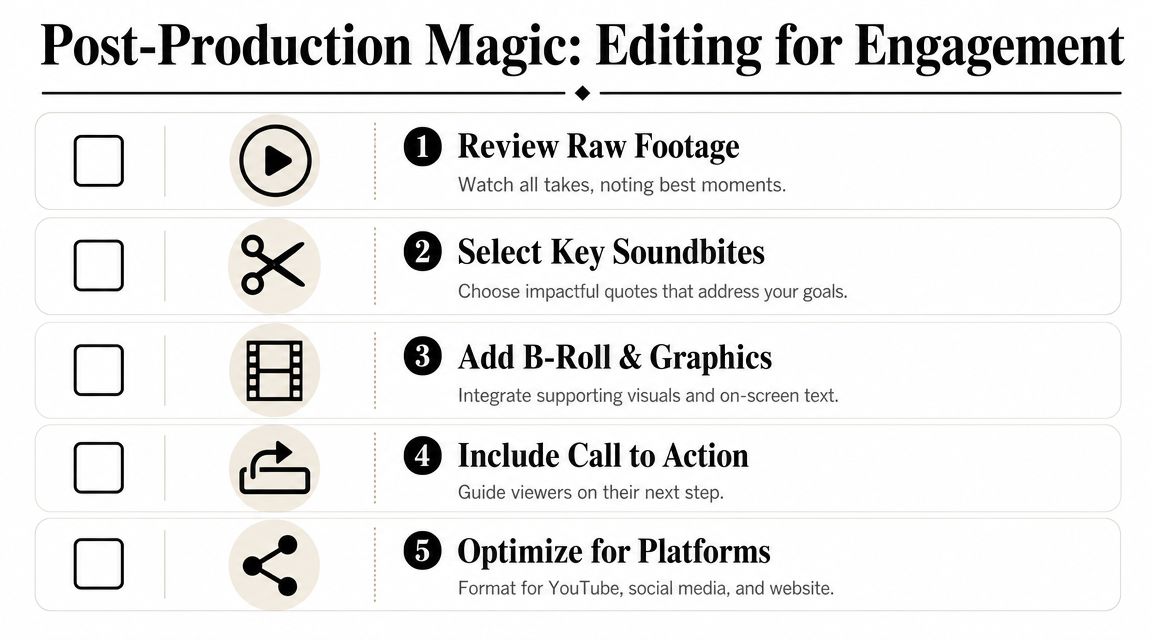
Most small business testimonial videos improve when the edit gets tighter, not fancier. You don’t need elaborate motion graphics. You need a clean structure, useful visuals, readable captions, and a call to action that matches where the viewer is watching.
A practical edit sequence
Start by watching all footage once without cutting. Mark the lines that answer these questions:
- What was the problem?
- Why did they choose this business?
- What happened during the service experience?
- What changed afterward?
Then build the cut in that order. For many local businesses, that’s enough story structure.
Use b-roll to cover jump cuts and support claims. If the client talks about a new roof, show the roof. If they mention your team’s punctuality, show the truck arriving or the crew setting up. If they mention a cleaner office, show the finished space.
What to cut and what to leave in
Editors often over-clean testimonial footage. That can make the speaker feel robotic.
Keep these:
- Natural pauses that make the person sound thoughtful
- Small smiles or reactions that show comfort
- Plainspoken wording that sounds like the customer, not your copywriter
Cut these:
- Repeated phrases
- Long setup chatter
- Off-topic tangents
- Distracting filler if it slows the pace too much
Editing note: Cut the clutter, not the personality.
Captions are non-negotiable
A practical testimonial workflow includes adding captions and branded overlays in the final edit, as noted earlier in the production process guidance. That matters because many viewers watch with the sound off, especially on social platforms and mobile devices.
If you’re editing in CapCut, Adobe Premiere Pro, Final Cut Pro, or DaVinci Resolve, generate captions first, then clean them manually. Auto-captions save time, but they still need a human pass for names, service terms, and punctuation.
Keep branding light. A logo in the corner, a name/title lower third, and maybe a short end card are usually enough. If the design work starts competing with the customer’s face, you’ve gone too far.
The Business Side of Video Testimonials Cost ROI and Legal
Testimonial video production isn’t just a creative task. It’s a budget decision, a risk decision, and a process decision.
That matters because many owners either under-budget and end up with weak assets, or overspend on production value that doesn’t improve trust. The smarter approach is to treat testimonial videos like any other business investment. Match the spend to the expected use, lifespan, and impact.
What the market says about cost and return
A 2025 statistics summary reports that 44% of marketers spend more than US$15,000 to produce a single testimonial video, while 72% of marketers say testimonial videos deliver an ROI between 50% and 500%, according to Electro IQ’s testimonial video statistics summary.
For a small business, that doesn’t mean you need to spend at that level. It means serious marketers already treat these videos as meaningful assets, not throwaway content. It also explains why higher-trust industries such as healthcare, legal, and specialized services keep investing in them.
How to think about ROI without fooling yourself
A testimonial video can pay off in several ways:
- Lead quality improves: Prospects arrive pre-sold on your reliability or process.
- Sales calls get shorter: The customer story answers objections before the meeting.
- Close confidence goes up: Your team has proof to send after estimates and consultations.
- Website trust gets stronger: The business feels established, not anonymous.
That said, you should still track performance. This guide to measuring marketing ROI is useful if you want a grounded way to evaluate whether your video is influencing calls, form fills, and lead quality instead of just collecting views.
Release forms aren’t optional
A verbal “yes, you can use it” isn’t enough. Get a signed release before publishing anything.
Your release form should include:
- Identity details: Full legal name of the participant and business name if relevant
- Usage permission: Clear consent to record, edit, publish, and distribute the footage
- Media scope: Website, social platforms, paid ads, email, landing pages, and future marketing materials
- Editing consent: Permission to trim, caption, add graphics, and combine with b-roll
- No compensation terms or stated compensation: Spell out what was agreed
- Withdrawal language: Clarify whether and how consent can be revoked
- Date and signature: Signed and dated by the participant
If your testimonial includes health details, legal matters, children, internal company information, or sensitive customer records, tighten your process further. This resource on avoiding data privacy mistakes is worth reviewing before you publish anything tied to identifiable personal information.
Good testimonial production protects the business and the customer at the same time.
Amplify Your Message Local SEO and Ad Strategies
A finished video sitting in a Dropbox folder does nothing. Distribution is where testimonial video production starts acting like a lead asset.
For most Southwest Florida businesses, the priority order is straightforward:
- Put it on a high-intent page first. Your homepage, service page, or estimate-request page should get the video before your social channels do.
- Upload it to your Google Business Profile. That gives local searchers another trust signal when they compare providers.
- Use shorter cuts for paid social. A full testimonial can feed shorter versions for Facebook, Instagram, and YouTube placements.
- Send it during follow-up. Include it after estimates, consultations, or inquiry replies.
- Target by geography and service line. A Naples legal testimonial shouldn’t be framed the same way as a Cape Coral roofing one.
If you’re running campaigns in Fort Myers, Estero, Bonita Springs, or Naples, pair video proof with tightly targeted local campaigns rather than broad awareness pushes. This guide to online advertising for small business is a good companion if you want to turn testimonial content into actual lead-generation ads.
If you want testimonial videos that feel credible, fit a small-business budget, and support local lead generation, Polaris Marketing Solutions can help you build the right strategy around them. From website placement and local SEO to ad distribution and conversion tracking, the team helps Southwest Florida businesses turn customer stories into marketing assets that pull their weight.