

If you're running a law firm, accounting practice, or consulting business in Fort Myers, this situation is familiar. Referrals still come in, but not consistently enough to support growth. Paid ads generate some leads, but the cost feels hard to justify when half the inquiries aren't a fit.
That's where SEO for professional services stops being a marketing side project and starts acting like business infrastructure. When someone searches for a specific service in Fort Myers, Cape Coral, Estero, Bonita Springs, or Naples, they're often already problem-aware. They don't need brand awareness. They need the right provider, fast, and they usually choose from the few firms Google puts in front of them.
The firms that win search don't always have the biggest teams or the oldest names. They usually have clearer service pages, cleaner sites, better local signals, and tighter measurement. More important, they track what matters after the click: qualified inquiries, booked consultations, and new revenue.
Why SEO is Your Firm's Best Source for New Clients
A Fort Myers business owner gets hit with a contract dispute on Tuesday morning. By lunch, they are searching for a commercial litigation attorney nearby. A family realizes a parent needs an estate plan and starts comparing elder law firms on their phones that night. A medical practice owner in Estero sees margins tightening and looks for a CPA who understands physician groups.
Those prospects are not browsing for ideas. They are trying to hire.
That is why SEO tends to outperform channels that interrupt people or depend on perfect timing. Search puts your firm in front of buyers who already know they need help and are actively weighing options. For law firms, accounting practices, and consultancies, that usually means better inquiry quality and a shorter path to consultation.
The broad search behavior supports that case. 68% of online experiences begin with a search engine, Google handles 8.5 billion searches per day, and 46% of monthly Google searches have local intent according to this SEO statistics compilation. In a market like Fort Myers, where firms often compete across Cape Coral, Bonita Springs, Estero, and Naples, local service searches create a steady stream of buyers who are already close to a decision.
The firms that convert that demand usually make one thing easy. They publish pages that match specific services and specific client problems. A Fort Myers estate attorney needs a page for probate administration. A CPA firm should have a page for small business tax planning in Southwest Florida. A consultant serving contractors should not bury "fractional CFO for construction companies" inside a generic advisory page and hope prospects figure it out.
Search visibility also changes lead flow in a very practical way. The firms near the top get the calls, the form fills, and the consultation requests. Firms lower on the page get whatever is left. In professional services, where one retained client can cover months of SEO work, that gap has direct revenue impact.
I saw this firsthand running a service business. Referral leads were valuable, but they came in waves. SEO gave us a steadier pipeline because it kept producing opportunities even when referral activity slowed or paid campaigns were paused. That is a different risk profile than channels where lead volume disappears the moment you stop spending.
SEO also holds up well against paid acquisition on economics. According to this SEO market and ROI summary, businesses commonly put 10% to 20% of digital marketing budgets into SEO, and the same summary reports an average SEO return of 22:1, with 5:1 often used as a benchmark for effective marketing. Those numbers are directional, not a promise, but the underlying point is sound. For a lawyer, accountant, or consultant with strong client value, one qualified matter or engagement can justify the investment quickly.
The key is to judge SEO by business outcomes, not vanity metrics. More traffic is only useful if it produces qualified inquiries, booked consultations, and new client revenue. If your current marketing still relies too heavily on inconsistent referrals, pair SEO with a broader lead generation strategy for professional services so your pipeline is built on measurable demand, not hope.
Build Your Digital Foundation with a Technical SEO Audit
A surprising number of firms try to scale content on top of a weak website. That's backwards. If your pages load slowly, break on mobile, or don't get indexed properly, the rest of your SEO work gets throttled before it has a chance to perform.
For professional services, a practical benchmark is site loading speed under 3 seconds, and the recommended workflow is to fix crawl, indexation, and speed issues before scaling content, as outlined in this technical SEO strategy guide.
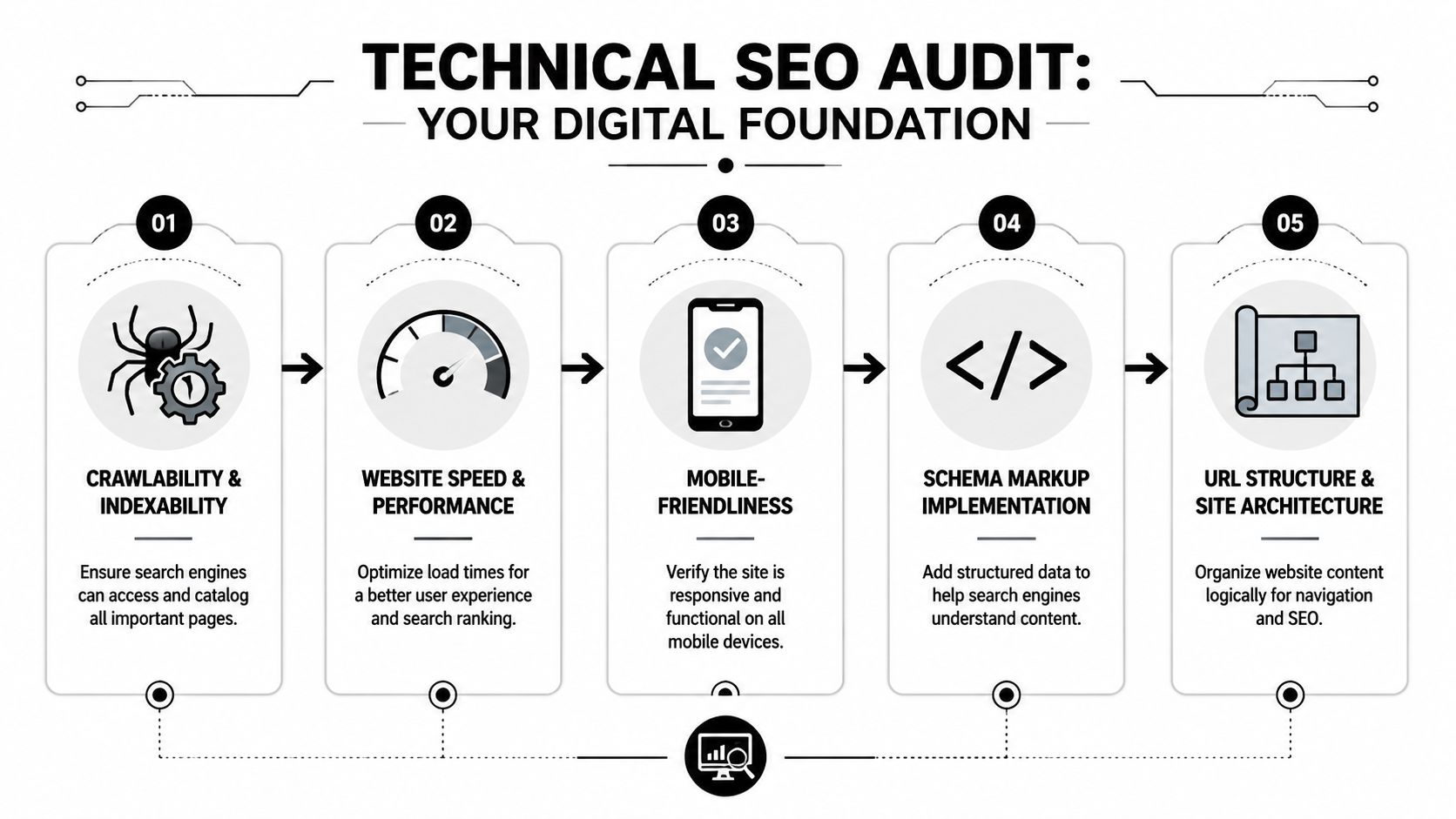
Start with a practical audit checklist
Don't overcomplicate this. A useful technical audit for a law firm, CPA, or consultancy usually starts with five checks.
- Check crawlability: Open Google Search Console and review which pages are indexed, excluded, or returning errors. If your core service pages aren't indexed, rankings won't follow.
- Test speed: Run your homepage, top service pages, and contact page through PageSpeed Insights. Team photos, oversized office images, and bulky plugins are common causes of slow performance.
- Review mobile usability: Most prospects will first see your site on a phone. Test menus, forms, click-to-call buttons, and map embeds on iPhone and Android devices.
- Inspect URL structure: Keep service URLs short and descriptive. A page like
/business-tax-planning-fort-myers/is easier for users and search engines to understand than a vague or parameter-heavy URL. - Look at architecture: Your homepage should link clearly to practice areas, industries, locations, and contact actions. If users need too many clicks to reach a service page, your site structure is probably muddy.
What usually breaks on professional services sites
The most common issues aren't exotic. They're operational.
A Fort Myers consulting firm might have one long “Services” page trying to rank for everything. A law firm may have attorney bio pages but weak practice-area pages. An accounting site might rely on a template built years ago, with giant hero images and slow mobile performance.
Those problems create two separate losses. Search engines struggle to understand the site, and human visitors lose patience before they contact you.
Slow pages don't just frustrate visitors. They also reduce the chance that Google will fully crawl and prioritize the pages you want ranking.
Free tools that help you find the bottlenecks
You don't need an enterprise stack to spot the basics. Use:
- Google Search Console for indexing, queries, and technical alerts
- Google PageSpeed Insights for speed diagnosis
- Google Analytics for user behavior and conversion paths
- Screaming Frog for crawling page titles, status codes, internal links, and duplicate issues
- Mobile browser testing on actual devices for usability problems that tools miss
One simple Fort Myers example: if an attorney's homepage uses large drone shots of the office, multiple chat widgets, and uncompressed headshots, PageSpeed Insights will usually expose the weight problem quickly. Compress the images, reduce script bloat, and retest before writing another blog post.
If you want a reference point for what a structured review looks like, sample SEO audit reports can help you compare your current site against a more disciplined process.
Fix order matters
Many firms ask whether they should work on content, local SEO, or backlinks first. The honest answer is that technical cleanup comes first because it affects everything else.
Use this priority order:
- Repair indexing and crawl issues
- Improve speed and mobile usability
- Tighten page structure and internal links
- Only then expand content production
- Track inquiries after each major round of fixes
That sequence keeps you from pouring effort into pages that search engines and users can't reliably access.
Map Your Services to High-Intent Keywords
The biggest keyword mistake in SEO for professional services is trying to rank the entire firm with a handful of broad phrases. “Fort Myers law firm,” “accountant Fort Myers,” and “business consultant Florida” sound useful, but they usually attract mixed intent and weak conversion.
High-performing firms go narrower. They map each core service to its own page, then build supporting content around the questions, scenarios, and objections that surround that service.
Think like the client, not like the firm
Google's SEO Starter Guide emphasizes unique, user-focused content organized by topic, and for professional services that means building pages around the actual questions prospects ask, not generic firm branding, as explained in Google's SEO Starter Guide.
That distinction matters in local markets. A Fort Myers CPA firm may describe itself internally as a full-service tax and advisory practice. A prospect won't search that way. The prospect searches for the immediate need:
- tax planning for medical practice Fort Myers
- IRS notice help Cape Coral
- bookkeeping for restaurant group Naples
- outsourced controller for growing construction company Fort Myers
Each of those deserves its own page or subpage if it's a real service line.
Build a keyword map around services and problems
The cleanest way to do this is to inventory your revenue-producing work, then map the related searches to dedicated URLs. Don't start with keyword tools alone. Start with your calendar, intake calls, and sales conversations.
Look at:
- Core services: What do clients hire you for?
- Buyer language: What words do prospects use on calls and contact forms?
- Location modifiers: Which cities and service areas matter most?
- Decision triggers: What event causes someone to search now?
A Fort Myers business attorney might identify “partnership dispute,” “contract review,” and “commercial lease” as separate service tracks. Those shouldn't live under one generic business law page if the firm wants strong intent matching.
Service page keyword strategy template
| Core Service | Primary Keyword (Problem + Location) | Secondary Keywords (Question-Based) | Call to Action |
|---|---|---|---|
| Business Formation | business formation attorney Fort Myers | how to form an LLC in Florida, do I need an operating agreement | Schedule a consultation |
| Tax Planning | tax planning for small businesses Fort Myers | how to reduce business tax liability, when should I meet a tax advisor | Book a tax strategy call |
| Management Consulting | operations consultant Fort Myers | how to improve workflow in a service business, when to hire a consultant | Request a discovery meeting |
| Estate Planning | estate planning attorney Cape Coral | do I need a will and trust, what documents are included in an estate plan | Contact our office |
| Commercial Accounting | outsourced controller Naples | what does an outsourced controller do, when to move beyond bookkeeping | Talk with an advisor |
Use this as a working template, not a one-time worksheet. Add pages when a service proves commercially important. Remove or merge pages that don't align with a real buyer need.
The page should match the moment the buyer is in. Someone searching a broad category is browsing. Someone searching a problem plus location is often deciding.
What works and what doesn't
Here's the trade-off most firms have to accept. Broad pages are easier to manage. Specific pages generate better leads.
What works:
- Dedicated pages for each major service
- FAQs built from intake questions
- Internal links between related services and supporting articles
- Calls to action matched to service complexity
What doesn't:
- One “Services” page with six paragraphs and no depth
- Thin location pages that swap city names
- Blog posts unrelated to your actual services
- Keyword targeting based on search volume alone
A practical Fort Myers example: if you're a consultant serving contractors, a page about “business consulting” is too broad. A page on “job costing and operations consulting for Fort Myers service contractors” is far more likely to attract the right inquiry.
The best keyword map usually feels less glamorous than firms expect. It looks like disciplined alignment between services you want, phrases prospects use, and pages built to convert those searches into consultations.
Win Your Local Market with Google Business Profile
A Fort Myers prospect searches for "business attorney near me" or "CPA Fort Myers" because they want to hire someone nearby, not read a generic article. In that moment, your Google Business Profile often shapes the first impression before your website gets a fair shot.
For lawyers, accountants, and consultants, local search matters because it produces high-intent inquiries. These are not vanity clicks. They are people comparing firms, checking credibility, and deciding who to call for a consultation.

Set up your profile like a client acquisition asset
A surprising number of professional service firms claim their profile, add hours, and stop there. That leaves money on the table.
Start with the fields that influence both visibility and conversion:
- Primary category: Pick the category tied to the service you want more of. A Fort Myers estate planning firm should not default to a broader label if estate work is its growth priority.
- Business description: State who you serve, what problems you solve, and the areas you cover in plain English.
- Services section: List specific services such as business litigation, tax planning, outsourced CFO support, or operational consulting.
- Photos: Add the office exterior, signage, conference room, reception area, and current team photos.
- Contact accuracy: Keep your name, address, phone number, and website consistent with your site and major directory listings.
Good photos do not create rankings on their own, but they do affect whether a prospect trusts the listing enough to contact you. A Fort Myers family law office with clear exterior shots, attorney headshots, and a professional meeting space usually converts better than a profile with a logo and one blurry lobby photo.
Use the profile to pre-qualify inquiries
The best profiles answer practical questions before someone calls. That improves lead quality and saves staff time.
Use the Q&A section and service details to address questions such as:
- Do you meet clients in person, by phone, or by Zoom?
- Do you serve only Fort Myers, or also Cape Coral, Estero, and Bonita Springs?
- What kinds of matters or engagements are a fit?
- What should a client bring to the first consultation?
This short walkthrough is useful if you want to see optimization steps in action:
Posts can help here too, if you use them with discipline. An Estero accounting firm might post quarterly tax reminders or year-end planning deadlines. A consultant serving contractors in Fort Myers might post a short note about scheduling audits or job costing reviews. These updates will not replace strong service pages, but they can reinforce relevance and give prospects another reason to reach out.
Reviews shape trust and lead quality
Reviews matter most when they reflect the actual buying concerns of your next client. Volume helps, but specificity closes.
The timing matters. Ask after a successful milestone, a resolved issue, or a productive engagement phase. That usually gets better feedback than a generic request sent at random.
Use a simple script like this:
We appreciate the chance to help. If you'd be comfortable sharing a quick review about your experience, it would help other Southwest Florida clients understand what it's like to work with our team.
Keep the request short. Send the direct review link. Make it easy to complete on a phone.
For a Bonita Springs consulting firm, the strongest reviews often mention responsiveness, clarity, follow-through, and the kind of problem solved. For a law firm, reviews that mention communication and professionalism tend to do more work than vague praise. For a CPA, comments about accuracy, deadlines, and practical advice carry weight.
Small details often decide local visibility
Local SEO for professional services usually comes down to consistency and alignment.
First, make sure your service areas are reflected the same way across your profile, website, and listings. If you actively work in Fort Myers, Cape Coral, North Fort Myers, Estero, Bonita Springs, and Naples, that footprint should be clear everywhere a prospect checks.
Second, be selective with categories. More is not better. The right category mix helps Google understand what you do and helps prospects decide whether your firm fits their need.
Third, send profile traffic to the page that matches the search intent. If someone finds your listing for tax planning, they should land on a tax planning page, not your homepage. That one change often improves consultation rates because the visitor does not have to hunt for relevance.
If you want a practical framework for reviewing those details, this Google Business Profile optimization checklist covers the fields and content areas firms skip most often.
A strong profile does not win on its own. It supports the part of SEO that professional service firms should care about most: qualified local inquiries that turn into booked meetings and new client revenue.
Establish Authority with Content and Links
Once your technical base is stable and your service pages are mapped correctly, authority becomes the next constraint. Google needs evidence that your firm is a credible source on the topics you cover. Prospects need the same thing.
For professional services, authority doesn't come from publishing random blog content every week. It comes from building a body of useful, specific material around the work you want to sell, then earning mentions and links from organizations that reinforce your credibility.
Build content around real client questions
Strong content for lawyers, accountants, and consultants usually starts with repetitive client conversations. If prospects keep asking the same question before they hire you, that's a content opportunity.
Examples in Southwest Florida might include:
- A Fort Myers CPA firm publishing a guide on Florida sales tax issues for e-commerce businesses
- A business attorney writing a clear explainer on contract review before signing a commercial lease
- A consultant producing a resource on fixing scheduling bottlenecks in multi-crew service businesses
That type of content helps in two ways. It supports service pages with topical depth, and it gives referral partners, local organizations, and industry contacts something worth citing.
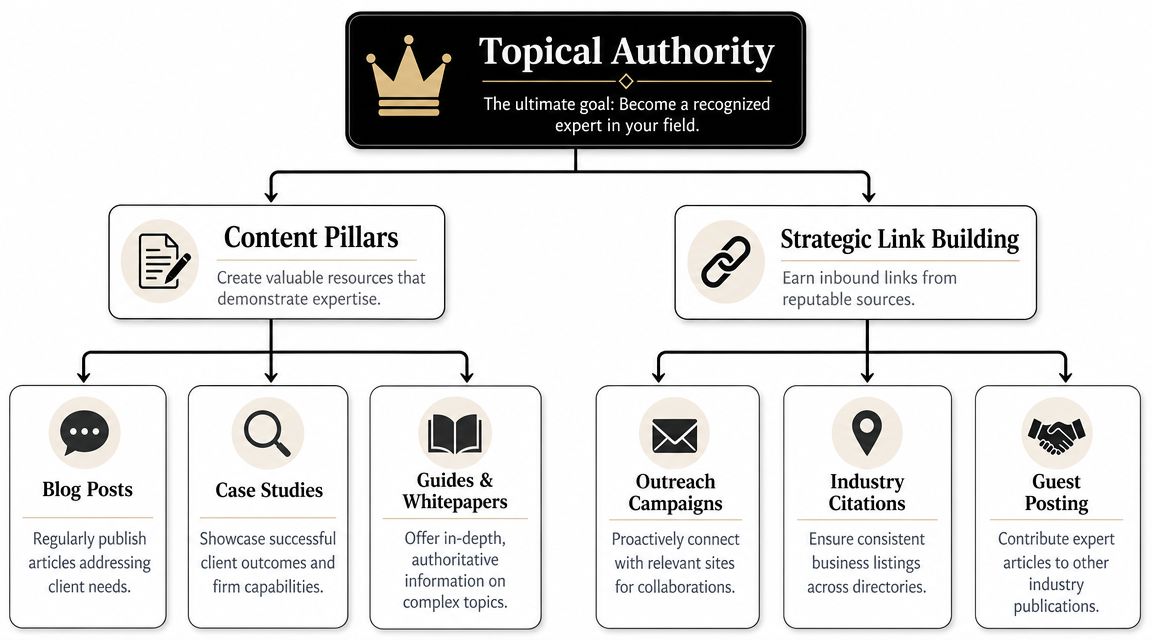
Think in clusters, not isolated posts
A common failure pattern is publishing disconnected articles with no relationship to the main service lines. That's how firms end up with traffic that never converts.
A better structure looks like this:
- Pillar page: One main page for a service or topic
- Supporting articles: Articles answering narrower questions around that service
- Internal links: Clear links between the pillar and the supporting pages
- Conversion path: Every supporting article leads the reader toward a consultation or related service page
For example, a Fort Myers estate planning firm might create a main estate planning page, then support it with articles on wills, trusts, probate preparation, healthcare directives, and common mistakes families make when documents are outdated.
Links should come from relevance, not tricks
Many firms still ask whether they should buy backlinks. For professional services, that's usually a bad trade. Low-quality links can clutter your profile and don't build the kind of trust that high-consideration buyers look for.
The better approach is to earn links through real relationships and useful assets:
- Industry associations: Contribute practical articles or resource pages
- Local publications: Offer commentary on issues affecting Southwest Florida businesses
- Partner businesses: Exchange audience value, not artificial link swaps
- Speaking and education: Turn workshop material into on-site resources worth citing
A Fort Myers consultant who speaks to a chamber group about hiring systems can often turn that talk into a downloadable checklist or article. That content can then attract local links naturally from the host organization or attendees who reference it.
A useful test: If the link would still be worth having even if Google ignored it, it's probably a good link opportunity.
Prepare content for AI-driven search
Google's AI Overviews now appear in more than 100 countries, and existing SEO advice often misses what that means for professional services. The emphasis is shifting toward trust signals, entity clarity, and AI-summary-friendly structure, as noted in this analysis of SEO trends for professional services.
That changes how content should be written.
Firms now need:
- Clear authorship: Show who wrote or reviewed the content
- Direct answers: Put concise, factual answers near the top of pages
- Strong structure: Use descriptive headings, FAQs, and organized sections
- Consistent firm identity: Keep service names, locations, and professional bios aligned across the site
This doesn't mean writing for robots. It means removing ambiguity.
A Fort Myers accounting firm that writes “We help businesses succeed” is hard to summarize and hard to cite. A firm that states “We provide tax planning, bookkeeping oversight, and outsourced controller support for service-based businesses in Southwest Florida” is clearer to both users and search systems.
Authority grows when expertise is visible
The firms that perform well over time usually do four things consistently:
- Publish content tied directly to commercial service lines
- Keep attorney, advisor, or consultant bios updated
- Refresh older pages so they don't go stale
- Build local and industry references that reinforce expertise
This is one area where process matters more than volume. Ten well-structured pages tied to real demand are usually more valuable than a large archive of generic posts no prospect would ever read before hiring you.
Measure SEO Success with Revenue-Focused Metrics
A Fort Myers law firm can climb in rankings, see more organic traffic, and still have a slow month for new matters. That happens when reporting stops at visibility and never reaches signed engagements.
Professional services SEO should be measured the same way owners judge any other marketing spend. Did it produce qualified inquiries, booked consultations, and new client revenue? Rankings matter because they create opportunities. They do not prove business value on their own.
A lot of SEO reporting misses that distinction. It treats impressions, clicks, and traffic growth as the finish line. For lawyers, accountants, and consultants, the better view is lead quality, consultation volume, and what happens after intake, as discussed in this professional services SEO measurement article.
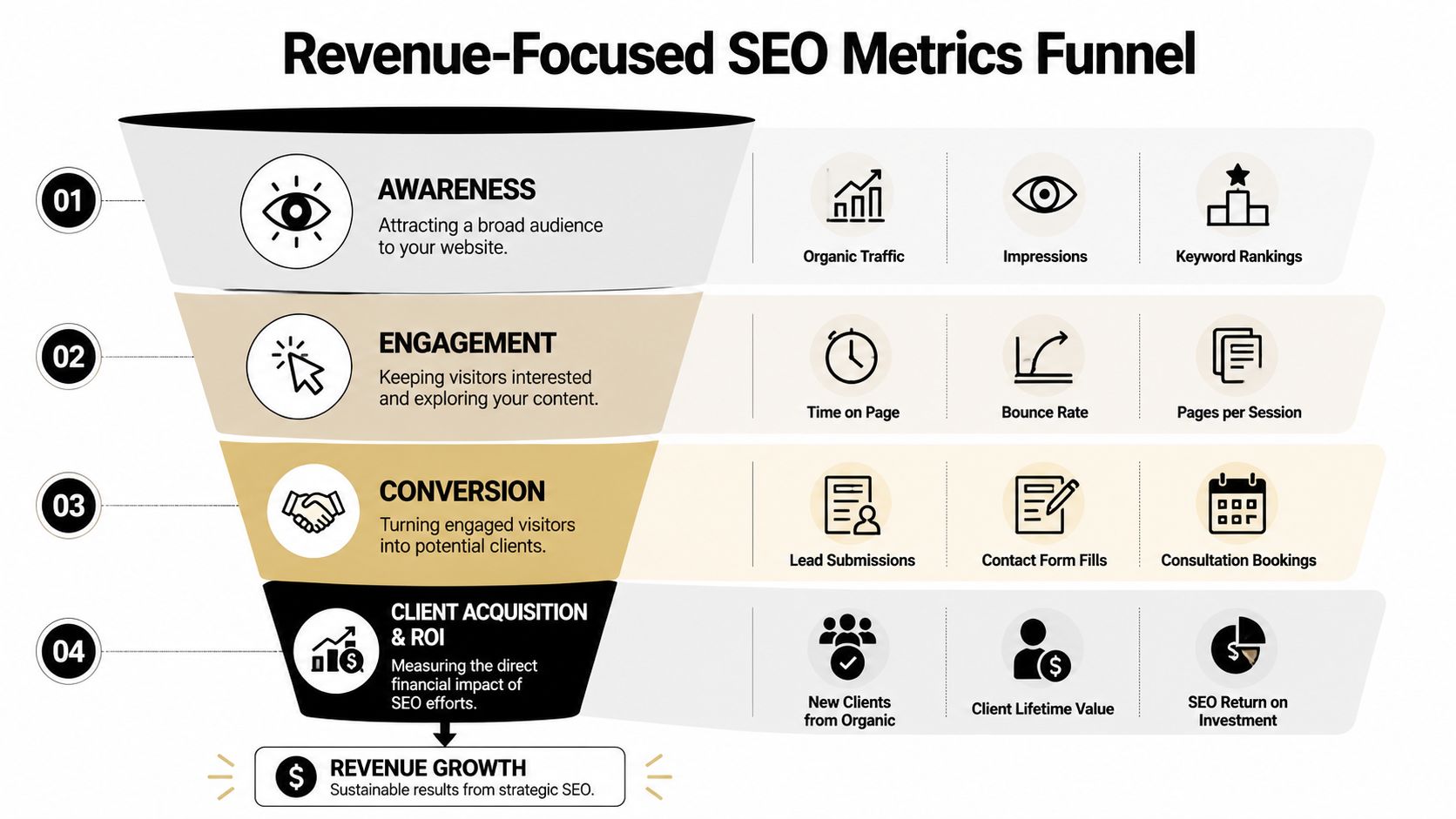
What to track instead of stopping at traffic
Start with traffic and rankings, then connect them to outcomes the firm can use in budgeting and staffing decisions.
Track these conversion points:
- Contact form submissions: Especially from service pages and bottom-of-funnel articles
- Phone calls: Calls from click-to-call buttons, tracked numbers, and Google Business Profile
- Consultation bookings: Scheduled tax reviews, case evaluations, or discovery calls
- Qualified lead status: Whether the inquiry fits your target client profile, budget, and geography
- CRM progression: Whether the lead moved to consult, proposal, engagement letter, or closed client
The pattern matters more than raw volume.
A Fort Myers CPA firm might see a general bookkeeping page attract more visits and more form fills than a tax planning page. But if the tax planning page produces business owners who book consultations and sign recurring advisory work, that page carries more revenue value. The same trade-off shows up for estate planning attorneys, business litigators, and B2B consultants. Lower traffic pages often bring the better-fit leads.
Build a measurement model your team can use
A useful reporting setup answers four questions clearly:
- Which pages attract organic visits?
- Which of those pages generate calls or forms?
- Which inquiries are qualified?
- Which qualified leads become revenue?
If the firm cannot answer those questions, the reporting is incomplete.
Google Analytics and Google Search Console are enough to get started. Many firms can add call tracking, form attribution, and CRM notes without much technical effort. The hard part is consistency. Intake staff need standard source labels. Attorneys, partners, or account managers need a shared definition of a qualified lead. Whoever answers the phone should ask how the prospect found the firm, even if software is tracking the visit.
I have seen this break down in simple ways. A Fort Myers consulting firm was getting steady organic leads, but every web form entered the CRM under a generic source bucket. The firm knew SEO was producing inquiries. It could not tell which service page brought in the retained projects. Once the intake process was cleaned up, the numbers showed that one niche operations consulting page was responsible for a meaningful share of new revenue. That changed the content plan for the next quarter.
A practical reporting dashboard for a service firm
Here's the type of monthly view that helps owners make decisions:
| Metric Group | What to Look At | What It Tells You |
|---|---|---|
| Visibility | Service-page impressions and search queries | Whether relevant demand is increasing |
| Engagement | Landing pages, time on page, next-step clicks | Whether visitors find the page useful |
| Conversion | Calls, form submissions, booked consultations | Whether pages create action |
| Pipeline | Qualified leads, proposals, new clients | Whether SEO is producing actual business |
This kind of dashboard makes trade-offs visible fast. A Fort Myers personal injury page may bring in a lot of calls but too many weak-fit cases. A business law page may generate fewer inquiries but far more retained matters. An accounting firm may find that outsourced CFO content brings in fewer leads than bookkeeping content, yet closes at a much higher value. Those are the decisions that matter.
Rankings are diagnostic. Revenue is the outcome. If reporting stops at rankings, the firm is measuring activity instead of business impact.
FAQ on SEO for professional services
How long does SEO take for a professional services firm
SEO takes time because professional services buyers look for trust, clarity, and fit before they reach out. Technical fixes can improve visibility early, but meaningful lead flow usually comes from stronger service pages, better local signals, and steady authority building. Progress should be judged by inquiry quality and pipeline movement, not short bursts of traffic.
Can I do SEO myself
Yes, some firms can handle parts of it internally. A smaller practice can often manage Google Business Profile updates, basic page improvements, and FAQ content if someone on the team owns the work consistently. The harder parts are technical cleanup, service-page strategy, measurement setup, and keeping the effort going during busy client periods.
What should I outsource first
Many firms get the biggest lift from outside help in one of three areas: technical audits, service-page strategy, or measurement setup. If the site is outdated, start with the technical foundation. If the site is clean but too generic, focus on service mapping and content. If traffic is coming in but nobody can tie it to revenue, fix the tracking first.
Should every service have its own page
If it is a service the firm wants to sell and prospects search for it in a distinct way, yes. Separate pages improve intent matching and make conversion paths easier to measure. The exception is when two services are so closely related that separate pages would create thin or repetitive content.
When should I bring in outside support
Bring in help when the firm is busy doing SEO work but still not getting qualified consultations. That usually shows up as weak local visibility, generic service pages, poor conversion rates, or reporting that never reaches revenue. Polaris Marketing Solutions is one option for Southwest Florida businesses that need SEO and local search support, alongside other agencies and consultants that specialize in professional services.
If your firm needs SEO that leads to qualified consultations instead of vanity reporting, Polaris Marketing Solutions can help you tighten your technical foundation, improve local visibility, and measure results around real pipeline impact.