
A lot of Fort Myers business owners handle reputation the same way they handle a leaking pipe under the slab. They deal with it only when it becomes impossible to ignore.
That usually happens at the end of a long day. You finish jobs, return calls, send invoices, check your phone, and see a fresh one-star review on Google. Now your rating looks weaker, your office manager is asking what to do, and you know tomorrow's customers will read that review before they ever call you.
That's why small business reputation management can't be treated like a side task. It needs a system. In Southwest Florida, where buyers compare multiple providers fast, your review profile, response habits, and local listings shape whether you get the call or the other contractor does.
Your Local Reputation Is Your Biggest Asset
A bad review hurts because it feels personal. For service businesses, it usually is. Your crew was in someone's home, your estimator met face-to-face with the prospect, and your name is attached to every part of the experience.
But this isn't just about pride. It's about buyer behavior. 97% of consumers read reviews for local businesses, consumers read at least 10 reviews before trusting a business enough to buy, and 40% only consider reviews written within the past two weeks. If you're a roofer in Fort Myers, a dentist in Estero, or a law firm in Cape Coral, that means prospects are judging you before they ever hit your website.
Why this hits service businesses harder
Service companies don't get many second chances. A customer searching for AC repair during a Florida heat wave won't spend much time decoding mixed reviews or stale profiles. They'll scan stars, read a few recent comments, and move on.
That's why I don't look at reputation as a PR issue. I look at it as a lead quality and conversion issue. Good reputation management filters in better prospects, supports local SEO, and gives your sales process less friction.
Practical rule: If your latest reviews are old, thin, or unanswered, you're asking your sales team to overcome avoidable doubt.
If you want a broader primer on online brand management for small businesses, that resource is useful. But for local service companies, the key is turning reputation into a repeatable operating process, not a one-time cleanup.
What a real system changes
A system does three things:
- It reduces surprises by helping you catch problems early.
- It creates review flow instead of waiting and hoping.
- It ties effort to revenue so the work keeps happening.
That's the difference between reacting to reviews and managing reputation like an asset.
Conduct Your Local Reputation Audit
Before you ask for more reviews or buy software, look in the mirror. Most businesses skip this step and go straight to tactics. That's a mistake.
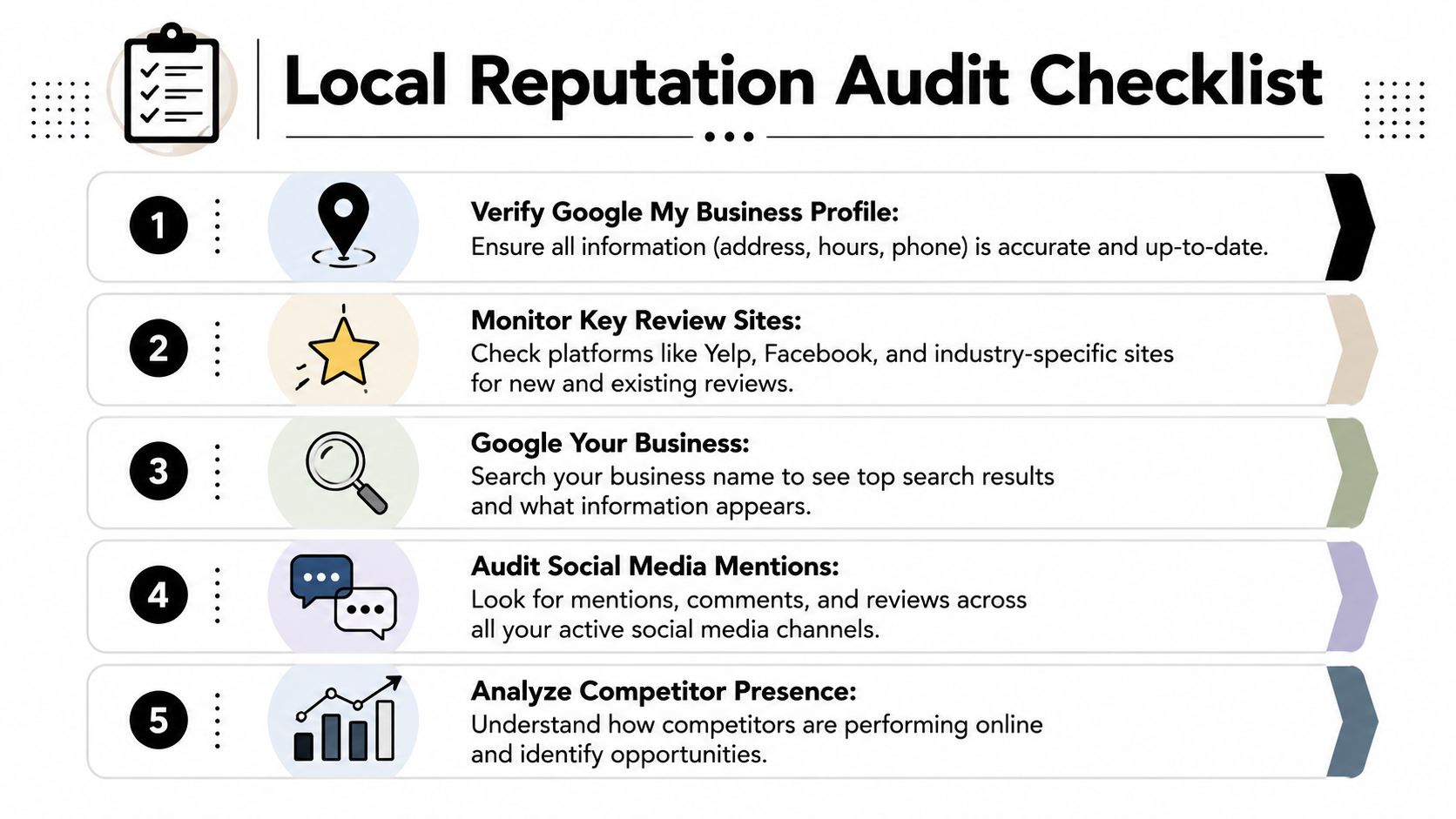
A local reputation audit shows where trust is leaking. Sometimes it's obvious, like a string of unanswered complaints. Sometimes it's boring but expensive, like an old phone number on a directory listing or a weak Google Business Profile category.
Search like a customer, not like the owner
Don't just search your business name once and call it done. Use the phrases a real prospect would use.
Try searches like:
- Brand searches such as your company name, your owner name, and common misspellings.
- Service plus city searches like “plumber Fort Myers,” “roof repair Cape Coral,” or “family lawyer Estero.”
- Reputation searches such as your business name plus “reviews,” “complaints,” or “BBB.”
- Image searches to see whether your trucks, staff photos, or jobsite images support a professional impression.
Open a spreadsheet and log what appears on page one. You're looking for review sites, map listings, social profiles, stale directory pages, and any result that could create confusion.
Audit the places that matter most
Generic ORM advice misses how service businesses win locally. For home services like HVAC or roofing, 68% of consumers check reviews before hiring, yet only 22% of contractors actively manage niche platforms. Businesses that adopt industry-specific strategies can boost local search rankings by up to 35%.
That means a Fort Myers HVAC company shouldn't stop at Google. It should also check the platforms customers use in that category.
Use this checklist:
- Google Business Profile. Verify business name, primary category, service areas, phone number, hours, website link, photos, services, and Q&A.
- Core review platforms. Check Google, Yelp, and Facebook.
- Industry sites. Contractors should review places like Angi or HomeAdvisor if those platforms show up in search results for their services.
- Local directories. Look for inconsistent citations that split trust signals.
- Social mentions. Scan comments and tags, especially if customers use Facebook heavily in your market.
Benchmark against three local competitors
Pick three businesses that keep showing up in map results. Not national chains. Not businesses in another state. Local operators competing for the same calls.
Use a simple comparison table like this:
| Audit point | Your business | Competitor A | Competitor B |
|---|---|---|---|
| Review freshness | |||
| Response quality | |||
| Photo quality | |||
| Service detail on profile | |||
| Niche platform presence |
You'll usually spot one of two problems. Either your reputation is weaker than you thought, or your competitors are doing far less than you assumed. Both are useful.
Don't audit for vanity. Audit to find the next fix that will produce a visible improvement in trust and local visibility.
If you want a structured way to assess your marketing foundations, that kind of framework can help organize what you find. The important part is not the template. It's acting on the gaps fast.
Optimize Your Core Digital Assets
If your foundational listings are messy, more reviews won't fix the underlying problem. They'll sit on top of weak local signals.
This is the part many owners avoid because it feels administrative. It is administrative. It also affects whether Google trusts your business details and whether prospects believe they've found the right company.

Treat your Google Business Profile like a second homepage
For a local service business, your Google Business Profile often gets seen before your website. That makes it a conversion asset, not a listing to “set and forget.”
If I were cleaning up a Fort Myers contractor profile today, I'd work through it in this order:
Choose the closest primary category
Don't pick a broad label because it sounds bigger. Pick the category that matches the core service customers search for.
Complete every field you can
Services, service areas, business description, hours, holiday hours, website link, and appointment or quote options all matter because incomplete profiles create doubt.
Upload photos that prove legitimacy
Use team photos, trucks, jobsite images, before-and-after work, office shots, and branded equipment. Skip stock-looking images when possible.
Build out the services section
A roofer shouldn't just say “roofing.” List roof repair, roof replacement, storm damage work, inspections, and maintenance if those are real services.
Seed the Q&A section
Add common pre-sale questions and answer them clearly. Think about financing, service area, emergency availability, warranty questions, or cleanup process.
A solid reference for this process is Polaris' Google Business Profile optimization checklist. Use it as a working list, not a one-time project.
Fix citation inconsistency before it costs you visibility
NAP means name, address, and phone number. When those details vary across directories, Google gets mixed signals and prospects do too.
Here's what this looks like in real life:
- Your Google profile says “ABC Plumbing LLC”
- Yelp says “ABC Plumbing”
- An old chamber listing uses a prior phone number
- A directory still shows your former office in North Fort Myers
That creates friction. A prospect sees two numbers and wonders which one is right. A search engine sees conflicting data and gets less confident.
Use a simple cleanup workflow
You don't need complicated software to start. A spreadsheet is enough.
Create columns for:
- Directory name
- URL
- Business name shown
- Address shown
- Phone shown
- Website shown
- Status
- Needs update
- Date fixed
Then work through your top listings first. Start with the ones that rank for your branded searches. If you're a law firm in Estero, those might include Google, Yelp, Apple Maps, Facebook, Bing Places, and major legal directories.
A polished profile gets attention. A consistent profile earns trust.
What works and what doesn't
A quick comparison helps here:
| Works | Doesn't work |
|---|---|
| Real project photos | Generic stock photos |
| Accurate service areas | Listing cities you don't actually serve |
| Consistent business info | Multiple versions of your company name |
| Specific service descriptions | Thin profile text with no detail |
| Updated hours and contact info | Old holiday hours and dead links |
This isn't glamorous work. It's foundation work. And once the foundation is clean, every review you earn has more SEO value and more conversion value.
Create a System for Generating Reviews
Most owners ask for reviews when they remember. That's not a strategy. That's luck.
A review system needs timing, ownership, and a repeatable trigger. If those three pieces are in place, reviews come in steadily. If they aren't, the process dies the moment things get busy.

Build the process around your actual customer journey
The best time to ask is right after the customer feels the result.
That moment is different by industry:
- Cleaning company. Ask after the walkthrough or after the client confirms the home looks great.
- HVAC company. Ask after the system is running properly and the technician has explained what was fixed.
- Medical or legal office. Ask after a positive service milestone, while staying compliant with your industry rules.
- Roofing company. Ask after final cleanup and punch-list completion, not while dumpsters are still in the driveway.
Don't ask too early. Don't wait so long the customer forgets the experience.
Assign one owner for the system
When “everyone” owns review requests, no one owns them. One person has to manage the flow.
That person should handle:
- Sending review links
- Checking for new reviews daily
- Following up on missed requests
- Flagging unhappy customers internally before they go public
In a small shop, this might be the office manager. In a larger operation, it might sit with customer service or marketing. The title matters less than the accountability.
If review generation depends on memory, it will fail during your busiest month.
Use copy that sounds human
Here are simple templates that work because they're direct.
Email template for home services
Subject: Quick favor about your service today
Hi [First Name],
Thanks again for choosing [Business Name]. If our team took good care of you today, would you mind leaving a quick review here?
[Review Link]
It helps other homeowners in [City] feel confident about calling us.
Thanks,
[Name]
[Business Name]
SMS template for contractors
Hi [First Name], thanks for choosing [Business Name]. If you have a minute, we'd appreciate a quick Google review about your experience: [Review Link]
Front-desk script for professional services
“We're glad we could help. If your experience was positive, we'd really appreciate a review. I can text you the link now.”
Short wins. Long scripts don't.
Add automation without making it robotic
Software aids the process. A CRM, job management platform, or review tool can send requests after a completed job, paid invoice, or closed appointment.
A practical setup looks like this:
| Trigger | Tool type | Action |
|---|---|---|
| Job marked complete | CRM or FSM tool | Send review SMS |
| Invoice paid | Billing automation | Send review email |
| Positive check-in call | Office workflow | Manual personal ask |
| New review received | Review dashboard | Alert team for response |
If you need tactical ideas for strategies for turning reviews into customers, that resource is worth a look. For local operators, the key is using those ideas inside a workflow your staff can repeat every week.
Later in the process, this walkthrough may help your team standardize requests and follow-up:
Make it easy for customers to say yes
The easier the ask, the more reviews you'll get.
Do these five things:
- Send one direct link so the customer doesn't have to search for your profile.
- Ask from a real person when possible, not a generic “no-reply” account.
- Mention the service so the customer remembers the exact experience.
- Use mobile-friendly channels because many customers will leave the review from their phone.
- Follow up once if they haven't responded.
For businesses that want a more structured approach, Polaris offers a resource on how to get more online reviews. It fits well when you're trying to turn random asks into a consistent system.
Respond to Every Review Professionally
A lot of owners still see review responses as damage control. That's too narrow.
Your response isn't only for the reviewer. It's for every prospect who reads that thread later. A sharp response can reassure a buyer who has never spoken to you. A defensive response can kill trust fast.

What good responses do
Good responses sound like a competent business speaking calmly. They don't sound scripted, angry, or desperate.
I like a simple framework for negative feedback:
A-R-T
- Acknowledge the concern clearly
- Resolve by showing you're taking action
- Take offline so the detailed fix happens privately
That's enough structure to keep your team from reacting emotionally.
Good vs bad examples
Five-star review
Bad response
“Thanks.”
Better response
“Thanks, Sarah. We appreciate you trusting us with your kitchen remodel cleanup. I'm glad the team left everything in good shape and communicated clearly throughout the job.”
Why it works: it sounds specific and confirms the service details future customers care about.
Three-star review
Bad response
“Sorry you feel that way.”
Better response
“Thanks for the feedback, James. We're glad we could help with the AC repair, and we also hear your concern about the arrival window. We're reviewing scheduling communication with the team so expectations are clearer.”
Why it works: it doesn't argue, and it shows the business read the review.
One-star review
Bad response
“That's not what happened. You never mentioned this during the job.”
Better response using A-R-T
“Hi Melissa, we're sorry to hear this. We understand your concern about the cleanup after the roof repair. That's not the standard we aim for. We'd like to make this right. Please contact our office at [phone] and ask for [name] so we can address the issue directly.”
Why it works: it acknowledges the issue, offers resolution, and moves the fix offline.
The wrong review response can create a second problem that's bigger than the original complaint.
Match the response to the industry
The wording should fit the business.
A roofer can mention crew cleanup, scheduling, materials, and final walkthrough. A medical office needs to be more careful and avoid discussing protected patient details. A law firm should avoid language that sounds like it's revealing case specifics.
Here's a simple comparison:
| Business type | Better response focus |
|---|---|
| Home services | Timeliness, workmanship, cleanup, communication |
| Healthcare | Courtesy, scheduling, office process, privacy-safe language |
| Legal | Professionalism, responsiveness, respect, no case details |
| Cleaning | Thoroughness, punctuality, trust, follow-up |
Set response rules your team can actually follow
Create a basic standard operating procedure:
- Respond to positive reviews with thanks and one specific detail.
- Respond to neutral reviews by acknowledging the mixed feedback and naming the improvement area.
- Respond to negative reviews using A-R-T.
- Never argue in public even if the review is unfair.
- Escalate sensitive reviews involving legal, safety, or compliance issues.
If you want help building scripts and escalation rules, Polaris has a practical guide on how to respond to negative reviews.
When software helps
As review volume grows, software becomes useful for alerts, response workflows, and approvals. Some teams use AI-assisted drafting to save time, then have a manager edit for tone and accuracy before posting. That's fine if the final response still sounds human.
The mistake is letting canned replies pile up. Customers can spot that immediately.
Measure What Matters and Prove ROI
If reputation management lives in the “important but hard to measure” bucket, it won't stay a priority. Busy businesses fund what they can connect to calls, booked jobs, and customer acquisition.
That's why measurement matters. Not vanity reporting. Useful reporting.
Start with the simplest business questions
At the end of each month, answer these:
- Did review volume increase?
- Did review quality improve?
- Did response time improve?
- Did Google Business Profile actions increase?
- Did lead quality or close rate feel stronger after reputation improved?
You won't answer every question perfectly on day one. That's fine. The point is building a reporting habit.
Track a small set of KPIs
Don't bury yourself in dashboards. Use a lean scorecard.
| KPI | What to look for | Why it matters |
|---|---|---|
| Review volume | Are new reviews coming in steadily | Shows your system is active |
| Review recency | Are recent reviews visible | Helps buyers trust current quality |
| Average rating trend | Is the trend holding or improving | Reflects customer experience over time |
| Response rate | Are you replying consistently | Shows prospects you're engaged |
| GBP actions | Calls, clicks, direction requests | Indicates local search engagement |
For most Fort Myers service businesses, Google Business Profile insights are the easiest starting point. Pair that with your call tracking, CRM notes, or simple lead logs. You're looking for patterns, not academic perfection.
Correlate activity with outcomes
Here's a practical example.
If your team cleaned up listings, increased review requests, and responded faster this month, check whether branded search behavior, map actions, and inquiry quality improved after that work started. If the answer is yes, you've got a business case to keep going.
This also helps with staffing decisions. If your office manager spends time on review follow-up but your profile becomes more active and leads become easier to close, that's not admin overhead. That's revenue support.
Track behavior before you try to prove causation. Consistent patterns are enough to make better decisions.
Build a monthly one-page report
Keep it simple:
What changed
Example: more reviews requested, responses handled daily, listings correctedWhat customers did
Example: more calls, more direction requests, stronger comment themes in reviewsWhat needs attention
Example: slow responses on weekends, weak review flow from one technician, stale photosWhat happens next
Example: update crew training, improve ask timing, refresh project photos
That report doesn't need to impress a boardroom. It needs to help you decide what to keep, what to fix, and where reputation is helping sales.
If your team needs help turning scattered review work into a practical local growth system, Polaris Marketing Solutions helps Fort Myers and Southwest Florida businesses improve Google Business Profile performance, review generation, local SEO signals, and reporting so reputation management supports real lead flow instead of becoming another unfinished marketing task.