
A lot of contractors in Southwest Florida are stuck in the same loop. Referrals carry the schedule for a while, then the pipeline thins out. One week you're pricing jobs in Fort Myers and Cape Coral nonstop. The next week you're looking at the phone, wondering whether to cut ad spend, chase old estimates, or hope storm season changes the pace.
That kind of lead flow makes it hard to hire, plan crews, or buy equipment with confidence. It also creates bad marketing decisions. Contractors boost a Facebook post, throw money at broad Google keywords, or hire someone who sends a report full of clicks but can't tell them which campaign produced booked work.
Online advertising for contractors works when it's treated like an operating system, not a gamble. In Southwest Florida, that means local intent, tight service-area targeting, landing pages built for mobile callers, and real tracking from click to call to closed job.
Stop Waiting for the Phone to Ring
A roofer in Fort Myers doesn't lose jobs only because another company does better work. Most of the time, they lose because the homeowner never sees them at the right moment. The same thing happens to HVAC companies in Cape Coral, paver crews in Naples, and cleaning businesses across Lee and Collier County. If you aren't visible when someone searches, someone else gets the call.
That matters because there are approximately 1.7 million online searches in the U.S. every month for independent contractors, and trade-specific searches are massive too, including more than 4.2 million for home builders and 1.2 million for roofing services according to contractor marketing search data.
What feast or famine looks like in the field
If you've run a service business, you already know the pattern:
- Busy months hide weak marketing: The schedule fills up from referrals, storm demand, or repeat customers, so ad problems go unnoticed.
- Slow months expose everything: Suddenly the broad keywords, weak website, and bad follow-up process start costing real money.
- Panic spending makes it worse: Contractors start buying random leads or turning on ads with no targeting plan.
I've seen this play out in home service businesses across Southwest Florida. The company owner usually isn't afraid of work. They're afraid of inconsistency. They can sell jobs, run crews, and handle customers. What they can't control is lead flow.
Practical rule: If your marketing only works when people already know your name, you don't have a lead system. You have a reputation system.
Why online ads change the game
Good advertising doesn't replace referrals. It fills the gaps between them. It lets you show up for high-intent searches, stay visible in your service area, and decide where to put budget based on job value instead of guesswork.
For example, a Cape Coral cleaning company might need recurring work in specific neighborhoods instead of low-margin one-time jobs all over the county. In that case, it helps to study how lead quality differs by source before spending more. This guide to qualified cleaning business leads is useful because it focuses on lead quality, not just lead volume, which is the same mindset contractors need in paid advertising.
The shift is simple. Stop asking, "How do I get more clicks?" Start asking, "How do I get more booked jobs in the zip codes I want to serve?"
Choose Your Digital Battlegrounds
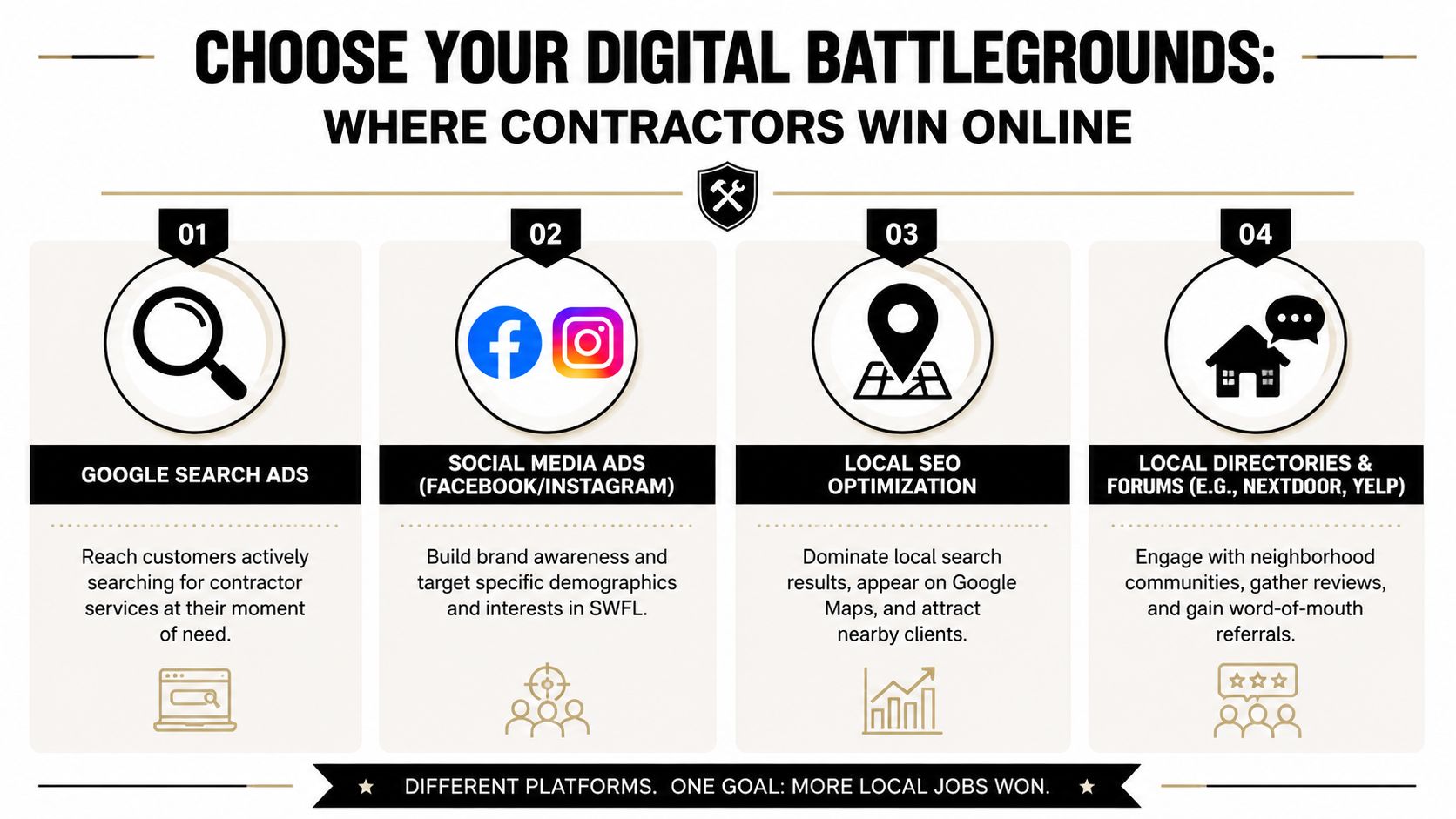
Contractors waste money when they treat every platform the same. They aren't the same. Each one reaches a different buyer at a different stage.
Which platform does what
Google Search Ads capture demand that already exists. Someone in North Fort Myers types in a service, wants help now, and is comparing options.
Google Local Services Ads are different. They lean hard on trust. For contractors, that's often where the quickest calls come from because the format feels local and direct.
Meta ads on Facebook and Instagram are useful, but usually not as a first-touch sales machine for urgent service categories. They work better for visibility, reminders, retargeting, and staying in front of homeowners before they need you.
Nextdoor is more neighborhood-driven. In places like Bonita Springs, Estero, and gated communities throughout Naples, local recommendations carry weight. That makes it valuable for trust-heavy services.
Ad Platform Comparison for Southwest Florida Contractors
| Platform | Best For… | Typical Cost | SWFL Nuance |
|---|---|---|---|
| Google Search Ads | Capturing high-intent searches from people actively looking for service now | Costs vary by keyword competition and market | Strong fit for urgent services like roofing repairs, AC service, plumbing, and water damage work |
| Google Local Services Ads | Trust-led local lead generation with a simpler path to calls | Pricing varies by trade and market | Works well where reviews, proximity, and service reputation matter more than flashy creative |
| Facebook and Instagram Ads | Brand awareness, retargeting, seasonal offers, and showcasing project visuals | Flexible budget range | Useful for reminding homeowners about services before heat, storms, or seasonal maintenance |
| Nextdoor | Hyper-local neighborhood credibility and community referrals | Flexible and localized | Especially relevant in community-oriented SWFL neighborhoods where word-of-mouth still drives decisions |
How I'd use them by trade
For a Fort Myers roofer, I'd put Google Search Ads and Local Services Ads first. Roofing buyers often search with immediate intent, especially after storm activity or when leaks show up. Meta can support with before-and-after project content and retargeting, but I wouldn't make it the main engine for lead flow.
For a Cape Coral HVAC company, Search Ads are strong for emergency and service terms, while Local Services Ads help with trust. Facebook and Instagram become more useful here for maintenance reminders, duct cleaning offers, and retargeting website visitors. If you want a closer look at how that side of the mix works, this page on Facebook ads for contractors is a solid reference for lead generation strategy.
For a Naples remodeling or paver company, the decision gets more nuanced. Search still matters, but the buyer often takes longer to decide. Meta and Nextdoor can support the trust-building side because those buyers compare aesthetics, neighborhood reputation, and previous work.
Google is where people ask for help. Meta is where you stay familiar. Nextdoor is where neighbors validate you.
The trade-off most contractors miss
Contractors love immediacy, which is why they lean toward paid search. That's fair. But a platform isn't good just because it produces leads quickly. It has to produce leads that fit your service area, average ticket, and production schedule.
A Naples pool cage contractor doesn't need cheap clicks from all over the region. They need the right homeowners, in the right communities, at the right point in the decision cycle. That's why choosing digital battlegrounds isn't about chasing the lowest click cost. It's about matching platform behavior to buyer behavior.
Design Your Southwest Florida Targeting Plan
Targeting is where most campaigns either get sharp or sloppy. A contractor can have good reviews, a clean website, and a fair budget, then still burn money by targeting half the state or bidding on searches that don't match the work they want.
Start with search intent, not broad categories
Don't build a campaign around "roofing" or "AC repair" alone. Build it around the way real homeowners search when they need a contractor.
A stronger keyword set looks like this:
- Location plus service: "roof repair Fort Myers" or "AC replacement Cape Coral"
- Urgency plus location: "emergency AC repair North Fort Myers"
- Problem plus service area: "leaking flat roof Naples"
- Project-driven terms: "paver patio installer Estero"
The reason this matters is practical. Effective PPC methodology for contractors includes geographic campaign structure and negative keywords, which can reduce cost-per-click by 20 to 30 percent according to this contractor PPC methodology guide.
Build your service area like an operations map
A lot of owners set targeting too wide because they don't want to miss jobs. Then they pay for clicks from areas they hate servicing.
Use your actual operating reality:
- Primary zone: Towns and zip codes where crews can respond fast and margins are healthy
- Secondary zone: Areas you want, but only for higher-value jobs
- Exclusion zone: Places that create windshield time, low close rates, or scheduling headaches
A Fort Myers-based contractor might prioritize Fort Myers, North Fort Myers, Cape Coral, and Estero first. Naples might stay in a separate campaign with different ad copy and a different budget because the buyer expectations are different there.
If local visibility is part of your long-term mix, local SEO for contractors matters alongside paid traffic, especially when you want your ad targeting and map visibility working together.
Use negative keywords like a filter, not an afterthought
Negative keywords save money fast. They keep your ads from showing on searches that attract DIY traffic, job seekers, bargain hunters, or people outside your actual service.
Common examples include:
- DIY intent: words tied to tutorials, materials, or how-to searches
- Employment intent: jobs, careers, apprenticeships
- Retail intent: product-only shoppers looking for parts or supplies
- Mismatched services: searches adjacent to your trade but not profitable for your business
A roofing company that installs tile and shingle systems shouldn't casually pay for traffic related to unrelated repair types they don't offer. An HVAC company focused on replacement work shouldn't buy broad traffic from people looking for parts.
Tight targeting doesn't shrink opportunity. It removes waste.
Add SWFL seasonality to the setup
Southwest Florida isn't one market. Fort Myers, Cape Coral, Estero, Bonita Springs, and Naples all behave differently. Snowbird-heavy zones often search differently than full-time residential neighborhoods. Post-storm demand can shift service interest fast. New construction pockets can create bursts of interest for pavers, fencing, cleaning, and landscaping.
A practical targeting plan might separate:
- Resident campaigns: year-round homeowners with ongoing maintenance needs
- Seasonal owner campaigns: absentee owners who care about reliability, check-ins, and property protection
- Development campaigns: ads aimed at newer communities where homeowners need multiple exterior services after move-in
For example, if you want to reach homeowners in a fast-growing pocket near Estero or a new residential cluster near Babcock Ranch, build a dedicated campaign with local place references, a matching landing page, and a call-to-action tied to estimates or inspections.
Craft Ads and Landing Pages That Convert
Good targeting gets the click. Good messaging gets the lead. Most contractor ads fail because they sound like every other contractor ad. "Quality service." "Free estimates." "Family owned." None of that is bad, but none of it creates urgency or relevance on its own.
Write ads that sound local and specific
A Southwest Florida homeowner responds to concrete problems. Humidity, salt exposure, storm prep, heat, roof leaks, algae buildup, and insurance concerns are real. Your ad should sound like it knows the area.
Here's the difference.
Weak ad
- Roofing Services
- Free Estimates
- Call Today
Stronger ad
- Roof Repair in Fort Myers
- Fast Response for Leaks and Storm Damage
- Licensed Crew. Local Estimates Available
For HVAC:
Weak ad
- AC Experts Near You
- Great Service and Fair Pricing
Stronger ad
- AC Repair in Cape Coral
- Ready for Peak Heat and Humidity
- Call Now for Fast Local Service
Match the landing page to the search
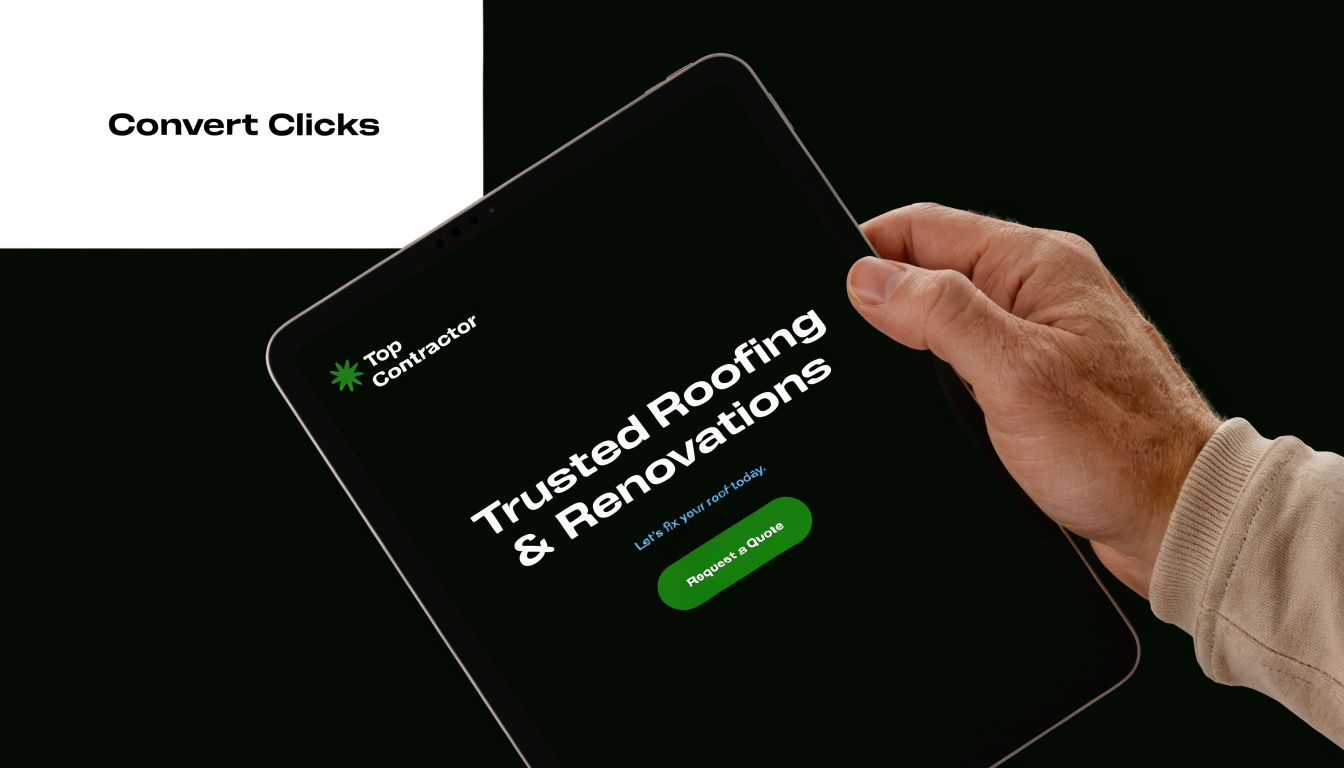
The biggest mistake I see is sending paid traffic to the homepage. Homepages try to do too much. A landing page should do one job.
That page needs to answer five questions immediately:
- What do you do
- Where do you do it
- Why should I trust you
- How do I contact you
- What happens next
A roofer running ads in Naples should have a Naples roofing landing page. Not a general website page that also talks about gutters, siding, windows, and company history.
Field note: When the ad says one thing and the page says five different things, the prospect hesitates. Hesitation kills calls.
Mobile-first isn't optional
Most contractor traffic is mobile, and that changes design decisions. Buttons need to be obvious. Forms need to be short. Phone numbers need to be tap-to-call.
With 78 percent of local mobile searches resulting in an offline purchase, a mobile-first landing page with a clear click-to-call button is essential according to Blue Corona's contractor marketing statistics.
If you want a benchmark for page structure, this collection of examples of high-converting landing pages is helpful because it shows how layout, message match, and CTA placement work together.
A simple landing page checklist:
- Headline match: Repeat the service and location from the ad
- Tap-to-call CTA: Keep it visible without scrolling
- Trust signals: License, insurance, review snippets, service badges
- Local proof: Photos of actual work, neighborhood references, city names
- Short form: Ask only for what the office needs to respond
A quick walkthrough helps visualize what a stronger conversion setup looks like.
Use extensions and assets that remove friction
In Google Ads, use every relevant extension available. Call extensions, location details, sitelinks for service pages, and callouts all make the ad more useful before the click.
For local service businesses, clarity beats cleverness. Homeowners don't need a slogan. They need confidence that you serve their area, solve their problem, and will answer the phone.
Manage Your Budget and Measure Real ROI
A contractor doesn't need a perfect dashboard on day one. They do need a clean way to answer one question. Which ads are producing profitable jobs?

Set a budget you can control
Start with a budget that fits your close rate, average job value, and sales capacity. A campaign isn't healthy if it generates more calls than your office can answer or more estimates than your team can run properly.
Budget control comes from structure:
| Tracking piece | What it tells you | Why it matters |
|---|---|---|
| Campaign spend | Where budget is going | Prevents one service or area from quietly eating the whole account |
| Call tracking | Which ads drive phone leads | Separates real lead sources from vanity traffic |
| Form tracking | Which pages and campaigns create inquiries | Shows whether landing pages are doing their job |
| Closed-job tracking | Which leads became revenue | Lets you cut channels that look busy but don't produce profit |
Track beyond the ad platform
Ad platforms will gladly show you clicks, impressions, and conversions. That's useful, but it isn't enough for a contractor trying to prove ROI.
An effective tracking methodology is essential because 70 percent of contractor ad campaigns fail without proper attribution. The key KPIs are ROAS with a target of 400 to 600 percent and CPA under $150 for high-value leads in trades like HVAC and roofing, according to this advertising measurement framework.
What that means in practice:
- Use call tracking numbers: One for Google Ads, one for Local Services, one for Meta if needed
- Add UTM parameters: So Google Analytics 4 can identify campaign, ad group, and source details
- Log leads inside your CRM: Not just whether someone called, but whether the lead booked, canceled, or closed
- Review by job value: A campaign producing fewer but better jobs may beat a campaign with lots of weak leads
If your follow-up process is messy, your ad data will look worse than it really is. That's why integrating lead sources into your sales workflow matters. For contractors comparing systems, this look at a Revenue-driving construction CRM is useful because it focuses on tying lead handling to actual revenue, not just contact storage.
A simple reporting rhythm that works
Most small contractors don't need fancy reporting. They need consistency.
Review these weekly:
- Lead source quality: Which campaigns produced actual estimate requests or calls worth answering
- Search term quality: Which queries matched the work you want
- Landing page behavior: Where people dropped off or called quickly
- Sales outcome: Which leads turned into scheduled appointments and signed jobs
One practical option in this space is Polaris Marketing Solutions, which offers online analysis, PPC management, local targeting, and reporting for businesses in Fort Myers and nearby Southwest Florida markets. That's useful if you want help connecting ad activity to local lead flow without piecing together multiple vendors.
A campaign can look expensive at the click level and still be profitable at the job level. Contractors who don't track that difference usually cut the wrong ads.
Local Pitfalls and A SWFL Success Story
Running ads isn't the hard part. Running ads without fooling yourself is the hard part. A lot of contractors think the account is working because they see calls, traffic, or a report full of green arrows. Then they look at the bank account and know something's off.
Three expensive mistakes
The first mistake is bidding too broad. If a Cape Coral paver company bids on generic outdoor terms, they'll attract people looking for ideas, materials, or cheap fixes. Broad traffic feels active, but it often clogs the pipeline with low-fit leads.
The second mistake is sending ad traffic to the homepage. A homeowner who clicked on a "Naples driveway paver installation" ad should not land on a general site page with every service under the sun. That's how intent gets diluted.
The third mistake is tracking clicks instead of revenue. In seasonal markets like Southwest Florida, only 22 percent of contractors effectively use call tracking integrated with a CRM to measure true ROI, and over-reliance on simple click metrics is a known pitfall in markets with demand swings, according to Contractor Growth Network's discussion of digital marketing for contractors.
A realistic Cape Coral example
Let's use a hypothetical paver company in Cape Coral. They start where many contractors start. Broad search terms. One campaign for all of Lee County. Ads pointing to the homepage. No distinction between residential and commercial leads. Calls come in, but the owner can't tell which jobs came from paid ads and which came from referrals.
Then the setup changes.
They split campaigns by service intent. Driveways get their own campaign. Patios get their own. Cape Coral stays separate from Naples because project expectations and travel economics aren't the same. Each campaign gets a matching landing page with local photos, service-area language, and one clear CTA.
The office adds call tracking and starts logging every lead by source, estimate status, and outcome. After a few weeks, they notice something important. One campaign doesn't produce the most calls, but it produces the best estimates. Another campaign creates plenty of activity but weak-fit prospects.
That changes budget decisions fast.
The account didn't improve because the contractor spent more. It improved because they finally saw which leads turned into profitable work.
What actually worked
The difference came from discipline:
- Sharper targeting: Service-specific and area-specific campaigns
- Better message match: Ads and landing pages talking about the same thing
- Cleaner operations: Calls tracked, leads logged, jobs connected back to source
- Budget reallocation: Money moved toward high-fit campaigns instead of high-noise campaigns
That's the part most generic advice skips. Online advertising for contractors isn't won by launching ads. It's won by closing the loop between marketing and sales.
If you're in Fort Myers, Cape Coral, Estero, Bonita Springs, or Naples and you're tired of guessing which ads are worth keeping, Polaris Marketing Solutions can help you build a local campaign structure, tighten tracking, and connect ad spend to qualified leads and booked work.