

Most physicians are trying to protect a public reputation with only a tiny amount of public evidence. Studies found the median doctor has just 7 total online reviews in one year and 8 to 10 in the next, which makes a rating unusually fragile when one unhappy patient posts publicly (PMC review data).
That’s why reputation management for doctors isn’t a vanity project. In Fort Myers, Cape Coral, Estero, Bonita Springs, and Naples, patients compare providers fast, often on a phone, often before they ever visit your website. If your listings are incomplete, your Google Business Profile is weak, and your review process is passive, you’re letting chance shape your first impression.
A strong reputation program does three jobs at once. It gives patients confidence, gives staff a repeatable process, and gives the practice more control over what appears when someone searches a doctor’s name.
Build Your Digital Foundation
Patients already use reviews as a front-door filter. Patient behavior surveys show 77% of patients use online reviews as the first step in finding a new doctor, and 72% only consider providers with an average rating of four stars or higher (healthcare reputation management survey summary).
That changes the operating reality for any practice manager in Southwest Florida. You’re not just managing schedules, phones, and patient flow. You’re managing discoverability and trust.

Start with an audit, not a response
Most practices jump straight to “how do we respond to a bad review?” That’s backward. First, find every place the practice and each physician already appear online.
Check:
- Google Business Profile for the practice and, where appropriate, physician listings
- Healthgrades profiles
- Yelp listings
- Apple Maps and Bing Places entries
- Local directory citations that may carry old addresses, wrong hours, or outdated specialties
- Physician name searches that surface third-party pages, old bios, or stale media mentions
Search in a clean browser and use variations a patient would use, such as “family doctor Fort Myers,” “pediatrician near me,” “cardiologist Cape Coral,” and each physician’s full name.
Practical rule: If a listing ranks on page one for your doctor’s name, it deserves active attention whether you like the platform or not.
Claim what you can control
Once you identify the listings, claim and verify them. This is the minimum standard for reputation management for doctors.
Focus on accuracy first:
Practice name consistency
Use the same business name everywhere. Don’t let one listing say “Smith Family Medicine” and another say “Dr. John Smith MD PA” unless there’s a strategic reason.Address and phone consistency
Fort Myers patients get frustrated quickly when they find an old suite number or disconnected line.Office hours and holiday updates
Seasonal traffic and snowbird population swings make accurate hours especially important in Southwest Florida.Provider details
Confirm credentials, specialties, accepted insurance summaries, and appointment links.Alerts and notifications
Turn on review and profile-change alerts so nothing sits unseen for weeks.
A simple spreadsheet is enough at this stage. Track platform, ownership status, login access, profile completeness, current rating, review count, and last update date.
Build a baseline your team can use
A practice manager needs a system, not a memory test. Create one internal document with:
- Platform owners so staff knows who has access
- Brand standards for practice name, doctor naming format, phone number, and address
- Response rules for who handles reviews and when legal or compliance review is required
- Monthly checkpoints for profile accuracy
If you want a broader framework for the discipline itself, this online reputation management guide is useful because it helps teams think beyond reviews and look at the full digital footprint.
In Fort Myers, where patients often compare options across nearby cities, foundation work pays off because it removes confusion before you ever ask for a review.
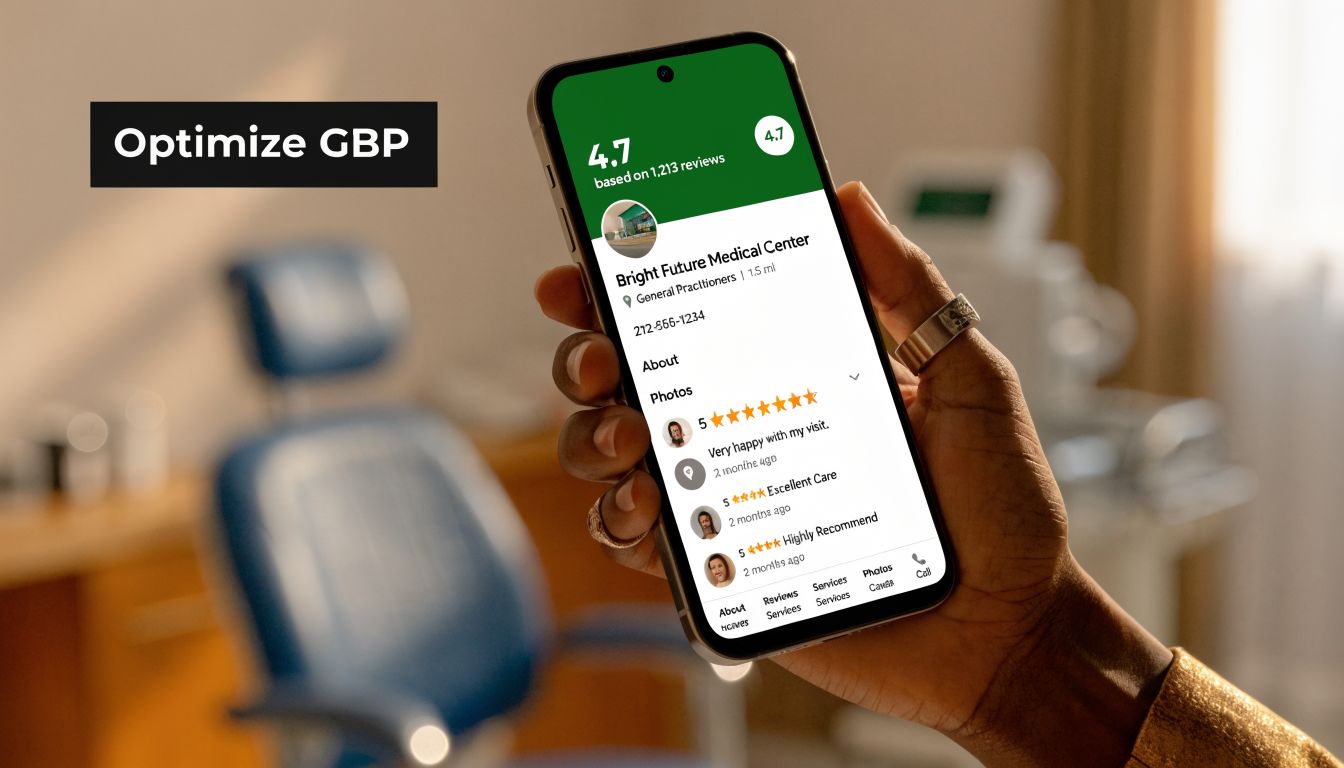
Optimize Your Google Business Profile
Your Google Business Profile is usually the most important listing you own. It shows up in branded searches, map searches, local service queries, and mobile decisions made in seconds.
A weak profile looks unfinished. A strong one answers basic patient questions before they call.
Fill every core field with intent
Don’t treat GBP like a directory listing. Treat it like a patient-acquisition asset.
Use this checklist:
Primary category
Choose the most accurate medical category available. Don’t get clever. Relevance matters more than creativity.Secondary categories
Add supporting categories only if they match actual services.Business description
Write plainly. State specialty, service area, and patient value. A Fort Myers primary care office might mention preventive care, chronic condition management, same-day sick visits, and location convenience.Services section
Add real service lines patients search for. A Naples dermatologist could list skin cancer screenings, acne treatment, cosmetic consultations, and rash evaluation. A Cape Coral family practice could list annual physicals, diabetes management, school physicals, and women’s wellness visits.Appointment link
Make booking easy. If your scheduling process is clunky, your profile underperforms.Hours
Include special hours when needed. Patients notice accuracy.
Use photos that reduce friction
Most medical profiles are overloaded with logos and underloaded with trust signals. Patients want to see the place, the people, and the experience.
Upload:
- Exterior photos so new patients recognize the building
- Lobby and reception images that lower anxiety
- Exam room photos that show cleanliness and professionalism
- Physician headshots that match your website bios
- Staff photos if they’re polished and consistent with your brand
Skip anything generic, heavily filtered, or stock-looking. In healthcare, credibility comes from clarity.
A good GBP photo set answers a patient’s silent questions: Will I find the office easily? Does this place look organized? Do these people seem professional?
Write your own Q and A before patients do
The Q&A feature is underused by medical practices. It’s one of the easiest ways to pre-handle patient uncertainty.
Add practical questions such as:
- Do you accept new patients?
- Do you offer same-day appointments?
- What ages do you treat?
- Is parking available on site?
- Do you provide telehealth visits?
- What should patients bring to their first appointment?
Keep answers general and operational. Don’t include anything that could create a privacy issue or imply individualized medical advice.
A short walkthrough can help if your team hasn’t worked inside GBP much:
Match the profile to local search behavior
Fort Myers patients don’t always search by physician name. Many search by condition, insurance, convenience, or geography. Your profile should reflect that reality.
Examples:
- A cardiology group may emphasize hospital proximity and follow-up care coordination.
- A pediatric practice may highlight friendly staff, easy parking, and same-week new patient visits.
- A specialist serving retirees may make accessibility details more visible.
- A multilingual office should clearly note language support in appropriate fields and imagery.
Review the profile monthly. Check for user-suggested edits, outdated hours, missing photos, and unanswered questions. Reputation management for doctors gets much easier when the main profile already looks trustworthy before the patient reads a single review.
Systematically Generate Positive Patient Reviews
Fort Myers practices rarely have a rating problem first. They usually have a volume problem.
As noted earlier, many physicians have so few reviews that one unhappy patient can distort the public picture for months. That is why review generation needs to be an operating procedure, not a once-in-a-while request from a physician who happens to remember.
Ask at the right moment
The best time to request a review is right after a patient interaction that felt organized, respectful, and complete. For most practices, that means checkout or a same-day follow-up message. Waiting a week lowers response rates. Asking before the patient has finished the visit creates friction.
Use a simple process:
Verbal ask at checkout
Front desk staff can say: “Thank you for coming in today. If you’d like to share feedback about your experience, we’d appreciate a Google review.”Short follow-up text or email
Send it shortly after the visit and link directly to the review page.QR code at reception
This helps patients who prefer to handle it on their phone before they leave.Patient portal message
If your office already uses the portal consistently, add review requests there instead of creating another channel.
In Fort Myers, convenience matters. Retirees, seasonal residents, working parents, and multilingual households all respond a little differently. A pediatric office near Gateway may get better results from text. A specialty group serving older patients in South Fort Myers may see stronger response rates from email and printed checkout cards. Match the method to the patient mix.
Keep every request HIPAA-safe
Review requests should stay operational and generic. Do not mention a diagnosis, procedure, provider specialty, or anything that confirms the person received care.
Approved examples:
Email example
“Thank you for visiting our practice. We value your feedback. If you’d like to share your experience, you can leave a review here.”Text example
“Thanks for choosing our office. We’d appreciate your feedback if you’d like to leave a review.”
That wording protects the practice and makes staff training easier. It also avoids a common mistake in healthcare marketing: trying to sound warm by adding details that should never appear in a public-facing message.
Build the system around staff behavior
Review generation succeeds or fails at the front desk.
If one receptionist asks and another skips it, volume stays flat. If the physician is expected to carry the whole process, it breaks the first time clinic runs behind. The fix is a short script, a trigger inside the workflow, and one person who checks that messages were sent.
A practical setup for a Southwest Florida practice looks like this:
- Checkout staff gives the same approved verbal prompt
- The system sends a same-day or next-day review request
- An office manager spot-checks delivery each week
- Leadership reviews review volume by provider and location each month
For a more detailed operations guide, this walkthrough on how to get more online reviews is useful because it shows how to make review requests part of normal practice flow instead of a campaign that fades out.
What works, and what creates problems
Some tactics produce steady growth. Others create legal risk, staff resistance, or reviews that sound unnatural.
What works
- asking consistently
- keeping the message short
- sending patients directly to the review page
- training staff on one approved script
- tailoring the channel to the patient population
- offering English and Spanish request templates when that fits the market
What backfires
- asking only after a bad review appears
- offering incentives
- using language that sounds promotional
- sending requests that mention treatment details
- putting the task entirely on physicians
- filtering patients by sentiment before requesting feedback
That last point matters. Many reputation platforms push practices toward selective review requests. Healthcare groups need to be careful here, especially if the process looks manipulative or conflicts with platform rules.
If your team is reviewing software or refining policy, these Sight AI review management insights are worth reading. They do a good job explaining how review workflows and response processes affect trust.
In this market, steady review growth protects referrals, supports local search visibility, and gives one angry post less power over your public reputation.
Respond to Every Review The Right Way
Silence sends a message. Patients read it as indifference.
That’s why review responses matter beyond customer service. Data shows 78% of patients feel a doctor who responds to reviews cares more about their patients, and a one-star increase in average rating can lead to a 5 to 9% increase in patient volume (review response and patient volume benchmarks).
The response rule most practices miss
A public review response is not mainly for the reviewer. It’s for the next patient reading the exchange.
That changes the tone immediately. You’re not trying to win an argument. You’re showing professionalism, restraint, and process.
Keep every reply:
- short
- polite
- free of PHI
- consistent with office policy
- written as if a referral partner might read it
For teams refining their approach, these Sight AI review management insights are useful because they break down why wording and timing shape perception.
Use templates, but don’t sound robotic
A template is a guardrail. It shouldn’t read like a copied press release.
Here are safe starting points.
| Review Type | Response Template |
|---|---|
| Positive review | Thank you for your kind feedback. Our team appreciates you taking the time to share your experience. We’re committed to providing thoughtful, professional care and are grateful for your trust. |
| Positive review mentioning staff | Thank you for your feedback. We’re glad our team made a strong impression. We appreciate you sharing your experience and look forward to continuing to serve our community with care and professionalism. |
| Neutral review | Thank you for taking the time to share your feedback. We value hearing from patients and use comments like yours to improve the experience we provide. |
| Negative review with no clear detail | Thank you for sharing your feedback. We take concerns seriously and aim to provide every patient with a respectful, professional experience. Because we value privacy, we can’t discuss specifics here, but we welcome you to contact our office so we can learn more. |
| Negative review about communication or wait time | Thank you for your feedback. We’re sorry to hear your experience didn’t meet expectations. We work hard to provide clear communication and timely service, and we appreciate comments that help us improve. Please contact our office if you’d like to discuss your concerns directly. |
| Possibly inaccurate or inflammatory review | Thank you for your comment. We’re committed to patient privacy and can’t address individual matters in a public forum. We encourage you to contact the office directly so concerns can be reviewed through the appropriate process. |
What to avoid every time
Many bad responses come from one of three mistakes.
First, the office confirms the reviewer was a patient. That creates risk. Even saying “we’re sorry your treatment took longer than expected” can cross a line.
Second, the writer gets defensive. Public arguments almost always make the practice look worse.
Third, the reply is too generic to feel sincere. “We strive for excellence” isn’t harmful, but it doesn’t sound human.
A compliant review response protects privacy, acknowledges the concern, and moves the conversation offline.
A practical workflow for the office manager
Use a simple triage system:
Routine positive reviews
Staff can answer using approved templates.Routine negative reviews
Office manager reviews before posting.Clinical allegations, billing disputes, discrimination claims, or legal threats
Escalate internally before any public response.
Set one standard turnaround target and make someone accountable for it. Review management fails when everyone assumes someone else is watching.
If your team is dealing with sharper criticism, this guide on how to respond to negative reviews is a useful companion for escalation and tone control.
In Fort Myers healthcare marketing, the best responders aren’t the most eloquent. They’re the most disciplined.
Use SEO to Build a Protective Digital Moat
A physician’s reputation is shaped long before a patient calls the office. In Fort Myers, branded searches often pull up a mix of practice pages, directory listings, hospital affiliations, old bios, and third-party websites. If those results are thin, outdated, or inconsistent, the practice loses control of first impressions.
SEO helps a practice control more of that first page with accurate, useful assets. For doctors, that matters because search results often influence trust before any staff member speaks to the patient.
Own more of the branded search results
Start with branded search coverage. A query like “Dr. Jane Smith Fort Myers” should return a set of results that confirms who the physician is, where she practices, what she treats, and how to contact the office.
That usually means building and maintaining:
- A physician bio page with current credentials, specialties, accepted insurance details where appropriate, and a clear call to action
- A location page for the office tied to local search intent
- A complete Google Business Profile
- Accurate directory listings across major healthcare and local platforms
- Specialty content connected to the physician’s actual services
- Local authority signals such as media coverage, speaking engagements, or community involvement
This work does not erase legitimate criticism. It gives patients better information faster, which is often the difference between a booked appointment and a bounce back to search.
Publish content that matches how patients search
A bare-bones website leaves too much room for weaker third-party results to rank. The fix is simple, but it takes discipline.
Publish pages that answer the questions patients ask before they schedule:
- Condition and treatment pages in plain language
- FAQ pages covering referrals, insurance, preparation, follow-up, and office policies
- Short articles tied to local concerns, seasonal issues, and common care decisions
- Provider spotlight pages that explain clinical focus, training, and communication style
In Southwest Florida, local context matters. A Fort Myers primary care practice may need pages on annual wellness visits, chronic disease follow-up, and care continuity for seasonal residents. A specialist may need content that explains referral timelines, imaging requirements, or what a caregiver should bring to the first appointment.
Build trust with visible cultural competence
In this market, cultural competence is part of reputation management.
Practices serving Fort Myers and the surrounding area often care for retirees, working families, Spanish-speaking households, and patients who rely on adult children or caregivers during appointments. The website should reflect that reality. Include language access information where relevant, use imagery that matches the community, and explain processes in a way that older adults and caregivers can act on quickly.
The operational trade-off is real. Content written for clarity and accessibility takes longer to produce than generic service pages. It also tends to perform better, reduce confusion, and support stronger patient experiences once people arrive in the office.
If your website says “patient-centered” but your content ignores how different patients seek out and experience care, patients notice the disconnect.
Support reputation work with local SEO discipline
Reputation management gets stronger when local SEO is handled with the same consistency as review monitoring. That includes citation accuracy, internal linking, physician-location alignment, and city-specific service pages where they make sense.
A multi-location group in Southwest Florida usually needs a tighter structure than a single-office practice. That is why many groups benefit from a focused plan for local SEO for medical practices, especially when they are competing across Fort Myers, Cape Coral, Naples, and nearby communities.
Search visibility is also changing as patients use AI tools to research providers and treatment options. The primer on What Is LLMO gives a useful explanation of how content structure and authority affect AI-driven discovery, which has direct implications for physician reputation online.
The goal is consistency across every result a patient sees. Correct facts. Clear specialties. Strong local relevance. Content that answers real questions. That combination makes a practice harder to displace in search and harder to misjudge from a quick Google search.
Measure Success and Know When to Hire an Expert
Reputation management for doctors only works if someone tracks outcomes. Otherwise the practice is just staying busy.
The right scorecard doesn’t need to be complicated, but it does need to be consistent.
What to track every month
Use a report that covers trendlines, not isolated snapshots.
Track:
Average rating by platform
Look for direction, not drama over one review.Review volume by provider and location
This helps you spot gaps between physicians, offices, or service lines.Review velocity
Freshness matters. An old profile can look neglected even if the rating is solid.Response rate and response speed
If replies are inconsistent, your process isn’t stable.Common themes in reviews
Watch for recurring mentions of front desk experience, wait time, scheduling, billing confusion, bedside manner, or communication.

What a useful report actually tells you
A good report answers management questions fast:
- Which physician profiles need attention?
- Which location is generating the strongest patient sentiment?
- Are review requests being sent consistently?
- Are negative themes operational or reputational?
- Are branded search results improving or getting messier?
If a report only lists star ratings and screenshots, it’s not enough. The office manager needs interpretation and next actions.
For example, if one Fort Myers office receives repeated complaints about phone responsiveness, that’s not a copywriting problem. It’s an operations problem with a reputation symptom. If another provider has a good in-office reputation but weak public visibility, the issue may be low review capture and thin branded search coverage.
Know when DIY stops being efficient
Some reputation issues are manageable in-house. Others need outside help because the cost of mishandling them is too high.
You should strongly consider expert support when:
- Negative reviews arrive in clusters
- A physician’s name surfaces outdated or harmful search results
- A complaint raises legal, regulatory, or discrimination concerns
- The practice operates across several locations and no one owns the process
- The office manager is spending too much time coordinating platforms manually
High-stakes matters deserve special attention. Patients increasingly search a doctor’s name plus “lawsuit,” and proactive SEO and reputation work can reduce the visibility of those legal records by over 40%, though that often requires professional help beyond a typical practice manager’s scope (online legal-reputation risk discussion).
Some problems are review-management problems. Others are search-result-control problems. Treating them the same way wastes time.
How to evaluate an agency in the Fort Myers market
Ask direct questions:
- Who writes the response playbooks?
- How do you handle HIPAA-sensitive review workflows?
- What happens when a legal issue appears in search?
- How do you report progress on review volume, ratings, and branded search visibility?
- Who owns the listings, logins, and assets?
- What changes will you recommend for both SEO and patient experience?
A credible partner should talk about process, compliance, content control, local search, and reporting. They shouldn’t promise to “erase” criticism or flood the internet with fake positivity.
The best agencies help the practice create a durable system. That’s what turns reputation management from reactive cleanup into a stable growth channel.
If your practice in Fort Myers or the wider Southwest Florida market needs a clearer system for reviews, local search visibility, and physician brand protection, Polaris Marketing Solutions can help you assess where your reputation stands and where the biggest opportunities are. Their team works with local businesses on SEO, review management, and reporting that ties digital visibility back to real patient acquisition goals.