
A lot of Fort Myers business owners are in the same spot right now. You’re spending money on boosted posts, a few ads, maybe a flyer run, maybe a website update, and you still can’t clearly answer one simple question: what’s bringing in customers?
That problem gets expensive fast for service businesses. A roofing company in Cape Coral, an HVAC shop in Estero, a cleaning company in Fort Myers, or a law office in Naples can burn through a modest budget on scattered tactics that never turn into steady lead flow. The issue usually isn’t effort. It’s lack of focus.
I’ve seen this from the operator side, not just the marketing side. Small business owners don’t need another list of trendy ideas. They need affordable marketing for small businesses that fits real-world constraints: limited time, limited staff, uneven seasonality, and pressure to make every dollar work.
Your Guide to Smart, Affordable Small Business Marketing
If your marketing feels random, it probably is. One week you’re posting on Facebook. The next week you’re paying for ads. Then you ask a friend to “do SEO,” and nothing changes except your frustration.

Affordable marketing works when you stop treating every channel like a separate project and start treating marketing like a system. For a local service business in Southwest Florida, that system usually starts with three things: a clear goal, a strong local presence, and a short list of repeatable actions you can keep doing.
That also means tracking cost, not just activity. If you’re trying to optimize your Cost Per Customer Acquisition (CPA), you need to know which channels are producing calls, quote requests, and booked jobs, not just likes or website visits. Vanity metrics don’t pay payroll.
A practical local strategy usually leans on low-cost assets you control: your Google Business Profile, your website, your reviews, your email list, and your customer base. If you need a broader framework for that mix, this guide to digital marketing strategies for small businesses is a useful companion.
Practical rule: If a tactic takes money every month but doesn’t build an asset you own, treat it carefully.
The businesses that stay visible in Fort Myers aren’t always the ones with the biggest budgets. They’re often the ones with the clearest message, the strongest local signals, and the discipline to keep doing the basics well.
Build Your Marketing Foundation Before You Spend a Dollar
A Fort Myers service business can burn through a month of marketing budget fast. One boost on Facebook, a few Google clicks, a coupon mailer, and a part-time assistant posting to Instagram. Then the phone stays quiet because the underlying problem was never reach. It was a weak foundation.
Before you spend on promotion, get clear on what you are trying to produce, who you want more of, and how you will know a lead was worth the money. That prep work matters even more in Southwest Florida, where service businesses often juggle seasonal demand, storm-related spikes, and wide service areas from Cape Coral to Naples.

Start with one clear local goal
“Get more customers” does not help you choose a channel, write an offer, or judge results.
A usable goal includes five parts:
Specific result
Example: generate qualified AC repair leads.Geographic area
Example: Fort Myers, Estero, or Cape Coral.Time frame
Example: within the next 90 days.Lead quality standard
Example: homeowners requesting service, not price shoppers outside your area.Tracking method
Example: form submissions, calls, booked estimates, or service requests.
A strong version sounds like this: generate qualified HVAC repair inquiries from Estero homeowners within 90 days through local search, review generation, and follow-up email.
That kind of goal saves money because it rules out bad fits early. If the goal is repair calls in Fort Myers, broad awareness campaigns across all of Lee and Collier County can wait.
This is the first step in any workable 30/60/90-day plan. The first 30 days should tighten the target before you add spend.
Know exactly who you want more of
A lot of owners already know their best customers. They just have not defined them clearly enough to market to them on purpose.
If you run a landscaping company in Naples, your best customer may be a homeowner in a gated community who wants recurring maintenance and fast communication. If you own a cleaning company in Fort Myers, the better fit may be property managers and vacation rental owners, not one-time residential jobs. If you are a plumber in Cape Coral, your best leads may come from older homes with urgent repair needs, not new construction.
Use a short customer profile:
- Location: Fort Myers, Cape Coral, Bonita Springs, Naples
- Property type: homeowner, condo owner, office manager, storefront tenant
- Urgency level: emergency service, planned project, recurring maintenance
- Decision trigger: storm damage, system failure, moving, seasonal upkeep
- Main objection: price, trust, speed, scheduling, proof of quality
That profile shapes everything that follows. Your homepage gets sharper. Your reviews become more relevant. Your offers stop sounding generic.
The cheapest lead is usually the one you qualify before you pay to attract it.
Check your top three local competitors
Skip the giant spreadsheet. A practical review is enough.
Pick three businesses that show up often in your service area and compare what a customer sees first:
- Google Business Profile strength: photos, review volume, response quality, service descriptions
- Website clarity: whether the homepage explains what they do and where they work within a few seconds
- Location pages: whether they target Fort Myers, Cape Coral, Estero, or Naples individually
- Offers: free estimates, financing, seasonal inspections, maintenance plans
- Proof: reviews, before-and-after photos, trust badges, project galleries
This exercise usually reveals one of two problems. Either the competitor has stronger proof, or they explain their value faster. In plenty of local markets, the business winning the click is not the best operator. It is the clearest one.
If you want a simple worksheet to organize spending decisions, a small business budget template can help you map out fixed costs, flexible marketing spend, and what you are willing to test without guessing.
Set a budget you can sustain for 90 days
Small business marketing breaks down when the budget changes every week. One month of effort rarely tells you much, especially for local service businesses where response rates can swing with weather, tourism, and season.
A better approach is to set a number you can sustain for the next 90 days, then match the channel mix to that amount. For many Southwest Florida service businesses, that means starting with owned assets and low-cost follow-up before paying for cold traffic. The goal is consistency, not activity for its own sake.
Here is the trade-off I see all the time. Owners either spend too little to gather any signal, or they spend too much before the message and tracking are ready. Both mistakes are expensive.
Pick fewer channels and define your scorecard
Under budget pressure, fewer channels usually produce better results.
For many service businesses, a solid starter mix looks like this:
- Local visibility: Google Business Profile and local SEO
- Relationship: email or text follow-up
- Proof: reviews and project photos
Then set a scorecard tied to revenue, not vanity metrics. Good KPIs include:
- qualified calls
- estimate requests
- booked jobs
- referral leads
- repeat inquiries
- close rate by lead source
If you need a practical baseline before changing anything, this small business SEO checklist is useful for spotting the obvious issues first.
That foundation gives the 30/60/90-day roadmap something to build on. Without it, even affordable marketing gets expensive fast.
Master Your Free Local Digital Footprint
For most local businesses, the most valuable free marketing asset is your Google Business Profile. Not your logo. Not your latest social post. Not your business card.
When someone in Fort Myers searches for “roof repair near me” or “family lawyer Naples,” Google often shows the map pack before anything else. If your profile is incomplete, outdated, or inactive, you’re giving away local intent to competitors.
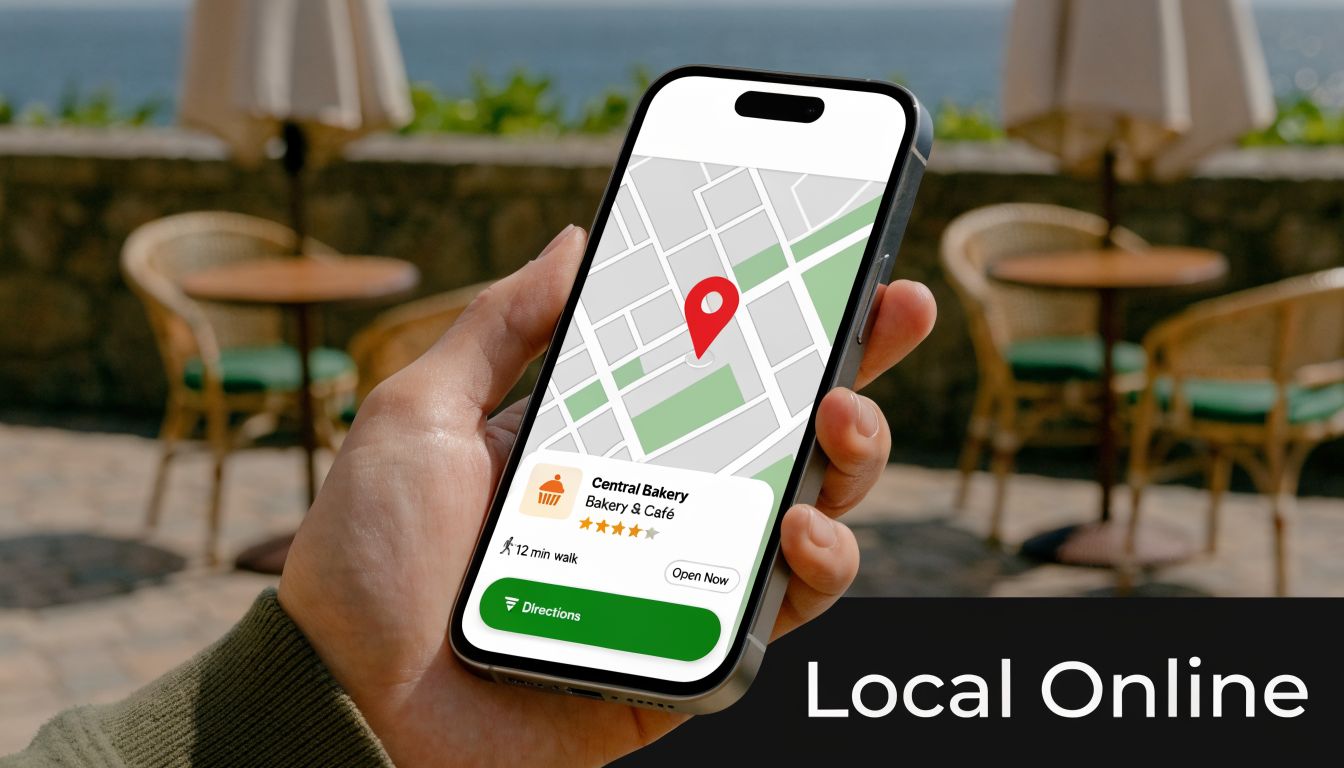
According to Elevated Marketing Solutions’ local visibility guide, optimized Google Business Profile listings can boost local search visibility by up to 70%. For home services in competitive markets like Fort Myers, a well-managed GBP can generate 2 to 3 times more qualified local leads than broad social media efforts, and 46% of all Google searches now have local intent.
Treat your Google Business Profile like a sales page
A claimed profile isn’t an optimized profile. A lot of owners stop at name, phone, and hours. That’s not enough.
For an HVAC contractor in Estero, a strong profile should include:
- Accurate primary and secondary categories: Choose the main service carefully. Don’t dilute the profile with irrelevant categories.
- Service areas: List the actual places you serve, such as Fort Myers, Estero, Bonita Springs, Cape Coral, and Naples if those are active areas.
- Services section: Add specific services like AC repair, maintenance, ductless installation, thermostat replacement, and emergency service.
- Business description: Write plain, local copy. State what you do, who you serve, and where you work.
- Photos: Upload recent jobsite images, team photos, trucks, before-and-after shots, and office photos if applicable.
- Hours and special hours: Update them before holidays and storm-related disruptions.
- Q&A: Seed common questions with useful answers. A Fort Myers law office could answer “Do you offer consultations?” or “What areas do you serve?”
- Posts: Publish updates, seasonal reminders, service promotions, or community involvement.
If you want a practical reference point, this list of local listing sites can help you identify the places where your business information should stay consistent beyond Google.
Reviews are part of visibility and conversion
A lot of businesses ask for reviews only when they remember. That approach produces long gaps, inconsistent quality, and missed trust signals.
Review generation works better when it’s built into the job workflow. Ask after a successful outcome, not days later when the customer has moved on.
Here are simple review request scripts you can adapt:
For home services at job completion:
“Thanks again for having us out today. If the service went well, would you mind leaving a quick Google review? It helps local homeowners find us.”For professional services after a resolved matter or milestone:
“We appreciate the opportunity to help. If you’re comfortable sharing your experience, a short Google review would mean a lot to our team.”For recurring service businesses:
“You’ve worked with us for a while now. If you’ve been happy with the consistency, we’d be grateful for a review.”
Don’t overcomplicate the ask. Make it easy. Send the direct review link by text or email while the experience is still fresh.
A review request should feel like the final step of good service, not a separate marketing campaign.
Respond to every review like a local business owner
Owners often underestimate how many prospects read responses, especially on negative reviews.
For positive reviews:
- thank the customer by first name if appropriate
- mention the service performed
- reinforce your service area or specialty naturally
For negative reviews:
- stay calm
- acknowledge the issue
- invite an offline resolution
- never argue in public
Bad response:
- defensive
- vague
- dismissive
Better response:
- “Thanks for the feedback. We’re sorry the scheduling experience didn’t meet expectations. We’ve reached out directly to make this right.”
That answer isn’t just for the unhappy customer. It’s for the next prospect comparing three companies.
Clean up your citations
Citations are listings of your business name, address, phone number, and related details across directories and platforms. Problems show up when one listing has an old phone number, another uses a different business name, and a third still points to your former address.
That inconsistency weakens trust and can create friction for customers trying to contact you.
Focus first on:
- Google Business Profile
- Apple Maps
- Bing Places
- major local and industry directories
- chamber or association listings if relevant
Then audit the basics:
- business name matches everywhere
- phone number is consistent
- address is consistent if you serve from a public location
- website URL is correct
- categories align with your actual service
A small local company doesn’t need a fancy citation strategy to start. It needs accuracy.
Use posts and photos to stay active
Profiles that sit untouched look neglected. That matters.
A Fort Myers roofer can post:
- recent storm-related inspection availability
- before-and-after repair photos
- service reminders before hurricane season
- financing or estimate updates
A Naples med spa can post:
- treatment FAQs
- provider introductions
- appointment reminders
- seasonal skin care guidance
This walkthrough is worth watching if you want to see profile setup and optimization in action before updating your own listing.
The main point is simple. Your free local digital footprint should answer three questions immediately: what do you do, where do you do it, and why should someone trust you?
Implement High-Impact Low-Cost Marketing Channels
Once your local foundation is solid, the next job is creating repeatable activity that keeps leads moving. At this stage, many businesses get distracted. They chase whatever platform feels active instead of choosing channels that match buyer behavior.
For service businesses, low-cost channels work best when each one has a job. Your content answers questions. Your social proof shows the work. Your email follow-up closes the loop.
Content that earns trust before the call
Content marketing for local businesses doesn’t need to be complicated. It needs to be useful.
A Naples roofing company doesn’t need to publish abstract thought leadership. It needs articles and pages that answer the exact questions homeowners type into Google or ask on the phone:
- how to tell if storm damage requires repair
- what to do after a roof leak
- what affects the cost of replacement
- when to repair versus replace
A Fort Myers family law office can do the same:
- what to bring to an initial consultation
- how contested and uncontested divorce differ
- what clients should expect during the first stage of the process
The best low-cost content usually starts with your front desk, estimator, service manager, or inbox. Every repeated question is a topic.
If a prospect asks the same question three times in a month, it probably deserves its own page, email, or video.
A simple content rhythm works:
- one service page improvement each month
- one short FAQ article
- one photo-based project update
- one email built from that same material
That repurposing matters because it keeps effort under control.
Be selective with social media
Social media wastes money when it becomes a habit with no strategy behind it. A lot of owners post because they think they’re supposed to, not because the platform supports how their customers choose vendors.
For many Southwest Florida service businesses:
- Facebook works well for community visibility, neighborhood credibility, and local recommendations.
- Instagram works well when visual proof matters, such as landscaping, remodeling, roofing, med spa services, or detailing.
- TikTok or Reels can work if you can consistently show short, useful, local video content.
What usually doesn’t work is trying to maintain five platforms badly.
Use social media for:
- before-and-after work
- quick educational clips
- team introductions
- review screenshots
- seasonal reminders
- local event participation
Don’t use it as your main business foundation. Social platforms are borrowed space. Your profile, website, and email list are owned assets.
Email is still one of the best bargains in small business marketing
Email remains one of the strongest channels for affordable marketing for small businesses because it’s direct, low-cost, and useful at every stage of the customer relationship. According to LocaliQ’s small business marketing statistics, email marketing delivers $36 to $40 for every $1 spent. The same source notes that 54% of marketers use email to distribute content and 72% use it across the entire customer journey.
That matters for local service businesses because not every lead books immediately. Some compare vendors. Some wait until payday. Some need a reminder when the issue becomes urgent again.
A basic three-email sequence is enough to start.
A simple three-email lead sequence
Email one: fast response
Send soon after the inquiry. Thank them, confirm the service area, and explain the next step. Keep it short.
Email two: trust builder
Share what makes your process reliable. Include a review, a project photo, or a short explanation of how your team handles estimates, scheduling, or service visits.
Email three: decision nudge
Address the common hesitation. That may be timing, uncertainty, or fear of being oversold. Invite them to reply with questions or book.
Here’s what that might look like for a Fort Myers AC company:
- Email one subject: Thanks for reaching out about your AC issue
- Email two subject: What to expect when we inspect your system
- Email three subject: Need help deciding on repair or replacement?
That same structure works for cleaners, roofers, med spas, dentists, and legal offices. The wording changes. The logic doesn’t.
Build your list ethically and keep it useful
Don’t buy lists. Don’t scrape contacts. Don’t add people who never asked to hear from you.
Collect emails from:
- estimate forms
- service requests
- website pop-ups with real value
- post-service follow-up
- local event signups
- referral program invitations
Then send things people can use:
- maintenance reminders
- service area updates
- seasonal prep guidance
- FAQ answers
- limited promotions
- referral invitations
If execution is your bottleneck, not strategy, this guide on hiring a virtual assistant for internet marketing can help you delegate repetitive tasks like scheduling posts, organizing lead follow-up, or updating email lists without turning your office into a marketing department.
Your 30-60-90 Day Affordable Marketing Roadmap
A lot of Southwest Florida service businesses hit the same wall around month two. The phone is ringing some weeks, quiet the next, and the owner keeps asking whether the answer is Google Ads, Facebook posts, yard signs, email, or referrals. Usually, the actual problem is simpler. There is no sequence.
A Fort Myers plumber, a Cape Coral house cleaner, and a Naples med spa should not all spend the same way, but they do need the same discipline. Get the basics in place first. Add one or two low-cost channels next. Test paid traffic only after the business can track what happens to a lead.
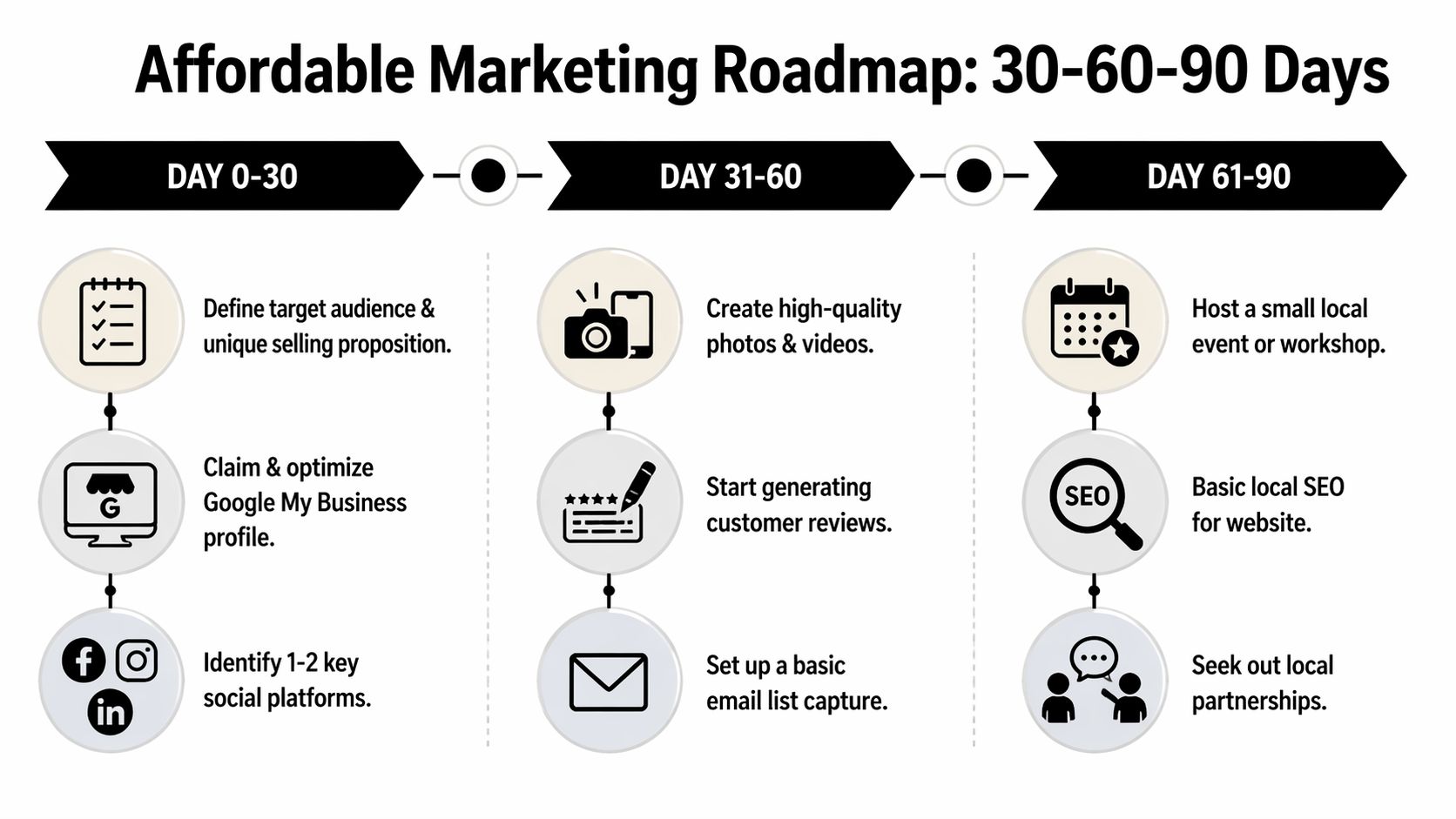
Days 1 through 30
Month one is about getting control of what already exists. Before spending on promotion, make sure a prospect in Fort Myers or Bonita Springs can find you, understand what you do, and contact you without confusion.
Priority actions:
- Pick one primary offer: emergency repair, free estimate, recurring maintenance plan, or consultation
- Choose one priority service area: start with Fort Myers, Cape Coral, or Naples instead of trying to cover all of Southwest Florida at once
- Clean up your Google Business Profile: categories, services, photos, hours, business description, and Q&A
- Set a review request routine: send a text or email after every completed job
- Fix core website pages: clear headline, clear service area, strong call to action, working contact forms, mobile-friendly layout
- Track leads: phone calls, form fills, booked jobs, and how each lead found you
- Add email capture where it makes sense: estimate requests, contact forms, and service follow-up
Skip the temptation to do everything.
Hold off on broad ad campaigns, daily posting across every platform, and expensive branding work that does nothing to improve calls or booked jobs. In the first 30 days, the goal is clarity and follow-through.
Days 31 through 60
Month two is where momentum starts to show, if month one was done right. Now there is a base to build on.
Focus on a short list:
- publish two useful pieces of content, such as an FAQ post or a city-specific service page support article
- post real project photos, review screenshots, or before-and-after results on one or two platforms
- send a simple email sequence to new inquiries who did not book right away
- collect customer stories and photos from completed jobs
- launch a basic referral offer for past clients and trusted local partners
Referral programs matter here, but they need to fit the business. A Naples cleaning company might offer account credit on the next visit. A Cape Coral HVAC company might offer a filter replacement or maintenance add-on. A Fort Myers roofer might hand neighbors a referral card after a visible reroof project in a subdivision.
Keep it trackable:
- note the referring customer in your CRM or spreadsheet
- give staff a standard way to log referrals
- remind happy customers after the job is complete, not weeks later
- make the reward simple enough that your office can manage it without extra friction
Good referral marketing works because it respects how local buying happens. In Southwest Florida, people ask neighbors, HOA groups, Facebook community pages, and real estate contacts who they trust. A structured referral process turns that existing behavior into a repeatable channel.
Days 61 through 90
By month three, the business should have enough information to make a decent decision. Not a perfect one. Just a useful one.
Review what is producing real inquiries:
- which service pages are generating calls or form submissions
- which review requests are turning into published reviews
- which content topics are getting responses
- which emails are earning replies
- which referral sources are sending the best-fit customers
- which city is responding best, Fort Myers, Cape Coral, or Naples
Then run one small paid test if lead handling is solid and tracking is working:
- a tightly targeted local search ad for one service
- a branded campaign if competitors are bidding on your business name
- a narrow geographic test in one ZIP code or one city
Keep the budget tight on purpose. A small business does not need to buy scale in month three. It needs proof that a paid channel can bring leads at a cost the business can live with.
This is also the right time to build the next quarter’s plan. Choose the next few content topics, tighten response time, clean up any weak spots in booking or follow-up, and decide whether expansion into another nearby market is justified.
Sample 90-Day Marketing Plan and Budget under $500 per Month
A workable budget in Southwest Florida usually looks different from a generic national template. Service businesses here often have to balance seasonal swings, broad service areas, and leads that still come in by phone first. That means more money should go toward visibility and follow-up than toward flashy creative work.
| Phase | Key Focus | Action Items | Sample Budget Allocation |
|---|---|---|---|
| Day 0-30 | Foundation | Optimize GBP, fix website messaging, set review workflow, add email capture, organize lead tracking | $0 to $200 for a call tracking tool, form help, or part-time admin support |
| Day 31-60 | Momentum | Publish two useful articles, post proof-driven social content, launch basic email sequence, start referral outreach | $100 to $250 for email software, light content help, and simple printed referral materials |
| Day 61-90 | Growth | Review results, test one local paid campaign, tighten follow-up, plan next quarter | $150 to $300 for a small Google Ads test in one service line or one priority city |
Here is what that can look like in practice.
- Month one: mostly owner time, plus a small spend to fix forms, improve tracking, or get help updating listings
- Month two: modest spend on email setup, content polishing, and referral materials your team will use
- Month three: one controlled ad test, while keeping budget available for the channels already producing leads
That is the trade-off with affordable marketing. Early dollars should buy better decisions, not more activity. A small business that follows a 30/60/90-day plan usually gets better results than one that spreads $500 a month across five disconnected tactics.
Putting It All Together for Lasting Growth
Affordable marketing doesn’t mean weak marketing. It means disciplined marketing.
The businesses that win locally usually aren’t doing everything. They’re doing the right few things repeatedly. They build a simple plan, tighten their local visibility, publish useful proof, follow up well, and make referrals easy. That combination compounds over time in a way scattered ad spend never does.
It also helps to think beyond digital-only tactics when they fit the service. For Florida businesses, especially trades, some offline visibility still punches above its weight. According to Fora Financial’s budget marketing ideas for 2025, guerrilla tactics like branded jobsite flags can outperform digital ads by 25% for impulse-driven trades, and hyper-local micro-influencer collaborations on TikTok and Reels are delivering 5.2x higher engagement than paid ads for SMBs. That doesn’t mean every business should rush into both. It means local attention can come from practical visibility, not just ad platforms.
The bigger lesson is simple. Smart effort beats scattered effort. Consistency beats excitement. A business that answers common questions, shows real work, collects reviews, and stays visible in its service area has a much stronger foundation than one chasing every new tactic.
If you’re in Fort Myers, Cape Coral, Estero, Bonita Springs, or Naples, start with the basics and make them tighter every month. That’s how affordable marketing turns into durable growth.
If you want a clear picture of where your business stands online, Polaris Marketing Solutions offers a complimentary, no-obligation online presence analysis and competitor report for Southwest Florida businesses. It’s a practical next step if you want to see how your local visibility, reviews, website, and search presence compare before you spend more on marketing.