
You’re probably in one of two situations right now. Either your firm has a decent website but barely shows up when someone searches “financial advisor in Fort Myers,” or you do appear occasionally, but the leads are inconsistent and the compliance side makes every marketing move feel risky.
That’s normal in this industry. Financial advisors don’t get to market like roofers, dentists, or e-commerce brands. You need local visibility, but you also need language, reviews, and content that won’t create problems later. That’s why local seo for financial advisors has to be built differently. The goal isn’t just more clicks. It’s qualified local demand, stronger trust signals, and a process your compliance team can live with.
Your Digital Storefront Google Business Profile
Your Google Business Profile is the closest thing you have to a digital branch office. For many prospects, it’s the first thing they see before they ever reach your site. If that profile is incomplete, outdated, or vague, you lose trust before the conversation starts.
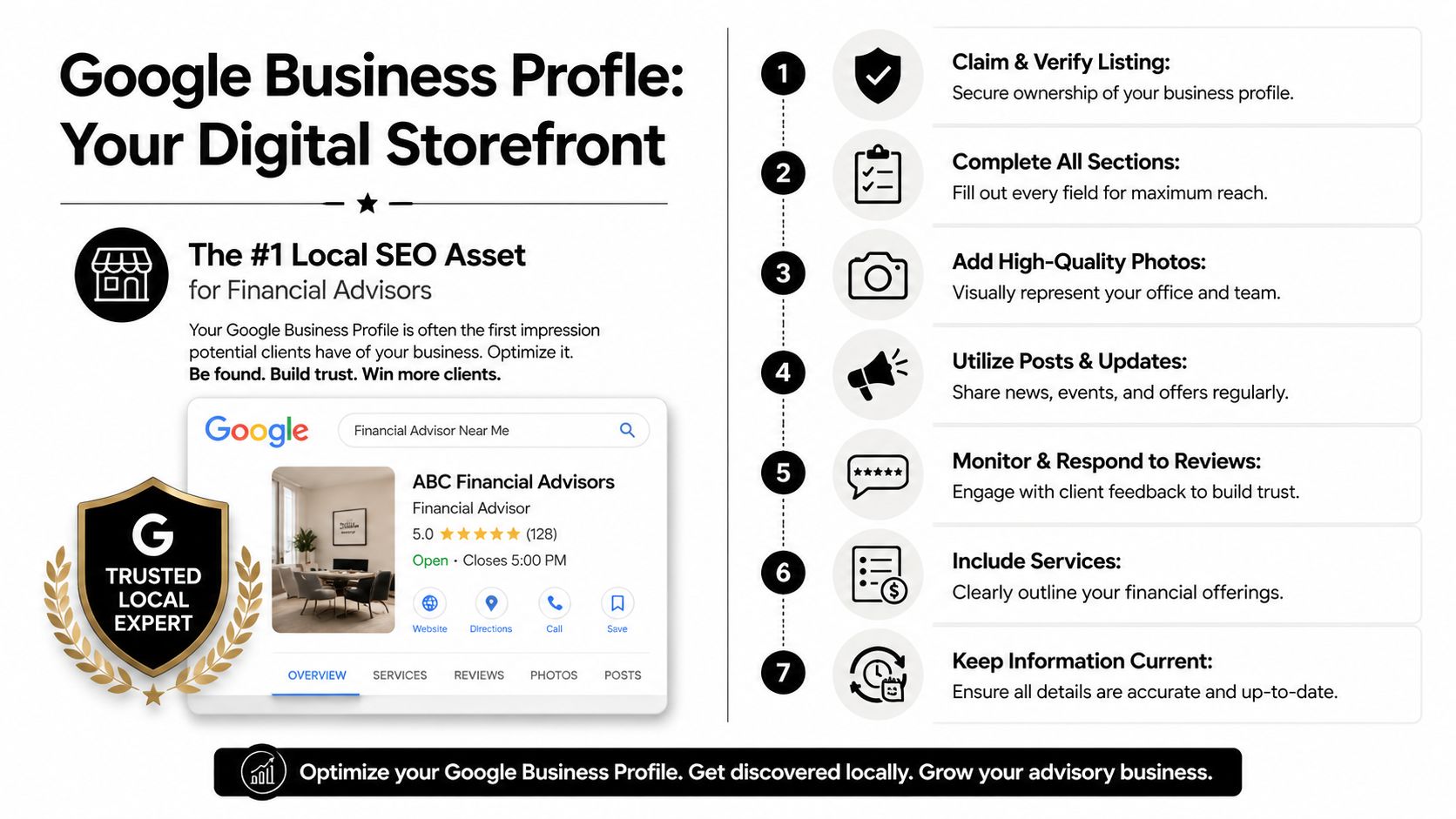
A complete profile matters because businesses with complete Google Business Profiles are 2.7x more likely to be trusted, and businesses appearing in Google’s Local Pack can capture up to 93% more calls, clicks, and directions, according to AltaStreet’s guide to mastering local SEO for financial advisors.
A half-filled Google Business Profile feels like a branch office with no sign, no receptionist, and the lights off.
Fill every field like it affects a client decision
It does. Google wants completeness, but prospects do too.
Think about how people evaluate an advisor locally. They check your business name, category, hours, address, reviews, website link, and photos in seconds. If your category says something broad like “financial institution” when “financial planner” is more accurate, you’ve already made your relevance weaker. If your hours are missing, your address format is inconsistent, or your services aren’t listed clearly, Google has less confidence and prospects have less clarity.
Start with these essential steps:
- Claim and verify the listing: Don’t leave an auto-generated profile floating around unmanaged.
- Use consistent NAP: Your business name, address, and phone should match your website exactly.
- Choose categories carefully: “Financial Planner” is often better than a generic category if that reflects the actual business.
- List real services: Retirement planning, estate planning coordination, wealth management, tax-aware planning, and similar services should appear if they’re accurate and approved.
- Set office hours and service areas: Especially important if you serve nearby cities like Cape Coral, Estero, Bonita Springs, or Naples.
If you want a practical walkthrough for the setup details, this guide on how to optimize Google Business Profile is a useful reference.
Write a description that markets without crossing the line
Many advisors get sloppy when crafting their description. Your description should explain who you help, where you work, and what kind of planning you offer. It should not make promises, imply guaranteed outcomes, or use puffed-up claims that compliance would flag.
A solid example:
Fee-based financial planning firm serving Fort Myers and surrounding Southwest Florida communities. We help individuals, families, and business owners with retirement planning, investment strategy, and long-term financial decision-making.
That works because it’s specific and restrained. It doesn’t say you’re “the best.” It doesn’t mention returns. It doesn’t promise results.
Use photos that make the office feel real
Stock imagery hurts more than people think. A local advisory firm should look local.
Upload:
- Office exterior shots: So people can recognize the building.
- Conference room photos: Clean, professional, and current.
- Team headshots: Real people build trust faster than generic finance graphics.
- Community involvement photos: If your firm sponsors local events or speaks at workshops, those images support local relevance.
For firms trying to discover local SEO keywords, use what people search in your market and reflect that language naturally in your services and business description. Don’t stuff city names into every line. Use them where they belong.
Posts and updates are useful, but not the first priority
Google Business Profile posts can help keep the profile active, especially if you share seminar announcements, office updates, or educational reminders. But don’t treat posts as the foundation. A verified, complete, accurate profile with good photos and clean service information does more heavy lifting than a stream of forgettable updates.
If your profile is incomplete, posting weekly won’t save it. Finish the basics first.
Build Your Local Hub on Your Website
Your Google profile gets attention. Your website closes the gap between interest and inquiry.

A strong local website matters because 52.3% of clients still prefer an initial in-person meeting, and using geo-targeted phrases like “financial advisor in Fort Myers” in title tags, H1s, service pages, and image alt text helps Google understand your local relevance, according to Stallion Cognitive’s compliance-focused local SEO guide.
What a real local landing page should include
Most advisor websites make one mistake here. They create a generic “locations” page with a city name swapped into thin copy. That won’t carry much weight, and it won’t persuade a prospect.
A useful Fort Myers page should include:
- A clear H1: “Financial Advisor in Fort Myers, FL”
- A short introduction: Who you serve and what problems you help solve
- An embedded map: Useful for people planning a visit
- Office hours and contact details: Keep them visible
- Service relevance to the area: Retirement planning for pre-retirees, business-owner planning, seasonal resident concerns, estate coordination
- A strong call to action: Schedule a consultation, request a call, or ask a question
- Compliance-reviewed proof points: If testimonials or endorsements are used, they need proper review and handling
Local signals that belong on the page
Google reads structure as much as copy. Prospects do too.
Use local language where it helps the page make sense:
- Title tag with city + service
- H1 and supporting subheads with location context
- Image alt text tied to the office or city
- Footer NAP that matches your profile and citations
- Internal links to related service pages and local articles
Practical rule: If a city page would still make sense after replacing “Fort Myers” with any other city, it’s too generic.
Schema helps Google connect the dots
LocalBusiness schema is basically a digital name tag. It tells search engines who you are, where you are, and how to classify the business. Advisors often ignore it because it sounds technical. Your developer shouldn’t.
A simple example might look like this:
<script type="application/ld+json">
{
  "@context": "https://schema.org",
  "@type": "FinancialService",
  "name": "Example Wealth Management",
  "address": {
    "@type": "PostalAddress",
    "streetAddress": "123 Example Blvd",
    "addressLocality": "Fort Myers",
    "addressRegion": "FL",
    "postalCode": "33901",
    "addressCountry": "US"
  },
  "telephone": "(239) 555-0100",
  "url": "https://www.example.com"
}
</script>
Keep the schema aligned with the exact business details shown elsewhere. If your website says one thing and directories say another, that inconsistency weakens the entire local picture.
Establish Trust with Citations and Reviews
An advisor can have a polished profile and a clean website, then still lose ground because the rest of the web tells a messy story.

That story starts with citations. If your firm appears on Yelp with one phone number, on the BBB with a slightly different address, and on another directory with an old suite number, Google sees uncertainty. Prospects do too. In financial services, uncertainty is poison.
Where citations matter most
You don’t need to be on every directory that exists. You need to be consistent on the ones that help validate the business.
Focus on a core set that often includes:
- Google Business Profile
- Yelp
- Better Business Bureau
- FINRA BrokerCheck
- NAPFA
- Apple Maps
- Local chamber of commerce listings
- Relevant local business associations
The important part isn’t volume for the sake of volume. It’s accuracy across the web. If your office moved, changed phone systems, or rebranded, old directory records need to be cleaned up. That’s often where local rankings tend to stall.
For firms that want help with the cleanup process, local citation building services can save a lot of manual work.
Reviews carry weight before anyone calls
Financial advice is a trust sale. Reviews help a prospect answer one question fast: “Do people seem comfortable dealing with this firm?”
That doesn’t mean chasing volume at all costs. It means building a process that’s compliant, repeatable, and natural.
A review request should be simple. It should never pressure a client to mention investment performance or make claims you wouldn’t want quoted in an audit.
A safer request sounds like this:
Thank you for working with our team. If you’d like to share feedback about your experience with our communication, professionalism, or service, we’d appreciate it.
That language keeps the focus on the client experience. It avoids coaching them toward performance-related statements.
How to respond without creating problems
Reviews aren’t just about getting them. Responses matter too.
Use this approach:
| Situation | Better response |
|---|---|
| Positive review | Thank them warmly, keep it general, avoid discussing account details |
| Negative review | Acknowledge the feedback, invite an offline conversation, do not reveal private information |
| Vague review | Respond professionally without assuming specifics |
In local SEO, consistency builds trust twice. Once with Google, and once with the human being reading your profile at 9 p.m. before deciding whether to call.
Create Content That Answers Local Questions
Two advisors can publish the same number of articles and get completely different outcomes.

The first advisor writes broad posts like “What Is Retirement Planning?” and “How Much Should You Save for the Future?” Those articles may be accurate, but they compete with national publishers, giant finance brands, and every generic blog on the internet.
The second advisor writes for the place they serve. That advisor becomes easier to find and easier to trust.
According to Promodo’s guide to local SEO for financial advisors, a strong content strategy relies on geo-modified long-tail keywords, such as “retirement planning in Naples,” and recommends creating 2-4 location-specific blog posts per month that address local pain points.
What local content looks like in Southwest Florida
Local SEO for financial advisors stops being theory.
In Fort Myers, Cape Coral, Estero, and Naples, local concerns aren’t abstract. They’re tied to how people live:
- Seasonal residency questions: planning for snowbirds with homes in more than one state
- Hurricane preparation: financial checklists, document storage, insurance coordination conversations
- Retirement relocation issues: tax planning, estate documents, healthcare planning transitions
- Small business owner concerns: succession, cash flow reserves, personal versus business planning
- Family wealth topics: helping adult children, caregiving, and legacy planning
Good topics might include:
- Financial checklist for Fort Myers residents during hurricane season
- Retirement planning considerations for seasonal Florida residents
- Estate planning conversations Naples families shouldn’t delay
- What Southwest Florida business owners should review before year-end
The advisor who wins locally doesn’t sound generic
The winning advisor doesn’t just insert city names into old blog posts. They answer local questions in a way that proves they understand the market.
A generic article says, “Prepare your finances for emergencies.”
A local article says, “Before hurricane season, Fort Myers households should review where estate documents are stored, confirm emergency cash access, and revisit property and flood coverage with the right professionals.”
That feels different because it is different.
If you want a broader framework for ROI-focused finance content strategies, it helps to think of every article as supporting one of three goals: local discovery, trust building, or consultation readiness.
Local links come from community involvement
The strongest local links usually come from things real firms do offline.
A few examples:
- Sponsor a local event: If your firm supports a charity run or community fundraiser, ask for a sponsor listing with a website link.
- Write for a local publication: Tax season, retirement planning, and year-end topics can fit guest columns well.
- Join the chamber: Chamber listings often support both visibility and local trust.
- Partner with nearby professionals: CPAs, estate attorneys, and insurance professionals can become referral relationships and local link sources.
The best local content doesn’t try to impress Google first. It answers the exact question a nearby prospect already has.
Navigate Compliance and Advertising Rules
A lot of local SEO advice for advisors is borrowed from industries with fewer guardrails. That’s a mistake.
Financial advisors don’t get to publish first and clean it up later. The content, review process, and profile language all sit inside a regulated environment. That changes how you write, what you ask for, and what you publish.
A 2025 FINRA report indicated that 35% of advisor websites face compliance violations in their marketing materials, and those violations can risk fines up to $100,000 per incident, according to Brookstone Capital Management’s advisor SEO resource. That’s the part generic SEO articles usually skip.
The safest local SEO often performs better anyway
Compliance isn’t the enemy of effective marketing. Sloppy marketing is.
When advisors chase flashy copy, they often end up with language that sounds unbelievable to prospects and risky to regulators. “Top-rated.” “Guaranteed.” “Best returns.” “Proven wealth growth system.” Even when that language slips through, it usually weakens trust rather than improving it.
Plain, specific, accurate language works better for this audience.
Compliant language examples
| Topic | Compliant Example (Do This) | Non-Compliant Example (Avoid This) |
|---|---|---|
| GBP description | We help individuals and families with retirement planning and long-term financial decision-making in Fort Myers. | We deliver the best retirement outcomes in Fort Myers. |
| Investment language | We provide personalized planning based on each client’s goals and circumstances. | We guarantee results tailored to your future. |
| Review requests | If you’d like, please share feedback about your experience working with our team. | Please leave a positive review about how much we improved your portfolio. |
| Case study copy | This example shows the planning process used for a client situation, with no assurance of similar outcomes. | Our strategy helped this client outperform the market, and it can do the same for you. |
| Local service page | We work with pre-retirees, retirees, and business owners across Southwest Florida. | We are the most trusted wealth firm in Southwest Florida. |
Guardrails that keep local campaigns usable
A few habits reduce risk fast:
- Get description language reviewed: Especially on your Google Business Profile and city pages.
- Avoid performance claims: Don’t imply returns, superiority, or certainty.
- Be careful with testimonials: If your firm uses them, they need proper handling under your compliance process.
- Document your review process: Consistency matters.
- Use disclaimers where appropriate: Particularly when discussing examples or educational material.
There’s a useful lesson here from other regulated sectors too. If you’ve ever seen how teams approach secure ChatGPT in healthcare, the pattern is familiar. The strongest systems aren’t built by ignoring the rules. They’re built by creating workflows that respect them.
Compliance guardrails don’t slow good marketing down. They stop bad marketing from creating expensive problems.
Measure What Matters and Scale Your Growth
Rankings are useful. They’re just not enough.
What matters is whether local search creates booked consultations, qualified calls, and real opportunities. Advisors who treat local SEO as a visibility project often get frustrated. Advisors who treat it as an attribution project usually make better decisions.
According to Savvy Wealth’s discussion of SEO for financial advisors, while 76% of local searchers visit a business within 24 hours, firms need to track the true customer acquisition cost from Google Business Profile and other channels, and that kind of attribution can reveal a 3x lead ROI from a well-executed local strategy.
The metrics worth watching
If I’m looking at local performance for an advisory firm, I care about a short list:
- Search queries in Google Search Console: Which local phrases are generating impressions and clicks
- Calls from the Google Business Profile: Especially branded and “near me” demand
- Contact form submissions from city pages: A cleaner signal than sitewide forms alone
- Direction requests and appointment clicks: Useful intent signals
- Lead quality by source: Which channel produces the right kinds of conversations
- Cost per acquisition by channel: Organic, paid search, referrals, and other lead sources shouldn’t be lumped together
How to set up clean attribution
Start simple.
Use Google Search Console to identify local queries. Use GA4 to track form submissions and page-level engagement. If phone calls matter, use call tracking in a way that preserves reporting clarity. Then push those leads into your CRM with source labels that are useful.
For example, “organic” is too broad. Better labels are:
- GBP call
- Fort Myers city page form
- Naples retirement article form
- Branded organic search
- Paid local ad
That’s the level where decisions improve. You can see whether a location page drives serious consultations or just casual traffic.
Scale only after the core market works
A lot of firms try to expand into every nearby city too soon. They launch pages for Naples, Bonita Springs, Estero, Cape Coral, and North Fort Myers before Fort Myers is even performing well.
That usually creates more maintenance than momentum.
A better sequence looks like this:
- Get the Google Business Profile fully dialed in.
- Build one strong city page around the core office location.
- Publish local content consistently.
- Tighten citations and review operations.
- Track leads by source.
- Expand into nearby markets once the first location produces reliable demand.
If you want a clearer framework for attribution and channel performance, this guide on how to measure marketing ROI is worth reviewing.
Organic local SEO compounds over time. If you need faster lead flow while organic visibility is still building, paid local campaigns can help. Just make sure they’re measured separately. Blended reporting hides what’s working.
If you want help turning this into a practical system, Polaris Marketing Solutions works with Southwest Florida businesses on local visibility, conversion-focused websites, and ROI tracking that makes marketing easier to defend. If your advisory firm wants stronger local reach in Fort Myers, Cape Coral, Estero, Bonita Springs, or Naples, start with a clear audit of your profile, site, citations, and tracking. That’s usually where the clear growth path becomes obvious.