
Empty chairs create pressure fast. Hygiene gaps show up on payroll day. The doctor's schedule has room, the team is ready, and the phone still isn't ringing enough. That's where most dental owners start looking at Google Ads, usually after trying referrals, postcards, or social posts that felt busy but didn't produce enough booked patients.
Google Ads works differently because it reaches people who are already looking for care. They're not scrolling for entertainment. They're searching for a dentist, a second opinion, a same-day appointment, or a higher-value service like implants or cosmetic work. If you want a channel you can control week to week, Google search is usually the fastest path to demand that already exists in your market.
Why Google Ads Is a Non-Negotiable for Modern Dental Practices
A dental practice can't build a growth plan on hope. Referrals matter. Reviews matter. Organic rankings matter. But none of those gives you reliable control over how many prospective patients raise their hand this week.
Google Ads does.
When someone searches for a dentist, they usually need one now. That makes search intent different from social media traffic and different from long-term SEO. SEO earns visibility over time. Social can support awareness. Google Ads puts your practice in front of people at the moment they're ready to call, book, or compare providers.
Intent beats interruption
A person searching for “emergency dentist near me” behaves differently from someone who happens to see a dental ad in a Facebook feed. One is solving a problem. The other is being interrupted. That distinction matters because dental advertising gets expensive when you pay for attention from people who weren't serious to begin with.
This is also why Google Ads isn't just “more marketing.” It's a patient acquisition system. You can decide which services deserve budget, which zip codes deserve attention, and which offers deserve a landing page. If your implant schedule has room, you can push implant campaigns. If hygiene openings are the problem, you can shift toward new patient exams and general dentistry.
Practical rule: Use Google Ads for demand capture, not for vague brand exposure. Buy clicks from people searching for care, not from people who might care later.
Practices that want steadier growth usually combine search advertising with broader effective patient volume strategies that improve scheduling, follow-up, and operational capacity. Marketing can fill demand. Operations has to convert it.
Why dentists can't treat this like a side project
The reason Google Ads becomes essential for many practices is simple. It gives you a lever you can pull when the schedule softens. That doesn't mean it replaces every other channel. It means it fills a role no other channel fills as directly.
A healthy strategy often uses Google Ads for immediate lead flow and SEO for compounding visibility. If you're also working through broader dental patient growth priorities, paid search is the piece that can generate demand while the slower channels mature.
Here's the blunt version:
- Referrals are valuable. They're also unpredictable.
- SEO is important. It's also slower.
- Google Ads is immediate. You can launch around the services you want more of now.
For a modern dental practice, that level of control isn't optional. It's how you stop letting the schedule drift.
Setting Your Budget and Campaign Structure
Most failed dental campaigns don't start with bad ad copy. They start with a bad setup. Budget gets spread too thin, services get mixed together, and the practice can't tell what's producing calls versus what's just spending money.
A cleaner structure fixes that.
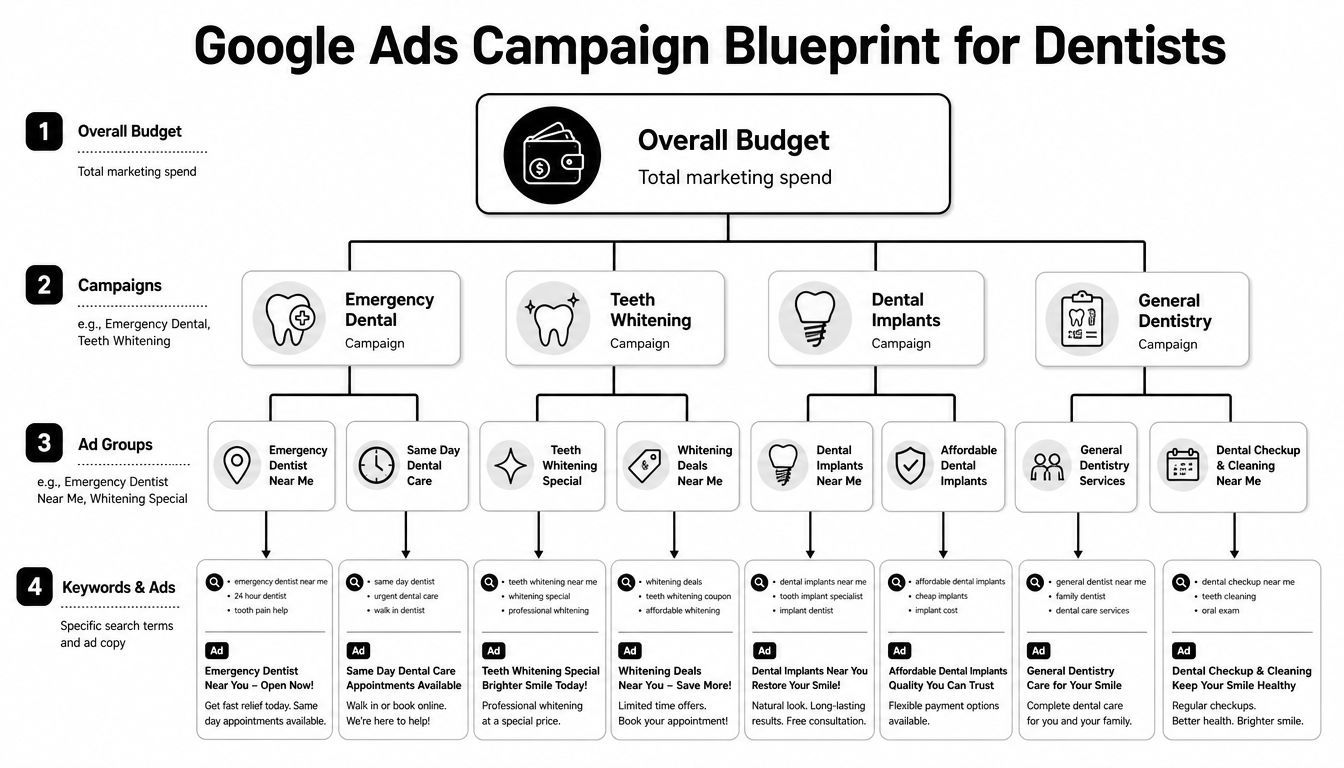
Build around services, not one giant campaign
Start with separation. Don't lump emergency, general dentistry, and high-ticket services into the same campaign. They have different economics, different search behavior, and different landing page needs.
A practical setup looks like this:
| Campaign type | What it targets | Why it should stand alone |
|---|---|---|
| General dentistry | New patient exams, cleanings, family dentist terms | Keeps everyday acquisition visible and measurable |
| High-value services | Implants, cosmetic cases, Invisalign-related searches if offered | Protects budget for the services with larger revenue potential |
| Remarketing | Previous website visitors | Gives you a second chance to bring back undecided prospects |
That structure gives you control over spend, messaging, and landing pages. It also makes reporting cleaner. If the implant campaign is producing calls but general dentistry isn't, you'll know. If a whitening offer gets clicks but no appointments, you'll see that too.
Set budget by market reality
Dental ad costs change a lot by geography. According to Dentx budget guidance for dental Google Ads, competitive urban markets should budget between $4,000 and $8,000+ per month, suburban practices typically spend $2,000–$4,000/month, and smaller or rural practices often start with $1,000–$2,000/month.
Those numbers matter because underfunded campaigns often produce bad conclusions. A practice spends too little, gets thin data, and decides Google Ads “doesn't work.” In reality, the budget never gave the campaign enough room to generate useful signal.
Here's how I'd think about it in plain business terms:
- Urban practice: You're buying visibility in a crowded auction. Go in expecting pressure on cost.
- Suburban practice: You still need enough spend for consistency, but you can usually be more selective.
- Rural or smaller market: A smaller budget can work if targeting is tight and the practice answers the phone well.
Don't pick a budget by gut feel. Pick it by market competition, service mix, and the number of new patients you can actually handle.
Match structure to how patients search
The ad account should mirror the way a patient thinks. Someone with a broken tooth doesn't search the same way as someone researching veneers. Someone ready for implants needs different reassurance than someone looking for a family dentist who accepts new patients.
That means each campaign should have its own:
- Dedicated ad groups built around closely related search terms
- Service-specific ads that match the keyword and city
- Landing pages that continue the same promise made in the ad
- Call tracking numbers so calls can be attributed accurately
One more practical note. If your budget is limited, don't launch every service line at once. Start with the services that matter most to your schedule and margins. It's better to dominate a narrow slice than to dilute the whole account.
Keyword Strategy and Hyper-Local Targeting
Keywords decide intent. Location settings decide whether that intent belongs to someone who can become a patient. Get either one wrong and Google Ads turns into a very efficient way to buy bad traffic.
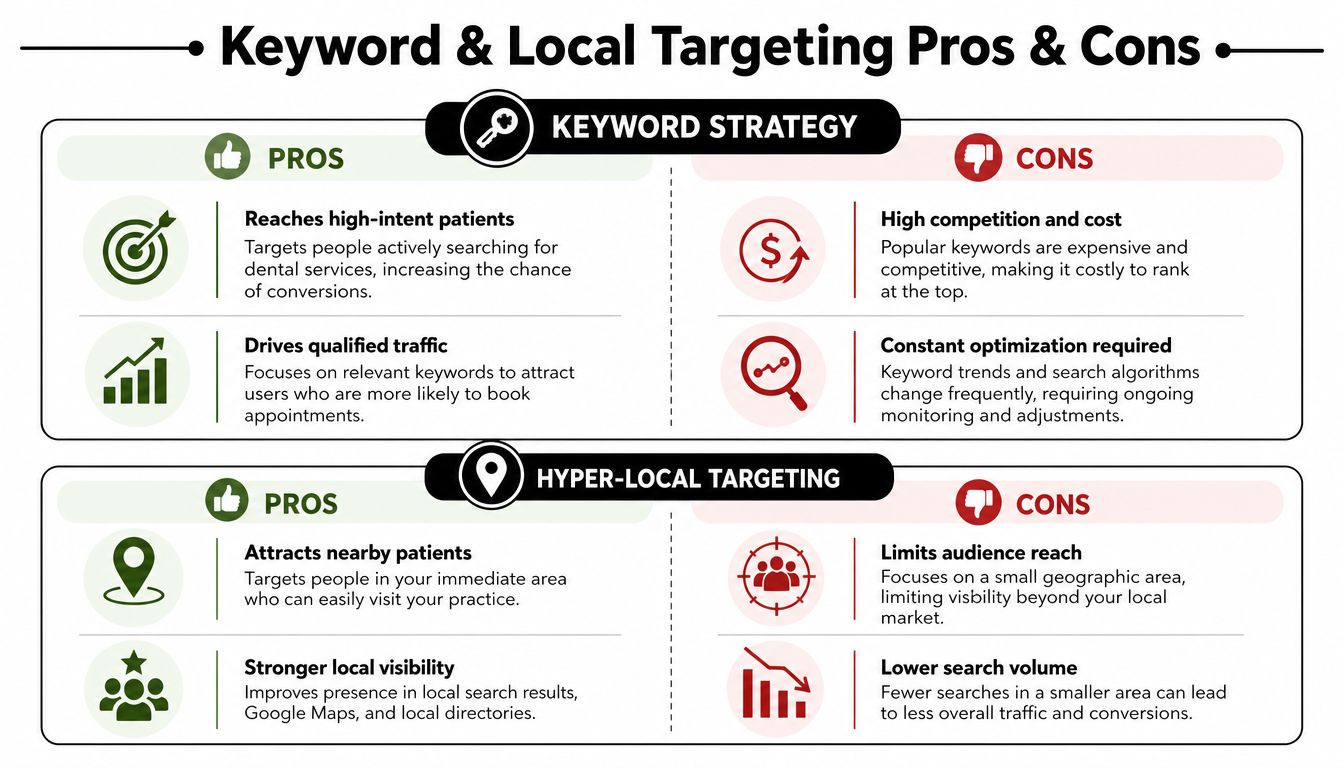
Target searches that signal booking intent
The strongest keywords usually sound like something a real patient says right before taking action.
Good starting examples include:
- Emergency need: “emergency dentist near me,” “tooth pain dentist,” “same day dentist”
- General care: “dentist near me,” “family dentist [city],” “dentist accepting new patients”
- High-value services: “dental implants [city],” “cosmetic dentist [city],” “teeth whitening near me”
These terms work because they imply immediate interest, local relevance, or a specific service. They don't read like research terms. They read like buyer terms.
Now compare that to searches you usually want to block with negatives:
- Job seekers: “dental assistant jobs,” “dental receptionist jobs”
- DIY researchers: “home teeth whitening,” “how to pull a tooth at home”
- Freebie and mismatch searches: “free dental care,” “dental school clinic”
- Pure information terms: “what is a root canal,” “dental x-ray meaning”
A useful habit is checking your Search Terms report often and adding negatives aggressively. Dentists waste a lot of spend on curiosity clicks and employment searches because nobody cleaned up the query list.
Tight radius beats broad reach
Local targeting in dentistry should be narrower than most business owners expect. Patients won't drive far for routine care. The ad platform has to reflect that.
According to ViziSites' guidance on dental geo-targeting, dental advertisers should set a 5–15 mile radius around the practice and use the “People in or regularly in your targeted locations” setting. The same source notes that downtown practices often succeed with 5 miles, while rural clinics may need 15.
That setting matters more than it looks. If you use a broader presence option, Google can show your ads to people who aren't really part of your service area. You pay for the click, but the patient was never likely to book.
A simple decision guide:
| Practice type | Radius starting point | Why |
|---|---|---|
| Downtown or dense urban | 5 miles | Traffic and convenience limit travel tolerance |
| Suburban | Mid-range local coverage | Patients may travel farther, but not endlessly |
| Rural | Up to 15 miles | Fewer nearby options expand the practical service area |
Run ads when someone can actually book
One of the easiest ways to waste money is running search ads after hours when nobody can answer the phone and the website doesn't offer a real booking path.
That's why dayparting matters. If your office is closed and there's no functioning online scheduler, pause the ads. A click at the wrong time isn't just lower quality. It's often dead spend.
If a patient can't call, submit, or book in the moment, don't pay to bring them in that moment.
This matters even more for emergency searches from mobile users, where urgency is high and patience is low. Miss that window and many searchers move to the next practice.
Ad Copy and Landing Pages That Convert Searches to Appointments
A patient searches on a phone, sees three or four sponsored options, and makes a snap judgment. They're not reading every word. They're scanning for trust, convenience, and whether your practice looks like the right fit for the problem they need solved.
That's why weak copy and generic landing pages kill campaigns.
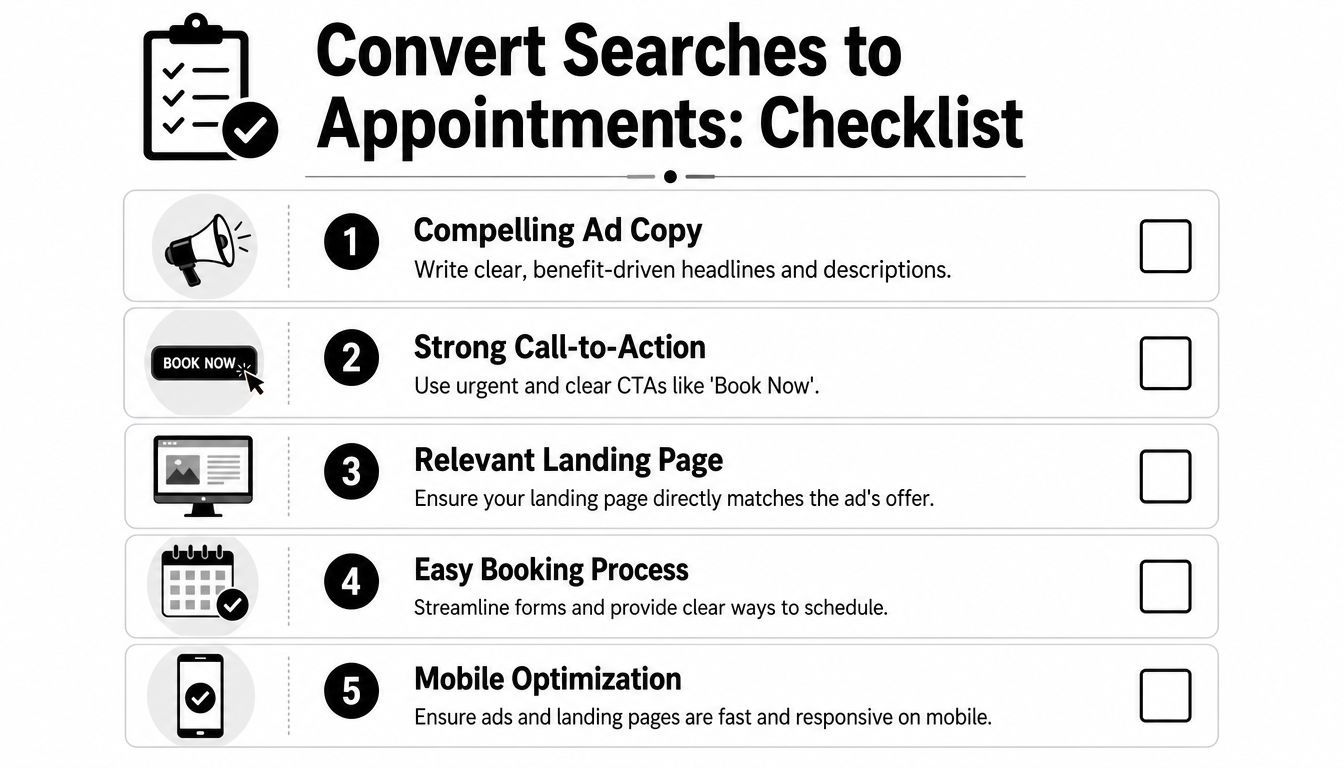
Start with the visual checklist below.
Write ads that sound like a local practice, not a template
According to NxLevel Consultants' dental ad advice, mobile device targeting is critical because many “emergency dentist near me” searches come from smartphones, and ad headlines should include the keyword, city or location, unique values such as “Same-Day Appointments,” and social proof such as “4.9★ Google Rating.”
That guidance lines up with what converts in real accounts. The best dental ads reduce uncertainty fast.
For example, an emergency ad might lead with:
- Emergency Dentist in Fort Myers
- Same-Day Appointments Available
- 4.9★ Google Rating
- Call Now for Immediate Help
A cosmetic ad might shift tone:
- Teeth Whitening in Naples
- New Patient Specials Available
- Trusted Local Dental Team
- Book Your Consultation
The details matter. “Experienced care” is vague. “Same-day appointments” is concrete. “High-quality dentistry” is forgettable. A visible rating, city name, and direct booking prompt gives the searcher something to act on.
Here's a useful reference point if you want to study the anatomy of pages built to convert. These examples of high-converting landing pages make it easier to spot the difference between a brochure site and a booking page.
The landing page has one job
Don't send paid traffic to the homepage unless you enjoy paying for confusion.
A homepage tries to do everything. A landing page should do one thing well. If the ad is about implants, the page should be about implants. If the ad offers same-day emergency appointments, the page should confirm that immediately and make calling effortless.
A strong dental landing page usually includes:
- A headline that matches the ad
- A click-to-call number above the fold
- A simple appointment form
- Provider credibility and review proof
- Location and hours
- A clear next step without distractions
The ad makes the promise. The landing page has to fulfill it without making the patient hunt.
This short video gives a useful visual on the conversion flow from search click to booked appointment.
Mobile friction costs appointments
A dental patient on a smartphone won't tolerate much friction. If buttons are small, forms are clunky, or the phone number isn't tappable, the campaign loses value before the front desk ever gets a chance.
Think through the journey in order:
- The patient sees a local, relevant headline.
- They click and land on a page that confirms they're in the right place.
- They can call immediately or request an appointment without scrolling through clutter.
- The office responds like the lead matters.
That sequence sounds basic. It isn't common enough.
Tracking Conversions and Calculating True ROI
At 7:45 p.m., a patient searches “emergency dentist near me,” clicks your ad, and calls. Nobody answers. The next morning, the ad platform still shows a click, maybe even a conversion, but the practice got nothing from it. That is why dental ROI tracking has to go past platform numbers and reach the front desk, the schedule, and the actual patient record.

Track the chain, not just the click
A dental practice should be able to follow paid search through five points: click, call or form, scheduled appointment, kept appointment, and production collected. If any link is missing, ROI gets fuzzy fast.
For most offices, the minimum setup is straightforward. Track phone calls from ads and landing pages. Track form submissions. Make sure someone in the practice management system records the lead source with enough detail to be useful, such as emergency, implants, Invisalign, or new patient exam.
The better setup goes one step further. Use campaign-level call tracking numbers, review call recordings or transcripts, and compare ad conversions against what the front desk booked. That is how you catch the common dental money pit of after-hours spend with no online booking. Google may count the lead. The practice may never speak to the patient.
High-value treatment makes this even more important. An implant lead and a cleaning lead can both show up as one conversion in Google Ads, but they do not carry the same revenue potential, close rate, or follow-up time.
Use benchmarks carefully
Benchmarks are useful for context, not for running the practice by averages. According to 2024 data from Elevated Digital Solutions' dental Google Ads benchmark article, dental campaigns often see conversion rates around 4.2%, with wide variation based on offer, location, and campaign quality. The same source notes that patient acquisition costs can differ sharply between general dentistry and higher-ticket services such as implants or cosmetic cases.
That is the right way to use benchmark data. Compare it against your own numbers by service line, not as a blanket pass or fail. A campaign with a higher cost per lead can still be the better investment if it consistently brings in profitable cases. A cheap campaign that fills the phone with insurance mismatch calls or low-intent shoppers is usually expensive in the end.
A simple scorecard keeps the discussion grounded:
| Metric | What it tells you |
|---|---|
| Calls and forms | Whether ads generate patient inquiries |
| Scheduled appointments | Whether inquiries turn into booked visits |
| Kept appointments | Whether lead quality and follow-up hold up |
| Cost per new patient | Whether acquisition cost makes financial sense |
| Revenue from acquired patients | Whether the campaign produces profit |
Calculate ROI the way an owner would
Use a formula tied to actual business results.
ROI = (Revenue from Google Ads patients – Ad spend – management costs) / total marketing cost
That means revenue from patients who came through paid search, minus media spend and whoever manages the account, divided by the full cost to acquire them. If you want a cleaner reporting model, this guide on how to measure marketing ROI lays out the attribution side clearly.
One more hard truth. An ad account can look fine while the campaign loses money. That usually points to an operational problem, not a bidding problem. Calls go unanswered. Insurance questions get handled poorly. Leads sit overnight. Staff logs everything under “Google” and nobody knows which campaign produced the patient.
Fix the tracking. Then judge the ads.
Optimizing Campaigns and Avoiding Costly Mistakes
A dental ad account usually loses money in quiet, boring ways. The bids may be fine. The problem is often wasted clicks from bad searches, ads running after the office closes, stale landing pages, or no feedback loop from the front desk.
That is why optimization has to match how a practice operates, not how a marketing report looks.
The routine that keeps waste under control
A useful review process looks like this:
- Check search terms every week: Add negatives for job seekers, dental school searches, at-home remedies, free care queries, and services you do not want to sell.
- Review lead quality, not just volume: Listen to call recordings or read transcripts. You will hear fast whether ads are attracting implant cases, emergency patients, or people asking only about the cheapest cleaning.
- Adjust ad copy based on patient intent: If one ad brings in high-value treatment inquiries and another attracts price shoppers, rewrite the weaker message.
- Keep landing pages current: Paid traffic should land on pages with accurate hours, current offers, clear insurance guidance, and a booking path that works on mobile.
- Get front desk feedback every week: Ask which calls turned into appointments, which ones stalled, and what questions kept coming up.
The front desk's feedback matters because they hear objections, insurance concerns, urgency, and confusion before anyone managing the ads does. If that information never gets back into the account, the same weak traffic keeps coming in.
Two mistakes burn budget fast
The first is after-hours spend without online booking. According to Oral Health Group's guidance on dental advertising, practices waste money when ads keep running while the office is closed and patients have no practical way to book right away. Their guidance also recommends dayparting, so ad schedules match staffed hours or at least the times when a real booking action can happen.
For a dental practice, this is not a minor settings issue. If someone searches for an emergency dentist at 9:30 p.m., clicks your ad, and reaches a voicemail with no online scheduling option, that click is usually gone for good.
The second is policy noncompliance. Google Ads policy guidance for dentists explains that dental advertisers cannot target users based on specific health conditions, treatment history, or prior dental search behavior. It also explains that a dentist cannot be described as a specialist, such as an orthodontist, unless that provider has the formal credentials required for that specialty.
Those are not minor details. They can limit delivery, trigger disapprovals, or put the whole campaign at risk.
Treat the account like a practice asset. Small setup errors can drain budget for months.
What good optimization looks like in practice
Good management is repetitive. That is the point.
Over time, the account should get tighter. Search terms get cleaner. Geographic targeting gets sharper. More budget goes to services that produce profitable cases, and less goes to clicks that never had a chance to book.
In practice, that usually means fewer irrelevant calls, stronger alignment between ad copy and landing page, better visibility into which campaigns produce scheduled patients, and less waste during hours when nobody can answer the phone.
For dentists, the win is not more traffic. It is more of the right patients, at the right times, with fewer leaks between the click and the appointment.
If your practice needs a clearer paid search strategy, Polaris Marketing Solutions helps businesses build ROI-focused campaigns that turn local search demand into real leads and appointments. If you want a practical second opinion on your current setup, they're a good team to talk to.