

You're probably looking at a search result right now where a competitor owns the box above the normal blue links. Maybe it's a roofing company answering “best roof for Florida heat,” or a law firm grabbing “what to do after a car accident in Fort Myers.” Your site might already be on page one, but you're still getting outranked by a tighter answer.
That's the practical value of featured snippet optimization. It's not about writing longer blog posts or stuffing in more keywords. It's about shaping the answer so Google can lift it cleanly, trust it, and show it first.
For local service businesses, this matters more than most SEO guides admit. A roofer, HVAC company, paver installer, estate attorney, or med spa often wins leads from non-transactional questions that happen before the buyer is ready to call. If you become the clearest answer early, you stay in the running when that prospect turns into a customer.
Decoding Google's Featured Snippets
A featured snippet is the answer box Google sometimes places above the standard organic results. Most local businesses run into three formats over and over: paragraph, list, and table. If you can recognize which format Google wants, your odds improve because you stop guessing and start matching the result type.
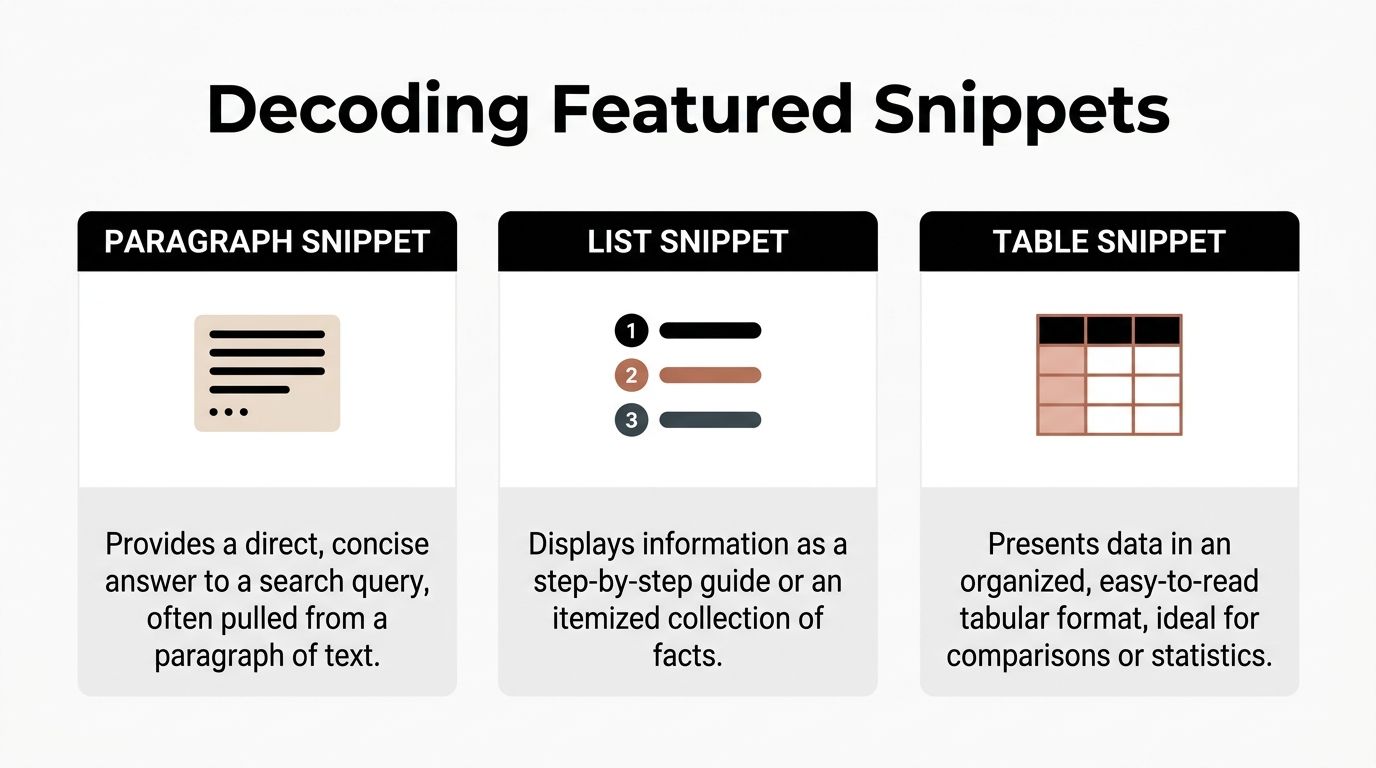
The three formats that matter most
A paragraph snippet usually answers a direct question. Think “What are the best pavers for Florida climate?” or “How long does a tile roof last in Southwest Florida?” Google wants a short explanation it can quote almost as-is.
A list snippet works when the search implies steps, options, or rankings. A restoration company might target “steps to prepare your home for a hurricane.” A family lawyer might target “steps to file for divorce in Florida.” In both cases, Google can pull a clean sequence.
A table snippet shows up when the searcher needs comparisons. That can be roofing materials, AC system types, estate planning documents, or paver material differences. If the page already presents the information in a simple table, Google has an easier job.
| Featured Snippet Types for Local Businesses | Best For Answering | Local Business Example Query |
|---|---|---|
| Paragraph Snippet | Direct definitions or short explanations | What are the best roofing materials for Fort Myers homes |
| List Snippet | Steps, checklists, ranked options | Steps to prepare a home for hurricane season in Cape Coral |
| Table Snippet | Comparisons, pricing ranges, feature breakdowns | Paver material comparison for Florida climate |
Match the query, not your preferred format
A lot of businesses get it wrong. They write everything as long-form sales copy, then wonder why Google chooses someone else. If the query asks for steps, don't force a paragraph. If the query asks for a comparison, don't bury the answer inside five dense paragraphs.
A Fort Myers law firm might have a strong article on personal injury claims, but if the query is “what happens after filing a personal injury claim in Florida,” Google is more likely to favor a structured step list than a broad homepage paragraph. The same applies to trades. A paver company shouldn't answer “travertine vs concrete pavers in Florida” with a generic service page. A side-by-side table is usually the better move.
Practical rule: Before you write anything, search the query and copy the format pattern Google already rewards.
If you're also trying to understand how this connects to broader search behavior beyond classic SEO, this Answer Engine Optimization guide gives useful context on why direct-answer content matters.
What local businesses should notice on the SERP
For local service companies, the overlooked opportunity is the location-specific informational query. Generic SEO guides focus on national terms. Real buyers in Southwest Florida search differently. They ask questions tied to weather, code concerns, materials, storm prep, neighborhoods, and insurance realities.
Examples:
- Roofers: “best roof for hurricane-prone areas in Florida”
- HVAC companies: “how much does a new AC cost in Florida”
- Pavers: “best pavers for pool decks in Florida heat”
- Law firms: “how long do you have to file a claim in Florida”
- Plumbers: “common plumbing issues in old Florida homes”
Those searches often sit between awareness and action. They're not ready for a quote yet, but they're close. If you own the answer, you've earned attention before the sales call.
Finding Your Easiest Snippet Opportunities
Most businesses waste time chasing brand-new keywords they don't rank for. That's usually the slow route. The strongest move is simpler: go after terms where you already have visibility and a competitor owns the snippet.
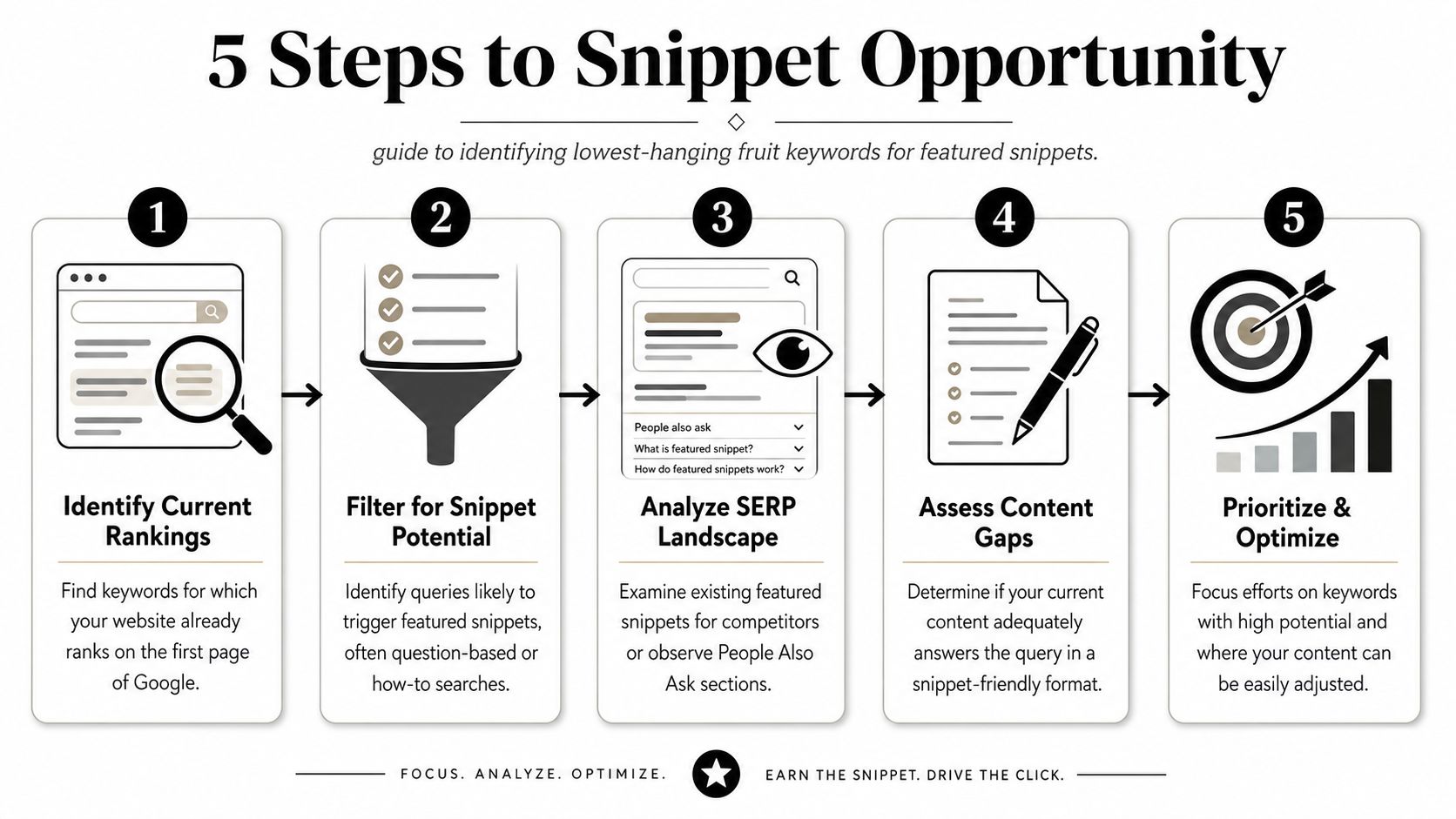
The clearest data-backed approach is this: “The most effective strategy for winning featured snippets is to target keywords where a website already ranks in positions two through five on the first page of Google's Search Engine Results Pages (SERPs), as this 'next-rank' opportunity represents the highest probability of securing Position Zero” according to Search Engine Watch's featured snippet analysis.
The workflow that actually saves time
Open Ahrefs, Semrush, or a similar rank tracking tool. Pull your organic keyword list. Then filter for queries where your page ranks in positions 2 through 5 and where the SERP already includes a featured snippet. That gives you a shortlist of pages that are already trusted enough to compete.
If you serve Fort Myers or nearby markets, your targets might look like:
- A roofer: “best roof underlayment for Florida”
- An HVAC contractor: “how often should AC be serviced in Florida”
- A lawyer: “what is comparative negligence in Florida”
- A paver company: “best pavers for Florida climate”
- A plumber: “why do older homes have low water pressure”
Once you have the list, search each term manually. Look at the live SERP. Is the current snippet a paragraph, list, or table? If your page doesn't match that format, you've already found the first fix.
For businesses that need a better process for reviewing competitors before editing pages, this guide to competitor analysis tools is a practical place to tighten your workflow.
What to inspect on the winning page
Don't just look at who owns the snippet. Look at how they structured it.
Ask these questions:
- Does the answer appear directly under a question-style heading
- Is the wording objective instead of promotional
- Is the format easy to extract
- Does the page go deeper after the short answer
That last point matters. The snippet itself is short, but the page still needs substance. Google often pulls a compact answer from a page that also covers context, examples, and related questions well.
The best snippet opportunities usually aren't hidden. They're sitting on pages that already rank well and just need cleaner formatting.
A repeatable review process for local pages
Use this sequence on every candidate page:
- Start with ranking data: Export page-one keywords and isolate terms where you sit just below the top result set.
- Check snippet presence: If Google isn't showing a snippet for the query, it's not your best first target.
- Study intent closely: “Best,” “what,” “how,” “why,” and “steps” often signal snippet-friendly searches. Local examples matter here, like “best roofing material for Naples homes” instead of a broad national phrase.
- Compare structure: If the competitor uses a list and your page uses long paragraphs, rewrite the answer block instead of rewriting the whole article.
- Prioritize pages with easy edits: A service page or blog post that already has traffic and internal links is usually faster to improve than building something from scratch.
Later in the process, a quick visual walkthrough can help your team spot patterns in live search results.
The key is restraint. Don't build a 50-page content plan before proving you can win one or two snippets from pages already near the top.
Crafting Content That Google Wants to Feature
The pages that win snippets usually don't sound fancy. They sound clear. That's the shift a lot of businesses need to make.
A typical local business post starts with a soft intro, a little brand talk, then a long explanation. That's fine for a human reader who lands on the page and scrolls. It's weak for featured snippet optimization because Google wants the direct answer first.
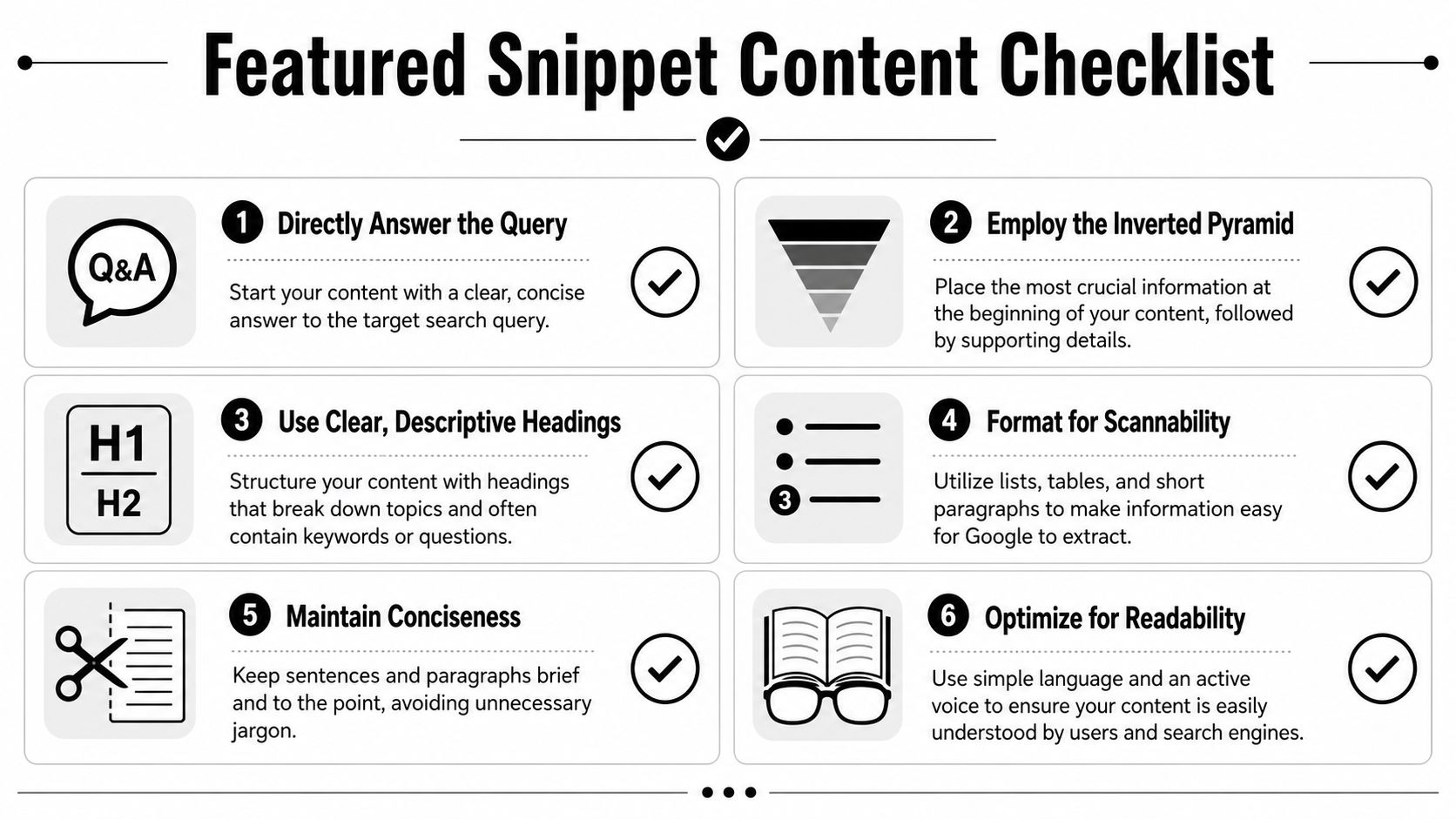
Before and after on a roofing page
Here's the kind of paragraph I see all the time on a roofing company blog targeting a query like “best roofing material for Naples homes”:
Before
Naples homeowners have many roofing options to choose from, and each material comes with its own pros and cons depending on budget, appearance, durability, and maintenance needs. Our team has helped many customers choose the right roofing system for their property based on years of experience in Southwest Florida.
That paragraph is readable. It's also not snippet-friendly. It talks about the company, delays the answer, and sounds like marketing copy.
Here's the better version.
After
What is the best roofing material for Naples homes
Tile and metal roofing are often strong choices for Naples homes because they hold up well in Florida heat, handle heavy rain, and offer long-term durability. The best option depends on budget, roof design, and maintenance preference.
That structure is much closer to what Google can lift. Research summarized by Ranktracker's featured snippet statistics overview identifies 40 to 50 words as the optimal length for paragraph snippets, or roughly 250 to 300 characters, and recommends placing that concise answer immediately below an H2 or H3 that contains the target question.
The inverted pyramid works because it removes friction
Local businesses often want to “warm up” the reader. That instinct comes from sales. In search, it can get in the way.
Lead with the answer. Support it after.
A good paragraph snippet block follows this order:
- Question heading: Use the query naturally as an H2 or H3.
- Direct answer: Give the plain answer first.
- Supporting context: Add local nuance after the answer block.
- Expansion: Cover cost, climate, maintenance, permit issues, or common objections below that.
Example for an HVAC page:
How often should AC be serviced in Florida
Most Florida AC systems should be serviced at least twice per year because they run heavily in long cooling seasons and face added wear from heat, humidity, and salt air in coastal areas.
Then continue with the practical details. Explain spring and fall scheduling, filter checks, drain line issues, and why coastal systems need closer attention.
If you're also reworking pages for newer search behavior, this resource on optimizing content for AI search is useful because the same clear-answer structure often helps beyond traditional snippets.
How to build a list snippet from a weak article
List snippets are where formatting mistakes show up fast. A generic article titled “How to choose hurricane shutters in Fort Myers” might bury all the steps in long paragraphs. Google has to work too hard to extract the order.
A stronger version looks like this:
Steps to choose hurricane shutters in Fort Myers
Step 1 Choose a shutter type that fits your opening
Compare accordion, roll-down, colonial, and panel shutters based on budget, appearance, and ease of use.
Step 2 Check wind-load requirements
Make sure the product matches local code and the opening size on your home.
Step 3 Review material durability
Look at how aluminum, steel, or polycarbonate options perform in heat, rain, and salt air.
Step 4 Confirm installation requirements
Ask whether mounting conditions, anchors, and wall material affect the install.
That's easy for a user to scan and easier for Google to understand.
For list-oriented pages and supporting content ideas, this roundup of content marketing strategies for small businesses can help you turn one topic into multiple useful assets.
What usually fails
The pages that miss snippets often share the same problems:
- Brand-heavy answers: “At our company, we believe…” belongs lower on the page, not in the answer block.
- Long intros: If the first useful line appears halfway down the page, you're making extraction harder.
- Mixed intent: A page trying to rank for “best roof material,” “roof replacement cost,” and “roof leak signs” all at once often feels muddy.
- Overwritten list items: If every step turns into a mini essay, the structure breaks down.
Write the answer block like a neutral expert. Write the rest of the page like a helpful local operator.
That balance works well for service businesses. The snippet earns visibility. The supporting content earns trust.
Applying the Right Technical and Page Structure
Good content can still lose if the page layout is messy. Featured snippet optimization works best when the answer sits inside a clean, obvious structure that search engines can parse without guessing.
Build a simple snippet container
Think of a snippet container as one tight unit on the page:
- A question-based H2 or H3
- A direct answer immediately underneath
- Supporting content below that in the right format
If you're targeting a paragraph snippet, the answer block should be the first text after the heading. Don't insert an image, banner, form, or callout box between the heading and the answer. For list snippets, keep the steps grouped tightly and labeled in a consistent way. For table snippets, place the comparison table under a heading that clearly names what's being compared.
A lot of local business sites break this pattern by adding design elements between the heading and the answer. It may look fine visually, but it weakens the signal. Search engines read structure, not just aesthetics.
Match the winning format, then add depth
There's a practical reason competitor audits matter. According to Get Athenic's featured snippet optimization guide, manually auditing competitor snippet structures and matching the exact format while improving content depth by 20% can produce a 35% higher snippet theft success rate than generic content updates. The same source notes that FAQ or How-To schema markup helps reinforce the Q&A format.
That doesn't mean schema alone wins the snippet. It means schema supports a page that is already structured well.
A few clean examples:
- Paragraph target: H2 asks the question, one short answer paragraph follows, then deeper local explanation.
- List target: H2 frames the process, each step is broken into a consistent subheading.
- Table target: H2 names the comparison, table appears immediately after, then a short interpretation below.
Where schema helps local businesses
If you run WordPress, tools like Yoast, Rank Math, or your page builder may already give you a simple way to add FAQ or HowTo schema. For a lawyer answering common legal process questions, FAQ schema can reinforce that Q&A structure. For a contractor publishing a step-by-step guide, HowTo schema can support the page's intent.
Still, don't overcomplicate it. Start with the visible page structure first. Schema is reinforcement, not a rescue plan.
If you want a broader refresher on how this fits into site-wide search performance, Oviond's explanation of on-page and off-page SEO is worth reading.
Technical checks that are worth your time
Use this list before you republish:
- Header alignment: The heading should closely match the query wording.
- Answer proximity: Put the answer directly after the heading.
- Format consistency: Don't switch list styles halfway through a process page.
- Table cleanliness: Keep columns simple and labels obvious.
- Schema support: Add FAQPage or HowTo where it fits the content well.
For a more detailed cleanup pass on page structure and SEO signals, this guide to technical on-page SEO is a helpful companion.
Measuring Your Snippet Wins and Planning Your Next Move
Winning one snippet is useful. Keeping it and multiplying it is where the substantial return shows up.
What to watch in Google Search Console
Open the Performance report and review queries and pages after you update a snippet-targeted page. You're looking for changes in impressions, clicks, average position, and the specific search terms tied to the page. Search Console won't label every snippet win neatly, so combine it with manual SERP checks for your priority queries.
If a Fort Myers estate planning page starts appearing more often for “what documents are included in an estate plan,” that's a sign the page is becoming more relevant for the query pattern, even if you still need to confirm live snippet ownership. The same goes for home services pages answering common material, maintenance, or process questions.
Don't measure snippets page by page forever. Measure them topic by topic.
Use topic clusters to defend and expand wins
Many campaigns excel when employing this approach. Instead of optimizing one isolated article, build supporting content around the same subject. A core page on “best roofing materials for Florida homes” can be reinforced by supporting pages on tile vs metal, underlayment choices, hurricane durability, insurance considerations, and maintenance expectations.
That structure does more than help users. According to Proven ROI's featured snippet techniques article, batching optimizations by topic cluster and reinforcing the answer paragraph with internal links can increase snippet win rates by 18% compared with isolated optimizations.
A simple local cluster might look like this:
- Core page: Best pavers for Florida climate
- Support page: Travertine vs concrete pavers in Southwest Florida
- Support page: Are brick pavers too hot for pool decks
- Support page: How long do pavers last in Florida rain and sun
- Support page: Common paver maintenance mistakes in coastal areas
What to do when a competitor takes the snippet
Check the live SERP and compare structure again. Did they add a cleaner answer block? Did they switch to a table? Did they answer the question more directly? Most of the time, the page didn't lose because your domain suddenly became weak. It lost because someone made extraction easier.
That's a useful signal. Update the page, tighten the answer, strengthen internal links, and recheck adjacent supporting pages.
Common Featured Snippet Questions Answered
How long does it take to win a snippet after updating a page
Sometimes it happens quickly after Google re-crawls the page. Sometimes it takes longer. The practical answer is to expect a range from days to weeks and avoid constant rewriting in the meantime.
If the page already ranks well and the edit is tightly aligned with the existing SERP format, changes can show up faster. If the page also needs authority, internal links, or stronger supporting content, it can take longer.
Should the snippet answer mention my business name
Usually, no. A major mistake is writing the answer block like ad copy. Search Engine Land's guidance on featured snippet optimization notes that using brand names or first-person language such as “I” or “we” in the snippet text can reduce objective clarity and cause Google to favor more neutral content.
That means this is weak:
“We recommend metal roofing because our team has installed it for years in Fort Myers.”
This is stronger:
“Metal roofing is a strong option for many Fort Myers homes because it handles heat well, sheds rain effectively, and offers long-term durability.”
What if I lose a snippet I already won
Treat that like competitor intelligence, not a setback. Recheck the format first. Then review whether your answer still matches search intent. A paragraph may have become a list query. A general answer may have been beaten by a more local or more direct version.
A quick recovery process works well:
- Review the current SERP: See what format Google now prefers.
- Compare answer blocks: Read yours against the winner side by side.
- Tighten neutrality: Remove self-references, branded language, and soft intros.
- Improve support sections: Add deeper explanation below the snippet block so the page feels complete.
Do local queries work for featured snippets
Yes, but they're less neatly covered in most SEO advice. That's why local businesses should test queries tied to climate, neighborhoods, property types, legal process, and regional conditions. A roofer in Southwest Florida should target different informational searches than a roofer in Colorado. The same logic applies to attorneys, dentists, HVAC companies, and restoration firms.
The businesses that do best here usually stop publishing generic “ultimate guides” and start answering the exact questions customers ask on calls every week.
If you want help turning those questions into pages that actually compete in search, Polaris Marketing Solutions helps Fort Myers and Southwest Florida businesses build practical SEO strategies around real local intent, clear on-page structure, and measurable lead-focused outcomes.