
A lot of small business owners hit the same wall. The phone rings from referrals, existing customers are happy, and the work is solid, but when someone nearby searches for the service you offer, your business barely shows up.
That problem feels personal because it costs real jobs. A roofer in Fort Myers, a med spa in Estero, a family law firm in Cape Coral, or a cleaning company in North Fort Myers can all be doing excellent work and still lose attention to competitors with stronger local signals online.
In many cases, the gap isn't some advanced SEO trick. It's basic visibility infrastructure. If your listings are missing, inconsistent, or scattered across weak platforms, Google has less confidence in your business data, and customers have fewer places to confirm you're legitimate. If you've been wondering why your business isn't showing up on Google, directories of companies are one of the first places to look.
Why Your Business Feels Invisible Online
A common local scenario goes like this. You search your own service from your phone, and the businesses that show up first aren't necessarily better than you. They're just easier for Google and customers to verify.
A Fort Myers contractor might have a decent website but no claimed Apple Maps listing, an incomplete Google Business Profile, old hours on Facebook, and different phone numbers across older citations. Meanwhile, a competitor has cleaner listings, recent reviews, and matching contact details everywhere. The competitor looks more established online, even if your crew does better work on the job.
That's why directory work matters so much for small businesses. It isn't glamorous, and it usually isn't the thing owners want to spend a Friday afternoon fixing. But it often decides who gets discovered first.
The local search problem isn't always your website
Many owners assume invisibility means they need a full website rebuild. Sometimes they do. Often they don't.
A lot of the time, Google is trying to confirm three simple things:
- Who you are
- Where you are
- How customers should contact you
If those details conflict across the web, your visibility gets muddy. If they match across reputable directories of companies, your trust signals get stronger.
Practical rule: Before you spend heavily on advanced SEO, make sure your basic business information is accurate, claimed, and consistent on the platforms customers actually use.
Why this hits hard in competitive local markets
In Southwest Florida, competition is crowded in home services, legal, healthcare, and professional services. You don't need every listing on the internet. You need the right listings, managed correctly.
That shift in thinking matters. Directories aren't just old-school citations. They're digital storefronts, trust checks, and local relevance signals rolled into one. For a business owner who needs leads now, that's a practical starting point.
What Are Business Directories and Why They Matter
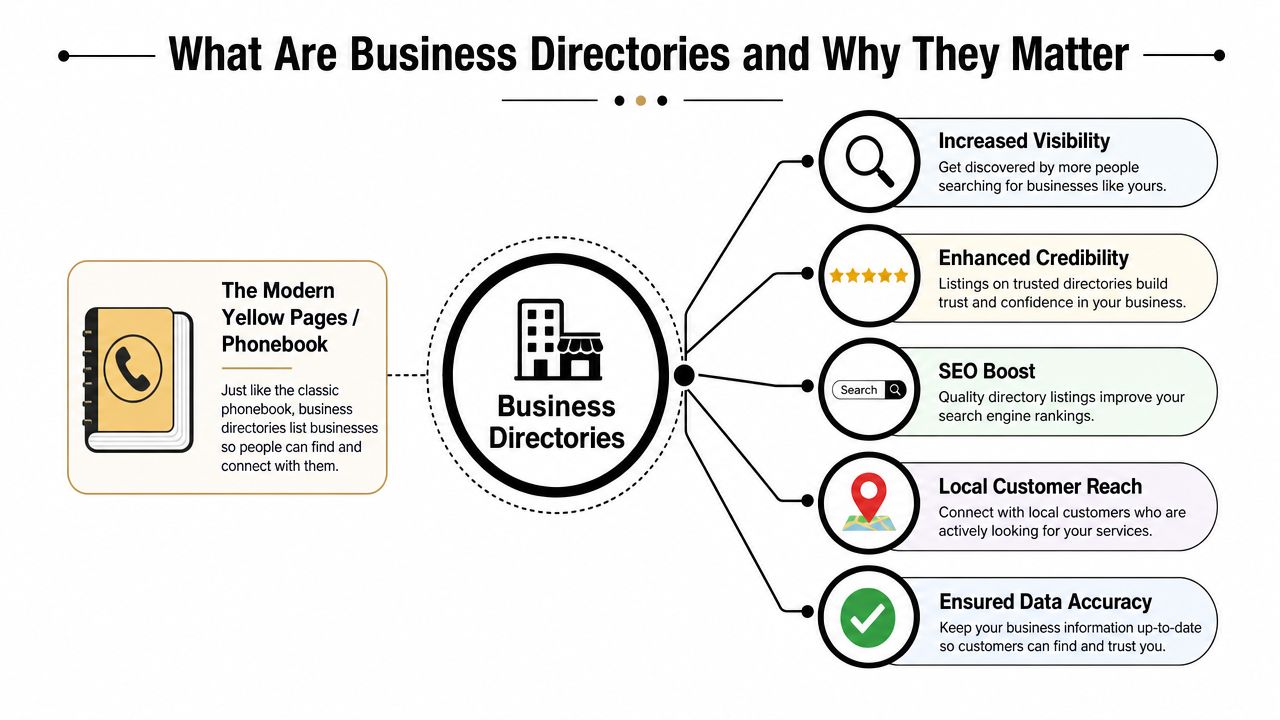
Think of business directories as the modern Yellow Pages, except smarter, searchable, and tied directly to how people discover local companies today. They don't just list a business name. The good ones help customers compare providers, confirm contact information, read reviews, and decide who to call.
Search engines use them too. When your business name, address, and phone number match across reputable listings, Google gets a cleaner picture of your location and legitimacy. Customers get the same benefit. They can quickly confirm whether you're open, where you serve, and whether other people trust you.
They help both buyers and search engines
For a customer, a listing answers practical questions fast. Do you have the right phone number posted? Are your hours current? Are there photos that make the business feel real? Can they tell what services you offer?
For Google, directories act like corroborating records. They support your core business details across the web. That doesn't replace your website, but it strengthens the evidence behind it.
Here are the main ways directories help:
- Visibility in more places: Your business can appear in map apps, niche search tools, and local results beyond your own site.
- Trust through consistency: Matching business details reduce confusion for customers and platforms.
- Reputation support: Review-enabled directories give prospects another place to evaluate you.
- Lead qualification: Niche directories can attract people looking for a specific service, not just browsing.
Not all directories serve the same purpose
Some directories function as broad business databases. Others are industry tools. Others are local trust hubs such as chambers of commerce or community organizations.
One example of the larger research side of directories is that Dun & Bradstreet's commercial database contains more than 120 million business records, and users can search by factors like geographic area, business type, and revenue, which makes it useful for market research and planning, according to MIT Libraries' guide to company and industry research.
That matters because directories of companies aren't just places where your listing sits. They're part of a larger discovery system. Customers use them to find providers. Sales teams use them to research prospects. Search engines use them to validate entities.
A good directory listing does two jobs at once. It helps a person decide whether to contact you, and it helps a search engine decide whether to trust you.
What a strong listing actually includes
At minimum, your listing should contain the same core information everywhere. Then you improve it with details that reduce hesitation.
A strong profile usually includes:
| Listing element | Why it matters |
|---|---|
| Business name | Keeps branding consistent and avoids confusion |
| Address and phone | Supports local relevance and direct contact |
| Hours | Prevents wasted calls and bad customer experiences |
| Photos | Makes the business look active and legitimate |
| Services or categories | Helps platforms match you to relevant searches |
| Website link | Gives customers a clear next step |
Most small businesses don't need a complicated directory strategy to start. They need a clean one.
Separating Quality Directories from Digital Junk
A lot of directory advice still pushes the same old message. Get listed everywhere. More citations are better. Submit to every site you can find.
That advice can backfire now.
Recent data shows low-quality directories with "thin content and no real users" can actively punish Google Maps SEO rankings, which is why trust signal integrity matters more than just piling up listings, as discussed in Uberall's guide to business directories in the USA.
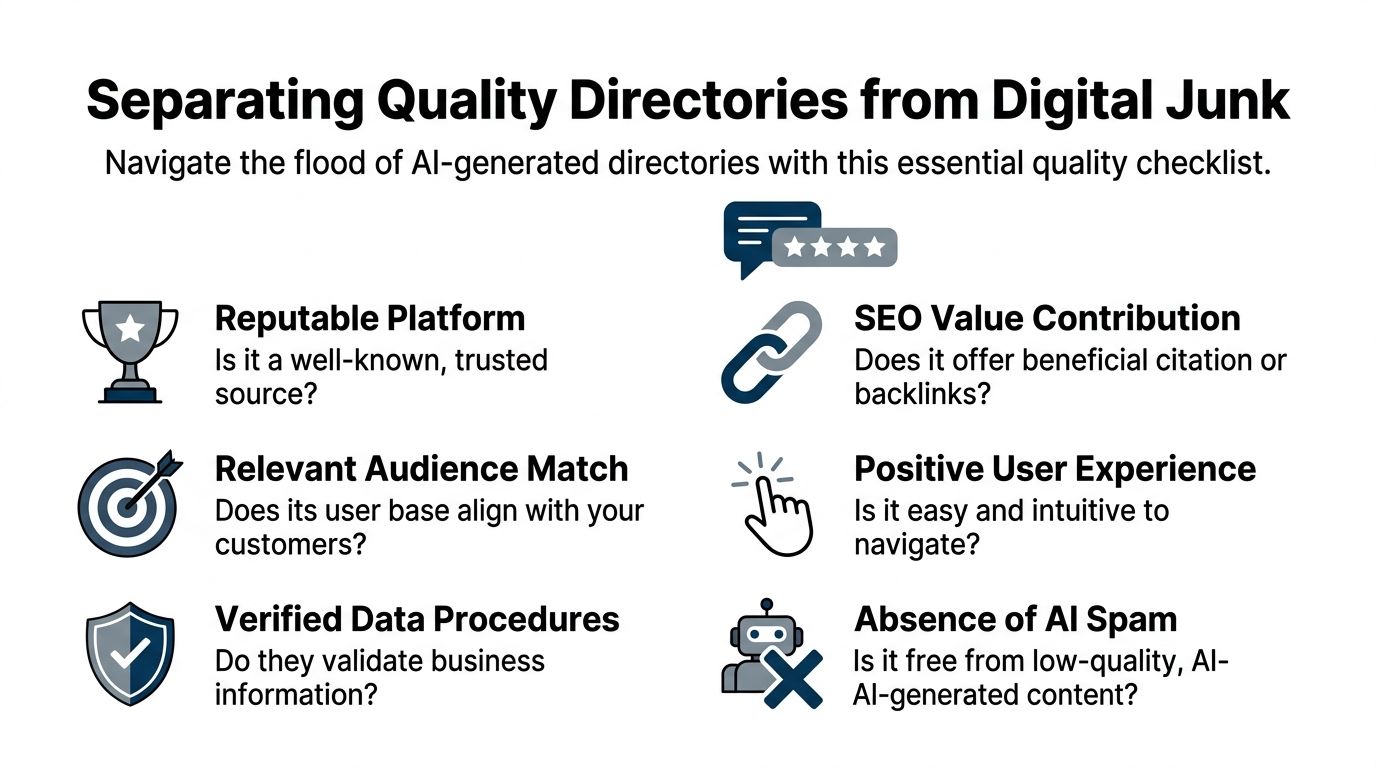
Spam directories usually reveal themselves quickly. They scrape business data, publish low-value pages, and offer almost no reason for a real human to visit. Some are bloated with poor listings, weak moderation, and obvious AI-generated filler content. A listing there doesn't build trust. It muddies it.
Green flags that a directory is worth your time
Before claiming or creating a profile, check the platform like a buyer would.
Look for these signs:
- Real user value: The site gives visitors a reason to use it, such as reviews, category filters, maps, service details, or comparison features.
- Human oversight: You can see moderation, profile standards, support pages, or a real editorial presence.
- Relevant audience: The directory fits your market, your geography, or your industry.
- Clean structure: Listings are readable, links work, and pages don't feel mass-generated.
- Listing depth: The platform allows useful business details, not just a name and random backlink.
Red flags that usually mean walk away
Some directories promise SEO value but exist mainly to sell upgrades or scrape information.
Skip directories that show these patterns:
- Broken pages everywhere: If the site feels abandoned, buyers won't trust it either.
- Thin, repetitive content: Thousands of near-identical location or category pages are a warning sign.
- No evidence of real users: No reviews, no active business profiles, no sign anyone uses the site.
- Aggressive upsells first: If the platform pushes paid placement before basic profile quality, be cautious.
- Messy category matching: If a plumber sits beside unrelated listings with no logic, the platform likely has weak data controls.
If you wouldn't send a customer there, don't send your business data there.
A quick video overview can help if you want to see this quality gap in practice:
A simple verification framework
Use this five-minute check before you submit any listing.
- Search your own category on the directory. Do the results look useful or machine-generated?
- Open several business profiles. Are they complete, current, and readable?
- Check whether businesses engage there. Reviews, updates, and claimed profiles are good signs.
- Inspect the site's reputation manually. Does it feel like a platform someone would bookmark?
- Ask one hard question: Would this listing still matter if SEO didn't exist?
That last question filters out a lot of junk. The best directories of companies still have standalone value. They help real people find real businesses.
The Must-Have Directories for Every Local Business
Most owners don't need a list of a hundred platforms. They need a short list in the right order. That's how you protect your time and improve ROI.
The easiest way to think about directories of companies is by tiers. Start with the platforms that shape local discovery. Then move into supporting listings, niche directories, and local organizations.
Tier 1 includes the non-negotiables
These are the listings every local business should handle first because customers and map platforms rely on them constantly.
Google Business Profile sits at the top because it affects maps visibility, local search impressions, reviews, and customer actions. After that, Apple Maps, Facebook, and Bing Places are practical priorities because they help cover the major ecosystems people use every day.
If your resources are tight, don't rush past this tier. A complete, accurate presence here beats scattered listings on twenty weak sites.
Tier 2 supports trust and data consistency
The next layer includes large directories and review platforms that reinforce your business details and widen your footprint. Yelp often lands in this group for local businesses because customers still use it to compare providers.
Broader databases also matter in the larger business research ecosystem. In this context, directories can support visibility beyond simple consumer discovery.
Tier 3 gets more valuable as intent gets sharper
Niche platforms often outperform broad sites. A general directory might bring curiosity. An industry directory often brings a person looking for exactly what you sell.
Businesses listed on well-chosen industry-specific directories receive 3x more qualified leads than those only on general directories, according to HubSpot research discussed by Jasmine Directory.
Examples vary by trade:
- Contractors and home pros: Houzz can matter because buyers browse by project type and style.
- Law firms: Avvo can help because legal shoppers often compare by practice area.
- Healthcare providers: Health-focused directories can support discovery based on specialty criteria.
- Industrial firms: ThomasNet and GlobalSpec can make sense for procurement or engineering teams browsing by specs or capabilities.
Niche directories usually work best when the buyer already knows what they need and is trying to decide who can deliver it.
Tier 4 is where local credibility gets personal
For Southwest Florida businesses, hyper-local platforms can carry more trust than another generic listing site. Local chambers, regional business groups, and community directories signal that you're part of the local business community, not just another web page.
Examples worth checking include the Greater Fort Myers Chamber of Commerce and SWFL Inc. These aren't magic SEO buttons. They matter because they align with local relevance, local relationships, and local buyer trust.
Here's a simple way to prioritize.
| Tier | Directory Examples | Why It's Important |
|---|---|---|
| Tier 1 | Google Business Profile, Apple Maps, Facebook, Bing Places | Core local visibility and map-based discovery |
| Tier 2 | Yelp, major business databases, broad citation platforms | Supports consistency, reviews, and wider trust signals |
| Tier 3 | Houzz, Avvo, ThomasNet, GlobalSpec, healthcare-specific directories | Higher intent traffic and better-fit leads |
| Tier 4 | Greater Fort Myers Chamber of Commerce, SWFL Inc., local associations | Strengthens local credibility and community relevance |
A Fort Myers HVAC company doesn't need every directory a law office needs. A Naples med spa doesn't need the same mix as an industrial supplier. The right stack depends on how your customers search.
Your Step-by-Step Listing Management Process
Directory work gets messy when owners do it ad hoc. They claim one listing today, update another next month, then realize six versions of their phone number are floating around online.
The fix is a repeatable process.
Start with a master information sheet
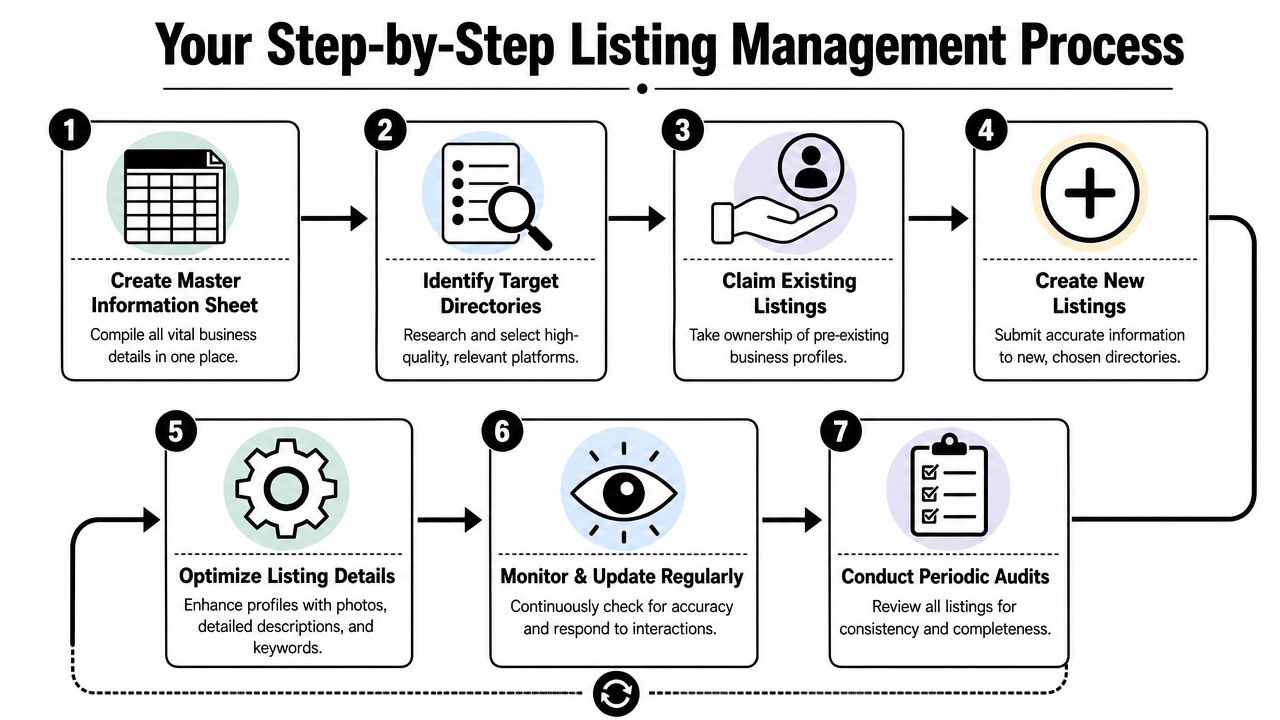
Open a spreadsheet. Put your official business name, address, primary phone number, website URL, business categories, hours, short description, long description, logo, and approved photos in one place.
Also include practical variations you'll need, such as a short service summary for tighter profiles and a longer description for directories that allow more detail. This is the document you return to every time you claim or edit a listing.
Keep one version of the truth. That's what prevents drift.
Claim Google Business Profile first
For local SEO, this is the first listing to lock down. When creating a Google Business Profile, businesses must manually define their Name, Address, and Phone number, upload photos, and set business hours to establish an accurate presence, according to Coursera's local SEO overview.
That sounds basic, but a lot of visibility problems start right there. Wrong primary category, old hours, weak photos, missing services, and an unclaimed listing can all weaken performance.
Build outward in order
After Google, move to your top-priority platforms and work down your tier list. Don't try to tackle everything in one sitting.
A practical workflow looks like this:
- Audit existing listings: Search your business name, phone number, and address to find duplicates or bad data.
- Claim before creating: Many businesses already have profiles published by platforms or data feeds.
- Create new listings selectively: Add profiles only on platforms you've vetted.
- Complete each profile fully: Fill in categories, descriptions, hours, photos, and service details.
- Track status in your spreadsheet: Claimed, pending, live, duplicate reported, or needs update.
If you're working on authority beyond local citations, curated submission resources can help you get backlinks for startups without relying on random junk directories. That's useful when you're trying to stay selective instead of chasing volume.
Use tools carefully, not blindly
Listing management software can save time, especially once you're dealing with multiple locations or recurring updates. But software doesn't replace judgment. You still need to decide which directories of companies deserve your business data and which don't.
If you want a baseline process for local submissions, this local directories submission resource is a practical reference point for organizing the work.
Manual review beats blind automation when your reputation is on the line.
The best systems combine a master sheet, a priority list, and periodic checks. That's what keeps listings accurate instead of merely distributed.
Maintaining and Auditing Your Directory Presence
A directory strategy isn't finished when the listings go live. That's when the maintenance work starts.
Businesses change. Hours shift for holidays. Staff members answer reviews differently over time. Service offerings expand. If your listings don't keep up, the trust you've built starts slipping.
Reviews and engagement affect the quality of your presence
Customers notice whether a business pays attention. A stale profile with unanswered reviews looks neglected, even if the business itself isn't.
That doesn't mean you need to reply with a scripted paragraph every time. It means you should acknowledge praise, address complaints professionally, and watch for patterns that signal a real issue. If three customers complain about missed callbacks, that's not just a reputation problem. It's operational feedback.
Audit your top listings on a schedule
At least periodically, pull up your master sheet and compare it against your key profiles. You're checking for drift.
Review these items first:
- Core contact data: Name, address, and primary phone number
- Hours: Especially around holidays, seasonal changes, and special closures
- Services and categories: Make sure they still reflect what you sell
- Website link: Confirm it points to the correct page
- Photos and branding: Remove outdated or low-quality assets where possible
To strengthen local relevance on your own site, it's also critical to include your specific address and phone number on every individual location page so signals don't get diluted, as explained in Polaris Agency's local SEO guide.
Cleanup is part of maintenance
Bad citations don't always disappear on their own. Duplicate listings, old suite numbers, call tracking leftovers, and outdated service areas can linger for years.
If you've got messy legacy data across multiple platforms, a structured citations cleanup service can be a useful benchmark for what a proper correction process should involve.
Treat listings like business assets, not set-and-forget profiles. They need upkeep because customers and search engines keep checking them.
Five Common Directory Mistakes to Avoid
The biggest mistakes usually aren't technical. They're operational.
Using inconsistent business details
A company name with "LLC" on one listing, no "LLC" on another, and different phone numbers across platforms creates confusion. Pick one standard version and stick to it.Ignoring negative reviews
Silence makes the complaint feel unanswered, even when the issue was minor or fixable. A calm response shows prospects you're paying attention.Letting hours go stale
Holiday hours, seasonal changes, and temporary closures create frustration fast. Wrong hours don't just lose visits. They damage trust.Paying for premium placement on weak directories
A flashy sales pitch doesn't make a directory valuable. If the site has poor user experience, weak moderation, or obvious spam patterns, keep your money.Treating Google Business Profile like a one-time setup
Profiles need tuning. Categories, photos, services, and Q&A all affect how complete and trustworthy the listing feels. If you want a practical outside reference, these Google Business Profile optimization tips can help you spot weak areas in your setup.
If your business is solid but your visibility still feels uneven, Polaris Marketing Solutions can help you clean up citations, strengthen your local SEO foundation, and turn directory listings into a real lead source. See what makes sense for your market at Polaris Marketing Solutions.