

When a homeowner in Cape Coral needs a plumber, what’s the first thing they do? They pull out their phone and search "plumber near me" on Google. Getting your business listed in local directories is how you put your name directly in front of them at that exact moment. This isn't just about being in some online phone book; it’s about generating real leads and climbing the local search rankings.
Why Local Directory Listings Are Critical for Growth
Think of every local directory as a vote of confidence for your business. Each time your company’s information appears online, search engines like Google see it. These digital mentions are called citations, and they’re a powerful signal that your business is legitimate, established, and relevant to local customers.
Before we get into the nitty-gritty, it helps to be clear on what a business directory is and how it actually works. At their core, they are platforms that organize businesses by category and location, making it easy for users to find the services they need. For example, a user can go to Yelp, type in "electrician" and "Fort Myers, FL," and get a list of relevant local businesses.
The Power of NAP Consistency
The absolute foundation of any local SEO strategy that gets results is NAP consistency. This is a non-negotiable, and it stands for your:
- Name
- Address
- Phone Number
When your NAP details are perfectly identical across every single directory, it sends a crystal-clear signal to Google: this business is real, it’s active, and it's located right where it claims to be. Even a tiny variation, like listing "Suite 101" on one site and "#101" on another, can create confusion for search engines. This fractures your online authority and can tank your rankings.
Imagine a roofer in Naples. They need to make sure their business name, address, and phone number on Yelp are an exact match to what’s on their Google Business Profile, their Angi profile, and the local Chamber of Commerce site. This builds a powerful web of trust that Google rewards with higher visibility.
A consistent citation profile is like having dozens of trusted local sources all vouching for your business. The more consistent voices Google hears, the more confidently it will feature you in local search results.
This consistency is what gets you into the Google "Map Pack"—that high-value block of the top three local results shown with a map. And considering that over 46% of all Google searches have local intent, showing up in those crucial moments isn’t just a marketing box to check. It’s a fundamental driver of real business growth.
How to Prepare Your Business Information for Submission
Hold on a minute. Before you rush to submit your business to dozens of local directories, there’s a critical first step that most people get wrong. You need to create a single, perfect record of your business information.
Getting this wrong is one of the biggest—and most common—roadblocks to local SEO success. Inconsistent data confuses Google and erodes customer trust. Taking the time to build this "single source of truth" now will prevent massive headaches and ranking problems down the road.
Your Essential Business Information Checklist
To make this simple, we've put together a checklist. Your goal is to gather and standardize every piece of information before you start submitting. You'll copy and paste directly from this master file, guaranteeing every entry is identical. Consistency is everything.
| Data Point | Example for a Fort Myers Plumber | Your Business Information |
|---|---|---|
| Legal Business Name | SWFL Coastal Plumbing, LLC | |
| Full Street Address | 1234 Sunshine Blvd, Ste 200 | |
| City | Fort Myers | |
| State | FL | |
| ZIP Code | 33901 | |
| Local Phone Number | (239) 555-1234 | |
| Website URL | https://www.swflcoastalplumbing.com | |
| Business Description | We provide 24/7 emergency plumbing repair and installation services for homeowners in Fort Myers, Cape Coral, and Bonita Springs. Specializing in leak detection, water heater repair, and drain cleaning. | |
| Primary Category | Plumber | |
| Secondary Categories | Emergency Plumbing Service, Water Heater Repair Service, Drain Cleaning Service | |
| Hours of Operation | Mon-Fri: 8:00 AM – 5:00 PM, Sat: 9:00 AM – 1:00 PM, Sun: Closed |
Once you have this filled out, you have a rock-solid foundation. This document is now your go-to resource for every directory, social media profile, and online mention of your business.
Why This Level of Detail Matters
It might seem tedious, but search engines are incredibly literal. Small differences, like listing your address as "St." on one directory and "Street" on another, can be enough to make Google think they are two different locations. This dilutes your authority and hurts your rankings.
We've seen it time and again: a study found that 80% of consumers lose trust in a local business if they find incorrect contact details online. Your prep work here is what builds that initial trust with both search engines and the customers you want to attract.
Crafting a Description and Categories That Convert
Now, let's talk about the details that actually sell your services. A generic business description is a huge missed opportunity. You need to write a compelling summary that tells people exactly what you do, who you serve, and where you do it.
Take this example description for an electrician:
"SWFL Electric Pros provides expert residential and commercial electrical services across Fort Myers, Cape Coral, and Naples. From new construction wiring and panel upgrades to emergency generator installation before hurricane season, our licensed electricians ensure your property is safe and up to code. We specialize in fast, reliable service for Southwest Florida homeowners."
This works because it's packed with local keywords ("Fort Myers," "Naples," "Southwest Florida") and specific service terms ("panel upgrades," "generator installation") that real customers are searching for.
When it comes to your business category, be as specific as possible. Don't just pick "Contractor." Choose "Electrical Contractor" or "Residential Electrician." Most directories let you add a primary category and several secondary ones. Use them all. For example, if your primary category is "Landscaper," you could add secondary categories like "Lawn Care Service," "Tree Trimming," and "Irrigation System Contractor." This is crucial for showing up in the right searches.
Putting this all together can feel like a full-time job. If you'd rather focus on running your business, exploring professional local citation building services can save you a ton of time and ensure it's done right from the start.
Finally, gather your best photos—images of your team, your work, and your service area. With a complete information packet ready to go, the actual submission process becomes a simple, efficient task instead of a frustrating mess.
Alright, you’ve gathered all your business information and have it perfectly organized. Now comes the part where the rubber meets the road: manually submitting your business to local directories.
This is where your prep work really starts to pay off. Going through this process by hand, rather than relying on an automated service, gives you total control. It ensures every single detail across every platform is exactly how you want it. Yes, it takes more upfront effort, but the accuracy and the ability to hand-pick high-value local sites are absolutely worth it.
This is the straightforward workflow that turns a potentially messy job into a clean, repeatable process.
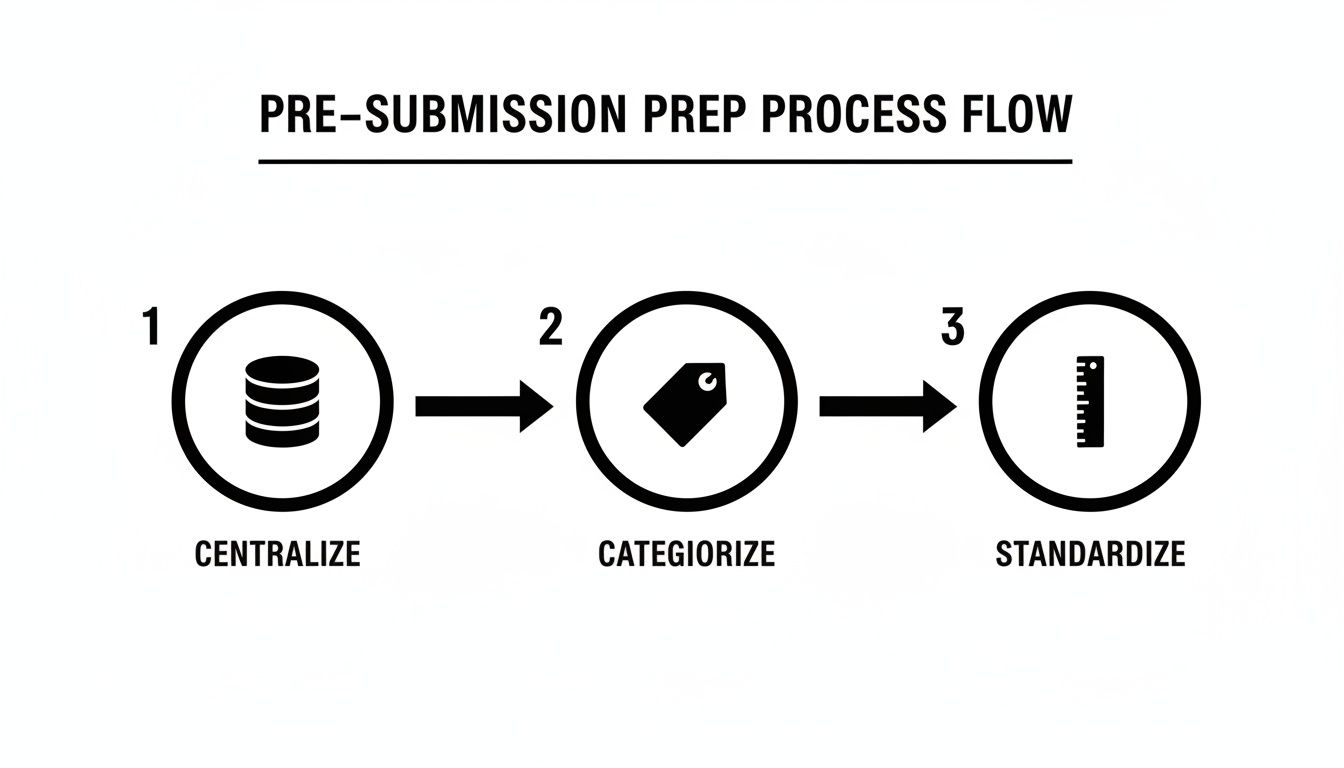
When you centralize your data, nail down your categories, and standardize every detail beforehand, the actual submission becomes a simple, error-free task.
A Real-World Submission Example
Let's walk through what this looks like in practice. Say you’re adding your business to a super-local directory, like the one for the Bonita Springs Area Chamber of Commerce. On most of these sites, you'll find a clear call to action like "Add a Business," "Join," or "Create Your Listing."
Once you’re on the submission form, you’ll simply copy and paste from that master document—your "single source of truth." This is why that first step is so critical.
- Business Name: Copy "SWFL Coastal Plumbing, LLC" precisely as it is. No adding "Inc." or tweaking the spelling.
- Address: Paste "1234 Sunshine Blvd, Ste 200, Fort Myers, FL 33901" without any changes.
- Photos: This part is huge. You need to upload high-quality photos that scream "local," not generic stock images. Show your team on a job in Bonita Springs, a finished project in a recognizable neighborhood, or your branded truck parked near a local landmark. These visuals are what build real trust with local customers.
Thinking about the specific steps required, the landlord registration process on different rental platforms offers a good parallel. Each site has its own unique quirks, but the fundamental need for accurate, consistent information is always the same.
Pro Tip: Set up a dedicated email address just for these submissions, like
listings@yourbusiness.com. This is a lifesaver. It keeps all your verification emails in one spot and stops crucial messages from getting buried in your main inbox.
The All-Important Verification Step
After you hit "submit," the directory isn't just going to take your word for it. They need to verify that you are who you say you are. This is the final checkpoint before your listing goes live.
You’ll typically see one of a few common methods:
- Postcard Verification: Google and other major directories will often mail a postcard to your business address. It will have a unique PIN you need to enter online to confirm your location. This is still the gold standard.
- Phone Call Verification: Some sites will call your listed business number. It might be an automated system giving you a PIN or a real person on the line. For example, a Yelp representative might call to confirm your business details.
- Email Verification: This is the easiest one—you just click a confirmation link sent to the email you provided.
It’s absolutely vital to get your team ready for this. Let your front desk staff know to expect verification calls. A missed call can set your listing back for weeks. And keep a close eye on the mail, because that verification postcard can look a lot like junk mail and get tossed by mistake.
Hunting Down and Merging Duplicates
As you start submitting to local directories, you might be surprised to find that your business is already listed. These could be old profiles with a previous address, or listings automatically created by data aggregators. We call these rogue duplicates, and they are poison for your local SEO.
Before you even think about creating a new profile, always search the directory for your business name and any variations. For example, if your business is "SWFL Coastal Plumbing, LLC," you should search for "SWFL Coastal Plumbing" and "Coastal Plumbing Fort Myers." If you find a duplicate, don't just make another one. Instead, look for a button that says "Claim This Listing." The process is a lot like a new submission, but you’ll be taking control of an existing profile to update it.
Merging these duplicates is a non-negotiable step. It cleans up confusing signals for Google and consolidates all your "link juice" into one powerful listing. This is just as critical as optimizing your main profiles. To make sure your most important listing is perfect, take a look at our complete Google Business Profile optimization checklist.
Prioritizing the Most Impactful Local Directories
Not all directories are created equal. When you’re submitting your business to local directories, the goal isn't just to get listed everywhere—it's to show up on the right ones. A focused, tiered approach saves a ton of time and delivers much better results because you're concentrating your energy where customers are actually looking.
This is about working smarter, not harder. You’re not just creating citations; you’re building real visibility that translates directly into phone calls, website clicks, and paying customers.
Start with the Undisputed Champion: Google Business Profile
Before you even think about another directory, your entire local SEO world has to revolve around your Google Business Profile (GBP). It is, without question, the single most critical listing for any local business. It's not just a listing; it's an interactive storefront that appears in Google Search and, most importantly, on Google Maps.
The power of GBP in local search is hard to overstate. By 2026, Google Business Profile is projected to handle roughly 68% of all local search traffic. Even more impressive, verified GBP listings generate an average of 595 calls per year—that’s about 50 calls every month, creating a steady flow of warm leads.
Your Google Business Profile is your number one priority. No other directory comes close in its ability to generate direct customer engagement. Treat it as the central hub of your entire local online presence.
Tier 1: The Essential Heavyweights
Once your Google Business Profile is polished and fully optimized, the next move is to secure your spot on the other major data aggregators and high-authority platforms. These are the household names that feed your business information to hundreds of smaller apps, GPS systems, and websites.
Getting your info right here creates a powerful ripple effect across the web. The key players in this tier are:
- Apple Maps: Absolutely essential for capturing the millions of iPhone, iPad, and Mac users who rely on Apple’s native mapping app every day.
- Yelp: A massive review site that heavily influences consumer decisions and frequently pops up in search results for local service queries.
- Bing Places for Business: While it's not Google, Bing still owns a significant slice of the search market and is the default search engine for many Microsoft products.
Tier 2: Niche and Industry-Specific Directories
With the big names covered, it’s time to get more targeted. This tier is all about websites that are highly respected within your specific industry. A listing on one of these sites is a powerful signal of credibility to both Google and your potential customers.
For instance, a lawyer in Fort Myers would get immense value from a profile on Avvo or FindLaw. Similarly, a home builder in Cape Coral should make it a priority to be on Houzz and HomeAdvisor. These platforms attract users who are already looking for specialized professionals, making them a fantastic source of high-quality leads. Finding the right ones for your business is a critical step, and you can explore top local listing sites for various business types to get started.
Tier 3: Hyper-Local SW Florida Directories
Finally, let's bring your focus right down to the community level. These are the directories that prove you are a true local business, deeply embedded in the Southwest Florida market.
Think about where a long-time resident of Naples or Bonita Springs might look for a trusted local company. Getting listed on these sites solidifies your local relevance like nothing else.
- Local Chamber of Commerce sites (like the Bonita Springs Area Chamber of Commerce)
- Local news publication business listings (such as the Naples Daily News or The News-Press)
- Community-specific directories that cater directly to your city or county.
Submitting to these hyper-local directories shows you're part of the community's fabric, building a level of trust that a national brand just can't replicate.
Common Mistakes to Avoid When Submitting to Directories

Getting your business successfully listed is a huge step, but I've seen countless companies undermine their own hard work with simple, avoidable mistakes. Honestly, learning what not to do is often the fastest way to get ahead in local search.
These errors might seem small, but they create a ton of confusion for search engines and, even worse, for your potential customers. Getting this right from the very beginning is what separates a strong online foundation from a weak one.
Tiny NAP Inconsistencies Cause Big Problems
The single most damaging mistake we see is a failure to maintain 100% NAP consistency. Even the slightest difference between your Google and Yelp profiles can split your SEO authority and leave search algorithms guessing.
Let me give you a real-world example we fix all the time:
- On Google Business Profile: Your address is
123 Main St, Suite 101 - On Yelp: Your address is
123 Main Street, #101
To a person, that’s the same place. To a search engine, those can look like two entirely different locations. This dilutes the power of both listings, sinking your chances of ranking in local searches. The same rule applies to your business name—using "SWFL Plumbing LLC" on one site and just "SWFL Plumbing" on another is a critical foul.
Choosing Overly Broad Categories
When you submit to local directories, they ask you to pick a business category. This is not the time to be vague. Choosing an overly broad category is a massive missed opportunity to attract ready-to-buy customers.
Think about it: a roofer in Naples who just picks "General Contractor" is now forced to compete with every home builder, plumber, and electrician in town.
A much better choice would be "Roofing Contractor" as the primary category. Then, get specific with secondary categories like "Roof Repair" and "Metal Roofing." This precision tells directories exactly who you serve, making sure you show up when your ideal customers are searching.
Specific categories connect you with people who have a high intent to purchase your exact services.
The "Set It and Forget It" Mentality
Submitting your business information isn't a one-and-done task. Treating it that way is a surefire way to watch your online presence slowly decay over time.
Your business is always evolving. Hours change for the season, you add a new service, or maybe you get a new phone number. If you don't update that information across every single directory, you're essentially broadcasting inaccurate data. Research has shown that 80% of consumers lose trust in a local business if they find incorrect information online.
Here are a few other common missteps to watch out for:
- Using Low-Quality Photos: Ditch the generic stock photos. Upload high-resolution images of your actual team on the job, your completed projects in Fort Myers, and your branded service vehicles parked in a driveway. Show people the real you.
- Ignoring Spammy Directories: Don't waste your time submitting to every directory under the sun. Focus your energy on high-authority sites and platforms relevant to Southwest Florida. Listing on junk, spammy directories can actually hurt your reputation with Google.
- Forgetting to Track Your Listings: This is a big one. Keep a simple spreadsheet of every directory you've submitted to, along with your login info. This turns future updates from an impossible chore into a manageable task.
Frequently Asked Questions About Local Directory Submissions
Even with the best checklist, some questions always pop up once you start digging into local directory submissions. We've been there. Here are some straight answers to the most common questions we hear, based on our experience helping businesses just like yours.
How Long Does It Take to See SEO Results?
This is the big one, right? While it's not an overnight flip of a switch, you'll probably see results faster than you expect. A properly tuned-up Google Business Profile can start generating more phone calls and map views within just a few weeks.
But when it comes to the broader directory submissions, think of it as building a long-term foundation for your business's authority. You should expect Google to start noticing these new citations and factoring them into your rankings within 2-3 months. The real magic happens with consistency; building these citations over time creates a powerful, lasting boost to your local visibility.
Should I Do Manual Submissions or Use an Automated Service?
This guide is built around manual submission, and for good reason. It gives you complete control and is the absolute best place to start. It’s free (aside from your time) and allows you to nail those hyper-local Southwest Florida directories that the automated tools often miss entirely.
A hybrid approach is what we see work best. Handle your most important profiles—like Google, Bing, and Apple Maps—manually for maximum control. Once those are perfect, you can use a service to scale your efforts across dozens of other directories.
Services like BrightLocal or Yext can be a huge time-saver, pushing your data out to many sites at once. But they come with a subscription fee and a big catch: if you cancel the service, your listings can often revert to their old, incorrect state or disappear completely.
What if My Business Moves or Changes Phone Numbers?
If this happens, updating your information needs to be your top priority. Inaccurate NAP (Name, Address, Phone) data is a huge red flag for search engines and can directly tank your rankings and, worse, send customers to the wrong place.
Here's the game plan:
- Start with Your Own Website: Your website is your home base. Make sure it's correct first. For example, update the address in your website's footer and on your contact page.
- Update Google Business Profile Next: This is your single most important digital storefront. It has to be accurate.
- Work Through Your Master List: Go down the spreadsheet you created and methodically update every single directory one by one. This is where having a spreadsheet with links to each profile and your login info saves the day.
This is exactly why keeping that detailed spreadsheet with all your listings and login info is an absolute lifesaver. It turns a potential disaster into a straightforward, manageable task.
Managing local directory submissions is an ongoing job, but it's absolutely vital for any local business in Fort Myers trying to get ahead.
If you’d rather have a team of experts handle the meticulous work of building citations and managing your local SEO, Polaris Marketing Solutions is here to help. Get your free online analysis today and see exactly how you stack up against the competition.
Find out more at https://polarismarketingsolutions.com.