
A Cape Coral cleaning owner opens the weekly Google Ads report and sees the same uncomfortable question: “Where did the budget go?” The spend column shows the total, but it doesn't explain whether the campaign bought affordable traffic, expensive traffic, or clicks from people who were never likely to book.
The cost per click formula provides that first answer. It turns ad spend and click volume into a practical number, then gives you a starting point for judging auction pressure, lead quality, and profitability. For a Southwest Florida business, a click isn't valuable because it's cheap. It's valuable when the resulting customer produces enough profit to justify the cost.
What CPC Really Means for a Local Business
Cost per click, or CPC, is the amount an advertiser pays for a click on an ad. A click occurs when someone selects the advertisement and visits the linked page, calls through a call asset, or takes another platform-defined click action. It isn't the same as an impression, which only records that the ad appeared, and it isn't the same as a conversion, such as a completed quote request or booked appointment.
That distinction matters for a local service company with a limited weekly budget. A campaign can generate plenty of impressions without bringing visitors to the website. It can also generate clicks without producing calls, forms, or booked jobs. CPC tells you how efficiently the campaign is purchasing visits, but it doesn't tell you whether those visits are commercially useful.
Practical rule: Treat CPC as a traffic-cost metric first. Judge business performance with qualified leads, booked work, and customer acquisition cost.
A Fort Myers HVAC company might consider a $4 click reasonable if the visitor needs emergency service and the company can turn that visit into a profitable repair. A Naples personal injury lawyer may see a $40 click because the keyword reflects a high-value legal matter and intense advertiser competition. Those figures aren't automatically good or bad. They belong to different business models, search intents, and revenue opportunities.
Google Ads defines average CPC by dividing the total cost of clicks by the total number of clicks, as explained in its average CPC guidance. The result is an average across a reporting window, so individual clicks can cost different amounts.
Clicks are only one step in the funnel
For a Cape Coral cleaner, the useful sequence is:
- Impression: A nearby searcher sees the ad.
- Click: The searcher visits the service page or uses a click-enabled ad feature.
- Lead: The person calls or submits a request.
- Booked job: The business accepts and schedules the work.
- Profitable customer: Revenue remains after fulfillment and marketing costs.
CPC sits between visibility and lead generation. A low number can signal efficient traffic, but it can also reflect broad, low-intent searches. A higher number may be acceptable when the visitor is ready to hire. Read CPC beside search terms, locations, devices, call quality, and booking outcomes rather than using one blended number as a verdict.
The Cost Per Click Formula Explained Step by Step
The standard calculation is simple:
Average CPC = Total advertising cost ÷ Total clicks
Use the same reporting period for both inputs. If you pull spend from one date range and clicks from another, the result won't describe the campaign accurately. Google Ads also explains that CPC bidding uses a maximum bid ceiling, while the actual charge can be lower than that ceiling because the auction determines the final amount.
Step one, collect the matching inputs
Start with the ad cost and click count from the same campaign and date range. Then divide the cost by clicks.
A Cape Coral pool service spends $480 over two weeks and receives 1,200 clicks:
$480 ÷ 1,200 = $0.40 average CPC
The reported average is low compared with the Fort Myers roofing example below, but that doesn't prove the pool campaign is stronger. You'd still need to inspect search intent, lead volume, and booked estimates.
A Fort Myers roofing campaign spends $1,500 and generates 75 clicks:
$1,500 ÷ 75 = $20 average CPC
That higher result indicates a more expensive auction or a more valuable search category. It may still work if the clicks produce qualified roof-repair opportunities with enough contribution profit.
Step two, connect CPC to CPM and CTR
When you know CPM and CTR, you can derive CPC with:
CPC = (CPM ÷ 1000) ÷ (CTR ÷ 100)
The equivalent simplified form is CPC = 0.1 × CPM ÷ CTR, as shown in this CPC and CPM calculator explanation. With a $20 CPM and a 2% CTR, the implied CPC is:
($20 ÷ 1000) ÷ (2 ÷ 100) = $1.00
At a fixed CPM, stronger click-through performance lowers the implied CPC because more people click from the same impression spend.
| Metric | Cape Coral Pool Service | Fort Myers Roofer |
|---|---|---|
| Total ad cost | $480 | $1,500 |
| Total clicks | 1,200 | 75 |
| Average CPC | $0.40 | $20.00 |
| Position detail | Average position three | Not provided |
| Main interpretation | Lower-cost traffic requiring quality checks | Competitive, high-value traffic requiring lead-quality checks |
For budget planning, a simple spreadsheet is enough. A calculator such as the Outrank pricing tool can also help organize cost assumptions, but no tool can replace the search-term and conversion review that tells you whether the clicks matter.
What Drives Your Actual Click Price
The formula tells you what the campaign paid on average. The auction explains why each click landed at its particular price.
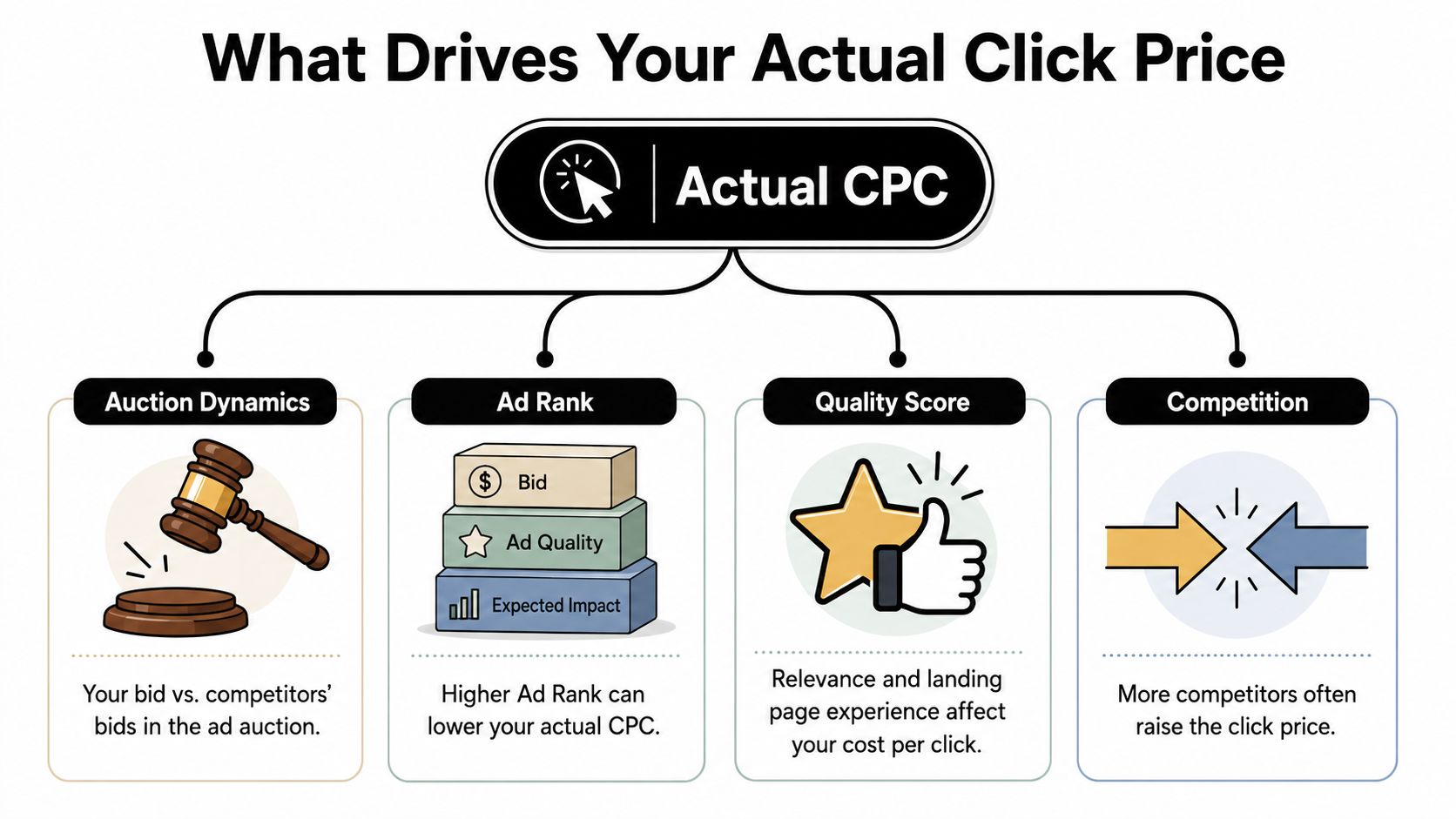
Google describes actual CPC as the final amount charged for a click, generally below the advertiser's maximum CPC bid. The maximum bid acts as a ceiling, not a guaranteed rate. A competitor's position, your ad quality, and the available auction all influence the amount required to win or retain placement.
Auction dynamics and Ad Rank
A useful working model is Ad Rank = maximum bid × Quality Score, although Google's auction uses multiple quality and context signals. The advertiser with the largest bid doesn't automatically receive the strongest position. A relevant ad with a stronger quality profile can compete effectively without matching a larger maximum bid.
The common settlement explanation uses the next advertiser's Ad Rank divided by your Quality Score, plus a small increment. The exact auction experience can vary, so use the formula as a planning model rather than an invoice guarantee. Google's actual CPC FAQ confirms the central point, your maximum CPC is a ceiling and the actual CPC is often lower.
Quality Score and relevance
Expected CTR, ad relevance, and landing-page experience shape Quality Score. A Fort Myers HVAC ad promising same-day air-conditioning repair should send the visitor to a page that clearly supports that promise. A generic homepage creates friction, weakens relevance, and may force the advertiser to pay more for comparable visibility.
For local PPC, review keyword-to-headline alignment, service-area language, mobile usability, page speed, and the clarity of the call request. The PPC keyword research guide can help organize service and location themes before you build ad groups.
Competition and context
Industry benchmark data shows broad CPC variation. WordStream's 2026 Google Ads benchmark reports an all-industry average CPC of $5.42 across more than 13,000 U.S.-based campaigns, with averages ranging from $1.63 in Arts & Entertainment to $9.87 in Attorneys & Legal Services. The figures appear in the supplied Google Ads benchmark reference, and they demonstrate why a Fort Myers legal keyword shouldn't be compared with a low-competition service category.
Device, location, time, and intent also change the auction. A mobile search for emergency roof repair may attract a different set of advertisers and a different user than a desktop research query. Segment CPC by device, ZIP code, and search term before making a bid change.
Average CPC vs Actual CPC vs Effective CPC
Two Fort Myers roofers can set the same $20 maximum CPC and still experience different economics. One click may clear at $13.80, while another platform-reported click costs $16.40. After agency fees, software, creative production, and call tracking are included, the second roofer's effective CPC may reach $18.25.
Those numbers describe different layers of cost. Average CPC summarizes the campaign. Actual CPC describes the auction-clearing price for one click. Effective CPC includes the broader costs required to produce the attributed click.
Google's CPC bidding explanation states that advertisers pay for clicks and that actual CPC is typically lower than the maximum bid. A bid adjustment can change eligibility or bidding intensity without guaranteeing a matching invoice amount. For example, a 20% mobile increase raises the bid used for eligible mobile auctions, while a 15% location decrease reduces the bid emphasis for the selected area. The final charge still depends on the auction.
| Metric | Formula | Example | What It Tells You |
|---|---|---|---|
| Average CPC | Total ad cost ÷ total clicks | $1,000 ÷ 75 = $13.33 | Blended media cost across the reporting period |
| Actual CPC | Auction-clearing charge for one click | $13.80 | What the platform charged for that specific click |
| Effective CPC | All campaign-related costs ÷ attributed clicks | $1,370 ÷ 75 = $18.27 | The broader cost of generating each attributed click |
The effective figure can include management, software, creative, landing-page, and call-tracking expenses. Invalid clicks, platform credits, and unrecorded internal work can also change the result. If you leave those costs out, the dashboard may look efficient while the business account tells a different story.
For two competing roofers, compare effective cost and qualified leads, not just the CPC displayed in Google Ads.
The practical review should connect maximum CPC, actual CPC, cost per lead, and customer acquisition cost. A roofer paying more for a click may still outperform a competitor if those clicks produce better calls, stronger estimates, and more closed work.
Forecasting CPC for a Local Campaign
A Cape Coral HVAC company doesn't need advanced modeling software to create a useful CPC forecast. It needs a clean starting point, explicit assumptions, and a habit of replacing assumptions with campaign data.
Begin with a comparable campaign. If the reference campaign spent $2,400 and received 180 clicks, its starting average CPC is:
$2,400 ÷ 180 = $13.33
That figure is a starting observation, not a promise for the HVAC account. Search competition, service mix, location, device distribution, and ad quality can all move the result.
Build the estimate in four steps
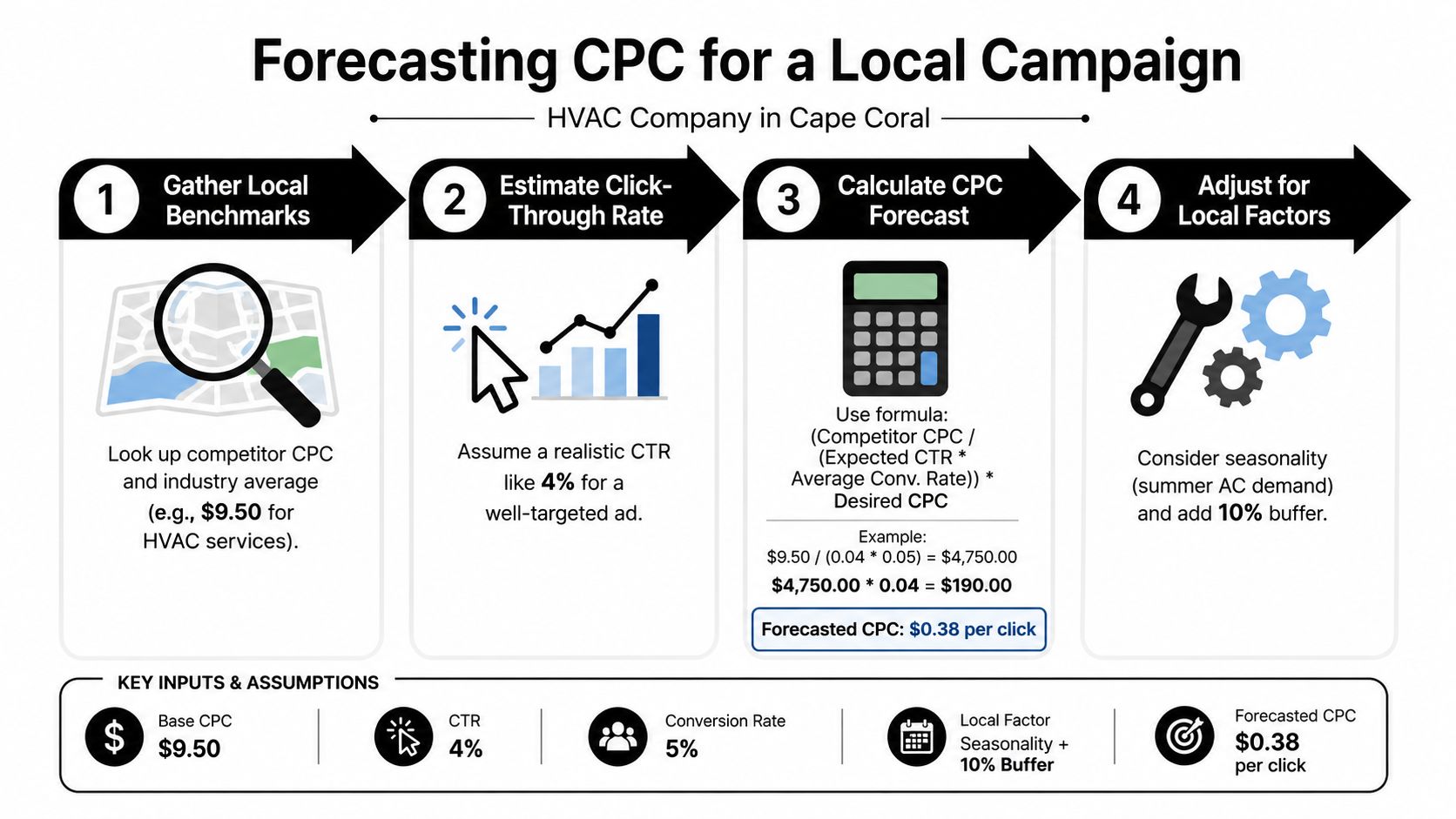
- Gather local benchmarks. Record comparable CPC data, service keywords, and locations. A resource covering keyword CPC forecasting tips can help structure the assumptions.
- Estimate traffic. Project clicks by dividing the available budget by estimated CPC. Then estimate impressions by dividing projected clicks by expected CTR.
- Apply local adjustments. Model the effect of mobile demand, tighter service areas, seasonal AC searches, and bid changes separately rather than hiding everything inside one average.
- Create scenarios. Use low, likely, and high CPC cases. Compare the resulting click volume with the number of qualified leads the company needs.
The supplied reference asset illustrates a four-step forecasting process, but its sample values aren't verified campaign benchmarks for Cape Coral. Don't treat them as local facts. Build the forecast from the company's own account history or a clearly comparable campaign.
A practical worksheet might include:
- Budget: What can the HVAC company spend during the reporting period?
- Estimated CPC: What does comparable search traffic cost?
- Projected clicks: Budget divided by estimated CPC.
- Expected CTR: Clicks divided by impressions.
- Qualified-lead assumption: How many visitors become meaningful inquiries?
- Break-even CPC: The highest click cost the economics can support.
Review the forecast weekly by search term, device, and location. A local campaign's actual results will eventually displace most estimates. For broader budget context, compare the forecast with this Google Ads cost guide before increasing spend.
What CPC Is Too High for Your Business Model
The lowest CPC isn't automatically the best CPC. A $6 click that never produces a booking can hurt more than a $24 click from a homeowner actively searching for emergency roof repair.
A useful ceiling comes from contribution profit and the rate at which clicks become customers:
Break-even CPC = Profit per converted customer × Click-to-customer conversion rate
For a conservative operating target, multiply the break-even CPC by the desired profit factor. That target should sit below the absolute ceiling so the business has room for lead-quality variation, missed calls, refunds, and operating costs.
Two Southwest Florida examples
A Cape Coral cleaning company earns $140 contribution profit per booked job and converts 4% of clicks into bookings:
$140 × 4% = $5.60 break-even CPC
A practical target could be $4.20, leaving room between the target and the break-even point. That target only makes sense if the 4% rate reflects qualified bookings rather than every form submission.
A Fort Myers law firm earns $1,200 contribution profit per signed client and converts 2.5% of clicks into signed clients:
$1,200 × 2.5% = $30 break-even CPC
A $20 click may be attractive under those assumptions. The legal campaign still needs call qualification, consultation quality, signed-client tracking, and attribution discipline.
| Business | Profit per Customer | Booking Rate | Break-Even CPC | Interpretation |
|---|---|---|---|---|
| Cape Coral cleaning company | $140 | 4% | $5.60 | A $4.20 target leaves operating room |
| Fort Myers law firm | $1,200 | 2.5% | $30.00 | A $20 click can fit the model if lead quality holds |
Count call duration, qualified conversations, assisted conversions, and signed work, not only form submissions. Maximum CPC controls bidding, actual CPC records the auction charge, cost per lead measures inquiry generation, and customer acquisition cost reveals what the business paid for a customer.
The right threshold isn't an industry average. It's the price at which an average click still supports acceptable profit for that specific business.
Proven Ways to Lower CPC and Track ROI
Use this checklist during the next optimization cycle. Each action should connect to a search term, device, location, or conversion outcome.
Tighten match types. Move a Cape Coral cleaning campaign away from unnecessarily broad targeting and test phrase or exact match around services such as recurring home cleaning and move-out cleaning. Review whether the narrower traffic produces better inquiries before expanding again.
Prune search terms weekly. A Fort Myers paving or HVAC account can attract searches for employment, equipment, training, or unrelated information. Add irrelevant terms as negative keywords, then preserve high-intent variations that produce qualified calls.
Improve ad relevance. Put the service and local promise in the headline, then match the landing page to that exact intent. A roofing ad for storm damage should lead to storm-damage information and a clear estimate request, not a generic services page.
Make mobile pages usable. Test the call button, form, page speed, and service-area clarity on the phones customers use in Cape Coral, Fort Myers, and Naples. Better relevance can improve auction efficiency, but a lower CPC doesn't matter if mobile visitors can't contact the business.
Use schedules and bid adjustments selectively. Schedule ads during hours when the team can answer calls. Increase bids only for devices or ZIP codes that produce booked work, and reduce exposure where clicks repeatedly fail to qualify.
Rotate credible ad angles. Test proof points, service guarantees, response speed, and specific service areas instead of changing headlines randomly. Avoid chasing a higher CTR if the additional clicks produce weaker leads.
Track revenue, not just traffic. Use ROAS = revenue ÷ ad cost as a simple return measure, then connect every click source to the CRM. A Cape Coral cleaning business should be able to identify whether a click led to a booking, while a Fort Myers HVAC company should distinguish a service call from a profitable installation opportunity.
For teams producing ad-focused landing content, how to create AI advertorials can inform the content workflow, but human review still needs to verify local claims, service details, and conversion intent.
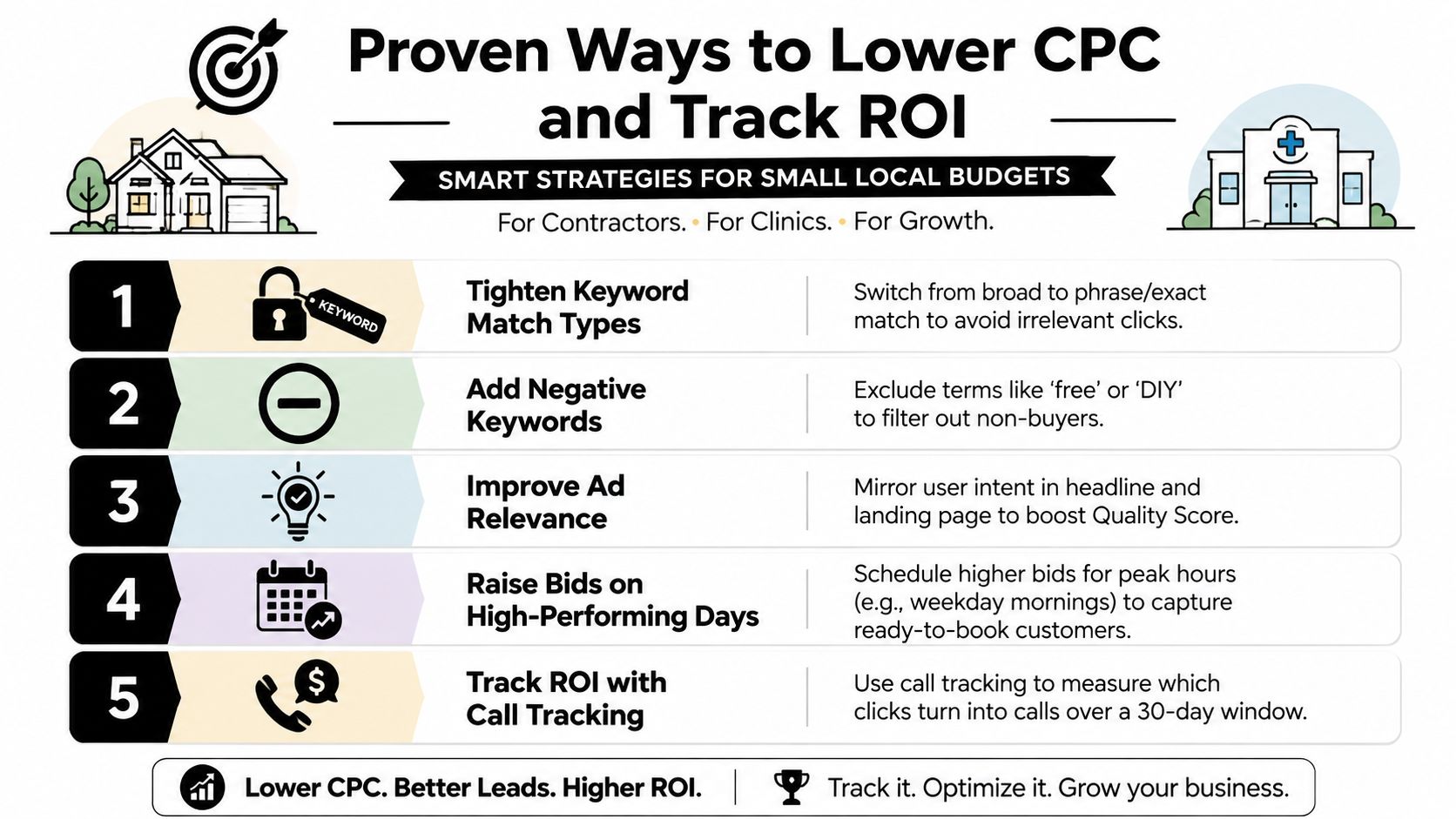
A 30-day review cadence keeps the process manageable. Check CPC, search terms, lead quality, booked jobs, and revenue together, then make a small set of changes rather than rebuilding the account every week. For implementation details, use this Google Ads conversion tracking resource to connect advertising activity with actual business outcomes.
Polaris Marketing Solutions helps Southwest Florida businesses plan and manage PPC campaigns around CPC thresholds, qualified leads, and measurable revenue instead of dashboard averages alone. Visit Polaris Marketing Solutions to request an online analysis and competitor report for your Fort Myers, Cape Coral, or nearby service area.