
You're probably here because your Google Ads budget keeps moving faster than your leads. Clicks come in. Search terms look relevant at first glance. Then the month ends, and you're left with a report full of traffic but not enough calls, forms, or booked jobs to justify the spend.
That problem usually starts before the campaign launches. It starts with keyword selection.
Most advice about keyword research for PPC tells you to chase “high-intent” keywords. That's only half right. Intent matters, but for a local business, keyword suitability matters just as much. If a term sounds perfect but the click price can wipe out your daily budget in a handful of visits, it's not a good keyword for your account. It's a good keyword for someone with a bigger wallet.
Stop Wasting Your PPC Budget on the Wrong Keywords
A lot of small businesses make the same move first. They open Google Ads, list the obvious service keywords, add the city name, and bid on the terms that look closest to a sale. On paper, that sounds smart. In practice, it often burns cash.

In local markets, some of the “best” looking keywords are priced for larger advertisers. Many high-intent keywords such as “best HVAC repair Fort Myers” have CPCs exceeding $25, and 68% of small businesses abandon these keywords due to budget constraints according to Search Engine Land's PPC keyword research discussion. That's the gap most keyword guides ignore.
Why expensive doesn't mean profitable
A keyword can be high intent and still be wrong for your account.
If you run a roofing company, dental office, or cleaning service in Southwest Florida, you don't need every expensive click. You need the clicks most likely to turn into revenue without forcing you to overspend before enough data comes in. That means weighing three factors together:
- Intent fit: Is the searcher trying to hire, compare, or just learn?
- Budget fit: Can you afford enough clicks to test and optimize?
- Local fit: Does the query match the towns and service area you cover?
Practical rule: Don't ask, “Is this keyword good?” Ask, “Is this keyword good for my budget, my service area, and my sales process?”
That shift changes the whole account. Instead of pouring budget into one prestige keyword, you start building a workable mix of service terms, location modifiers, and longer phrases that a real local buyer would search.
What works better for small local campaigns
The better path is usually narrower and less glamorous. You look for keywords that still show buying intent, but aren't trapped in the most aggressive bidding pocket. You also tighten your negatives early, write ads around one service theme at a time, and keep checking what searches are triggering spend.
If your campaigns keep leaking money through loose targeting, this guide to improving Google Ads ROI is worth reading because it focuses on one of the biggest profit killers in local PPC: irrelevant clicks you could have blocked.
The smartest keyword research for PPC isn't about winning the most competitive auction. It's about building a list you can afford to run long enough to improve.
Map Customer Intent Before You Search for Keywords
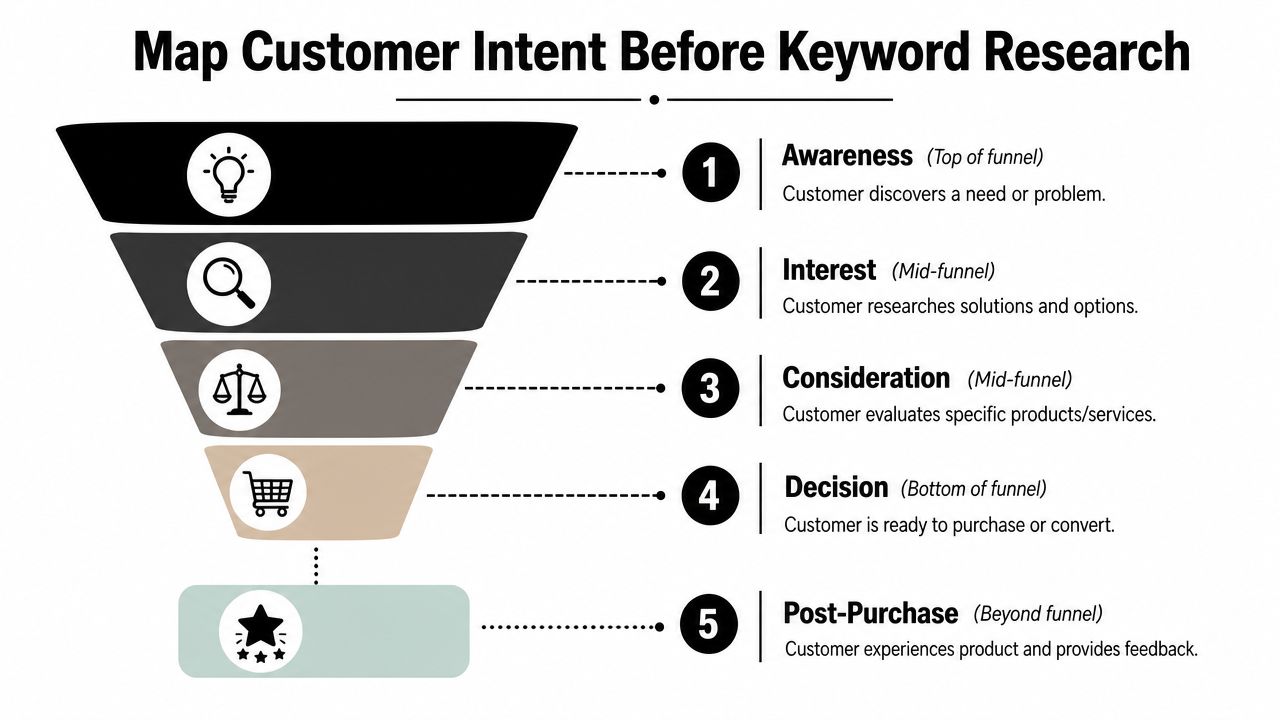
Before opening Google Keyword Planner, map how customers think when they need your service. Many campaigns fail at this stage. The account gets built around product names and industry jargon, while the customer is searching in plain language.
For a local plumber, the customer journey doesn't start with “residential plumbing solutions.” It starts with “water heater leaking,” “drain backing up,” or “plumber near me open now.”
Sort searches by buyer stage
I like to split local service keywords into three practical buckets.
- Problem-aware searches: These are symptoms and frustrations. Think “ac not cooling house” or “why is my roof leaking.”
- Option-aware searches: These show comparison behavior. Think “best roofer in Naples” or “tankless vs standard water heater.”
- Ready-to-hire searches: These are the money terms. Think “emergency plumber Fort Myers” or “water heater installation Cape Coral.”
Intent starts shaping budget decisions. Keywords with buyer modifiers like “buy,” “review,” or “price” are more valuable because they signal readiness to purchase. A phrase like “buy HVAC filter online” might convert at 3-5%, while “how to fix HVAC” converts below 1% according to Channable's discussion of PPC keyword intent.
That doesn't mean you should bid on every transactional phrase you find. It means you should identify which phrases show action, then judge whether they also fit your budget and geography.
A simple local example
Say you run a plumbing company with two profitable services: leak detection and water heater installation.
Your starting map might look like this:
| Customer stage | What they search | PPC decision |
|---|---|---|
| Early problem | leak in ceiling, no hot water | Usually low priority for direct-response search ads |
| Mid research | water heater replacement cost, slab leak detection company | Good testing territory |
| Bottom intent | plumber for water heater install near me, leak detection Fort Myers | Highest priority |
A lot of owners skip this step because they want to get to the tool fast. That's backwards. The tool should confirm your thinking, not replace it.
Search behavior makes more sense when you listen to the way customers describe the problem before they know the technical term.
That's also why customer interviews, call notes, estimate requests, and front-desk conversations matter. If your office hears “my AC is blowing warm” all day, don't build the entire campaign around “HVAC system diagnostics.” The customer isn't searching like a technician.
If you want a useful framework for collecting that language from the people you serve, mastering customer voice for product teams has practical ideas that translate well to PPC messaging and keyword discovery.
A quick visual walkthrough can help if you want to think through the full funnel before building your list:
What to write down before touching a keyword tool
Use a blank sheet or spreadsheet and list:
- Core services you want more of.
- Profit drivers you'd rather sell first.
- Customer phrases from calls, texts, and contact forms.
- Service areas by city, neighborhood, or county.
- Urgency modifiers like emergency, same day, open now, estimate, repair, install.
That list becomes the backbone of your keyword research for PPC. It keeps you focused on real demand instead of random tool suggestions.
How to Source Your Initial Keyword Master List
Once the intent map is clear, build a master list. Don't filter too early. At this stage, you're collecting possibilities from several angles, then trimming later.
I usually start with raw language from the business itself. Service pages, quote requests, phone logs, Google Business Profile reviews, and emails all contain useful phrasing. A cleaning company may say “move-out cleaning,” while customers say “apartment cleaning before landlord walkthrough.” Both belong on the list.
Start with what customers already say
Use four simple buckets and dump ideas into each one:
- Service terms: house cleaning, tile roof repair, family dentist, payroll attorney
- Problem terms: stains on carpet, AC blowing hot air, cracked driveway, tooth pain
- Location terms: Fort Myers, Cape Coral, Estero, Bonita Springs, Naples
- Modifier terms: near me, affordable, same day, emergency, licensed, best, reviews
Then combine them manually. A few examples:
- emergency AC repair Fort Myers
- affordable house cleaning Cape Coral
- tile roof leak repair Naples
- family dentist near me
- water heater installation Estero
These combinations won't all be winners. That's fine. The point is to create enough structured options that your later filtering step has something to work with.
Use competitor visibility without copying competitors blindly
Auction Insights is one of the most practical places to look when you already have ads running. It helps you see which advertisers overlap with you and where competition is concentrated. For example, Google Ads Auction Insights can show a competitor bidding on “best cleaning service Fort Myers” with a $12 CPC and 40% auction overlap, which can help you spot alternatives like “affordable eco-friendly cleaning” with a $4 CPC and 5% overlap as described in Commerce Pundit's PPC keyword research guide.
That example matters because it illustrates the core use of competitor research. You're not trying to clone a rival's list. You're trying to spot where everyone is overpaying and where the gaps are.
If you want broader frameworks for studying competitors across digital channels, this piece on strategies for outsmarting video rivals has useful thinking around pattern spotting and message gaps. The same mindset applies to paid search.
You can also compare paid search signals with a broader stack of platforms and workflows using these competitor analysis tools.
Pull in your internal data
Some of the best keywords never come from a third-party tool first. They come from your own business.
Look at:
- Search terms from existing campaigns: These show what people typed.
- Website search logs: Useful if visitors search on your site.
- Contact form phrasing: Often clearer than your own service names.
- Sales objections: If prospects keep asking “do you serve North Fort Myers,” there's probably a local query pattern behind that concern.
Build the master list wide, then narrow it hard. Thin lists miss opportunity. Messy lists can be cleaned up.
A good master list includes obvious service keywords, ugly long-tail phrases, local variants, comparison terms, and branded competitor opportunities if those fit your strategy. Don't worry yet about match types or bids. Just make sure the list reflects how people buy locally, not just how your website describes the service.
Refine and Select Keywords That Fit Your Budget
This is the point where keyword research for PPC stops being creative and starts being financial. Your spreadsheet may have hundreds of ideas. Most don't deserve budget.
Google Keyword Planner is where I pressure-test the list. I'm not looking for the biggest search volume. I'm looking for terms that show enough local demand, the right intent, and a click cost that leaves room to learn.
Filter for suitability, not ego
A lot of owners get attached to the biggest service keyword in their category. Usually that's the one every competitor wants too. If the bid range is too steep, you can burn through budget before you get enough conversion data to make smart decisions.
What matters more is whether the keyword can survive inside your economics. Ask:
- Can this term generate enough impressions in my service area?
- Can I afford enough clicks to judge performance?
- Does the phrase suggest a buyer, not just a browser?
- Can I write a highly relevant ad and send traffic to a matching page?
That last point gets overlooked. Campaigns using poorly matched keywords can see up to 70% lower CTR, while keywords with explicit purchase intent such as “buy” and “price” can produce conversion rates 3.5x higher than informational keywords according to PBJ Marketing's PPC keyword research analysis.
What I actually keep and cut
When reviewing a shortlist for a local contractor, I usually sort terms into three groups.
| Keep | Test carefully | Cut or park |
|---|---|---|
| Clear service + city phrases | Comparison phrases with uncertain CPC | Broad educational queries |
| “Near me” variants with local relevance | Expensive bottom-funnel terms | Vague one-word industry terms |
| Longer phrases tied to profitable jobs | Competitor brand terms if policy and fit allow | Keywords outside service area |
A few practical examples for an HVAC company:
- Keep: AC repair Fort Myers, emergency AC service Cape Coral, ductless mini split installation Naples
- Test carefully: best AC company Fort Myers, HVAC replacement financing
- Cut or park: how AC works, HVAC salary, DIY AC repair
Use local forecasting correctly
Always narrow forecasts to your actual geography. Don't judge a Fort Myers service keyword by statewide traffic. Statewide data can make a term look healthier than it will be in your real market, and that leads to bad assumptions about impression volume and daily spend.
I also like to flag terms that are affordable but too vague. Cheap clicks aren't a win if they attract the wrong person. A lower CPC only helps if the search intent still matches the service you sell.
If you need a broader framework for turning paid search decisions into lead quality and margin, this small business PPC management guide is a useful companion.
Cheap and profitable are not the same thing. Expensive and valuable are not the same thing either.
Your shortlist should feel smaller than you expected. That's a good sign. The strongest local campaigns usually begin with a compact set of suitable keywords, then expand only after the account proves where quality leads are coming from.
Structure Keywords into High-Performance Ad Groups
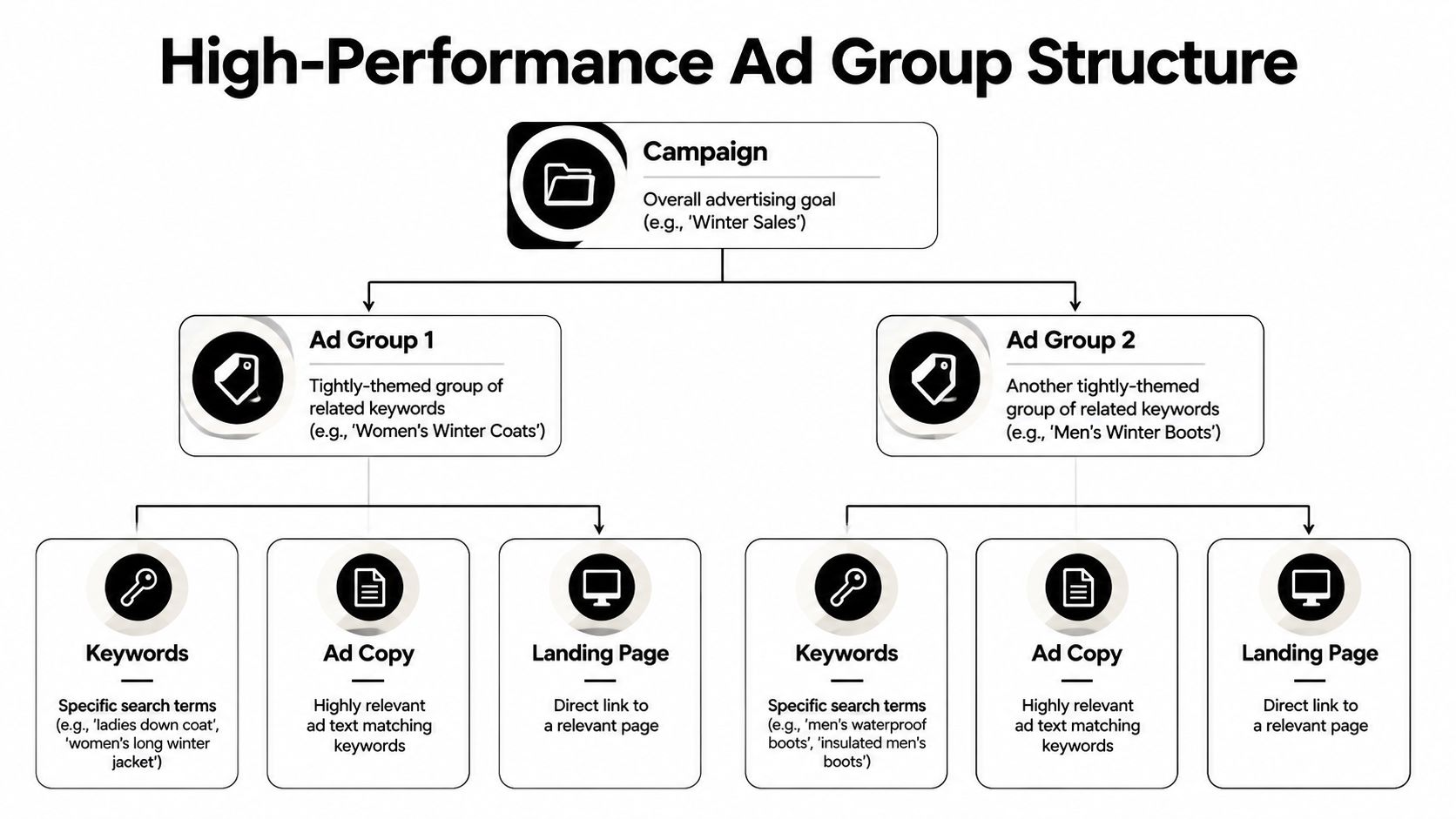
A good keyword list still underperforms if the campaign structure is sloppy. Ad groups are where relevance gets built. If one ad group mixes emergency repair, maintenance plans, installation, and troubleshooting terms, your ads become generic and your landing page match gets weaker.
That hurts performance fast.
Group by one clear theme
For local accounts, I prefer tight ad groups around a single service or service-intent cluster.
A cleaning company might separate:
- recurring house cleaning
- deep cleaning
- move-out cleaning
- office cleaning
A plumbing company might separate:
- water heater installation
- drain cleaning
- leak detection
- emergency plumber
Each group gets its own ad copy and the closest matching landing page. That's the structure that makes your account easier to optimize later. If you want to see how different account setups look in practice, these pay-per-click advertising examples are helpful for visualizing campaign organization.
PPC keyword match types explained
| Match Type | Syntax | Example Search It Will Match | Best For |
|---|---|---|---|
| Broad Match | emergency plumber fort myers | urgent plumbing help near Fort Myers, local pipe repair service | Discovery, with tight monitoring and negatives |
| Phrase Match | "emergency plumber fort myers" | best emergency plumber fort myers, emergency plumber fort myers open now | Controlled expansion around a core phrase |
| Exact Match | [emergency plumber fort myers] | emergency plumber fort myers | Highest precision for proven terms |
I rarely trust broad match without strong negatives and active review. Exact and phrase usually give small local businesses a cleaner start because you can control spend while learning what people type.
Negative keyword layering for local campaigns
Negative keywords aren't just housekeeping. They protect your budget, but they can also block good traffic if handled carelessly.
Misconfigured negative keywords can block 30-40% of qualified local leads, and 41% of small-business PPC campaigns in local markets suffer lead loss from overly aggressive negative keyword rules according to Diginius on PPC keyword selection.
That happens all the time in multi-city service areas. A business adds negatives too broadly for surrounding towns, device terms, or service modifiers, then wonders why lead flow thins out.
Use layered negatives like this:
- Account-level negatives: free, DIY, jobs, careers, training
- Campaign-level negatives: service lines that don't belong in that campaign
- Ad-group negatives: close variants that should route to another ad group instead
For a roofer, “metal roof repair” might be a negative in the tile roof ad group, but not across the whole account. For a med spa, “school” or “certification” belongs widely, while specific treatment exclusions may belong only in one campaign.
A negative keyword should block waste, not opportunity. If you can't explain exactly what traffic it excludes, don't add it yet.
This is also where local judgment matters. If you serve Fort Myers, Cape Coral, and Estero, don't casually negative nearby location modifiers because they look irrelevant at a glance. Search behavior around local geography is messy. People often search from one city for a provider in another.
Maintain Your Edge with Ongoing Keyword Optimization
The first round of keyword research gets the campaign live. Ongoing optimization is what keeps it profitable.
That's not just best practice. 57% of PPC specialists do keyword research weekly and 38% do it monthly, while failing to keep adding negatives can waste up to 30-40% of ad spend on irrelevant traffic according to Zen Agency's PPC keyword benchmarks.
The simplest recurring workflow
I like a short recurring review cycle rather than a dramatic overhaul.
- Check the Search Terms report: Find real queries that triggered ads. Add strong ones as keywords. Block weak ones as negatives.
- Pause weak spend: If a keyword keeps spending without producing the right lead behavior, cut it or lower its priority.
- Promote proven terms: Move winning searches into tighter ad groups with more precise match types and stronger ad copy.
- Review local relevance: Make sure searches still match the towns and services you want.
- Refresh ad text: If one keyword group is pulling quality traffic, test ad copy that mirrors the exact search language more closely.
What small business owners should remember
Your account doesn't fail because the original keyword list was “bad.” More often, it slips because nobody keeps trimming waste and promoting what works. Local search changes. Competitors adjust bids. Seasonal services rise and fall. Search terms drift.
Keyword research for PPC is never finished. The businesses that treat it like a living process usually keep more control over cost, lead quality, and growth.
If you want help building a practical PPC keyword strategy around a real local budget, Polaris Marketing Solutions works with businesses across Fort Myers and Southwest Florida to improve lead quality, reduce wasted ad spend, and turn search campaigns into a clearer source of ROI.