
Your phone isn't ringing enough. The contact form gets spam or junk leads. You paid good money for a site that looks polished, but it hasn't changed the business. That's where most small business owners start when they ask how to choose a web design agency.
If you're a contractor in Fort Myers, Cape Coral, Estero, or Naples, you don't need “a modern website.” You need a site that helps a homeowner decide fast, trust you, and contact you. A dentist needs appointment requests. A law firm needs qualified consultations. A cleaning company needs local visibility and steady lead flow. Design matters, but performance matters more.
Too many businesses hire agencies the same way they'd pick a restaurant. They scroll the portfolio, say “that looks nice,” and sign. Then they find out the agency built a pretty shell with no local SEO plan, no conversion thinking, and no structure for growth. If you want to understand the broader role an agency should play beyond design, this breakdown of what a digital marketing agency does is a useful starting point.
Your Website Is an Employee Not a Brochure
A website isn't wall art. It's an employee.
It should answer questions, filter bad-fit leads, build trust, and push the right visitors to call, book, or request a quote. It works nights, weekends, and holidays. If it doesn't do that, it's not doing its job.
What business owners get wrong
Most owners judge websites the way non-buyers judge websites. They notice colors, animations, and whether the homepage feels current. Buyers notice something else. They ask:
- Can I trust this company
- Do they serve my area
- Can they solve my problem
- What do I do next
If an agency can't build around those questions, the site won't produce.
Practical rule: If an agency spends more time talking about fonts than leads, keep looking.
A Fort Myers roofer doesn't need a trendy homepage with vague slogans. He needs service pages for storm damage, shingle replacement, tile roof repair, and inspection requests. He needs clear calls to action, local proof, and a structure that supports search visibility in the neighborhoods he serves.
What a good agency actually builds
A strong agency builds a sales tool, not just a design file. That means the site should include:
- Clear page purpose: Every page should support one action, like calling, scheduling, or requesting an estimate.
- Local intent coverage: Service-area pages should match where you want to win business.
- Trust builders: Reviews, licensing details, project photos, before-and-after work, warranties, and FAQs should reduce hesitation.
- Post-launch thinking: The site should be easy to improve after launch, not frozen in time.
The point of this process is simple. Stop buying a website based on taste. Start buying one based on whether it can help your business grow.
Define Your Website Goals and Budget
A Fort Myers contractor calls three agencies and asks for a new website. One proposal comes back at $2,500. Another is $7,500. A third is $18,000. All three promise a better site. None of those numbers mean anything until you decide what the site needs to produce.
Set the target before you ask for a price.
A good agency can only price the work if you define the business outcome, the scope, and the limits. If you skip that step, you invite vague proposals, surprise fees, and a site that looks fine but does not bring in calls or quote requests.
Replace design goals with revenue goals
“Make us look more professional” wastes everybody's time.
Write down 3 to 5 outcomes you want the website to drive. Keep them measurable and tied to sales or lead quality. For a local service business, that usually means more form submissions, more phone calls, better rankings for money pages, stronger visibility in the cities you serve, or fewer drop-offs on mobile.
Here's the difference:
| Business type | Weak goal | Better goal |
|---|---|---|
| Roofing company | We need a new website | We need estimate requests from Fort Myers and Cape Coral roofing service pages |
| Dental office | We want a fresh design | We need more implant and cosmetic consult requests |
| Cleaning company | We need to look credible | We need homeowners to request estimates online |
| Law firm | We want to update branding | We need qualified consultation leads from practice-area pages |
That kind of clarity changes the agency conversation fast. The right firm starts asking about lead flow, service margins, search intent, and which pages need to pull their weight. The wrong firm keeps talking about homepage styles.
Build a one-page brief before you request proposals
You do not need a bloated RFP. You need a clear brief.
Use a planning worksheet or a website design brief template and keep it to one page if possible. Include the information an agency needs to build the right scope:
- Primary objective: phone calls, estimate requests, consultation bookings, or online sales
- Best-fit customer: homeowner, property manager, patient, local resident, or B2B buyer
- Service area: Fort Myers, Cape Coral, Estero, Bonita Springs, Naples, or nearby markets
- Core pages needed: home, service pages, city pages, reviews, about, FAQs, contact, financing, careers
- Required features: click-to-call, forms, CRM integration, booking tool, review feed, galleries, chat
- Required access and deliverables: hosting access, domain access, CMS login, analytics setup, basic on-page SEO, post-launch support
This step saves money because it cuts confusion. It also makes proposals easier to compare. If one agency includes copywriting, local landing pages, call tracking, and analytics setup while another leaves all of that out, you can spot the difference before you sign.
If you need help framing a realistic starter scope, this guide to affordable web design for small business gives useful context on where to spend and where to trim.
Set a budget that matches the job
Cheap web design usually creates expensive problems. You pay once for the build, then again to fix weak copy, missing SEO structure, poor mobile conversions, or a site that your staff cannot update.
Clutch's overview of web design pricing shows that project costs vary widely based on scope, features, and agency expertise. That should be obvious, but many owners still ask for custom design, copywriting, local SEO setup, CRM integration, and fast turnaround on a bargain budget. That is how bad projects start.
Use simple budget logic:
- Basic local service site: budget for strategy, copy, conversion-focused structure, mobile performance, and core SEO setup
- Growth-focused local lead generation site: budget for service pages, location pages, tracking, stronger content, and a tighter conversion path
- Advanced site: custom functionality, portals, heavy integrations, or complex workflows require a higher budget and a stricter process
- Tight budget: cut scope first, not the fundamentals. Launch the pages that drive revenue, then add extras in phase two
For local contractors, I recommend funding the pages that can rank and convert first. A Fort Myers plumbing company gets more value from strong drain cleaning, water heater, repipe, and emergency service pages than from custom animation or trendy effects.
Decide what you will not compromise on
Some items should be required from day one.
You need ownership of the website, access to the hosting account, access to the domain, editable content in the CMS, conversion tracking, and basic technical SEO setup. If an agency treats those as add-ons or avoids the topic, walk away.
You also need a launch plan that fits your business. A paving contractor may need separate pages for residential and commercial work. A roofer may need storm damage and insurance claim pages before hurricane season. A dentist may need treatment pages and compliant forms before spending on ads. Budget follows priorities. It should not follow agency preferences.
A short, blunt brief protects you from buying the wrong thing. That matters more than any pitch deck.
Evaluate Agency Portfolios and Case Studies
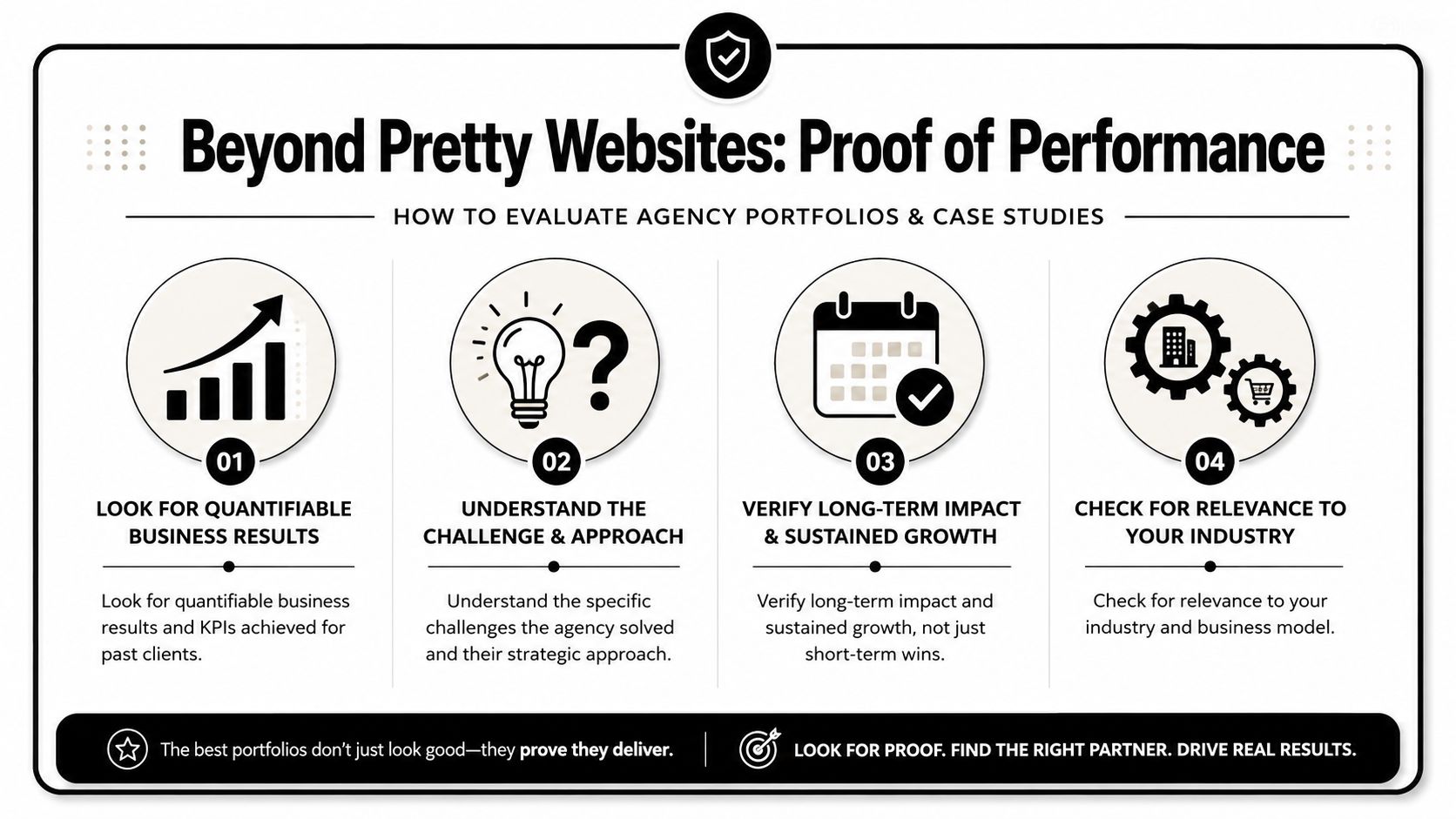
A Fort Myers contractor hires an agency, gets a sharp-looking site, and six months later the phone still isn't ringing. I've seen that mistake too many times. Portfolio reviews need to answer one question. Can this agency build a site that brings in qualified leads?
Start with recent work that matches your business
Ask for live examples from the last 12 to 18 months, not a greatest-hits reel from five years ago.
Agencies change fast. Staff turns over. Strategy shifts. The designer who made their best-looking project may be gone, and the account team selling you today may have had nothing to do with that work. If they can't show recent sites for contractors, home service companies, medical practices, or other local service businesses, lower their score.
Keep your shortlist tight. Three to five agencies is enough. Review live sites on your phone, not just desktop screenshots. Then ask what happened after launch.
What a real case study should show
A case study earns your attention when it explains the business problem, the plan, and the result. If it skips the result, it is a design sample.
Use this filter:
| Question | What you want to see |
|---|---|
| What problem did the client have | Weak lead flow, poor local visibility, low mobile conversions, unclear service pages |
| What did the agency change | Site structure, page copy, calls to action, location pages, trust elements, tracking |
| How did they measure success | Form fills, phone calls, booked jobs, organic traffic trends, lead quality |
| Did results continue after launch | Performance over time, not launch-week screenshots |
Strong agencies can explain how they helped a business optimise your website for search engines while improving conversion paths. That matters more than polished mockups.
For local service businesses, ask for examples where the agency improved service pages, quote requests, call tracking, and local search visibility together. Those pieces work as one system.
Ask questions that expose strategy
Weak agencies talk about colors, fonts, and brand feel. Good agencies can explain decisions in plain English.
Ask these questions:
- What business problem was this site built to fix
- What was wrong with the old site
- Why did you structure the pages this way
- Which calls to action produced the most leads
- What changed after launch
- Which pages pulled their weight
- What would you change if you rebuilt it now
Then listen for specifics. A serious agency can tell you why a plumbing site needed separate pages for water heaters, drain cleaning, repipes, and emergency service. They can explain why a Fort Myers roofer needs storm damage pages, financing language, and visible review proof near every conversion point.
If they keep drifting back to visuals, they are selling visuals.
Check the live site, not the screenshot
Screenshots hide bad performance. Open the actual websites they claim as wins.
Click through the menu. Test the forms. Check the mobile experience. Read the page copy. Search the page titles and headings. Look for basic technical on-page SEO elements such as clear title structure, useful headings, internal links, and service-focused copy. You do not need an audit yet. You need proof that the agency builds sites that are usable, clear, and built to rank.
A case study without a live link should make you suspicious.
Portfolio warning signs
Some red flags are easy to miss until you know what to look for:
- Every site feels the same. That usually means they start with a template and swap logos.
- There are no business results. No traffic trends, no lead data, no discussion of booked work.
- They only show brand-heavy projects. A contractor website has a different job than a boutique fashion site.
- They avoid discussing constraints. Experienced teams can explain tradeoffs, priorities, and what they chose not to build.
- They have no local examples. If they do not understand service areas, trust signals, and quote flow, you will pay to teach them.
Score the agency like a business decision
Do not pick a firm because their homepage impressed you.
Score each agency on five points: relevant industry experience, proof of outcomes, clarity of strategy, quality of live sites, and confidence in the team's answers. The best-looking agency often loses once you use that filter. Good. That usually saves money and gets better results.
Assess Technical SEO and Local Expertise
A local service business can't separate web design from search visibility.
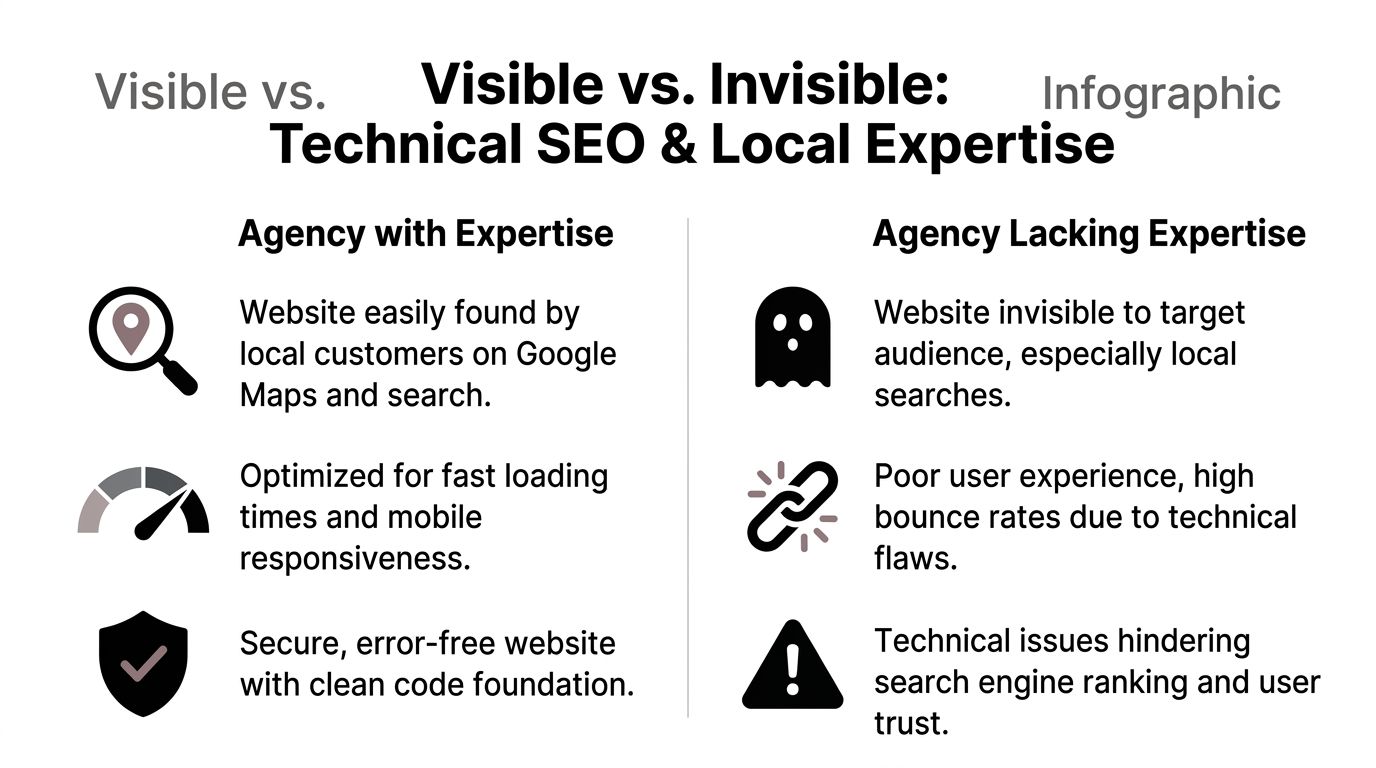
If your new site looks sharp but doesn't rank for the places and services that matter, you bought decoration. For contractors and local practices in Southwest Florida, technical SEO and local search structure are not optional add-ons. They're core parts of the job.
Why generalist agencies miss local lead generation
CliqStudios points out that when choosing an agency for a local service business, you need to assess whether they understand service-area pages, review management, and local search competition, because generalist agencies often overlook those realities in its FAQ on how to choose a web design agency.
That's exactly the issue I see with contractors. A generalist agency might build one “Services” page and call it a day. A local-focused agency knows that a roofer may need separate pages for repair, replacement, storm response, and inspections, plus location-specific content for Fort Myers, Cape Coral, and nearby markets.
What to look for on the technical side
You don't need to be an SEO expert. You need to know what to ask.
A solid agency should be able to explain, in plain English, how they'll build a site that search engines can crawl and local customers can use. If you want a plain-language primer, this resource on how to optimise your website for search engines is helpful background before discovery calls.
Look for agencies that can speak clearly about:
- Site structure: How they organize services, locations, and supporting content.
- Mobile experience: Local searches happen on phones. If the mobile layout is sloppy, conversions drop.
- Page speed and code quality: Slow sites lose impatient buyers.
- Local business signals: Location relevance, review integration, and consistent trust information.
- On-page SEO basics: Title tags, internal linking, headings, image handling, and crawlable content.
If you want a reference point for what that work includes, this overview of technical on-page SEO shows the kinds of foundational elements a capable agency should already have baked into its process.
Questions that separate real expertise from buzzwords
Ask these in discovery calls:
| Ask this question | Why it matters |
|---|---|
| How would you structure pages for our service areas | It reveals whether they understand local intent |
| How do you approach duplicate content across nearby cities | It shows whether they know the difference between local targeting and copy-paste junk |
| How do reviews fit into the website strategy | Local trust and conversion are tied together |
| How do you support Google Business Profile visibility from the site | Good agencies connect website structure with local search presence |
| How do you decide which services deserve standalone pages | This reveals strategic thinking, not just design execution |
Specialist or generalist for Fort Myers businesses
For local service companies, I lean toward agencies that understand lead generation, local search, and service-based buyer behavior.
That doesn't mean they must only work with contractors. It means they should understand the mechanics of local demand capture. A Fort Myers agency that regularly works with service businesses will usually ask sharper questions about neighborhoods, emergency intent, review velocity, financing pages, and quote friction than a broad agency that mostly builds brand sites.
A local contractor's website should be built for homeowners with urgent problems, not for design awards.
One example in this market is Polaris Marketing Solutions, which offers website design, hosting, SEO, and related digital marketing services for Southwest Florida businesses. That kind of integrated setup can make sense when you need design, local visibility, and ongoing support to work together instead of living in separate vendors.
Navigate Proposals and Spot Red Flags
Proposals tell you how an agency thinks.
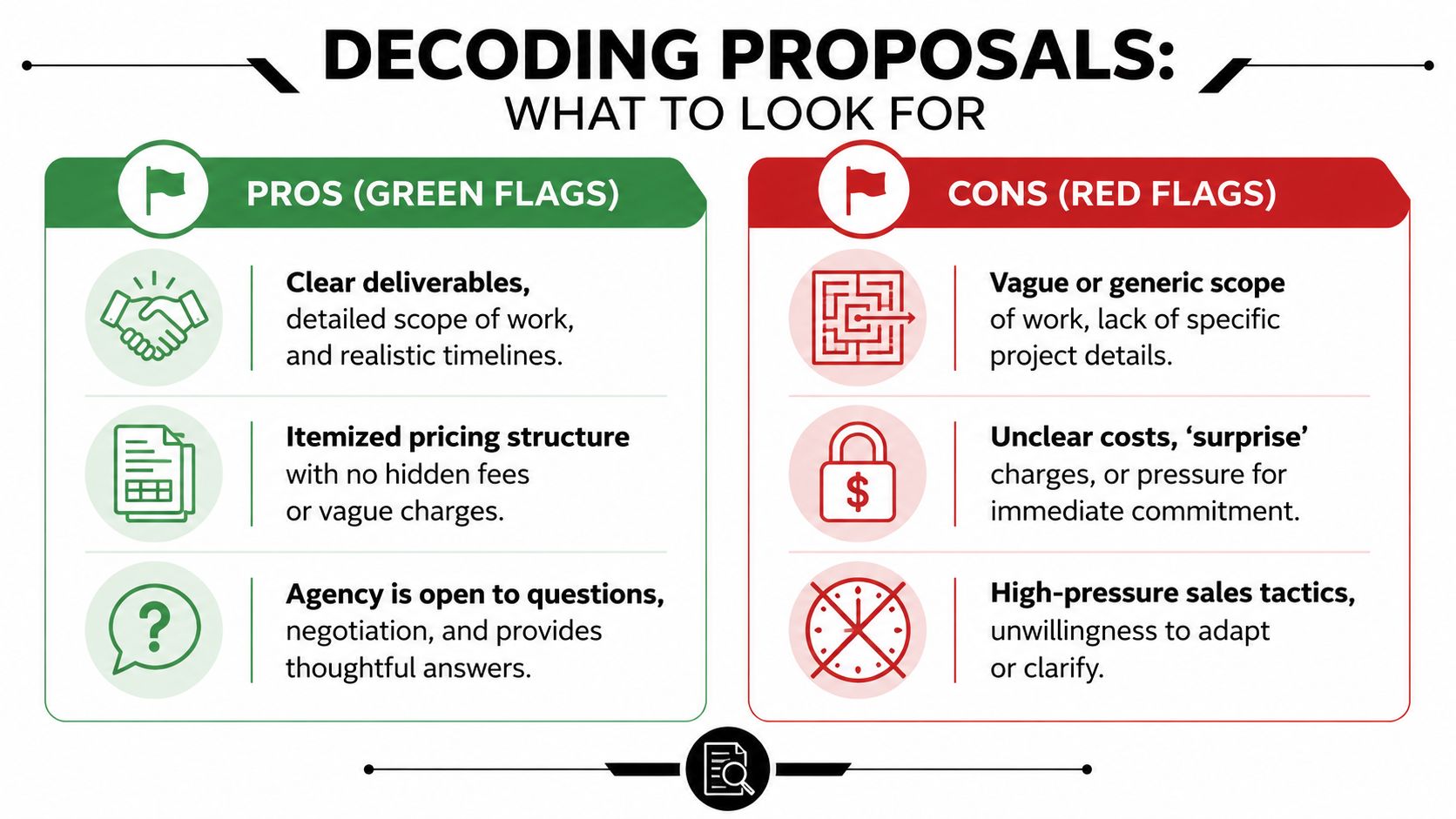
A weak proposal hides behind broad language. A strong proposal explains deliverables, ownership, process, assumptions, and what happens after launch. If you're serious about learning how to choose a web design agency, evaluating proposals carefully can still prevent many bad decisions.
For a quick visual guide, review this before you compare bids:
What a useful proposal includes
You should be able to answer these questions by reading the proposal:
- What exactly are they building
- What pages and features are included
- Who is doing the work
- What content responsibilities belong to you
- What happens if the scope changes
- What do you own at the end
- What support exists after launch
If those answers aren't clear, the proposal is not ready to sign.
Oneton Creative highlights a key gap in most advice: buyers need a repeatable evaluation framework to judge whether an agency ties design decisions to conversion, SEO, or lead generation results, not just generic case studies, in its article on choosing the best web design agency. That's exactly right. The proposal should show how the agency connects work to outcomes.
Vague proposal versus strong proposal
| Weak proposal | Strong proposal |
|---|---|
| “Custom website design” | Specific page list, functionality, revision process, and launch steps |
| “SEO included” | Clear explanation of what SEO work is in scope |
| “Responsive design” | Mobile-first approach and testing process |
| “Ongoing support available” | Defined maintenance terms, response process, and responsibilities |
| “Timeline depends on client feedback” | Milestones, dependencies, and approval checkpoints |
Red flags that usually predict pain
Watch for these:
- They don't ask hard questions: If they never dig into lead quality, close rates, service areas, or margins, they're not thinking like a growth partner.
- The price feels strangely low: That often means templates, weak strategy, or heavy outsourcing.
- They won't name the team: You need to know who's designing, building, and managing the project.
- They promise everything: Fast timeline, low price, unlimited revisions, guaranteed results. That combination usually falls apart.
- They avoid ownership details: If the contract is murky about files, access, hosting, or transfer rights, stop.
Accessibility belongs on this checklist too. If the site serves the public, ask how the agency handles accessibility review and testing. This guide for assessing software accessibility posture gives you practical vendor questions to use before signing.
You should also see how the agency talks through real decision-making. This video is worth watching before your final calls:
Contract terms you should not gloss over
Read these carefully:
- Ownership terms. Make sure the contract states you own the website assets and content rights once final payment is made.
- Hosting and maintenance. Know whether hosting is optional, required, month-to-month, or locked into a longer arrangement.
- Cancellation language. If the project goes sideways, you need a clean exit path.
- Post-launch responsibilities. Clarify what bug fixes, edits, updates, or training are included.
Bad relationships rarely start with one giant lie. They start with vague wording that gives the agency room to underdeliver.
Printable Agency Selection Checklist
Most businesses don't need more advice. They need a usable filter.
The web design industry is mature enough that buyers should expect professional process and structure. Made By Shape notes that the UK web design sector generated £621.3 million in revenue in 2023, which reinforces that this is a serious, established market where businesses should expect formalized standards when evaluating agencies in its review of web design agency statistics and trends.
That's why a checklist works. It keeps you from making an emotional decision.
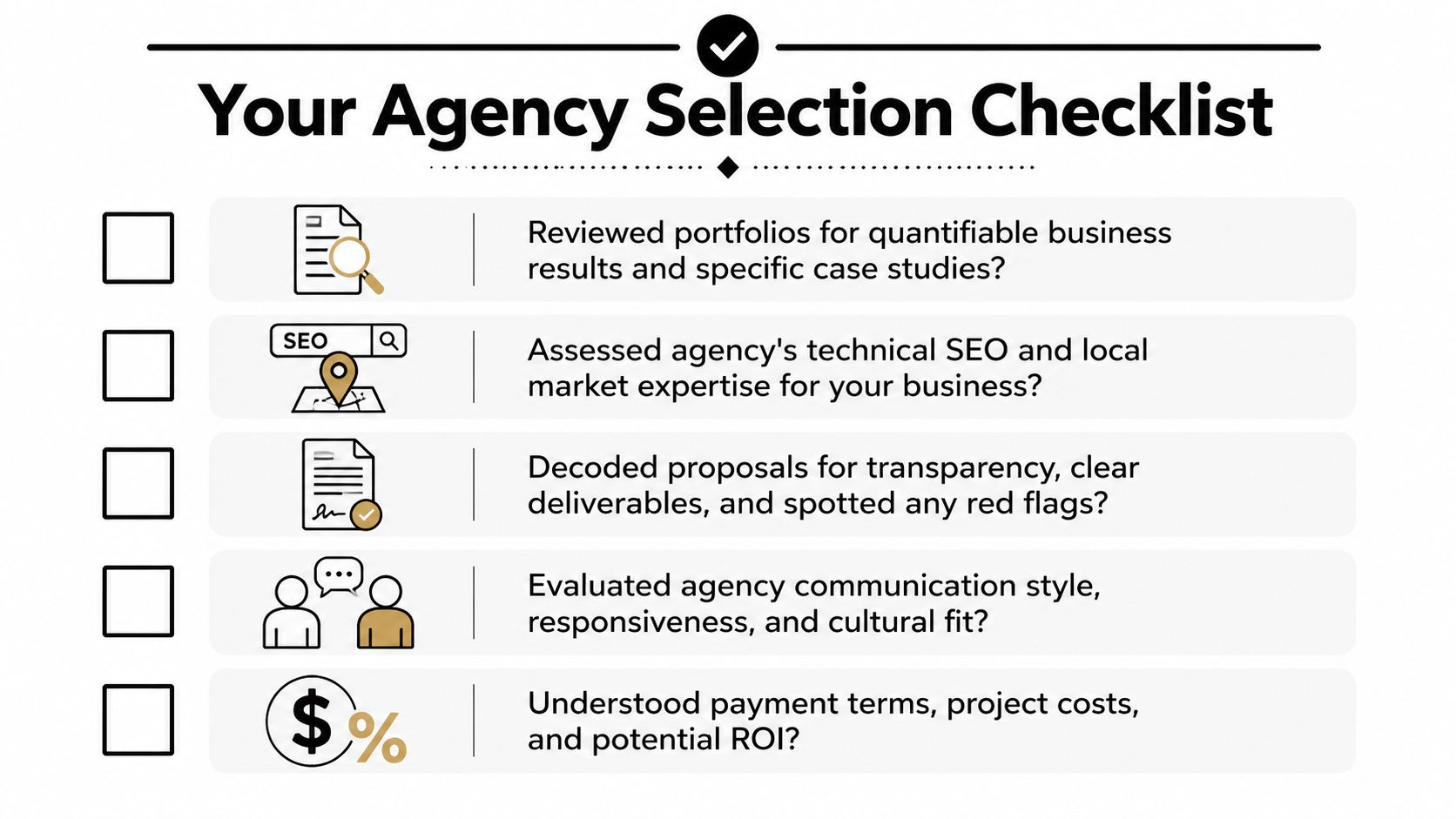
Print this before discovery calls
Use this as a yes-or-no screen.
- Goals defined. I wrote down 3 to 5 success metrics tied to leads, bookings, or qualified inquiries.
- Budget range set. I know what I can invest and what scope fits that budget.
- Required pages listed. I documented service pages, location pages, trust pages, and must-have features.
- Recent work reviewed. I looked at portfolio examples from the last 12 to 18 months.
- Results requested. I asked for proof of business outcomes, not just screenshots.
- Local SEO questions asked. I asked how the agency handles service-area pages, reviews, and local competition.
- Technical basics covered. I asked about mobile usability, page structure, speed, and post-launch support.
- Proposal compared. I reviewed deliverables, timeline, pricing clarity, and assumptions.
- Ownership confirmed. I know who owns the site, files, content, and hosting access.
- Red flags checked. I noted any vague language, pressure tactics, or unrealistic promises.
Use this scoring note during final review
Write one sentence for each finalist:
| Category | Your note |
|---|---|
| Business understanding | Did they understand how your company makes money |
| Local expertise | Did they understand your service area and lead flow |
| Proof of results | Did they show evidence, not just visuals |
| Communication | Were they clear, direct, and responsive |
| Proposal quality | Was scope and ownership easy to understand |
The right agency should make your decision easier as you get deeper into the process. The wrong one makes everything sound fuzzy until after you sign.
If you use this checklist, you'll avoid the most common mistake small businesses make. They buy a website before they buy a plan for results.
If you want a second opinion before you sign with any agency, Polaris Marketing Solutions works with small and mid-sized businesses in Fort Myers and across Southwest Florida on website design, hosting, SEO, and lead-generation strategy. A practical review of your goals, local search needs, and proposal options can save you from paying twice for the same website.