
If you're running a roofing company in Naples, a dental clinic in Cape Coral, or a cleaning business in Fort Myers, you've probably hit the same wall most owners hit. You know people are searching for what you sell. You know your competitors are showing up. But your website isn't bringing in enough calls, your ads feel hard to trust, and every marketing pitch sounds like a list of buzzwords.
That confusion is usually what sits behind the question, what does a digital marketing agency do.
The short answer is simple. A good agency helps your business get found, earn trust, and turn attention into leads. The useful answer is more specific. It builds the online system that moves a prospect from a Google search to a phone call, contact form, booked appointment, or signed job.
For a local service business in Southwest Florida, that system isn't theoretical. It's your Google Business Profile, your website speed, your reviews, your landing pages, your ad targeting, your follow-up emails, and the reporting that tells you whether the money coming out of your account is coming back with profit attached.
The Core Mission an Agency Fulfills for Your Business
A digital marketing agency is the general contractor for your online presence.
Most business owners don't need five separate specialists who never talk to each other. They need one team that can look at the whole property. Your website is the storefront. Your search visibility is the street location. Your ads are the signs on the road. Your landing pages are the front desk. Your follow-up process is what happens after someone walks in.

Why isolated marketing work usually underperforms
A lot of small businesses hire marketing help one piece at a time.
One person builds a site. Another runs ads. Someone else posts on Facebook. The owner answers reviews when they remember. The result is usually a scattered system where each part exists, but nothing supports the next step.
That matters because customers don't experience your marketing in pieces. They experience it as one journey. They search, compare, click, judge, and decide quickly.
Practical rule: If your ads, website, reviews, and local search presence don't agree with each other, the customer notices even if you don't.
A strong agency doesn't just "do SEO" or "run PPC." It aligns the full path so the right people can find you and feel confident enough to contact you.
What the business owner should expect
From the client's side, value isn't activity. It's coordination and accountability.
A useful agency should help you answer questions like these:
- Where are leads coming from: Google search, paid ads, maps, referrals, email, or repeat visitors.
- What is slowing conversions down: weak landing pages, poor mobile experience, thin reviews, unclear offers, or missed follow-up.
- What should happen next: keep investing, fix a bottleneck, or stop spending on a channel that looks busy but doesn't produce revenue.
If you've never worked with an agency before, this guide on understanding how agencies operate gives a practical outside view of how agency relationships are usually structured.
For a Fort Myers contractor or clinic, the mission is straightforward. Build a digital presence that works like business infrastructure, not decoration. When that infrastructure is solid, marketing stops feeling like random expense and starts acting like a pipeline.
A Practical Guide to Core Digital Marketing Services
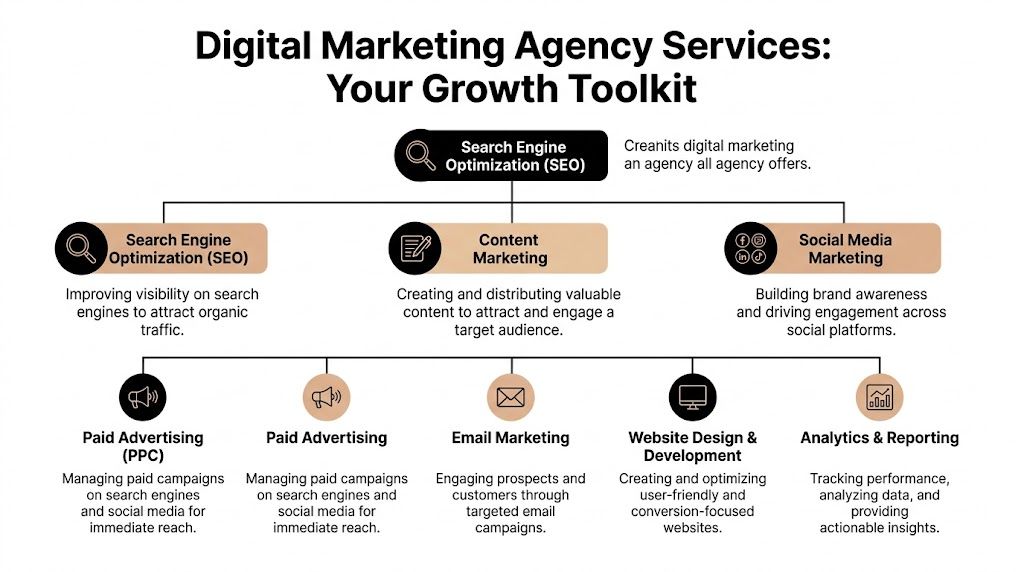
When owners ask what an agency does, they usually hear a service list. SEO. PPC. Social media. Content. Web design.
That list isn't wrong. It's just incomplete.
What matters is what each service changes concretely. For a local service business, each one should tie back to calls, booked estimates, scheduled appointments, or repeat business.
SEO helps you get chosen before the call
Search engine optimization is what helps your business show up when someone searches for a service you already provide.
For a Fort Myers business, that often starts with local intent. Someone searches "roof repair near me," "family dentist Cape Coral," or "house cleaning Fort Myers." If your site is slow, your pages are thin, your Google Business Profile is neglected, or your business information is inconsistent online, you lose visibility before the customer even compares offers.
Digital marketing agencies employ specialized SEO teams that conduct technical audits, optimize on-page elements like meta tags and site speed, and build off-page authority through citation consistency, resulting in 20 to 30 percent higher local pack visibility for SMBs. For businesses in Fort Myers, that includes Google Business Profile optimization and review management to capture local leads from nearby searches, according to Green Mind Agency's breakdown of agency structure.
A good SEO deliverable isn't "we added keywords." It's more concrete:
- Technical cleanup: improving load speed, crawlability, broken pages, and mobile usability
- Local signals: tightening citations, categories, services, and map relevance
- Service pages: building pages that match what people search for in Southwest Florida
- Review support: helping you gather and respond to reviews in a structured way
PPC buys speed when you need leads now
SEO compounds over time. PPC is what you use when you need immediate visibility.
If a Cape Coral dental office wants more new patient inquiries for a specific service, paid search can put the business in front of high-intent searchers the same week the campaign launches. The same goes for an HVAC company in Estero during peak season or a paving contractor in Bonita Springs trying to fill the schedule.
The mistake I see often is treating PPC like a slot machine. Turn it on, pick broad keywords, send traffic to the homepage, and hope.
That burns cash.
A real PPC service includes keyword match types, negative keywords, location targeting, ad copy testing, landing page alignment, and conversion tracking. If the ad says "free consultation" but the landing page is slow or vague, the campaign underperforms no matter how good the targeting is.
The strongest paid campaigns don't just buy clicks. They remove friction between search intent and action.
Website design turns attention into inquiry
A website isn't there to impress other marketers. It's there to help a prospect decide.
For local service businesses, the website has a short list of jobs. Explain the service clearly. Build trust fast. Make it easy to contact you. Work well on mobile. Load quickly. Support SEO. Route visitors to the right next step.
Here is where many agencies get lost. They focus on visual polish and miss buyer behavior.
A Fort Myers home services site should make these things obvious within seconds:
| What the visitor needs | What the site should show |
|---|---|
| Do you serve my area | Service area pages and local references |
| Can I trust you | Reviews, credentials, photos, and clear company info |
| What do you do | Focused service pages, not vague generalities |
| What do I do next | Prominent calls, forms, and conversion paths |
For owners looking at broader planning, this guide to digital marketing strategies for small businesses is useful because it connects channel choices to business goals instead of treating every tactic as equally important.
Content, email, and social support the sales cycle
Not every prospect converts on the first visit.
Content marketing helps answer questions before a sales call. Email keeps your business in front of leads who weren't ready today. Social media helps validate that your company is active, real, and consistent.
These channels work best when they support buyer intent, not when they exist to fill a calendar.
For example:
- A clinic can use email to remind inactive patients about seasonal services or appointment availability.
- A contractor can publish service-area content that answers common objections and supports local SEO.
- A professional firm can use social content to reinforce authority, then direct traffic to a consultation page.
If your business also needs better outreach or prospecting systems, this roundup of B2B lead generation tools is a practical companion resource.
Polaris Marketing Solutions offers website design and hosting, local SEO, PPC, social media management, and e-commerce design for Southwest Florida businesses. That's a useful example of how a local agency can package multiple trades under one roof instead of handing you disconnected services.
Understanding the Agency Workflow and Deliverables
Most business owners don't lose trust because marketing is difficult. They lose trust because the process feels hidden.
A good agency relationship shouldn't feel like dropping money into a black box and waiting for a report full of charts you didn't ask for.

What usually happens first
The first stage is discovery.
That means learning how your business works. Not just your services, but your margins, service areas, seasonality, close rates, busiest jobs, weakest jobs, and what a qualified lead looks like. A clinic and a pressure washing company don't need the same funnel, even if both want more leads.
Then comes the audit. That usually includes your website, local presence, ad accounts, competitors, reviews, analytics setup, and current conversion paths. For many small businesses, a complimentary online analysis and competitor report is a useful starting point because it shows where the obvious leaks are before any campaign starts.
The work you should actually see
The digital advertising market is projected to grow from $734.24 billion in 2024 to $843.48 billion in 2025, and agencies matter because they integrate channels so SEO, paid ads, and email guide customers from awareness to purchase. That integrated approach matters because companies with 30+ landing pages see 7x more leads than those with fewer, according to Unity Connect's digital marketing statistics.
That sounds big-picture, but the client-facing side should stay concrete. You should expect deliverables you can recognize.
Typical agency deliverables include:
- Strategy documents: target services, priority markets, channel focus, and near-term actions
- Execution items: revised web pages, campaign builds, tracking setup, new ad copy, new landing pages
- Reporting assets: dashboards, monthly summaries, keyword movement, lead data, and budget review
- Communication rhythm: scheduled check-ins, approval requests, and plain-language next steps
If an agency can't explain what changed this month, why it changed, and what happens next month, the problem isn't just communication. It's strategy discipline.
A lot of owners also benefit from seeing a simple overview before the deeper numbers. This video does a solid job of showing how digital marketing work fits together in practice.
How collaboration should feel
The healthiest agency relationships feel closer to working with an operations partner than a vendor.
That means the client still has a role. You approve messaging. You provide sales feedback. You tell the agency which leads were junk, which ones closed, and which services matter most this quarter.
The agency brings the outside perspective, execution bandwidth, and channel expertise. The business owner brings frontline market reality. When both sides share information, the marketing gets sharper fast.
How to Measure Real Results and Marketing ROI
Most small businesses don't need more metrics. They need better ones.
A dashboard can look impressive and still tell you almost nothing about business performance. Impressions, reach, and likes have their place, but they don't answer the question owners care about. Did this marketing produce qualified leads and profitable work?

Metrics that matter more than vanity metrics
For a local service business, the core scorecard is usually smaller than people think.
Track the numbers that connect spend to revenue activity:
- Lead volume: calls, forms, booked appointments, estimate requests
- Lead quality: real prospects in your service area asking for the right service
- Conversion rate: how many visitors or clicks become inquiries
- Cost per lead: what you paid to generate each valid opportunity
- Close rate by source: which channels produce jobs, not just conversations
Here, a lot of agencies talk confidently and report vaguely. The gap is real. Small businesses need a framework that distinguishes vanity from business impact.
Reviews and reporting both affect ROI
Many agencies talk about ROI, but few give SMBs a clear framework. That's a serious issue because 93% of consumers read reviews before purchasing, and businesses that respond to reviews see 50% higher spending. Strong agencies connect reporting to business outcomes, including channels like PPC, which can deliver a 200% ROI, and email marketing, which can return $36 for every $1 spent, based on Seven Figure Agency's overview of agency reporting and ROI.
For a Fort Myers clinic or contractor, that means review management isn't some side task. It directly affects whether a prospect trusts your business enough to call.
It also means reports should answer practical questions:
| Question | Useful reporting answer |
|---|---|
| Are leads increasing | Show calls, forms, and booked actions by channel |
| Are leads getting better | Separate qualified leads from spam or bad-fit inquiries |
| Is the spend efficient | Compare channel cost against actual lead outcomes |
| What should change | Identify weak pages, weak keywords, and weak offers |
For owners who want a more grounded framework, this resource on how to measure marketing ROI is a good place to start.
What to ask your agency: "Can you show me which campaigns generated calls, forms, and booked jobs, not just traffic?"
If they can't answer that clearly, the reporting needs work.
What to Expect in Your First 90 Days as a Client
The first 90 days are usually where expectations go wrong.
Owners want results quickly, which is fair. Agencies need time to fix tracking, tighten messaging, clean up targeting, and build the right assets. Both things are true at once.
Days 1 through 30 build the foundation
The first month is usually diagnosis and setup.
That includes account access, analytics review, website and SEO audits, competitor review, service prioritization, local profile cleanup, and conversion tracking. If paid ads are part of the plan, the campaign structure starts taking shape here.
For local businesses, this is also when quick structural issues get addressed. Wrong business categories, inconsistent contact details, weak service pages, missing calls to action, and poor mobile layouts often surface early.
Typical early deliverables include:
- Audit findings: what is broken, missing, or underperforming
- Priority plan: which services and locations get attention first
- Tracking setup: call tracking, form tracking, and campaign attribution
- Asset requests: photos, offers, FAQs, testimonials, and approvals
Days 31 through 60 put campaigns in motion
Month two is where the visible work starts going live.
Website edits get published. Google Business Profile improvements start showing up. Paid campaigns launch. New landing pages appear. Ad copy gets tested. Content starts supporting key service areas.
This is also when owners should start hearing more specific feedback from the agency. Which keywords are too broad. Which pages need stronger trust signals. Which services deserve separate landing pages.
Early wins usually come from fixing obvious friction, not from chasing every channel at once.
Days 61 through 90 focus on efficiency
By month three, the first layer of data starts to matter.
In the first 90 days, a PPC campaign is structured with precise keyword match types and negative keyword lists, which can cut wasted ad spend by 15 to 20 percent. Agencies also aim for a Quality Score of 7/10 or higher by improving ad relevance, helping lower acquisition costs and support a target ROAS of 4:1 to 8:1, as outlined in Upwork's explanation of digital marketing agency PPC work.
That doesn't mean every business hits those targets immediately. It means the campaign is being built in a disciplined way.
By the end of this phase, a client should be able to see:
- What launched
- What early data says
- What is being cut
- What is being improved next
What doesn't work is expecting miracles from sloppy foundations. What does work is using the first 90 days to build a cleaner system that can scale without wasting budget.
Decoding Agency Pricing Models for Your Budget
Pricing gets awkward when nobody explains what you're buying.
A digital marketing agency isn't priced like one thing because the work isn't one thing. Ongoing SEO, ad management, content, design support, and analytics all have different labor demands and different timelines.
Most local businesses allocate 5 to 10% of revenue to digital marketing, and that investment matters because 49% of businesses report organic search as their highest ROI channel, according to the earlier data source already referenced in this article.
The three pricing models you will see most often
The right model depends on the kind of work you need.
| Pricing model | Best fit | Upside | Trade-off |
|---|---|---|---|
| Monthly retainer | SEO, PPC, content, ongoing optimization | Predictable budget and continuous work | Not ideal if you only need one short project |
| Project fee | Website redesign, landing page build, setup work | Clear scope and defined endpoint | Doesn't cover ongoing improvement |
| Hourly billing | Consulting, troubleshooting, one-off support | Flexible for small needs | Harder to forecast monthly cost |
Where small businesses often choose wrong
A lot of owners try to buy long-term growth on a one-time budget.
That usually shows up when someone wants sustained SEO results but only wants a one-time project. It rarely holds. Search visibility, content refinement, competitor movement, and local optimization all require ongoing work.
On the other hand, some businesses sign broad retainers when they really need a focused project first, such as a website rebuild or analytics cleanup.
A smarter way to decide is to ask:
- Do I need ongoing lead generation support or a fixed deliverable
- Is my main problem visibility, conversion, or tracking
- Do I have internal staff who can carry part of the load
Cheap marketing is expensive when it creates bad data, weak leads, and a site that still doesn't convert.
The right budget conversation isn't about finding the lowest number. It's about matching the pricing model to the business problem.
Finding Your Growth Partner Not Just a Service Provider
The right agency doesn't just perform tasks. It helps you make better growth decisions.
That distinction matters more for small and mid-sized businesses than for big companies. You don't have room for wasted spend, vague reporting, or channels that look busy but don't produce revenue. You need a partner that can connect visibility, conversion, and follow-up into one working system.
If you're evaluating options, this guide on how to choose a digital marketing agency is a practical way to filter out vague pitches and focus on fit.
For a Southwest Florida business, fit includes local understanding. A strategy that works for a national e-commerce brand isn't automatically right for a Fort Myers contractor, Naples law firm, or Cape Coral clinic. The market is different. Search behavior is different. Trust signals are different.
A good agency should leave you with more clarity, better data, stronger assets, and a repeatable way to generate qualified leads. That's the answer to what a digital marketing agency does.
If you're a small or mid-sized business in Southwest Florida and want a clearer view of what your current marketing is doing, Polaris Marketing Solutions offers digital marketing support for local businesses that need better visibility, stronger lead flow, and more transparent reporting.