
A lot of Naples business owners are in the same spot right now. Referrals still come in. Past clients still send people your way. Your reputation is solid. But when someone new searches on their phone for a service you offer, your website either looks dated, loads poorly, or doesn't give them a clear next step.
That gap costs real opportunities.
In Naples, that problem gets sharper because your audience isn't just year-round locals. It also includes seasonal residents, visitors, and high-intent buyers who often make decisions quickly. If your site feels like a brochure instead of a lead-generation tool, someone else gets the call.
Your Digital Anchor in Naples Beyond Just a Pretty Website
A common Naples scenario looks like this. A home service company has strong word of mouth, a healthcare practice has loyal patients, or a law firm has deep local credibility. Then a prospect hears the name, searches online, and lands on a site that hasn't kept pace with how people buy.
The result usually isn't dramatic. It's quiet. The visitor hesitates, doesn't see enough trust signals, can't find the right service page, or leaves because the mobile experience feels clunky. The business owner doesn't always notice the loss because the phone never rings with the leads that never converted.
That's why Website Design Naples FL should be treated as a business infrastructure decision, not a visual upgrade. A strong site has to support trust, local visibility, and conversion at the same time. If you're evaluating a redesign, these web design best practices for business sites give a useful baseline for what a modern site should do.
Your website isn't competing with your old website. It's competing with the fastest, clearest local option a buyer sees right now.
What a High-Performing Naples Website Accomplishes
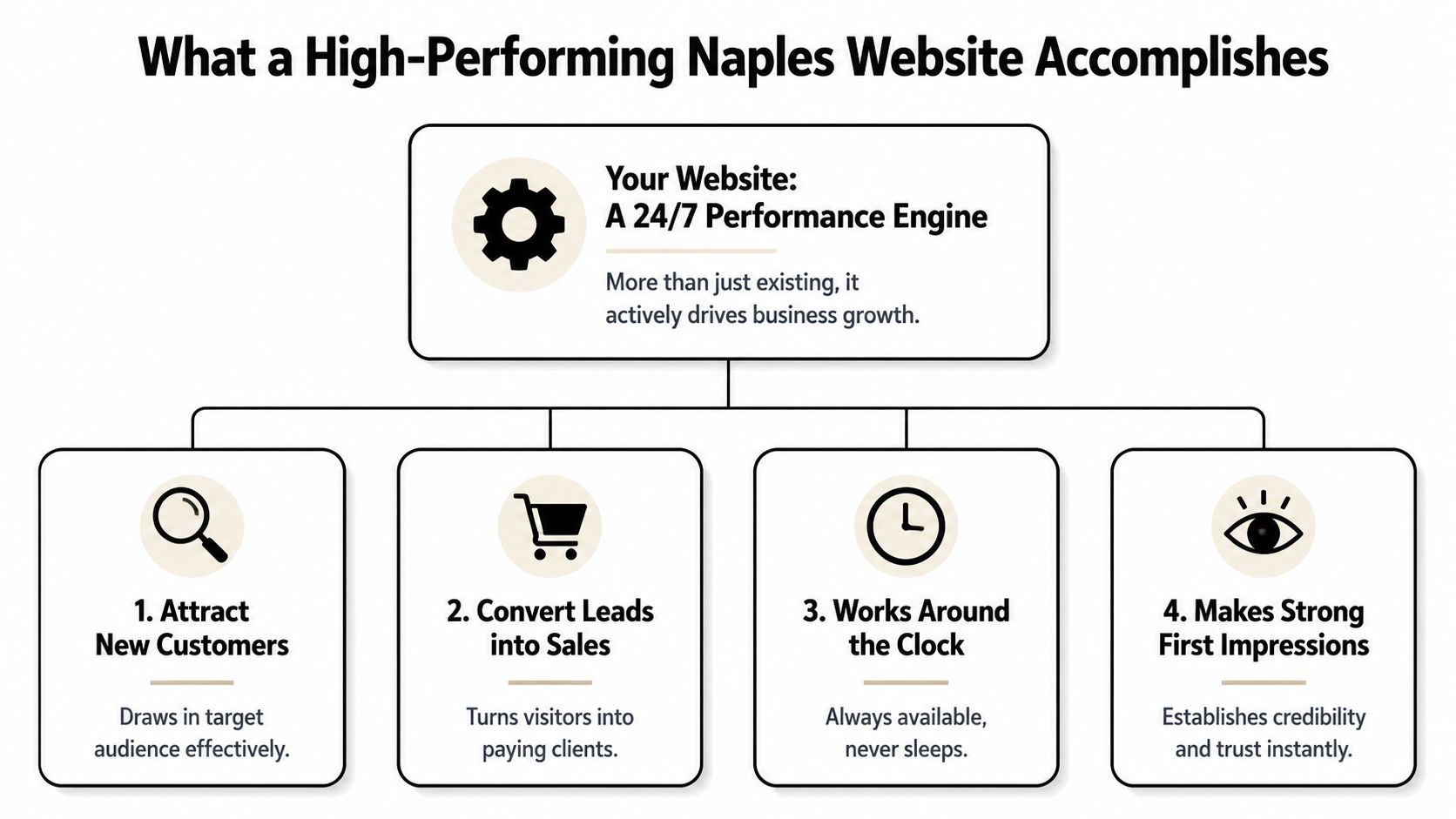
A high-performing website works like a well-run storefront. The front is clean. The entrance is easy. People know where to go, what you do, and how to buy. Online, that comes down to three practical jobs. Make a strong first impression, work flawlessly on mobile, and move visitors toward action.
Research cited by Hostinger's web design statistics roundup notes that the U.S. web design services market reached $43.5 billion in 2024 and continues growing at a 2.2% CAGR, while roughly 94% of first impressions are design-related. For Naples businesses, that matters because the site often shapes trust before a call ever happens.
Speed and clarity win first
If a visitor lands on your homepage and has to decode what you do, the page has already failed. The first screen should answer three things fast:
- What you offer: “Naples pool remodeling,” “family dentistry,” “estate planning,” or whatever your primary service is.
- Who you serve: Naples, plus the nearby areas that matter to your sales footprint.
- What to do next: Call, book, request a quote, or schedule a consultation.
A slow, cluttered page does the opposite. It makes the buyer work.
Mobile isn't optional
A Naples customer often finds you from a phone while on the move. Local agencies that serve Naples explicitly emphasize responsive and mobile design as a core service, and Exploritech's discussion of responsive and mobile website design notes that modern web traffic is dominated by mobile devices and that search engines evaluate mobile usability as part of ranking. In practice, strong sites use fluid grids, compressed media, and lightweight scripts so pages load cleanly on cellular connections.
That directly affects local lead flow. Someone tapping from map results or a “near me” search needs readable text, thumb-friendly buttons, and a short path to contact.
If you want a useful outside perspective on what mobile friction looks like in real use, SmashPops' mobile experience insights are worth reviewing.
Conversion paths need to be obvious
A lot of Naples websites hide the action step. They put the phone number in tiny text, bury the contact form, or make the visitor bounce between pages to figure out pricing, service area, or availability.
What works better:
- For home services: “Request an Estimate” above the fold, service-area pages, and quote forms that ask only what the office needs.
- For healthcare: a clear appointment request path, insurance or service info, and trust-building provider bios.
- For legal and professional services: a prominent consultation CTA, practice-specific pages, and intake forms that don't overwhelm.
Practical rule: If someone can't understand your offer and take the next step in under a minute on a phone, the design is getting in the way of revenue.
Integrating Local SEO from Day One
A website without local SEO is a storefront on a side street with no signage. It may look polished, but it won't pull in the people already searching for your service nearby.
Many redesigns often miss the mark. The business approves attractive mockups, launches the new site, and then learns that the pages weren't structured to compete in Naples search results or support Google Business Profile visibility. Local SEO has to shape the site architecture before design decisions are finalized.
Build pages around buying intent
A single “Services” page rarely pulls its weight. Buyers don't search in broad categories. They search by need and location.
A better structure looks like this:
- Primary service pages: One page per main revenue service.
- Location-supported pages: Pages that reflect how people search in Naples and nearby service areas.
- Intent-driven copy: Real questions, service specifics, and proof points instead of generic marketing filler.
For example, a roofing company shouldn't stop at “roofing services.” It needs pages that match actual local demand patterns, such as repair, replacement, inspection, or storm-related service in the areas it serves.
Add local signals that search engines can read
Design isn't only visual. It also includes what sits under the surface. A lead-focused Naples site should include clean heading structure, crawlable page content, internal linking between related services, and schema markup that helps search engines understand local business details.
That matters because it supports both discoverability and relevance. A page that's easy for Google to interpret is also easier to maintain as your service footprint expands.
For a deeper look at how these pieces work together, this guide to small business website SEO fundamentals is a practical reference.
Tie the website to your Google Business Profile
Many businesses treat their Google Business Profile as one thing and the website as another. That split hurts performance.
The stronger setup is integrated:
| Website element | Local SEO benefit |
|---|---|
| Service pages aligned to actual categories | Supports relevance for local searches |
| Consistent business details across the site | Reinforces trust and local clarity |
| Review references and trust content | Helps visitors validate the business quickly |
| Location-focused internal links | Guides both users and search engines |
A Naples user may discover you on Google Maps first, then click through to your site for reassurance. If that page doesn't confirm service area, expertise, and next steps, the click doesn't become a lead.
The website should finish the sale that the map listing starts.
The Polaris Partnership Our Design and Development Process
Most business owners don't need more jargon. They need a process that makes sense, shows progress, and keeps the project tied to business goals.
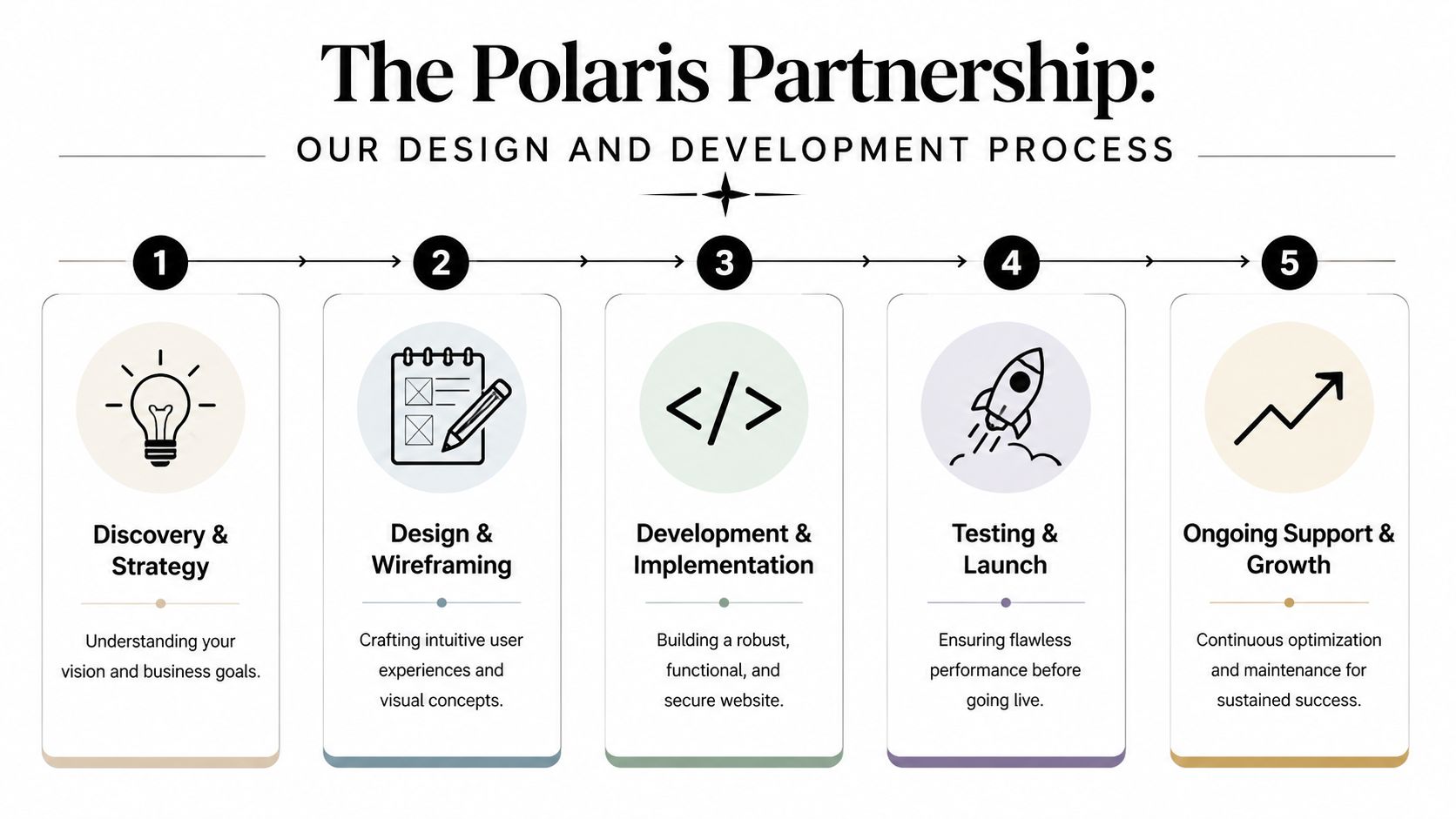
A solid web project usually moves through a few clear stages. That keeps decisions organized and prevents the common problem where a site looks fine at launch but fails in real use because no one mapped user behavior, local search intent, or content requirements early.
What the process should include
Discovery and business review
Start with essential questions. Which services drive profit? Which areas matter most? What objections do prospects bring into the sales call? Those answers shape the site more than colors ever will.Wireframes and content structure
Before design polish, map the page flow. Home, service pages, location pages, trust pages, forms, and calls to action all need a job.Development with visible checkpoints
You should be able to review progress privately before launch. That catches issues while they're still easy to fix.Testing before go-live
Test forms, mobile layouts, page speed behavior, browser compatibility, and the core user paths that produce inquiries.Post-launch handoff and support
Your team should know how to update basic content, add photos, and manage routine changes without unnecessary friction.
What transparency looks like in practice
Polaris Marketing Solutions is one option businesses in Southwest Florida use when they need website design tied to SEO, hosting, and local lead generation, rather than a design-only deliverable. The important point isn't the vendor name. It's whether the process stays visible and business-focused from discovery through launch.
If you want a sense of how buyers talk about web design experiences when the process is structured well, you can browse 30daysofwebdesign feedback and notice how often clarity, communication, and execution come up.
A good process removes surprises. It doesn't create dependence.
Website Design Investment and Tangible ROI
The first pricing question is usually, “What does a website cost?” The better question is, “What kind of website are we building, and what business outcome should it support?”
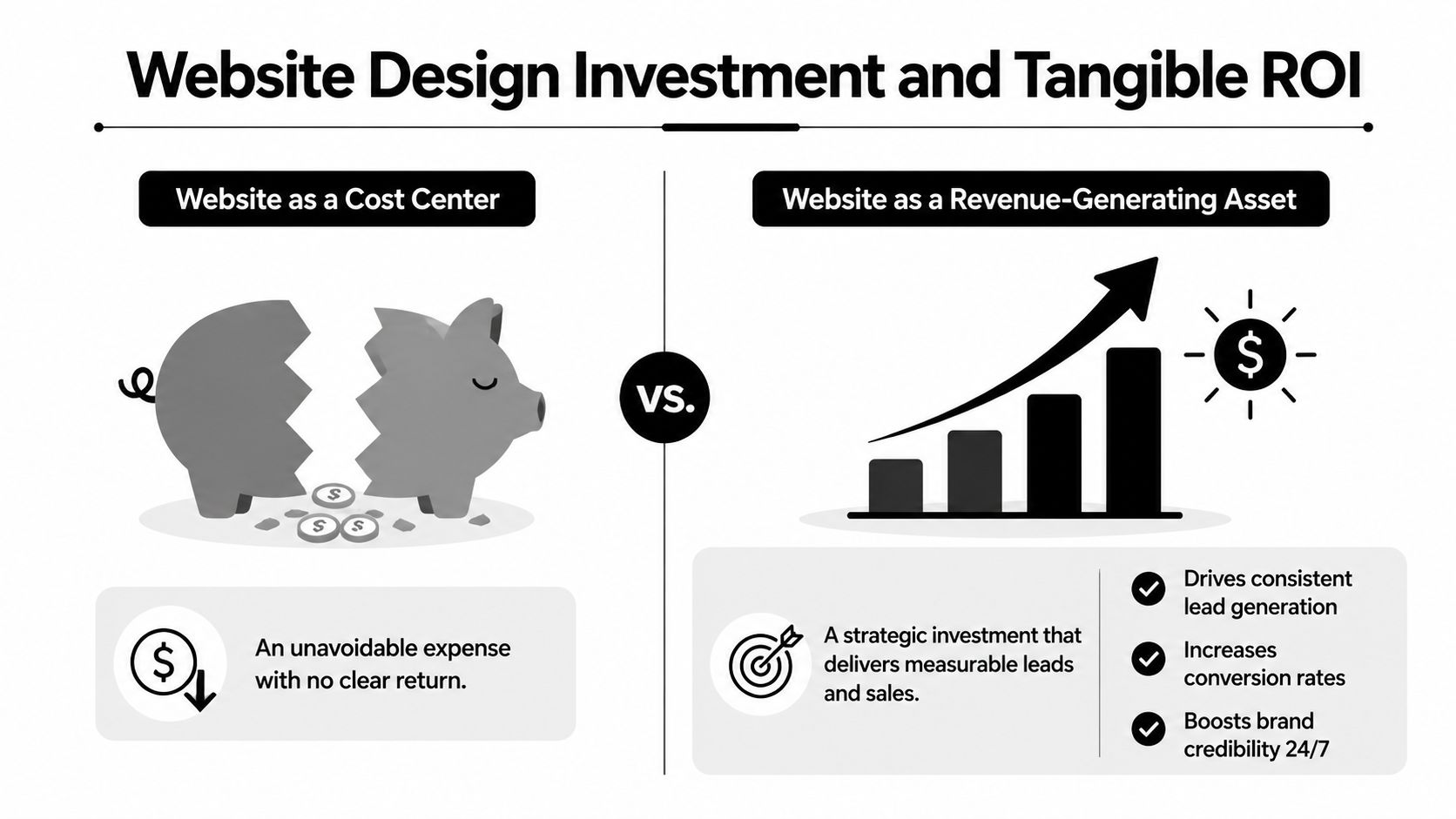
That distinction matters because a brochure site and a lead-generation site are not the same product. One gives basic information. The other is built to help buyers find you, trust you, and contact you without friction.
According to a Naples web design benchmark published by Scott Carr's Naples web design pricing overview, local projects often range from $3,000–$15,000+ depending on scope. A brochure site sits near the low end, while a site with custom forms, schema markup, location pages, and stronger conversion architecture demands more build time and testing.
What usually drives the investment
Here's a practical breakdown:
| Scope item | Why it changes cost |
|---|---|
| Custom page templates | Requires more design and front-end build work |
| CMS setup and content structure | Affects scalability and editing workflow |
| E-commerce or booking features | Adds logic, testing, and user-flow complexity |
| Local SEO architecture | Needs service pages, location pages, and schema planning |
| Conversion-focused forms | Requires field planning, routing, and QA across devices |
A simple five-page site can be enough for some firms. It's often not enough for a contractor, multi-service provider, or local practice trying to compete across several service lines.
What makes the return tangible
ROI on a website shows up in operational and sales terms:
- Better lead quality: Visitors understand what you do before they contact you.
- Cleaner intake: Forms collect the information your team uses.
- Stronger close potential: Trust elements answer objections earlier.
- More durable visibility: The site supports organic search and Google Business Profile traffic instead of relying only on referrals.
If you want a plain-English refresher on how to think about returns from a business asset, what is return on investment gives a useful framing.
A cheap website that doesn't generate qualified inquiries is expensive to own. A more strategic website can reduce wasted clicks, weak leads, and admin back-and-forth.
Proof in the Portfolio Naples and SWFL Success Stories
The fastest way to judge web design work is to look past surface style and ask what business problem the site solved.
Three common Southwest Florida scenarios
A home service contractor often starts with a site that lists everything on one page. The company handles several profitable services, covers multiple cities, and has solid reviews, but the website doesn't separate those offers clearly. The fix is usually a tighter structure with dedicated service pages, cleaner quote forms, stronger mobile UX, and copy that matches what buyers ask on the phone.
A healthcare or wellness practice usually has a different challenge. Trust comes first. Visitors want to know who they're seeing, what to expect, whether the environment feels professional, and how to request an appointment without confusion. In those projects, provider bios, intake clarity, service explanations, and page flow matter as much as visual polish.
A legal or professional service firm often needs authority without clutter. The strongest sites in this category don't overload the homepage. They guide users into specific practice or service pages, answer common objections, and make consultation requests feel straightforward.
What to look for in a portfolio
Don't just ask whether the sites look good. Ask these questions:
- Does each project fit the industry? A med spa site shouldn't feel like a paving contractor site.
- Are conversion paths obvious? Calls, forms, and booking actions should be easy to find.
- Do local pages exist? That usually signals more strategic thinking.
- Can you see proof of real business alignment? The site should reflect how that company sells.
If you want examples of how different industries handle these trade-offs, the Polaris case studies collection is a useful place to compare project types and approaches.
Answering Your Naples Web Design Questions
Business owners usually ask better questions after they've been through one frustrating website project. The issues tend to be the same. Timelines drift. Content stalls. Updates become difficult. Ownership gets murky.
How long does a website project usually take
It depends on scope and responsiveness. A smaller brochure-style site moves faster because there are fewer page types, fewer content dependencies, and less testing. A lead-generation site takes longer because it needs service architecture, local page planning, forms, reviews of content, and stronger QA before launch.
The practical way to speed up a project is simple. Assign one point person on your team, gather photos and brand assets early, and approve rounds on schedule.
What do I need to provide
Most businesses should expect to provide:
- Core business details: service list, service areas, hours, and contact information.
- Brand assets: logo files, color preferences, and examples of sites you like.
- Trust material: photos, testimonials you have permission to use, team bios, and FAQs from real customer conversations.
- Operational details: who receives form submissions, how appointments are handled, and which services need priority.
If you don't organize this up front, delays usually hit during content review.
What maintenance does a site need after launch
Every website needs ongoing attention. That includes plugin and platform updates, security checks, form testing, content changes, and periodic reviews of page performance. A website isn't a one-time install. It's a business asset that needs upkeep if you want it to stay secure and usable.
Do I actually own the website
This is the question more buyers should ask first.
A local buying angle that often gets overlooked is website ownership and portability. As noted in Thumbtack's Naples web design marketplace context, many buyers never ask whether they fully control the domain, hosting, CMS, and content if they switch agencies later. That matters because bundled offers can make the launch feel simpler while hiding migration friction later.
Ask these direct questions before signing:
- Who owns the domain name account
- Who controls hosting access
- Which CMS or platform is being used
- Whether you receive all site files and content
- What happens if you switch providers
The better provider is often the one that makes exit easy.
See Where You Stand Get Your Free Website Analysis
A Naples website should do more than look current. It should help the right people find you, trust you, and contact you without hesitation. If it isn't doing that, the problem usually isn't one thing. It's a mix of structure, mobile usability, local SEO, weak CTAs, or ownership choices that made updates harder than they should be.
A fresh analysis usually reveals those gaps quickly. When you compare your current site against nearby competitors, the missed opportunities become obvious. Maybe your service pages are too thin. Maybe your Google Business Profile and website aren't aligned. Maybe your forms are asking too much. Maybe the design is fine, but the strategy underneath it isn't.
If you want to make a smarter decision before committing to a redesign, start with a no-pressure review of what's working and what's getting in the way.
If you want a second set of eyes on your current site, Polaris Marketing Solutions offers website analysis and competitor review support for Southwest Florida businesses that need clearer direction on design, local SEO, lead flow, and website ownership.