

A lot of Southwest Florida business decisions get made on a hunch.
A Fort Myers roofer thinks tile repair might be worth adding because a few recent callers asked about it. A Cape Coral attorney starts thinking about a second office because “that side of town is growing.” A Naples dentist spends more on ads because the phones feel slower than they did a few months ago. None of those ideas are unreasonable. The problem is that each one can turn into an expensive mistake if it's based on scattered impressions instead of evidence.
That's where market research comes in.
At its simplest, market research is the process of gathering and interpreting information so you can make better business decisions. It helps you answer questions like: Is there real demand for this service? Which neighborhoods produce the best clients? What are competitors doing well? Where are people getting frustrated? What price range gets accepted without constant pushback?
For local businesses, that matters more than most owners realize. In Southwest Florida, small shifts in neighborhood growth, seasonal demand, service radius, traffic patterns, and competitor positioning can change whether a move pays off or flops. Good research doesn't eliminate risk. It cuts down blind risk.
Stop Guessing and Start Growing
A Naples HVAC owner adds a second install crew because calls feel busy. Three months later, the schedule is uneven, payroll is tighter, and too many of the new leads are coming from areas with long drive times and lower close rates.
That happens all over Southwest Florida. A plumber in Cape Coral assumes a nearby neighborhood is worth targeting. A Fort Myers attorney opens up spend on Google Ads because competitors seem louder. A Bonita Springs med spa adds a service after hearing about it from a handful of patients. Sometimes those calls work out. Plenty of times, they turn into wasted budget because the decision was built on anecdotes instead of a clear read on demand, competition, and margin.
Good market research gives you that clear read.
For a local business, it usually looks simple. Check where profitable jobs already come from. Review Google Business Profiles and service pages for nearby competitors. Look at recurring review complaints. Ask recent customers what they compared, what almost stopped them from booking, and what they could not find locally. That is market research in practice. It helps you choose with better odds before you commit money, staff time, trucks, rent, or ad spend.
Practical rule: If a decision affects hiring, expansion, pricing, or marketing budget, get evidence first.
This work is common for a reason. Businesses across industries keep paying for research because guessing is expensive, and even basic customer and competitor research can prevent bad bets.
For home service companies and professional practices in Southwest Florida, the return is straightforward. You spot real demand sooner. You avoid chasing the wrong ZIP codes. You price with more confidence. You put your budget where it has a better chance to produce revenue.
The Two Core Types of Market Research
Think of market research like running a GPS for your business. You need two things. You need existing map data, and you need live information from the road in front of you.
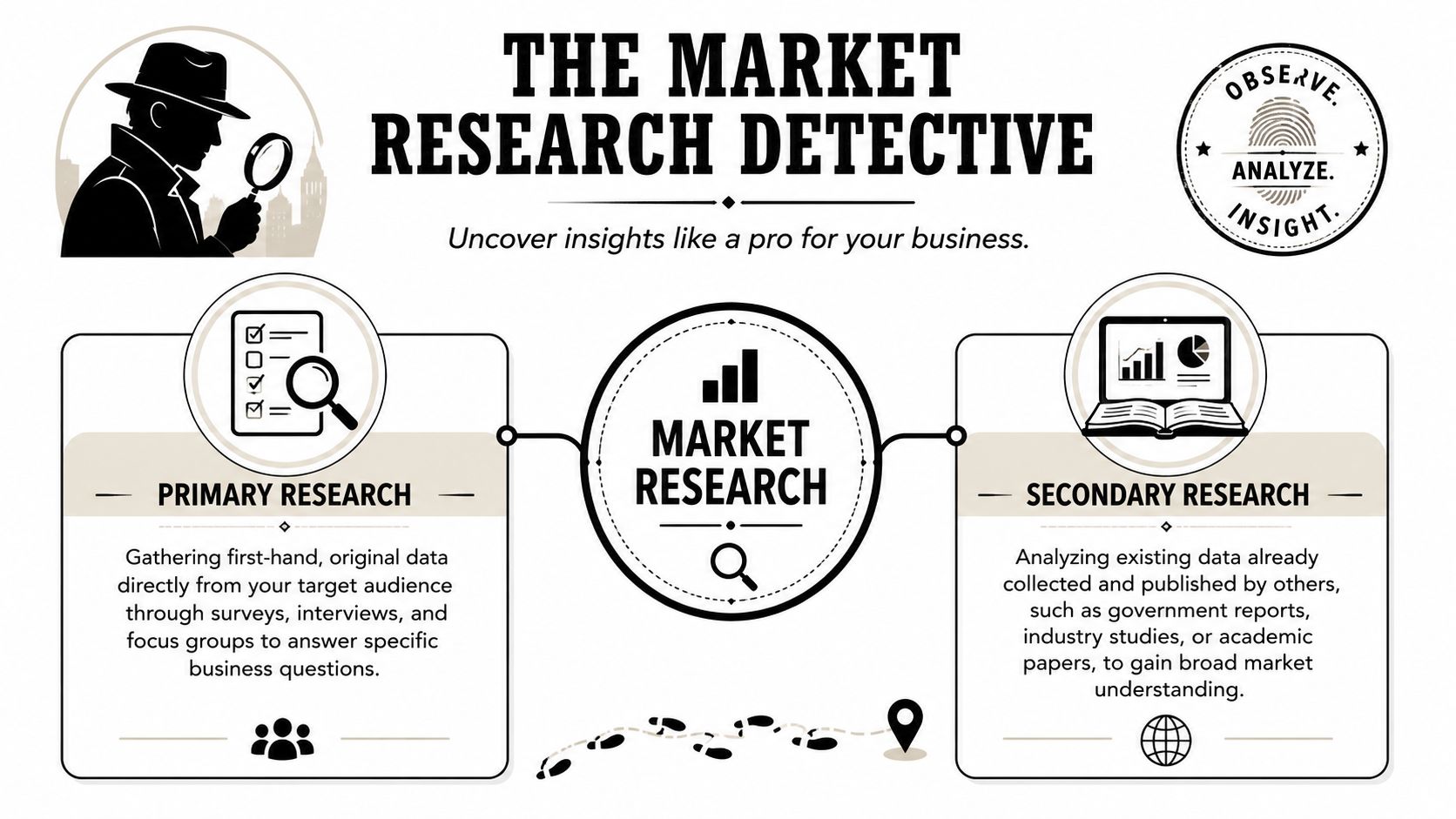
Primary and secondary research
Primary research is information you collect yourself. That includes customer interviews, short surveys, intake form questions, follow-up texts, and sales calls where you deliberately ask the same questions and record the answers.
Secondary research is information that already exists. That can include Census data, local government data, competitor websites, Google reviews, your own CRM, job history, and industry reports.
If you run a Bonita Springs restaurant, primary research could be asking regular customers why they order takeout on certain nights. Secondary research could be pulling sales reports by item, checking local population patterns, and reviewing nearby competitors' menus and reviews.
One gives you direct voice-of-customer input. The other gives you market context.
Qualitative and quantitative research
The second split is just as important.
Qualitative research tells you why people think or behave a certain way. You get that from interviews, open-ended survey responses, review comments, and conversations at the estimate stage.
Quantitative research tells you how much, how often, or which pattern shows up most clearly. You get that from survey totals, lead source tracking, close-rate reports, booking trends, and service-area data.
Salesforce describes market research as the structured collection and interpretation of primary and secondary data to quantify demand and segment audiences, and notes that strong research combines qualitative input for motivations with quantitative input for validation in order to turn raw observations into decisions such as which segment is most profitable in its guide to how to conduct market research.
That's the part many businesses miss. They either collect opinions with no numbers behind them, or they stare at spreadsheets with no understanding of why customers act that way.
Good local research usually needs both. The numbers tell you where the pattern is. The conversations tell you what the pattern means.
A simple way to use both
Here's a practical breakdown for a local business:
| Research type | What it answers | SW Florida example |
|---|---|---|
| Primary | What are people saying directly to us? | A Cape Coral plumbing company texts recent customers and asks what almost stopped them from booking |
| Secondary | What can we learn from existing information? | A Fort Myers law firm reviews competitor locations, service pages, and review topics |
| Qualitative | Why do customers choose or hesitate? | A Naples med spa asks callers what made them compare providers |
| Quantitative | Which pattern is showing up most often? | An HVAC company checks how many booked jobs came from each ZIP code |
When owners understand these four building blocks, market research stops sounding academic and starts looking like disciplined decision-making.
Common Research Methods for Small Businesses
Most small businesses don't need a research department. They need a usable toolbox.
For SMBs with limited budgets, a practical framework is to start with secondary research for market size and demand, then use primary research only for unanswered questions like pricing, messaging, or objections, as outlined in SurveyMonkey's guidance on market research for small businesses.
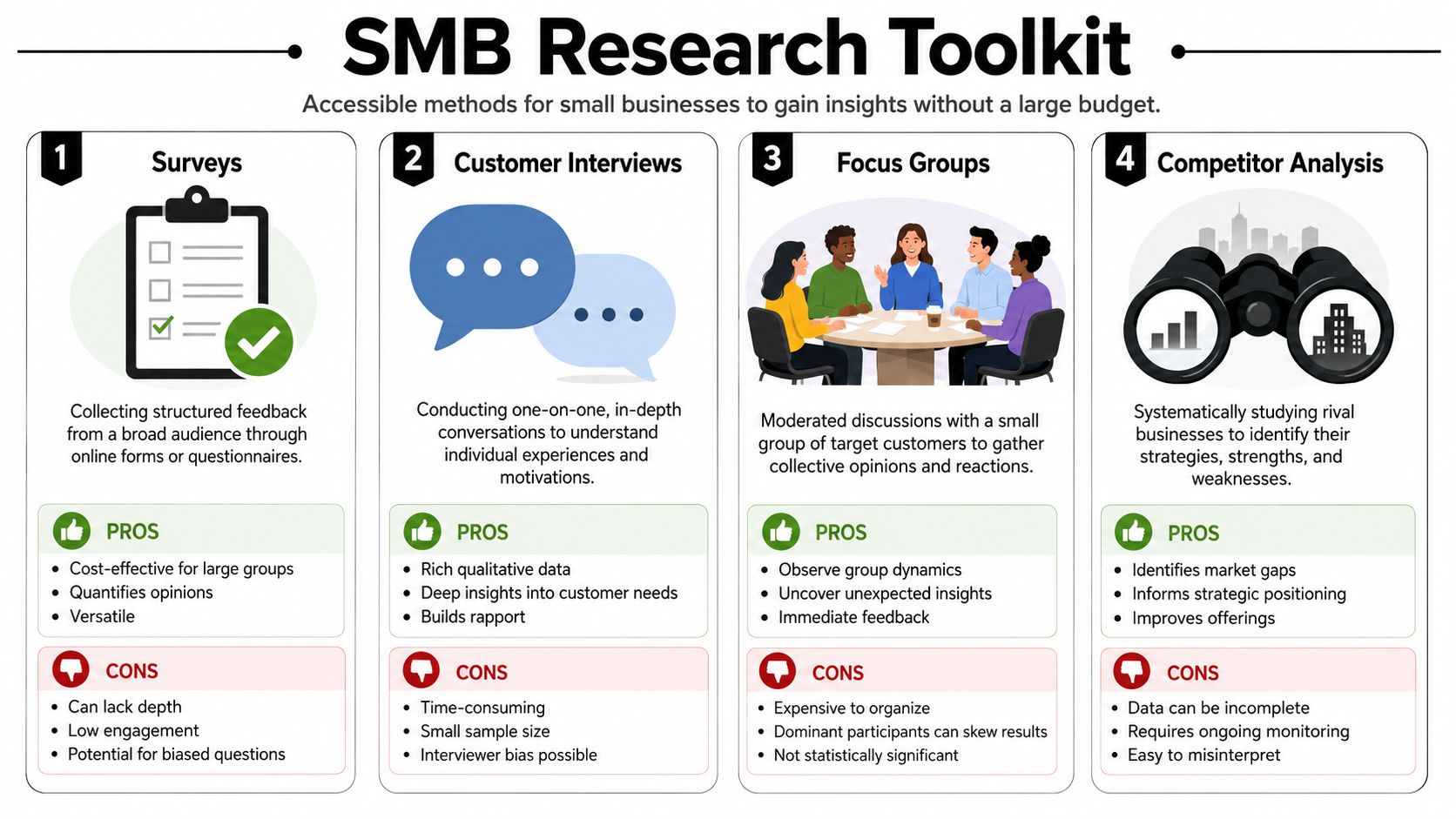
Start with the data you already have
Most owners skip the easiest source. Their own records.
Look at invoices, estimate requests, booked jobs, no-sale notes, call logs, top ZIP codes, highest-margin services, and repeat-customer patterns. A Naples professional practice might find that one service gets lots of interest but low conversion, while another gets fewer inquiries and stronger margins. That changes where marketing dollars should go.
If you don't review internal data first, you can end up paying to “discover” something your software already knew.
Use short surveys the right way
Surveys work well when you need structured feedback from a broad group. They work poorly when the questions are vague, leading, or too long.
A Cape Coral plumber testing a new water filtration service doesn't need a twenty-question form. He needs a short survey to current customers asking whether they've considered the service, what concern matters most, and what would make them request an estimate. If you want a fast starting point, these pre-made survey templates can help you avoid writing clunky questions from scratch.
Keep survey questions practical:
- Ask about behavior: “Have you considered this service in the last year?”
- Ask about friction: “What would stop you from booking?”
- Ask about priorities: “What matters most when choosing a provider?”
- Avoid vanity questions: If the answer won't affect pricing, staffing, service mix, or marketing, cut it.
Interview customers and prospects
Interviews give you depth that surveys can't.
A Fort Myers cleaning company could call five recent customers and five lost estimates and ask the same three questions. Why did you choose us or not choose us? What mattered most? What almost made you go another direction? Those calls often reveal language customers use, which can improve ads, website copy, and sales scripts.
Watch competitors without copying them
Competitor research isn't about imitation. It's about spotting gaps.
Check service pages, review volume, review complaints, response style, offers, office locations, FAQs, booking flow, and the wording they use in titles and headings. If you want a structured way to organize that process, this guide to competitor analysis tools is a useful reference point.
Field note: The fastest win in competitor research is usually not “What are they doing better?” It's “What are customers still complaining about even after hiring them?”
Listen where locals actually talk
In Southwest Florida, that often means local Facebook groups, Nextdoor threads, community forums, and review platforms.
You're not looking for gossip. You're looking for recurring issues. Slow callbacks. Missed appointments. Confusing pricing. Poor communication. Lack of weekend availability. Those patterns can show you exactly how to position your business.
How Research Drives Real Results in SW Florida
A Cape Coral contractor gets plenty of website traffic, but the schedule still has holes. Calls come in, estimates go out, and too many jobs stall. In Southwest Florida, that usually points to a local fit problem. The offer, service area, timing, or message is off.

Better positioning in crowded markets
Research helps a business find the angle that buyers already care about.
A Fort Myers roofing company is a good example. If the owner treats every roofing lead the same, marketing gets broad and expensive fast. If he reviews estimate requests, sales notes, competitor offers, and local complaints, he may spot a pattern. Homeowners are not just looking for a roofer. They are looking for someone who calls back, shows up, explains the timeline clearly, and will take on smaller tile repairs that bigger crews ignore.
That changes the whole pitch. The company can build its offer around responsiveness, repair work, and clear communication instead of competing on vague claims about quality.
The same thing happens in professional services. A Naples law firm may learn that prospects are frustrated by slow intake and unclear next steps. An Estero dental office may find that first-contact concerns are practical ones, like appointment availability, insurance questions, and how quickly the front desk responds. Good research turns those patterns into stronger messaging, better intake, and more signed clients.
Smarter use of digital channels
Local buying behavior leaves clues all over your own marketing systems.
Appointment requests, call logs, search queries, service page performance, Google Business Profile insights, and CRM notes can show where interest is strong and where the process breaks down. You do not need a formal study to learn something useful. You need clean inputs and a habit of reviewing them.
I have seen this a lot with home services in Southwest Florida. A business gets traffic from Naples, but booked work keeps coming from Fort Myers and Cape Coral. That usually means one of two things. Either the Naples traffic is weak, or the company has not built enough trust there yet. Both call for a different response than raising ad spend alone.
The same goes for service pages. If one page gets calls and another only gets views, the problem may be the offer, the page copy, the price positioning, or the way that service is explained. A tighter local marketing strategy for small business growth starts with that kind of local evidence, not guesswork.
Less waste and fewer bad bets
Research protects budget just as much as it helps growth.
It helps owners avoid opening in the wrong area, adding a service with weak demand, or pushing messages that sound good internally but do not matter to buyers. Those mistakes are common because they feel reasonable at the time. They are also expensive.
A pool service company in Bonita Springs might assume price is the main objection. A closer look at reviews, callbacks, and canceled quotes may show something else. Homeowners are upset about missed visits, weak communication, and not knowing whether the tech arrived. That changes what the company needs to fix first. Better scheduling, better follow-up, and better service notifications can produce more revenue than another discount offer.
That is how research pays off in SW Florida. It helps owners make sharper decisions about positioning, service areas, operations, and budget before they spend more money on the wrong move.
Your 5-Step Local Market Research Plan
A good research process doesn't need to be fancy. It needs to be repeatable.
High-quality market research works as an evidence system for decision-making. Combining secondary research with direct data collection helps businesses answer questions about demand, market size, and pricing so they can make stronger go or no-go decisions, according to this roundup of market research advice from industry experts.
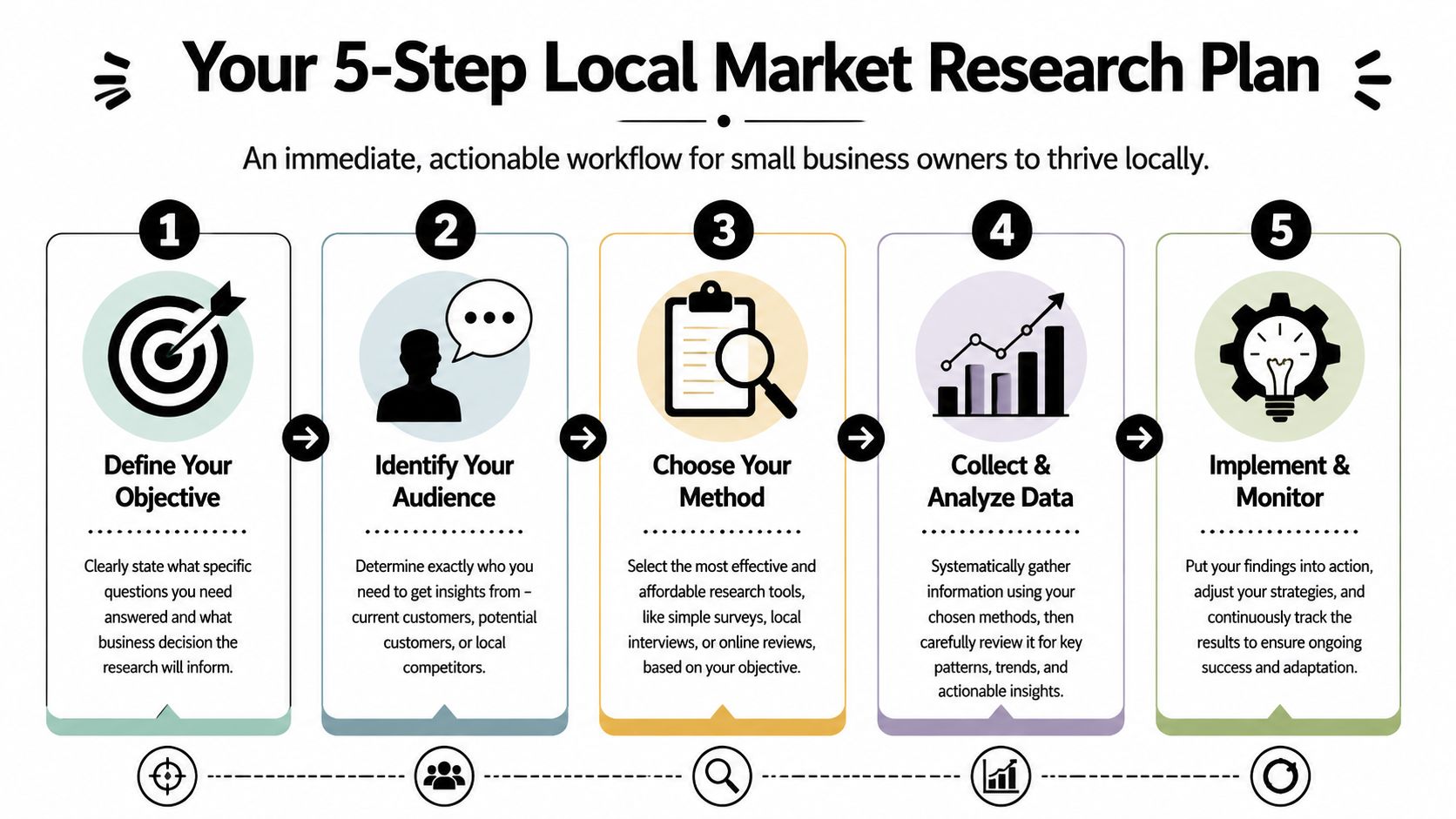
Step 1 Define the decision
Don't start with “we need market research.” Start with a business decision.
Bad question: “How do we grow?”
Better question: “Should we invest in another truck to serve more Cape Coral jobs?”
Better question: “Should we add emergency service hours?”
Better question: “Should we open a second office in Naples?”
A useful research question has money attached to it. If the answer won't change action, it's not a strong question.
Step 2 Pull your internal data
Before you ask the market anything, check what your business already knows.
Review:
- Lead locations: Which ZIP codes produce inquiries and which produce booked work?
- Service mix: Which services lead to strong margins and repeat business?
- Sales friction: Where do prospects hesitate, stall, or disappear?
- Customer quality: Which neighborhoods or client types produce smoother jobs?
This is also where many companies start seeing the value of proper audience segmentation. Different customer groups often need different offers, service pages, and follow-up messaging.
Step 3 Analyze local competitors
Now move outward.
Make a short list of direct competitors in your immediate service area. Look at their Google Business Profiles, websites, reviews, office locations, categories, service pages, and review responses. You're trying to answer a few grounded questions:
| Question | What to look for |
|---|---|
| Where are they concentrated? | Office locations, service-area language, neighborhood pages |
| What are they pushing hard? | Homepage offers, service highlights, ad language |
| Where are customers unhappy? | Repeated complaints in reviews |
| What are they ignoring? | Missing services, weak FAQs, poor responsiveness, thin local content |
Don't overcomplicate this. A simple spreadsheet is enough.
Here's a helpful walkthrough on the basics:
Step 4 Talk to the right people
Once you've reviewed existing data, fill the gaps with direct outreach.
Use a short survey, a few customer calls, or quick conversations with recent leads. If you're testing pricing, ask about perceived value and comparison behavior. If you're testing messaging, ask what phrase or promise sounds most relevant. If you're considering expansion, ask location-specific questions.
Ask people close to a real buying decision. Random opinions from people outside your market will send you in circles.
For a home service company, five to ten strong conversations can be more useful than a pile of weak survey responses. For a professional practice, intake staff often hear the same objections every week. Capture them in writing.
Step 5 Decide and monitor
Many businesses stop short at this point. They gather information, nod at it, then keep operating the same way.
Make the decision. Launch the service, pause the expansion, revise the offer, or shift the budget. Then monitor what happens. Track call quality, booked work, close rates, review themes, and geographic spread after the change.
If the data supports the move, keep going. If it doesn't, adjust early.
That's what market research is supposed to do. Not create more paperwork. Create enough clarity to act with confidence.
Take the First Step to Smarter Marketing
A Fort Myers contractor books a steady stream of estimates, stays busy, and still feels like marketing is hit or miss. The phones ring one month, slow down the next, and nobody is fully sure which ZIP codes, services, or messages are producing profitable jobs. That is usually the point where market research starts paying for itself.
Market research is a normal part of running a business well. It helps owners answer practical questions before they spend on ads, add staff, open a new territory, or push a service that local demand does not support. IBISWorld classifies Market Research & Public Opinion Polling under NAICS 54191 and notes in its industry report on market research and public opinion polling that the sector is projected to reach $37.7 billion by the end of 2026, with 46,569 businesses in the category.
For Southwest Florida companies, the lesson is straightforward. You do not need a research department. You need a repeatable way to check demand, pressure-test assumptions, and make the next decision with less risk.
In practice, that usually means looking at the signals already sitting inside the business. Job history. Lost estimates. Reviews. Intake notes. Search trends by town. Competitor offers. Customer objections that keep showing up in Naples, Cape Coral, Sarasota, or Punta Gorda.
That kind of research works because local markets are rarely as mysterious as they seem. A plumbing company can see where higher-ticket jobs are coming from. A med spa can compare what new patients ask about on the phone versus what its website pushes. A law firm can spot which practice areas generate inquiries but stall before consultation. Those patterns are useful because they point to where budget should go, and where it should not.
Good operators have always used instinct. I did too when I ran a home services company. Instinct helps you move fast. Research helps you avoid paying for the wrong move.
If you want a practical place to begin, Polaris Marketing Solutions offers a complimentary online analysis and competitor report for local businesses in Southwest Florida. It gives you a clearer view of how your business appears online, where competitors may be outranking you, and which local opportunities deserve a closer look before you commit more budget.