

A lot of Fort Myers business owners are in the same spot. They paid for a solid-looking website, added their services, maybe even posted a few photos, and then waited for calls that never really came. The site exists, but it isn't pulling its weight.
That usually isn't a design problem alone. It's a prioritization problem. Small business website SEO fails when owners try to do everything at once, or worse, spend months on low-impact tasks while the highest-impact fixes sit untouched. If your budget is tight and your schedule is packed, the order of operations matters more than the size of the checklist.
Why Your Website Is Quiet and How to Fix It
A Fort Myers pressure washing company might have a clean website, a contact form, and a service list. But if the home page says only "quality exterior cleaning" and the service pages don't clearly target what people search, that site won't do much. The owner sees traffic here and there, but not the kind that turns into calls.
The harder truth is that a website alone no longer creates trust. According to Network Solutions' small business website statistics, 81% of shoppers research online before making a purchase, and 94% of first impressions are tied to website design. For a local service business, your website often acts as the first screening step before anyone reaches out.
That means a site can be "live" and still be invisible. Or visible and still unconvincing.
The real issue isn't effort
Most owners I talk to aren't ignoring marketing. They're doing too many disconnected things. They post on Facebook when they remember. They tweak a headline. They ask their web designer about SEO. They get told to blog more. None of that is wrong. It just isn't sequenced.
Practical rule: If your website isn't generating leads, don't start by publishing more content. Start by checking whether Google can trust, understand, and locally connect the pages you already have.
For Fort Myers businesses, that usually means asking a few blunt questions:
- Can customers find you locally: Do you show up when someone searches for your service plus Fort Myers, Cape Coral, Estero, or Bonita Springs?
- Does the site match intent: When a visitor lands on a page, does it clearly explain the service, area served, and next step?
- Does the site feel current: Old photos, thin service pages, and clunky mobile layouts make people hesitate.
A lot of generic advice throws fifty tactics at you. That's not useful when you're running jobs, managing staff, and answering calls. A better starting point is a focused small business SEO guide that treats SEO like a work order, not a theory class.
What actually changes the outcome
The businesses that get traction usually do three things well. They fix technical issues that block performance. They treat Google Business Profile like a lead source, not a directory listing. Then they build pages around the services and locations that make them money.
That approach is less exciting than chasing hacks. It works better.
Foundation First A Technical SEO Health Check
Before you worry about rankings, look at the site the way Google and a phone user experience it. If pages load slowly, break on mobile, or trigger security warnings, local SEO work gets weaker fast.
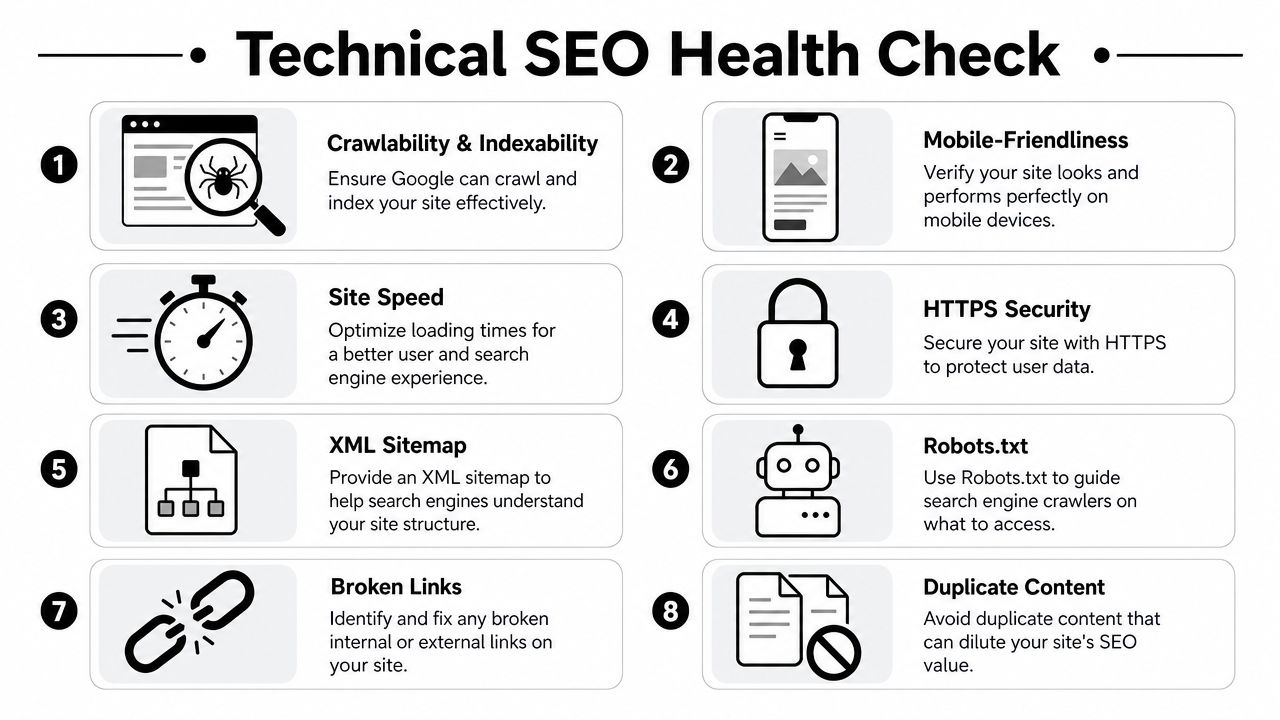
Speed, mobile, and security come first
A delayed page doesn't just annoy people. According to the earlier-cited Network Solutions data, one second of load-time delay can reduce conversions by up to 20%. For a Fort Myers roofer or med spa, that can mean a visitor leaves before they ever tap the call button.
Start with these checks:
Run PageSpeed Insights
Paste in your home page and one core service page. Don't obsess over every color-coded warning. Focus on whether the page feels slow on mobile and whether the report flags obvious image, script, or layout issues.Use your own phone
Pull up the site on cellular service, not office Wi-Fi. Check whether text is easy to read, buttons are easy to tap, and the phone number is clickable without zooming.Confirm HTTPS
Your browser should show the site as secure. If a contact form loads on a non-secure page, that's a trust problem and a lead problem.
What owners should look for without getting technical
You don't need to read code to spot the common failures.
- Pages that drag: Large images, autoplay elements, and overloaded templates often slow home pages and service pages.
- Mobile layouts that fight the user: Text that's too small, menus that cover the screen, and forms with too many fields kill conversions.
- Broken trust signals: Mixed content warnings, expired certificates, or awkward redirects make the site feel neglected.
Salesforce's small business SEO guidance also calls out page speed, broken links, redirect chains, and duplicate titles or meta descriptions as practical audit items. If you want a shortcut for surfacing those issues and to identify ranking and content gaps, an SEO audit tool can help you see what needs attention before you start rewriting pages.
A technically "good enough" site usually beats a prettier site that loads slowly, breaks on phones, or confuses search engines.
A simple go or no-go checklist
Use this as your pass-fail list before deeper SEO work:
| Check | What good looks like | If it's not good |
|---|---|---|
| Crawlability | Important pages can be found and indexed | Check sitemap, internal links, and blocked pages |
| Mobile usability | Service pages are easy to read and use on a phone | Simplify layout and buttons |
| Speed | Key pages load without obvious lag | Compress images and reduce heavy scripts |
| Security | Site uses HTTPS throughout | Fix certificate or mixed-content issues |
| Broken links | Navigation and buttons all work | Repair or remove dead links |
| Duplicate pages | Titles and meta info are distinct | Rewrite overlaps on key pages |
For businesses that need help implementing these fixes, technical on-page SEO support can cover the cleanup work after the audit. The key is to fix the runway before asking the site to produce more leads.
Dominate Local Search with Google Business Profile
If you serve a local market, your Google Business Profile is often more valuable than your home page. A fully built profile can put your business in front of buyers before they ever click through to your website.
That matters because search behavior is concentrated. Ahrefs reports that SEO drives 1,000%+ more traffic than organic social media, and the #1 organic result gets 39.8% of clicks in its SEO statistics roundup. For local service businesses, the map pack is often the fastest route to calls because it captures people who already know what they need.
What makes a profile outperform local competitors
Take a Bonita Springs HVAC company. If its Google Business Profile has the right primary category, recent job photos, complete service descriptions, updated hours, and a steady stream of reviews, it usually looks more credible than a competitor with a half-filled listing and blurry logo.
The difference isn't subtle. One profile looks active and specific. The other looks abandoned.
Prioritize these tasks first:
- Choose the closest-fit primary category: Don't go broad if a more exact category exists for your service.
- Fill out services with plain language: Use real customer wording, not generic marketing copy.
- Upload recent photos from actual jobs: Trucks, staff, before-and-after shots, and completed projects all help.
- Keep hours accurate: Holiday and seasonal changes matter more than owners realize.
- Use posts for offers or updates: Especially useful for seasonal services in Southwest Florida.
What to write in the profile
Most businesses leave money on the table in the business description and service sections. Write them as if a customer is comparing three providers on their phone.
Bad version: "We provide quality HVAC solutions with outstanding service."
Better version: "Residential AC repair, system replacement, and maintenance for homes in Bonita Springs, Estero, and Fort Myers. Emergency service available for cooling issues during peak summer months."
That kind of wording helps both the customer and the platform understand what you do.
For a practical walkthrough, this guide on how to optimize Google Business Profile covers the fields and updates that matter most for local visibility.
A quick visual walkthrough helps if you're setting this up yourself:
The fastest wins most owners miss
Google Business Profile isn't "set it and forget it." The profiles that keep earning local visibility usually show signs of life.
- Fresh photos: Add real images from current work, not just brand graphics.
- Review responses: Reply to every review, good or bad, with a useful human response.
- Service accuracy: Remove old offerings and add profitable ones.
- Q&A coverage: Seed common questions if customers ask the same things repeatedly.
If you can only improve one asset this month, make it your Google Business Profile. For most local businesses, that's the shortest line between search visibility and a ringing phone.
Create On-Page Content for Local Customers
Once the technical base is stable and your profile is active, the next job is tightening the pages that drive sales. At this stage, many small business website SEO campaigns drift off course. Owners either publish vague service pages or chase blog topics that never connect back to revenue.
The better move is simpler. Build strong local service pages first.
According to BDC, small businesses should begin with a core keyword set of 20 to 50 phrases and map those terms to page titles, headings, service pages, and FAQs in its SEO guidance for small businesses. That's a manageable range for a local company. It's enough to create focus without turning the project into a spreadsheet marathon.

Turn generic pages into local money pages
A page called "Roofing Services" is too broad to do much in a competitive local market. A page called "Metal Roof Installation in Fort Myers and Lee County" gives both searchers and search engines a much clearer signal.
A strong local service page should include:
- A clear title tag: Put the main service and location close together.
- A headline that matches the search: If someone searched for paver sealing in Fort Myers, the page should say that plainly.
- Specific service detail: Explain what you do, what's included, and who it's for.
- Local context: Mention neighborhoods, weather issues, building styles, or common regional concerns where relevant.
- A direct call to action: Call, request an estimate, book an inspection, or schedule service.
Here is the difference in practice.
| Weak page | Stronger page |
|---|---|
| "Window Services" | "Hurricane-Resistant Window Installation in Fort Myers" |
| "Landscaping" | "Landscape Maintenance for Fort Myers HOAs and Commercial Properties" |
| "Cleaning" | "Move-Out Cleaning Services in Cape Coral and North Fort Myers" |
Write for buyers, not for keywords alone
Fort Myers customers don't search the way business owners write. They ask practical questions.
A homeowner might search:
- metal roof repair Fort Myers
- best windows for hurricane season
- AC replacement Bonita Springs
- paver sealing near me
Your page should answer the implied question right away. What do you offer, where do you offer it, and why should someone trust you with the job?
Field note: The best-performing local pages usually sound less like ad copy and more like a helpful estimator talking through the work.
Use FAQs and supporting content the smart way
FAQs help when they remove hesitation. They don't help when they're stuffed with robotic phrasing.
Good FAQ examples for a Fort Myers service page:
- How long does paver sealing last in Southwest Florida conditions?
- Do you handle permit-related roofing work in Lee County?
- What's the difference between AC repair and replacement for an older system?
Then add supporting blog content that feeds your service pages. If you sell windows, write something like "Choosing Hurricane-Resistant Windows in Southwest Florida." If you run a lawn or landscaping company, cover irrigation timing during the rainy season or plant choices that handle local heat and salt exposure.
What to optimize first
Don't try to rewrite your whole site in one push. Start here:
- Top three revenue services
- One location-focused page for each major service area
- FAQs on those core pages
- One blog post that supports a money page
That sequence keeps content tied to leads instead of vanity traffic. A contractor in Fort Myers doesn't need fifty blog posts before fixing the page that should already be ranking for "service + city."
Build Local Authority and Earn Trust
A local website can be technically clean, well written, and still underperform if Google doesn't see enough off-site trust signals. That's where authority work comes in. Not flashy authority. Local authority.
For a Fort Myers law firm, cleaning company, dentist, or pool builder, authority usually grows from three sources working together: citations, reviews, and local links.
Citations need consistency, not creativity
A citation is any listing of your business name, address, and phone number on another website. If your address is spelled one way on your site, another way on a directory, and a third way on a chamber listing, that inconsistency chips away at trust.
Start with the obvious places:
- Google Business Profile
- Apple Maps
- Yelp
- Better Business Bureau
- Fort Myers or regional chamber listings
- Industry-specific directories
Keep the business name, address, phone number, and website format consistent everywhere. This is boring work. It matters.
Reviews do more than reassure buyers
Reviews help people decide whether to call you. They also reinforce that your business is active and serving real customers in the area.
A simple process works best:
- Ask right after a successful job: Don't wait two weeks.
- Send one direct review link: Remove friction.
- Train staff to mention it naturally: Especially for home services and healthcare front desks.
- Respond to every review: Thank positive reviewers and address complaints without sounding defensive.
A Fort Myers tile installer with fewer reviews but better, more specific responses often looks more trustworthy than a competitor with many reviews and no replies.
People don't read reviews like marketers. They scan for signs that you'll show up, communicate well, and solve the problem without drama.
Local links should reflect real community involvement
Don't buy backlinks. BDC explicitly warns against buying links because it violates Google's guidelines, as noted earlier in the article. A small business gets better value from community-based mentions that make sense in actual contexts.
Examples that often lead to natural links:
- sponsoring a youth sports team
- supporting a local nonprofit event
- joining the chamber
- partnering with a nearby business on an event or guide
- being featured by a neighborhood association or local publication
If link outreach is part of your plan, a local link building service can help organize the process around local relevance rather than random directory spam.
The trade-off is simple. Cheap, artificial authority usually creates a mess. Slow, legitimate authority holds up.
Your Practical 90-Day SEO Roadmap
Small business owners don't need another giant checklist. They need a sequence they can put into practice. The useful framework here is straightforward. A small-business SEO workflow should start with Google Business Profile, then move to keyword research and content, then local signals and reviews, and finally to technical items like site speed and mobile usability. That order keeps effort tied to visibility instead of busywork.
This is what that can look like for a Fort Myers service business with limited time.
Sample 90-Day SEO Plan for a Local Service Business
| Month | Primary Focus | Key Tasks | Est. Budget |
|---|---|---|---|
| Month 1 | Visibility foundation | Audit site health, fix major mobile issues, complete Google Business Profile, choose core keywords, verify tracking for calls and forms | Low to moderate |
| Month 2 | Revenue pages | Rewrite top 3 service pages, add FAQs, improve titles and headings, request reviews from recent customers, clean up main directory listings | Moderate |
| Month 3 | Authority and content | Publish 1 supporting blog post, continue review requests, build local citations, seek community links, review search and lead data | Low to moderate |
Month 1 should stay narrow
Most owners overload the first month. Don't. Pick the tasks that unblock everything else.
Use Month 1 to:
- clean up obvious technical barriers
- finish every important field in Google Business Profile
- define your core keyword set
- make sure calls and forms can be tracked
If you're short on staff time, delegating repetitive tasks helps. Something as simple as citation cleanup, review follow-up, or formatting content briefs can be handed off. This piece on hiring virtual assistants for marketing is useful if you're trying to keep SEO moving without pulling your office manager off higher-value work.
Month 2 is where lead generation improves
This is the month that usually changes the quality of inbound traffic. Tighten the pages tied to your most profitable services. If you're a Fort Myers HVAC company, that might mean AC repair, AC replacement, and maintenance. If you're a law firm, it might mean family law, personal injury, and estate planning.
Focus on:
- stronger page titles
- clearer service descriptions
- local FAQs
- better calls to action
- recent testimonials or review snippets
Month 3 builds trust around the site
At this stage, your site should already be easier to understand and easier to find. Now support it.
Track practical outcomes, not vanity metrics:
- phone calls
- form submissions
- direction requests from Google Business Profile
- which service pages bring in actual inquiries
If a page gets traffic but no leads, it's a conversion problem. If it gets no impressions, it's a visibility problem. Those are different fixes.
A business that wants done-for-you execution can work with an agency such as Polaris Marketing Solutions for local SEO, website improvements, and reporting. The main point is less about who does the work and more about doing the right work in the right order.
If your website looks fine but isn't producing enough local leads, Polaris Marketing Solutions can help you prioritize the fixes that matter first. The team works with Southwest Florida businesses on local SEO, Google Business Profile optimization, technical cleanup, and service-page improvements built around real lead generation. If you want a practical next step, start with a conversation and see where your current site is leaking visibility.