

If you're a roofer, cleaner, HVAC company, or paving contractor in Fort Myers, you've probably had this moment. A customer says they found your competitor on Google Maps, called them first, and booked before they ever reached your website. You know your work is better, but online you look smaller, quieter, and harder to find.
That's where most business owners make the wrong assumption. They think local SEO is either expensive or shady. In practice, cheap local seo can work if you define cheap the right way. Cheap should mean focused, lean, and disciplined. It should not mean buying a random package that promises rankings and does almost none of the work that moves local visibility.
Small businesses don't need every marketing tactic. They need the handful that create local trust, map visibility, and steady lead flow. That matters because local SEO campaigns deliver exceptional ROI, with 40% achieving 500% or better returns. With 46% of all Google searches being local and 80% of those converting according to Backlinko's local SEO stats. The takeaway is simple. The basics are worth doing well.
Your Guide to Smart and Cheap Local SEO

A lot of owners search for cheap local seo when they're already feeling behind. Their website is live, their truck wraps look sharp, and they've got real customers. But when someone searches “roof repair Fort Myers” or “house cleaning Cape Coral,” another company gets the call.
The answer usually isn't a giant retainer. It's tighter execution.
What cheap should actually mean
Cheap local seo works when you put your time and money into the few assets that influence local buying decisions fastest:
- Google visibility first: Show up where people search for nearby help.
- Trust signals second: Reviews, accurate listings, and clear service information.
- Local pages third: Give Google and customers a reason to connect your business to specific cities and neighborhoods.
That's the high-efficiency path. It's the same logic a practical owner uses in operations. You don't replace every tool in the truck. You fix the bottleneck that slows the whole job down.
Practical rule: If a tactic doesn't help you appear in Maps, build trust, or clarify where you work, it probably doesn't belong in a budget local SEO plan.
What this looks like for a busy service business
For a Fort Myers contractor, smart cheap local seo often means this:
- Finish the Google Business Profile completely.
- Ask for reviews every week.
- Clean up business listings so your information matches everywhere.
- Build a page for each important service area.
- Repeat the routine monthly instead of chasing hacks.
That's not flashy. It is sustainable. And for a business owner juggling estimates, jobs, hiring, and callbacks, sustainable beats impressive every time.
Master Your Google Business Profile First
Your Google Business Profile is the first place to concentrate effort. For most local service businesses, this is the asset that decides whether you show up in map results, look credible, and earn the first phone call.
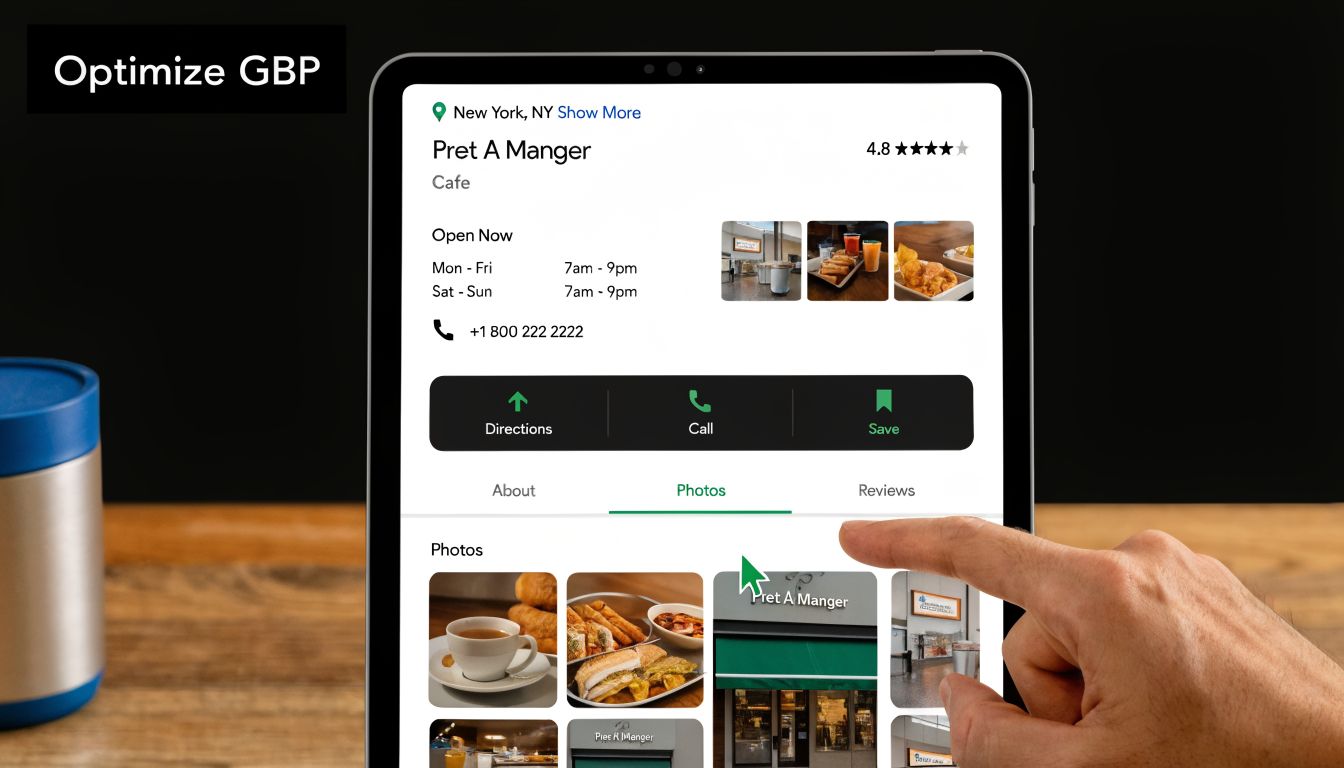
A budget plan falls apart when this profile is half-finished. An HVAC contractor in Fort Myers with the wrong categories, old photos, no service details, and no posting rhythm won't get much traction even if the website is decent. That's why realistic pricing matters. Proper Google Business Profile optimization requires about $80 to $200 per month in labor costs if done right, as noted in this Google Business Profile cost breakdown. If someone offers “full local SEO” for less than it costs to manage the profile properly, something is getting skipped.
The minimum setup every service business needs
Use one clear business name everywhere. Add the primary phone number you answer. Fill out hours, service areas, business description, services, and categories with care.
For an HVAC company, the profile should reflect how customers search. That means choosing the most accurate primary category, adding related service categories only when they match real work, and writing a description that mentions services and locations naturally.
Use this as a working checklist:
- Choose the right categories: Start with your core service, not a vague catch-all.
- Finish every profile field: Incomplete profiles look neglected and rank like it.
- Upload jobsite media regularly: Photos of installs, repairs, crews, wrapped vehicles, and finished work help the profile feel active.
- List actual services: Add the specific jobs you want calls for.
- Keep hours accurate: Holiday and storm-response changes matter for trust.
If you need a field-by-field process, this Google My Business optimization checklist is a solid reference.
What to post each month
Most owners overcomplicate Google Posts. You don't need polished ad campaigns. You need relevant updates tied to real jobs and real local demand.
A Fort Myers HVAC company can rotate posts like these:
| Post type | Example |
|---|---|
| Seasonal service | AC tune-up availability before peak heat |
| Urgent problem | Emergency no-cool service after hours |
| Proof of work | Recent condenser replacement in a local neighborhood |
| Offer | Diagnostic special or maintenance plan reminder |
Short, plain updates work. Add a photo from the field, mention the city, and keep the copy useful.
One more media resource is worth watching before you build your posting process:
The weekly rhythm that keeps GBP alive
A neglected profile usually looks the same. No recent photos. No post activity. Reviews sitting unanswered. Old hours. No sign that the business is active.
A simple operating rhythm fixes that:
- Monday: Check for suggested edits, messages, and questions.
- Midweek: Upload fresh photos from recent jobs.
- Friday: Publish one post tied to a service, seasonal issue, or completed project.
A complete profile beats a clever one. Customers want proof that you're active, local, and reachable.
Build Local Trust with Reviews and Citations
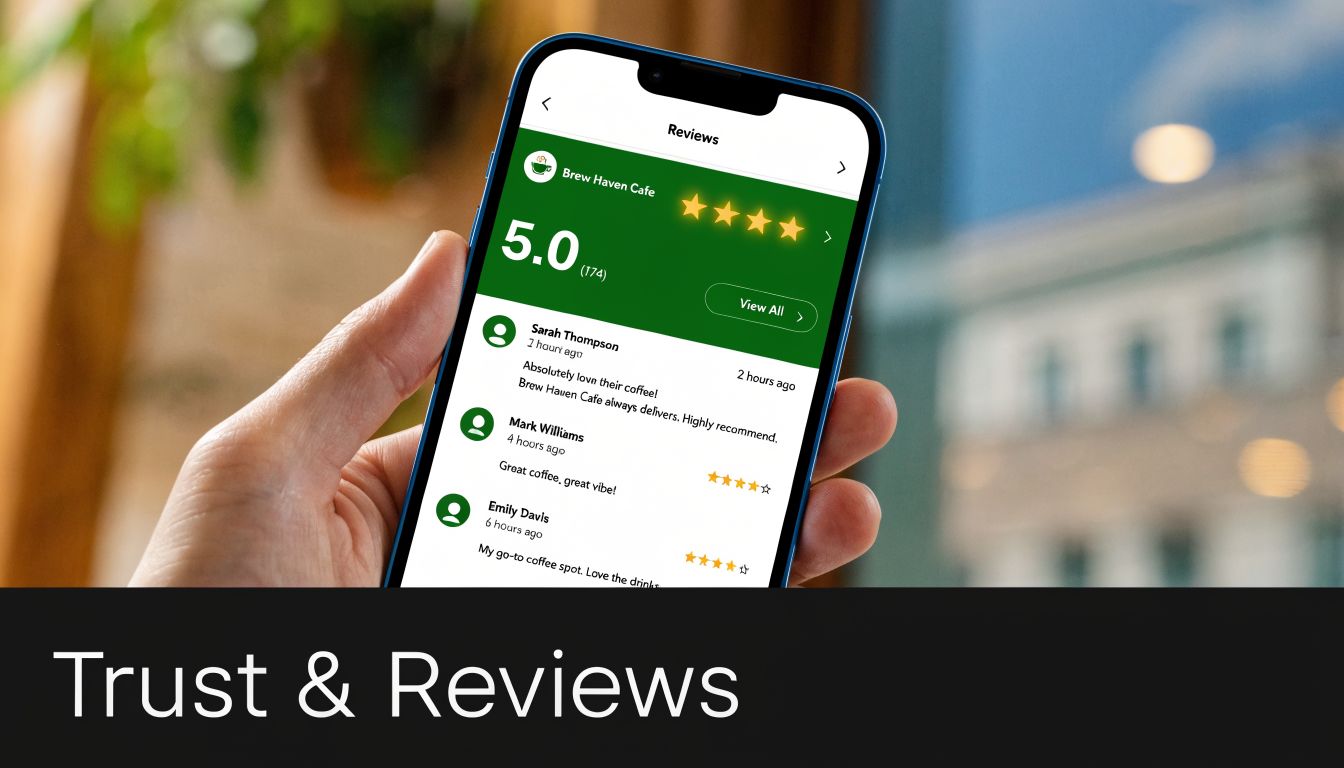
Reviews and citations do a different job than your Google profile. They confirm that your business is real, consistent, and trusted by actual customers. When those signals are weak, cheap local seo gets unstable fast.
A good analogy is dispatch. If your office gives one address to the customer, another to the tech, and a third to the GPS app, the whole day gets messy. Search engines react the same way when your business information varies online.
Why consistency matters more than most owners think
Businesses with inconsistent Name, Address, and Phone information across their online citations can see their local search visibility drop by 20% to 40%, according to this citation consistency analysis. That's why a business listed as “ABC Cleaning Services” in one place and “ABC Cleaning Svcs” in another can create unnecessary confusion.
Start with a master version of your business details and stick to it exactly:
- Business name: Pick one format and never improvise.
- Address or service-area details: Use the same presentation across profiles.
- Phone number: One main number, formatted the same way each time.
- Website URL: Choose the version you want everywhere.
A review request process that doesn't feel awkward
Most happy customers won't leave a review unless you ask at the right time. The best moment is right after a successful job, when the result is fresh and the customer is relieved.
A cleaning company can text something simple like this:
We loved helping with your home today. If you've got a minute, a quick Google review would help our small business a lot.
That works because it's short, human, and easy to act on.
For a more complete process, including follow-up ideas, this guide on how to get more online reviews is useful.
The cheapest citation workflow that still works
Don't try to submit to every directory at once. Start with the listings that customers and search engines are most likely to trust, then expand into niche and local sources.
Use a basic workflow:
- Audit existing listings: Search your business name, old phone numbers, and old addresses.
- Fix the major platforms first: Google, Yelp, BBB, Angi, Facebook, and industry-specific listings.
- Track everything in one sheet: Status, login, live URL, and notes.
- Recheck monthly: Small errors creep back in.
Once your foundation is clean, local link building becomes more effective. If you want practical ideas beyond directory listings, this resource on proven tactics for building link equity gives useful ways to earn supporting links without relying on spammy outreach.
Create Content That Wins Local Customers
A lot of service businesses have one generic services page and hope Google figures out the rest. That usually fails in wider service areas. If you work across Fort Myers, Cape Coral, Estero, Bonita Springs, and Naples, your site has to make those service relationships obvious.
That's where most cheap local seo efforts for service-area businesses break down. DIY local SEO often fails for service-area businesses that lack a physical address, and dedicated service-area pages have been proven to boost Map Pack visibility by up to 40% in competitive markets, according to DesignRush's affordable SEO analysis.
A practical example from a Cape Coral paver company
Take a fictional paver company based in Cape Coral. The owner wants more work in Bonita Springs and Naples. Instead of building one broad page called “Paver Services,” the smarter move is to create separate pages such as:
- Paver Installation in Bonita Springs
- Driveway Pavers in Naples
- Patio Paver Repair in Bonita Springs
Each page should feel like it belongs to that place. Not with filler. With relevant details.
What makes a local service page strong
A useful page for “Driveway Pavers in Naples” should include:
- A direct headline: Say the service and city clearly.
- Local relevance: Mention neighborhoods, property styles, weather wear, or common homeowner concerns in that area.
- Proof: Add photos or testimonials from nearby jobs when available.
- Service clarity: Explain what you do, who it's for, and what to expect.
- A real contact path: Click-to-call button, form, and service details.
Don't build city pages by swapping place names into the same copy. Customers can tell. Google can too.
A page like that helps both ranking and conversion because it answers the customer's actual question: “Do these people work here, and do they handle my kind of job?”
Use jobsite content more than once
Business owners can save time here. A single job can produce website copy, Google posts, short videos, before-and-after images, and social content. If your crew filmed a short driveway walkthrough in Bonita Springs, don't let that live in one place only.
Use that video to support the service page, clip it into a Google post, and turn the spoken explanation into a short FAQ section. If you need help stretching one video into multiple assets, these tools to repurpose video content can speed up the process without creating extra work for your office.
The important part is relevance. Cheap local seo gets traction when each page is attached to a real service, a real place, and a real business workflow.
A Realistic Local SEO Budget and Toolkit
Most owners don't need a huge software stack. They need a realistic setup they'll use every month. Cheap local seo gets expensive when you buy tools you never open or hire bargain services that leave key tasks undone.
The good news is the floor is lower than many people think. Affordable local SEO tooling budgets can start as low as $40 to $80 per month for a single location, covering essentials like Google Business Profile optimization plus a citation management platform, according to Rankmax local SEO benchmarks.
A good better best framework
Here's a practical way to think about spend.
| Level | Best for | What it includes |
|---|---|---|
| Good | Owner-led single-location business | Basic citation tool, Google Business Profile work, review requests, manual page updates |
| Better | Growing service business | DIY tools plus part-time help for content, listings, and review follow-up |
| Best | Multi-location or highly competitive market | Dedicated management for GBP, citations, service pages, and reporting |
The “good” option works when the owner or office manager can protect time each month. The “better” option fits companies that have momentum but not enough internal time. The “best” option makes sense when mistakes cost more than management does.
What belongs in a lean toolkit
A budget-friendly stack should be boring and dependable:
- Citation management platform: Keep business listings aligned without chasing edits one by one.
- Canva: Create simple graphics for Google posts and local updates.
- Google Search Console and Analytics: Monitor search terms and page activity.
- Shared spreadsheet or task board: Track review requests, listing fixes, and page updates.
For social scheduling, compare tools carefully before adding another subscription. This guide to PostClaw's cheapest scheduler guide is useful if you want a low-cost way to queue supporting content without overpaying.
Where cheap usually goes wrong
The biggest mistake is confusing low price with low total cost. A service that's inexpensive upfront can still waste months if it doesn't handle the basics consistently.
Watch for these red flags:
- No work breakdown: If they can't explain what happens monthly, assume very little happens.
- No review system: Local trust won't build itself.
- No citation cleanup: Inconsistent business data keeps dragging performance down.
- No local page work: Service-area expansion won't happen on its own.
If you're comparing DIY versus outside help, this page on affordable marketing for small businesses gives a useful frame for thinking about value rather than just sticker price.
Your Monthly Action Plan and When to Hire Help
The best cheap local seo plan is the one your team can repeat while still running the business. That means attaching tasks to a monthly rhythm instead of treating SEO like a side project you touch only when leads slow down.
A monthly checklist for a busy owner
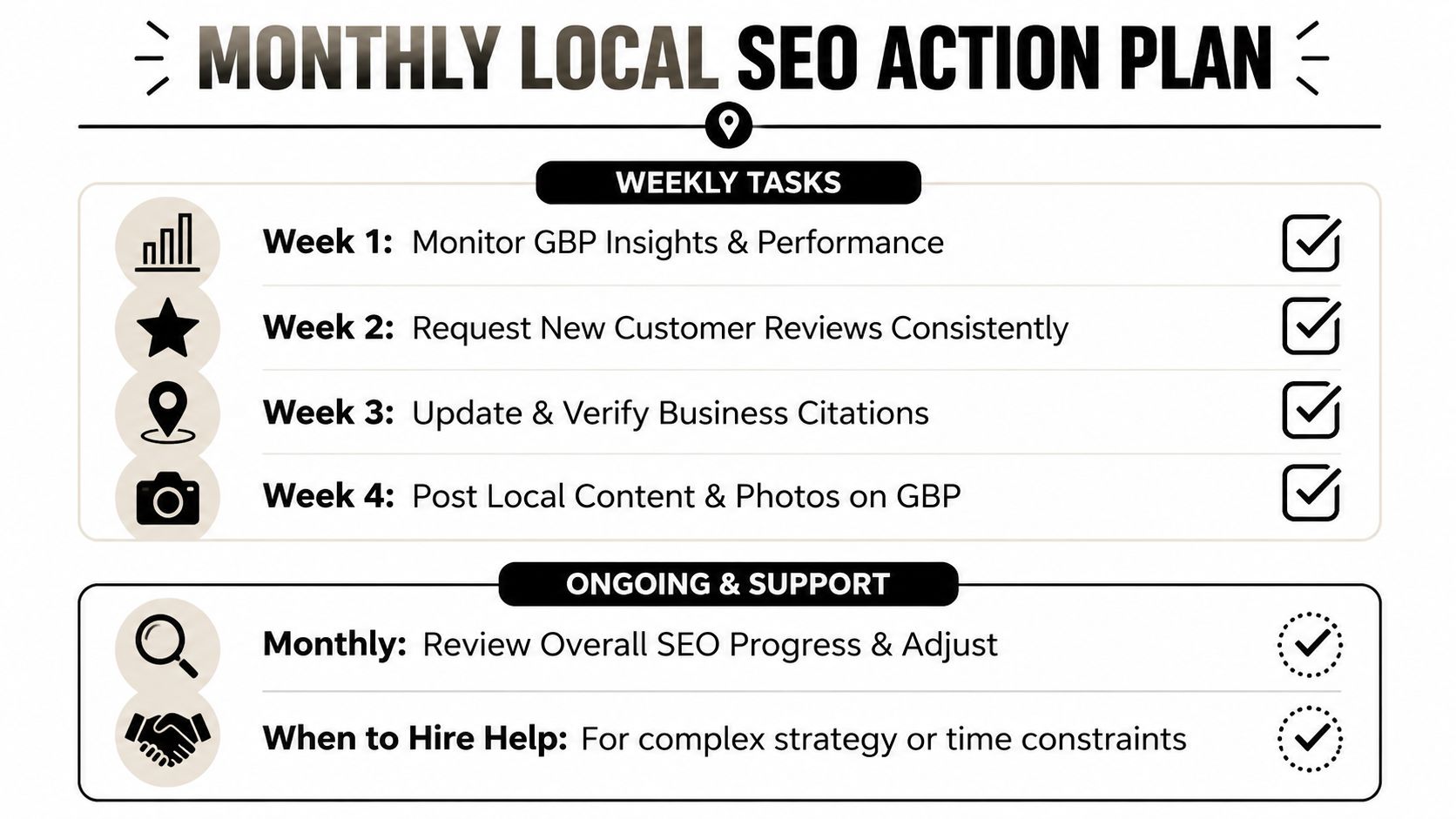
Use a simple cadence like this:
- Week 1: Review Google Business Profile insights, check calls and activity, update hours if needed.
- Week 2: Ask recent customers for reviews and respond to the ones that came in.
- Week 3: Check your main citations for errors or duplicates and fix one problem source.
- Week 4: Add fresh local content. Update one service-area page or publish one useful Google post with new photos.
- Monthly review: Look at what brought calls, what pages are gaining traction, and where you're still invisible.
The win isn't doing everything. The win is doing the right few things every month without dropping them.
This matters even more in competitive trades. Ultra-cheap local SEO services under $500 per month have a 35% failure rate for competitive niches like home services because they often ignore review management. In contrast, even free tools like Canva for GBP posts can double impressions when used consistently, according to Seoprofy's affordable SEO review.
When DIY stops being cheap
DIY stops making sense when it steals too much owner time or stalls out in tougher markets. If you're missing follow-ups, skipping updates, or trying to expand into places like Naples or Bonita Springs with no clear local page strategy, the hidden cost is distraction.
Hire help when:
- Your office can't keep the routine going
- You need cleaner execution across several service areas
- You're competing in a tougher niche and need tighter local strategy
- Marketing work is pulling you away from estimates, jobs, and customer service
Cheap local seo works best when it's steady, specific, and tied to your real operating week. If you want a team that understands that balance and can help you turn local search into a repeatable lead source, Polaris Marketing Solutions can help you assess what's worth doing now, what can wait, and where professional support will pay off.