

Some weeks the calls come in fast. Then they dry up, and you're back leaning on referrals, yard signs, or shared lead platforms that send the same prospect to three other contractors. That kind of pipeline makes it hard to schedule crews, buy materials confidently, or plan growth.
Most homeowners and property managers don't start with a phone book or a Facebook post. They open Google, type the service they need plus the city, and click the company that looks credible. That's where seo services for contractors stop being a marketing extra and start acting like a job pipeline.
Why Your Phone Isn't Ringing Consistently
A homeowner in Fort Myers finds a roof leak after a storm, grabs their phone, and searches for help. An hour later, one contractor has the call. Another never even made the shortlist. In Southwest Florida, that gap usually comes down to visibility, trust, and how clearly your business shows up when the job is urgent.
Good contractors lose work every week for reasons that have nothing to do with workmanship. The problem is usually a weak pipeline. Referrals come in waves. Lead sellers send the same prospect to multiple companies. Then crews sit half-booked while the phone stays quiet.

What matters is not raw traffic. It is whether the right people can find you, trust you fast, and contact you without friction. That is the difference between SEO that looks busy in a report and SEO that produces estimates, deposits, and booked jobs.
In my experience, inconsistent call volume usually points to a few specific breakdowns:
- You are not showing up where local buyers look first: Your business is buried in the map pack or missing for searches tied to your services and cities.
- Your website is costing you calls: Visitors land on the page, but they do not see enough proof, clear service info, or an easy next step.
- Google is getting mixed signals: Your service pages, service areas, and business details do not line up cleanly.
- Your reputation is too quiet: Happy customers exist, but your reviews are not strong enough to help close the decision.
Contractors in Cape Coral, Naples, Bonita Springs, and Estero run into this all the time. They may rank for their company name and still miss the searches that produce new work, like "tile roof repair Naples" or "kitchen remodel Fort Myers." That gap is where revenue slips. SEO only pays off when it connects the work on your site and Google Business Profile to qualified local intent.
If your listing is not appearing where it should, start by checking why your business may not be showing up on Google. Many visibility problems come from fixable issues, not a lack of demand.
The same goes for trust. A contractor can have solid craftsmanship and still lose the job if the site looks thin, the phone number is hard to find, or the reviews feel dated. Buyers make that call fast, especially on mobile.
I have seen this in contracting firsthand. A well-built business can still have a shaky marketing foundation. If the online basics are off, every other effort has to work harder, the same way crews fight a bad slab for the rest of the build.
For owners who want broader insights for custom home construction, the same principle applies. The companies that win steady work make it easy for the right customer to find them and easy to say yes.
Practical rule: If a prospect cannot tell what you do, where you work, and how to contact you in a few seconds, the next contractor gets the call.
SEO fixes that by building a system around qualified searches and measurable outcomes. The goal is not more impressions. The goal is more of the right calls, from the right areas, that turn into profitable jobs.
The Blueprint for Contractor SEO Success
Contractor SEO works a lot like building a house. If the slab is bad, it doesn't matter how nice the finishes look. If the framing is crooked, every trade behind it pays for that mistake. Your online presence works the same way.
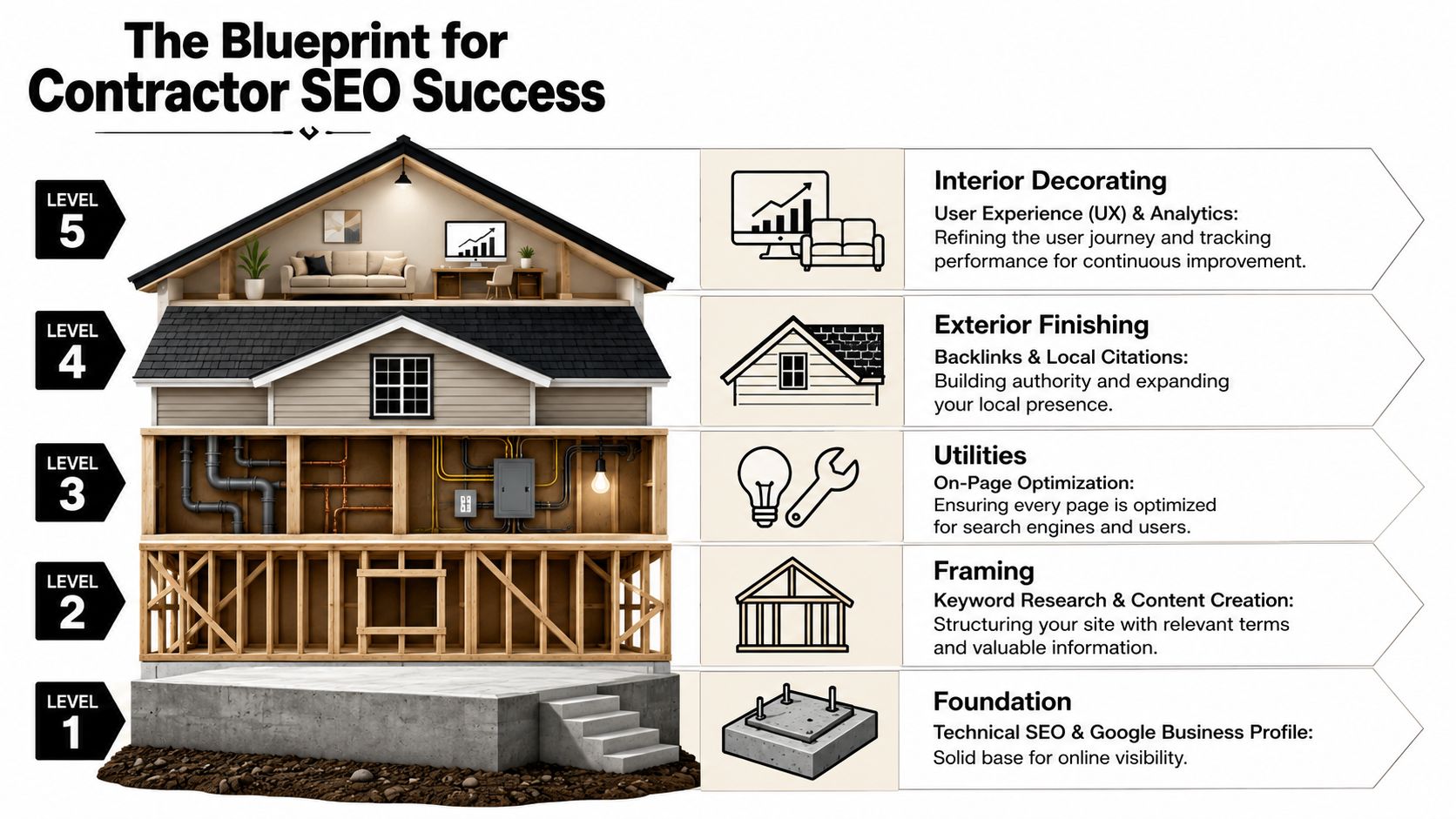
Foundation
The base is technical SEO and local SEO. That means your Google Business Profile is accurate, your business name, address, and phone are consistent, and your website loads cleanly on mobile. Without that, Google hesitates to trust what it's seeing.
For contractors serving multiple areas, the foundation also includes clear service-area signals. If you work Fort Myers, Cape Coral, Estero, Bonita Springs, and Naples, your site should reflect that with purpose. Don't leave Google guessing.
Framing
The next layer is keyword research and page structure. Many contractor sites go wrong at this stage. They build one generic "Services" page and expect it to rank for roofing, remodeling, pavers, concrete, HVAC, and every city they serve.
That approach is like trying to frame a whole house with half the lumber. Instead, create structure around how customers search. One page for metal roofing. Another for roof repair. Another for commercial roofing. Then match those services to the places you work.
For builders looking at how specialized buyers think through projects, I like the insights for custom home construction from RBA Home Plans. It helps illustrate how specific customer intent gets when the project value is high.
Finishes
Once the structure is solid, you work on the parts that make people choose you. That includes:
- Project content: Before-and-after photos, case studies, FAQs, and service explanations
- Reviews: Fresh reviews with thoughtful responses
- Authority signals: Local citations, relevant links, and proof of real work
- User experience: Clear calls to action, click-to-call buttons, and forms that don't fight the user
A contractor-focused digital strategy usually blends all of that. If you want a local example of how those pieces fit together, digital marketing for home services shows the broader mix beyond rankings alone.
The best SEO campaigns don't chase traffic for its own sake. They make it easier for the right customer to trust you fast.
Dominate Your Local Map with Foundational SEO
A homeowner in Fort Myers hears water dripping through the ceiling after a storm. They grab their phone, search for a roofer, and call one of the first local businesses that looks legitimate. In that moment, your Google Business Profile often matters more than your homepage.
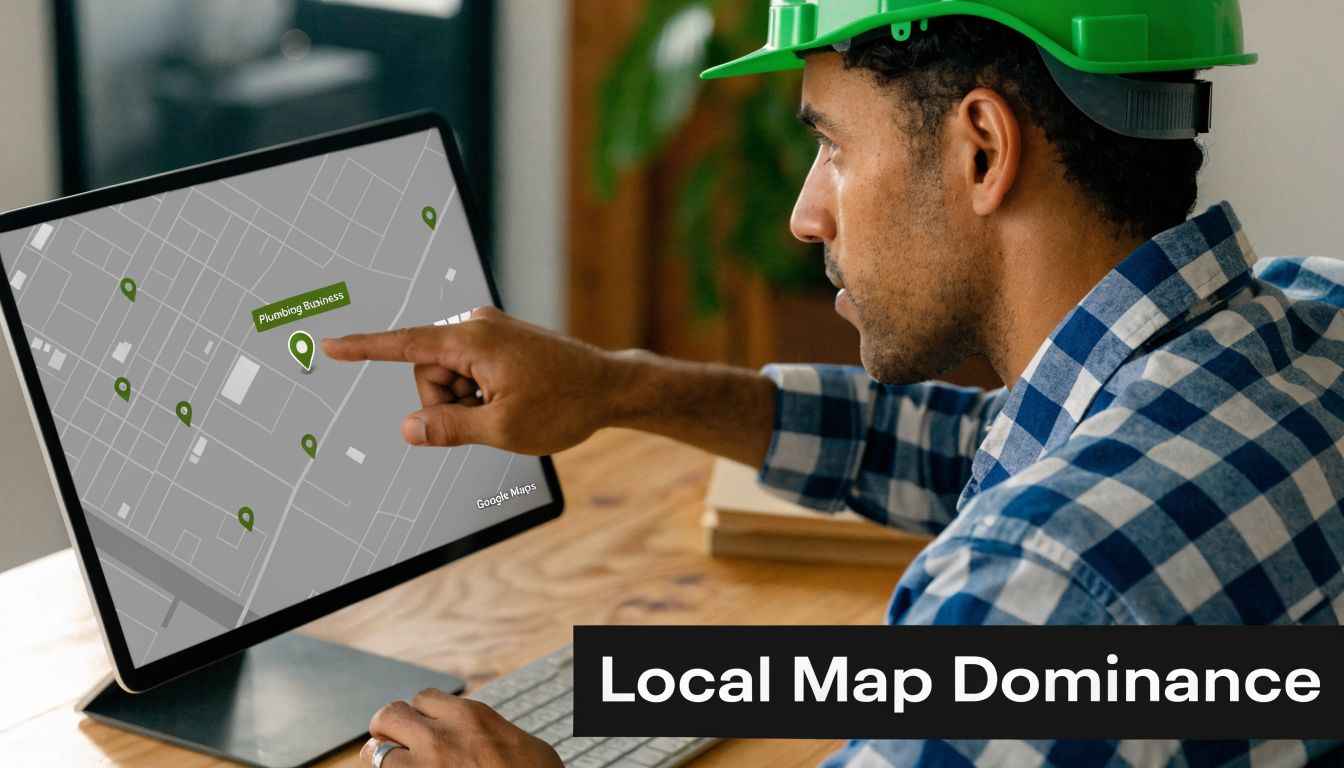
Map visibility drives real leads because local searches usually come from people who need help soon, not from somebody casually browsing. In Southwest Florida, where service areas overlap and competition is tight from Naples to Cape Coral, a well-built local presence can decide who gets the call.
Tighten up your Google Business Profile
Start with the parts that affect both visibility and trust. Pick a primary category based on the service that brings in the highest-value work, then add secondary categories that match real jobs you want more of. If roof replacement is your money maker, lead with that direction. If inspections, repairs, or metal roofing are separate profit centers, reflect that clearly.
Then complete the profile the way a serious buyer checks it on their phone between appointments:
- Services: List specific services instead of one generic description.
- Photos: Add real project photos, crew shots, trucks, progress images, and finished work.
- Service areas: Include the cities you serve.
- Business description: Explain what you do, who you help, and where you work in plain language.
- Hours and contact info: Keep them current so you do not lose easy calls.
One warning here. Do not stuff city names or services into every field just because you can. Google wants a real business profile, not a pile of keywords. Clean, accurate information usually outperforms forced optimization over time.
Clean up your citations
Citations are mentions of your business name, address, and phone number across directories and local listings. They work like permit paperwork. If the company name changes from one form to the next, or the phone number is old in three places, trust drops.
That problem shows up all the time with contractors who have changed offices, added a tracking number, or merged with another company. The fix is simple, but it takes discipline. Choose one standard business format and use it everywhere. Keep a spreadsheet with every login, every listing, and every correction date. That small bit of admin work supports map rankings and cuts down on bad leads calling the wrong number.
If you want the next step after cleanup, this guide on how to rank in Google Maps for local service searches breaks down the pieces that help contractors show up more consistently.
Before you move on, this walkthrough is worth a watch:
Build a review system, not a review wish
Reviews affect rankings, but that is only half the job. They also help close the sale. A homeowner comparing three contractors in Bonita Springs usually leans toward the company with recent reviews, specific job details, and professional responses.
Random review requests produce random results. Build the ask into your closeout process so it happens after every good job.
A simple workflow works well:
- Ask at the right moment: Ask right after the customer says they are happy.
- Send a direct link: Remove extra steps.
- Give light guidance: Ask them to mention the service and city in a natural way.
- Respond to every review: Show future customers you are active and accountable.
Here are two usable response examples:
"Thanks for trusting us with your roof replacement in Fort Myers. We appreciate the feedback and we're glad the crew delivered a smooth project."
"We're sorry the experience didn't meet expectations. We take this seriously and want to make it right. Please contact our office so we can review the job details with you directly."
I have seen contractors spend months chasing rankings while ignoring the profile that sits right in front of ready-to-call prospects. Foundational local SEO is less glamorous than big traffic reports, but it is often where booked jobs start.
Turn Your Website Into a 24/7 Sales Tool
A contractor website shouldn't act like an online brochure. It should answer questions, show proof, and make calling easy. If it doesn't, you can rank and still lose work.
Build pages for the way people search
One of the biggest mistakes I see is the all-in-one services page. It may look clean, but it doesn't match search intent well. Someone searching "HVAC repair in Cape Coral" wants a page clearly about that service in that location, not a general home page with a short paragraph buried halfway down.
A stronger structure looks like this:
- Core service pages: HVAC repair, AC installation, ductless mini-splits, maintenance plans
- Location pages: HVAC repair in Cape Coral, HVAC repair in Bonita Springs, AC service in Fort Myers
- Support pages: Financing, FAQs, emergency service, service agreements
- Proof pages: Project galleries, reviews, case-study-style job recaps
For on-page SEO, write title tags that are specific and readable. A clean example is: Expert Paver Sealing in Fort Myers, FL | Company Name. The page headline should match the service. The copy should explain what you do, who you help, and what the next step is.
Fix speed before you buy more traffic
Slow sites bleed leads. Contractor sites with unoptimized high-resolution photo galleries can load in 6-8 seconds, causing 53% of mobile visitors to leave immediately. Post-optimization, load times can drop below 3 seconds, boosting mobile rankings and lead conversions, according to technical SEO guidance for contractor websites.
That matters a lot in the trades because photo-heavy websites are common. Crews want to show their work. That's good for trust, but oversized images, bloated themes, and too many scripts can make the site drag.
Focus on these fixes first:
- Compress images: Convert oversized jobsite photos to web-friendly formats like WebP.
- Trim unused code: Remove plugins and scripts that don't serve a real purpose.
- Check mobile click paths: Make sure the phone number and quote button are easy to tap.
- Test key pages: Use Google PageSpeed Insights and GTmetrix on your home page, top service pages, and gallery pages.
A fast site doesn't just help rankings. It helps the customer stay long enough to call.
Make every page answer one sales question
Each important page should help the visitor move one step closer to hiring you. That means including:
| Page type | Main question it should answer | What to include |
|---|---|---|
| Service page | Do you handle this job? | Scope of work, benefits, FAQs, call button |
| Location page | Do you work in my area? | City references, service details, local proof |
| Gallery page | Can I trust your workmanship? | Real photos, captions, project context |
| Contact page | How do I reach you now? | Click-to-call, short form, business hours |
If you wouldn't hand a page to a prospect during an estimate, it probably needs work.
Decoding SEO Pricing and Measuring Real ROI
Contractors usually ask the right question first. Not "How many keywords will I rank for?" but "What does this cost, and does it pay off?"
That's the right way to look at it. SEO should be measured like equipment, labor, or a sales hire. It needs to produce work.
Common pricing models for contractors
Pricing structures vary, but most agencies and consultants package SEO in three ways.
| Pricing Model | Typical Cost (Fort Myers Market) | Best For | What to Expect |
|---|---|---|---|
| Monthly retainer | Varies by scope and competition | Contractors who want ongoing growth | Recurring work on content, technical fixes, local SEO, reporting, and optimization |
| Project-based fee | Varies by deliverables | Website rebuilds, one-time audits, setup work | Defined scope such as a site audit, page optimization, or Google Business Profile cleanup |
| Hourly consulting | Varies by expertise and need | In-house teams or owners who need guidance | Strategy calls, audits, troubleshooting, and direction without full implementation |
No matter which model you choose, ask what work is included. "SEO" can mean anything from a real local growth plan to someone changing title tags once a month and sending a glossy report.
Look at return, not just spend
The strongest argument for SEO in the trades is that it can become a durable lead source once the groundwork is in place. SEO services for contractors deliver an exceptional 681% return on investment, with a typical breakeven period of just 5 months, according to contractor SEO ROI data.
That doesn't mean every campaign performs the same way. It does mean the channel is worth taking seriously if your market depends on local search.
A useful way to think about it is the same way property owners think about efficiency upgrades. The upfront cost matters, but the payoff matters more. That's why I like these expert insights on Florida solar ROI as an analogy. Contractors already understand investments that lower acquisition costs and create longer-term returns.
What real ROI tracking looks like
Good SEO reporting should answer business questions such as:
- Which service pages produce calls and forms
- Which cities generate the best leads
- Whether map visibility is improving
- How many leads become estimates and jobs
- What your cost per qualified lead looks like over time
If an agency can only show impressions, clicks, and "visibility scores," you're not getting the full picture. Rankings matter. Revenue matters more.
How to Choose an SEO Agency That Gets Results
A contractor in Fort Myers can spend six months paying for SEO, see prettier reports, and still have the same problem on Monday morning. The phone stays inconsistent, the sales calendar has gaps, and nobody can explain which work produced actual estimates.
That usually comes down to one issue. The agency is reporting marketing activity instead of sales progress.
Ask questions that expose their process
Good agencies can show you how they plan, what they do each month, and how they connect that work to calls, form fills, and booked jobs. Weak agencies stay vague on purpose. They rely on broad language, generic deliverables, and ranking talk because those are harder to challenge.
I look for answers that sound like a job scope, not a pitch deck. If an agency cannot explain how it will improve your Google Business Profile, service pages, city pages, review flow, site speed, and conversion tracking, you are not looking at a system. You are looking at loose tasks.
Ask questions like these:
- How do you define a qualified lead for my trade and service area?
- How do you track calls, forms, and booked estimates from organic search and maps?
- What specific work will you complete each month?
- How do you handle Google Business Profile categories, services, posts, and reviews?
- How do you build location pages that are useful for each city instead of thin copy with city names swapped out?
- If my site is slow or hard to use on a phone, who fixes it?
- Who writes the content, and how do they match what homeowners are searching for?
- How do you report results in a way that ties back to revenue?
In Southwest Florida, that last question matters even more. Search demand shifts by season, storm events can change urgency overnight, and service areas often overlap. An agency that knows the region should be able to tell you how it will separate Naples from Fort Myers, or Cape Coral from Sarasota, instead of treating the whole area like one city.
Know the red flags
Some warning signs are obvious.
If an agency guarantees a #1 ranking for a competitive term, keep moving.
Others show up in the sales call and the proposal:
- They sell traffic as the end goal. Contractors need qualified leads, not visits from people outside the service area or looking for DIY advice.
- They avoid specifics. No task list usually means no accountability.
- They barely mention local search. For contractors, map visibility, reviews, and city-level relevance drive a large share of calls.
- They use the same package for every trade. HVAC, roofing, remodeling, paving, and pool construction have different search patterns and different sales cycles.
- They do not ask about close rates or average job value. If they never ask what a lead is worth to you, they cannot judge whether the campaign is paying off.
One more red flag from experience. If an agency talks like every lead has equal value, expect bad decisions. A page that brings in ten tire-kickers is less useful than a page that produces two solid estimate requests for your highest-margin service.
Look for fit, not flash
The right agency understands how contractors sell. A homeowner searches, compares a few options, makes a call, schedules an estimate, then decides based on trust, timing, and price. SEO has to support that whole path. It starts with visibility, but it has to end with contact and conversion.
Polaris Marketing Solutions is one Southwest Florida option that offers local SEO, website support, reporting, and broader digital marketing for small and mid-sized businesses. Whether you hire that team or another one, choose a partner that can talk clearly about lead quality, service-area strategy, and booked-job value.
A good agency should sound less like a software demo and more like a foreman walking a site. Clear scope. Clear sequence. Clear accountability. That is how you get results that show up in the office and on the schedule.
Your 10-Point Contractor SEO Starter Checklist
A lot of contractor SEO problems are easy to spot once you look at the business the same way a homeowner does. They search a service, scan the map, click a site, and decide within seconds whether to call. If any step breaks, leads dry up.
Use this checklist like a punch list before sign-off. It helps you find the issues that block qualified calls, not just traffic.
Ten yes or no checks
- Search your main service and city: Do you show up in the map pack or on page one for your core service?
- Check your Google Business Profile category: Does your primary category match the service line that brings the best jobs?
- Review your contact path: Is your phone number clickable on mobile from every key page?
- Audit service pages: Do you have a separate page for each main service instead of one broad services page?
- Audit location coverage: Do you have useful city pages for the areas you serve?
- Test your website speed: Do your main pages load fast on a phone, especially pages with project photos?
- Look at your reviews: Are you asking for reviews as part of your job closeout process?
- Check your responses: Do you reply to new reviews quickly and professionally?
- Verify business details: Is your name, address, and phone number formatted the same across your site and directory listings?
- Review your lead tracking: Can you trace calls and form submissions back to organic search and map results?
One review habit that pays twice
Reviews help in two places. They improve local visibility, and they help homeowners trust you enough to call.
The number matters less than the process. A steady flow of recent reviews usually does more for a contractor than a burst of twenty reviews followed by six quiet months. The same goes for responses. A short, professional reply tells the next prospect that your company stays engaged after the job is done.
Keep the system simple:
- Ask every happy customer
- Send the request while the job is still fresh
- Respond to every review
- Track whether review growth turns into calls, estimates, and booked work
The contractors who win local search usually are not using secret tactics. They handle the basics consistently, and they measure whether those basics turn into real jobs.
If this checklist exposes gaps in map visibility, page coverage, site speed, or lead tracking, start there. In Southwest Florida, that usually means tightening service-area pages, improving your Google Business Profile signals, and making sure every call source can be tied back to revenue.
Polaris Marketing Solutions can help assess your website, local visibility, and competitive position in Fort Myers and the wider Southwest Florida market. The right next step is a clear review of what is stopping calls now, what fixes will likely produce qualified leads, and how to measure results by booked jobs instead of vanity metrics.