
An AI visibility score is a 0 to 100 metric that shows how often your business appears, gets cited, and gets recommended inside AI-generated answers. For a Fort Myers business, that matters because those answers are becoming the new front page of search.
If you've already invested in SEO and your website still gets traffic, but the phone feels quieter than it used to, you're not alone. A lot of local owners are seeing the same thing, especially in service businesses where buyers now ask ChatGPT, Google AI Overviews, Perplexity, Gemini, and Copilot for a shortlist before they ever click a blue link.
Your New Competitive Edge in Southwest Florida
A contractor in Fort Myers can rank well on traditional search and still lose the lead to a competitor in Naples who shows up more often in AI answers. That's the shift local businesses are dealing with right now. The old question was, “Am I on page one?” The newer question is, “Does the AI system trust my business enough to mention me first?”
That's why AI visibility needs its own measurement. Traditional SEO tools tell you about rankings, impressions, and clicks. They don't tell you whether your business is being cited inside conversational answers that customers now treat like a recommendation from a trusted person.
Practical rule: if a buyer asks an AI for a roofer, plumber, or attorney, the recommendation process starts before the click. Your brand needs proof that AI systems can recognize, verify, and reuse.
For Southwest Florida service businesses, the local angle matters even more. A roofer in Cape Coral doesn't need a generic national footprint. The business needs the right mix of local proof, service clarity, and third-party confirmation so the system can connect the name with the city, service, and need. That's where the AI visibility score becomes useful, because it turns a fuzzy idea into something you can track and improve.
If you're trying to understand the broader shift in search behavior, boost online visibility in 2026 is a useful primer on how answer engines fit into the new search mix. For a practical breakdown of answer engine optimization itself, the internal overview on answer engine optimization helps connect the concept to day-to-day marketing work.
What Is an AI Visibility Score
A good way to read an AI visibility score is as a composite metric that shows how often a brand is found, mentioned, cited, and recommended in AI-generated answers, not just in traditional search results. One published model weighs signals such as mention rate, citation rate, and position to produce the score RankBits.
For a Fort Myers contractor, law firm, or home service company, that score works like a digital reputation report card. A higher score usually means AI systems can identify the business entity clearly, find enough supporting evidence, and repeat that result across multiple engines. A weak score can show up even when the website looks solid, because the model may not connect the entity cleanly, may rely on lower-trust sources, or may produce inconsistent answers across prompts Authority Tech.
What the score is really measuring
The strongest definitions break the score into a few practical signals:
- Entity resolution: Can the AI tell exactly which business is which?
- Mention frequency: Does the brand come up at all, and often enough to matter?
- Citation support: Are there credible sources backing the mention?
- Source authority mix: Are trusted pages showing up, or weak ones?
- Cross-engine consistency: Does the result hold up across different AI platforms?
That structure makes the score closer to a presence metric than a ranking metric. A business might appear in one answer but fail in another, which means the score reflects visibility quality, not just raw exposure. For a closer look at how visibility work gets translated into practical marketing steps, the overview on answer engine optimization is useful.
A practical comparison from AI Optimization Services on optimizing for AI search helps frame the score around content, proof, and coverage. A broader explanation from what is AI visibility score and how should marketers use it also shows why different tools can score the same brand differently, since each platform weighs signals in its own way.
Why the number alone isn't enough
A score only makes sense when you know what went into it. One tool may emphasize recommendation rate, another may lean on citations, and another may care more about topic coverage. That means the score is useful, but only if you treat it as a diagnostic, not a trophy.
If you are comparing vendors or platforms, check what the score includes, what prompt set was used, and which AI engines were monitored. Without that context, the number can look precise while still being misleading.
For local owners who want a broader search strategy alongside AI visibility, boost online visibility in 2026 is a useful primer on how answer engines fit into the search mix.
Interpreting Your Score Against Competitors
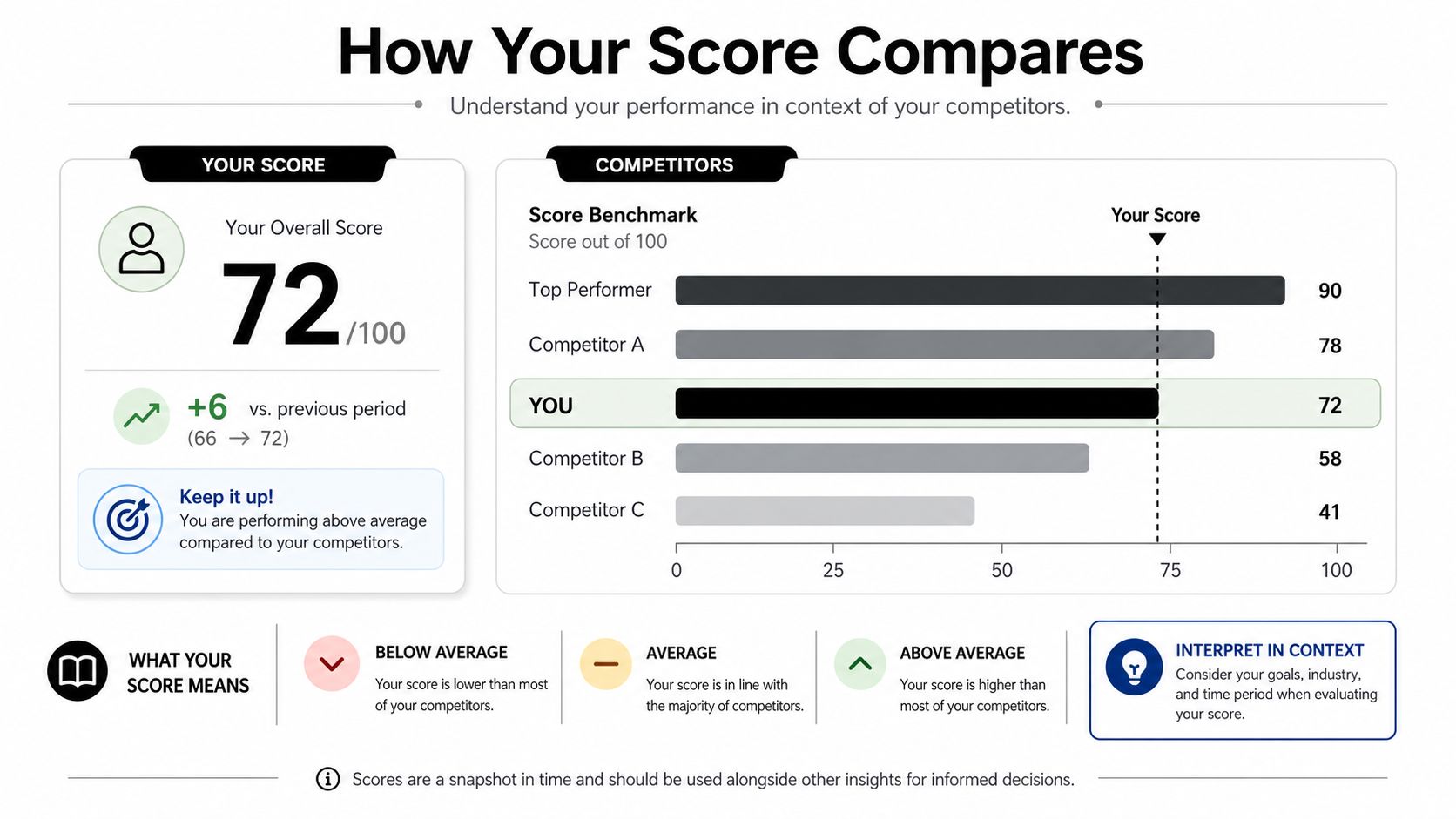
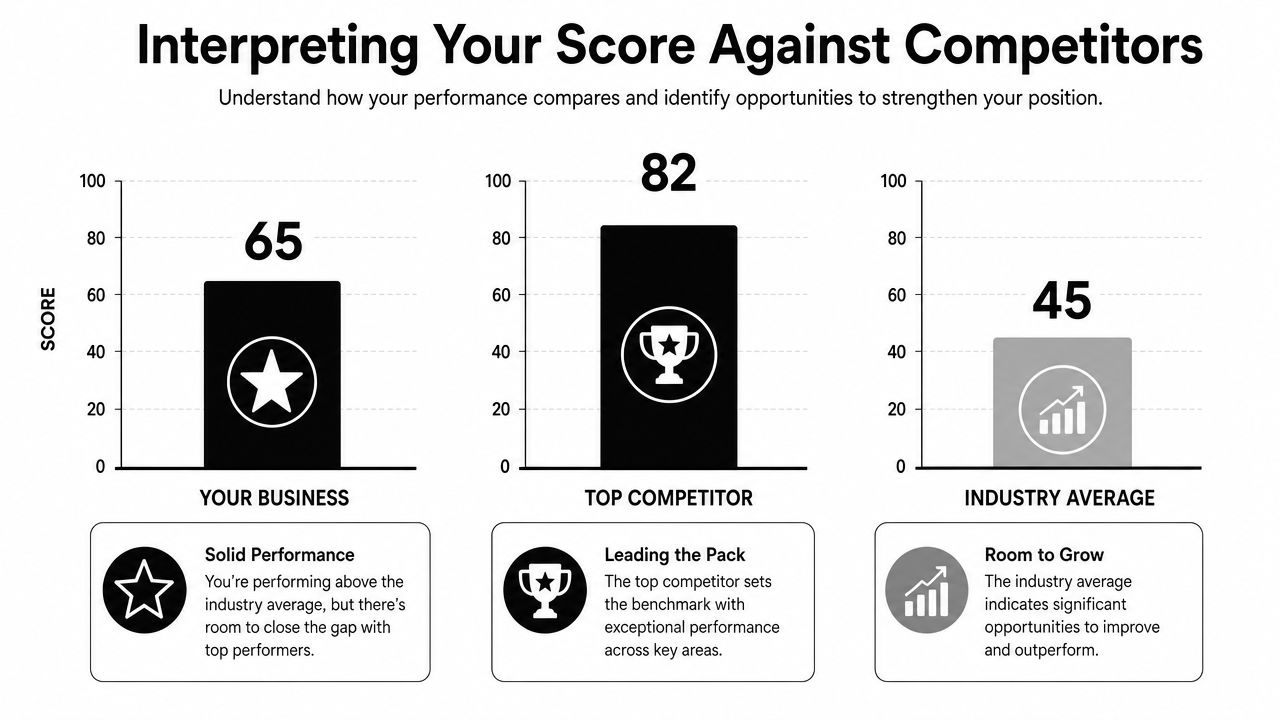
The number matters less than the comparison. A Fort Myers plumber with a score of 60 may be in better shape than a Cape Coral competitor at 65 if the lower-scoring brand is mentioned in the right places, for the right prompts, with stronger local proof. The job is to see what the score says about the gap, then decide what to fix first.
Use your top two or three local competitors, not a random national brand. When you compare roofers in Fort Myers, Estero, and Naples against one another, patterns show up fast. One company may be cited often but only for broad informational queries. Another may be cited less often, but as the preferred option for local, high-intent questions.
A score gap usually points to a proof gap, a coverage gap, or both.
Read the score as a clue, not a verdict
A low score usually points to a specific weakness:
- Review signals are thin. AI systems do not have enough third-party confidence to surface the business often.
- Business data is inconsistent. The company name, address, or service area may vary across directories.
- Entity signals are weak. The brand is not clearly tied to the right category or location.
- Coverage is uneven. The business shows up for one engine but disappears in another.
That is why different tools can show different numbers for the same business. A platform that weighs citations heavily will score a company differently than one that prioritizes recommendation language or platform coverage. The metric is still useful, but only if you understand what it measures and what it leaves out.
For a practical comparison framework, best tools for competitor analysis can help you set up a cleaner side-by-side review. For a closer look at the mechanics behind optimizing for AI search, use it as a reference point for how answer engines weigh content, proof, and coverage.
A practical Fort Myers example
Take three local roofers. If one has a lower score than the other two, the next step is not guessing. Check whether the business has fewer reviews, weaker location pages, fewer local citations, or inconsistent directory data. In most cases, the score is pointing to missing evidence somewhere in the brand's digital footprint.
That is the useful part. The score does not just tell you where you stand. It tells you where to investigate next.
Why Your Score Matters for Fort Myers Businesses
For a Southwest Florida service business, the score is tied to real revenue questions. If someone in Naples asks an AI for the best roofer, the best AC repair company, or a local law firm, the system has to decide which businesses look credible enough to recommend. If your business doesn't show up, a competitor gets the lead.
That matters most in service areas like Fort Myers, Cape Coral, Bonita Springs, Estero, and Naples, where customers often want a local provider with enough proof to trust. AI engines rely on local signals because they need to decide which business serves the area, which one has the right service scope, and which one looks established enough to mention.
Local proof changes the recommendation
A high score usually means the business has enough evidence attached to it for AI systems to trust the recommendation. That can include location relevance, service descriptions, reviews, citations, and consistent business identity across the web. A low score usually means one of those signals is missing or weak.
For a local contractor, that can show up as a business being ignored for “roof repair in Bonita Springs” even when the company technically serves that area. For a professional firm, it might mean the business gets passed over in favor of a competitor whose website and directory profiles make the city-service relationship clearer.
Local visibility is proof-based. AI systems lean toward businesses that look established, specific, and easy to verify.
The practical takeaway for owners in Southwest Florida is simple. Don't think of the score as a vanity metric. Think of it as a map of whether AI systems have enough local evidence to recommend your company when a buyer asks for help nearby.
What a weak score usually means locally
In markets like Fort Myers and Naples, weak visibility often comes from missing proof rather than missing effort. The website may be live, but the city pages are thin. The Google Business Profile may exist, but the service list is incomplete. Reviews may be present, but they don't mention the actual service or location.
That's why the score matters. It helps a business owner see whether the local footprint is strong enough for AI systems to recommend the company with confidence, or whether the business is still invisible in the places buyers are now asking first.
Core Strategies to Improve Your AI Visibility
The first layer is the website itself. AI systems need a clean, understandable source of truth before they can cite you, and most local businesses never make that easy enough. A thin homepage and a generic services page won't give answer engines much confidence.
Start with structured service pages. Each major service should have its own page, written in plain language, with the cities you serve and the problems customers ask about. A paving company, for example, can use project galleries to show real finished work, while a roof repair company can publish before-and-after photos and job breakdowns that make the service unmistakable.
Make the site easier to read as an entity
The next move is entity clarity. Schema markup helps the site describe who you are, what you do, and where you work, so AI systems don't have to guess. That matters because a business name alone is often not enough to connect the company with a category, service area, and brand identity.
Then build content around actual questions. If customers ask, “How much does a new roof cost in Florida?” or “What should I look for in an AC repair company?” the business should have pages that answer those questions directly. That gives the models something concrete to cite instead of forcing them to infer the answer from vague marketing copy.
For a tactical walkthrough on creating AI-assisted search content, the guide to AI-powered SEO solutions is a useful reference because it shows how content can be organized around answerable topics. If you want to connect that work to a broader website strategy, Polaris Marketing Solutions also offers an AI Search Visibility Platform that shows how a brand appears in ChatGPT, Perplexity, Gemini, and Google AI Overviews, then surfaces the pages and fixes needed to get cited.
Build evidence, not fluff
A useful test is whether every important page answers one clear buyer question and gives the AI a reason to trust you. If a page only repeats service keywords, it won't help much. If it includes service details, proof points, and clear location relevance, it has a much better chance of earning citations.
- Optimize site structure: Give each service and location a dedicated, easy-to-crawl page.
- Create high-quality content: Answer real customer questions with plain language and specific examples.
- Build authoritative backlinks: Earn mentions from sources AI systems already trust.
- Ensure mobile-friendliness: Buyers often check your site from a phone after an AI recommendation.
Those four levers work together. A better site structure makes your proof easier to parse, and stronger content makes it easier to cite. Without both, AI visibility stays fragile.
Boosting Your Score with Hyper-Local Signals
Google Business Profile is one of the clearest local trust signals a service business can control. Make sure the profile is complete, the services list reflects what you sell, and the business details match the rest of the web. For Southwest Florida businesses, this consistency matters because answer engines use it to confirm that the business really serves the city it claims.
The profile should also stay active. Regular photo uploads show the company is operating, and Q&A engagement helps answer common buyer questions before a competitor does. If a customer asks whether you handle emergency plumbing in Cape Coral or HVAC maintenance in Estero, the answer should already live in your profile and website content.
Reviews do more work than most owners think
Fresh reviews are not just social proof. They are also evidence that real customers are choosing the business now, not years ago. Reviews that mention the service and location, like a positive note about AC repair in Cape Coral, give AI systems more context than generic praise ever will.
Ask for reviews right after the job, while the service experience is still fresh.
That same logic applies to citations. Your name, address, phone number, and service areas should line up across major directories and local sources. If one profile says Fort Myers and another says Estero, the mismatch can weaken the entity signal and reduce visibility.
For a more detailed local checklist, the internal guide on how to optimize Google Business Profile is worth using alongside your review and citation work. It fits especially well for service-area businesses that need to show up in multiple nearby cities without confusing the model.
Group your local signals by market
A common mistake is treating every location the same. A business that serves Fort Myers, Cape Coral, Naples, and Bonita Springs should look at each market separately. The location page, review pattern, and directory footprint for each city need to reinforce one another.
That's how you help AI systems decide that your business belongs in local recommendations. When the evidence is aligned, the brand looks easier to trust, and the score usually becomes more actionable. When the evidence is scattered, the business can stay hidden even if the service is strong.
Measuring and Reporting Your AI Visibility
A useful tracking system starts small. Pick 10 to 15 core prompts that reflect real buyer behavior, like “best pavers in Fort Myers” or “emergency plumber near me.” Those prompts should match the services and cities that matter most to the business, because the prompt set is the measurement instrument.
Track the results on a schedule instead of checking once and forgetting about it. Some 2026 guidance recommends refreshing results weekly or at least 2 times per week, while another recommends a broader prompt set of 50 to 100 keywords for a more thorough analysis API Serpent. The main point is consistency, not perfection.
Use the same prompts every time
If the prompts change every week, the score becomes hard to compare. The better approach is to keep the core set stable for a 30 to 90 day window so you can see whether new content, better local signals, or stronger citations are changing the result API Serpent. That time window helps separate real progress from random answer variation.
You can monitor manually or with a simple tool. The key is to log whether the business appears, whether it is cited, and whether it is mentioned first or later in the answer. Over time, that gives you a more useful picture than a single score snapshot.
Build a simple reporting habit
A clean report for a small business owner should answer three questions:
- Are we showing up?
- Are we being cited or recommended?
- Are we improving in the prompts that matter most?
If the answer is no, the next step is usually not more guesswork. It's reviewing the website proof, the Google Business Profile, reviews, and citation consistency that shape the score in the first place.
That makes the metric practical. It's not just a dashboard number. It becomes a way to connect local marketing work to whether AI systems are choosing your business in Southwest Florida.
Polaris Marketing Solutions helps Fort Myers businesses strengthen the local signals that shape AI visibility, from website structure and Google Business Profile optimization to reviews, citations, and location-specific content. If you want a clearer view of how your business appears in AI-generated answers and what to fix next, visit Polaris Marketing Solutions and request a complimentary online analysis and competitor report.