
You've probably had this happen already. A plumbing lead comes in from Google, the phone rings, and the caller either wants a quote for a dripping faucet, asks for a job application, or turns out to be a DIYer who just needed a quick how-to video. The ad looked busy, the spend moved, but the calendar didn't fill with profitable work.
Google Ads for plumbers works when the account is built around intent, lead quality, and service-line economics, not just clicks. The difference between a campaign that books emergency calls and one that burns cash usually comes down to structure, exclusions, landing page quality, and how tightly the budget follows the jobs you want.
Understanding the Economics of Plumbing Ads
A plumbing account cannot be judged by traffic alone, because the numbers change fast once lead quality enters the picture. In a benchmark covering non-branded Google Ads spend across plumbing contractors and hundreds of campaigns, analysts found that average cost per lead and Performance Max lead costs were far apart, which is a clear sign that campaign type changes the economics of the account (Searchlight Digital benchmark). That gap matters because an emergency call, a routine maintenance inquiry, and a low-intent form fill do not carry the same value.
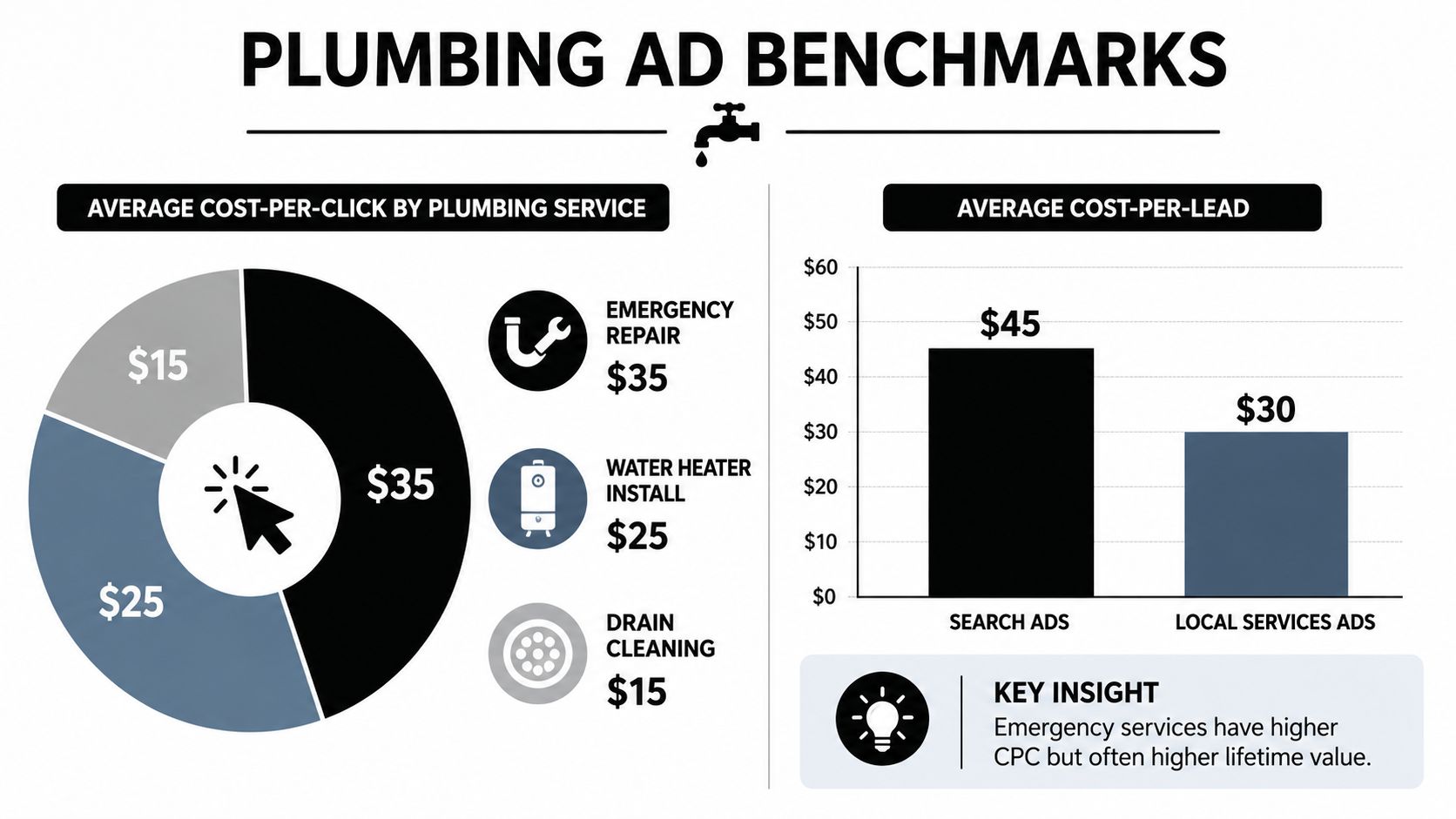
The practical lesson is straightforward. Search campaigns usually pull higher-intent demand, but that intent comes with a premium, and home-services benchmarks show that click prices have moved up across the category (LocaliQ home-services benchmarks). Plumbing sits in that same auction environment, so campaigns get expensive quickly if the account is broad, unfocused, or built to chase every possible inquiry instead of the jobs you want.
A better way to judge spend is by the kind of lead it brings in. If the phone rings with job seekers, DIYers, or price shoppers who are not ready to book, the campaign may look active while producing very little revenue. Emergency calls, leak repair, drain backups, and other high-margin service lines deserve different treatment from general maintenance, because the close rate and job value are usually not the same.
Practical rule: do not ask whether a campaign is “cheap.” Ask whether the booked jobs cover the lead cost and still leave room for labor, dispatch, and profit.
Budgeting should start with your own numbers, not a generic media promise. A practical method used for plumbers is to divide the number of new jobs you want by your expected close rate, then multiply the lead count by a midpoint CPL estimate to set an initial budget (Lead Shutter budget method). If you want a quicker check before launch, calculate your CPL and compare it with what your current mix of emergency work, replacements, and routine service can support.
Return on investment needs the same discipline. If ads are generating leads but the office is not booking enough profitable work, the account can still appear healthy inside Google Ads while losing money after labor, parts, and dispatch are counted. The right measure is whether paid search is feeding revenue that matches the margin profile of the job, because form fills alone do not pay the crew.
For attribution and profitability, use this ROI measurement guide as a working reference. The useful question is not spend divided by leads, it is spend divided by booked jobs and service profit.
Structuring Campaigns for Service and Urgency
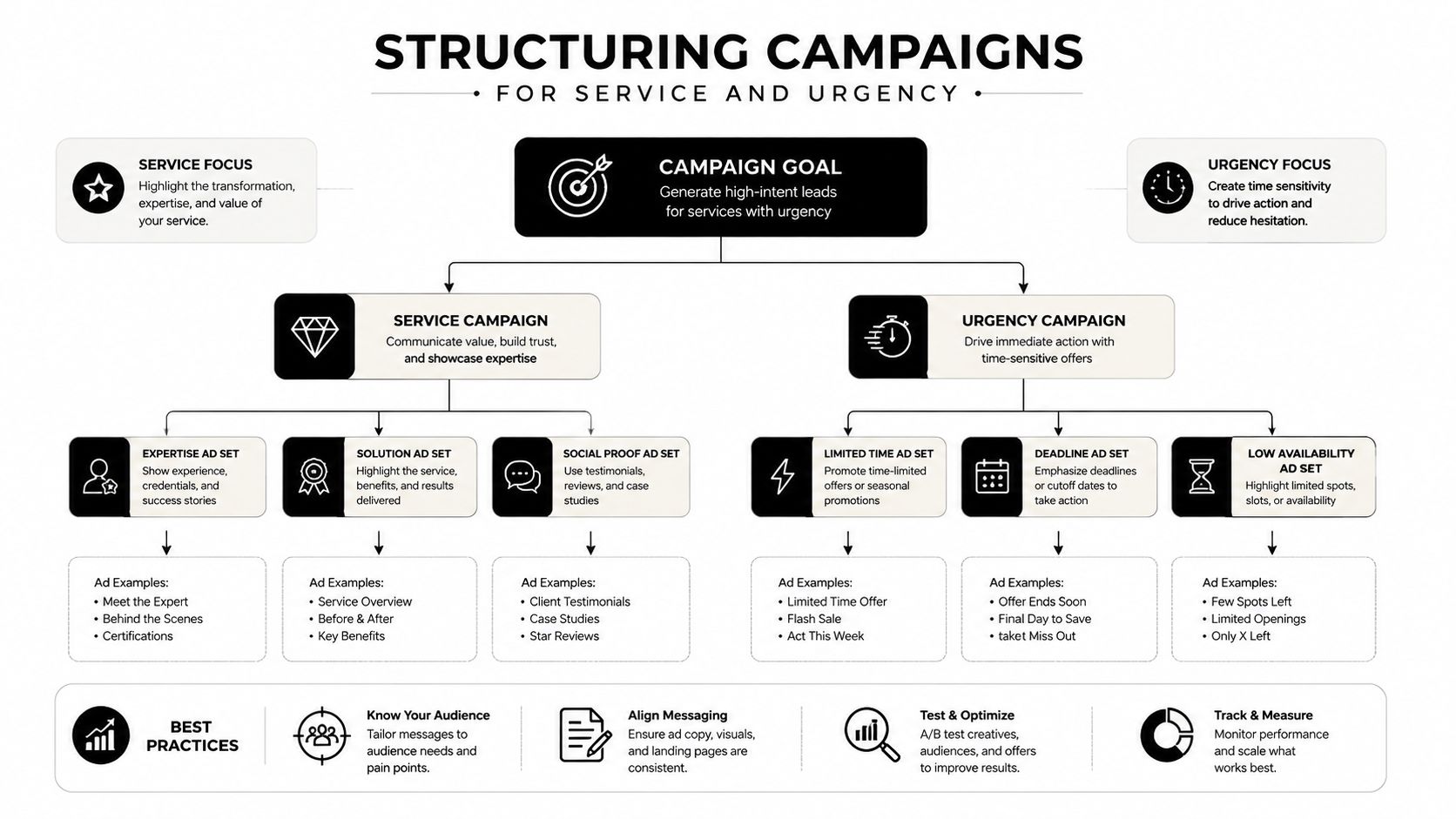
A single catch-all campaign usually creates the same problem every week, wasted budget on mismatched searches. Plumbing is too urgent and too fragmented for one bucket. A homeowner with a burst pipe is not the same buyer as someone who wants routine drain maintenance, and Google Ads should reflect that difference from the first day.
Build around urgency first
The best accounts separate Emergency Plumbing from General Maintenance. One source recommends four to six campaigns around services, while another advises a dedicated Emergency Services campaign with terms such as emergency plumber, burst pipe, water leak, no hot water, backed up drain, and flooded basement (Watson Co. campaign setup). That split matters because emergency work deserves tighter control, more aggressive bids, and its own geographic radius.
Use a 10 to 15 mile radius for emergency campaigns, then widen broader service campaigns to 15 to 25 miles from the shop or service area (Watson Co. campaign setup). That keeps urgent money close to home and prevents the account from paying for distant leads that are hard to dispatch profitably.
Map ad groups to actual problems
Within each campaign, keep ad groups tightly themed. A water heater ad group should not share space with drain cleaning. A sewer issue should not sit next to faucet repair. The point is message match, your ad copy, keyword theme, and landing page should all line up with the exact problem the searcher typed.
A plumbing account gets more efficient when every click has one job, to move a specific problem into a booked appointment.
A useful operating rule is to keep the keyword set small. Plumber-focused guidance commonly recommends either 10 to 15 high-intent terms or 20 to 40 tightly themed keywords to reduce irrelevant traffic and improve lead quality (YouTube plumber campaign guide). That doesn't mean you stay tiny forever. It means you start narrow, prove intent, and then expand only where the booked-job data supports it.
For service-area businesses, budget control follows structure. Emergency campaigns should receive priority because they're built around urgency, while broader maintenance campaigns can absorb less aggressive pacing. If the account owner can't tell at a glance which service line is consuming spend, the structure is too loose.
Mastering Keyword Selection and Negative Lists
The biggest money leak in plumbing search isn't always the click, it's the wrong click. A strong keyword list gets you into the right auctions, but the negative list keeps you out of the wrong ones. In practice, exclusion work often improves the account more than adding new terms.
Start with exact and phrase intent
Plumbing campaigns usually perform best when the highest-intent terms are kept tight and predictable. A high-control setup for plumbers should use Search campaigns with Display Network and Search Partners turned off, then organize keywords into tight service-specific ad groups and convert broad terms to exact match (YouTube plumber campaign guide). That prevents Google from stretching the account into casual or research-heavy queries that don't book jobs.
The search term report is where the work happens. Review it weekly, not occasionally. If you wait a month, you've already paid for a pile of irrelevant clicks that told you nothing useful about the market.
Block the queries that never become jobs
Some negative terms deserve to be standard in nearly every plumbing account. The clearest examples are DIY, salary, jobs, parts, and supply house. Those queries usually signal researchers, job seekers, or supply buyers, not homeowners looking to hire.
A practical negative list often includes these groups:
- DIY intent: block searches like “how to fix,” “DIY plumbing,” and “how to unclog.”
- Employment intent: block “plumbing jobs,” “plumber apprenticeship,” and “hiring plumber.”
- Supply intent: block “plumbing parts,” “plumbing supplies,” and “supply house.”
- Education intent: block “plumbing school,” “license exam,” and “master plumber test.”
That pattern keeps spend focused on customers, not browsers. A small account can't afford to fund curiosity searches when the primary goal is emergency calls and booked appointments.
For deeper keyword planning, a useful companion resource is keyword research for PPC. The best planning process is still simple, though. Group service terms by urgency, add negatives from day one, then use search term reports to prune waste every week.
Practical rule: if a query sounds like someone trying to learn plumbing, enter the exclusion list first and ask questions later.
One more point gets overlooked. Tight keyword control can support stronger relevance and better ad delivery, but only if the ad copy and landing page mirror the same service. That's why the negative list works best when paired with focused ad groups and direct-response pages.
Optimizing Landing Pages and Call Tracking
Sending paid traffic to a homepage is usually a conversion killer. A generic page forces a stressed homeowner to hunt for the right service, figure out whether you handle their issue, and decide whether to trust you. Many potential customers won't bother.
A stronger approach is a dedicated landing page for each core service. For plumbing, that means the page should match the keyword theme, carry a prominent Click-to-Call button, and include a simple form for people who prefer not to talk immediately. The less friction the page creates, the more likely a high-intent visitor is to take the next step.
The most useful companion example set is these high-converting landing page examples. The pattern you want is consistent, clear service messaging, immediate contact options, and trust signals that reduce panic.
Make the phone the primary conversion path
Plumbing leads are often phone-first because the searcher is in a hurry. That means the call experience matters more than a decorative homepage layout. A visible phone number, sticky call button, and obvious service area can do more for performance than another paragraph of brand copy.
Call tracking is also essential. Use unique tracking numbers so you can attribute calls to the right campaign, ad group, and search theme. Without that, you're guessing which keywords lead to booked work, and guessing is the fastest way to overspend in local service ads.
If you can't tell which search term created the call, you can't tell which search term deserves more budget.
Build for mobile and trust
Plumbing searches happen in stressful moments, which makes mobile performance critical. The page should load cleanly, the buttons should be easy to tap, and the trust signals should be visible without digging. Reviews, licensing badges, and service-area clarity do a lot of heavy lifting because they lower the mental cost of making contact.
The right landing page also helps filter lead quality. Someone who's serious about emergency service will usually call or form-fill if the page makes the next step obvious. Someone who is price-shopping for a minor repair is more likely to bounce, which is fine if your funnel is designed around the jobs you want.
Budgeting and Bidding for Profitability
A plumbing account that starts with a random daily budget is usually built backward. Bidding should follow revenue math, not habit. You do not need to spend enough to feel active, you need to spend enough to buy the right volume of leads at a cost that still supports booked jobs.
Reverse-engineer the budget from jobs
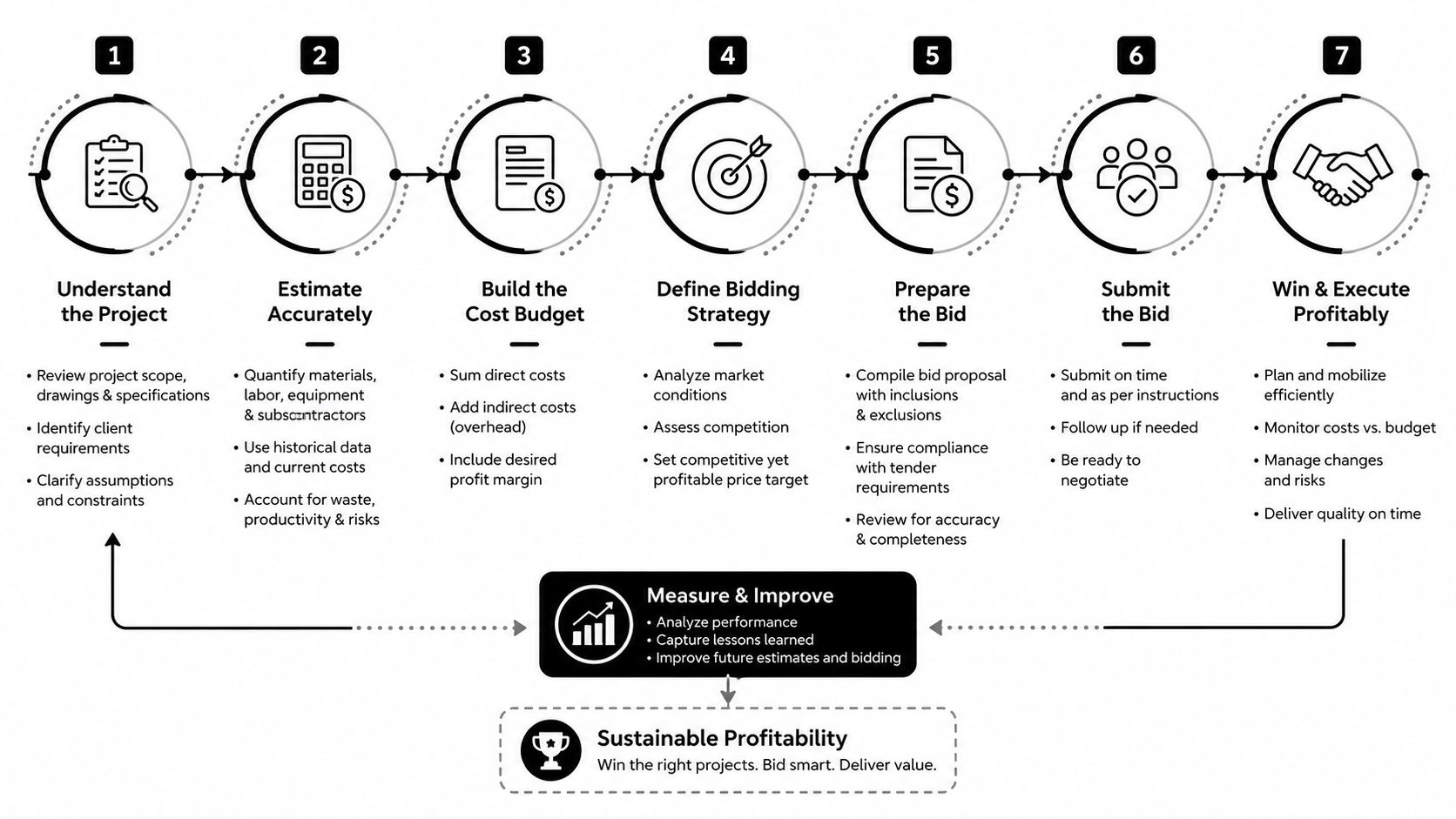
A practical budget-planning rule for plumbers is to start with the number of new jobs you want, estimate how many leads those jobs require based on your close rate, then multiply that lead count by a realistic midpoint CPL of $150. The source notes that a 30% to 40% close rate is typical, and that makes the calculation useful rather than abstract.
That approach matters because lead quality varies. A call from a homeowner with an active leak has a different value than a form from someone comparing prices, and neither is the same as a message from a job seeker or a DIYer looking for free advice. If the business wants 10 new jobs, it first has to estimate how many leads those jobs require, then check whether the resulting spend matches the service line it wants to grow.
Match bid strategy to data maturity
New accounts usually need more manual control early on because there is not enough conversion history for automated bidding to make good assumptions. That keeps the system from optimizing toward the wrong calls, like low-intent research traffic or quote shoppers who never book.
As conversion data builds, automation can help, but only after the account has enough signal to learn from. A conservative daily budget ceiling and geographic presence targeting are part of that same discipline (Insidea Google Ads guide). Presence targeting matters because ads should show to people within the service area, not just those who happen to search from outside it.
Use time and device intentionally
Not every click is equally valuable. Emergency leads often spike when the homeowner needs help immediately, so timing matters. Mobile users also tend to convert more naturally in a service emergency because they can call directly from the search results, which means device-level judgment should be part of the bidding plan.
The mistake is treating automation as a shortcut. Automation works best after the account already knows which keywords, locations, and times of day produce booked work. Before that, discipline beats sophistication.
Local Services Ads vs Search Ads
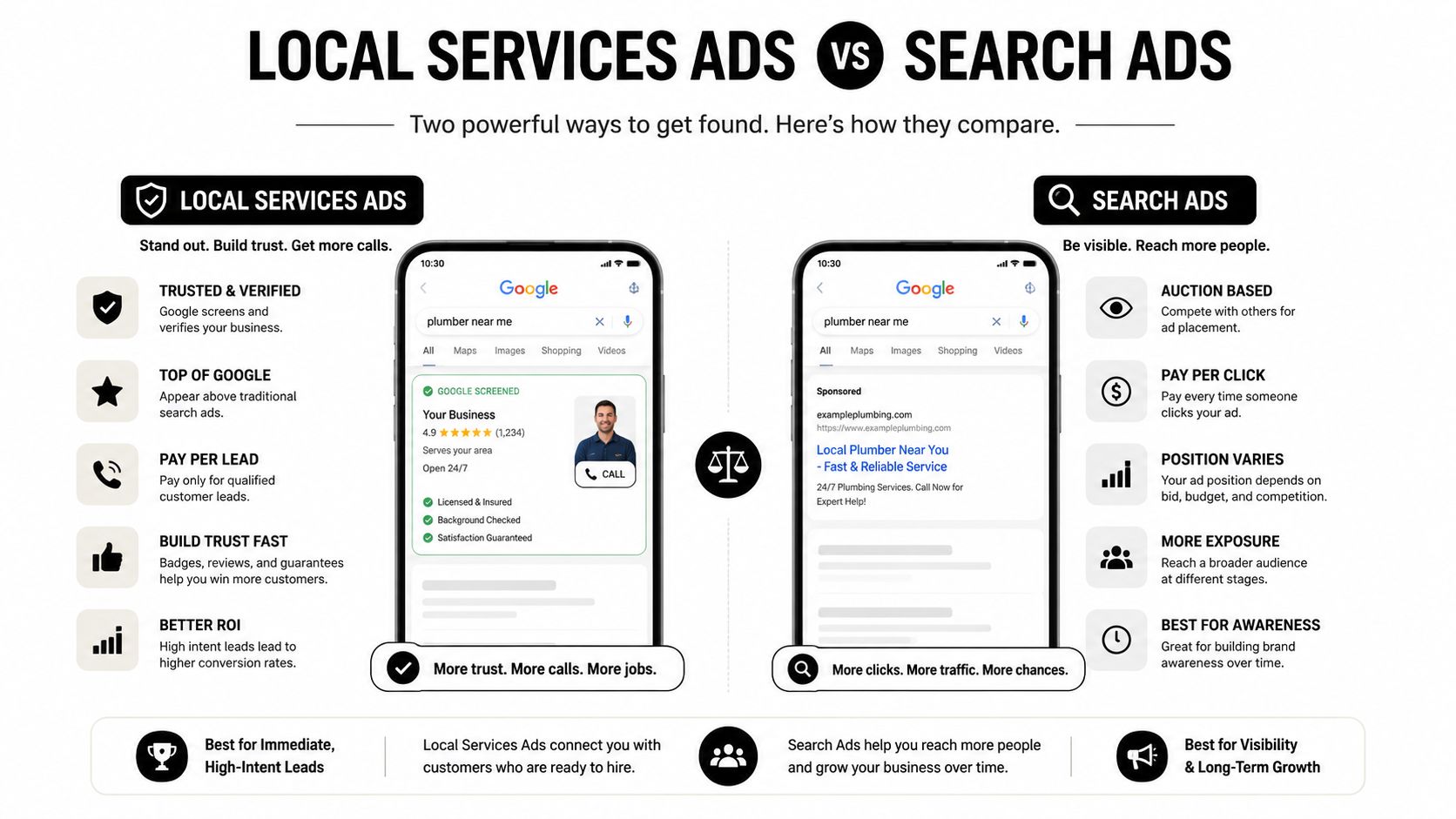
A plumbing owner sitting on too many low-quality leads usually needs a split approach, not a single-channel bet. Local Services Ads are built to surface trust and generate calls fast, while Search Ads give tighter control over keywords, ad copy, and where the click lands. The better setup is usually to assign each channel a specific job and measure it by booked work, not by raw inquiry count.
What LSAs do well
LSAs sit above standard search ads and bill on a pay-per-lead basis, which many contractors prefer because the cost is tied to inquiries rather than clicks. They also carry the Google Guaranteed badge after Google's screening process, including background, license, and insurance checks according to the plumbing trade guidance in the brief.
That badge helps in plumbing because urgency changes how homeowners behave. When a pipe bursts or a drain backs up, many people use the badge as a fast trust signal instead of spending time comparing multiple sites.
What Search Ads do better
Search Ads give the business more control over lead quality. You can shape the keyword mix, write service-specific ad copy, and send traffic to a page that matches the exact search intent. That matters when the goal is to steer spend toward profitable work, such as emergency repairs, and away from inquiries that burn time, like job seekers or DIYers asking for free advice.
The economics also differ in a way plumbers feel quickly. As noted earlier, one benchmark showed non-branded Google Ads and Performance Max producing very different lead costs, which is a reminder that channel choice has to be judged by booked jobs, service type, and how well the system matches the business model. A cheaper lead is not always a better lead if it never turns into revenue.
Use both with clear roles
The most practical setup is a hybrid one. Let LSAs handle broad visibility and trust-heavy lead capture, while Search Ads cover service lines, emergency keywords, and the neighborhoods where tighter control matters. That gives the business more screen presence and reduces the risk of depending on one lead source that may not fit every job type.
The accounts that struggle usually ask one channel to do everything. That creates blind spots and fills the phone with mismatched inquiries. The accounts that perform better give LSAs a trust role and Search Ads a precision role, then compare booked jobs instead of raw lead counts.