
You can be good at what you do in Fort Myers and still feel invisible online.
That’s the frustration a lot of Florida business owners bring to digital marketing. The phone rings from referrals, a few repeat customers keep things moving, and the website exists, but it doesn’t produce steady leads. Meanwhile, a competitor with a cleaner Google profile, stronger reviews, and better follow-up keeps showing up first.
That gap is what fl digital marketing is really about. Not posting more for the sake of posting. Not chasing vanity metrics. It’s about building a system that helps local customers find you, trust you, and contact you when they’re ready to buy.
Thriving in the Crowded Southwest Florida Market
A familiar scenario plays out every week in Southwest Florida. A contractor in North Fort Myers does solid work, has loyal customers, and assumes the website should be enough. Then a homeowner in Cape Coral searches on a phone, compares a few listings, reads reviews, and calls someone else before lunch.
That’s not because the better company won. It’s because the more visible company did.

For Fort Myers-area businesses, the move online isn’t a side issue anymore. 78% of mobile searches result in an in-store or on-site visit within 24 hours, and 93% of customers read online reviews before making a purchase, according to Colorlib’s digital marketing statistics roundup. That means your search presence, reviews, and website experience often shape the sale before you ever answer the phone.
Why a basic website no longer carries the load
A lot of local businesses still treat their website like a digital brochure. It lists services, adds a contact form, and waits.
That approach breaks down in a market like Southwest Florida, where buyers compare options fast and usually on mobile. If your site loads slowly, doesn’t show clear service areas, or lacks proof that you serve places like Estero, Bonita Springs, or Naples, you’ll lose attention quickly.
Three problems usually show up together:
- Weak local relevance because pages say “Florida” or “Southwest Florida” but never speak directly to the town the customer searched
- Thin trust signals because reviews, project photos, certifications, and clear service details are missing
- No follow-up system because leads come in but nobody tracks where they came from or what turned into revenue
Practical rule: In local service businesses, your online presence is your first sales call. If it doesn’t answer “Do you serve my area?” and “Can I trust you?” fast, the lead moves on.
What a proactive strategy looks like
Good fl digital marketing for a Fort Myers SMB starts with local visibility and buyer intent. It means your business appears where people look, your reviews support the click, and your site makes taking the next step easy.
If you want a practical look at how that works for smaller companies, this overview of digital marketing for local businesses is a useful starting point.
In this market, passive marketing loses. Businesses that win usually do the simple things consistently, and they do them where local buyers are already making decisions.
Your Digital Marketing Toolbox Explained
A good business owner doesn’t use one tool for every job. Digital marketing works the same way.
If you run a roofing company, law office, med spa, or cleaning service in Florida, you don’t need every tactic. You need the right mix. The mistake I see most often is businesses buying one isolated service and expecting it to solve a revenue problem on its own.
The core tools and what each one is for
SEO is your long-game tool. It helps your business show up when people search for the services you offer. Done right, it builds durable visibility around your service pages, location pages, Google Business Profile, and supporting content.
PPC is for speed. If you need leads now, paid search can put you in front of high-intent buyers quickly. The trade-off is simple. Traffic stops when spend stops, so PPC works best when the landing pages, call tracking, and intake process are already solid.
Social media helps with familiarity and trust. For most SMBs, it’s not the primary lead engine by itself. It works better as a support channel that reinforces credibility, shows recent work, answers objections, and keeps your brand visible.
Your website is the storefront. Every channel pushes people there, even if the first touch happened on Google Maps, Facebook, or an ad. If the site is confusing, dated, or light on proof, the rest of the campaign has to work twice as hard.
How the tools work together
The highest-ROI setups usually combine channels instead of betting on one.
A practical way to consider this is:
- SEO captures steady demand from people already searching.
- PPC fills the gaps when you need immediate lead flow or want to target specific services.
- Social content builds confidence after someone discovers your brand.
- CRM and automation protect the lead once it comes in.
That last piece matters more than many owners realize. A lot of companies don’t have a traffic problem. They have a follow-up problem. If you’re comparing options for lead tracking, pipeline management, and automation, ReachInbox's GoHighLevel guide gives a practical breakdown of what that kind of platform can handle.
The wrong question is “Which marketing channel is best?” The better question is “Which channel solves the next bottleneck in my sales process?”
Don’t buy tools before you diagnose the gap
If your rankings are weak, start with SEO fundamentals. If rankings are decent but leads are inconsistent, add paid search. If leads come in but don’t close, tighten intake, automation, and follow-up.
That’s also why competitor review matters before spending more. Looking at how similar businesses structure offers, service pages, reviews, and ads can save a lot of wasted trial and error. This guide to best tools for competitor analysis is helpful when you want to see what local competitors are doing without guessing.
Winning Locally with Fort Myers SEO
Generic SEO sounds good in a proposal. It rarely wins in Fort Myers.
Local customers don’t search the way marketers talk. They don’t usually type broad terms and browse for fun. They search with urgency and location in mind. “Emergency plumber Cape Coral.” “Family lawyer Naples.” “AC repair Estero.” If your strategy doesn’t match that behavior, you’re paying for activity, not results.
With over 1,055 digital marketing companies in Florida, the market is crowded, according to DesignRush’s Florida digital marketing agency listings. In that environment, broad, copy-paste SEO falls flat. A business in Southwest Florida needs local specificity to stand out and produce measurable return.
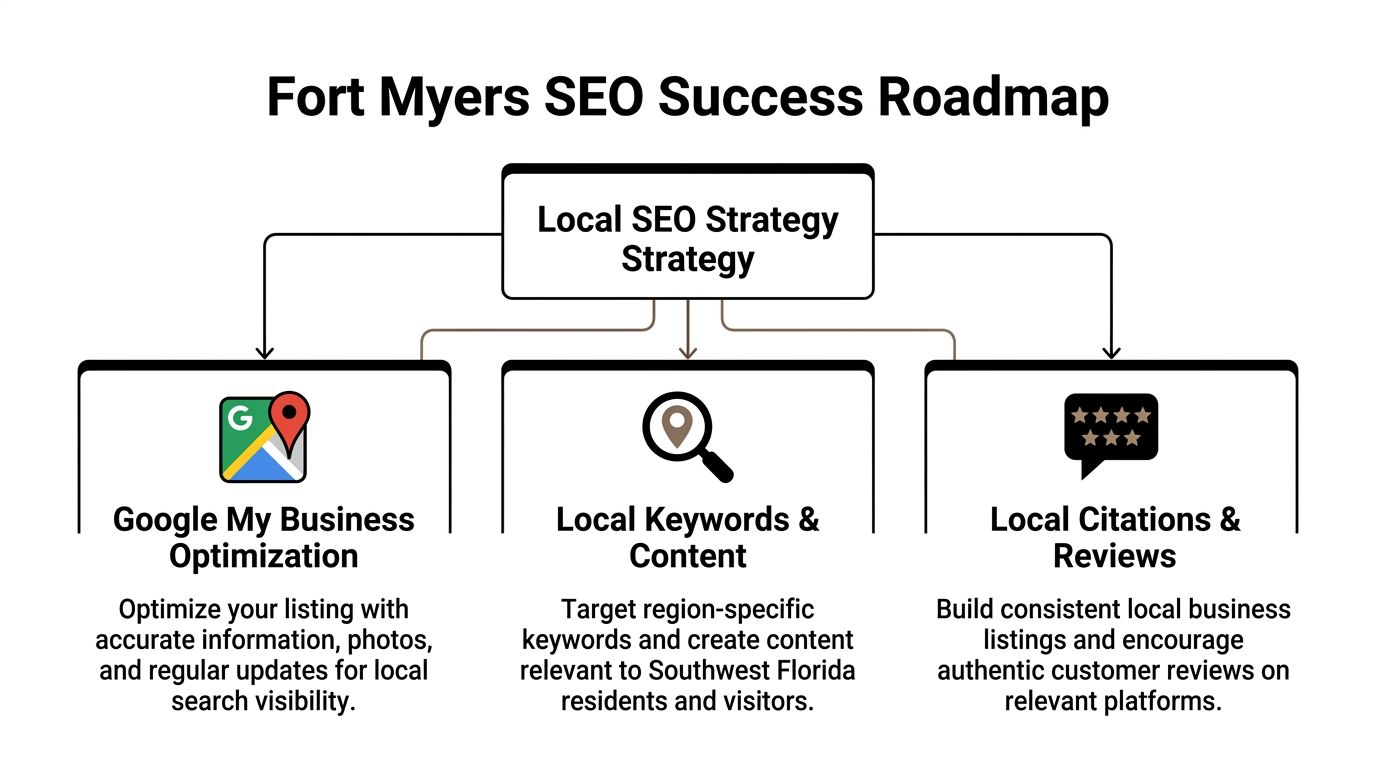
The three local pillars that actually move the needle
A Fort Myers SEO strategy usually works best when it’s built on three pieces.
Google Business Profile discipline
Your Google Business Profile isn’t a set-it-and-forget-it listing. It needs accurate service categories, correct service areas, business hours, recent photos, and a steady flow of authentic reviews. Local search visibility often improves when this profile reflects the business clearly and consistently.
For home service companies, photos matter more than owners think. Jobsite images, trucks, team photos, before-and-after work, and short updates all reinforce trust.
Location-specific service pages
A generic “Services” page won’t compete well against businesses that publish pages tied to real search intent. A roofer should have separate pages for Fort Myers, Cape Coral, Estero, and Naples if those are active service areas. An HVAC company shouldn’t bury ductless mini-split service inside a broad page if buyers are searching for that service directly.
A better structure looks like this:
- Primary service page for the main category, such as roof repair
- City page for each target market, such as roof repair in Bonita Springs
- Support content answering specific local questions, such as storm damage, insurance documentation, or seasonal maintenance
Reviews and citation consistency
Reviews influence clicks, calls, and trust. Citations help validate the business information across the web. If your business name, address, and phone details vary from one listing to another, local search signals get muddy.
A local SEO campaign usually fails for boring reasons. Wrong categories. Inconsistent contact details. Thin pages. No review process.
A practical example for a trade business
Take a plumber serving Fort Myers and Cape Coral. A weak SEO plan targets “plumber Florida” and publishes blog posts nobody nearby is searching for. A stronger plan builds pages for drain cleaning, water heater replacement, and emergency plumbing tied to each priority service area, then connects those pages to a tuned Google Business Profile and a review request process.
If you’re in the trades and want more ideas on what qualified lead generation can look like, this plumbing lead generation guide is worth reviewing, even if your service category is adjacent.
Local SEO wins when it mirrors how local customers shop. That’s the difference between traffic that looks nice in a report and calls that turn into booked jobs.
Tailored Strategies for Your Florida Industry
The right marketing plan for a Naples law firm won’t look like the right plan for a North Fort Myers paver. That’s why industry-specific priorities matter.
Most small businesses don’t need more tactics. They need sharper choices. The best fl digital marketing plans match buyer behavior, sales cycle, and the kind of trust each industry has to earn before someone reaches out.
Top Digital Marketing Priorities by Industry in SWFL
| Industry | Top Priority #1 | Top Priority #2 | Why It's Critical |
|---|---|---|---|
| Home services | Google Business Profile optimization with current photos, service areas, and review requests | Location-based service pages tied to towns and specific jobs | Buyers often need help fast and compare a few nearby options. Visibility and trust need to be immediate. |
| Healthcare | Clear, professional website pages for core treatments or specialties | Educational content answering common patient questions in plain language | Patients want reassurance before they contact a provider. Clarity, professionalism, and trust matter early. |
| Legal | Practice-area pages built around specific case types and local intent | Reputation management through reviews, testimonials where appropriate, and authority-focused content | Legal clients are cautious. They want to know the firm handles their issue and appears credible before they call. |
What works for home services
For contractors, urgency shapes the whole funnel. Someone with a broken AC unit or a roof leak isn’t browsing for entertainment. They’re checking who serves the area, who looks legitimate, and who can respond quickly.
That’s why these tend to matter most:
- Strong service-area clarity so a customer in Estero or Bonita Springs knows immediately that you work there
- Recent proof of work through project photos and job-specific content
- Fast contact paths with click-to-call buttons, short forms, and clear next steps
What works for healthcare and legal
Healthcare buyers want confidence and clarity. They often need answers before they need an appointment. A clean website, clearly written treatment pages, and educational content help lower hesitation.
Legal buyers are usually under pressure and don’t want vague language. They respond better to focused practice pages, clear intake steps, and trust signals that show professionalism without fluff.
Field note: If your business depends on trust, generic copy is expensive. It makes you sound interchangeable right when the prospect is deciding who feels credible.
A practical rule across all three industries is this. Lead with the problem you solve, make the local area obvious, and remove friction from the first contact. Fancy campaigns don’t fix unclear positioning.
Future-Proofing Your Business with Modern Tech
Search has changed. Ranking in the traditional results still matters, but it’s no longer the whole game.
More business owners are noticing that Google now answers more questions directly on the page. That means your goal isn’t only to rank. Your goal is to make your business information clear enough for modern search systems to understand, trust, and surface.

According to SMA Marketing’s overview of Florida digital marketing services, businesses implementing proper structured data, or Schema Markup, are seeing their content cited in Google’s AI Overviews 3-4x more frequently than competitors, and the article frames this shift as part of the move into Generative Engine Optimization, or GEO.
What GEO means for a Florida SMB
GEO is the practical next step after traditional SEO. Instead of only optimizing for blue links, you structure your content so AI-driven search features can interpret it accurately.
For a local business, that usually means making sure search engines can clearly understand:
- Who you are
- What services you offer
- Where you operate
- How customers can contact you
- What others say about your business
Schema markup helps package that information in a machine-readable way. A human visitor may never see it directly, but search systems do.
Where to apply schema first
Most SMBs don’t need to overcomplicate this. Start with the pages that drive buying decisions.
The first places to review are usually:
- Homepage with business identity and location details
- Service pages that explain exactly what you offer
- Location pages tied to real cities you serve
- Review-related elements where appropriate and accurate
- Google Business Profile alignment so details match across the web
A short walkthrough helps if this feels abstract:
Future-proofing is really about clarity
This isn’t about chasing every new trend. It’s about making your digital assets easier to interpret as search evolves.
A company with a messy site structure, vague service pages, and inconsistent business details will struggle no matter what acronym gets added to the marketing conversation. A company with clean content architecture, strong local relevance, and proper structured data is in a better position for what comes next.
That’s why modern fl digital marketing isn’t only creative. It’s technical in the right places.
Measuring Real ROI from Your Marketing Spend
Most owners don’t care about impressions unless impressions turn into calls, appointments, booked jobs, or retained clients.
That’s the right instinct. Marketing gets expensive when reporting focuses on activity instead of outcomes. The businesses that improve fastest usually know which channels produce qualified leads, what those leads cost, and which ones become revenue.
According to CyberTek Marketing’s piece on data analytics for South Florida companies, companies that track KPIs closely and shift budget toward their strongest channels see ROI increases between 40-100%. That result comes from measurement and reallocation, not from doing more of everything.
Metrics that matter more than vanity stats
A practical reporting setup for an SMB should answer a short list of business questions.
Focus on metrics like:
- Cost per lead so you know what it takes to generate an inquiry
- Lead quality by source so you can separate junk form fills from real opportunities
- Conversion rate from visitor to lead, and lead to sale
- Return on ad spend for paid channels
- Call and form attribution so you know which campaign produced the contact
Likes, reach, and traffic can still be useful context. They just shouldn’t drive budget decisions by themselves.
A simple budget decision framework
Here’s the logic that works in practice.
If Google Ads sends leads but they’re weak, fix targeting or landing pages before increasing spend. If SEO pages bring the right traffic but the form conversion rate is poor, improve the page offer, trust elements, and call-to-action. If social content gets engagement but no pipeline movement, use it to support credibility rather than treating it like your core lead channel.
Bottom line: Measurement isn’t reporting for reporting’s sake. It tells you where to cut, where to double down, and what to stop tolerating.
For owners who want a broader framework specifically on social channels, this guide on how to measure social media ROI effectively is a solid companion to channel-level reporting.
What good reporting should feel like
A good report should make decisions easier. It shouldn’t bury you in charts that look impressive but don’t lead anywhere.
That’s also why many SMBs benefit from a central dashboard and regular review cadence. If you want a more grounded explanation of what to track and how to connect it to business outcomes, this resource on how to measure marketing ROI lays out the basics clearly.
In practical terms, ROI improves when someone reviews the numbers, finds waste, and makes a change. Data only matters when it changes what you do next month.
Your First Steps to Growing Online
A Fort Myers owner often starts in the same spot. The phone rings inconsistently, referrals still matter, and online marketing feels like six disconnected projects competing for the same budget. The fastest fix is usually simpler than people expect. Get the basics working before adding more channels.
I learned that lesson building a local Florida service business. Growth did not come from doing everything. It came from finding the one point in the buying process that was leaking revenue, fixing it, and only then adding the next layer.
Step 1
Audit the first impression your market gets online. Search for your core services the way a customer in Fort Myers would. Review your Google Business Profile, recent reviews, service pages, contact forms, page speed, and mobile usability. Pay attention to friction. If a buyer has to guess what you do, where you serve, or how to contact you, that problem costs money.
Step 2
Choose the bottleneck closest to revenue. For some Florida businesses, that is weak local search visibility. For others, it is a website that gets visits but fails to turn them into calls. In plenty of service companies, the issue is follow-up. Leads come in, then sit too long without a response. Fixing one high-impact constraint usually produces a better return than splitting budget across several smaller improvements.
Step 3
Build a simple plan around lead quality and return. Use only the channels that support that goal. That might mean SEO to capture local demand, paid search for immediate lead flow, website updates to improve conversion, CRM automation to speed up follow-up, or review generation to strengthen trust.
For many owners, this is the point where outside help makes sense. The right agency should be able to bundle the work into a strategy that fits your margins, sales cycle, and staffing reality, not hand you a generic monthly package.
That matters in Fort Myers because buyers compare options quickly and make trust decisions before they ever call. In a crowded Southwest Florida market, a clean online presence and a clear follow-up process usually outperform flashy campaigns with weak execution.
Start with the leak that hurts revenue most. Measure what happens. Then make the next move.