
You're trying to decide whether to hire a Fort Myers agency, keep marketing in-house, or fire the vendor who keeps sending pretty reports that don't match your phone. That's a real business problem, not a branding exercise. If your goal is more calls, more form fills, and fewer wasted invoices, you need to judge Fort Myers advertising agencies the same way you'd judge any contractor, by capacity, accountability, and whether they can move leads.
The local market isn't a toy market either. Nationally, the U.S. advertising agencies industry is projected to reach $88.7 billion in 2026, with about 114,000 businesses and a 6.7% CAGR from 2021 to 2026, according to IBISWorld. That national scale matters in Fort Myers because small local agencies are competing inside a bigger, faster, more data-driven industry, where clients expect stronger analytics, cleaner attribution, and clearer ROI.
What Fort Myers Advertising Agencies Actually Do for Small Businesses
A lot of business owners think an agency just “runs ads.” That's too narrow. In Fort Myers, a serious agency usually handles the mix of work that keeps a local business visible, credible, and easy to contact, including website support, search visibility, paid traffic, creative, and reporting.
Take the usual Southwest Florida owner I meet. A contractor in Cape Coral wants more calls during busy season. A dental practice in Estero wants more new patient inquiries without flooding the front desk. A law firm in Fort Myers wants the phone to ring from people who need the service, not from bargain shoppers or junk leads. Those are different businesses, but the agency job is similar, build demand, capture it, and prove what happened.
What a digital marketing agency does in practice is usually more useful than the label “full service.” The work should connect visibility to action. If the agency can't explain how a click turns into a call, or how a review request helps a map ranking, it's probably selling activity, not results.
The local reality in Southwest Florida
Fort Myers isn't flooded with giant holding-company shops. The local pool is smaller, and directory listings show that clearly. The Better Business Bureau's Fort Myers advertising category includes several local firms, and the city's agency ecosystem is mostly small-to-mid-sized rather than enterprise-scale. TechBehemoths' Fort Myers directory reported 3 companies providing advertising services in the city in its 2025 ranking, and Clutch's July 2026 Fort Myers rankings show agencies with staff sizes ranging from 2–5 to 10–15 employees, which is a practical signal of how these shops are built to work.
Practical rule: If you're a small business, don't chase the fanciest pitch. Chase the agency that has enough people to keep your account moving when one strategist is out sick or buried in another client's launch.
That smaller scale can be an advantage. You're more likely to get direct senior involvement, faster feedback, and campaigns that don't get lost in layers of bureaucracy. But it also means you need to check whether the agency has enough bench depth to handle your scope.
The Core Services You Should Expect from a Fort Myers Agency
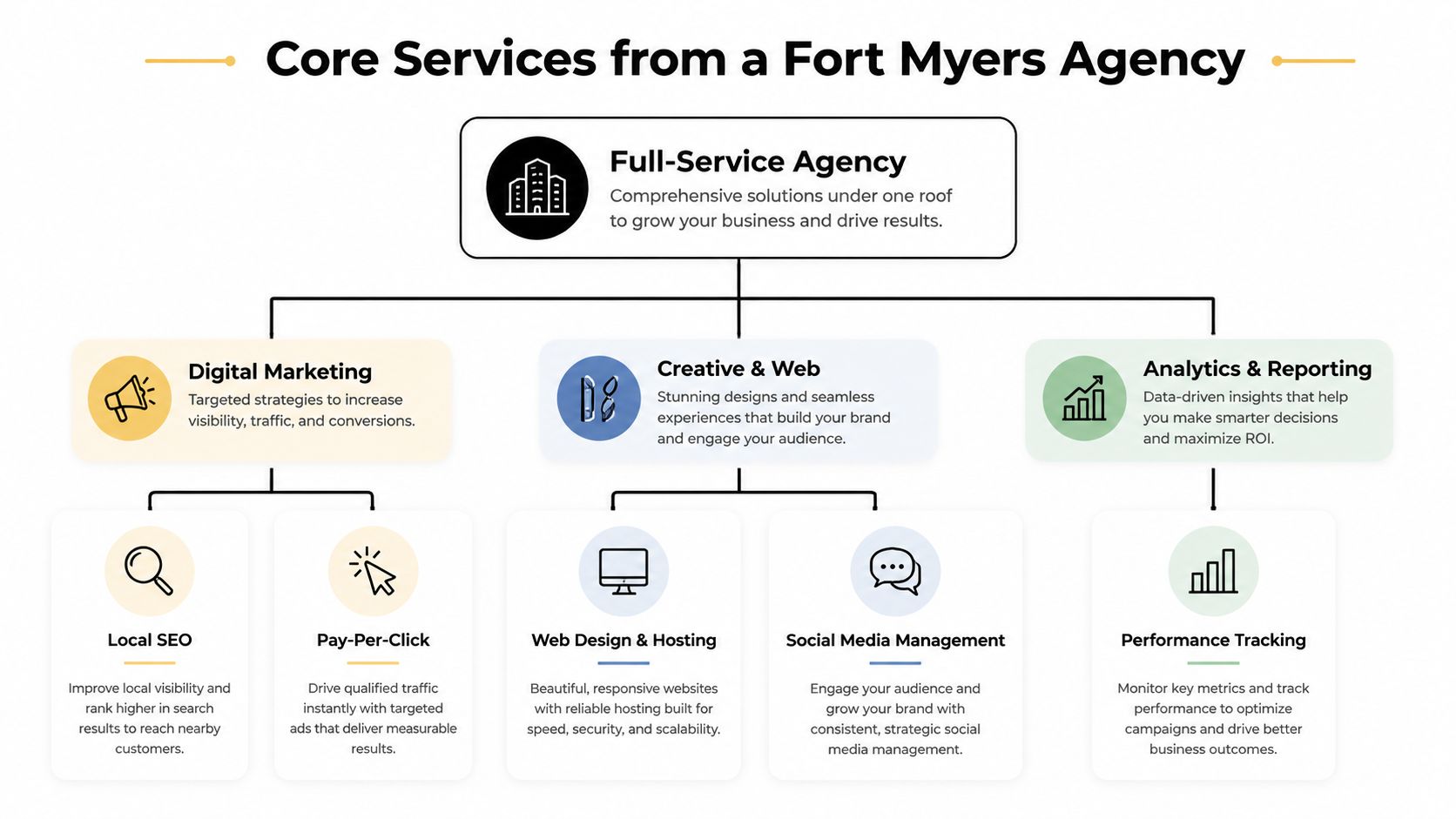
A serious agency should not force you to buy random tactics in isolation. The better move is a connected stack, because the website, search visibility, ads, reviews, and reporting all feed each other. That's the difference between a nice-looking vendor roster and an actual lead-generation system.
Start with local SEO and Google Business Profile work
If you're a local business, local SEO is the first thing I'd check. It's what helps you show up in map results, branded searches, and location-driven queries. In the post-2024 search environment, that matters more because AI Overviews and conversational search have made local entity signals, reviews, and structured business information more important than ever.
That means the agency should be comfortable with Google Business Profile optimization, review management, citation cleanup, and location pages. If they're not talking about those things, they're behind.
Add PPC when you need immediate lead flow
Pay-per-click advertising is the fast lever. It's useful when you need to get in front of people who are already looking for your service, especially if organic visibility is still building. A good Fort Myers agency should know how to write ads, pick keywords, and filter out junk searches so your budget doesn't disappear into curiosity clicks.
Web design, hosting, and conversion support matter too
A lot of campaigns fail because the site can't close the deal. Web design and hosting should make the site fast, credible, and easy to contact on a phone. If the agency also handles landing pages, form optimization, and call tracking, that's a real advantage.
Social, reputation, and reporting are not side dishes
Social media management matters when your audience needs reminders, proof, and local familiarity. Review and reputation management matter because people read reviews before they call. Performance tracking matters because you should be able to see which channel drove the call, the form fill, or the booked job.
A connected platform approach can also reduce attribution gaps. Hibu describes this kind of integrated stack for Fort Myers businesses, with website design, SEO, online advertising, listings management, review management, and marketing automation in one environment. That model is worth considering if you want fewer moving parts and cleaner reporting.
SEO services in Fort Myers should never be sold as isolated blog writing. If the agency can't tie SEO to calls, forms, and map visibility, it's not doing the job.
Realistic Pricing and Engagement Models in Fort Myers
Most agency websites dodge pricing because pricing forces accountability. I don't. If a Fort Myers agency won't discuss what's included, what's extra, and what the work is supposed to produce, walk away.
Fort Myers tends to be a small-to-mid-sized agency market, so pricing is usually less inflated than in major metros, but you can still get overcharged fast if the proposal is padded with fluff. Project work, like a new website or a Google Business Profile overhaul, should be priced differently from ongoing retainers for SEO, PPC, or social management.
Typical Fort Myers Agency Pricing by Service Tier
| Service | Starter Range | Growth Range | What You Get |
|---|---|---|---|
| SEO | Basic optimization and foundational pages | Ongoing local SEO, content, and GBP support | Clearer map visibility, better local search presence, and better lead quality |
| PPC | Small campaign setup and management | Multi-campaign management with tighter tracking | Qualified clicks, call tracking, landing page testing, and budget control |
| Web design | Simple brochure site or refresh | Custom site with conversion focus | Better mobile experience, stronger trust signals, and better form performance |
| Social media | Basic posting support | Ongoing content and community management | Brand visibility, local familiarity, and retargeting support |
That table is the frame, not a quote sheet. The key question is what the proposal includes. If “SEO” only means one blog and a few meta tags, that's thin. If “PPC management” doesn't include search term cleanup, negative keywords, or conversion tracking, the campaign will leak money.
Direct advice: Buy the outcome, not the deliverable list. A long list of tasks doesn't matter if the phone still stays quiet.
For smaller budgets, I'd prioritize in this order, website conversion fixes, local SEO, and PPC. Social can help, but if the site is weak and the local listing is messy, social just drives people to a leaky bucket. If the agency can explain how it balances these channels, that's a sign you're talking to a strategist, not a sales rep.
Affordable marketing for small businesses should mean disciplined scope, not bargain-bin execution. One practical option in the local market is Polaris Marketing Solutions, which offers website design, hosting, local SEO, pay-per-click, and social media management, but any agency you consider should be judged on the same standards, not the brand name.
The Vetting Checklist That Separates Real Agencies from Sales Teams
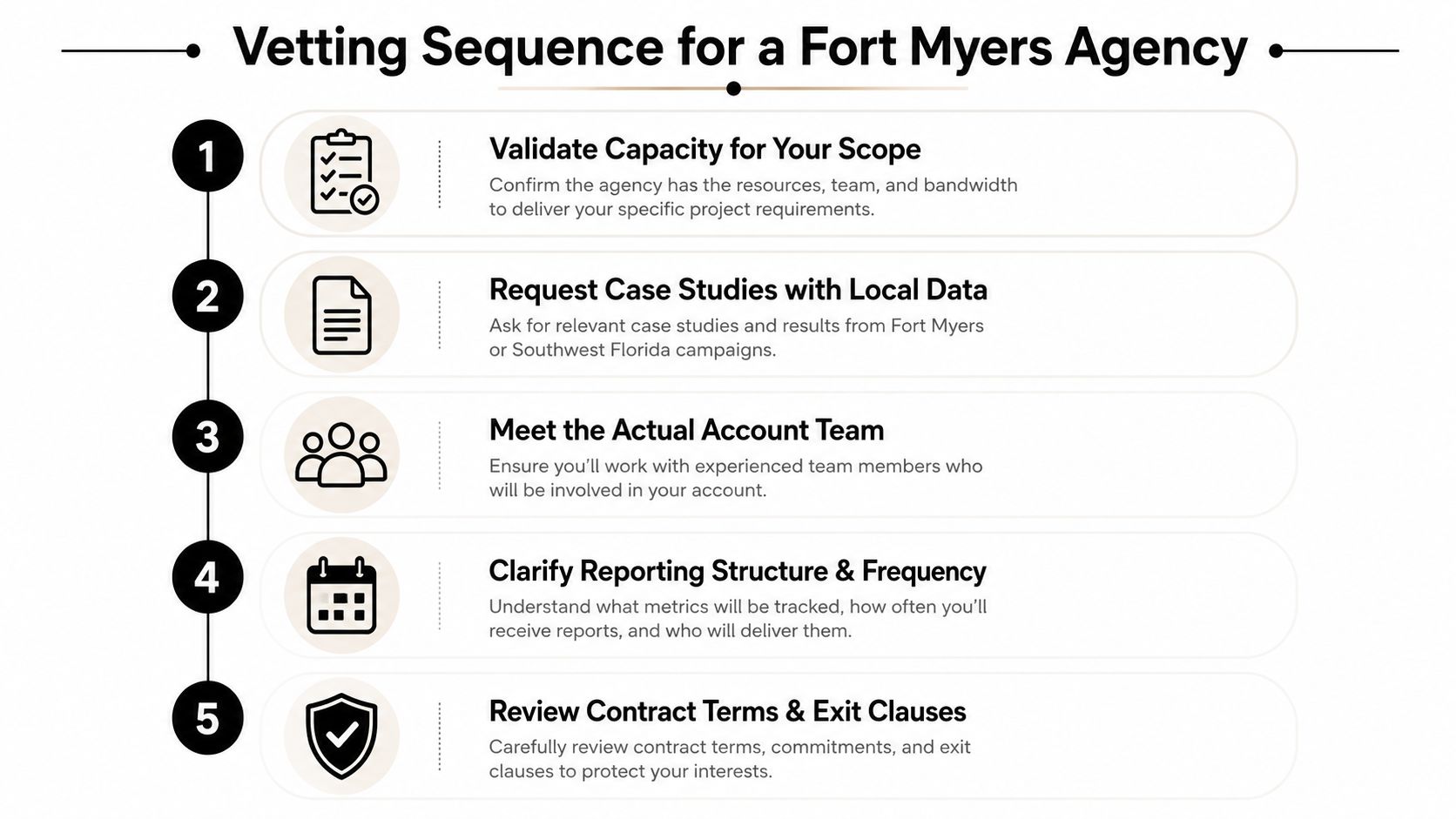
A real vetting process starts before anyone sends a proposal. Sit down and make the agency show you how they work, how much capacity they have, and how they measure lead quality. If they can't answer those questions cleanly, you're not talking to a serious operator.
Ask who will actually do the work
You need names, not a vague “team” answer. Ask who handles strategy, who runs ads, who writes content, and who owns reporting. If one person is expected to carry every channel, that can work for a tiny account, but it usually breaks down once the scope gets real.
Staffing gives you a useful clue about delivery capacity. Agencies with only a few people can handle a tight local account, while firms with a larger staff are better positioned to cover SEO, PPC, and creative work without stretching one strategist thin.
Request sample reports and ask what drives them
A serious agency should show you a report before you sign anything. Look for calls, form fills, source tracking, Google Business Profile actions, and channel-level performance. If the report focuses only on impressions and clicks and skips lead quality, the agency is grading itself on activity, not results.
Ask what the numbers mean in plain English. A shop that can explain which campaigns create calls, which pages convert, and which sources waste money is doing real management, not just sending exports from a dashboard.
Cross-check directories, but don't worship them
The BBB Fort Myers category can confirm that a firm is active locally. Clutch and TechBehemoths can help you compare presence and staffing. Directory visibility still tells you almost nothing about whether the agency can handle your account well. Ask what it has done for clients like you, and press on the details that matter in a local lead business.
Use these discovery-call questions
- Who owns my account day to day? You need a named contact.
- How do you measure calls and form fills? If they only talk about clicks, that is weak.
- What's included in the monthly fee? Hidden work creates conflict later.
- How do you handle Google Business Profile, reviews, and citations together? That stack matters for local search.
- What happens if the campaign needs to change fast? That tells you how responsive they really are.
A good agency does not get defensive when you ask for proof. It gets specific.
Red Flags That Should End the Conversation
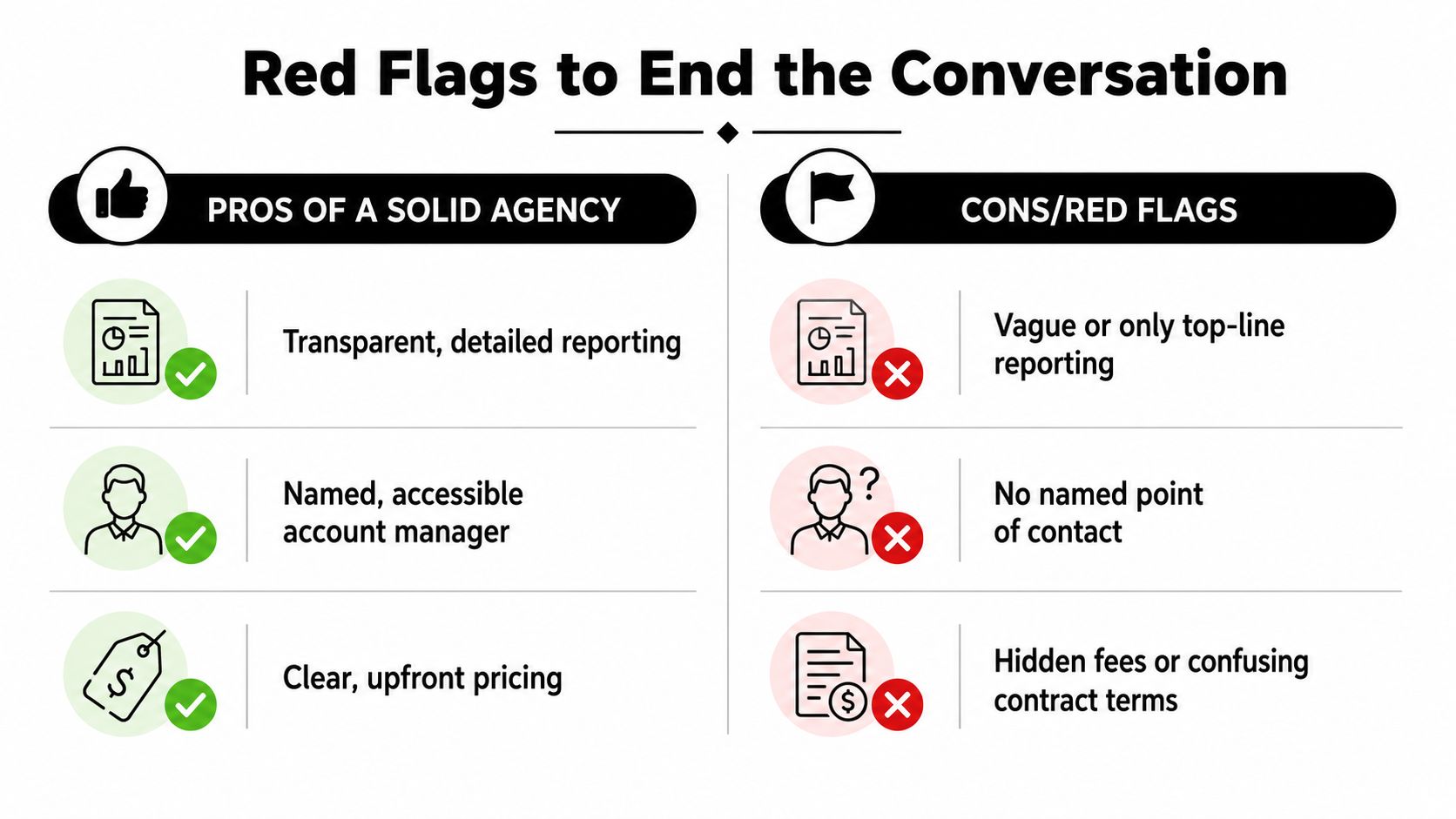
Some red flags are obvious. Others hide behind polished pitch decks. If you see any of these, stop the process and move on.
What a solid agency looks like
A solid shop is transparent, specific, and accountable. It names the account owner, shows the reporting cadence, and explains pricing in plain English. It can also tell you how it handles Google Business Profile work, reviews, and location pages together, because that's where local search lives now.
What should make you walk away
- Vague reporting. If the agency only wants to discuss impressions and clicks, it's hiding the part that matters, lead quality.
- No named contact. If you can't get a direct point of accountability, you'll spend your time chasing answers.
- Hidden fees or confusing contract terms. If the proposal is hard to read, the working relationship will be harder.
- Guaranteed rankings or guaranteed lead counts. That's a sales pitch, not a credible promise.
- No clear view of AI-driven search behavior. If they ignore AI Overviews, conversational search, and local entity signals, they're not current.
The newest red flag is simple. If the agency treats the post-2024 search environment like it's still 2022, it's already behind. That means weak attention to Google Business Profile dependence, no discussion of reviews and citations, and no real plan for location pages or branded search visibility.
A lot of owners get trapped because the pitch sounds confident. Confidence is cheap. Specificity is what you pay for.
Onboarding Done Right and What the First 90 Days Should Look Like
The first 90 days tell you whether the agency is organized or just optimistic. Good onboarding is not paperwork. It's the setup that decides whether the next six months produce useful data or a mess of disconnected numbers.
Days 1 to 30 should be about access and baseline
In the first month, the agency should ask for access to Analytics, Search Console, Google Business Profile, and ad accounts. It should also collect brand assets, logins, service-area details, and any existing creative that still works. By the end of this stage, you should know what the baseline is, where leads are coming from, and what the initial KPIs are.
Days 31 to 60 should focus on launch and reporting cadence
This is when campaigns should go live or move into active optimization. The agency should set a reporting rhythm, usually monthly, and tell you what it's watching by channel. If it's handling ads and SEO together, it should also be watching calls, form fills, GBP actions, citation consistency, and cost per lead by channel.
Days 61 to 90 should reveal whether the plan is working
By this point, the agency should have enough data to make real adjustments. That could mean shifting spend, rewriting ad copy, changing landing pages, tightening location targeting, or improving review requests. If nobody can explain what changed and why, the account is drifting.
A simple way to keep the relationship healthy is to ask for these checkpoints:
- Week 1: All access granted, goals confirmed, and tracking verified.
- Month 1: Baseline report delivered, with lead sources and initial gaps.
- Month 2: Campaign changes made based on early data, not assumptions.
- Month 3: Formal review of what produced calls and what wasted spend.
That cadence keeps you out of the weeds without giving the agency a free pass. It also tells you very fast whether the team can think like operators instead of artists.
Your Next Step and How to Get a Free Starting Audit
If you're comparing Fort Myers advertising agencies this week, use a simple filter. Can the agency explain its service mix clearly? Can it show real reporting? Can it name the actual people on your account? Can it handle local search, paid media, and reputation work together without hand-waving? If the answer is no to any of those, keep looking.
The fastest way to test a vendor without signing a contract is to ask for a starting audit. A proper audit should show current rankings, Google Business Profile health, citation gaps, and where competitors are winning. That gives you a clean benchmark before any retainers or ad spend start.
You don't need a sales call to get smarter. Ask for the audit, compare the findings, and use the same scorecard across every agency you talk to. The one that explains the gaps plainly and shows how it'll fix them is usually the one worth keeping in the conversation.
A CTA for Polaris Marketing Solutions.