
A roofer in Cape Coral discovers that Google shows the right phone number, Yelp shows an old one, and a chamber profile still lists an address from before the business moved. A homeowner searching from Fort Myers doesn't know which listing is correct. Most won't investigate. They'll call a competitor whose information looks more trustworthy.
That situation is common across Southwest Florida. Local business directory submission still has a place in a modern marketing program, but the work has changed. The goal isn't to publish a business everywhere. It's to create a reliable, complete presence on the platforms customers, search engines, maps, and AI systems use to identify local providers.
Why Directory Submissions Still Matter in 2026
The business owner with conflicting listings usually thinks the problem is SEO. In practice, it's often a trust problem first. A prospective customer comparing cleaning companies in North Fort Myers, or searching for a personal injury attorney in Naples, may check a directory before visiting a company's website. If the phone number fails, the address looks unfamiliar, or the hours conflict, the customer has a reason to keep searching.
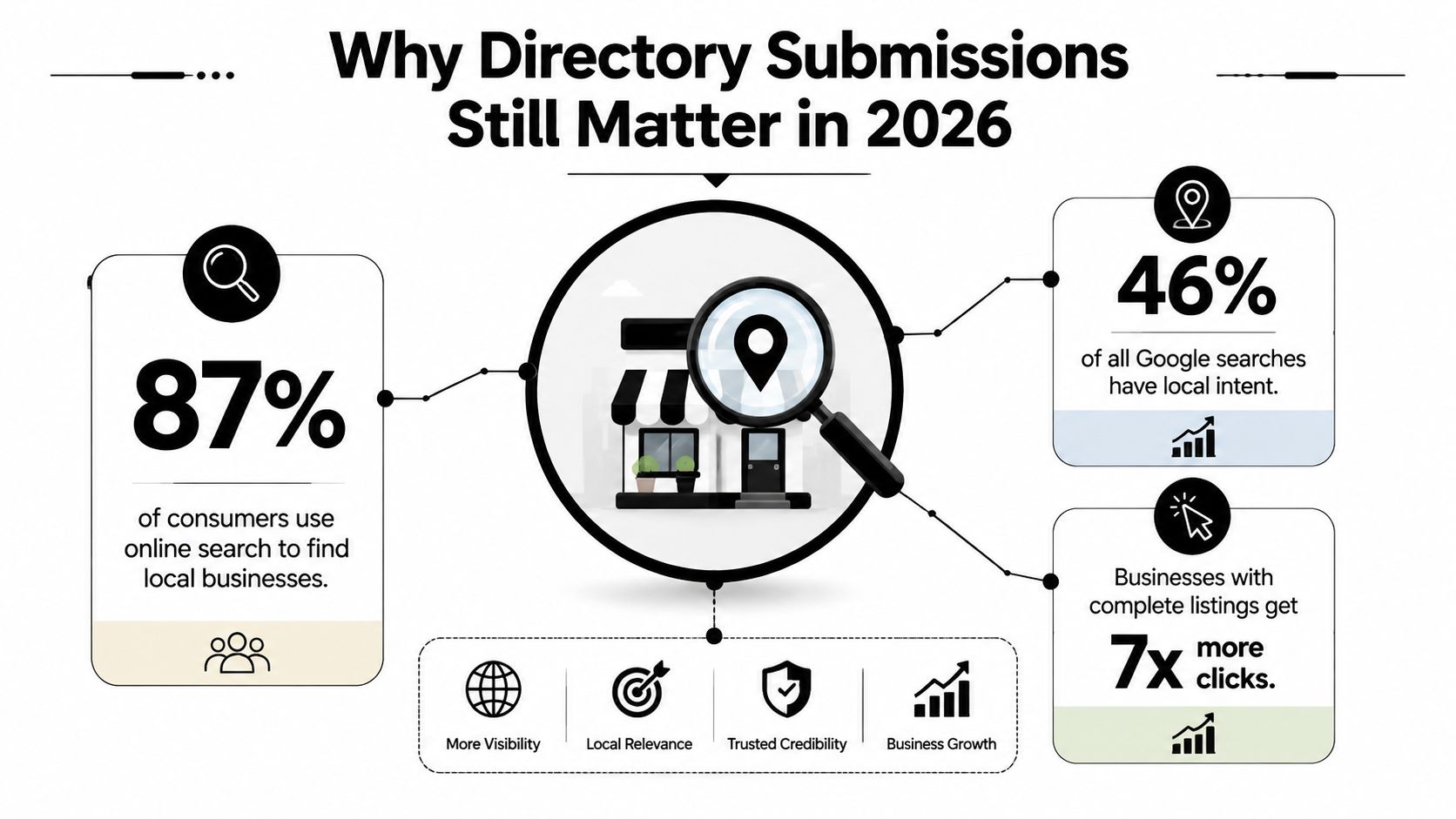
A major 2024 BrightLocal visibility study found that business directories appeared in 31% of the top ten organic search results overall for local-intent queries and 37% of informational local-intent searches. Yelp represented 28% of all directory results, while Tripadvisor represented 10% and Expertise represented 8%. The same study found directories in 72% of fast food restaurant searches, the highest share among the industries tested. These findings show why directories remain part of the searchable local ecosystem, particularly when people compare providers before making contact. (BrightLocal visibility study summary)
Directories serve two audiences
Consumers use listings to confirm basic facts. Search systems use the same information to connect a named business with a location, category, phone number, website, and services. That second function matters as search expands beyond traditional blue links and map results. A consistent listing can act as an entity-confirmation layer, not merely a place to acquire a backlink.
The consumer-trust evidence is direct. A BrightLocal trust report found that 94% of consumers used a business information site or directory to find a local business in the previous 12 months, while 85% encountered incorrect or incomplete listing information. 63% said they would stop using a business after finding incorrect information on a listing. (BrightLocal trust report summary)
A plumbing company serving customers across North Fort Myers may not need a public storefront address, but it still needs accurate service areas, hours, phone details, and categories. A dental office in Fort Myers needs its physical location, suite information, appointment details, and holiday hours to match everywhere. The listing format differs, but the standard is the same: customers should encounter one dependable version of the business.
Practical rule: Treat every important listing as customer-facing infrastructure. Submission starts the job. Maintenance keeps it useful.
For a deeper look at how search experiences are moving toward direct answers, review this guide to answer engine optimization. Businesses that want a disciplined approach can also use these local SEO citation tips to support a broader listing process.
Preparing Your Master Business Record Before Submitting
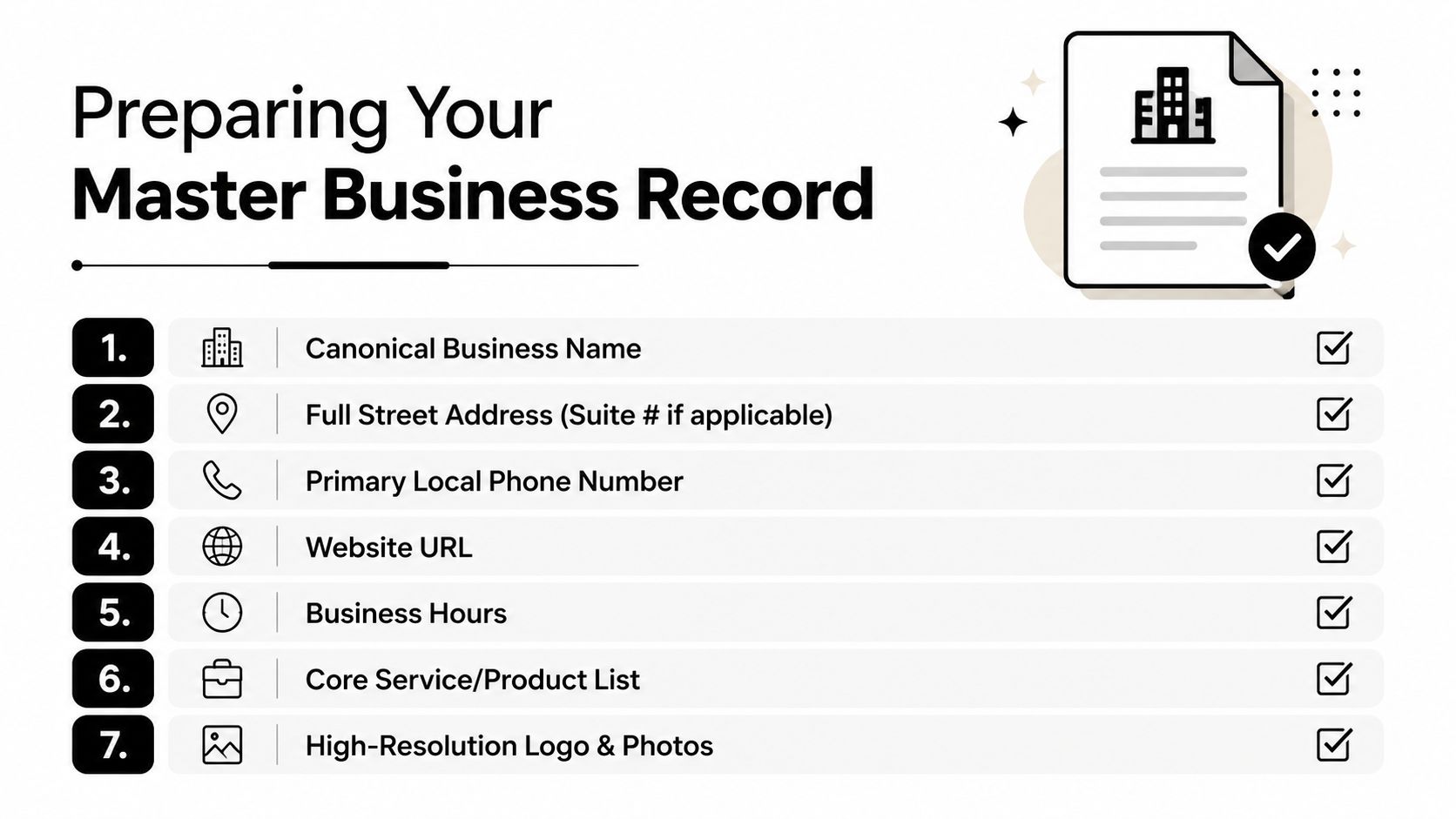
Don't open directory accounts until the business has one approved source of truth. I use a master business record because small variations introduced during manual submission create problems that are tedious to find later. The record should be stored somewhere the owner and marketing team can access, with a clear date showing when the information was last reviewed.
Start with the canonical business name. Use the legal name or established DBA that customers recognize, not a string of location or service keywords. A roofing contractor might be listed as “Gulf Coast Roofing LLC” rather than “Cape Coral Roof Repair and Replacement,” unless the latter is the actual public business name.
Record the complete address exactly as it should appear, including suite or unit information. Decide whether the street line uses a consistent abbreviation, then use that format everywhere. Add the primary local phone number, any approved secondary number, and the preferred website URL. Don't alternate between different URL versions without a reason, and don't send every directory to a different landing page unless each destination has a clear purpose.
Build the record around real customer decisions
Hours need more than a weekday schedule. Include appointment requirements, emergency availability, seasonal changes, and holiday closures where the platform supports them. A service business should distinguish between office hours and customer-service availability. A dental practice should show whether new patients can book online, while a roofer should explain whether emergency calls receive after-hours responses.
Create a service and product list using the language customers use. Then research category options inside Google Business Profile, Yelp, Apple Business Connect, and other priority platforms. Choose the most accurate primary category first, followed by relevant secondary categories. Don't select a category because it has a larger apparent audience. A Cape Coral roofing contractor and a Fort Myers dental practice need different category structures because search systems interpret their services differently.
A practical record might include:
- Business identity: Gulf Coast Roofing LLC, public-facing DBA, owner-approved description.
- Location data: exact street format, suite details if applicable, service areas, and directions.
- Contact data: primary local phone, approved tracking policy, email, and website.
- Operating data: normal hours, appointment rules, emergency response details, and holiday schedule.
- Classification: primary category, secondary categories, core services, and specialties.
- Brand assets: logo, storefront or team photographs, project images, and profile descriptions.
A physical retail location should publish its customer-facing address when eligible. A plumbing company that visits customers but doesn't receive walk-in traffic should configure itself as a service-area business rather than inventing a public office address. Google Business Profile's location rules make this distinction important for address display and customer visits. (Local citation building guidance)
Before publishing, compare the record with the website footer, contact page, social profiles, invoices, and existing profiles. Once the source document is clean, use this Google Business Profile setup guide to handle the primary profile with the same data.
Prioritizing Which Directories to Submit To First
The right sequence prevents a common waste pattern: a business spends hours submitting to obscure directories while its Google profile is unclaimed, its Yelp page is incomplete, and its Apple listing has an outdated phone number. Directory quality is more important than directory count.
Start with the platforms that customers and search systems commonly use to verify a local business. A practical first group includes Google Business Profile, Apple Business Connect, Bing Places, Facebook, Yelp, Yellow Pages, and BBB. Claim each profile, complete its structured fields, add suitable photos, select accurate categories, and document the verification status.
Next, distribute the approved master record through Data Axle, Localeze, and Foursquare. These sources can feed information to other platforms, so accuracy at this stage reduces downstream corrections. This workflow is more efficient than entering slightly different data into every directory by hand. (Local citation workflow guidance)
A practical order for Southwest Florida businesses
After core platforms and aggregators, look for sources with genuine local or industry relevance. A Fort Myers law firm may prioritize a professional association and local chamber profile. A Bonita Springs HVAC company may benefit from a trade directory, a chamber listing, and a regional service platform. A doula serving Naples and Estero should evaluate specialist resources, including these curated doula list websites, because audience relevance can matter more than a generic directory's broad reach.
For businesses around Cape Coral, Fort Myers, Estero, Bonita Springs, and Naples, assess chambers of commerce, neighborhood organizations, tourism resources where appropriate, and legitimate industry associations. A listing deserves attention when people can find it, understand it, and act on it. Check whether the page has recent activity, clear editorial standards, useful categories, and a real audience for the business.
| Platform | Priority Level | Verification Method | Typical Approval Time |
|---|---|---|---|
| Google Business Profile | Essential | Platform verification, such as phone or postcard when offered | Varies by profile and method |
| Apple Business Connect | Essential | Account and business verification | Varies |
| Bing Places | High | Account and business verification | Varies |
| High | Page and business information confirmation | Varies | |
| Yelp | High | Email, phone, or platform review | Varies |
| Yellow Pages | Supporting | Account and listing confirmation | Varies |
| BBB | Industry and trust relevance | Business review and verification process | Varies |
The local listing sites guide can help organize the core, aggregator, local, and niche layers without turning submission into an uncontrolled spreadsheet project. Stop when a new directory fails the relevance, accuracy, or user-value test.
Verifying and Auditing Your Directory Listings
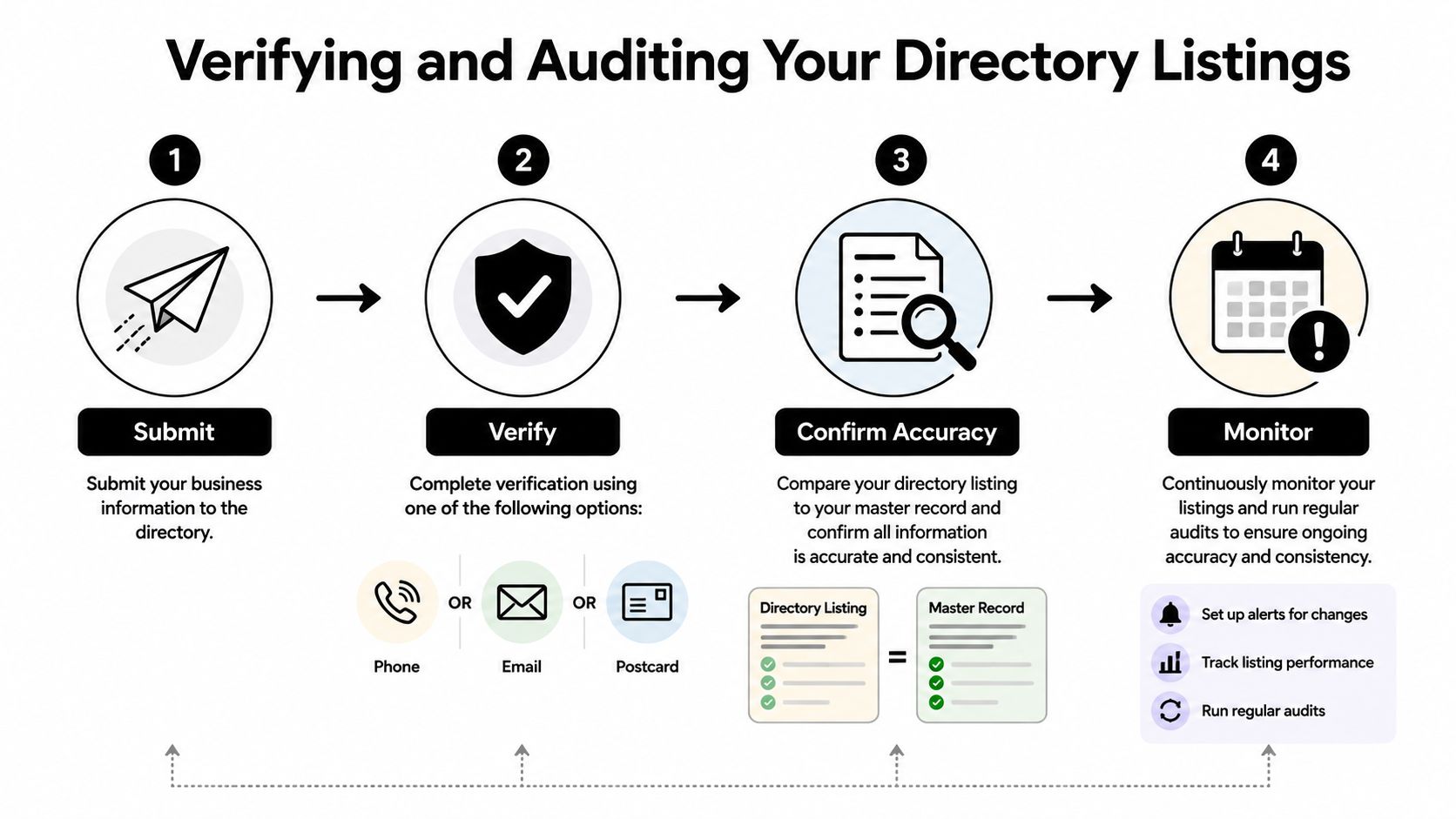
A listing isn't finished when the form says “submitted.” It needs to be live, claimed, accurate, and complete. Verification may involve a phone call, email, postcard, business document, or platform review. Save confirmation emails, verification dates, login ownership, and the profile URL in the master record so a future employee doesn't have to reconstruct the account history.
Google Business Profile may use postcard or phone verification depending on the business and available methods. Other platforms may request an email confirmation or documentation. Complete the required step promptly, then open the public listing from a logged-out browser and compare it against the master record.
Audit for contradictions and duplicates
Search the business name in quotation marks, then search combinations of the business name, phone number, street address, and city. Check Google, Bing, Apple Maps, Yelp, Facebook, Yellow Pages, BBB, chamber websites, industry platforms, and any directory that ranks for the business name. Look for duplicate profiles, unclaimed pages, old addresses, wrong categories, incomplete hours, and descriptions that imply services the business doesn't provide.
The 2021 BrightLocal consumer study found 85% of consumers encountered incorrect or incomplete listing information, and 77% saw conflicting information across online directories. Wrong phone numbers affected trust for 66% of consumers in the study, while wrong addresses affected 60%. (BrightLocal local citations trust report)
Use a simple audit checklist:
- Identity: Compare the business name character by character.
- Location: Confirm the address, suite, map pin, and service-area settings.
- Contact: Test the phone number and check whether it reaches the right team.
- Hours: Review normal, holiday, and appointment-based availability.
- Classification: Confirm the primary category and service descriptions.
- Ownership: Check that the correct business account controls the listing.
- Public view: Inspect the live page on desktop and mobile.
A North Fort Myers plumber should hide a residential address if the business doesn't receive customers there and use service-area settings correctly. A retail flooring showroom should publish its customer-facing location, parking guidance, and opening hours. When an aggregator has supplied an incorrect detail, correct the upstream record and submit a direct correction to the affected directory. Fixing only one copy often leaves the error active elsewhere.
Use the following video as a visual walkthrough of the verification and monitoring mindset.
Common Directory Submission Mistakes to Avoid
The old “submit everywhere” approach creates more maintenance than value. One recent dataset found that only 61% of live directories had ever published a listing, suggesting that many platforms are inactive, thin, or unevenly maintained. The same research notes that citations contribute only a limited share of local ranking signals, around 6% of local pack signals and 7% of local organic signals, so businesses should emphasize quality and consistency rather than volume. (Directory ecosystem analysis)
Errors that create avoidable risk
Changing the business name across platforms makes the entity harder to reconcile. Don't add “best,” “near me,” a city name, or a service keyword unless that wording is part of the public name. A company known as “Suncoast Paving” should not become “Best Cape Coral Driveway Paving Suncoast Paving” on a directory.
Submitting to inactive directories consumes time and can place the brand beside stale or low-quality information. Before creating a profile, check whether the directory has maintained categories, current businesses, useful pages, and a clear correction process. If it offers no customer value and appears abandoned, skip it.
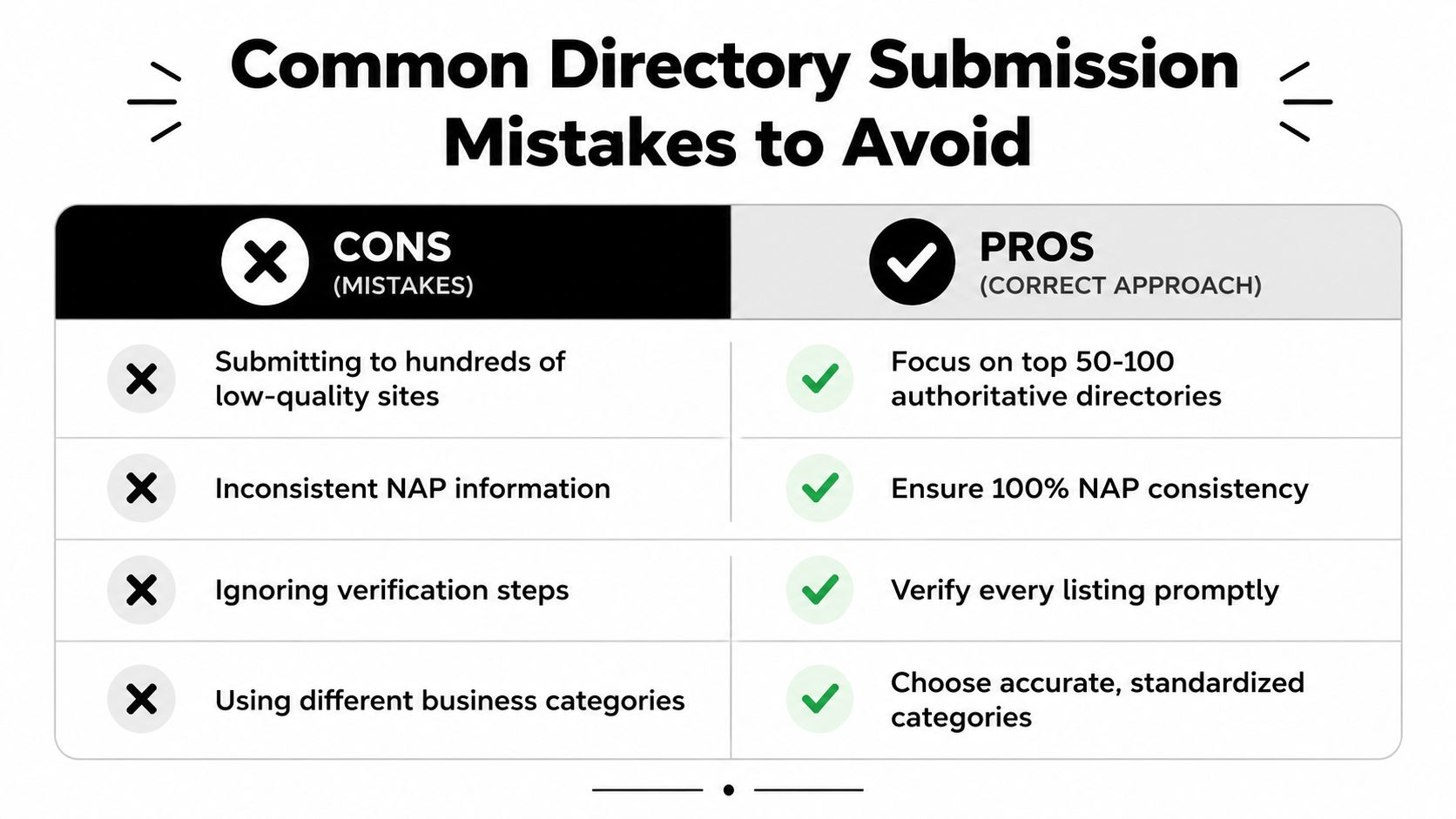
Ignoring verification leaves profiles vulnerable to edits, duplicates, and incomplete public information. Claim the listing, finish the confirmation process, and keep the account credentials under business control.
Using different categories can send mixed signals about the business. A roofing contractor shouldn't alternate between roofer, general contractor, construction company, and home improvement store without a clear service rationale.
A smaller portfolio of accurate profiles is easier to monitor and more credible than a large collection of neglected listings.
Review core profiles after any move, phone change, rebrand, ownership change, or major hours update. For ordinary maintenance, include directory checks in a recurring marketing calendar. The exact schedule depends on the business's rate of change, but no listing program should be considered permanent after its initial submission.
Connecting Directory Management to Broader Local SEO Success
Directory management works best as part of a connected local search system. The listing supplies consistent identity data. Google Business Profile supports map discovery. Reviews provide customer feedback. Location-specific pages explain where the business works and what it offers. Together, these assets help people and search systems understand whether a provider fits a particular need in Fort Myers, Cape Coral, Estero, Bonita Springs, Naples, or a nearby service area.
The relationship with AI search makes accuracy more important, not less. A 2026 SOCi benchmark reported average Google Business Profile claim coverage of 97.9%, average profile completeness of 86.6%, and a 35.9% average Google 3-Pack appearance rate in traditional local search. The same benchmark found inaccurate business data in AI local recommendations about one-third of the time, with business profile information only 68.3% accurate in ChatGPT and 68.0% in Perplexity. (SOCi local visibility benchmark)
A workable 90-day operating plan
During the first phase, create the master record, claim priority profiles, resolve ownership issues, and correct the website's contact information. During the next phase, complete core platforms and aggregators, then add relevant chamber, regional, and industry listings. In the final phase, inspect live pages, remove duplicates, correct inherited errors, and record baseline visibility and engagement observations.
Track practical signals rather than vanity totals:
- Local pack presence: Watch whether the business appears for important service-and-location searches.
- Organic visibility: Monitor location-based queries and whether directory pages appear before the business website.
- Profile actions: Review calls, direction requests, website visits, messages, and appointment activity where platforms provide those measures.
- Data accuracy: Recheck phone, address, hours, categories, and service areas after business changes.
- AI discovery: Test representative customer questions in relevant AI tools and verify whether the business information is correct.
A tool such as MapLeads for local SEO can support local prospecting and location-focused workflows, while a hands-on team can manage the listing, content, review, and reporting pieces together. Polaris Marketing Solutions offers local directory listings and citation management alongside Google Business Profile optimization, local SEO, website work, review management, and location-specific content for Southwest Florida businesses.
Polaris Marketing Solutions can audit your existing listings, build a controlled master record, and manage accurate directory submissions across Fort Myers and surrounding markets. Visit Polaris Marketing Solutions to request a complimentary online analysis and competitor report, then use the findings to prioritize the listings that deserve attention first.