
95% of travelers read reviews before booking, and a 1-star rating increase can raise revenue by more than 5%. That's why online reputation management for hotels isn't a soft branding task, it's a direct commercial lever that shapes demand, pricing, and conversion before a guest ever calls the front desk. In practice, the properties that treat reviews as revenue data move faster, price with more confidence, and lose fewer lookers to the competitor next door.
Most hotels still manage reputation like a cleanup job. A bad review appears, someone apologizes, and the issue gets filed under marketing instead of operations. That approach misses the point, because guests aren't reading one comment in isolation, they're scanning patterns, comparing ratings, and deciding whether your hotel belongs in the shortlist at all.
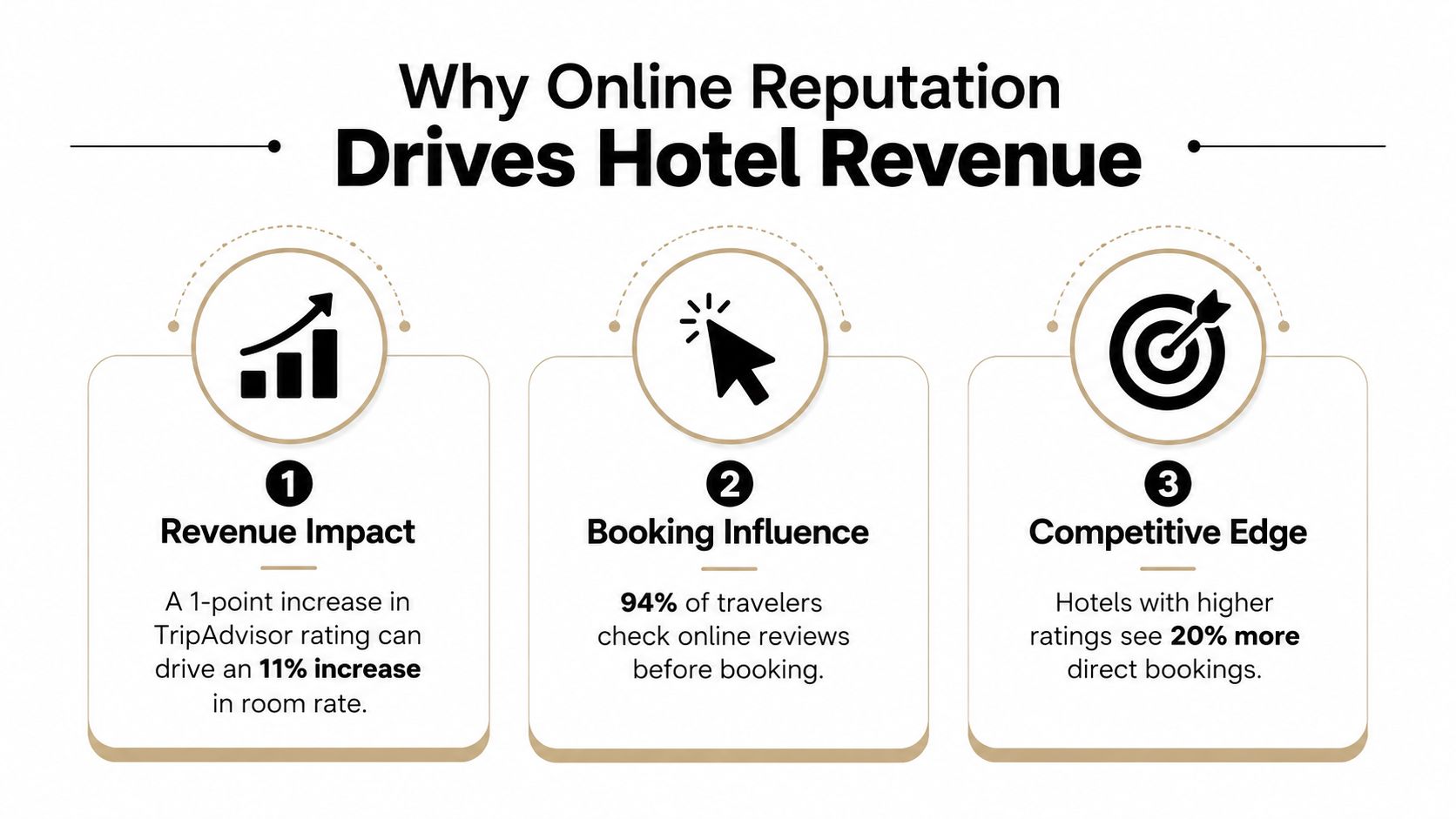
Why Online Reputation Drives Hotel Revenue
If two hotels look similar online, the one with the stronger reputation usually wins the first click and often the booking too. 79% of travelers are more likely to book the higher-rated of two otherwise identical hotels, and travelers read an average of nine reviews before booking, which means they are looking for consistency, not a single perfect comment. The booking decision starts long before rate comparison, and review quality often determines whether your property makes it into the consideration set in the first place. Revinate's hotel online reputation management research makes that point unmistakable.
Reputation is a demand lever, not a vanity metric
A rating move has revenue consequences because guests use reviews as a proxy for risk. Cornell Hospitality Research analyzed more than 9,500 hotels worldwide, over 3 million reviews, and 9.5 million mentions, and found that a 1-point increase in a hotel's 100-point Global Review Index led to a 0.89% increase in ADR, a 0.54% increase in occupancy, and a 1.42% increase in RevPAR. The same research found that a 1-point increase on a 5-point user-rating scale made potential customers 13.5% more likely to book. Cornell Hospitality Research's reputation study summary shows that reputation is tied to price power and room demand.
Practical rule: if your reviews improve, do not only celebrate the rating. Watch whether your ADR, occupancy, and direct inquiries improve with it.
That is the operational lens hotels need. Reputation affects how confidently revenue teams hold rate, how often sales teams win group business, and how much pressure the front desk feels to discount late in the cycle. It also changes the way a guest perceives a property before arrival, which is why a stronger reputation can support direct bookings and reduce the need to compete purely on price.
For travelers heading into a specific destination, reputation can even shape the ancillary choices around the stay. A useful local example is the kind of planning guests do around transfers for Algarve hotel guests, where the hotel experience and the surrounding logistics are part of the same purchase decision.
A reputation program also needs a clear setup before it can protect revenue. The Google side starts with the right profile structure, and a practical reference point is Google Business Profile setup for getting the basics in place before reviews begin to stack up.
Setting Up Your Hotel Reputation Monitoring System
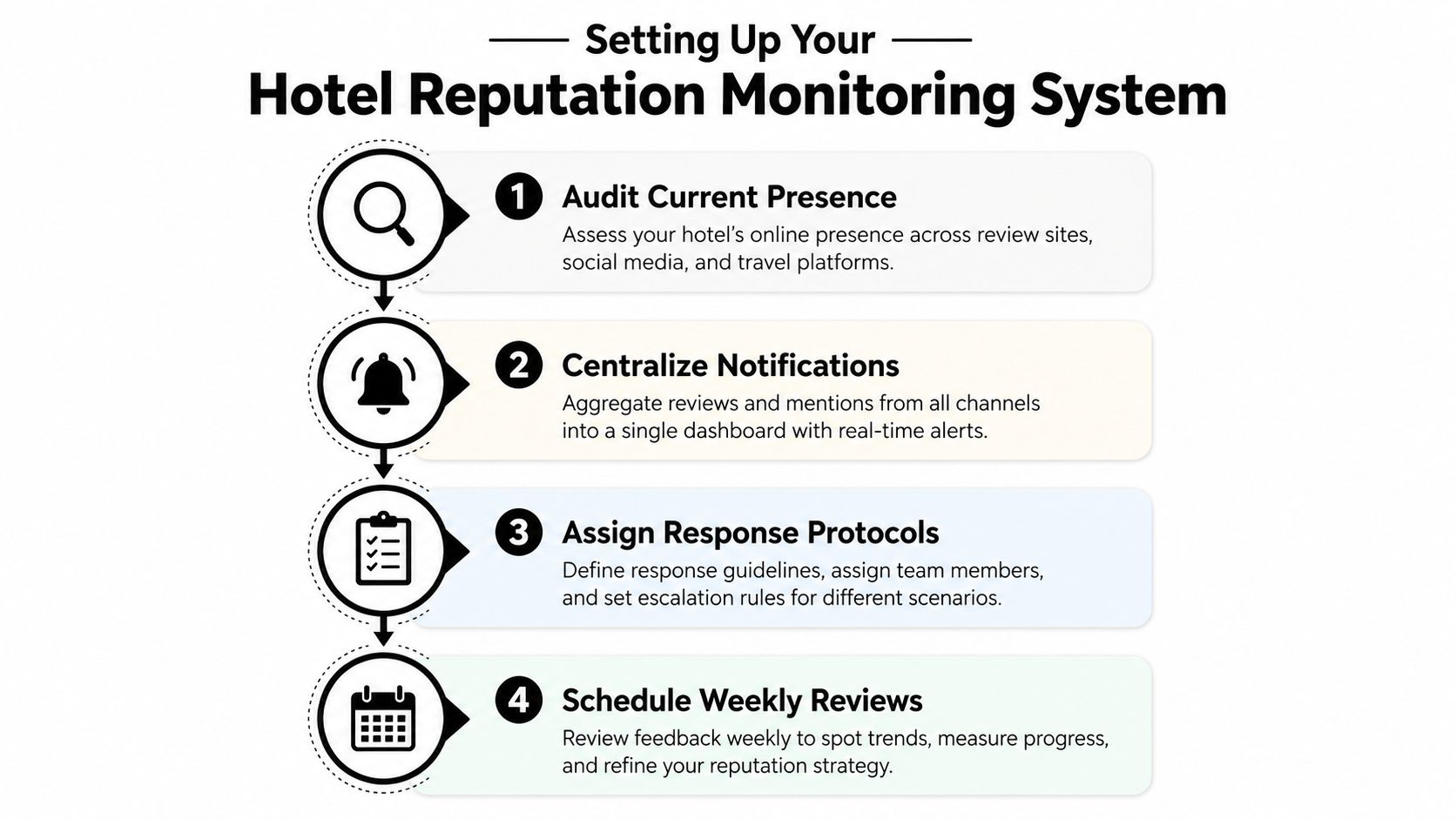
A hotel can't manage what it doesn't see. Guest sentiment now shows up across Google Reviews, TripAdvisor, OTAs, social media, in-stay messaging, and survey channels, so a single-platform approach leaves blind spots everywhere else. The cleanest structure is a three-part system, multichannel feedback collection, centralized analytics, and prioritized responses within fixed time windows, because that's what turns scattered comments into something operations can act on.
Build the workflow around channels, not reactions
Start with a weekly audit of every place guests can leave meaningful feedback. That means Google Business Profile, TripAdvisor, OTA review sections, social mentions, and direct guest messages, with one person responsible for making sure nothing gets stranded in an inbox. If you need a practical starting point for the Google side, the setup guidance at Google Business Profile setup is a useful reference for establishing the foundation before reviews start piling up.
Then centralize the incoming signals. A spreadsheet works for a small property, but the primary objective is to see recurring themes, assign ownership, and stop the same complaint from bouncing between departments. A complaint about noise should not sit in the same queue as a maintenance issue, and a service failure that affects check-in should reach the manager on duty before the next shift.
Don't ignore pre-review feedback
The strongest reputation systems don't wait for the public review to learn there's a problem. Guest messages, in-stay complaints, and survey answers are often the earliest warning signs that a room, service process, or staffing pattern is slipping. Revinate's benchmark data cites a 22.42% average guest engagement rate with messaging in 2025, which makes pre-review communication too important to treat as an afterthought. My Lighthouse's hotel reputation management resource frames that channel as part of the operating system, not just customer care.
A simple weekly checklist keeps the process honest:
- Audit every channel: Check Google, TripAdvisor, booking platforms, and social mentions on a fixed day each week.
- Log the pattern, not just the post: Tag issues by theme, department, and urgency so trends don't get buried.
- Route fast fixes immediately: Housekeeping, maintenance, and front office issues should go straight to the right manager, not to a shared inbox.
- Review unresolved complaints weekly: Anything still open after the first pass needs a named owner and deadline.
If a hotel only checks reviews when a manager has time, the hotel is already behind. The property needs a standing process, not a mood-based one.
How to Respond to Reviews That Actually Convert
A response can either calm a future guest or make them nervous. Research summarized in hospitality industry sources says 64% of travelers are less likely to book a hotel that replies aggressively to negative reviews, while 78% say management responses give them a favorable impression because it signals the hotel cares about guests. That's why tone matters as much as content, and why a defensive reply can hurt conversion even when the original complaint is small. Benbria's reputation management facts capture that effect clearly.
The response has to sound like a person who can help
The best public reply does three things. It acknowledges the issue without arguing, it shows the hotel understands the guest's concern, and it points to a next step that feels real. A generic “sorry for your experience” response is weak, but a combative reply is worse because it tells every future reader that the hotel protects ego instead of service.
Here's the practical difference in tone:
| Review Response Templates by Scenario | What to Include | What to Avoid |
|---|---|---|
| Cleanliness complaint | Acknowledge the specific room issue, apologize plainly, confirm housekeeping follow-up, invite direct contact | Denial, sarcasm, blaming the guest |
| Staff behavior complaint | Recognize the interaction, apologize for the experience, state that the feedback has been shared with management | Defensive language, arguing about intent, scripted corporate phrasing |
| Noise complaint | Validate the disruption, mention the hotel is reviewing room assignment or quiet-hour controls, offer a direct contact point | Promising what you can't verify, overexplaining, making excuses |
A response to a cleanliness complaint might read, “Thank you for telling us this. I'm sorry the room didn't meet our standard, and I've shared your comments with our housekeeping leadership so they can review what happened. Please contact the hotel directly if you'd like to discuss your stay further.”
A response to a staff complaint should sound equally measured. The point is not to win the argument, it's to show the next guest that management is alert, accountable, and able to correct course.
Timing changes how the response is read
Replying quickly matters because the guest is still emotionally present and future readers see the property as attentive. I'd treat 24 to 48 hours as the practical window, not because speed alone fixes a problem, but because delay signals drift. For a hotel team juggling arrivals, departures, and house counts, that means assigning one person per shift to draft, review, and post responses instead of leaving it to whoever has free time.
For a useful model of escalation logic and wording choices, the guide on responding to negative reviews is worth keeping on hand. A strong reply doesn't need to be long. It needs to sound like someone at the property owns the issue and knows how to resolve it.
Generating More Positive Reviews Through Guest Experience
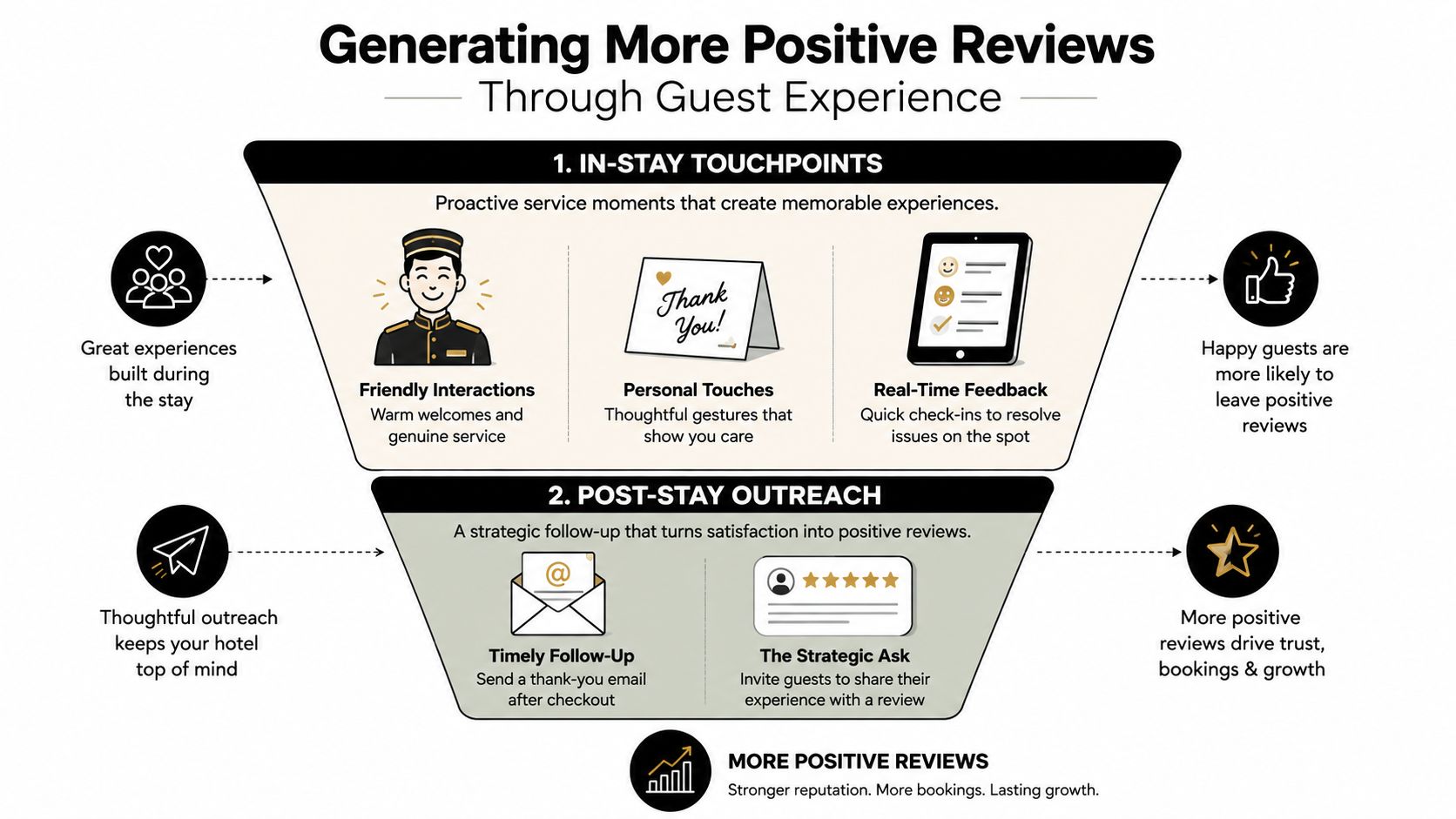
Hotels get more good reviews when the stay gives guests something worth writing about. The first layer is the in-stay experience, which means creating moments that feel personal instead of routine. The second layer is the post-stay ask, which should be timely, easy, and specific enough that a satisfied guest doesn't have to think hard about what to do next.
Build review-worthy moments before checkout
The easiest wins are often the most human ones. A personalized welcome note, a check-in interaction that uses the guest's name, or a checkout conversation that feels like a thank-you instead of a transaction can change whether someone leaves a review at all. These details don't need to be expensive, they need to feel intentional.
Staff behavior matters more than most managers admit. Guests remember who solved a problem quickly, who made a dinner recommendation without being asked, and who noticed a special occasion. Those are the moments that create the emotional nudge behind a positive review.
EU tourism guidance on hotel reputation management says hotels should track review sites from Google Reviews and TripAdvisor to OTAs and social media, reply to reviews in a timely and adequate manner, and create campaigns to boost reviews using reputation-management tools. The EU-backed best practices guide is useful because it treats review generation as an operating practice, not a marketing trick.
Ask after the stay, while the experience is fresh
The request should feel natural, not needy. Ask after checkout, thank the guest for staying, and make the review path simple. If the team waits too long, the stay loses emotional freshness and the guest moves on.
how to get more online reviews becomes an operations question, not just a marketing one. The strongest approach combines a good experience, a clean follow-up, and a clear reason to leave feedback.
A useful internal example is event-related stays. When a property handles a group booking well, the review often reflects the organizer's stress level as much as the room itself. For operators who manage meetings, weddings, or local functions, ABC Hire's event management guide is a reminder that smooth logistics create the kinds of positive post-event impressions guests write about.
The best review campaign is still a stay that feels organized, warm, and easy to recommend.
Handling Fake Reviews and Reputation Crises
A reputation crisis in hotels usually starts with a few review signals that look small on their own. A guest complaint may be valid, exaggerated, or completely fabricated, and the wrong reply can turn any of those into a larger problem. In operations, I have seen managers lose control by answering in anger, which gives the complaint more attention than it would have received on its own.
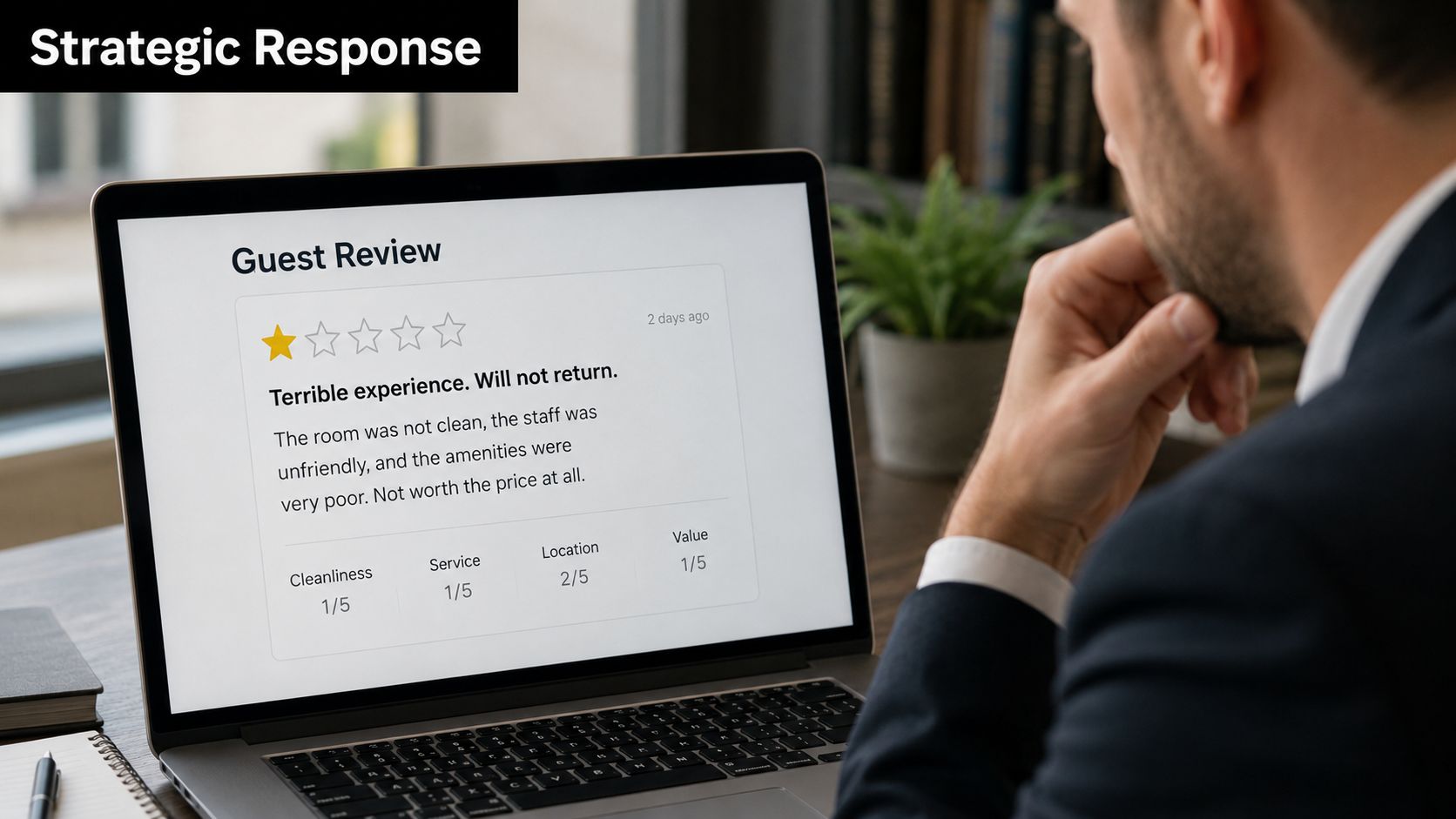
Decide first whether the review needs a public response
A recoverable service issue usually deserves a calm public reply. An obviously fake, abusive, or impossible-to-solve complaint is often better handled through platform reporting and internal documentation. The priority is credibility, not public drama.
The decision process should stay simple. Confirm whether the review is real and detailed enough to answer. Decide whether a public response will help future readers more than it helps the reviewer. Then route the case to direct outreach, platform escalation, or both.
Treat a review spike like an operational alarm
A sudden run of negative reviews usually points to something that broke in the guest journey. Housekeeping, breakfast, room assignment, staffing, or a policy change can all trigger the same pattern. Once the spike appears, the response has to move beyond reputation and into operations quickly.
The Cornell findings cited earlier matter here in a different way. If a stronger reputation supports pricing power and occupancy, a sudden drop can do the opposite and make rate resistance worse at the same time. That is why a reputation slide should be treated as commercial risk, not only a communications problem. The Cornell findings cited earlier help explain why the revenue team should care as much as the marketing team.
Use the response path that fits the situation:
- Fake or abusive review: Report it through the platform and document why it lacks credibility.
- Real complaint with bad tone: Reply briefly, stay factual, and move the conversation offline.
- Operational failure affecting multiple guests: Fix the service issue first, then explain what changed.
- Viral complaint: Assign one spokesperson, one message, and one internal owner for the fix.
Staff should not freelance replies during a crisis. One defensive response can spread faster than the original complaint, especially when it sounds dismissive. Keep the language calm, assign ownership clearly, and make the corrective action visible inside the hotel.
Tracking Reputation ROI and Making Internal Process Changes
The clearest reputation metrics are the ones that show up in revenue behavior. Track response rate, response time, review volume growth, rating trends, and how those shifts line up with conversion and ADR movement. If the numbers improve but bookings do not, the hotel probably has a distribution problem, a pricing problem, or a service issue that reputation work alone will not fix.
Measure the right things, not everything
A useful monthly dashboard does not need to be crowded. It needs to show whether the hotel is answering reviews quickly, whether feedback volume is healthy, whether ratings are moving up, and whether the business is seeing commercial improvement in the same period. That makes reputation a management conversation rather than a marketing report buried in a folder.
The Cornell data referenced above gives revenue teams a practical way to estimate the upside. If a 1-point increase in the 100-point GRI is associated with a 0.89% increase in ADR, 0.54% increase in occupancy, and 1.42% increase in RevPAR, the hotel can estimate the revenue value of stronger reputation instead of guessing. The The Cornell Hospitality Research summary is useful for revenue managers who need to justify time spent on reputation work.
Fix the process behind the feedback
Good reputation management eventually forces internal change. If guests keep mentioning check-in delays, the front desk workflow needs adjustment. If housekeeping comments keep appearing, the inspection process needs tightening. If staff behavior shows up in reviews, training and shift supervision need to change.
That is why reputation should sit in the same conversation as service recovery, staff coaching, and shift handoffs. A property that routes review insights back into operations prevents repeat problems instead of merely apologizing for them. One practical option for hotels that want support on that side of the work is Polaris Marketing Solutions, which provides online reputation management strategies alongside local SEO and reporting.
Track what guests say, then change the process that caused them to say it.
The hotels that do this well stop treating reviews as isolated comments. They use them as a live feedback system that shapes pricing, service quality, and the guest experience from first search to final checkout.
If your hotel needs a tighter reputation process, clearer review response systems, and a way to connect guest feedback to revenue, visit Polaris Marketing Solutions. The team builds practical digital marketing and reputation management strategies that help hotels strengthen their online presence, improve local visibility, and convert more qualified bookings.