
Monday starts with two estimate requests, a late crew member, and three customer texts asking for updates. By noon, Instagram still hasn't been touched, Facebook messages are unanswered, and the idea of filming a Reel feels ridiculous. This represents the no time for social problem for most owners in Fort Myers and Southwest Florida. Social media isn't hard because the apps are confusing. It's hard because service businesses run on interruptions.
That pressure is getting worse, not better. Americans now spend less time socializing in person than they used to, with average daily face-to-face social time falling from 45 minutes to 35 minutes over the past two decades, according to Axios' analysis of the American Time Use Survey. At the same time, social platforms still absorb huge attention. Global users spend an average of 2 hours and 24 minutes a day on social media, according to the social media usage data summarized by the University of Maine resource. So your customers are scrolling, but that doesn't mean your business has to live online all day to stay visible.
The fix usually isn't “post more.” It's building a system that fits around jobs, calls, appointments, and actual billable work. In some cases, that means batching. In others, it means repurposing, delegating, or skipping low-return channels entirely and pairing social with search visibility. If you're trying to keep up without turning social into another full-time role, Veo3 AI's guide to scaling content creation is a useful companion read.
1. Social Media Scheduling and Batching Content
The fastest way to stop social from interrupting your day is to stop treating it like a daily task. Batch it.
For a roofing company, cleaning service, or HVAC team in Southwest Florida, that usually means one content block each month. Pull jobsite photos, reviews, before-and-after shots, crew moments, and seasonal reminders into one folder. Then write and schedule everything in one sitting using tools like Buffer, Later, Hootsuite, or Meta Business Suite.

What batching looks like in practice
A local paver might batch:
- One proof post: A finished driveway with a short caption about the project type and location
- One trust post: A screenshot of a customer review turned into a branded graphic
- One educational post: A quick explanation of sealing vs. replacement
- One culture post: Crew on-site, truck wrap, or a community event photo
That gives you a simple monthly base without waking up every morning wondering what to publish.
Practical rule: If posting depends on your memory, it won't stay consistent during busy weeks.
The other benefit is mental bandwidth. You make decisions once, not every day. If you need help choosing tools that fit a small team, this roundup of social media management tools for small businesses is a practical place to compare options.
Where this works and where it breaks
Batching works best for evergreen content. It's strong for service reminders, review posts, team introductions, and project highlights. It's weaker for live event coverage, trend-driven content, and fast reactions.
Use a simple split:
- Scheduled content: Your baseline presence
- Live content: Only when something worth posting happens
That balance keeps the feed active without forcing your staff to become full-time creators.
2. Repurposing Content Across Multiple Platforms
A Cape Coral plumber finishes a water heater install, snaps two photos, and answers the same customer question for the third time that week. That answer should not live and die in a text thread. It can become a Facebook post, a short Reel, an email tip, and a Google Business Profile update with very little extra work.
That is the value of repurposing. You stop treating every platform like it needs a brand-new idea.
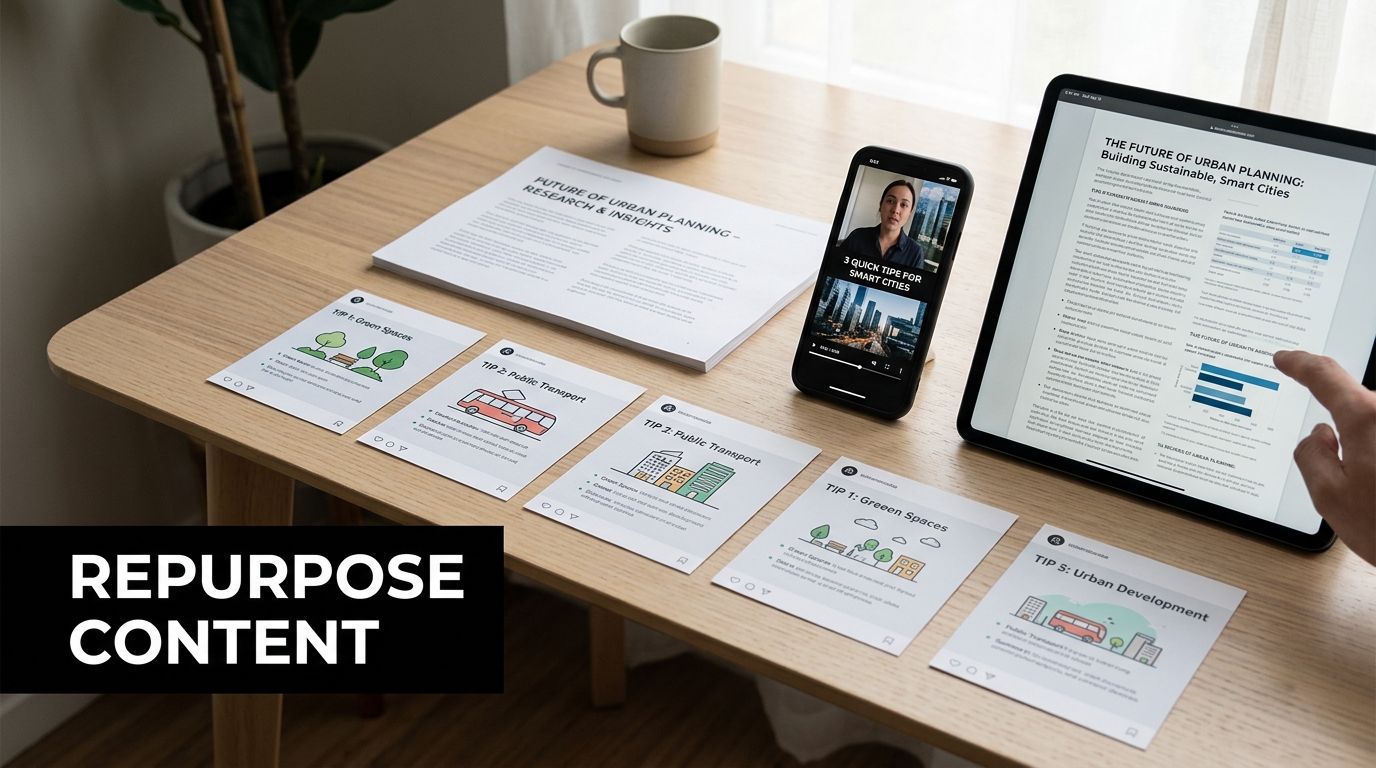
A single topic, such as “how often to clean a tile roof in Southwest Florida,” can stretch across several channels. The blog covers the full explanation. Instagram gets a carousel with warning signs and maintenance tips. Facebook gets a shorter homeowner-focused post. LinkedIn gets a version framed around property value and maintenance planning. A short video turns the same talking points into something your crew can film on-site in a few minutes. Tools like Canva, CapCut, and ChatGPT can speed up formatting, captions, and scripting.
One source piece can cover the week
Here's what that looks like for a Fort Myers cleaning company:
- Website article: “What move-out cleaning includes”
- Facebook post: 3 things landlords notice first
- Instagram carousel: Before, checklist, after
- Short video: A cleaner walking through a finished unit
- Email: “Vacancy turnover cleaning before the next tenant arrives”
Your customers do not all pay attention in the same place. Some check Facebook between jobs. Some scroll Instagram at night. Some only open email when they need a service. Repurposing gives you broader coverage without multiplying the planning work.
For teams trying to stretch every asset further, this guide on boost views with content repurposing is worth bookmarking.
Where owners save time, and where they waste it
Repurposing works well when the original idea is useful, local, and tied to real customer questions. It works poorly when someone copies the same caption and pastes it everywhere.
I see this a lot with service businesses. A Sarasota lawn care professional posts a vertical video with a caption full of hashtags and slang, then drops the exact same copy onto LinkedIn. It looks off. The job is not to create five original posts from scratch. The job is to adapt one message to the way each platform is used.
Keep three things consistent:
- The topic: one clear customer question
- The proof: photo, video, review, or result
- The call to action: what the customer should do next
Change three things:
- The hook: what earns attention on that platform
- The format: video, static image, carousel, or text
- The caption length: short for fast-scroll platforms, fuller for email or LinkedIn
If you have no staff support, do the first pass yourself and keep it simple. If your office manager or VA can help, hand off resizing, caption cleanup, and scheduling. If neither of you has time, this is one of the first parts worth outsourcing to an agency because the source material already exists. That lowers cost and keeps the business owner from becoming the bottleneck.
3. User-Generated Content and Customer Testimonials
A Fort Myers pool company finishes six jobs in a week. The owner has no time to film fresh content, but customers already sent two pool photos, one thank-you text, and a new Google review. That is enough for several strong social posts if the business has a simple process for collecting and using it.
For service businesses, some of the best social proof is already sitting in text threads, review alerts, and job-completion photos. A homeowner in Cape Coral sends a picture of a pressure-washed driveway. A Naples client leaves a review after an AC repair. A patient mentions a smooth check-in experience at a local practice. Those are marketing assets, not just nice feedback.
What to collect from customers
Ask for:
- Before-and-after photos: Strong fit for cleaning, painting, landscaping, paving, roofing, and exterior work
- Short testimonial videos: A 15 to 30 second phone clip is often enough
- Permission to reuse reviews: Turn a written review into a simple branded graphic, as noted earlier
- Tagged posts: Repost customer content with clear credit
Visible proof usually beats polished copy. In local service markets, a real photo from a Punta Gorda customer plus a specific review about showing up on time will usually do more than another generic “we care about quality” post.
I recommend building this into the job closeout process. Send one short follow-up text after the work is done. Ask for a photo, a review, or both. Keep the wording simple so the customer can respond in under a minute.
This also creates a clean handoff if the owner is not the one posting. An office manager can collect screenshots and approvals. A VA can turn them into posts and queue them up. If you need bilingual help for follow-up and admin support, Spanish Speaking VAs can be a practical option for Southwest Florida businesses serving both English and Spanish-speaking customers.
The trade-off is consistency. Some weeks you will have plenty of usable customer content. Other weeks you will have almost none, especially if your team forgets to ask or the jobs are less visual. That is why testimonials and user-generated content work best as one content lane, not the full calendar.
If you want help building a repeatable local review and content workflow, this breakdown of social media marketing support for Fort Myers businesses shows what that process can look like in practice.
4. Outsourcing Social Media Management to Agencies or Virtual Assistants
It is 7:15 p.m. in Fort Myers. The last job ran late, two quote requests are still sitting in Instagram DMs, and tomorrow's post has not been written. That is the point where social media stops being a marketing task and turns into an operations problem.
Handing it off can fix that, but only if you match the help to the actual bottleneck. A virtual assistant is usually the better choice when the business already has photos, offers, and a basic posting plan. An agency is the better fit when nobody has time to plan content, edit video, manage approvals, and report on results.
Two delegation paths that make sense
For a Cape Coral pool company, a VA can handle the repeatable work. Upload before-and-after photos, schedule posts, reply to simple comments, and flag lead messages for the office. If your customer base includes both English and Spanish speakers, Spanish Speaking VAs can be a practical option for inbox coverage and follow-up.
For a larger service business, the gap is usually bigger than scheduling. A Sarasota law firm, Naples med spa, or Fort Myers roofing company may need content planning, creative direction, monthly filming, ad coordination, and clear reporting tied to leads. In that case, a local partner often makes more sense than trying to coordinate freelancers one by one.
Outsourcing also works best when the owner stays involved in a few specific places and gets out of the way everywhere else. Approve offers. Flag busy seasons. Share real job photos and customer questions. Let the VA or agency handle the formatting, posting, and day-to-day management.
What good outsourcing actually requires
The handoff needs structure or it turns into another thing to manage. At minimum, the provider needs:
- Voice examples: a few captions, emails, or text replies that sound like your business
- Content access: jobsite photos, team photos, service FAQs, promos, and seasonal reminders
- Response rules: who answers DMs, how fast, and which messages need to be escalated
- Approval process: one decision-maker, one review window, and clear deadlines
Many local businesses face a recurring problem. They hire help to save time, then create delays by reviewing every caption three days late. The trade-off is simple. The more you delegate, the more you need clear guardrails up front.
If you want to see how that support is typically structured at the local level, Fort Myers social media management services for local businesses gives a practical example of what agency help can cover without putting the owner back in the posting loop.
5. Strategic Content Pillars and Themed Content Days
It's 7:30 p.m. in Fort Myers. The day got away from you, the phone is still buzzing, and someone says, “We need to post something.” That scramble usually means the business has no content framework, not a lack of ideas.
Content pillars solve that by narrowing your choices. Instead of starting from zero every time, you build around a small set of repeatable topics tied to how customers decide who to hire. For a local service business, that usually means proof, education, people, and local relevance.
A practical pillar setup for local service businesses
For a Fort Myers HVAC company, the pillars might look like this:
- Proof: completed installs, service-call photos, review screenshots
- Education: filter changes, thermostat problems, maintenance tips
- People: technician spotlights, owner perspective, team moments
- Local relevance: storm prep, peak heat reminders, community involvement
Then give each one a home on the calendar. Review Thursday. Maintenance Monday. Project Friday. The names do not matter much. The repeatability does.
This helps more than owners expect because it cuts decision fatigue. A Cape Coral plumber with three solid pillars can post for a month faster than a competitor who keeps chasing random ideas from Instagram. The same structure also makes delegation easier. If you hand content to a VA or agency, they can turn job photos and customer questions into posts without guessing what fits your brand.
What works better than trend chasing
For Southwest Florida service companies, consistency usually beats novelty. A roof cleaning company in Naples does not need to copy every trending audio clip. It needs visible before-and-after proof, practical advice about algae and storm season, and a feed that keeps reinforcing the same buying signals.
That is the value of themed days. They create recognition.
Customers start to know what your business posts and why it matters. Tuesday might be a maintenance tip. Friday might be a finished project. Over time, that pattern builds familiarity, which matters a lot for service businesses people call when something breaks, leaks, or stops working.
Owner filter: If a theme does not help a buyer trust you, understand your service, or remember your name, cut it.
The trade-off is variety. If your pillars are too broad, the content gets vague. If they are too narrow, the feed gets repetitive. Four to five pillars is usually the right range for a local service company. Keep the categories steady, then refresh the examples inside them with new jobs, new questions, and seasonal angles.
6. Micro-Content Strategy and Short-Form Video Focus
A Sarasota HVAC owner does not need a polished 60-second production to win on social. A 12-second clip of a clogged drain line, a quick explanation, and a clean repair shot will usually do more than an overedited video that takes half a Saturday to finish.
That is the standard to use with short-form video. Fast to film. Easy to repeat. Clear to a local buyer.
You already have what you need for this. A phone, decent light, and a few editing basics are enough. InShot and Instagram Reels handle the workflow for many service businesses without adding another complicated system.

The kind of video that's actually realistic
For an electrician in Cape Coral or a plumber in Fort Myers, practical micro-content usually falls into a few repeatable formats:
- Quick fix myth: “Stop resetting this breaker until you check what's overloading it”
- Jobsite walkthrough: One problem, one repair, one result
- Before-and-after reveal: Panel cleanup, fixture swap, drain line repair
- Seasonal advice: Storm prep, humidity issues, maintenance reminders
Keep each clip tight. Show the problem, show the work, give one useful takeaway, and stop. That structure works because local service buyers are not looking for entertainment first. They want proof that you know what you're doing.
Short-form video gets reach, but it can also become a time sink fast. Owners start chasing hooks, transitions, captions, and trending audio, then wonder why social still feels behind. For a Southwest Florida service company, the better approach is usually one afternoon of filming each month, then cutting that footage into small pieces for the next few weeks.
The real trade-off on video
Video often outperforms static posts for attention, but attention is not the same as return. If a Naples roofer spends three hours filming and editing one Reel that brings in no estimate requests, that was expensive content. If the same owner records six simple clips during active jobs and hands editing to a VA or agency, the math changes.
This is where delegation starts to matter. The owner or tech captures raw footage in the field. Someone else trims it, adds captions, and schedules it. That setup keeps the content grounded in real local work without turning the business owner into a full-time creator.
If your team is stretched thin, post fewer videos and make each one easier to produce. Then pair that with a stronger response process, because community engagement strategies for local businesses often turn simple video views into actual conversations faster than posting more clips.
7. Community Engagement Over Content Creation
Some businesses post constantly and still feel invisible. Others barely post, but they reply fast, show up in local conversations, and stay top of mind. The second group often gets better local traction.
Community engagement is the lower-lift path when content creation keeps stalling. Instead of trying to publish something new all the time, spend focused time responding to comments, replying to messages, thanking customers for tags, and interacting with nearby businesses and community pages.
A better use of limited time
For a med spa, law office, or home service business, useful engagement includes:
- Replying to every review mention: Publicly and with a real sentence
- Commenting on partner businesses: Realtors, builders, designers, HOAs, nonprofits
- Answering DMs quickly: Even if the reply is just a next-step instruction
- Joining local conversation threads: Weather prep, local events, neighborhood updates
This doesn't feel as productive as building a content calendar, but it often produces better relationship signals. If someone in Fort Myers tags your business in a neighborhood recommendation thread and you reply quickly and professionally, that interaction can matter more than a generic post from the same day.
Strong local social usually looks less like broadcasting and more like being visibly responsive.
When to prioritize engagement first
Use this route if your business already has some visibility but weak follow-up. It's especially useful when your team gets tagged, receives questions, or earns reviews but lets them sit untouched.
For owners who need a practical framework, these community engagement strategies line up well with local business realities. The warning is simple. Don't spend time chatting on irrelevant posts just to “be active.” Engagement only pays when it happens in the right circles.
8. Automated Email-to-Social-Post Workflow and RSS Integration
It's 6:15 p.m. You finally finish estimates, return two calls, and remember social media right as you lock up. For a lot of Southwest Florida service businesses, that is the primary use case for automation. It keeps approved content moving when the owner is busy running the business.
If you already publish articles, send a newsletter, or post updates on your website, tools like Zapier, IFTTT, Make, and Mailchimp can turn one piece of content into a repeatable posting workflow. A new blog post can create a Facebook draft. A newsletter issue can trigger a LinkedIn post. An RSS feed can send fresh site content into your scheduler without anyone copying and pasting headlines every week.
For a Cape Coral HVAC company, Naples dental office, or Fort Myers law firm, the practical version is usually simple:
- Publish one approved article or update on the website
- Use the RSS feed or CMS trigger to send it into Zapier or Make
- Auto-generate a post draft with the headline, link, and short summary
- Send that draft to a scheduler for Facebook or LinkedIn
- Reuse the same topic in the next email newsletter
That setup saves time because it removes repetitive admin work. It also creates consistency, which is usually the bigger problem for small local teams. The trade-off is quality control. Auto-posting raw website headlines often produces stiff captions, awkward formatting, or posts that make sense on LinkedIn but feel out of place on Facebook.
Use automation for distribution. Keep people involved in judgment.
That means approving the source content first, setting rules for which posts get syndicated, and reviewing anything customer-facing that could sound tone-deaf during a storm, holiday week, or local news event. A Sarasota med spa can automate blog promotion. It should not automate replies to pricing questions or treatment concerns. A plumbing company can auto-queue maintenance tips from its website. It still needs a human to adjust messaging during hurricane prep season, when local attention shifts fast.
This is also where delegation fits better than full automation. A VA can spend 20 minutes each week reviewing drafts before they go live. An agency can build the workflow once, set guardrails, and handle exceptions. That hybrid approach usually works better than asking software to do strategy by itself.
For businesses with very limited time, the goal is not to post more. The goal is to make existing content travel farther with less manual effort, while keeping the final output accurate, local, and worth reading.
No-Time-for-Social: 8-Point Strategy Comparison
| Strategy | 🔄 Implementation Complexity | ⚡ Resource Requirements | 📊 Expected Outcomes | 💡 Ideal Use Cases | ⭐ Key Advantages |
|---|---|---|---|---|---|
| Social Media Scheduling and Batching Content | 🔄 Moderate, setup of tools, templates, and calendar | ⚡ Upfront 2–3 hrs/week + scheduling tool subscription | 📊 Consistent cadence and predictable analytics | 💡 Service businesses needing steady presence (contractors, clinics) | ⭐ Reduces daily effort; improves timing and consistency |
| Repurposing Content Across Multiple Platforms | 🔄 Moderate–High, requires content planning and format skills | ⚡ Tools for editing and templates; time to adapt formats | 📊 Broader reach and efficiency from one source piece | 💡 Businesses with pillar content (blogs, long videos) | ⭐ Maximizes ROI of each content asset; cost-effective reach |
| User-Generated Content and Customer Testimonials | 🔄 Low–Moderate, set submission guidelines and moderation workflow | ⚡ Minimal production; incentives and legal permissions | 📊 Increased authenticity, higher trust and engagement | 💡 Customer-facing services with visual outcomes (cleaning, trades) | ⭐ Low-cost content; strong social proof and community buy-in |
| Outsourcing Social Media Management to Agencies/VAs | 🔄 Low internal complexity, Moderate vendor selection overhead | ⚡ Ongoing budget ($300–3,000+/month) and onboarding time | 📊 Professional execution, measurable reporting, time freed | 💡 Owners wanting hands-off social or scaling lead gen | ⭐ Access to expertise; removes daily owner workload |
| Strategic Content Pillars and Themed Content Days | 🔄 Moderate, initial framework and testing required | ⚡ Planning time + template creation; schedule tools | 📊 Predictable content variety and easier batching | 💡 Businesses seeking structure and consistent brand voice | ⭐ Eliminates daily decision fatigue; simplifies delegation |
| Micro-Content Strategy and Short-Form Video Focus | 🔄 Moderate, learn hooks, editing, and platform nuances | ⚡ Small filming sessions + editing apps; trend monitoring | 📊 High engagement and virality potential per post | 💡 Brands that benefit from visual demos or fast growth | ⭐ Algorithm-favored reach; strong engagement per time invested |
| Community Engagement Over Content Creation | 🔄 Low, consistent daily/time-boxed routine | ⚡ 15–20 min/day; no ad spend required | 📊 Deeper loyalty and higher-quality referral leads (slower) | 💡 Local businesses focused on referrals and repeat customers | ⭐ Cost-free; builds genuine relationships and trust |
| Automated Email-to-Social-Post Workflow and RSS Integration | 🔄 Moderate, technical setup and testing of automations | ⚡ Automation tools (Zapier/IFTTT), initial config time | 📊 Reliable multi-channel distribution; saves weekly time | 💡 Organizations with regular blogs/newsletters | ⭐ Scalable "set-and-forget" distribution; reduces manual errors |
From Overwhelmed to In Control Your Next Step
Having no time for social media doesn't mean you need to disappear online. It means you need to stop treating every platform, every format, and every posting idea as equally important. Most small businesses do better when they simplify first, then scale only what's working. That could mean batching a month of proof posts, repurposing one article into several assets, or handing execution to someone who can keep the engine running.
There's also a bigger strategic reality behind this. Social attention is massive, but real social time is shrinking, and that changes how local businesses should think about visibility. For many service companies, trust now comes less from constant chatter and more from proof, responsiveness, reviews, and discoverability. If you're stretched thin, posting everywhere isn't a serious plan. Building a system that supports sales is.
That's where local search needs to stay in the conversation. For businesses that serve a defined geographic market, Google Business Profile often matters more than another rushed Instagram post. According to this Fort Myers SEO guide, Google Business Profile accounts for 50% of local ranking factors, and the practical work is clear. Complete all fields, add 15 to 20 or more professional photos, list 15 to 25 specific services, and publish weekly updates. For a contractor, clinic, or law office in Southwest Florida, that's often a better time investment than trying to win every platform.
If you want the simplest path forward, pick one primary strategy from this list and commit to it for the next month. Don't adopt all eight at once. A cleaning company might start with batching and testimonials. A medical office might use automation plus community response. A roofing company might keep social light and focus harder on Google Business Profile, review generation, and location-based SEO.
For businesses in Fort Myers, Cape Coral, Estero, Bonita Springs, Naples, and nearby markets, a local partner can help connect social efforts to lead generation instead of vanity activity. Polaris Marketing Solutions is one relevant option for companies that want social media support tied to broader local SEO and digital marketing goals. A complimentary analysis can help you see whether your real bottleneck is content, consistency, delegation, or visibility in search.
If you're tired of social media falling to the bottom of the list, Polaris Marketing Solutions can help you build a practical plan that fits your workload, your market, and your lead goals without turning social into another full-time job.