
If you're like most local professional service owners, your lead flow probably feels uneven. One month the phone rings because a past client sent someone your way. The next month, you get a few website inquiries, but half of them aren't a fit. Then you look at your marketing and realize you're not short on activity. You're short on a system.
That problem shows up everywhere in Southwest Florida. A Fort Myers law firm may have a decent reputation but weak service pages. A Naples consultant may have a polished website but no follow-up process. An accounting firm in Cape Coral may get strong referrals but lose opportunities because nobody logs them, tracks them, or follows up fast enough.
Lead generation for professional services works when you stop treating it like a collection of random tactics and start treating it like an intake pipeline. That means knowing where leads come from, choosing channels that match your market, building pages that convert, and tracking what turns into paying clients. Local trust matters. Search visibility matters. Response time matters. So does common sense.
Audit Your Current Lead Flow
Most firms don't need more tactics first. They need a clear picture of what's already happening.
Professional services firms typically convert website visitors into marketing-qualified leads at about 2 to 5%, and a small firm with 10,000 monthly website visitors might generate roughly 200 to 500 qualified leads per month, according to Prospeo's professional services lead generation benchmarks. If your numbers are far below that range, your problem may not be traffic. It may be offer clarity, intake friction, or weak follow-up.

Start with where clients actually come from
Pull the last few new matters, retainers, or consulting engagements. Don't overcomplicate it. Open your calendar, CRM, inbox, or intake notes and answer four basic questions:
- Source: Did this client come from Google, a referral partner, a past client, a directory, paid ads, or direct outreach?
- Intent: Were they actively looking for your service, or were they only browsing?
- Path: Did they call, submit a form, book a consultation, or send an email?
- Outcome: Did they become a client, stall out, or turn out to be a poor fit?
This quick review usually exposes the first leak. Many firms think they generate weak leads, however, the issue is that they don't define a qualified lead consistently. A personal injury firm and a business consultant shouldn't count every contact the same way.
Practical rule: If you can't answer where your last ten qualified leads came from, you don't have a lead generation problem. You have a visibility and tracking problem.
Run a simple digital footprint check
Your website and local presence should make it easy for the right person to take the next step. Use this short checklist:
- Homepage CTA: Is there one clear next action, such as "Schedule a consultation" or "Request a case review"?
- Service pages: Does each core service have its own page, or are they buried in one generic list?
- Google Business Profile: Are hours, categories, services, photos, and contact details complete and current?
- Forms: Do forms ask for the information you need without creating friction?
- Intake process: When someone calls or submits a form, who responds and how quickly?
A Fort Myers estate planning attorney, for example, may have strong reviews and still lose leads because the website sends everyone to a generic contact page. A Naples business consultant may get good traffic from LinkedIn but never convert it because the call-to-action is buried below long blocks of abstract copy.
Establish your baseline before changing anything
Write down a few numbers and observations from the last month or quarter. Keep it practical:
| What to check | What you're looking for |
|---|---|
| Website inquiries | How many real prospects contacted you |
| Phone calls | Which calls were sales opportunities |
| Qualified leads | Which inquiries matched your ideal client |
| Closed clients | Which channel produced actual revenue |
| Response gaps | Where leads sat too long without follow-up |
You don't need an advanced dashboard yet. You need enough clarity to stop guessing.
Once you know whether your bottleneck is visibility, conversion, or follow-up, your next move becomes obvious.
Choose Your Lead Generation Channels
Most small firms waste money because they spread themselves too thin. They post on every platform, boost random social posts, buy a few directory listings, and hope something sticks. That's not a channel strategy. That's drift.
A better approach is to choose channels based on four things that matter to a local service business: cost, speed, lead quality, and fit with your market. A 2026 benchmark roundup reported that the median cost per lead for professional services is about $184, while top-quartile firms get leads for $92, which shows how much channel selection and optimization affect efficiency, according to Digital Applied's lead generation statistics roundup.
Compare the core channels before you commit
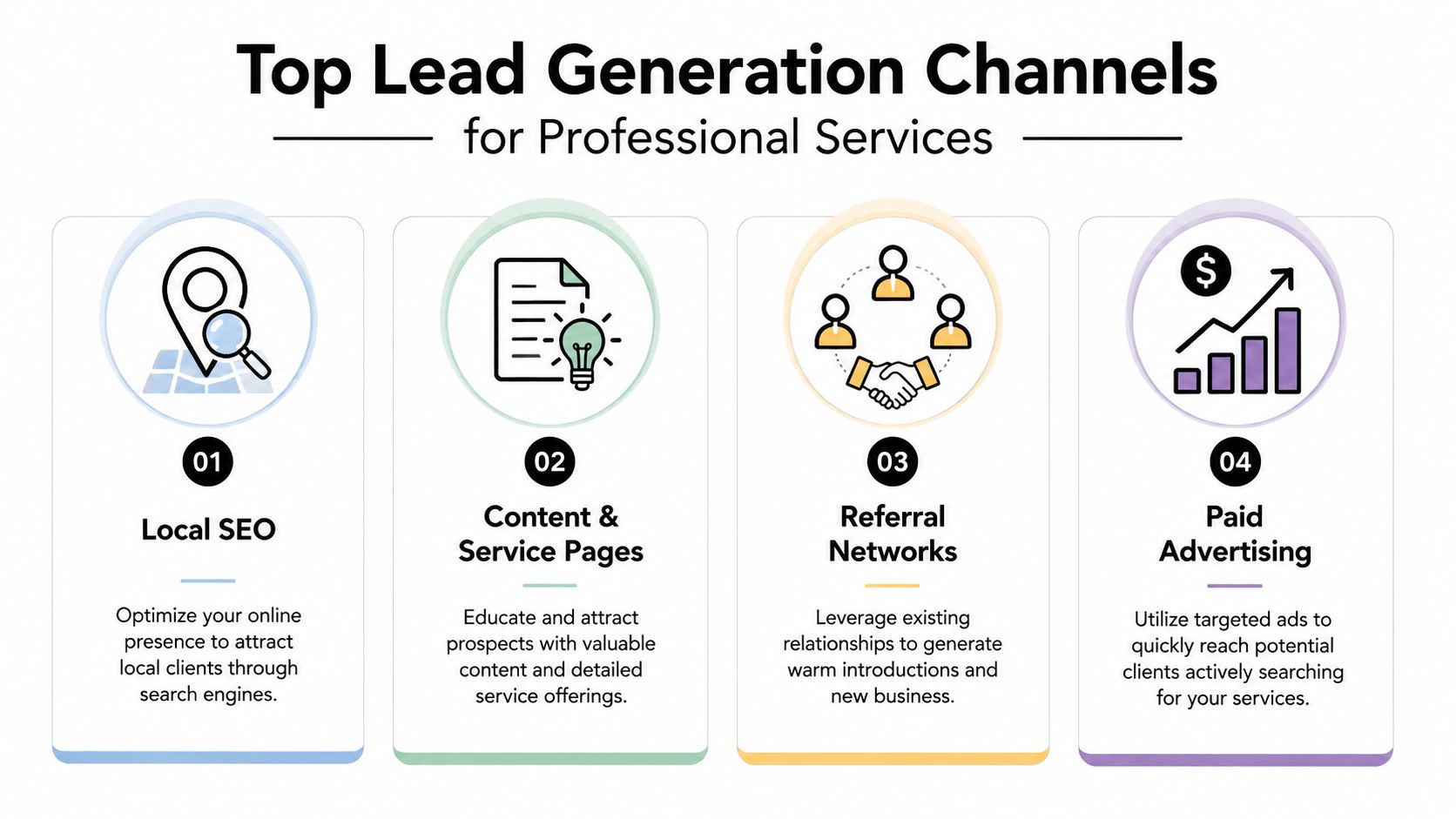
| Channel | Typical Cost | Time to Results | Lead Quality | Best For |
|---|---|---|---|---|
| Local SEO | Lower cash cost, higher time investment | Slower start, stronger long-term payoff | High when search intent is local and specific | Law firms, accountants, consultants, healthcare practices |
| Content and service pages | Moderate effort, often tied to website work | Medium | High if pages match real services and buyer questions | Firms with expertise that needs explanation |
| Referral networks | Low direct cost, requires process and consistency | Can produce results quickly | Often strongest fit | Trust-based services and niche specialists |
| Paid advertising | Faster spend, tighter control needed | Fastest feedback | Good if targeting and landing page are strong | New services, urgent lead gaps, competitive markets |
What works first for a local firm
If you're a Fort Myers law firm or a Naples accounting practice, local SEO is critically important. People search by need and location. They don't search for "client-centered solutions." They search for "business attorney Fort Myers" or "CPA Naples small business."
Content and service pages come next because search visibility without conversion is wasted traffic. If someone lands on your page and still can't tell whether you handle probate, compliance consulting, tax strategy, or mediation, they leave.
Referrals deserve more structure than most firms give them. They often produce your warmest leads, but they dry up when you rely on memory instead of a repeatable process. Strategic partners, past clients, and adjacent professionals can feed your pipeline steadily if you make it easy for them.
Paid ads are the fastest lever, but they punish sloppy execution. If you send ad traffic to your homepage, use broad keywords, or fail to screen for fit, you'll burn budget fast.
A practical way to choose your first moves
Use your first hours and dollars where they remove the biggest friction.
- If nobody can find you locally: Prioritize Local SEO and your Google Business Profile.
- If traffic exists but inquiries are weak: Fix service pages and lead capture.
- If referrals are happening but inconsistently: Build a referral process and partner outreach list.
- If you need leads soon: Launch a tightly scoped paid search campaign around one service.
For a Cape Coral family law practice, I'd start with local SEO and service pages. For a Naples consultant launching a new advisory offer, I'd test paid traffic and pair it with direct outreach.
Lead generation for professional services gets cheaper and more predictable when your channels support each other. Paid ads can validate messaging. SEO compounds over time. Referrals bring trust. Service pages convert all of it.
Dominate Local Search with SEO
For local firms, Google is often the front desk before your office staff ever speaks to a prospect. If your firm doesn't show up where people are searching, you're invisible to buyers who already have intent.
For regional markets, local SEO often beats broad national tactics. Data cited in SalesBread's guide to lead generation for professional services says that for small firms in markets like Southwest Florida, local SEO can deliver 3.5x higher conversion rates, and in places like Naples or Cape Coral, up to 60% of leads can come from local search and Google Business Profile interactions. That lines up with what many local firms see in practice. High-intent prospects usually start with maps, reviews, and service-area searches.

Fix your Google Business Profile first
Your Google Business Profile is not a side listing. It's a conversion asset.
A Fort Myers attorney should fully list practice areas. A Naples consultant should clearly define services, categories, office hours, and contact methods. Add real office photos, team photos, and local visuals that support trust. Keep the business description readable. Skip fluff and say what you do, who you help, and where you work.
Use these actions as a baseline:
- Choose accurate categories: Start with your primary service, then add relevant secondary categories.
- List services clearly: Break out the actual services clients hire you for.
- Upload useful photos: Office, exterior, team, and branded visuals help confirm legitimacy.
- Answer common questions: Use the Q&A section to address practical client concerns.
- Publish updates: Google Posts can highlight recent articles, service updates, or seasonal issues.
If you need a solid process, this Google Business Profile optimization checklist is a useful way to make sure the basics aren't missing.
Build pages for location plus intent
A lot of firms make the same mistake. They build one "Services" page and expect it to rank for everything.
That doesn't work well in local search. A better structure is one page per core service, with local relevance built into the copy. For example:
- Estate planning attorney in Bonita Springs
- Business litigation lawyer in Fort Myers
- HR consulting for Naples healthcare practices
- Tax planning for Cape Coral small businesses
Don't force location names into every sentence. Use them naturally in the headline, body copy, title tag, and supporting sections. Explain the actual client problem, your approach, and what happens next.
The firms that win local search usually aren't the biggest. They're the clearest, most complete, and most relevant to the searcher's immediate need.
There are also strong frameworks for best local search engine optimization if you want a broader reference point for citations, reviews, and on-page local signals.
Reviews and citations do the trust work
Reviews influence both ranking visibility and conversion. Ask for them after a successful outcome, not months later when the client has moved on mentally. Make the request simple. Send the direct review link. Tell them what kind of feedback is most helpful without scripting the response.
Citations matter too. Your business name, address, phone number, and website should be consistent across legal directories, local chambers, professional associations, and mainstream business listings.
A short walkthrough can help if your team wants a visual reference before updating listings or pages:
SEO for local professional services isn't about gaming Google. It's about removing doubt. When your profile is complete, your pages match search intent, and your reputation is visible, local prospects feel safer taking the next step.
Create Service Pages That Convert
A lot of professional service websites read like brochures written for peers, not buyers. They talk about philosophy, credentials, and firm history before they explain the problem the client needs solved. That's why traffic alone doesn't turn into leads.
The better model is simple. Build each page around one service, one audience, and one next step.
A local example that gets the structure right
Take a Naples-based consultant offering operational advisory services to small medical practices. A weak page might open with broad language about excellence, partnership, and strategic vision. A stronger page gets specific fast.
The headline should speak to the problem. The opening should explain who the service is for. The next section should describe the issues the client is dealing with right now, such as workflow bottlenecks, reporting confusion, or staffing friction. Then the page should explain how the engagement works in plain language.
Here's a structure that tends to work well:
- Headline with a clear outcome: Say what the service helps the client accomplish.
- Problem section: Show that you understand the situation they're in.
- Process section: Explain what working with you looks like.
- Credibility section: Introduce the expert, experience, or approach behind the work.
- Proof section: Add testimonials, reviews, or examples if appropriate.
- Call to action: Give one direct next step.
What most firms get wrong
They bury the contact option. They write long paragraphs full of internal language. They try to make one page rank for every service and every city. Or they ask for too much too early with bloated forms.
If your page offers a consultation, your form should support that action instead of slowing it down. This guide on how to create effective lead capture forms is a helpful reference for reducing friction while still collecting useful intake details.
A service page should answer three questions fast. Is this for someone like me? Can this firm solve my problem? What's the next step?
Give cautious prospects a lower-friction option
Not every visitor is ready to book. Some are comparing providers. Some are early in the process. Some want reassurance before they talk to anyone.
That's where a basic lead magnet helps. For a Fort Myers law firm, that could be a short estate planning checklist. For a Naples consultant, it could be a practical guide on avoiding common operational mistakes. For a CPA, it might be a year-end tax prep worksheet for business owners.
The key is relevance. A generic PDF called "Ultimate Guide to Success" won't help. A focused download tied directly to one service can.
Keep the page human
Professional services sell trust, but trust doesn't come from sounding formal. It comes from clarity.
Use short paragraphs. Answer common objections. Show the person or team behind the service. Add an FAQ if clients ask the same things repeatedly. Make the call-to-action visible above the fold and again lower on the page.
A good service page doesn't try to impress everyone. It helps the right prospect feel understood enough to contact you.
Use Paid Ads for Immediate Leads
SEO takes time. Referrals take relationships. Paid ads give you speed.
That doesn't mean Google Ads is easy money. It means you can generate lead flow faster if you stay narrow, match the ad to a real search need, and send the click to a page built for one action.

Start with one service, one audience, one landing page
Say you're a therapist in Estero offering anxiety counseling. Don't build your campaign around broad mental health terms and send traffic to your homepage. Build a dedicated landing page for anxiety counseling, speak directly to that need, and make the contact action obvious.
The same principle applies to legal and consulting offers. A Fort Myers business lawyer should run a separate campaign for contract review or business formation if those are separate buyer intents. A Naples consultant launching a compliance service should give that offer its own page.
A clean landing page should include:
- A direct headline: Match the searcher's intent.
- Brief supporting copy: Explain the problem and your solution without clutter.
- One form or call option: Don't split attention across multiple actions.
- Trust elements: Reviews, credentials, or professional affiliations if appropriate.
Use ad copy that screens for fit
Paid ads work better when they qualify, not just attract. Your ad should tell people what you do and who it's for.
If you serve business owners, say that. If you work by appointment only, say that. If you focus on one geographic area, make that clear. Better targeting usually means fewer wasted clicks and better conversations.
For outreach beyond search ads, persistence matters. A practical benchmark from Rattleback's professional services lead generation process shows that multi-touch outreach with 6 to 8 touches over 2 to 3 weeks can produce much stronger engagement, and quarterly campaign sprints can support 10 to 15% overall lead conversion when the process is managed well. That's especially useful when you're pairing ads with follow-up email or LinkedIn touches for high-value services.
Keep the budget controlled while you test
Don't launch five services, three audiences, and two cities at once. Start smaller.
A disciplined paid campaign answers these questions quickly:
- Which search terms trigger qualified inquiries?
- Which ad messages get the right people to click?
- Which landing page language drives contact?
- Which leads turn into consultations or signed clients?
If you're comparing approaches or need a primer on setup logic, this resource on pay-per-click for small businesses gives a useful overview of how small firms can approach paid campaigns without overspending.
Paid ads are best used as a testing environment. They show you which offers, messages, and searches deserve more long-term investment.
Used well, paid advertising doesn't replace SEO or referrals. It gives you immediate signal while the rest of your lead generation engine matures.
Build a Systematic Referral Engine
Referrals are usually the easiest leads to close and the easiest leads to waste.
Too many firms say referrals are their best source, then handle them casually. A client mentions your firm to a friend. A banker says they'll keep you in mind. A CPA promises to send opportunities. Then nothing gets tracked, nobody follows up properly, and the warm lead cools off. That's expensive negligence.
According to Glion Consulting's guide for professional service businesses, referrals can convert at up to 4x higher than other channels, but without a CRM or simple tracking system, an estimated 70% of referral potential decays due to inactivity. That should change how you treat every introduction.
Stop waiting and start prompting
You don't need a pushy script. You need timing and clarity.
Ask for introductions right after a successful outcome, a positive review, or a strong piece of client feedback. That's when the client is most likely to help. Keep the ask simple and specific.
For example:
If you know another business owner dealing with the same issue, feel free to introduce us. We work best with clients who need practical help and want a straightforward process.
That works better than "send anyone our way." Specificity helps people remember who to refer.
Build partner relationships with adjacent professionals
Some of the best referral sources are professionals who serve the same client before or after you do.
A business attorney can build relationships with accountants, bankers, commercial insurance advisors, and fractional CFOs. A Naples consultant can partner with HR firms, IT providers, or local business coaches. The connection works when both sides understand the ideal fit.
Create a one-page partner brief that includes:
- Who you help: Industry, business type, or client situation
- What problems you solve: The issues that usually trigger engagement
- What a strong referral looks like: The signs that someone is ready
- How to connect: Direct contact details and preferred intro method
Put the follow-up on rails
Referrals die when they sit in someone's inbox.
Set one rule internally. Every referral gets logged, acknowledged, and acted on the same day if possible. If the lead isn't ready, assign a next step instead of hoping someone remembers later. Even a basic spreadsheet is better than a verbal handoff.
A referral engine doesn't need to be fancy. It needs to be intentional. Firms that systemize referrals protect their warmest opportunities instead of letting them fade.
Track Your Results and Prove ROI
Lead generation for professional services gets easier once you can answer one question with confidence: which efforts are producing qualified clients, not just activity?
That's where most firms get stuck. They know they got calls. They know traffic went up. They know a campaign "felt busy." But they can't tie that effort to consultations, retained matters, or signed engagements. Without that connection, every marketing decision turns into an argument.
A better system starts with cost per qualified lead, not vanity metrics. A proven framework from ClicksGeek's lead generation guide for professional services says $50 to $150 CPQL is a strong target, and firms that fail to track it often see customer acquisition costs rise by 2 to 3x because they can't identify which campaigns are producing real clients.
Track the metrics that matter
You don't need a massive tech stack. You need a short list of numbers reviewed consistently.
Focus on these:
- Qualified leads: How many inquiries match your ideal client
- Lead source: Where each qualified lead came from
- Consultations or discovery calls: Which channels create real conversations
- Lead-to-client rate: Which sources produce signed business
- CPQL: What you're spending to generate a qualified opportunity
For a Fort Myers law firm, this may mean separating family law leads from estate planning leads and tagging whether they came from Google Business Profile, organic search, referral, or paid ads. For a Naples consultant, it may mean tracking which service page generated the inquiry and whether the lead matched the intended offer.
Use a simple dashboard your team will actually update
A spreadsheet works if it's maintained. HubSpot's free tier can work too. So can a basic CRM if your intake team will use it consistently.
At minimum, every lead record should include source, service requested, qualification status, follow-up owner, and final outcome. If you want a practical primer on how to measure campaign success, that's a useful companion to building a simple ROI view.
You should also define a response process. If a lead comes in, who owns it? When do they reply? What happens if the prospect doesn't respond? A clean dashboard without a response standard still leaks opportunities.
The marketing report matters less than the handoff. If nobody acts on the lead fast, your attribution data won't save the sale.
Connect channel performance to business decisions
Once tracking is in place, the pattern gets clearer. You may find local SEO drives fewer but better matters. Paid ads may generate volume for one service and poor fit for another. Referrals may close better than anything else but need tighter follow-up.
That's when lead generation stops feeling abstract. It becomes operational. You can shift budget, rewrite weak pages, pause bad campaigns, and expand the channels that produce revenue.
If you want a more complete framework for tying spend to outcomes, this guide on how to measure marketing ROI is a practical reference for small businesses that need clearer reporting.
If your firm wants help building a lead generation system that fits the Fort Myers and Southwest Florida market, Polaris Marketing Solutions can help. They work with small and mid-sized businesses on local SEO, Google Business Profile optimization, websites, PPC, and reporting built around real business results. If you want a clearer view of where your leads are coming from and where your best opportunities are hiding, it's worth starting with a conversation.