
A Fort Myers contractor usually asks the wrong first question. It’s rarely “Should I run Google Ads or Facebook Ads?” The key question is “Which platform will bring calls, booked estimates, and paying jobs inside my service area without wasting my staff’s time?”
That distinction matters because cheap traffic can still be expensive. A low-cost lead that never answers the phone, lives outside your service radius, or only wanted a ballpark price is not a win. A more expensive lead from someone who searched for your exact service in Cape Coral, Estero, Bonita Springs, or Naples often is.
Most google ads vs facebook ads articles stay too broad to help a local service business. They compare platforms like every advertiser is a national ecommerce brand. That’s not how a roofer, HVAC company, plumber, cleaner, chiropractor, or law office in Southwest Florida operates. Local businesses have tight service boundaries, immediate revenue goals, and limited follow-up capacity.
Your Fort Myers Business Needs Leads Not Clicks
If you’re running a home service business in Fort Myers, you’ve probably heard both sides already. One person says Google is too expensive. Another says Facebook is cheaper and easier. Both statements can be true, and both can still lead you to the wrong decision.
The problem is that clicks don't pay payroll. Jobs do. For a local contractor, the best ad platform is the one that produces qualified leads, not the one that produces the most form fills.
A qualified lead is someone who fits the job you want, in the area you serve, with a real chance of becoming revenue. If your team needs a cleaner definition, this guide on LeadBlaze on qualified leads is useful because it separates raw inquiries from leads that are sales-ready.
The local reality in Southwest Florida
A Fort Myers roofer after a storm has a different problem than an online store. A cleaner in Estero can’t profitably serve every town in Lee County. A paving company in Cape Coral doesn’t want DIY traffic, job seekers, or price shoppers from outside its route.
That’s why generic platform advice breaks down fast.
Practical rule: If your business has a service radius, dispatch schedule, and a sales team that also has to do actual work, lead quality matters more than ad platform popularity.
Here’s how that looks in practice:
- An HVAC company needs calls from homeowners with an immediate issue.
- A cleaning company may need recurring clients who trust the brand before they book.
- A dental office may need both active “dentist near me” searchers and people who need more familiarity before scheduling.
- A law firm may need high-intent inquiries, not volume for volume’s sake.
The google ads vs facebook ads decision only gets clearer when you stop asking which one is cheaper and start asking which one fits the way your customers buy.
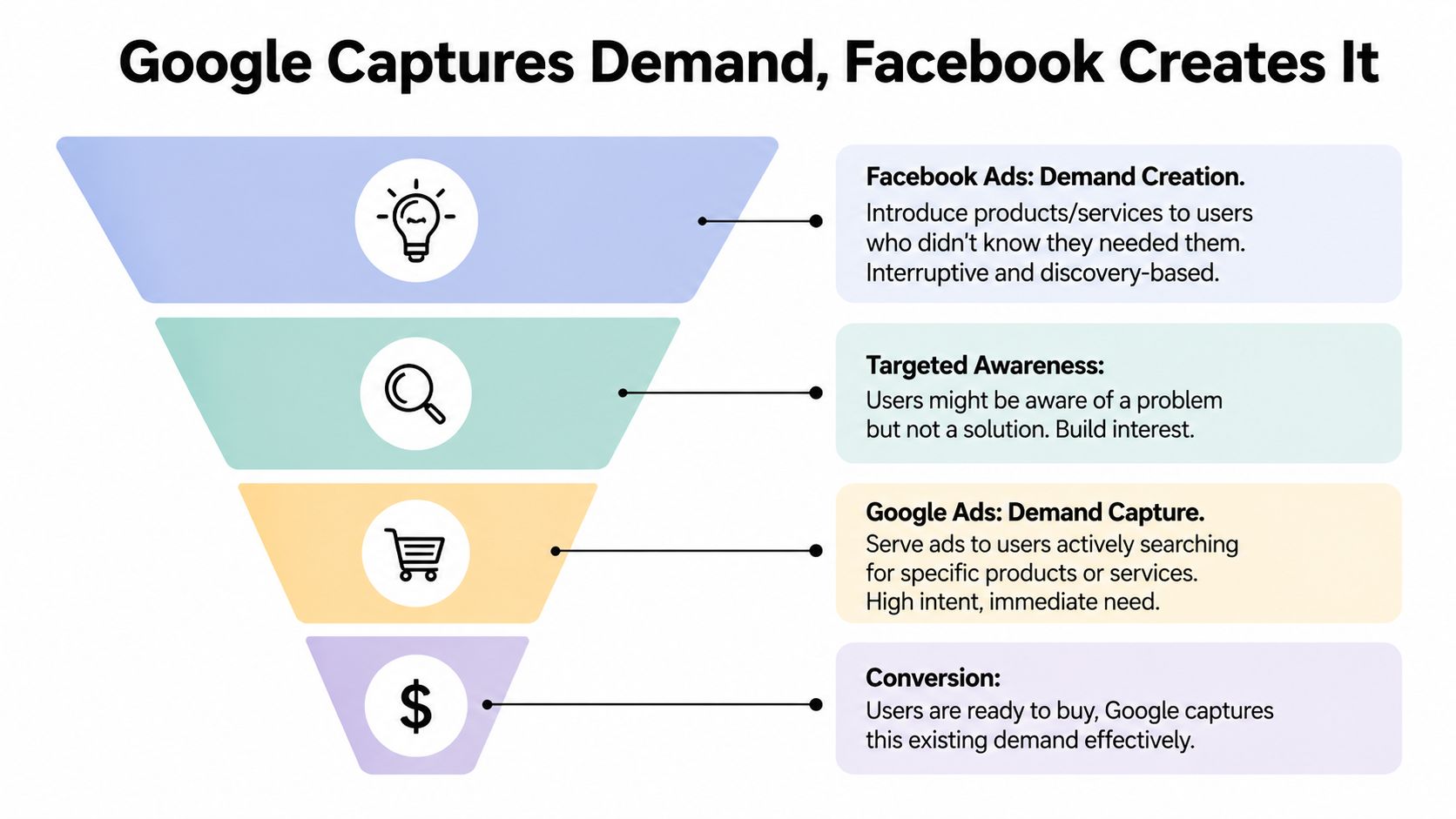
Google Captures Demand Facebook Creates It
The simplest way to understand google ads vs facebook ads is this:
Google captures demand. Facebook creates demand.
Google reaches people when they’re already looking. Facebook reaches people while they’re browsing, scrolling, or watching.
What Google does well
Google works best when intent already exists. Someone types a service into search because they need something now, or soon. That’s why it’s so effective for emergency repair, replacement, quote requests, and branded follow-up searches.
Google also operates at huge scale. It processes about 8.5 billion searches per day, while Facebook has around 2.96 billion monthly active users globally, according to this 2025 comparison of Google and Facebook ad performance. Those numbers matter less as bragging rights and more as a reminder that the two platforms solve different problems. Search volume reflects active intent. Social audience size reflects available attention.
For a Fort Myers service business, Google is the platform for queries like:
- “AC repair Fort Myers”
- “roof leak repair near me”
- “paver sealing Cape Coral”
- “emergency plumber Bonita Springs”
Those aren’t casual signals. They’re buying signals.
What Facebook does well
Facebook is different. The person seeing your ad usually did not open the app to find a roofer or a chiropractor. They were doing something else, and your ad interrupted that behavior.
That sounds like a weakness, but it’s not. It’s useful when your buyer needs education, trust, repetition, or a reminder.
Facebook is strong when you need to:
- Introduce your brand to homeowners who may need your service later
- Promote visual offers like before-and-after work, office tours, or testimonial videos
- Retarget visitors who know your company but haven’t acted yet
- Generate top and middle funnel interest for offers that aren’t urgent
A roofer benefits from Google when someone searches for help after damage. That same roofer benefits from Facebook when promoting seasonal inspections before storm season.
The hunter and farmer model
Google is the hunter. It goes where demand already exists.
Facebook is the farmer. It plants attention, builds familiarity, and creates future demand.
That difference should shape your campaign setup, your expectations, and your timeline.
If you’re using Meta automation tools or building tighter workflows around campaign management, a tool set like facebook ads mcp can help organize execution. The bigger strategic point is simpler. Facebook needs stronger creative and patience. Google needs tighter targeting and stronger landing pages.
What this means for a Fort Myers contractor
Ask one question before you spend a dollar:
Does my customer already know they need me?
If the answer is yes, start with Google.
If the answer is not yet, or not always, Facebook can help create that awareness and keep your business visible until the need becomes urgent.
That’s the core of google ads vs facebook ads. Everything else is execution.
The Real Cost of a Lead in Southwest Florida
A Fort Myers plumber can buy a batch of cheap leads this week and still have an empty schedule next week.
That happens when owners judge ads by click price instead of booked work. Low CPC looks efficient in the platform. It does not tell you whether the lead answered the phone, lived inside your service area, wanted service now, or turned into revenue.
For a local contractor, the score that matters is simple. How much did it cost to produce a qualified lead that became a job?
Google Ads vs. Facebook Ads for local service ROI
| Metric | Google Ads (Search) | Facebook Ads (Awareness/Leads) |
|---|---|---|
| Primary strength | Captures existing demand | Generates interest and fills the pipeline |
| Average CPC | Usually higher | Usually lower |
| Average CPL | Often higher at the lead stage | Often lower at the form-fill stage |
| Lead quality | Usually stronger for urgent, high-intent services | Often mixed, especially for broad offers |
| Nurturing requirement | Lower if the search term matches the service | Higher because many prospects are earlier in the buying cycle |
| Speed to revenue | Faster for repairs, replacements, and quote requests | Slower unless follow-up is strong and the offer is highly specific |
| Best fit | Immediate service needs, estimate requests, branded search | Seasonal promos, financing offers, testimonials, remarketing |
The gap shows up after the click.
A Google lead from someone searching for AC repair, roof leak help, or water damage cleanup usually starts closer to a booked appointment. A Facebook lead often needs more follow-up, more qualification, and better timing. That does not make Facebook bad. It means the sales process is different, and the labor cost is higher.
For a roofing company, that difference gets expensive fast. If your team is trying to sort storm chasers, out-of-area homeowners, insurance shoppers, and price-only leads, the cheapest lead source can become the most expensive one to operate. This is why a contractor needs a search strategy built around buyer intent, local targeting, and service-specific keywords, not generic traffic. A solid Google Ads setup for roofing contractors shows how that works in practice.
The costs owners feel in the office
Low-quality leads create operational drag.
The CSR spends time calling numbers that never answer. The estimator drives to appointments that were never serious. The owner reviews reports that show lead volume while the calendar stays thin.
Those costs usually show up in three places:
- Admin time gets burned on calls, texts, voicemails, and reschedules for people who were never qualified.
- Sales capacity gets wasted because your field team works weak estimates instead of better opportunities.
- Response time drops for serious buyers when the pipeline is cluttered with junk leads.
Raw lead count can hide all of that.
Why Southwest Florida changes the math
Fort Myers businesses do not serve everyone. They serve a defined radius, with real travel time, crew scheduling limits, and route density concerns.
That makes lead quality more important than national averages. A lead in Cape Coral may be profitable. A lead two counties away may not be worth the windshield time. A Facebook campaign can produce interest outside your target area or from homeowners who like the offer but have no immediate need. Search traffic usually filters harder because the prospect is already looking for a local solution.
That is why a higher-priced Google lead can still produce better margin. The lead is more likely to match the service, timing, and geography your business can handle.
How to judge platform performance
Use a weekly scorecard tied to operations, not vanity metrics:
- How many leads were inside the service area
- How many answered the phone or replied
- How many were qualified for the service you want
- How many became estimates, inspections, or booked calls
- How many became revenue, and at what gross margin
That framework gives owners a cleaner way to compare platforms.
If Google sends fewer leads but more of them turn into jobs, it is doing its job. If Facebook produces lower-cost leads that your office can qualify and nurture profitably, it can work well too. If the team cannot follow up quickly, or the campaign keeps attracting weak-fit prospects, the lower CPL is just cheaper waste.
Platform Recommendations for Local Industries
A Fort Myers contractor, a Naples dental office, and a local law firm should not split budget the same way. The platform choice depends on how the customer buys, how fast they need help, and how easy it is for your team to turn interest into booked work inside your service area.
Home services
For most home service companies in Southwest Florida, Google should carry the heavier load.
A homeowner with a dead AC in July, a roof leak after a storm, or a backed-up drain usually goes to search first. That traffic is not just higher intent. It is easier to match to profitable jobs, tighter service zones, and real scheduling capacity.
Facebook still has a job. It usually performs better for offers that need reminders, repetition, or visual proof before someone takes action.
Use Google first for services like:
- emergency HVAC repair
- roof leak service
- plumbing calls
- paver or driveway repair
- water, mold, or storm restoration
Use Facebook first for offers like:
- maintenance memberships
- seasonal tune-ups
- financing promotions
- before-and-after project content
- testimonial and reputation campaigns
Roofing is a good example. Search is usually the better channel for repair intent and estimate requests. Facebook helps keep your brand in front of homeowners who are comparing options or delaying the decision. If that is your category, this guide to Google Ads for roofing contractors shows how to structure campaigns around local search intent.
Healthcare and wellness
Healthcare usually works best with both platforms, but each one has a different job.
Google fits direct demand. Searches like “dentist Fort Myers,” “walk-in clinic near me,” or “chiropractor Naples” come from people looking for a provider now. That makes search a strong fit for appointment-driven campaigns.
Facebook is better for reducing hesitation. Provider videos, office tours, patient education, and community-facing creative can make the practice feel familiar before the patient ever searches your name. That matters more in categories where trust affects conversion.
Legal services
Legal advertising has less room for waste. Click prices can be high, so weak traffic gets expensive fast.
Google is usually the starting point for firms that want consultation requests from people already looking for representation. Facebook works better as a support channel for retargeting, credibility content, and educational ads that stay in front of prospects during a longer decision cycle.
That split matters in legal because the prospect often researches several firms before calling one.
Professional services and local specialists
For accountants, med spas, consultants, specialty clinics, and similar local businesses, the right platform usually comes down to whether the offer solves an active need or has to be sold visually.
Start with Google if the prospect already knows what they want and is searching for it. Start with Facebook if the service depends on presentation, education, or repeated exposure. Use both if the sale needs awareness first and conversion later.
A med spa often benefits from Facebook because the creative can show results, environment, and brand feel. A tax preparer during filing season usually gets better traction from Google because the need is immediate and the search is direct.
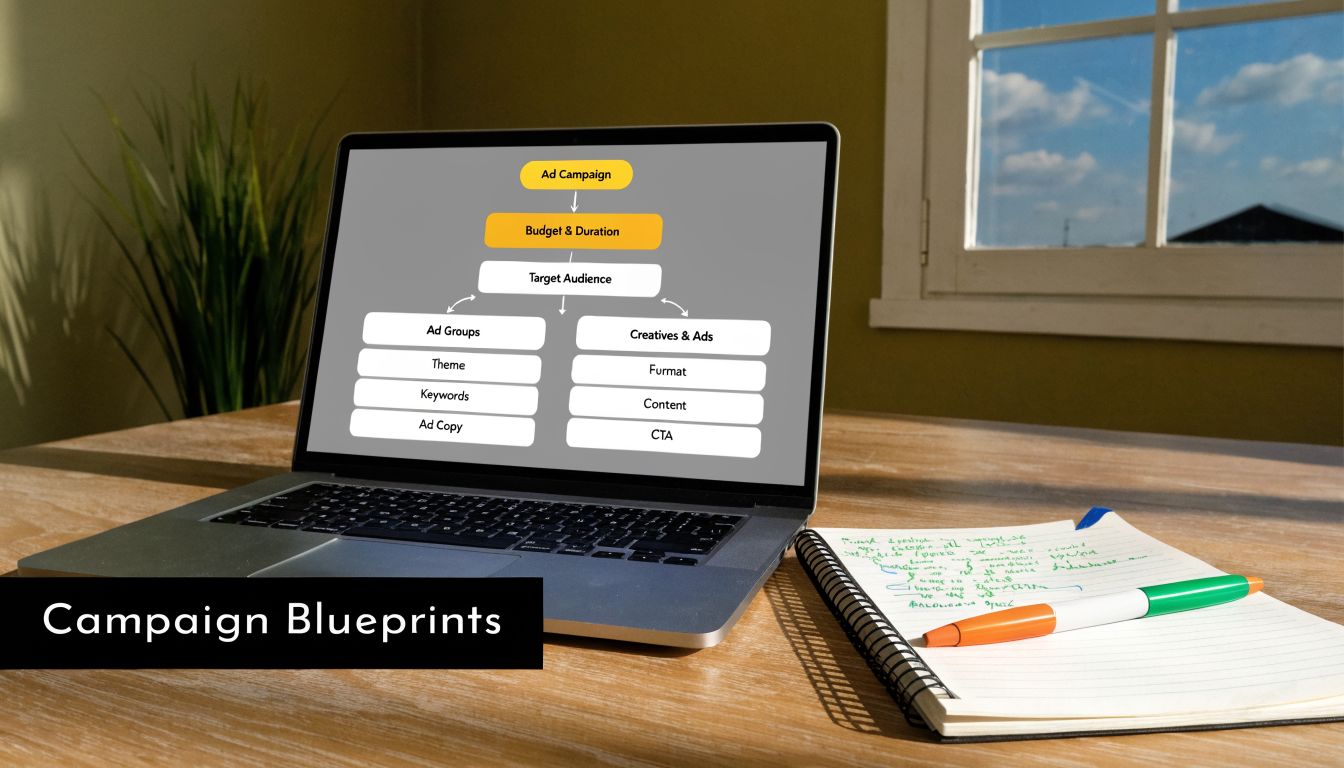
Sample Campaign Blueprints for a Fort Myers Business
The best way to make sense of google ads vs facebook ads is to look at build-outs you could run.
Facebook’s lower entry costs can make it easier to start testing. Average CPL is $27.66 on Facebook versus $70.11 on Google, according to these 2025 lead cost benchmarks for Meta and Google. For a local service business, that doesn’t automatically make Facebook better. It means Facebook is often the easier place to test awareness, while Google tends to justify its higher cost through stronger intent.
Blueprint one for Google emergency service
Business: Cape Coral paving company
Goal: inbound quote requests for repair work
Campaign setup
- Location targeting: Focus only on the actual service area. Use Cape Coral and closely served areas. Don’t let the platform expand beyond where crews can profitably go.
- Keyword intent: Target phrases such as driveway repair, paver repair, cracked driveway repair, and location-modified versions tied to Cape Coral.
- Negative keywords: Block DIY terms, employment terms, wholesale terms, free terms, and unrelated searches.
- Ad schedule: Run when calls can be answered quickly. If after-hours calls matter, route them to a tracked voicemail process.
Ad copy formula
Use simple search ad structure:
- Headline around the service plus location
- Proof point such as licensed, local, fast scheduling, or free estimate
- Direct CTA like call now or request an estimate
Example approach:
“Driveway Repair in Cape Coral”
“Fast Local Estimates”
“Call Today for Repair Options”
Landing page essentials
- Clear headline matching the search
- Click-to-call button at the top
- Service area mention
- Before-and-after image or proof
- Short form for quote requests
- No distracting menu clutter
A tighter setup usually beats a broad one.
Blueprint two for Facebook local awareness and leads
Business: Estero cleaning service
Goal: generate homeowner interest and consultation requests
Campaign angle
Run a short testimonial video focused on trust, consistency, and ease of booking. Target homeowners in the company’s preferred neighborhoods and keep the message about the outcome, not just the cleaning process.
For Facebook campaign setup help, a practical reference is this resource on Facebook ad best practices for small businesses.
Audience and creative
- Audience: Homeowners inside the service radius
- Format: Short video first, then retarget engaged viewers with a lead form or booking offer
- Offer: Recurring cleaning consultation, first service discussion, or seasonal reset message
- Creative focus: Team professionalism, home appearance, reliability, and social proof
The video below gives a useful visual framework for ad planning and campaign structure.
Lead handling matters more on Facebook
If you use in-platform lead forms, call fast. Social leads often cool off quickly. The campaign isn’t finished when the form comes in. It’s finished when the lead books.
Mini Case Studies Real Results in SWFL
The best local strategy usually matches platform to buying behavior. Two short examples make that clear.
The Bonita Springs roofer
After a major weather event, a roofer doesn’t need to create awareness from scratch. Homeowners already know they have a problem. They need someone credible, local, and available.
In that situation, shifting budget toward Google usually makes sense because search intent is already present. The business focuses on high-intent keywords, localized landing pages, and immediate phone response. Fewer leads come in than a broad social campaign might generate, but more of them are real quote opportunities.
The long-term payoff is bigger than just the first repair. Attribution models often show Google bringing in higher customer lifetime value because repeat, high-intent buyers and branded follow-up searches are easier to connect back to search behavior, as explained in this breakdown of Facebook vs Google attribution and lifetime value.
The Naples med spa
A new med spa launching a service has the opposite problem. People may not be actively searching for that exact offer yet. They need to see it, understand it, and want it.
That’s where Facebook often shines. Video creative, educational clips, social proof, and retargeting can build recognition before a prospect ever searches the brand. Once interest develops, Google can capture branded searches and bottom-funnel intent later.
Facebook often starts the conversation. Google often closes the one that matters.
What both examples have in common
Neither business wins by asking which platform is universally better. They win by matching the channel to the moment.
The roofer relies on demand capture first. The med spa relies on demand creation first. In both cases, the strongest setup usually becomes full funnel over time. Facebook keeps the brand visible, and Google converts people when they’re ready to act.
That’s the useful answer in google ads vs facebook ads. The right platform depends on whether your buyer is already searching or still needs a reason to care.
How to Allocate Your First $1000 Ad Budget
A first budget should be built around urgency, sales cycle, and follow-up capacity. Not platform hype.
If you have $1000, don’t spread it so thin that neither platform gets enough data to be useful. Put money where the buying intent is strongest for your business type.
Start with the business model
If you run an emergency or need-based service, lean hard into Google first.
Examples:
- HVAC repair
- plumbing
- roofing repair
- restoration
- urgent legal consultations
If you run a business that benefits from visuals, education, or repeat exposure, Facebook deserves more room.
Examples:
- cleaning services
- med spas
- cosmetic dentistry
- wellness services
- home improvement offers that aren’t urgent
A simple allocation framework
Use this as a practical starting point.
For immediate-need services
- Put most of the budget into Google Search
- Reserve a smaller portion for Facebook retargeting or branded visibility
- Keep the search campaign tight by geography, service, and keyword intent
For awareness-dependent services
- Split budget more evenly
- Use Facebook for education and first-touch attention
- Use Google for branded search and bottom-funnel conversion coverage
For established local brands
- Fund the channel already proving booked jobs
- Use the second channel to fill the gap in the funnel rather than duplicate the same task
A practical reference for owners planning smaller campaigns is this guide on pay-per-click for small businesses.
Ask these questions before you spend
- Do customers already know they need me?
- Can my staff follow up quickly on form leads?
- Is my offer urgent or considered?
- Does my service require trust before action?
- Can I clearly define my service radius?
- Would I rather have fewer stronger leads or more leads to sort through?
If your team can't respond fast and qualify well, Facebook lead volume can become a burden instead of an asset.
What usually works for Fort Myers SMBs
For many Southwest Florida contractors, the best first move is simple. Start with Google for core service demand. Add Facebook once the search campaign is stable and you’re ready to build awareness, retarget visitors, or push seasonal offers.
That approach respects how local businesses operate. Crews need profitable jobs. Office staff need manageable lead flow. Owners need a channel they can tie back to revenue.
google ads vs facebook ads isn’t a theoretical debate. It’s a budgeting decision tied directly to cash flow. If your service solves an urgent problem, let Google catch that demand. If your offer needs attention, trust, and repeated exposure, let Facebook warm the market first.
If you want help building a channel mix that fits your Fort Myers service area, sales cycle, and budget, Polaris Marketing Solutions can help you map the right split between Google Ads, Facebook Ads, landing pages, and local lead tracking so you spend toward qualified opportunities instead of guesswork.